Atlas (mythology) HIGHLIGHTED
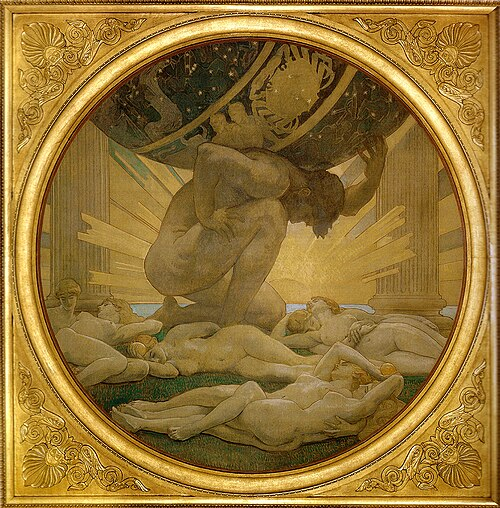
Atlas and the Hesperides
by John Singer Sargent (1925).
This article is about the Titan.
For other uses, see Atlas (disambiguation).
In Greek mythology, Atlas (/ˈætləs/; Ancient Greek: Ἄτλας, romanized: Átlas) is a Titan condemned to hold up the heavens or sky for eternity after the Titanomachy.
Atlas also plays a role in the myths of two of the greatest Greek heroes:
Heracles (Hercules in Roman mythology) and
According to the ancient Greek poet
Atlas stood at the ends of the earth in the extreme west.[1]
Later, he became commonly identified with the Atlas Mountains in northwest Africa.[2]
Atlas was said to have been skilled in
- philosophy,
- mathematics, and
- astronomy.
- In antiquity, he was credited with inventing the first celestial sphere.
- In some texts, he is even credited with the invention of astronomy itself.[3]
rk NOTE: So somebody is blaming ATLAS for creating the EARTH as a GLOBE and then he supposedly creates the BOOK called "atlas"?
Atlas was the son of the Titan Iapetus and the Oceanid Asia[4] or Clymene.[5]
He was a brother of Menoetius, Epimetheus and Prometheus.[6]
He had many children, mostly daughters, the Hesperides, the Hyades, the Pleiades, and the nymph Calypso who lived on the island Ogygia.[7]
Flemish cartographer
characterized Atlas as the founder of geography, leading to the modern sense of the term "atlas" for a collection of maps after Mercator published his own work in honor of the Titan.
rk NOTE: I suspect that these "characters" such as MERCATOR and ATLAS are made up mythology by those who desire a "RESET" aka "NEW WORLD ORDER." This "Mythology" appears to be a "back-drop" story for unquestioning researchers to use as "sources" that cannot be proved due to its ancient lineage.
The "Atlantic Ocean" is derived from "Sea of Atlas." The name of Atlantis mentioned in Plato's Timaeus dialogue derives from "Atlantis nesos" (Ancient Greek: Ἀτλαντὶς νῆσος), literally meaning "Atlantean Island".[8]
rk Question: It is said that the waters of the Atlantic Ocean a VERY COLD; WHY? Does the water flow down from the ARCTIC? then move to the warmer PACIFIC Ocean? What makes one ocean cold and the other warm? AND if Australia is close to the cold "Antarctic" edge of the Earth,
why is the island full of DESERT?
Etymology
The etymology of the name Atlas is uncertain.
rk NOTE: Didn"t you just tell the reader
the origin of the name above?
Virgil translated etymologies of Greek names by combining them with adjectives that explained them: for Atlas his adjective is durus, "hard, enduring",[9]
which suggested to George Doig that Virgil was aware of the Greek τλῆναι "to endure"; Doig offers the further possibility that Virgil was aware of Strabo's remark[10] that the native North African name for this mountain was Douris.[11]
Since the Atlas Mountains rise in the region inhabited by Berbers, it has been suggested that the name might be taken from one of the Berber languages, specifically from the word ádrār "mountain".[12]
Traditionally historical linguists etymologize the Ancient Greek word Ἄτλας (genitive: Ἄτλαντος) as comprised from copulative α- and the Proto-Indo-European root telh₂-* 'to uphold, support' (whence also τλῆναι), and which was later reshaped to an nt-stem.[13]
However, Robert S. P. Beekes argues that it cannot be expected that this ancient Titan carries an Indo-European name, and he suggests instead that the word is of Pre-Greek origin, as such words often end in -ant.[13]
Mythology
War and punishment
Main article: Titanomachy
Atlas and his brother Menoetius
WORDPLAY: Menoetius = men/of/earth/eat/us
sided with the Titans
in their war against the
rk NOTE: Athena is/was and OLYMPIAN.
the Titanomachy.
When the Titans were defeated, many of them (including Menoetius) were confined to
but Zeus condemned Atlas to stand at the western edge of the earth and hold up the sky on his shoulders.[14]
rk Question: What will I find in the rest of this article if I substitute the name Zeus for "the One True GOD"?
Thus, he was Atlas Telamon, "enduring Atlas", and became a doublet of
the embodiment of the celestial axis around which the heavens revolve.[15]
A common misconception today is that Atlas's sentence was to hold the Earth on his shoulders, but Classical art shows Atlas holding the
not the
the solidity of the marble globe borne by the Farnese Atlas may have aided the conflation, reinforced in the 16th century by the developing usage of atlas to describe a
corpus of terrestrial maps.[citation ^needed]
Encounter with Perseus
Main article: Perseus
The Greek poet Polyidus
WORDPLAY: Polyidus = many/id/us = many/see/us
c.398 BC[16]
tells a tale of Atlas,
then a shepherd,
encountering Perseus
who turned him to stone.
Ovid later gives a more detailed account of the incident, combining it with the myth of Heracles.
In this account Atlas is not only a shepherd but also a king.[17]
According to Ovid, Perseus arrives in Atlas's Kingdom and asks for shelter, declaring he is a son of Zeus. Atlas, fearful of a prophecy that warned of a son of Zeus stealing his golden apples from his orchard, refuses Perseus hospitality.[18]
rk NOTE: Sounds like the "myth" of
Jesus being the son of GOD and King Herod.
What are the "apples" about?
In this account, Atlas is turned not just into stone by Perseus, but an entire mountain range: Atlas's head the peak, his shoulders ridges and his hair woods. The prophecy did not relate to Perseus stealing the golden apples but to Heracles, another son of Zeus, and Perseus's great-grandson.[19]
Encounter with Heracles
Main article: Heracles
rk NOTE: Isn't there a PERACLES in
this mess of myths?
One of the Twelve Labours of the hero Heracles was to fetch some of the golden apples that grow in
Hera's
WORDPLAY: Hera = he/Ra (Ra = satan)
garden, tended by Atlas's reputed daughters,
- the Hesperides
- (which were also called the Atlantides), and
- guarded by the dragon Ladon.
a lad on the dragon = kind of like in the movie "Never Ending Story"? as in GREEK, ROMAN, and EGYPTIAN mythology?
- Heracles went to Atlas and offered to hold up the heavens while Atlas got the apples from his daughters.[20]
Upon his return with the apples, however, Atlas attempted to trick Heracles into carrying the sky permanently by offering to deliver the apples himself, as anyone who purposely took the burden must carry it forever, or until someone else took it away.
Heracles, suspecting Atlas did not intend to return, pretended to agree to Atlas's offer, asking only that Atlas take the sky again for a few minutes so Heracles could rearrange his cloak as padding on his shoulders.
When Atlas set down the apples and took the heavens upon his shoulders again, Heracles took the apples and ran away.[citation ^needed]
In some versions,[21] Heracles instead built the two great Pillars of Hercules to hold the sky away from the earth, liberating Atlas much as he liberated Prometheus.
Other mythological characters named Atlas
 | It has been suggested that this article be split out into articles titled Atlas (Titan) and Atlas (mythology). (Discuss) (May 2026) |
rk NOTE: Every BabyBoomer on Earth KNOWS that to "split" means "to go" or "to leave" or to "get the hell out of here"! Ain so?
Besides the Titan, there are other mythological characters who were also called Atlas:
King of Atlantis
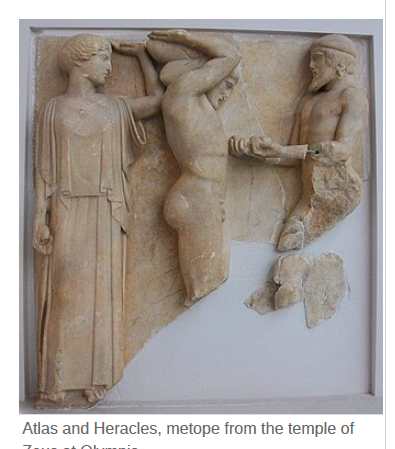
Atlas and Heracles, metope from the temple of Zeus at Olympia.
rk NOTE: Who is the WOMAN?
Could it be ATHENA? UNCREDITED?
According to Plato, the first king of Atlantis was also named Atlas, but that Atlas was a son of Poseidon and the mortal woman
Cleito.[22]
WORDPLAY: Cleito = I/too/see/El
(El = another name for satan)
The works of Eusebius[23] and
Diodorus[3] = die/odorus
rk Question: Are the reptilians down in the tunnels, that are all over the Earth, complaining about all the stinky dead bodies you are feeding them?
also give an account of Atlas. In these, Atlas's father was Uranus and his mother was Gaia. His grandfather was Elium "King of Phoenicia" who lived in Byblos with his wife Beruth. Atlas was raised by his sister, Basilia.[24][25][26]
King of Mauretania
Atlas was also a legendary king of Mauretania, the land of the Mauri in antiquity roughly corresponding with modern Morocco and Algeria. In the 16th century, Gerardus Mercator put together the first collection of maps to be called an "Atlas" and devoted his book to the "King of Mauretania".[25]
Atlas became associated with Northwest Africa over time. He had been connected with the Hesperides, or "Nymphs", which guarded the golden apples, and Gorgons both of which were said to live beyond Ocean in the extreme west of the world since Hesiod's Theogony.[27] Diodorus and Palaephatus mention that the Gorgons lived in the Gorgades, islands in the Aethiopian Sea.
The main island was called Cerna,
32). CERN:
https://bra.in/3jQ6AE
33). HAARP:
https://bra.in/7jXYn2
34). DARPA:
https://bra.in/8jXr7y
and modern-day arguments have been advanced that these islands may correspond to Cape Verde due to Phoenician exploration.[28]
The Northwest Africa region emerged as the canonical home of the King via separate sources. In particular, according to Ovid, after Perseus turns Atlas into a mountain range, he flies over Aethiopia, the blood of Medusa's head giving rise to Libyan snakes. By the time of the Roman Empire, the habit of associating Atlas's home to a chain of mountains, the Atlas Mountains, which were near Mauretania and Numidia, was firmly entrenched.[29]
Other
The identifying name Aril
rk NOTE: If the reader uses the satanic tactic of "inversion" and changes the "A" in aril to a "V", you get VRIL. See:
40). What is Spiritual Warfare MindMap: https://bra.in/5jQMQm
is inscribed on two 5th-century BC Etruscan bronze items: a mirror from Vulci and a ring from an unknown site.[30] Both objects depict the encounter with Atlas of Hercle—the Etruscan Heracles—identified by the inscription; they represent rare instances where a figure from Greek mythology was imported into Etruscan mythology, but the name was not.
The Etruscan name Aril is etymologically independent.[citation ^needed]
Genealogy
See PDF for visual "bloodline" of Atlas.
Sources describe Atlas as the father, by different goddesses, of numerous children, mostly daughters.
Some of these are assigned conflicting or overlapping identities or parentage in different sources.
- By Hesperis:
- The Hesperides[31]
- By Pleione (or Aethra[32]):
- By one or more unspecified goddesses:
Hyginus, in his Fabulae, adds an older Atlas who is the son of Aether and Gaia.[38]
Cultural influence
Main article: Atlas (disambiguation)
Atlas's best-known cultural association is in cartography.
The first publisher to associate the Titan Atlas with a group of maps was the print-seller Antonio Lafreri, who included a depiction of the Titan on the engraved titlepage he applied to his ad hoc assemblages of maps, Tavole Moderne di Geografia de la Maggior parte del Mondo di Diversi Autori (1572).[39]
However, Lafreri did not use the word "Atlas" in the title of his work; this was an innovation of Gerardus Mercator, who named his work Atlas Sive Cosmographicae Meditationes de Fabrica Mundi et Fabricati (1585–1595),[40] using the word Atlas as a dedication specifically to honor the Titan Atlas, in his capacity as King of Mauretania, a learned philosopher, mathematician, and astronomer.
In psychology, Atlas is used metaphorically to describe the personality of someone whose childhood was characterized by excessive responsibilities.[41]
Ayn Rand's novel Atlas Shrugged (1957) references the popular misconception of Atlas holding up the entire world on his back by comparing the capitalist and intellectual class as being "modern Atlases" who hold the modern world up at great expense to themselves.[citation ^needed]
rk NOTE: Who is JOHN GALT?
Michael J. Anderson explains that the earliest Greek vase paintings and sculptures depict Atlas with a rigid stance, representing his bearing the burden of Zeus's everlasting punishment. The depiction of Atlas as a muscular figure under the weight of a celestial globe or vault visually express the Greek concept of suffering, resulting from arrogance and rebellion. These artistic patterns explore larger Greek art themes that portray Titans as a symbol of divine punishment and cosmic order.
See also
- Atlas (architecture)
- Bahamut, a rough analogue from Arabian mythology, and other members of Category:World-bearing animals
- Farnese Atlas
WORDPLAY: Upelluri = I will lure
her to EL
- Nut (goddess), in ancient Egyptian mythology forced to hold up the sky
Notes
- Hesiod, Theogony 517–520.
- Smith, s.v. Atlas
- Referencing Diodorus:
- "[Atlas] perfected the science of astrology and was the first to publish to mankind the doctrine of the sphere. and it was for this reason that the idea was held that the entire heavens were supported upon the shoulders of Atlas, the myth darkly hinting in this way at his discovery and description of the sphere." Bibliotheca historica, Book III 60.2
- "Atlas was so grateful to Heracles for his kindly deed that he not only gladly gave him such assistance as his Labour called for, but he also instructed him quite freely in the knowledge of astrology. For Atlas had worked out the science of astrology to a degree surpassing others and had ingeniously discovered the spherical nature of the stars, and for that reason was generally believed to be bearing the entire firmament upon his shoulders. Similarly in the case of Heracles, when he had brought to the Greeks the doctrine of the sphere, he gained great fame, as if he had taken over the burden of the firmament which Atlas had borne, since men intimated in this enigmatic way what had actually taken place." Bibliotheca historica, Book IV 27.4–5
- Apollodorus, 1.2.3.
- Hesiod,Theogony 507. It is possible that the name Asia became preferred over Hesiod's Clymene to avoid confusion with what must be a different Oceanid named Clymene, who was mother of Phaethon by Helios in some accounts.
- Roman, Luke; Roman, Monica (2010). Encyclopedia of Greek and Roman Mythology. Infobase Publishing. p. 92. ISBN 978-1-4381-2639-5.
- Homer, Odyssey, 1.14, 1.50. Calypso is sometimes referred to as Atlantis (Ατλαντίς), which means the daughter of Atlas, see the entry Ατλαντίς in Liddell & Scott, and also Hesiod, Theogony, 938.
- "What does "Atlantis" mean? And why is the Space Shuttle Atlantis named after something underwater?". 8 July 2011.
- Aeneid iv.247: "Atlantis duri" and other instances; see Robert W. Cruttwell, "Virgil, Aeneid, iv. 247: 'Atlantis Duri'" The Classical Review 59.1 (May 1945), p. 11.
- Strabo, 17.3.2: οἱ μὲν Ἕλληνες Ἄτλαντα καλοῦσιν οἱ βάρβαροι δὲ Δύριν.
- Doig, George (1968). "Vergil's Art and the Greek Language". The Classical Journal. 64 (1): 1–6. ISSN 0009-8353. JSTOR 3296525.
- Hodgson, William (1834). "Grammatical Sketch and Specimens of the Berber Language: Preceded by Four Letters on Berber Etymologies, Addressed to the President of the Society by William B. Hodgson, Esq". Transactions of the American Philosophical Society. 4: 1–48. Retrieved 29 January 2026. pp. 4-5
- Beekes, Robert; van Beek, Lucien (2010). Etymological Dictionary of Greek. Vol. 1. Brill. p. 163.
- Hesiod, Theogony 517–520; Gantz (1993), p. 46
- The usage in Virgil's maximum Atlas axem umero torquet stellis ardentibus aptum (Aeneid, iv.481f, cf vi.796f), combining poetic and parascientific images, is discussed in P. R. Hardie, "Atlas and Axis" The Classical Quarterly N.S. 33.1 (1983:220–228).
- Polyeidos, fr. 837 Campbell; Ovid, Metamorphoses 4.627.
- Ovid, Metamorphoses 4.617 ff.
- William Godwin (1876). Lives of the Necromancers. London, F. J. Mason. p. 39.
- Ogden (2008), pp. 49, 108, 114
- Diodorus Siculus, 4.27.2; Gantz (1993), pp. 410–413.
- a lost passage of Pindar quoted by Strabo (3.5.5) was the earliest reference in this context: "the pillars which Pindar calls the "gates of Gades" when he asserts that they are the farthermost limits reached by Heracles"; the passage in Pindar has not been traced.
- Plato, Critias 133d–114a
- The "testimony of Eusebius" was "drawn from the most ancient historians" according to Mercator. Eusebius' Praeparatio evangelica gives accounts of Atlas that had been translated from the works of ancient Phoenician Sanchuniathon, the original sources for which predate the Trojan War (i.e. 13th century BCE).
- For further comment on Mercator's chosen Titanic genealogy see Keuning (1947), Akerman (1994) and Ramachandran (2015), p. 42
- Mercator & Lessing J. Rosenwald Collection (Library of Congress) (2000)
- See Bibliotheca historica, Book III, Eusebius' Praeparatio evangelica references the same mythology as Diodorus stating "These then are the principal heads of the theology held among the Atlanteans".
- See Gantz (1993), p. 401 and Ogden (2008), p. 47–49
- For instance, the Phoenician Hanno the Navigator is said to have sailed as far as Mount Cameroon in the 5th or 6th century BC. See Lemprière (1833), pp. 249–250 and Ovid, The Metamorphoses, commented by Henry T. Riley ISBN 978-1-4209-3395-6
- Lemprière (1833), pp. 249–250
- Paolo Martini, Il nome etrusco di Atlante, (Rome:Università di Roma) 1987 investigates the etymology of aril, rejecting a link to the verbal morpheme ar- ("support") in favor of a Phoenician etymon in an unattested possible form *'arrab(a), signifying "guarantor in a commercial transaction" with the connotation of "mediator", related to the Latin borrowing arillator, "middleman". This section and note depend on Rex Wallace's review of Martini in Language 65.1 (March 1989:187–188).
- Diodorus Siculus, 4.27.2; Gantz (1993), p. 7.
- Hyginus, De astronomia 2.21.4, 2.21.6; Ovid, Fasti 5.164
- Hyginus, Fabulae 192
- Hesiod, Works and Days 383; Apollodorus, 3.10.1; Ovid, Fasti 5.79
- Homer, Odyssey 1.52; Apollodorus, Epitome 7.24
- Hyginus, Fabulae 82 & 83
- Pausanias, 8.12.7 & 8.48.6
- Hyginus, Fabulae Preface
- Ashley Baynton-Williams. "The "Lafreri school" of Italian mapmakers". Archived from the original on April 23, 2016. Retrieved February 26, 2013.
- van Egmond, Marco. "The 'Atlas' by Mercator and Hondius". Utrecht University. Retrieved 21 September 2023.
- Vogel, L. Z.; Savva, Stavroula (1993-12-01). "Atlas personality". British Journal of Medical Psychology. 66 (4): 323–330. doi:10.1111/j.2044-8341.1993.tb01758.x. ISSN 2044-8341. PMID 8123600.
- "Nautilus Cup". The Walters Art Museum.
- Hesiod, Theogony 132–138, 337–411, 453–520, 901–906, 915–920; Caldwell, pp. 8–11, tables 11–14.
- Although usually the daughter of Hyperion and Theia, as in Hesiod, Theogony 371–374, in the Homeric Hymn to Hermes (4), 99–100, Selene is instead made the daughter of Pallas the son of Megamedes.
- According to Hesiod, Theogony 507–511, Clymene, one of the Oceanids, the daughters of Oceanus and Tethys, at Hesiod, Theogony 351, was the mother by Iapetus of Atlas, Menoetius, Prometheus, and Epimetheus, while according to Apollodorus, 1.2.3, another Oceanid, Asia was their mother by Iapetus.
- According to Plato, Critias, 113d–114a, Atlas was the son of Poseidon and the mortal Cleito.
- In Aeschylus, Prometheus Bound 18, 211, 873 (Sommerstein, pp. 444–445 n. 2, 446–447 n. 24, 538–539 n. 113) Prometheus is made to be the son of Themis.
References
- Akerman, J. R. (1994). "Atlas, la genèse d'un titre". In Watelet, M. (ed.). Gerardi Mercatoris, Atlas Europae. Antwerp: Bibliothèque des Amis du Fonds Mercator. pp. 15–29.
- Apollodorus, Apollodorus, The Library, with an English Translation by Sir James George Frazer, F.B.A., F.R.S. in 2 Volumes. Cambridge, Massachusetts, Harvard University Press; London, William Heinemann Ltd. 1921. Online version at the Perseus Digital Library.
- Diodorus Siculus (1933–67). Oldfather, C. H.; Sherman, C. L.; Welles, C. B.; Geer, R. M.; Walton, F. R. (eds.). Diodorus of Sicily : The Library of History. 12 Vols (2004 ed.). Cambridge, Mass.: Harvard University Press.
- Gantz, T. (1993). Early Greek Myth: A Guide to Literary and Artistic Sources. Baltimore: Johns Hopkins University Press. ISBN 978-0-8018-4410-2. LCCN 92026010. OCLC 917033766.
- Grafton, A.; Most, G. W.; Settis, S., eds. (2010). The Classical Tradition (2013 ed.). Cambridge, Mass.: Harvard University Press. ISBN 978-0-674-07227-5. LCCN 2010019667. OCLC 957010841.
- Hesiod, Theogony, in The Homeric Hymns and Homerica with an English Translation by Hugh G. Evelyn-White, Cambridge, Massachusetts., Harvard University Press; London, William Heinemann Ltd. 1914. Online version at the Perseus Digital Library.
- Hesiod; Works and Days, in The Homeric Hymns and Homerica with an English Translation by Hugh G. Evelyn-White, Cambridge, Massachusetts., Harvard University Press; London, William Heinemann Ltd. 1914. Online version at the Perseus Digital Library.
- Hornblower, S.; Spawforth, A.; Eidinow, E., eds. (2012). The Oxford Classical Dictionary (4th ed.). Oxford: Oxford University Press. ISBN 978-0-19-954556-8. LCCN 2012009579. OCLC 799019502.
- Hyginus, Gaius Julius, De astronomia, in The Myths of Hyginus, edited and translated by Mary A. Grant, Lawrence: University of Kansas Press, 1960. Online version at ToposText.
- Hyginus, Gaius Julius, Fabulae, in The Myths of Hyginus, edited and translated by Mary A. Grant, Lawrence: University of Kansas Press, 1960. Online version at ToposText.
- Keuning, J. (1947). "The History of an Atlas: Mercator. Hondius". Imago Mundi. 4 (1): 37–62. doi:10.1080/03085694708591880. ISSN 0308-5694. JSTOR 1149747.
- Lemprière, J. (1833). Anthon, C. (ed.). A Classical Dictionary. New York: G. & C. & H. Carvill [etc.] LCCN 31001224. OCLC 81170896.
- Mercator, G.; Lessing J. Rosenwald Collection (Library of Congress) (2000). Karrow, R. W. (ed.). Atlas sive Cosmographicæ Meditationes de Fabrica Mundi et Fabricati Figura: Duisburg, 1595 (PDF). Translated by Sullivan, D. Oakland, CA: Octavo. ISBN 978-1-891788-26-0. LCCN map55000728. OCLC 48878698. Archived from the original (PDF) on 10 March 2016.
- Ogden, D. (2008). Perseus (1st ed.). London; New York: Routledge. ISBN 978-0-415-42724-1. LCCN 2007031552. OCLC 163604137.
- Ogden, D. (2013). Drakon: Dragon Myth and Serpent Cult in the Greek and Roman Worlds. Oxford: Oxford University Press. ISBN 978-0-19-955732-5. LCCN 2012277527. OCLC 799069191.
- Ramachandran, A. (2015). The Worldmakers: Global Imagining in Early Modern Europe. Chicago: University of Chicago Press. ISBN 978-0-226-28879-6. OCLC 930260324.
- Smith, William; Dictionary of Greek and Roman Biography and Mythology, London (1873). "Atlas"
Anderson, Michael (1977). The Fall of Troy in Early Greek Poetry and Art. Oxford University Press. p. 112. ISBN 978-0-19-815064-0.
External links

Wikimedia Commons has media related to:
- "Atlas (1.)". Encyclopædia Britannica. Vol. III (9th ed.). 1878. p. 27.
- Warburg Institute Iconographic Database (c. 120 images of Atlas)
See PDF for complete Wikipedia article with pix, downloaded:
Wednesday, November 18, 2026, 11:42 AM
source:
ALSO SEE:
171). LINK TO
SATANIC LANGUAGE:
https://bra.in/3vGdy9
172). "WHAT IS SATANIC LANGUAGE?": https://bra.in/3vm87Z
HIGHLIGHTS, questions, and smart-ass comments are mine:
#614). MindMap: I AM SINCERELY:
https://bra.in/9vAeW3
Wednesday, November 18, 2026, 6:47 PM