Lone_Survivor
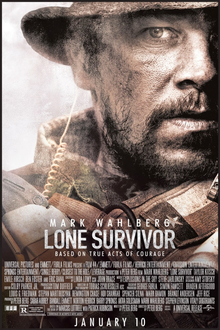
Theatrical release poster
Lone Survivor is a 2013 American action war drama film based on the 2007 nonfiction book by Marcus Luttrell with Patrick Robinson. Set during the war in Afghanistan, it dramatizes the unsuccessful United States Navy SEALs counter-insurgent mission Operation Red Wings, during which a four-man SEAL reconnaissance and surveillance team was given the task of tracking down the Taliban leader Ahmad Shah. The film was written and directed by Peter Berg, and stars Mark Wahlberg, Taylor Kitsch, Emile Hirsch, Ben Foster, and Eric Bana.
Upon first learning of the book in 2007, Berg arranged several meetings with Luttrell to discuss adapting the book to film. Universal Pictures acquired the film rights in August 2007, after bidding against other major studios. In re-enacting events, Berg drew much of his screenplay from Luttrell's eyewitness accounts in the book, as well as autopsy and incident reports related to the mission. After directing Battleship (2012) for Universal, Berg resumed working on Lone Survivor. Principal photography began in October 2012 and concluded in November, after 42 days. Filming took place on location in New Mexico, using digital cinematography. Luttrell and several other Navy SEAL veterans acted as technical advisors, while multiple branches of the United States Armed Forces aided the production. Two companies, Industrial Light & Magic and Image Engine, created the visual effects.
Lone Survivor opened in limited release in the United States on December 25, 2013, before opening across North America on January 10, 2014. The film received positive reviews; critics praised Berg's direction and realism, as well as the acting, story, visuals and battle sequences, though some criticism was directed at the film's focus on action rather than characterization. It grossed $154.8 million, of which $125 million was from North America, against a budget of $40 million. It was chosen by National Board of Review as one of the top ten films of 2013 and received two Oscar nominations for Best Sound Editing and Best Sound Mixing.
Plot
See also: Operation Red Wings
In 2005, Ahmad Shah, a local Taliban warlord in the Korangal Valley is identified as the person responsible for the deaths of several Marines, plus many villagers who are believed to have aided the American forces in Afghanistan. A Navy SEAL team, consisting of Michael Murphy, Matthew Axelson, Danny Dietz, and Marcus Luttrell, is ordered to capture Shah.
Inserted overnight via helicopter, the four-man team approaches Shah's last known location. Due to the mountainous terrain the team is operating in, communications with J-Bad become difficult. Though the team identifies Shah, they are discovered by local villagers, one of whom carries a walkie-talkie—believing that the villagers are Taliban sympathisers, the SEALs debate setting them free or killing them. Murphy orders them to be set free.
The team proceed up the mountainside, aborting their mission and intending to extract. However, the villagers alert the Taliban, who pursue the team. Though the SEALs begin with the advantage, the sheer number of Taliban forces overwhelms their position. Pushed toward a ravine, the SEALs are given little choice but to jump, but are thrown off balance when an RPG detonates in front of them. Dietz is killed, and the remaining SEALs try desperately to raise support. Murphy scales the cliff to gain a clear signal which finally alerts the QRF, though he is killed shortly after.
The QRF scrambles to the SEALs’ aid, though the two Chinook helicopters fly in without Apache support. Briefly encouraged by the arrival of reinforcements, Luttrell and Axelson watch helplessly as an RPG shoots down one Chinook. The second aborts, leaving Luttrell and Axelson to fend for themselves. Already grievously wounded from battle, the disoriented Axelson is cornered by Taliban gunmen and killed. Luttrell is also discovered, though he survives an RPG attack, hides from his pursuers overnight, and escapes.
Wandering alone, Luttrell happens across a small stream when he is discovered by Mohammad Gulab, a local Pashtun. Taking the wounded and exhausted Luttrell into his care, Gulab hides him from the Taliban in his home, and also sends another villager to the nearest American base to report on Luttrell's location. Shah arrives at the village to execute Luttrell; however, the villagers resist. Shah leaves, but returns later with several Taliban gunmen and engages the villagers. Rangers arrive mid-battle and evacuate Luttrell, who also thanks Mohammad for his assistance.
Images of the real Luttrell, Gulab and the fallen service members killed during the mission are shown during a four-minute montage, and an epilogue explains that the Pashtun villagers agreed to help Luttrell as part of a traditional code of honor known as the Pashtunwali.
Cast
What makes this story so special is the bond and the camaraderie between the guys, but also the state of where we are in the world today. The act of heroism by Gulab and his fellow villagers moved me the most. I found it so inspiring, and it gave me so much hope for the world.
—Mark Wahlberg[4]: 19
- Mark Wahlberg as Hospital corpsman First Class Marcus Luttrell
- Taylor Kitsch as Lieutenant Michael P. "Murph" Murphy
- Emile Hirsch as Gunner's mate Second Class Danny Dietz
- Ben Foster as Sonar technician Second Class Matthew "Axe" Axelson
- Eric Bana as Lieutenant Commander Erik S. Kristensen
Ali Suliman, who previously collaborated with Berg on the 2007 film The Kingdom, plays Mohammad Gulab, an Afghan villager.[5]: 43 Alexander Ludwig plays Navy SEAL Machinist's Mate Shane Patton.[4] Marcus Luttrell appears in an uncredited role. The cast is rounded out by Yousuf Azami as Ahmad Shah, a Taliban leader; Sammy Sheik as Taraq, a field commander of the Taliban group;[6] Rich Ting as PO2 James Suh; Dan Bilzerian as Senior Chief Daniel Healy; Jerry Ferrara as United States Marine Corps Sgt Hasslert; Scott Elrod as Peter Musselman; Rohan Chand as Gulab's son; and Corey Large as US Navy SEAL Captain Kenney. Zarin Mohammad Rahimi, who acted as a technical advisor during production, appears as an elderly shepherd who discovers the four-man SEAL team during the mission; Nicholas Patel and Daniel Arroyo play the goat herders who assist the shepherd.[4]
Following publication of Marcus Luttrell and Patrick Robinson's nonfiction book Lone Survivor (2007), producer Barry Spikings met Luttrell's attorney Alan Schwartz, who was interested in making a film adaptation.[4][7] Schwartz suggested that Spikings' son-in-law Akiva Goldsman write the screenplay. Goldsman did not believe he was the right screenwriter for the project, and suggested that Peter Berg write and direct the film.[7] Spikings and Goldsman passed the book on to Berg's producing partner Sarah Aubrey.[4][8] Berg first learned of the book while filming Hancock,[9] and after he and Aubrey read it, they arranged several meetings with Luttrell to discuss a film adaptation. Luttrell also viewed a rough cut of Berg's then-upcoming film The Kingdom (2007), and was impressed by his direction. "[Berg] caught me with his attention to detail", he said, "and how he portrayed the enemy in the film."[4][9]
The film rights to the book had become the subject of a bidding war among a host of established studios, including Warner Bros., Sony Pictures Entertainment, Paramount Pictures, DreamWorks, and Universal Pictures. Universal secured the rights in August 2007, for more than $2 million.[8] The studio had also acquired the United States distribution rights as part of a negative pickup deal with the film's producers.[10] Berg then chose to direct Battleship (2012) for Universal before resuming production on Lone Survivor.[11][12]
When Mark Wahlberg read the script and expressed an interest in portraying Luttrell, he and his manager Stephen Levinson pitched the concept to producer Randall Emmett, the co-founder of Emmett/Furla Films, during the 2012 filming of 2 Guns. After reading the script, Emmett traveled to Los Angeles, where he met with Berg and Aubrey to discuss the film's production.[13][14] After Universal secured the rights to distribute Lone Survivor in the United States, United Kingdom and Italy, executive producer Mark Damon's independent film company Foresight Unlimited took Berg and Emmett to the 2012 Cannes Film Festival to secure worldwide pre-sales. The film attracted $30 million in worldwide pre-sales to distributors in 40 international markets.[15][16]
Lone Survivor had an estimated budget of $40 million.[2] Three production companies – Emmett/Furla Films, Herrick Entertainment, and Envision Entertainment – collaborated to finance the film.[15][17] In addition, as part of the negative pickup deal with Universal, the film's producers—Berg, Aubrey, Spikings, Goldsman, Emmett, Wahlberg, Levinson, Norton Herrick, and Vitaly Grigoriants—contributed at least $1 million each to finance production costs.[18] To avoid further costs, Berg chose to work for a minimum salary allowed under Directors Guild of America rules, $17,000 a week.[18][19] He also convinced several cast and crew members to lower their asking prices.[18]
Casting
Berg had discussed the project with Wahlberg, Taylor Kitsch, Emile Hirsch, and Ben Foster years earlier.[4] Universal held an open casting call in Los Angeles, aiding in the filmmakers' search for supporting actors, extras, photo doubles, and stand-ins.[20] In August 2012, it was announced that Alexander Ludwig and Eric Bana had joined the cast.[21][22]
Although Wahlberg, Kitsch, Hirsch and Foster had physically trained for their roles prior to filming, Luttrell organized a three-week training regimen at a bootcamp in New Mexico,[23][24] where the actors were trained by elite military personnel in weapons, military communications, and tactics.[4] Military advisor Mark Semos[24] trained the four actors in live-firing exercises so they could feel the physical impact of firing military rifles. They also practiced "shoot move cover" drills to enable them to react convincingly as Navy SEALs during filming.[25]
Writing
This story is about working together for something bigger than our ego, bigger than our individuality. It's about coming together as a group—protecting each other, loving each other, looking out for each other—and finding a greater strength as a team than you could ever find as an individual. Marcus [Luttrell] wrote a book that, as much as it's about 19 people being killed on a tragic day in Afghanistan, is about brotherhood, sacrifice and team commitment.
—Peter Berg (writer, director and producer)[4]: 16
While the book chronicles Luttrell's 1999 enlistment and training, as well as his 2005 deployment to Afghanistan, Berg decided that the film adaptation would focus mainly on the events of the failed United States Navy SEALs mission Operation Red Wings, as well as the bonding and camaraderie of Luttrell and his fallen teammates.[4] Prior to writing the screenplay, Berg met with the families of the deceased. "My research started with meeting the families of the SEAL teammates who were killed", he said. "I went to New York and met the Murphys. I went to Colorado and met the Dietzes, and I went to Northern California and met the Axelsons. After spending time with them, you realize that these kids were the best and the brightest; they were the stars of the families. The grief and the wounds are still very raw. You would have to be inhuman to not feel the responsibility when that kind of grief gets shared with you."[4] Berg also expressed that he was motivated by the families to make the story as realistic as possible;[26] his goal was "to put [the viewer] into the experience of what these guys went through. And it was obviously a traumatic and violent and exhausting experience".[27]
To provide authenticity, Luttrell moved into Berg's home for one month while Berg was writing the script. He acted as a consultant, detailing to Berg his eyewitness account of the events that unfolded during Operation Red Wings.[4] Berg later embedded with a Navy SEAL team—becoming the first civilian to do so—and lived with them for a month in Iraq while he continued writing the screenplay.[28][29] In re-enacting the injuries and deaths of the fallen Navy SEAL servicemen, Berg relied on Luttrell's eyewitness accounts from the book, as well as autopsy reports of the deceased and after-action reports.[30] The United States Navy provided incident reports related to the mission,[26] as well as archival military training footage, which is shown during the film's opening credits sequence.[28]: 1 Still photographs shown during the opening credits sequence were taken from Richard D. Schoenberg's war photography book The Only Easy Day Was Yesterday: Making Navy SEALs.[4] During filming, there were some dialogue changes in comparison to Berg's script, as the filmmaker occasionally encouraged the actors to improvise their lines.[29]
Filming
Principal photography
Principal photography was scheduled to start on September 15, 2012,[16] but did not commence until October of that year. The film was shot on location in New Mexico.[4][11][18] The production received a 25% tax credit for shooting in the state.[31] Berg was granted creative autonomy, as Universal did not fully oversee the film's production.[10] With Lone Survivor, Berg continued his trademark of having war veterans as part of his film crew.[32] Luttrell, along with several other Navy SEAL veterans, acted as technical advisors during the production.[25] In addition, senior military advisor Harry Humphries, a former Navy SEAL who had worked with Berg on Hancock and The Kingdom, served as an associate producer.[4]
Filming first took place at the Sangre de Cristo Mountains of the Santa Fe National Forest. Eight days were spent on mountains ranging from 11,000 to 12,000 feet (3,400–3,700 m). In recreating the Hindu Kush mountain range that stretches between Afghanistan and Pakistan, the film crew shot at 10 separate locations in the national forest.[4] Stunt coordinator and second unit director Kevin Scott was given the task of depicting the four Navy SEALs tumbling down rugged terrain with sixty-degree inclines. Scott did not choreograph the stunts, nor did he have the performers use wires or dummies;[25][33] He instructed them to fall 15 to 20 feet (4.6–6.1 m) off cliffs and avoid looking at the ground until right before impact.[34] Several stunt performers were injured after falling from the mountains, as the falls proved too difficult to control.[33]
Production moved to Chilili, New Mexico for two weeks of filming. The location's wooded areas were used to film several battle scenes, and the art department built sets to create an Afghan village occupied by Ahmad Shah (Yousuf Azami) and his Taliban insurgents, as well as a Pashtun village where Luttrell (Mark Wahlberg) is rescued. Filming then moved to Kirtland Air Force Base in Albuquerque, New Mexico, which doubled for scenes set in Bagram Airfield, a U.S. military base in Afghanistan. The production then moved to soundstages at I-25 Studios in Albuquerque.[4] The filmmakers occupied two 26,000-square-foot (2,400 m2) stages in the facility[35] for interior scenes and bluescreen work.[4] The art department built the character Gulab's house, as well as interiors for Bagram Airfield's patrol base Camp Ouellette. The bluescreen work involved scenes depicting a CH-47 Chinook in a gimbal, and a 4-foot scale model of a Hindu Kush mountain cliff built by the art department team in Los Angeles.[4][28]: 1 Principal photography concluded in November 2012, after 42 days of filming.[4][11][18]
Cinematography
[Berg] wanted the audience to be as close to our characters and as close to the action as possible to experience the extreme circumstances our war heroes had to go through emotionally and physically.
—Tobias Schliessler (cinematographer)[36]: 2
While the film was based on actual events, it has been noted that it contained a number of historical inaccuracies.[46]
The number of Taliban fighters involved in the ambush has been widely disputed. In Marcus Luttrell's original after-action report, he stated that he and his teammates were attacked by 20–35 insurgents, while his book places the number at over 200.[47] The screenplay describes "A solid line of at least fifty Taliban in firing positions on top of the hill above them."[47] The summary of action for Lt. Murphy's posthumous Medal of Honor describes the enemy force as numbering "more than 50,"[48] while the official citation puts the number at "between 30 and 40 enemy fighters."[49]
In his book, Victory Point: Operations Red Wings and Whalers – the Marine Corps' Battle for Freedom in Afghanistan, military journalist Ed Darack cites a military intelligence report stating the strength of the Taliban force to be 8–10. The military intelligence estimate cited by Darack is based on research sourced from intelligence reports, including aerial and eyewitness studies of the battlefield after the fact, including the men sent in to rescue Luttrell, as well as reports from Afghan intelligence.[50][51][52]
The number of casualties sustained by the Taliban fighters has also been disputed. Naval Special Warfare Command has estimated that Luttrell and his teammates killed around thirty-five insurgents during the battle. Andrew MacMannis, a former Marine Colonel who was involved in planning Operation Red Wings and assisted in recovering bodies after the mission, has stated that there were no known enemy casualties. Mohammad Gulab, the Afghan villager who rescued Luttrell, agrees with MacMannis, as does another Marine who was involved with the mission, Patrick Kinser, who has said, "I've been at the location where [Luttrell] was ambushed multiple times. I've had Marines wounded there. I've been in enough firefights to know that when shit hits the fan, it's hard to know how many people are shooting at you. [But] there weren't 35 enemy fighters in all of the Korengal Valley [that day]." Furthermore, Gulab has claimed that he found Luttrell with eleven magazines of ammunition – the full amount that Luttrell had brought on the mission.[53]
In the film, the four-man SEAL reconnaissance team is discovered by three goat herders—an elderly man and two teenage boys. In fact, Luttrell wrote in his book that only one of the goat herders was a teenage boy, not two.[54] Luttrell's book and the film both suggest that the SEALs decision to release the goat herders led to their subsequent ambush - yet according to Gulab, people throughout the area heard the SEALs being dropped off by helicopter, and the Taliban proceeded to track the SEALs' footprints. Other villagers recounted to Gulab that the Taliban found the SEALs while the debate over the goat herders was taking place and that the Taliban then waited for a more opportune time to attack.[53] Additionally, in the film Murphy makes the decision to let the herders go following a debate by the SEAL team. In the book however the decision to let them go was decided by a vote, with Luttrell and Murphy voting to let them go, Axelson voting to kill them, and Dietz abstaining.[55]
The film shows Luttrell (Wahlberg) being able to walk after the Taliban's ambush on the four-man SEAL team. In reality, Luttrell explained that his legs were numb immediately after the ambush, and when feeling did return to them, the pain from the shrapnel in his legs made it too painful to walk; he had to crawl seven miles looking for water and sanctuary.[46][56] Luttrell also said that he did not witness the MH-47 Chinook helicopter being shot down, as seen in the film.[46] At the end of the film, the Pashtun villagers fight off a Taliban attack in a firefight that never actually happened. In reality, the Taliban fighters were outnumbered by the villagers and had no intentions of attacking the village. They did, however, enter the room where Luttrell was being kept and physically beat him, before being pressured to leave by the village elder. Luttrell also did not go into cardiac arrest after he was rescued, nor was he near death, as seen in the film.[47]
In the film the MH-47 Chinook is shown getting shot down by a RPG-7. In reality the MH-47 Chinook was hit by a SA-7 surface to air missile. ^[citation ^needed]
In his book, Luttrell claims that Ahmad Shah was "one of Osama bin Laden's closest associates".[47] The film's production notes add to this mistake, calling Shah "a high-level al Qaeda operative".[47] Shah was not actually a member of al Qaeda, nor did he know bin Laden. Rather, Shah was a local militia leader with ties to the Taliban.[47][53] In the film, Shah is said to have killed twenty Marines in the week before Operation Red Wings. Although Shah did in fact participate in multiple attacks against U.S. forces prior to the events of Lone Survivor, there is no evidence to suggest that he had been responsible for the deaths of any American service members. Only five Marines had died in combat in the entire war up to that point, and only two U.S. service-members were killed in Kunar Province in the months leading up to Operation Red Wings.[47][57]
DOWNLOADED FROM WIKIPEDIA
Tuesday, January 06, 2026 08:21PM
rk