Buffalo Soldier
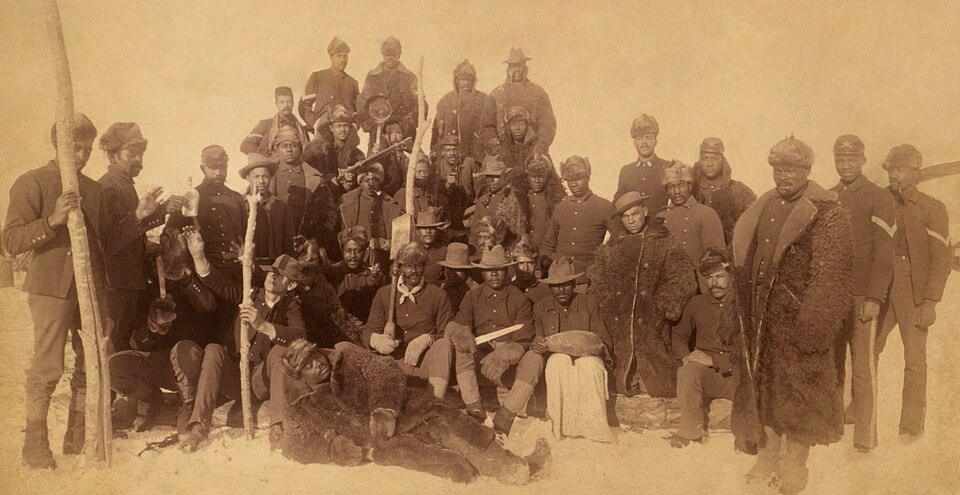
Buffalo Soldiers of the 25th Infantry Regiment in 1890
IMO, this article (PDF) is SLANTED to make the United States Military look innocent of the HORRIFIC manner in which the Negro/Black soldiers were treated. From my vantage point, all those soldiers were SLAVES for the military. I would like to see an ACCURATE ACCOUNTING of all those supposed Medals of Honor that the military claims to have presented to these soldiers. If any letters or journals, or even remembered stories of living relatives exist, they should be exposed to RE-WRITE this article by those who know the TRUTH rather than some propaganda devised by current military (who know that I use Wikipedia as a primary source for consistency!). rk
This article is about the nickname given to Black American US Army regiments. For the Bob Marley song, see Buffalo Soldier (song). For other uses, see Buffalo Soldier (disambiguation).
Buffalo Soldiers were United States Army regiments composed exclusively of Black American soldiers, formed during the 19th century to serve on the American frontier. On September 21, 1866, the 10th Cavalry Regiment was formed at Fort Leavenworth, Kansas. According to legend, during the exodus of the 1870s, more than 20,000 African Americans migrated to Kansas. They hoped their journey would take them far away from poverty from the South. Others escaped by being soldiers. They served in the segregated army units and fought in the Western Indian Wars from 1867 to 1896. According to legend, the men were called "buffalo soldiers" by the Apache and Cheyenne. The soldiers adopted the name as a sign of honor and respect. Units of Buffalo Soldiers answered the nation's call to arms mainly in the West, however, also in Cuba, the Philippines, Hawaii, and Mexico. They had a huge impact on the Reconstruction era.[1]
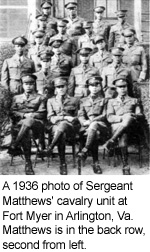
Although numerous Black Union Army regiments were raised during the Civil War (referred to collectively as the United States Colored Troops), "Buffalo Soldiers" were established by the U.S Congress as the first all-black Army regiments in peacetime.[2] The regiments were racially segregated, as the U.S. military would not desegregate until 1948. On November 15, 2024, Robert Dixon, the last surviving Buffalo Soldier, died aged 103.[3] The oldest Buffalo Soldier, Mark Matthews, died in 2005 at the age of 111 and was buried at Arlington National Cemetery.[4]
Etymology
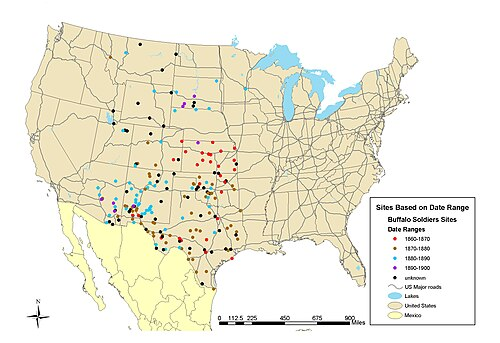
Buffalo Soldier sites from 1860 to 1900
Sources disagree on how the nickname "Buffalo Soldiers" began. According to the Buffalo Soldiers National Museum the name originated with the Cheyenne warriors in the winter of 1877, the actual Cheyenne translation being "Wild Buffalo". Writer Walter Hill documented the account of Colonel Benjamin Grierson, who founded the 10th Cavalry regiment, recalling an 1871 campaign against Comanches. Hill attributed the origin of the name to the Comanche, due to Grierson's assertions. The Apache used the same term ("We called them 'buffalo soldiers,' because they had curly, kinky hair ... like bison") as supported by other sources.[5][6][7][8][9] Another possible origin credits the Plains Indians who gave them that name because of the bison coats they wore in winter.[10] The phrase "Buffalo Soldiers" became a generic term for all black soldiers. It is now used for U.S. Army units that trace their direct lineage back to any of the African-American regiments formed in 1866.
Service
During the Civil War, the U.S. government formed regiments known as the United States Colored Troops, composed of black soldiers and Native Americans. The USCT was disbanded in the fall of 1865. In 1867 the Regular Army was set at ten regiments of cavalry and 45 regiments of infantry. The Army was authorized to raise two regiments of black cavalry (the 9th and 10th (Colored) Cavalry) and four regiments of black infantry (the 38th, 39th, 40th, and 41st (Colored) Infantry), who were mostly drawn from USCT veterans. The first draft of the bill that the House Committee on Military Affairs sent to the full chamber on March 7, 1866, did not include a provision for regiments of black cavalry; however, this provision was added by Senator Benjamin Wade prior to the bill's passing on July 28, 1866.[11] In 1869 the Regular Army was kept at ten regiments of cavalry but cut to 25 regiments of Infantry, reducing the black complement to two regiments (the 24th and 25th (Colored) Infantry). The 38th and 41st were reorganized as the 25th, with headquarters in Jackson Barracks in New Orleans, Louisiana, in November 1869. The 39th and 40th were reorganized as the 24th, with headquarters at Fort Clark, Texas, in April 1869. The two black infantry regiments represented 10 percent of the size of all twenty-five infantry regiments. Similarly, the two black cavalry units represented 20 percent of the size of all ten cavalry regiments.[11]
During the peacetime formation years (1865–1870), the black infantry and cavalry regiments were composed of black enlisted soldiers commanded by white commissioned officers and black noncommissioned officers. These included the first commander of the 10th Cavalry Benjamin Grierson, the first commander of the 9th Cavalry Edward Hatch, Medal of Honor recipient Louis H. Carpenter, and Nicholas M. Nolan. The first black commissioned officer to lead the Buffalo Soldiers and the first black graduate of West Point, was Henry O. Flipper in 1877.
From 1870 to 1898, the total strength of the US Army totaled 25,000 service members, with black soldiers maintaining their ten percent representation.
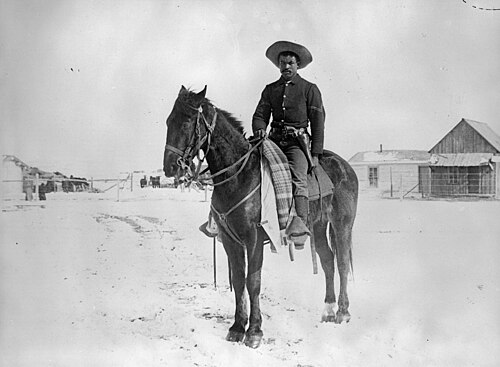
Buffalo Soldier in the 9th Cavalry, 1890
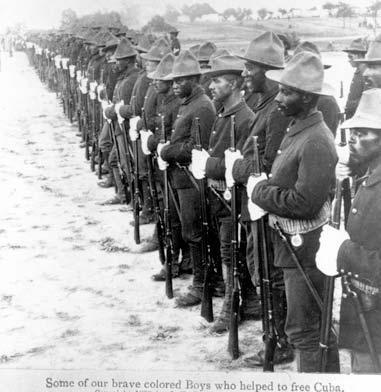
Buffalo Soldiers who participated in the Spanish–American War
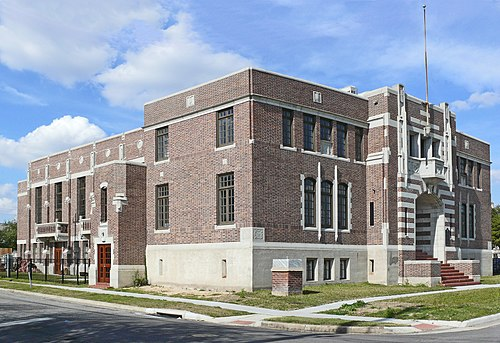
Buffalo Soldiers National Museum in Houston
Prejudice
The Buffalo Soldiers were often confronted with racial prejudice from other members of the U.S. Army. Civilians in the areas where the soldiers were stationed occasionally reacted to them with violence. Buffalo Soldiers were attacked during racial disturbances in Rio Grande City, Texas, in 1899,[41] Brownsville, Texas, in 1906,[42] and Houston, Texas, in 1917.[43][44]
During the Spanish–American War, the 9th Cavalry faced violent conflict with white citizens in multiple cities in Florida including Lakeland and Tampa.[45]
During the Indian Wars from 1866 to 1891, 416 soldiers were awarded the Medal of Honor. Although the Buffalo Soldiers were 12% of the U.S. Army infantry force and 20% of the cavalry force in this era, Buffalo Soldiers were awarded less than 4% of all Medals of Honor awarded. Other regiments during the era received a greater number of Medals of Honor but were not distinguished enough to see duty in Cuba for the Spanish–American War. For example, the 8th Cavalry Regiment with 84 Medals of Honor, were not assigned duty to fight in Cuba in 1898. Scholars have hypothesized that commanders were reticent to award behavior that they expected from soldiers, the bureaucracy impeded awards, and the posting of black soldiers to remote outposts reduced the visibility of black soldiers (the 1st Cavalry participated in twenty-one campaigns and the 2nd cavalry participated in nineteen campaigns during this era, compared to the 9th Cavalry's eight campaigns). Historian Thomas Phillips counted 2,704 engagements with native tribes during this era, of which the four black regiments participated in 141 or about 5%.[46]
Camp Logan mutiny
Main article: Houston riot of 1917
The Camp Logan Mutiny, also known as the Houston riot of 1917, was a mutiny and riot by 156 soldiers from the all-black 24th Infantry Regiment of the United States Army, taking place on August 23, 1917, in Houston, Texas. 118 soldiers were tried in three courts-martial; 110 were convicted, of whom 19 were executed; and 63 sentenced to life imprisonment. The Army announced on November 13, 2023, that the convictions of the 110 soldiers were overturned after a thorough review by the Army Board for Correction of Military Records found that the soldiers were wrongly treated because of their race and not given fair trials.[47]
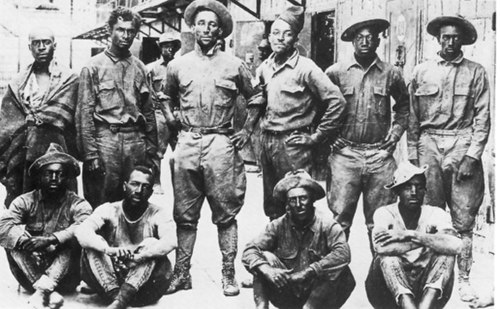
Buffalo Soldiers of the U.S. 10th Cavalry Regiment who were taken prisoner during the Battle of Carrizal, Chihuahua, Mexico in 1916
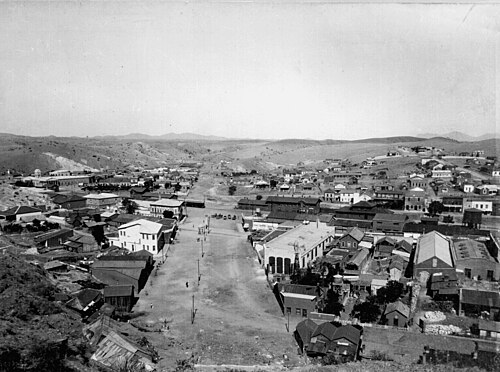
The U.S.-Mexico border in Nogales in 1898: International Street/Calle Internacional runs through the center of the image between Nogales, Sonora (left), and Nogales, Arizona (right). Note the wide-open international boundary. A Customs House is located near the center of the image.
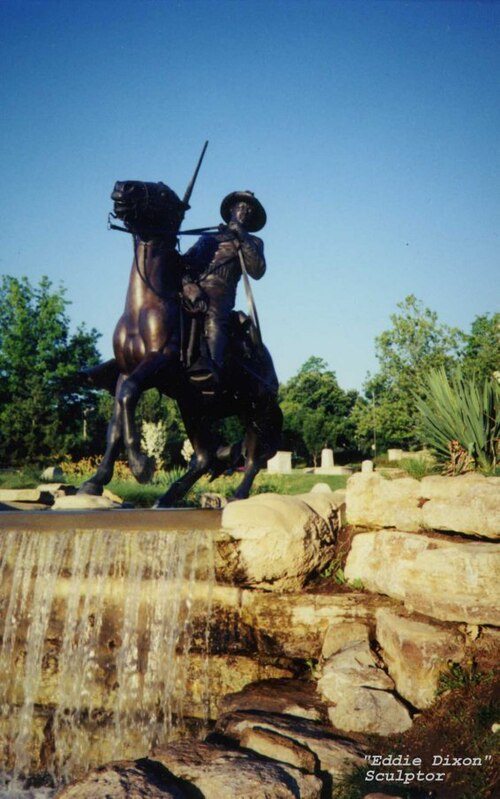
Buffalo Soldier Monument on Fort Leavenworth, Kansas
Legacy and honors
Memorials
In 1973, West Point Academy would become the first military academy to honor the Buffalo Soldier, renaming the area at the academy where the Buffalo Soldiers trained future officers "Buffalo Soldier Field" and placing a memorial rock at the northeast corner of the field.[64]
The Buffalo Soldier Monument by American sculptor Eddie Dixon was installed at the United States Military Academy in West Point, New York, in 2021.[65][66]
A monument dedicated to the Buffalo Soldiers, Fort Leavenworth, Kansas, were initiated and dedicated in 1992 by Gen. Colin Powell to the memory of the 9th & 10th Cavalry Regiments in the United States Army that were once only made up of black soldiers.[67]
On March 25, 2013, the Charles Young Buffalo Soldiers National Monument under the Antiquities Act of 1906 was designated by United States President Barack Obama as a unit of the National Park Service. The 19th-century house museum also has an exhibit on African American soldier, Charles Young and the Buffalo Soldiers.[68][69]
On February 20, 2014, officials at the United States Army post, Fort Bliss, changed the name of Robert E. Lee Road to Buffalo Soldier Road, recognizing the African-American units that moved through the fort in the 19th century; it also honors them since they protected American settlers in the west during the aftermath of the American Civil War.[70]
On June 23, 2020, The El Paso, Texas City Council voted unanimously to rename Robert E. Lee Road in east-central El Paso as Buffalo Soldiers Road.[71]
In September 2021, a new monument featuring a black soldier on horseback would be erected in honor of the Buffalo Soldiers on the west side of West Point Academy's Buffalo Soldier Field.[64][3] The plaque from the original memorial rock that was dedicated in 1973 would also be relocated and placed at the base of the new statue.[64]
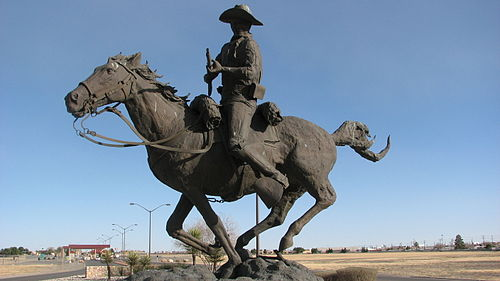
Buffalo Soldier Memorial of El Paso, in Fort Bliss, depicting CPL John Ross, I Troop, 9th Cavalry, in an encounter in the Guadalupe Mountains during the American Indian Wars
Medal of Honor recipients (1866–1918)
This list is of the officers and men who received the Medal of Honor for service with the original units called "Buffalo Soldiers".
- Edward L. Baker, Jr.
- Dennis Bell
- Thomas Boyne
- Benjamin Brown
- George Ritter Burnett
- Louis H. Carpenter
- Powhatan Henry Clarke
- John Denny
- Pompey Factor
- Clinton Greaves
- Henry Johnson
- George Jordan
- Fitz Lee
- Isaiah Mays
- William McBryar
- Adam Paine
- Isaac Payne
- Thomas Shaw
- Emanuel Stance
- Freddie Stowers
- William H. Thompkins
- Augustus Walley
- George H. Wanton
- John Ward
- Moses Williams
- William Othello Wilson
- Brent Woods
Other prominent members
This list is of other notable African Americans who served in the original units as "Buffalo Soldiers" from 1866 to 1918.
- John Hanks Alexander
- Allen Allensworth
- Lewis Broadus
- Charles C. Dawson
- Henry Ossian Flipper
- Edward W. Pearson, Sr.
- Charles Young
- Cathay Williams
See also
- Bicycle infantry
- Bisbee Riot
- Battle of the Saline River – one of the first combats of the 10th
- Black Seminoles (Cimarrones)
- Black Seminole Scouts
- List of African-American Medal of Honor recipients
- Military history of African Americans
- Racial segregation in the United States Armed Forces
- Camp Lockett
- Buffalo Soldier tragedy of 1877, also known as the "Staked Plains Horror"
- "Colonel" Charles Long
- The Buffalo Saga, memoirs of James H. Daugherty of the 92nd Infantry in World War II
- Tuskegee Airmen
- 1st Louisiana Native Guard
- 2nd Cavalry Division
- 92nd Infantry Division
- 93rd Infantry Division
- 366th Infantry Regiment
- 761st Tank Battalion
- 784th Tank Battalion
- MV Buffalo Soldier, a maritime prepositioning ship, used by the Military Sealift Command
- Tangipahoa African American Heritage Museum & Black Veteran Archives
- Buffalo Soldiers MC, a motorcycle club.
See PDF for complete article, downloaded
Tuesday, May 19, 2026 01:36PM