CITATION VII
- Passengers 8
Launched in the early 1990s as an upgrade of the Citation III and Citation VI, the Cessna Citation VII remains one of the fastest and most comfortable midsize business jets on the charter market.
About this aircraft
- The Cessna Citation VII was certified in 1992.
- It’s typically configured for eight passengers, with an extra seat in the enclosed lavatory if needed.
- The Cessna Citation VII can fly nonstop from London to most of Europe and from New York to Houston.
- A baggage hold behind the enclosed lavatory is large enough for five suitcases.
- Over 100 aircraft were delivered until production of the Citation VII ended in 2000 with the launch of the Citation Citation Sovereign
The Citation VII had several benefits that set it apart from the Citation III (the first Model 650 in the series). These included better takeoff, climb and cruise performance; a new Honeywell electronic flight instrument system; and Honeywell's SPZ-8000 autopilot/flight director system.
Interior design
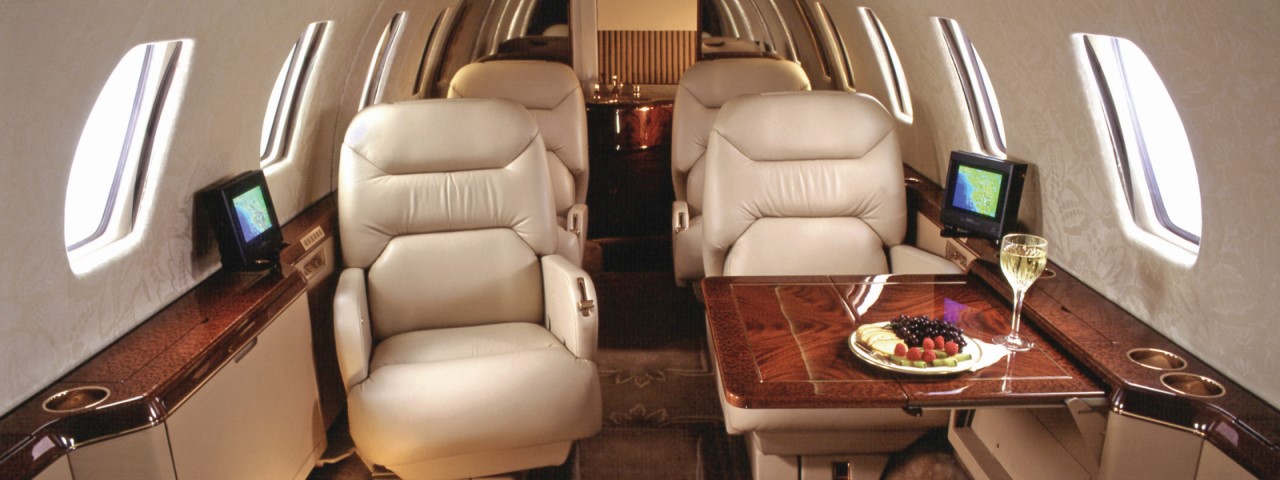
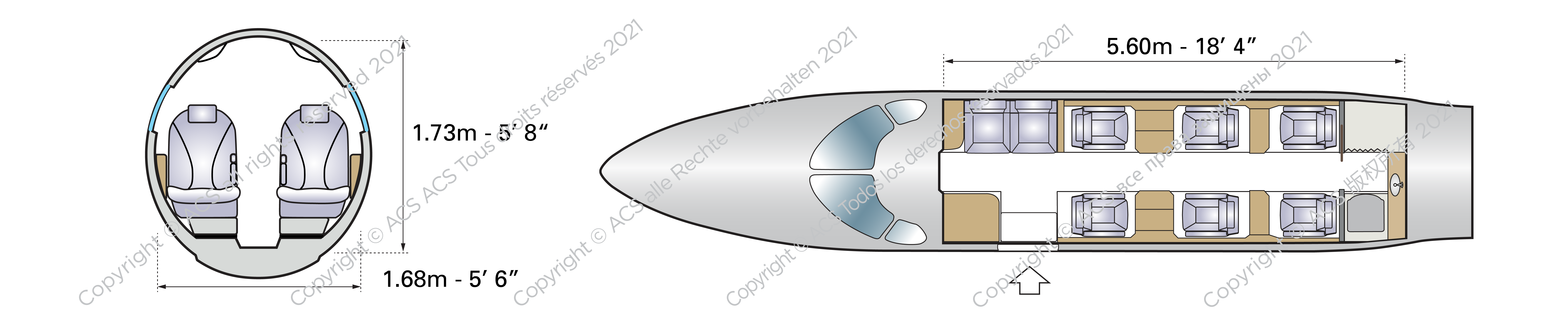
The Citation VII typically features a four-seat club section with two forward-facing seats at the rear and either a single or two-place divan at the front of the cabin. A rear enclosed lavatory can be used as an extra passenger seat. Many Citation VIIs have been retrofitted and uplifted with re-upholstered seats and new carpet and sidewall coverings over the years.
Below is a standard configuration found inside a Cessna Citation VII.
Interesting facts to learn before you fly
- The Citation VII has a larger lavatory than the Citation III. Additional upgrades include a refreshment centre, better cabin soundproofing for a quieter flight, and mod-cons such as a DVD player, TV screens and headsets.
- The interiors and cockpits of most Citation VIIs have been modernised over the years.
- Aircraft with no divan usually have a closet instead, adding up to 20 ft3 of extra baggage space inside the cabin.
Technological features
The Cessna Citation VII can reach a maximum cruise speed of Mach 0.72 thanks to powerful Honeywell TFE731-4R-2S engines.
The aircraft’s avionics system is almost identical to the Citation VI’s. The Honeywell digital SPZ-8000 flight control system comes as standard, but uses analog instead of digital autopilot to reduce acquisition cost and weight.
History
The Citation VII is part of the Citation 650 series, along with the III and the VI. The aircraft’s upgraded engines gave it better takeoff and altitude performance than its predecessors.
The Citation VII first flew in early 1991, with deliveries beginning the following year. Over 100 aircraft were built, with production ending in 2000 to make way for the much-improved Citation Sovereign.
Manufacturer
Cessna was founded in 1927 by Clyde Cessna and Victor Roos. It was originally called the Cessna-Roos Aircraft Company, but Roos’ name was dropped after he resigned just one month into the partnership and sold back his interest to Cessna.
Headquartered in Wichita, Kansas, the company specialised in producing small piston-powered planes and business jets. After becoming one of the world’s biggest general aviation producers, it was bought by General Dynamics in 1985 and by Textron in 1992. In March 2014, Cessna stopped operating as a subsidiary company and joined Beechcraft and Hawker as one of the three distinct brands produced by Textron Aviation.