Pharmacopoeia
Downloaded: March 14, 2025, 4:36 PM
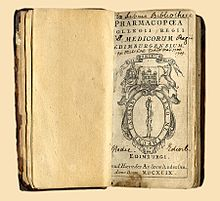
The 1699 Edinburgh Pharmacopoeia
A pharmacopoeia, pharmacopeia, or pharmacopoea (from the obsolete typography pharmacopœia, meaning "drug-making"), in its modern technical sense, is a book containing directions for the identification of compound medicines, and published by the authority of a government or a medical or pharmaceutical society.[1]
Descriptions of preparations are called monographs. In a broader sense it is a reference work for pharmaceutical drug specifications.
Etymology
The term derives from Ancient Greek: φαρμακοποιία, romanized: pharmakopoiia "making of (healing) medicine, drug-making", a compound of "medicine, drug, poison" (Ancient Greek: φάρμακον, romanized: pharmakon), with the verb "to make" (Ancient Greek: ποιεῖν, romanized: poiein), and the abstract noun suffix -ία -ia.[2][3]
In early modern editions of Latin texts, the Greek diphthong οι (oi) is latinized to its Latin equivalent oe which is in turn written with the ligature œ, giving the spelling pharmacopœia; in modern UK English, œ is written as oe, giving the spelling pharmacopoeia, while in American English oe becomes e, giving us pharmacopeia.