Improved hard water stability 2.8
1.1.Background
Most mills used DI/RO water as feed water for emulsion make-up.
Some mills use (would prefer to use) tap water, softened water or water from natural sources, such as lakes and underground water.
In China all plants use DI/RO water due to the variation in water hardness across regions.
The concern is not limited to water hardness but also the Cl-content from treated water.
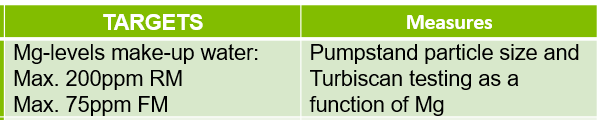
Hard water will impact on the streaming potential – as a result of the solubility behaviour of surfactants.
Hardness levels can be as high as 18-20 °dH (German hardness).
From experience:
NOA formulations appear more robust to hard water conditions.
This is probably due to the lack of fatty acids.
1.2.Concluding remarks
• This criterium appears to be difficult to achieve at a first assessment, especially to achieve results across the complete spectrum of hardness.
•Being a “Nice to have” criterium it will be secondary to other priority criteria and may not be able to be achieved. This will reflect in the final analysis at the end of the first round of discussions.
•The engineering solution of treating the water is so much simpler than the chemical solution of modifying the lubricant.
•A “Nice to have” would be the possibility of extending the RO/DI water quality range from the current recommended level of < 30 µS/cm to say 150 µS/cm.