LULAC lat am cits
===
see renta tamale
Elia Quintana, Director of Stakeholder Relations will lead API’s Energy Research Collaborative (ERC) with strategic partners focused on workforce development and engagement with non-traditional allies. Elia was an ERC participant, representing the Hispanic Association on Corporate Responsibility (HACR) where she served as Vice President of Corporate Relations. Prior to HACR, Elia served as Director of Corporate Relations with LULAC National Education Service Centers (LNESC), championing diversity and inclusion initiatives and focusing on recruitment, retention, career readiness training and leadership development programming for underserved communities.
===
===
an com dr 8 24
The “Party of Lincoln,” as Republicans call themselves, seems intent on undermining just about everything President Abraham Lincoln lived and died for. This includes Republican efforts to upend the way elections are run, by restricting who gets to vote, how voting is conducted, and how votes are counted and certified.
The outcome of the tight presidential race between former U.S. President Donald Trump and Vice President Kamala Harris will hinge on the votes in a handful of swing states. From Georgia to Arizona, Nevada to Michigan, Republicans are mounting an all-out assault on the election process that journalist Ari Berman refers to as a “five-alarm fire for democracy.”
“It appears that Georgia Republicans are laying the groundwork not to certify the presidential election if Kamala Harris wins,” Berman said on the Democracy Now! news hour. “They’re doing exactly what Trump wanted them to do in 2020. Trump made Georgia the epicenter of the attempt to try to overturn the election. He asked local and State Board of Elections and election officials not to certify the election. They refused to do so; they followed the law. It seems like in 2024 they’re going to extraordinary lengths to try to implement the measures that failed in 2020, to try to rig the election for Trump.”
The Republican Party of today, desperate to suppress the votes of people of color, could not be further from the Party of Lincoln.
Georgia Republicans altered how counties count and certify votes. The Democratic Party of Georgia, the Democratic National Committee, and 10 Democratic county election officials from across Georgia have sued, seeking to roll back the changes. Their lawsuit argues, “Georgia’s State Election Board has passed a host of last-minute rules that threaten to sow chaos and impede the vote-canvassing process.”
Berman warns: “These state and local election boards have been taken over, in some cases, by election deniers, by MAGA extremists…The administration of elections matters so much because you can cast a vote, you can have your vote counted, but it doesn’t actually matter until votes are certified.”
In Texas, the Republican-controlled state government has for years tried to restrict voting in districts where Democratic candidates do well. Donald Trump won Texas by over five percentage points in 2020, but President Joe Biden won the cities of Dallas, Fort Worth, Houston, Austin, and El Paso as well as the Rio Grande Valley.
Texas Gov. Greg Abbott announced this week that he has purged over 1 million voters from Texas voter rolls. This increasingly common tactic inevitably removes legally-registered voters, often through faulty data screens that target likely Democratic voters.
Meanwhile, Texas’ Republican Attorney General Ken Paxton, who’s currently agreed to do community service to avoid a felony criminal securities fraud trial, and survived an unrelated impeachment trial in the Republican-controlled state senate, has been raiding nonprofit organizations that provide services to immigrant and Latino communities.
Last week, under Paxton’s orders, the homes of a dozen members of LULAC, the League of United Latin American Citizens, were raided and searched by Texas authorities, including SWAT teams. One activist’s door was broken down. Texas House candidate Cecilia Castellano, running for an open seat to represent Uvalde, the town devastated by one of the worst school shootings in U.S. history, had her home raided. Government agents took her cell phone and, weeks ahead of election day, threw her campaign into chaos.
LULAC said in a statement, “Attorney General Paxton’s actions clearly aim to suppress the Latino vote through intimidation and any means necessary to tilt the electoral process in favor of his political allies.” LULAC has called on the Justice Department to investigate Paxton over the raids.
Juan Proaño, CEO of LULAC, said on Democracy Now!, “In the last U.S. Census, they reported 12.1 million Latinos in the state of Texas. For the first time, Latinos actually outnumber non-Hispanic whites, which is at 12 million. When you take into account not just the Latino population in the state of Texas, but the African American and Asian population… the minority community in Texas now stands at over 60%. Texas is and has been a majority-minority state. So, we see these, effectively, as tactics for the Republicans to actually stay in control of the government in Texas.”
If further evidence of Republican attempts to subvert the will of the voters were needed, Pluribus News, a nonprofit news organization, reports that Republican-controlled state governments are altering language on progressive state ballot initiatives to confuse or mislead voters. Arizona, for example, inserted “unborn human being” in place of fetus or embryo in the ballot initiative intended to guarantee the right to an abortion. Voters in Florida and Ohio will face similar confusing language in their ballot initiatives.
In President Lincoln’s final public address, three days before his assassination, Lincoln advocated that the right to vote be granted to formerly enslaved Black men (as only men could legally vote, until 1920). The Republican Party of today, desperate to suppress the votes of people of color, could not be further from the Party of Lincoln.
https://en.wikipedia.org/wiki/Domingo_Garc%C3%ADa_(politician)
---
trib
The League of United Latin American Citizens plans to request a federal investigation into raids Attorney General Ken Paxton conducted this week as part of what he called an “ongoing election integrity investigation.”
Gabriel Rosales, Texas LULAC’s state director, said in a statement that Paxton carried out the raids 11 weeks before the 2024 elections “to suppress the Latino vote through intimidation and any means necessary to tilt the electoral process in favor of his political allies.”
Agents raided the home of Cecilia Castellano — the Democrat running to succeed state Rep. Tracy King, D-Uvalde — and confiscated her phone as part of the search, according to Rosales. Republicans see that seat, which Gov. Greg Abbott carried by nearly 6 percentage points, as their best potential state House flip in November.
Law enforcement also searched the homes of at least five other Latino individuals, all of whom were working on Castellano’s campaign and three of whom are members of Texas LULAC, Rosales added. LULAC is a non-partisan, volunteer-based Hispanic civil rights organization headquartered in Washington.
The group is in the dark about the details of any accusations, Rosales said, “but there's none that we’ve been privy to that merits an investigation like this that wastes taxpayers’ money.”
“It is disgraceful and outrageous that the state of Texas, and its highest-ranking law enforcement officer is once again using the power of his office to instill fear in the hearts of community members who volunteer their time to promote civic engagement,” Rosales said in a statement.
Paxton announced on Wednesday that his office executed “multiple” search warrants in Frio, Atascosa and Bexar counties the day prior as part of an investigation into allegations of “election fraud and vote harvesting that occurred during the 2022 elections.” A two-year investigation, Paxton said, provided “sufficient evidence” to obtain the search warrants.
“Secure elections are the cornerstone of our republic,” Paxton said in a statement. “We are completely committed to protecting the security of the ballot box and the integrity of every legal vote. This means ensuring accountability for anyone committing election crimes.”
Paxton’s office did not reply to a request for additional information. His announcement did not detail the targets of the raids, the number of raids, or the reason specific homes were searched.
“It’s still very vague,” Rosales said in an interview. “That’s what’s really unnerving about the whole situation.”
According to one person whose home was raided, Rosales said, law enforcement suggested that he was accused of possessing “illegal voter information” — a claim that he denied and called politically motivated, saying voter information is publicly available.
“There’s no there, there,” Rosales said. “They’re using every tool in the toolbox to intimidate our people from coming out to the polls.”
The Texas Tribune
Rosales said he was working with the group’s national leaders and attorneys to draft a formal complaint with the U.S. Justice Department requesting a federal investigation into Paxton’s raids.
The attorney general’s office was asked to investigate the allegations of election fraud and vote harvesting during the 2022 elections by 81st Judicial District Attorney Audrey Louis, a Republican whose district includes Frio and Atascosa counties.
---
===
guard
one of the United States’ oldest Latino civil rights organizations is raising alarm after several of its members had their homes raided as part of a voter fraud investigation by the Texas attorney general’s office.
The League of United Latin American Citizens (Lulac) wants the Department of Justice to investigate raids on at least three of its members in Texas. Ken Paxton, the Texas attorney general, said in a statement last week his office had executed multiple search warrants in Bexar county, which includes San Antonio, as well as neighboring Frio and Atascosa counties as part of an ongoing, two-year investigation. The office did not provide details of the investigation or respond to a request for comment.
No one has been arrested and the exact nature of the investigation remains unclear. But the searches themselves were designed to intimidate, Lulac officials said.
‘A different level than 2020’: Trump’s plan to steal election is taking shape
Read more](https://www.theguardian.com/us-news/article/2024/aug/12/trump-overturn-result-presidential-election-vote)
“They’re trying to intimidate our folks that are out registering people,” said Lulac’s president, Roman Palomares. “What they’re trying to do is they’re trying to intimidate, and then that has repercussions down the line here, where folks read about that and they go, ‘God, I mean, if they’re doing that to her and I’m a registrar, God, how are they going to go after me?’”
A justice department spokesperson said the agency was aware of the matter and declined to comment further.
Lidia Martinez, 87, said nine officers from the attorney general’s office showed up at her front door at 6am last Tuesday and spent hours searching her home as she watched in her nightgown. She said they told her they were there because she had filed a complaint that senior citizens were not receiving their ballots.
Martinez was taken outside in front of her neighbors while officers searched the house, she said. Eventually, the officers left with her laptop, planner and cellphone.
Lidia Martinez, center, a volunteer and great-grandmother whose home was searched, center, speaks at a news conference for Lulac on Monday. Photograph: Eric Gay/AP
“I asked them why are you all doing this? And he said because there was fraud,” she said. “I said I’m not doing anything illegal. All I do is help the seniors.”
Texas has extremely strict rules around mail-in balloting. Only those who are sick, out of the county on election day, confined in jail, giving birth within three weeks of election day, or aged 65 and older are authorized to request a mail-in ballot. Anyone who assists someone in requesting a ballot must fill out a form indicating they assisted. Anyone who assists the voter in returning the actual ballot, other than a family or household member, must sign the envelope with the ballot noting their assistance.
Texas leans on new voting law to reject thousands of ballot applications
Read more](
https://www.theguardian.com/us-news/2022/feb/03/texas-new-restrictive-voting-law-reject-thousands-mail-in-ballots)
Paxton’s office has operated an entire unit dedicated to prosecuting cases of voter fraud for years. The unit has a budget of millions of dollars, but closes very few cases. In the last fiscal year, for example, it had a budget of $2.3m and handled just four cases, according to the Houston Chronicle.
In 2021, Texas’s highest criminal court ruled that Paxton could not unilaterally pursue cases and instead had to be invited to investigate by a local district attorney (in the Lulac matter his office has said he was invited by local prosecutor Audrey Louis to investigate). Even before that ruling, Paxton would inflate cases to create the impression that he was uncovering massive fraud in Texas.
Paxton, who filed an unsuccessful lawsuit at the supreme court to overturn the 2020 election results, also said last week his office was investigating reports of people registering non-citizens outside DMVs. That investigation appeared to be prompted by a quickly debunked claim from Fox’s Maria Bartiromo.
[
US House approves bill to ban non-citizens from voting in federal elections
Read more](
https://www.theguardian.com/us-news/article/2024/jul/11/save-act-voting-bill-passes-house)
Paxton’s investigations come as Republicans have sought to fan fears about non-citizen voting, which is extremely rare, ahead of this fall’s election.
A copy of the search warrant for Martinez provided by Lulac showed officers were instructed to collect evidence of violations of the Texas law that prohibits collecting mail-in ballots for compensation or “to deliver votes for a specific candidate or measure”. Officers were also instructed to gather evidence of a Texas law prohibiting the fraudulent use or possession of personal identifying information.
Martinez said the officers asked her about other Lulac members and Manuel Medina, a Democratic political operative and former chair of the Democratic party in Bexar county. Medina’s home was also searched last week, the Texas Tribune reported. An affidavit from Texas attorney general’s office investigator obtained by the outlet says officials have a recording of Medina discussing a scheme to collect votes for Cecilia Castellano, a Democrat running for a competitive state House seat.
Castellano said on Monday that her home had also been searched. Officers showed up at 6am with flashlights while her son was sleeping, she said.
“This is how the Republican party works. They cause confusion, false allegations and wasteful spending of our tax dollars,” she said.
CBS News
Texas Attorney General Ken Paxton raids Latino Democrats' homes, including those of LULAC members
21 hours ago
4:15
YouTube · CBS News
LULAC member describes Paxton voter fraud raid
Video21 hours ago
KHOU
87-year-old LULAC volunteer said AG Ken Paxton sent officers to raid her home
21 hours ago
More news
LULAC wants federal investigation of Texas AG over home ...
ABC Chicago
https://abc7chicago.com › post › lulac-wants-federal-in...
22 hours ago — A prominent Latino group is calling on the DOJ to investigate Texas Attorney General Ken Paxton for what it calls "voter intimidation."
Texas AG raids homes of Latino civil rights group members ...
NBC News
https://www.nbcnews.com › news › latino › house-raids...
2 days ago — The raids have triggered outrage and cries of voter suppression in Texas, a state with a long history of discrimination against citizens of ...
Texas Republicans accused of intimidation after raiding ...
The Guardian
https://www.theguardian.com › us-news › article › aug
1 day ago — League of United Latin American Citizens calls on US justice department to look into raids on at least three members.
LULAC member describes Paxton voter fraud raid
CBS News
https://www.cbsnews.com › video › lulac-member-desc...
23 hours ago — Lidia Martinez, a member of the League of United Latin American Citizens, describes a raid at her home in Texas where officers searched her ...
LULAC condemns Paxton's election fraud raids as “ ...
The Texas Tribune
https://www.texastribune.org › 2024/08/23 › texas-ken-...
5 days ago — The group said that searches the attorney general's office carried out this week targeted at least six Latinos, including a Democrat running ...
2007 corps convention
exon shell comcast att....
===
https://www.thenation.com/article/archive/why-arent-civil-rights-groups-standing-telecom-giants/
2013
no lnx
erika Delgado cut her landline service last December. She had cycled through four different companies since 2000, with each company charging her for calls she didn’t make, services she never signed up for and things she thought were included in her contract. After five years with Pacific Bell, Delgado moved to Verizon because it offered her discounted rates for weekend calls and other services. Though she qualified for Lifeline, a discount program designed to provide basic telephone service for low-income customers, a landslide of unexpected fees and overcharges soon overwhelmed her.
“They say they’ll give you discounts, but it’s not true,” says Delgado, a 40-year-old single mother of three children living off of the $850 a month she earns from her business selling clothes and electronics at the Mt. Vernon Swap Meet in San Bernardino, California. “They just charge, charge, charge.”
The War on America
Delgado cut her service with Verizon after just a year and a half and moved to AT&T. She decided to enroll in a $20-a-month plan that included long-distance calling, an important feature because she frequently makes calls home to Mexico. But after making two fifteen- to twenty-minute calls to Mexico, she was slapped with a $90 charge for the calls. She says AT&Tthen told her that her plan did not cover long distance to Mexico, and that $200 would cover the cost of the calls and the additional fees.
“I had to choose to either feed my kids or pay the bill,” she says. The company sent her to collections and she cut service with AT&T after just six months.
Now, with a mounting collections bill on her credit report, Delgado doesn’t even consider moving away from her mobile home or applying for a job that requires good credit. She has also given up entirely on getting the landline service she needs at home. Sometimes her cellphone doesn’t get a signal in her home, and when she can’t afford the electricity bill, she has no way to charge the battery. “I am a single mom and my kids have asthma,” she says. “In case of an emergency with my kids, I need reliable telephone service at home to call 911.”
Delgado’s decade-long struggle to find affordable and reliable telephone service is not unique. Her story, and the plight of millions of other low-income people, are at the heart of a debate between civil rights groups and public interest advocates who find themselves at opposite ends of a debate about what rules, if any, should prevent companies like AT&T from exploiting consumers like Delgado.
In November 2012, in anticipation of moving its telephone service from traditional, wired networks to IP-based phone networks, which transmit voice communications digitally, AT&T filed a petition with the FCC to run test trials of IP-based telephone services. In exchange for expanding these networks, the company is requesting “relief” from critical regulations that apply to wired telephone services. These regulations, which include obligations to provide universal service and state-enforced price and quality regulations, do not currently apply to IP-based telephone service. The petition has garnered critical responses from many public interest groups, including Free Press, the Center for Rural Strategies and the National Hispanic Media Coalition, which are concerned that relaxing these regulations will allow telecom companies to avoid regulating IP-based phone services, leaving them vulnerable to price gouging and poor service quality, with weak access for communities of color and rural residents. (For more about the AT&T petition’s potential impact on underserved communities, click here).
Despite public interests groups’ strong warnings that such regulatory relief would disparately impact communities of color, many business-friendly civil rights groups have come out in support of the petition. Groups such as the League of United Latin American Citizens (LULAC), the National Urban League and the Asian American Federation—all of which have received millions in private donations from AT&T—have filed comments with the FCC showing strong support of the company’s proposed plan for its transition to IP-based telephone services. None of their comments specify regulations that should apply to those services.
“The IP Transition will benefit underserved Asian American communities who remain on the wrong side of the digital divide,” wrote several Asian-American advocacy groups in a joint comment filing lead by the Asian American Federation. They explain that “the switch to an all-IP system will bring more competitive choices into the marketplace, which will provide benefits to consumers, including making high-speed broadband more affordable for Asian Americans who have not yet adopted broadband due to cost concerns.”
The National Urban League and National Action Network, both black advocacy organizations, echoed this reasoning in a joint filing: “We support the AT&T Petition as we understand it and urge the Commission to approve it in a manner that advances the interests of consumers of color.” The two groups wrote that the test trials can serve as “a roadmap” for the country’s transition to IP services and should be used to understand how AT&T’s regulatory relief will affect people of color’s “access to affordable, reliable service in the future.”
LULAC agrees, saying broadband brings economic opportunities, educational achievement and job training to Latinos. “Enhancing network capabilities with a smooth transition to all IP-enabled infrastructure will enable Hispanic Americans to multiply these benefits and further improve their ability to build a strong future for themselves and their families,” Paloma Zuleta, LULAC’s director of communications, told The Nation in an email. She went on to explain that policy and regulatory “modernization” that spurs “sustained and long-term private investment in America’s infrastructure” will lead to economic growth.
But history has shown that deregulation tends to hit low-income, working-class people of color most.The $30 billion payday loan industry offers a recent case in point. Payday lenders prey on low-income people by providing small, short-term loans at extremely high interest rates. In order to pay back these loans, plus interest, people often take out further payday loans. The result is millions of mainly poor and working class people of color trapped in a cycle of debt in an already precarious economy. The payday loan industry is a result of Reagan-era deregulation, which relaxed state caps on loan interest rates. This trend continued through the late ’90s as payday loan entrepreneurs capitalized on the country’s spirit of deregulation to get further exemptions from state interest rate caps. For public interest advocates, the impact of deregulation in other industries provide an example as to who will be affected most if the country’s communication industry is further deregulated.
“Deregulation in the communications industry is a lot like deregulation in food safety, worker safety, banks or other sectors,” says Matt Wood, policy director at Free Press. “The companies claim that regulations kill jobs and make the service more expensive. They promise that removing the rules will let them offer better products and more choices. But what we see instead is a series of broken promises, along with increased risks for the people who used to be protected by the rules.”
The extent of AT&T’s influence over some civil rights groups can be measured in the amount of its donations. In the Asian American Federation’s Biennial report last year, it listed AT&T as a “sustainer,” meaning the company contributed between $5,000 and $9,999 dollars. In 2006, the National Urban League received a $1.6 million grant from AT&T to launch five new digital career academies and expand offerings at eleven existing academies for black students, and it received another $1 million in 2008 for a college prep program aimed at black high schoolers. Donations to the National Action Network, if any, are not available, because AT&T is not required to disclose private corporate grants to the organization.Since at least 2004, LULAC has received between $1 million to $1.5 million in grants to fund technology centers for Latinos and a program aimed at curbing Latino dropout rates.
Money isn’t the only thing connecting these groups to AT&T—they share basic institutional ties. For example, the board vice chair of the Asian Pacific American Legal Center, which filed positive comments with the Asian American Federation, is formerly AT&T’s Pacific region director of marketing and community affairs. And AT&T’s director of external affairs served on Asian Pacific American Legal Center’s 2012 anniversary dinner committee, which AT&T sponsored. AT&T also sits on LULAC’s Corporate Alliance, which guides LULAC’s programming, and was a major sponsor of its National Legislative Conference and Awards Gala, where the organization discusses the year’s policy priorities. Just this April, the National Action Network honored Tanya Lombard, assistant vice president of public affairs at AT&T, and featured her on telecommunications policy panel at their national convention.
These relationships are not new. Civil rights groups have a long history with telecommunication companies that dates back to workplace discrimination lawsuit settlements in the 1970s. In 1972, the Equal Employment Opportunity Commission led a workplace discrimination lawsuit against AT&T for discriminating against women and people of color in hiring, promotions and pay. AT&T and the plaintiffs eventually settled the suit and the company was required to give millions in back pay to thousands of workers and establish internal affirmative action programs. Diversifying its hiring practices strengthened AT&T’s relationships with civil rights groups, who were critical of the company’s hiring discrimination.
A recent investigation led by the Center for Public Integrity revealed a longstanding relationshipbetween telecommunications companies and the Minority Media and Telecommunications Council, a Washington, DC–based pro bono law firm that represents civil rights groups on FCC issues. Critics of MMTC say it serves as the “nerve center” for civil rights groups’ actions on telecommunications issues. It was one of the lead organizations in a group filing on the AT&T petition that included the NAACP and the Rainbow PUSH Coalition. Over the last twenty years, MMTC has evolved from a volunteer-based organization to a fully-funded nonprofit. According to the Center’s report, most of the organization’s revenue comes through generous donations from companies, like Comcast and AT&T, and the organization’s decade-long business of brokering spectrum license sales and station sales to minority broadcasters on behalf of companies like Verizon and Clear Channel.
Despite these close and longstanding relationships, these groups deny accusations that their ties to AT&T affect their policy agenda. “Our decision to support the AT&T IP Transition Petition was based on the fact that the transformation is already underway in the US and globally,” writes Zuleta of LULAC.
The Asian American Justice Center, which has received donations from AT&T and supports its petition to the FCC, echoed this. “At the end of the day, AAJC is a civil rights group that works on behalf of the Asian American community,” Jason Lagria, telecommunications and broadband policy senior staff attorney for AAJC, told The Nation in an e-mail. “We value our supporters’ opinions, but that support doesn’t change our mission or positions we take.”
To be sure, civil rights groups like AAJC don’t always side with telecom companies. This year the organization urged the FCC to consider how their spectrum auction proceedings marginalized minority-owned broadcasters, a concern AT&T does not share, since it would subvert its goal to buy most of the available spectrum. And on August 9, mainstream civil rights groups and public interest groups claimed a joint victory when the FCC voted in a two-to-one decision to cap interstate prison phone rates to twenty-five cents per minute and ban phone service providers from charging extra fees to connect a call or use a calling card. Groups like the National Council of La Raza, the National Urban League and the NAACP were strong advocates in lowering the cost of these calls.
Some groups find that corporate funding is essential to keep their work moving forward. The National Hispanic Media Coalition, a public interest group opposing AT&T’s proposal, does not receive AT&T funding but has accepted corporate donations from groups like the National Association of Broadcasters. “Certainly if a sponsor wants to tell us their opinion, it means we’re going to listen,” says Jessica Gonzalez, the group’s vice president of policy and legal affairs. “But it doesn’t mean we need to adopt that position.” Gonzalez continues, “It puts Latino-led organizations in a tough position, because we’re trying to benefit our community, but there are never enough resources.” A 2011 report from Hispanics in Philanthropy found that only 1 percent of foundation money went directly to programs benefiting Latinos, even though Latinos made up roughly 13 percent of the population in 2010.
Corporate influence extends into the far reaches of state policymaking. In California, legislators passed a copycat deregulation bill, SB1161, which exempts VOIP-based telephone service from some basic regulations and strips the Public Utilities Commission of regulatory power. The campaign to keep basic consumer protections and regulations was no match for the company’s massive lobbying efforts. AT&T spent $1,902,774 in the nine months that it lobbied the California Public Utilities Commission and the state Capitol over SB 1161. Since 2005, the company has spent roughly $14,000 a day on state lobbying, according to the Los Angeles Times. Organizations such as the Hispanic Chamber of Commerce,California State Conference of NAACP and Asian Business Association were outspoken supporters of the bill, citing reasons similar to some civil rights groups’ support of AT&T’s FCC petition.
“AT&T has all the grassroots support money can buy,” says Mark Toney, executive director of TURN, a utility reform organization. TURN worked with sixty-five organizations in opposing the bill—none of which received funding to support their work opposing SB 1161. “Anyone can look at the list of bill supporters and see who is getting money and who is not.” The Hispanic Chamber of Commerce has received $30,000 from AT&T every year since 2006, according to TURN’s analysis of AT&T’s 2011 tax documents. The Hispanic Chamber of Commerce, California Black Chamber of Commerce and the Asian Business Center also share a $287,000 California Emerging Technology Fund grant, an effort supported by AT&T and Verizon as a condition of their respective 2005 mergers with SBC and MCI.
Public interest advocates say the fight for media reform and media justice is increasingly an economic one. “When you talk about dismantling this kind of monopoly power, you’re really talking about restructuring our whole economy,” Robert McChesney, professor of communications at the University of Illinois Urbana-Champaign and author of Rich Media, Poor Democracy: Communication Politics in Dubious Times, explained at the National Conference for Media Reform this year.
Advocates say the stakes are high and emphasize a need for unity among people of color. “I’ve spoken with several folks and made my personal plea out of respect that we really need you,” Joseph Torres, senior external affairs director at Free Press and co-author of News for All the People: The Epic Story of Race and the American Media, says of civil rights groups. “At times it’s a little painful because a lot of the positions some [civil rights groups] have taken on these telecom issues are the wrong positions.” While Torres says there should be room for debate between civil rights and public interest groups, “the policies telecom companies are trying to pass would have a negative impact on our community.” For Torres, aside from the affordability and service reliability issues in the petition, he sees it as another corporate ploy that would weaken the voices of people of color in this new technological era.
“We’ve been fighting to democratize traditional media from corporate gatekeepers who demonize our community,” Torres continued. “We need to ensure they don’t continue to act as corporate gatekeepers.”
After ten years of fighting for basic telephone service, Delgado refuses to fall for company ploys. For the last two years, she has worked as a parent leader with Congregations Organized for Prophetic Engagement, where she mobilizes parents at San Bernardino schools to testify at town hall meetings and lobby legislators on policy issues like California’s AT&T bill last year.
“These companies need to be stopped,” she says. “It’s difficult for companies to understand that it’s important for us to have reliable telephone service at home. The prices that they offer are too high. We need services that are affordable and reliable.”
For Delgado, the solution is clear. Now she waits for civil rights leaders to catch up.
To read more about AT&T’s petition to shed regulations as moves to digital telephone service, click here.
Leticia Miranda is a journalist based in New York City. She writes about race, technology and gender. Her work has appeared in a number of publications, including The Nation and Colorlines.com. Previously, Leticia has worked at the Open Technology Institute at the New America Foundation and Media Literacy Project in Albuquerque, New Mexico.
===
out of date 2009
https://www.opensecrets.org/federal-lobbying/clients/summary?id=D000052976
===
no twt lnx
https://www.alternet.org/2022/05/gigi-sohn/
'Infuriating': Telecom lobbyists spending big money to keep Gigi Sohn off FCC
Julia Conley and Common Dreams May 01, 2022
Consumer rights defenders are warning that telecom companies and lobbyists are taking advantage of the U.S. Senate's delay in confirming Gigi Sohn to the Federal Communications Commission by spending hundreds of thousands of dollars to pressure corporate Democrats to vote against the longtime public advocate.
"There's an unseemly amount of money being spent to promote disinformation about her," Greg Guice, director of government affairs for Public Knowledge, the group founded by Sohn, told MarketWatch this week. "These criticisms aren't based in fact whatsoever."
As Karl Bode wrote at Techdirt last week, former Democratic Sen. Heidi Heitkamp's rural-focused non-profit group recently launched a $250,000 social media ad campaign targeting at least two Democrats who have not yet confirmed how they plan to vote on Sohn's confirmation, even though it would give the party three of the five FCC seats for the first time in six years and would end the current deadlock.
The group's ads are aimed at Sens. Catherine Cortez Masto (D-Nev.) and Mark Kelly (D-Ariz.), neither of whom have indicated how they will vote on Sohn's nomination and both of whom are facing reelection campaigns in November.Politico has reported that Heitkamp is also running ads in West Virginia, where right-wing Democratic Sen. Joe Manchin was "undecided" on Sohn after meeting her.
Heitkamp's group, the One Country Project, is claiming that Sohn has been insufficiently committed to improving broadband access in rural communities, pointing to congressional testimony in which she said Congress has been "disproportionately focused on broadband deployment in rural areas."
As Chris Matthews wrote at MarketWatch, Sohn's testimony didn't "argue that the federal government shouldn't fund broadband deployment, but that the main hurdle for Americans accessing broadband in both rural and urban areas is affordability, not infrastructure."
Heitkamp started One Country Project with "leftover campaign cash" to start her political action committee, Matthews noted, and counted AT&T and Comcast as two of her biggest donors when she was in the Senate.
"Telecom monopolies are now terrified that the Sohn appointment won't just break 2-2 commissioner gridlock (they created) at the agency, it will mean the restoration of meaningful federal oversight over one of the least popular and least competitive industries in the Internet ecosystem," wrote Bode at Techdirt.
Andrew Lokay, an analyst with independent policy research firm Beacon Policy Advisors, told MarketWatch that opponents of Sohn in the telecom industry appear to be "taking advantage of Biden's delay in nominating Sohn and the crowded Senate calendar in an attempt to sink her nomination."
Craig Aaron, president of media and technology advocacy group Free Press, accused the telecom industry and its allies of waging a "dishonest astroturf campaign" against Sohn and called the effort to derail the nomination of a strong net neutrality defender "infuriating."
In addition to One Country Project's efforts, the League of United Latin American Citizens (LULAC)—which has long partnered with AT&T—published an op-ed in the Arizona Daily Star earlier this month accusing Sohn of having a "deeply problematic track record on media diversity issues."
:{
}:
The group wrote that as a senior staffer at the FCC, Sohn "masterminded a plan to give Google a government permission slip to steal, repackage and monetize TV programming without paying one cent to its creators"—a move which angered "diverse creators" and lawmakers over "how her proposal would impact vulnerable, underrepresented communities."
:{
}:
In fact, Bode wrote, "the FCC's goal was to kill the cable box monopoly and save consumers about $20 billion annually in bullshit rental fees," adding that "framing it as a handout to 'big tech' is an intentional misrepresentation."
LULAC denied to MarketWatch that its opposition to Sohn has anything to do with its relationship with AT&T, and the company said it has not donated any money directly to One Country Project.
But as Bode argued, "Sohn's so popular, and the goals of telecom monopolies (less competition, more revenue, no oversight) are so viciously unpopular, they've been forced to fabricate flimsy complaints and funnel them through proxy organizations in a bid to derail the popular nomination."
"If Sohn's nomination is scuttled, it will come at the hands of Senators Joe Manchin, Catherine Cortez Masto, Kyrsten Sinema (D-Ariz.), or Mark Kelly, who will, not coincidentally, parrot the false justifications for opposing Sohn's nomination concocted by the telecom lobby," Bode added.
"It will leave a permanent and violent scar on the political and policy landscape," he added, "loudly advertising once again that the voice of the public (which overwhelmingly supports holding telecom and media giants meaningfully accountable) simply doesn't matter in our purported democracy."
===
thehill
republicans pushed back on President Biden’s nominee to join the Federal Communications Commission (FCC), Gigi Sohn, at a Senate Commerce Committee hearing Wednesday over past comments she’s made regarding conservative media — resistance that could put her nomination in danger.
“All who know her would agree she is knowledgeable and a determined advocate,” ranking member Roger Wicker (R-Miss.) said in his opening statement about Sohn. “I am concerned about her record of expressing hyper-partisan views on many critical matters that have come before the commission and which may come before the commission again in the future.”
In the past, Biden’s nominees to other critical roles overseeing aspects of the tech industry, including Federal Trade Commission (FTC) Chairwoman Lina Khan and Justice Department antitrust division head Jonathan Katner, have been confirmed without significant backlash from the GOP.
The Senate Commerce Committee advanced acting FCC Chairwoman Jessica Rosenworcel’s nomination by a voice vote with just a handful of Republicans recording themselves as a “no” toward her nomination. The committee also voted 14-14 Wednesday to advance Biden’s nominee to fill an open FTC seat, Alvaro Bedoya,to a full Senate vote.
The GOP resistance to Sohn could throw a wrench into her nomination and Democrats’ ability to secure a majority on the board. It would also hinder Rosenworcel’s ability to get Democrats’ agenda through, includingreviving Obama-era net neutrality laws.
The FCC is split 2-2 along party lines until the vacant seat is filled.
Senate Democrats could overcome all Republicans voting against Sohn, but could not afford any defections to approve her nomination.
Sohn has a history of advocating for open and affordable communications networks. She is a distinguished fellow at the Georgetown Law Institute for Technology Law & Policy and a Benton Senior Fellow and Public Advocate. Between 2003 and 2016, Sohn served as a counselor to former FCC Chairman Tom Wheeler.
If confirmed, she would also be the first openly LGBTQ commissioner in the history of the agency.
“I’ve been asked why after a long career I would want a seat on the FCC. My answer is simple — if confirmed I would be serving on the commission at a critical time for our country. Thanks to the work of Congress over the past year, there are ample resources and bipartisan support to make enormous progress inclosing the digital divide in both rural and urban areas,” Sohn said.
“It would be the honor of a lifetime to help the FCC and Congress attain that goal,” she added.
Republicans on the panel, however, pressed Sohn over comments she made during her years in public advocacy.
Sen. Dan Sullivan (R-Alaska) asked Sohn about comments she made in the past about Fox News, including a tweet from last year where she called Fox News “state-sponsored propaganda.”
“For all my concerns about #Facebook, I believe that Fox News has had the most negative impact on our democracy. It’s state-sponsored propaganda, with few if any opposing viewpoints. Where’s the hearing about that?” she tweeted at the time.
“This goes directly to the power you’re going to have, this is not some kind of random tweet,” Sullivan said. “You are clearly indicating your bias against more conservative news sources, and yet you are now up for confirmation at one of the most powerful positions in America on free speech? I think that disqualifies you completely,” he added.
Sohn responded that the comments she tweeted were made in the context of a hearing that took place about Section 230 of the Communications Decency Act, a controversial provision which provides a liability shield for tech companies over content posted on their sites by third parties.
Republicans at the time claimed that social media companies censor with an anticonservative bias.
“As a public interest advocate, as part of my job, those were my words, those were my opinions, but they would have no bearing on how I would act if I was confirmed as an FCC commissioner,” Sohn said.
Sohn told the panel she is working with the Office of Government Ethics, adding that if there are concerns about bias, she will consult with the agency to see if she needs to recuse herself from any matters should she be confirmed as commissioner.
The opposition from the GOP comes after Republican lawmakers indicated in recent weeks that they were unhappy with Sohn’s nomination.
Outside of the Senate, Sohn’s support — or lack thereof — has been a mixed bag from both parties.
Republicans have criticized her past comments about Fox News, but conservative networks like Newsmax and One America News Network have thrown their support behind the Biden nominee.
“Freedom of speech is the lifeblood of our American experience and has always been at the core of my work. I am proud that some of the most conservative television networks are supporting my confirmation, because I worked with them for years to get access to cable subscribers after operators refused to carry them. I have also worked with communities of color and the LGBTQ-plus community to ensure access to their voices on different platforms without interference. I’ve always believed that democracy works best when voices of all kinds can speak and be heard,” Sohn said during the hearing.
Meanwhile, the League of United Latin American Citizens (LULAC) sent a letter to top Commerce Committee senators urging them to oppose Sohn’s nomination over her past actions the group said supported large technology companies in ways that harmed hundreds of small, independent, Latino-owned media companies.
For their part, Democrats on the panel lauded Sohn’s career and expertise in the area to fill the role on the commission.
“She has a decade long of experience as advocating on important telecommunications policies,” committee Chairwoman Maria Cantwell (D-Wash.) said.
TAGS BIDEN NOMINEEDAN SULLIVANFCCGIGI SOHNJESSICA ROSENWORCELJOE BIDENLINA KHANMARIA CANTWELLROGER WICKERSENATE CONFIRMATION HEARING
===
omg
November 30, 2021
The Honorable Maria Cantwell The Honorable Roger Wicker
Chair, Senate Commerce Committee Ranking Member
The United States Senate The United States Senate
Washington, DC Washington, DC
Dear Committee Chair Cantwell and Ranking Member Wicker:
We write on behalf of the members of the League of United Latin American Citizens
(LULAC) to oppose the nomination of Gigi Sohn to be a commissioner on the U.S.
Federal Communications Commission (FCC).
Ms. Sohn’s past actions have supported large technology companies in ways that have
hindered small, independent Latino-owned media companies and has jeopardized
Latino content creators. In addition, these actions have had the effect of erecting
unnecessary barriers to entry to capital markets for Latino-owned businesses.
While Ms. Sohn manages her public image as a proponent of net neutrality, during her
tenure as a senior advisor to the FCC, her counsel did not support nor advance Latino
or minority ownership in the media landscape.
Additionally, we are concerned by the eager public support by some extremist
conservative media platforms who have endorsed Ms. Sohn’s nomination and whose
support she has yet to publicly reject. While we support the First Amendment as a civil
rights organization, Ms. Sohn’s position as a defender of First Amendment rights is
being seen by proponents of the January 6 insurrection as supporting the kinds of
disinformation that fueled the attacks on our nation’s Capitol, impacted the 2020
presidential elections, and have promoted Spanish-language disinformation about the
COVID-19 vaccinations, including the use of social media platforms to promulgate the
same.
For these reasons, we urge you to oppose the nomination of Gigi Sohn to the FCC.
Please contact us at Policy@LULAC.org should you have follow-up questions
National President
Domingo Garcia
Chief Executive Officer
Sindy Benavides
National Officers
Roger C. Rocha, Jr.
Immediate Past President
Pablo A. Martinez
Treasurer
Richard Estrada, III
Youth President
Mari Corugedo
VP for Young Adults
Elia R. Mendoza
VP for Elderly
Elsie Valdes Ramos
VP for Women
Richard Estrada
VP for Farwest
Jose Javier Lopez
VP for Midwest
Ralina Cardona
VP for Northeast
Ivonne Quiñones Lanzo
VP for Southeast
Linda Chavez
VP for Southwest
State Directors
John Arnold, Ph.D.
Arizona
Rey Hernandez
Arkansas
Jose Barrera
California
Sonny Subia
Colorado
Anny Cordero
Connecticut
Jesse Garcia
District of Columbia
Cramer Verde
Florida
Maggie Rivera
Illinois
Nicolas Salazar
Iowa
Madaí Rivera
Kansas
Maria Rivera Brown
Massachusetts
James Fukuda
New Jersey
Fred Baca
New Mexico
Aureo Cardona
New York
Alicia Pagan
Ohio
Cecilia Giron Mendoza
Oregon
Jennie Rivera
Puerto Rico
Rudy Rosales
Texas
Yesenia Timoteo
Utah
Jasmin Chavez
Virginia
Gabriel Portugal
Washington
Jose Palacios
Wisconsin
===
===
https://en.wikipedia.org/wiki/League_of_United_Latin_American_Citizens
League of United Latin American Citizens (LULAC) is the largest and oldest Hispanic and Latino civil rights organization in the United States.[2] It was established on February 17, 1929, in Corpus Christi, Texas, largely by Hispanics returning from World War I who sought to end ethnic discrimination against Latinos in the United States. The goal of LULAC is to advance the economic condition, educational attainment, political influence, housing, health, and civil rights of Hispanic people in the United States. LULAC uses nationwide councils and group community organizations to achieve all these goals. LULAC has about 132,000 members in the United States.
- :{:{Organization:(style="display:table-cell"):}::(style="display:table-cell;padding-left:0px;padding-right:0.5em"):}:
- :{2:(style="display:table-cell;padding-left:0px;padding-right:0.5em"):}::{History}:
- :{2.1:(style="display:table-cell;padding-left:0px;padding-right:0.5em"):}::{Founders}:
- :{2.2:(style="display:table-cell;padding-left:0px;padding-right:0.5em"):}::{Formation}:
- :{2.3:(style="display:table-cell;padding-left:0px;padding-right:0.5em"):}::{Mexican Repatriation}:
- :{2.4:(style="display:table-cell;padding-left:0px;padding-right:0.5em"):}::{Migration and assimilation}:
- :{2.5:(style="display:table-cell;padding-left:0px;padding-right:0.5em"):}::{Role of women}:
- :{2.6:(style="display:table-cell;padding-left:0px;padding-right:0.5em"):}::{After World War II}:
- :{2.7:(style="display:table-cell;padding-left:0px;padding-right:0.5em"):}::{School desegregation}:
- :{2.8:(style="display:table-cell;padding-left:0px;padding-right:0.5em"):}::{Chicano Movement}:
- :{2.9:(style="display:table-cell;padding-left:0px;padding-right:0.5em"):}::{Late-20th century}:
- :{3:(style="display:table-cell;padding-left:0px;padding-right:0.5em"):}::{Local council impact}:
- :{4:(style="display:table-cell;padding-left:0px;padding-right:0.5em"):}::{Current activities}:
- :{5:(style="display:table-cell;padding-left:0px;padding-right:0.5em"):}::{See also}:
- :{6:(style="display:table-cell;padding-left:0px;padding-right:0.5em"):}::{References}:
- :{7:(style="display:table-cell;padding-left:0px;padding-right:0.5em"):}::{Further reading}:
- :{8:(style="display:table-cell;padding-left:0px;padding-right:0.5em"):}::{External links}:
Organization[
LULAC helps to promote education among Latin Americans in America. LULAC councils provide about one million dollars in scholarships to Hispanics every year. LULAC provides educational programming to disadvantaged youth throughout America. They help out 18,000 Hispanics every year. They also help Hispanics train for jobs. They have programs that provide job skills and literacy training to the Hispanic community in America.
Comparisons with the NAACP[
With respect to organizational structure, the League of Latin American Citizens was similar to the National Association for the Advancement of Colored People (NAACP). David G. Gutierrez said, "considering themselves part of a progressive and enlightened leadership elite, LULAC's leaders set out to implement general goals and a political strategy that were similar in form and content to those advocated early in the century by W.E.B. Du Bois and the National Association for the Advancement of Colored People: for an 'educated elite'".[3]: 77
Though the two civil rights groups may have possessed some institutional similarities, LULAC tried to establish distance from the African American civil rights struggle. As LULAC believed that blacks were more oppressed than Latinos; its members thought that joining forces would not strengthen its own struggle for equality. LULAC asserted that many Hispanics properly fell into the "white" category of the dichotomous black-white construction of race.[4]: 31 In 1936 the league "engaged in a series of lobbying activities as soon as it [the USCB] perceived that Mexican Americans would be categorized as part of a group of dark-skinned minorities."[4]: 32 They lobbied to demonstrate that Hispanic, Latino and Mexican American were not racial classifications, but cultural groups who were racially diverse, sharing a common Ethno-linguistic ancestry.[4]: 32
History:{:(style="margin-right:0.25em"):}:[edit:{]}:
Founders:{:(style="margin-right:0.25em"):}:[edit:{]}:
Ben Garza; Manuel C. Gonzales; Andres de Luna; Louis Wilmot; Alonso S. Perales; Rafael Galvan Sr.; Juan Galvan; Vicente Lozano; José Tomás Canales; Edwardo Idar; Mauro Machado; J. Luz Saenz; Juan C. Solis; E.H. Marin[5][6]
Formation[
The LULAC No. 7 hall inLaredo, Texas, first established in 1929[7]

LULAC was formed in 1929 as a result of the merger of several small groups also concerned with the status of Mexican Americans: the Order of the Sons of America (El Orden Hijos de America), the Order of the Knights of America (El Orden Caballeros de America) and the League of Latino American Citizens.[8][9][10] From an early date, women organized separate Ladies Councils within LULAC.[2] Overall, LULAC struggled to use the political system to erase discriminatory laws and practices in the U.S. Southwest. Although it was a nonpartisan group, it encouraged members to vote for candidates who were supportive of the group's ideals.[3]: 78
The first LULAC General Convention was held in Corpus Christi, Texas on May 18, 1929 at Allende Hall owned by Rafael Galvan, Sr. and Samuel Hinojosa. The first LULAC constitution was adopted. During the 1930s, LULAC's activities included voter-registration and petition drives; attempts to repeal the poll tax imposed in several states, which reduced its members' ability to register; and litigation to improve the conditions of Mexican Americans.[4]: 7 They also worked to improve education for Mexican Americans by conducting community-education campaigns and setting up a college scholarship program.[4]: 45 These activities conformed with existing institutional structures in the United States. A major event was the 1930 court case of Del Rio ISD v. Salvatierra, in which LULAC sued Del Rio Independent School District in for segregating Mexican Americans due to their race. Although the court was not fully favorable in its ruling, the case made an important inroad for desegregation cases to come.[11]
Mexican Repatriation[
LULAC's assimilation ideology emerged during the mass deportations occurring in theMexican Repatriation.

LULAC followed an assimilation ideology which emerged among cholos groups around the time of the Great Depression in the United States. Although the United States had recruited Mexican workers during the first quarter century, the economic problems of the depression increased animosity against immigrants and minority groups as people competed for work. In response to such sentiment, the federal government deported an estimated 500,000 Mexican nationals and Mexican Americans (including some American citizens) during the Depression to keep more work for US citizens. As a result, the proportion of native-born Americans among the total ethnic Mexican population was higher than had been the case in previous decades, and many grew up in United States culture rather than among immigrant communities. Benjamin Marquez asserts, "This demographic shift favored the rise of a more assimilated political leadership".[12]: 3 Earlier organizations, such as mutual-aid associations (mutualistas) and labor-based groups, had emphasized pan-Mexican cooperation among recent immigrants from Mexico, Mexican national residents, and Mexican Americans to combat economic, cultural, and political discrimination. But as LULAC has been interested in assimilation to the US, it admitted as members only those ethnic Mexicans who were United States citizens.[3]: 75
Migration and assimilation:{:(style="margin-right:0.25em"):}:[edit:{]}:
[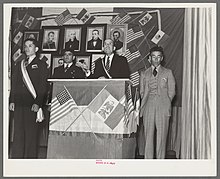 ](https://en.wikipedia.org/wiki/File:The_president_of_the_Mexican_colony_addresses_the_audience_at_the_Mexican_Independence_Day_program,_Saint_Paul,_Minnesota.jpg)
LULAC encouraged assimilation of its members into white U.S.A. culture.

LULAC promoted the full adaptation of its members into the dominant European-American culture, in the belief that this strategy would be the most successful way to combat discrimination. The organization claimed that discrimination was caused byracism, not by the economic or political systems. LULAC promoted capitalism and individualism; its leaders believed that, through hard work and assimilation into American culture, Mexican Americans could improve their socio-economic standing.[12]: 3–15
LULAC emphasized American patriotism as a path to assimilation. It asserted that Mexican Americans should disavow any allegiance to Mexico, remain permanently in the United States, and commit fully to democratic ideals.[4]: 23 The league's official song is "America"; its official language is English; and its official prayer is the "George Washington Prayer". The LULAC's constitution is modeled on the United States Constitution.
Because of LULAC's assimilation ideology and its advancement of the interests of Mexican-American citizens, it advocated restrictions on immigration. LULAC's central means of achieving equal status with European Americans was dependent on promoting the image of Mexican residents as conforming to the cultural norms of the United States. The League recognized that most of the dominant society did not distinguish among the cultures and attitudes of immigrants, citizens, and naturalized persons of Mexican descent.
New immigrants from Mexico resisted the assimilation strategy, as they had stronger ties to their native culture, limited English proficiency, and were willing to work for low wages. Some Mexican Americans knew that they would be lumped together with the recent immigrants and be perceived as "un-American", "backward", and "poor," and would be discriminated against. The league members shared the fear of many working-class Americans that the new immigrants, willing to work for low wages and contributing to job competition against Mexican Americans due to their numbers, would economically harm Mexican American citizens.[3]: 134–6 While other ethnic groups had similar tensions between more settled citizens and new immigrants (such as between German Jews and more recent immigrants of Eastern European Ashkenazi Jews at the end of the nineteenth century), a major difference for Mexicans and Mexican Americans was the continuing high rate of immigration into the United States, strengthening ties to the homeland culture and language.[3]: 3–4
Role of women:{:(style="margin-right:0.25em"):}:[edit:{]}:
LULAC was one of the first national organizations to place emphasis on the role of women.[13] By 1938, the first women's national office was created. State coordinators for women carry out local programs for women. There are many different programs and conferences for women created by the league. Like "Adelante Mujer Hispana" and two-day conferences that discuss education and employment.
Belen Robles served as the first national president of LULAC, starting in 1994.[14][15]
After World War II
Braceros picking tomatoes. LULAC fought against the extension of the program, calling it "legalized slavery."
During World War II the membership and activity of the organization decreased significantly. Many of its members joined or were drafted into the armed forces. LULAC campaigned against the Emergency Farm Labor Program (also known as the Bracero Program), which began in 1942 to fill the farm-labor shortage that resulted from the draft following the US entry into World War II. Although Mexican workers in this program were under contract with the government to go to the United States to work and to return to Mexico after a set amount of time, LULAC saw the program as paving the way for increased permanent immigration from Mexico. LULAC's opposition to the Bracero Program was consistent with its support for restricted immigration, as described earlier.[3]: 134–6
After the war, LULAC was revived by the enthusiasm of returning veterans who sought to claim the civil liberties they believed they had earned by their loyal military service.[4]: 115 The group continued to help the Mexican community with local activities such as Christmas toy drives, sponsoring Boy Scout troops, and campaigns against poll taxes.
School desegregation[

During the 1950s, LULAC began theLittle School of the 400 program, which was designed to teach Mexican-American children 400 English words before they began first grade. The project was initially run by volunteers, and shown after the first class to be successful in preparing children to do better in school; out of 60 participating children, only one had to repeat the first grade. The program expanded, and LULAC convinced the Texas legislature to underwrite it. Between 1960 and 1964 over 92,000 children benefited from the LULAC-initiated, English-centered preschool program.[4]: 51–52
LULAC also sued school districts which practiced segregation. Examples of successful cases include Mendez v. Westminster in 1945 and Minerva Delgado V. Bastrop Independent School District in 1948. In the Mendez case, Thurgood Marshall, then a lawyer for the National Association for the Advancement of Colored People (NAACP) filed an amicus brief in support of LULAC.[16] As Marquez notes, "Relying strictly on the volunteer labor of LULAC attorneys and their staff, from 1950–1957, approximately fifteen suits or complaints were filed against school districts throughout the Southwest".[4]: 54 These victories contributed precedents that were consulted in the deliberation by the United States Supreme Court in the Brown v. Board of Education (1954) case. In 1965, the 146 Councils were distributed among eight states, and by 1977, LULAC had offices in 21 states.[2]
Benjamin Marquez asserts, "Segregated schools, inferior equipment, and the lack of qualified teachers were seen as the primary obstacles to the full economic and social assimilation of the Mexican American".[4]: 28 LULAC believed that the public-school system, with the aforementioned issues corrected, would serve as a central instrument in the assimilation process of children, and thereby the Mexican-American community as a whole. It fully supported education of its members and adoption of fluent English. They believed that through formal education, Mexican Americans would learn how to function in American institutions, socialize with European-American children, and gain education to qualify for higher skilled jobs.[13]
Chicano Movement[
The rise of more radical groups in the 1960s brought change to LULAC. They began to turn away from supporting assimilation. They began to use public protest to bring attention to their cause. The group also began to seek government funding and grants to help build support for the group.[13]
Late-20th century[
SenatorBernie Sanders at a USFWS and LULAC event in Oct. 2015

Despite national visibility, LULAC lost strength since the late-twentieth century, with declines in membership and operating funds because of competition from other Mexican-American groups.[4]: 105 According to Benjamin Marquez, LULAC found it difficult to meet the needs and desires of an increasingly diverse Mexican-American population, in which immigrants have made up an increasingly higher proportion.[4]: 105 He writes, "While the league's public profile grew in the mid-1960s, and the group was involved in a wide range of political activities, these events occurred with decreasing mass participation".[4]: 105
Local council impact[
Founded in Corpus Christi in 1929, LULAC expanded first in Texas, adding 18 councils the next year. More were added in the next decade, but again mostly in Texas. With World War II, LULAC began to extend its reach to California, Arizona, New Mexico, and later Colorado. Victory in a precedent-setting 1945 lawsuit challenging segregation of Mexican American students in Orange County, California, helped the organization grow. LULAC claimed 2,500 members in 1951 and the number of chapters reached 83 in 1955 shortly after another pivotal legal victory (Hernandez v. Texas). The next decade brought LULAC new influence and a new geography, reflecting the Tejano diaspora that was now spreading into the upper Midwest. In 1965 the 146 Councils were distributed among 8 states. By 1977, LULAC had a presence in 21 states yet the total number of Councils had declined. But in 1988, LULAC saw a resurgence in new Councils as 551 were founded bringing the total to over 600. LULAC Councils and state offices were in 32 states including Washington D.C. and Puerto Rico, and reaching new geographies in the Upper East Coast and Florida. From an early date women organized separate Ladies Councils.[2]
Current activities[
Pres.Obama addresses the League of United Latin American Citizens

Education[
The LULAC National Educational Service Centers (LNESC) are part of a non-profit educational advancement organization which helps students with direct-service programs and scholarships.[17]
Legal campaigns[
Roger Rocha (born c. 1971), a health-care analyst from Laredo, Texas, was elected as the 2015 LULAC president at the annual meeting held in Salt Lake City, Utah. He vowed to push for unity in the organization.[18]In July 2017, Rocha strongly endorsed the lawsuit against Texas Senate Bill 4 which ends sanctuary cities in the state. The measure, signed into law by Governor Greg Abbott, permits law enforcement officers to inquire about the legal documentation of suspects detained for other reasons. Rocha claims that the bill was "specifically created to target Latinos," the largest minority group in Texas.[19]
In 2018, the Richmond Council for LULAC and four individual voters filed a federal lawsuit, LULAC of Richmond v. Public Interest Legal Foundation, in the Eastern District of Virginia against the Public Interest Legal Foundation for false reports about non-citizen voters published online. The lawsuit claimed violations of the Ku Klux Klan Act and the Voting Rights Act, as well as state defamation laws. The plaintiffs were successful.[20]
See also[
- American GI Forum (AGIF)
- Ramón H. Dovalina and Juan L. Maldonado
- Arnoldo Torres
- Latino
- NALEO
- League of United Latin American Citizens v. Perry
- MALDEF
- Mexican-American Education Council (MAEC)
- National Immigration Forum
- National Council of La Raza (NCLR)
- SVREP
- Labor Council for Latin American Advancement (LCLAA)
References
===
omfg
aug 3
Inside the Project Veritas Plan to Steal the Election
James O’Keefe’s group is part of a sprawling campaign to delegitimize mail-in balloting in the fall—a campaign being led by the White House.
https://newrepublic.com/article/158622/inside-project-veritas-plan-steal-election
https://newrepublic.com/article/158622/inside-project-veritas-plan-steal-election
James O’Keefe had big plans for 2020. The founder of Project Veritas, the conspiratorial right-wing group that specializes in Fox News–friendly “stings” intended to expose supposed liberal bias and corruption in American society, was planning on getting married this past May. The wedding, to a public school teacher, was to be at an exclusive country club in upstate New York. The guest list was packed with Make America Great Again world cognoscenti: Donald Trump Jr., Sean Hannity, Michelle Malkin, Supreme Court Justice Clarence Thomas, and his activist wife Ginni were all invited, as were several of O’Keefe’s most generous conservative donors, including Texas shale oil billionaire George Bishop and Bullpen Capital founder Paul Martino.
The wedding was, per an email blast, “postponed indefinitely” over the coronavirus, as the pandemic swept across the state this spring and early summer. Although O’Keefe himself declined to comment on this and many other details for this story, a well-placed frenemy is “90 percent sure they broke up.” In any event, while the pandemic may have derailed his personal life, it has only heightened the urgency of some of O’Keefe’s most lucratively funded dirty tricks.
For well over a year, Project Veritas has been secretly producing undercover stings designed to undermine the integrity of absentee and mail-in ballot counts—an endeavor codenamed “Diamond Dog,” according to documents we have obtained. Diamond Dog began as only one facet of Project Veritas’s 2020 rat-fucking strategy, but with the onset of the pandemic, which has made in-person voting a dicey proposition, it has since become one of the group’s top-line action items.
The shift reflects the Republican Party’s near-existential concerns about mail-in voting in November. Donald Trump has disingenuously railed against the practice numerous times over the past few months, betraying a deep anxiety. “Mail in ballots substantially increases the risk of crime and VOTER FRAUD!” he has tweeted. At other times he has claimed: “It will be the greatest Rigged Election in history”; “IT WILL ALSO LEAD TO THE END OF OUR GREAT REPUBLICAN PARTY”; and “SCAM!” Last week, he went so far as to suggest that the election should be delayed, saying that because of “Universal Mail-in Voting,” the vote would be “INACCURATE & FRAUDULENT.”
The purpose of Diamond Dog, as one source close to the organization put it, is “literally to get Trump reelected.” This source, like other past and present Project Veritas employees who have talked to us for this article,expressed fear of reprisals from the group and would only speak under the condition of anonymity.
Last year, Project Veritas’s donor development team solicited big-ticket funders with a pitch deck—frequently tailored to a given patron’s pet ideological grievances and personal hang-ups—offering tantalizing details about the group’s undercover operations for the 2020 campaign cycle. One iteration of this Apple Keynote file was prepared for an ask meeting with a person who appears to beCognex Corporation founder Robert Shillman, a devoted funder of Islamophobic causes who was also one of O’Keefe’s would-be wedding guests. (Shillman ended up pledging to donate $50,000 to the group.) The slate of investigations in the “Dr. Bob” pitch included schemes to procure evidence of “illegal aliens voting,” mail-in ballot tampering at “nursing homes,” and “the sale of absentee ballots and voter profiles on the ‘Dark Web.’”
By the end of summer 2019, Diamond Dog had already grown to be a cross-country effort, based on internal Project Veritas memos, research notes, and other documents that we have obtained. InCalifornia and Texas, Project Veritas has tasked its operatives with unearthing supposed evidence of widespread mail-in ballot forgery. In both states, Project Veritas has worked toinfiltrate the groups of volunteers and paid canvassers who collect absentee and mail-in voter applications from low-income, elderly, and minority groups—a perfectly legal practice in most states that conservatives have tried to label as nefarious “ballot harvesting.”
In Texas, Project Veritas has also coordinated in secret with a local Republican operative named Aaron Harris, codenamed “Dragon,”currently chief of staff to Republican congressman Lance Gooden. In turn, through the activist group he founded, Direct Action Texas, Harris has helped Project Veritas covertly strategize with a staffer working for the office of the state’s Republican Attorney General Ken Paxton. Paxton is leading the state’s “election integrity initiative,” one of many Republican efforts nationwide to suppress the vote under the guise of rooting out the nearly non-existent threat of voter fraud.
Granted, Project Veritas, whose fervor to own the libs is matched only by its comical incompetence, is hardly likely to tip the election in Donald Trump’s favor all by itself. But it is at the vanguard of a larger underhanded approach that Republicans, starting at the very top, are taking to the 2020 cycle. If they want to win, they really have no other choice but to undermine the vote: Trump’s poll numbers are in the basement, and he appears constitutionally incapable of making appeals beyond his hardcore supporters on the right.
Republicans have all but admitted that this is their strategy. In coordination with the Republican National Committee and a raft of independent conservative groups, Trump has staked the success of his entire reelection campaign to a widespread voter suppression effort built on the pretext of preserving election integrity.The project, led by his campaign’s senior counsel Justin Clark, has worked to place operatives in at least 10 battleground states to challenge voter rolls and procedures. Between lawsuits and local advertising blitzes—all regularly relayed to Trump in the Oval Office—the effort could cost “well over $20 million,” as the RNC told The Washington Post.
Project Veritas has been among the on-the-ground organizations at the forefront of these efforts and has benefited substantially as a result. According to internal Project Veritas documents, the group’s fundraising total for 2019 leaped up to more than $13.44 million, $4.58 million more than their 2018 returns and the group’s largest reported annual revenue figure to date. The group may be comically incompetent, but in these cursed times, we all know how dangerous comical incompetence can be once enough money and clout line up behind it.
For an operation premised on conspiracy theories and fueled by raging paranoia, it will come as no surprise that the agents helping to spearhead Project Veritas’s election mischief are oddballs on the fringes of American political life. In one slide prepared for Dr. Bob, a 69-year-old Florida resident, a registered Republican named Joseph Vancheri notifies O’Keefe of his soon-to-be status as apoll worker in Broward County, likely for undercoverElection Day snooping on Project Veritas’s behalf. Vancheri, an ex-cop and die-hard Trump supporter, has routinely taken to Facebook to lash out against “all the Trump haters” and “SHEEP,” including “SHIFTY SCHIFF” and “the Idiot Warren,” using Trump’s preferred epithet “Pocohontas [sic].” A first-generation immigrant himself, Vancheri has nevertheless long harbored hardline views on immigration that echo his anxieties over the potential for illicit enfranchisement of foreigners.
In another slide, Project Veritas boasts of receiving a tip from a former broadcast meteorologist named Arch Kennedy, who found it suspicious that 300 people were all registered to vote at the address for Emory University’s Emory Muslim Student Association in Atlanta. (In all likelihood these voters, who constitute 2 percent of Emory’s total student population and .0028 percent of Georgia’s population, have their mail forwarded there.) In 2017, Arch organized one of the anti-Muslim group ACT! For America’s 28 nationwide “March Against Sharia” rallies. Held in Atlanta’s Piedmont Park, it was a sparsely attended affair but still managed to include Republican Georgia State Senator Michael Williams, then mounting a doomed primary campaign for governor. [graf]
Iit’s unclear if either Vancheri or Kennedy’s offerings matured into full-fledged stings banked for the 2020 election. Neither they nor Project Veritas responded for comment, while the Project Veritas source who supplied the “Dr. Bob” pitch deck admitted that “a lot of it was kinda BS,” another example of the group “hyping themselves up to make themselves look better” and squeeze more money out of donors.Project Veritas went back to the well this weekend, soliciting donors in a mass email Saturday afternoon that promised a major ballot harvesting investigation that needs to be “completed as soon as possible.”
But other stings outlined in the Keynote file did materialize. The presentation, forexample, teased an inside man at Pinterestwho was “increasingly worried” about the platform’s “expanding community safety restrictions.” Sure enough, two months later, an ex-Pinterest Android app developer named Eric Cochran came forward with (later debunked) allegations in a series of Project Veritas and a *Newsweek*op-ed claiming that the platform was censoring anti-abortion Christian advertisers. The pitch deck also promised an exposé from a “CNN Insider” named Cary Poarch, a bombshell that fizzled in October 2019 when Poarch’s hidden recordings, taken while working as a freelance satellite truck operator for the news network, failed to expose more than the personal opinions of a few random employees.
Well before the pandemic drew national attention to mail-in voting, these documents show a discernible focus on “ballot harvesting” as part of the larger Republican effort to paint voting by mail as a threat to democracy. The concern stems from the party’s entrenched belief that, as Trump has tweeted, vote-by-mail “doesn’t work out well for Republicans,” since it often helps low-income people and minorities.
By late August 2019, the “Story Objective” for Diamond Dog had expanded, per one internal meeting document, to exposing “corruption within CA ballot harvesting companies and other states (TX) based on intel gains.” A Project Veritas undercover operative codenamed “Magnum” had been busy “attending local Democratic events in CA to find discussions of harvesting.” Another operative codenamed “GDog” was creating anentrapment scheme by posting “ads online looking for people to join his ballot harvesting.”
Texas has been a major theater for Project Veritas’s Diamond Dog operations, in no small measure because raw demographics have been threatening to turn the state blue for years. The sense of crisis comes from the state GOP’s failure to bring Latinos into their voting bloc. The legacy of such botched strategizing has been an assault on the state’s Latino electorate itself, with right-wing officials and political operatives raising suspicions about their very legitimacy as legal participants in the voting process.
Aaron Harris, a son of white evangelical missionaries who picked up Portuguese while growing up in Brazil and went on to become fluent in Spanish, has been relentlessly stoking paranoia over mail-in ballots since his first failed foray as a paid political consultant in 2014. Despite a sizable war chest from Dallas hotel magnate and Tea Party financier Monty Bennett, Harris’s candidates in the 2015 local election for the Tarrant Regional Water District lost. He quickly became fixated on the idea that thousands of forged mail-in ballot applications had been responsible for their defeat.
Unlike some Project Veritas associates, Harris has already managed to stir up some public alarm about alleged balloting fraud in cooperation with elected officials from the Republican Party. He has made repeated open records requests for “applications for ballot by mail” and copies of signed “ballot carrier envelopes” in Tarrant County and elsewhere in Texas, eyeballing the signatures on each for signs of fraud. (Emily J. Will, the board-certified forensic document examiner who tried to warn 60 Minutes about the dubious provenance of President George W. Bush’s supposedly doctored Air National Guard records in 2004, told us that a non-expert like Harris couldn’t be relied upon to discern a forged signature.)
In 2016, Harris sent the fruits of that labor to Texas Attorney General Ken Paxton, leading to four conspicuously timed indictments two years later on the eve of the 2018 midterm elections. Paxton described the four Hispanic women, paid canvassers soliciting mail-in ballot applications door-to-door, as an “organized voter fraud ring.” He named (but did not charge) a former local Democratic Party leader, Stuart Clegg, as the ringleader in the court filings.
That case, which is still ongoing, reveals the ways in which the official GOP subtly coordinates with its army of right-wing irregulars in the field. Paxton stridently enforces one of the strictest voter I.D. laws in the nation, while Harris and his political allies at Direct Action Texas and Empower Texans work to independently legitimize the attorney general’s partisan vendettas. Harris and local Republican lawyer Alex Kim, for example, inserted themselves into the prosecution’s caseby independently visiting one of the charged canvassers in prison, seemingly on their own initiative, in an effort to coerce the woman into flipping on Clegg.(A month after helping Harris sneak into the Tarrant County Jail to harass the canvasser, Kim won a local race to preside over the entire county as a judge for Texas’s 323rd District Court.)
Paxton’s office has often pursued these voter fraud cases through a prosecutorial diversion program, allowing them to juke their stats with “de minimis” cases without ever having to prove their arguments in open court or subject their methods to independent review. Their biggest confirmed conviction to date: sending a 37-year-old Mexican citizen and mother of four, Rosa Maria Ortega, to prison for eight years for the high crime of being confused that her status as a legal resident in Texas did not actually confer unto her the voting privileges of full United States citizenship. Ortega voted in five elections between 2004 and her 2017 sentencing, casting ballots for Republican presidential candidate Mitt Romney in 2012—and, tragically, for Ken Paxton himself in the 2014 Texas attorney general’s race.
All signs point toward Paxton getting even more aggressive in 2020, thanks to a wrecked-up and paralyzed response to the pandemic by both Trump and Texas Governor Greg Abbott. Republicans are nervous that even blood-red Texas might be in play come November. Last April, Paxton threatened felony charges for anyone who requests or advocates for mail-in ballots “based solely on fear of contracting Covid-19”—a move that was upheld by the Texas Supreme Court in May, then by the Trump-stacked U.S. Supreme Court in June. It’s now sure to set the stage for many of the alleged mail-in schemes that Project Veritas will purport to expose later this year.
---
One local Project Veritas operative assigned to coordinate with Aaron Harris in Texas is also a former undercover volunteer: Cassandra Spencer, codenamed “Foxtrot” and sometimes “Foxtrot Smith” internally. In 2017, Spencer became O’Keefe’s “Facebook Insider” after leaving a public information officer post with the Pflugerville, Texas, police department to join Facebook’s contingent workforce operations at BCForward in Austin as a social media content moderator.
Spencer has positioned herself at the extremely online intersection of gaming culture and the alt-right. She has described herself as a “Proud Boy’s Girl” on Medium and attended “Austin’s premier anime convention” IKKiCON in Final Fantasy X cosplay. She traveled to Washington, D.C., for the inaugural DeploraBall and operates her own Twitch stream, which she dubbed “a First Amendment zone” for her conservative followers, “not like many others.”For the 2020 Democratic primary in Iowa, Spencer posed as a volunteer for presidential hopefuls Elizabeth Warren and Bernie Sanders as part of a Project Veritas sting then-codenamed “Gold Mine."
[graf doc]
al?ready staked out on the Texas ballot-harvesting vanguard, Aaron Harris “met with Foxtrot” in person and “gave her a lead with someone to follow,” per internal Project Veritas research notes. As Diamond Dog progressed, Harris’s ties to Project Veritas deepened to include longtime employee and recruiting director Spencer Meads, codenamed “Brady,” and possibly an undercover journalist (UCJ) codenamed “Peter Pan.” Project Veritas’s expanding pool of Texas sources was meant to be a state secret, but the document offered a huge clue about who might be involved in an all-caps and highlighted portion that read: “CANNOT MENTION ATTORNEY GENERAL.” In the same document, after listing a series of major metropolitan areas in Texas as potential sites for their “ballot harvesting” investigation,a question is proposed: “Where does the AG’s guy suggest they go?”
When pressed for comment on his apparent role in facilitating communications between the Texas attorney general’s office and Project Veritas, Harris responded via his congressional email, “Do not contact me about my previous employment on official channels. Learn to be competent at your job.” After it was pointed out to Harris that the internal Project Veritas documents were sourced in the early fall of 2019, approximately 10 months after he became Congressman Gooden’s chief of staff, Harris became belligerent. To questions reiterated via personal text message, he responded, “I’ve asked you to stop harassing me and you want to argue about it? You are an idiot. You just keep proving it.”
Spencer did not respond to requests for comment for this story.
Only two principal targets, old Harris foes, were mentioned by name in the Project Veritas strategy document: Texas-based personal injury attorney Domingo Garcia, a former state representative and:{**the president of the**}::{League of United Latin American Citizens, or LULAC}:; and the Harvest Project Food Rescue of Dallas, a community group that Harris seems to believe is an insidious front through which the state’s left-wing operatives entice immigrant communities, with the lure of unsold fresh produce donated by local distributors, into filling out their own mail-in ballots and thus enfranchising themselves. (“I wake up usually at 4:30 in the morning, I have to go pick up the food by six,” Harvest Project co-founder Danaë Gutiérrez-Martínez said when asked about Harris’s allegations. “I don’t get home ’til eight at night, nine at night, sometimes, to get up the next day and do it again, especially right now with everything that’s happening. You know, I must be Superwoman if I have time to do anything else.”)
A long-since-ousted co-founder of the Harvest Project, Jose Barrientos was very publicly implicated in a mail-in ballot forgery scheme in 2017. But Paxton and the local district attorney ultimately indicted someone else entirely, 27-year-old Miguel Hernandez, for the felony offense. After 180 days stewing in jail, Hernandez was allowed to plead guilty to a misdemeanor with the understanding that his sentence would be limited to time served.
The beef between Harris’s groups and LULAC has been considerably more fraught. In the fall of 2016, Garcia publicly offered a $25,000 reward, funded through LULAC, for any information leading to the conviction of individuals “trying to intimidate a senior in Fort Worth or anywhere in Texas.” The target of their bounty was pretty clear, teed-up as it was by a Texas state representative, Ramón Romero, who had called out Harris by name for his door-to-door inquisition of seniors in Fort Worth’s predominantly Hispanic north side. Later at that same press conference, a related community service nonprofit, the United Hispanic Council of Tarrant County, announced that it had filed a complaint with the U.S. Department of Justice against Harris’s Direct Action Texas for creating “an atmosphere of fear and intimidation” in local Hispanic neighborhoods.
In January 2019, LULAC filed a lawsuit against Attorney General Paxton and the secretary of state in Texas, David Whitley,accusing them both of violating the Voting Rights Actin their haphazard attempt to purge the state’s voter rolls of non-citizens.
Whitley’s offices would quietly walk back their initial list of 95,000 suspicious voters, many of whom were discovered to be, in fact, naturalized citizens. Shortly thereafter, San Antonio federal district court Judge Fred Biery put a stop to the purge, declaring that state Republicans were trying “to ferret the infinitesimal needles out of the haystack of 15 million Texas voters.” Harris, for his part, was unrepentant, telling the*Texas Observer*, “We are changing the entire discussion on voter fraud in Texas.” He was not wrong. While Harris is now planning to run for a House seat himself, his tireless efforts there have laid the groundwork for Project Veritas and its GOP partners this election season.
---
When mainstream Americans think about James O’Keefe, if they think about James O’Keefe at all, it’s usually in reference to his most hilarious failures: ruining his own sting on George Soros’s Open Society Foundation by leaving a self-incriminating voicemail; failing to lure a CNN reporter onto his yacht for a detailed “faux seducing” prank; revealing his unseemly ties to the billionaire mercenary Erik Prince by posting his own vanity spy training photos on social media. If Diamond Dog follows the Project Veritas playbook, it will likely focus on goosing a few unguarded comments out of canvassers and other volunteers in the hope of netting an inflammatory sound bite or two.
A modest, practically harmless October Surprise. But it’s typically down ballot where the average Project Veritas video tends to have its most pernicious effects. Less well known than O’Keefe’s blunders on the national stage are the numerous documented instances in which his stings have been cited to justify new and more onerous voter I.D. laws or other election integrity legislation in state legislatures across the country.
In April 2012, Chris McDaniel, then Mississippi’s Senate elections committee chairman, cited a Project Veritas voter fraud video as evidence justifying the passage of the state’s “photo identification requirement” bill, which the state’s Republican Governor Phil Bryant signed that May. Despite legal challenges, this law is still on the books today.
Also that year, a Republican Minnesota state representative, Steve Drazkowski, praised a locally shot O’Keefe video—in which Project Veritas undercover operatives requested ballot applications for their friends “Timothy Tebow and Thomas Brady”—during a floor debate for his party’s own draconian voter I.D. bill. While Minnesota’s Democratic Governor Mark Dayton vetoed a strict version of that voter I.D. legislation, and Minnesota voters backed his decision in a ballot initiative later that year, the state’s Republican Party still plans to revisit the issue again this year. (“We have had a number of studies that have been completed, there’s a lot of new data on this topic, and there are court cases that have been decided,” as Minnesota GOP State Senator Scott Newman ominously put it, “none of which we had in 2012.”)
O’Keefe’s “Primary of the Living Dead” stunts during the and
 primaries in 2012—in which his operatives requested but crucially did not actually attempt to use, the ballots of deceased primary voters—aided the passage of stringent voter I.D. laws in those states. After New Hampshire enacted a law in 2018 tightening the state’s voting statutes, partly in response to a new series of Project Veritas videos, Democratic legislators made repeated attempts to repeal them, only to be thwarted by Republican Governor Chris Sununu’s veto.
O’Keefe’s wealthy donors surely remember these and other victories in vivid detail, in no small measure because they are reiterated tirelessly during O’Keefe’s paid speaking engagements and fundraising conclaves. Among Project Veritas’s 2019 contributors were several wealthy political groups, charitable foundations, and conservative billionaires with apparent interests in the outcome of Diamond Dog.
From California, a donation of at least $10,000 from a pledged $100,000 came to Veritas from Susan Groff, president of the Los Angeles-area construction equipment rental company Northwest Excavating. A prolific Republican donor along with her husband Howard, both Groffs were praised as “good friends, entrepreneurs and patriots” in a loving tribute entered into the Congressional Record by their longtime beneficiary, former GOP House Rep. Elton Gallegly.(Another $50,000 came into Project Veritas from a donor listed only as “Arnott”; the Orange County-based investment guru Robert D. Arnott, a Koch network ally and prolific Republican donor, denied responsibility when reached via email.)
In Texas, another $50,000 was passed on to Project Veritas from the Texas Free Market Fund through the group Donors Trust, the dark money “donor-advised fund” that has helped make contributions from the Kochs, the DeVos family, and others untraceable in future IRS filings. The charitable foundation of late Texas oilman Ken W. “Stinky” Davis, based like Project Veritas ally Aaron Harris in Tarrant County, also kicked in $5,000 to the group, the latest in the foundation’s influential spending spree on Republican politics in the Lone Star State and across the country.
In Florida, another donation of $50,000 came to the group through Donors Trust, this time from the free market defenders at the Thomas W. Smith Foundation.
There was also a whopping $261,000 donation from the “Smith Family.” Could it be the Smith family that has monopolized local network TV affiliates through Sinclair Broadcasting? Or is it Randall and Barbara Smith, Palm Beach residents whose vulture fund Alden Global Capital was once described by Joshua Benton, the founder of Harvard’s Nieman Journalism Lab, as “the gelatinous cube scouring the news industry’s dungeon”? Neither Smith families responded to requests for clarification on this issue.
Many additional hundreds of thousands of dollars worth of contributions to Project Veritas were attributed solely to “DT” on the group’s quarterly financial meeting documents. The initials may refer to Donors Trust or to the constellation of corporate and (ostensibly) philanthropic organizations tied to President DonaldTrump himself. While Trump is a well-known past donor to Project Veritas—a framed photo of him and O’Keefe rests prominently on a bookshelf at Project Veritas headquarters in Mamaroneck, New York—many other donors were evidently so secret that they were listed simply as “anonymous” even on the group’s own internal documents.
---
Cash matters, but O’Keefe’s personal connectionsare where the depth and seamlessness of this coordination with the Republican Party become truly apparent. They also offer a glimpse into the vast network that has formed to suppress the vote this fall—a network years in the making, of which Project Veritas is but a humble node.
Take litigator William Consovoy, the legal point man on many of the conservative-funded election integrity cases pursued during the Trump era. He is, like O’Keefe, a New Jersey native with a long history in local Republican politics. A former law clerk for Clarence Thomas, Consovoy is also reportedly a friend of Federalist Society Executive Vice President Leonard Leo, whose nephew David Maxham has been a friend of O’Keefe’s since their undergraduate years at Rutgers. (Maxham, naturally, was also invited to O’Keefe’s wedding.)
This year, Leonard Leohas stepped aside from day-to-day management of the Federalist Society to run a new conservative donor group, CRC Advisors, that is pouring money into Consovoy’s legal challenges in key battleground states across the country. CRC has been steering money into something called the “Honest Elections Project,” a fictitious name filed in Virginia for Leo’s old group the Judicial Education Project,now officially called the 85 Fund. As The Guardian reported, 99 percent of the Judicial Education Project’s funding in 2018 was a single $7.8 million donation funneled through Donors Trust.guk?
With generous assistance from the Honest Elections Project and the RNC, Consovoy’s firm Consovoy McCarthy PLLC has recently brought cases against the re-enfranchising of felons in Florida and sued to block California’s plans to deliver absentee ballots to all of the state’s registered voters. Consovoy has contributed to related motions filed in Pennsylvania, Wisconsin, Nevada, Michigan, and Texas, where Ken Paxton’s victory against mail-in voting in May earned praise from President Trump on Twitter.
If you strain to look beyond the lonely partisan kitsch of James O’Keefe’s bungled scams and harebrained hoaxes, it’s plain to see the march of a whole battalion of Diamond Dog operatives and lawyers turned loose on the integrity of the ballot in key battleground states.
Liz Farkas, a New York state–licensed private investigator, provided additional reporting and research for this article.
Matthew Phelan has written for Chemical Engineering, New York, Jacobin, and Gawker, where he founded the conspiracy vertical Black Bag in 2014.
Jesse Hicks is a journalist whose work has appeared in Vice, Politico, Harper’s, and elsewhere.
Read More:
The Soapbox, Politics, Election 2020, Donald Trump, Project Veritas, James O'Keefe, Clarence Thomas, Donald Trump Jr., Michelle Malkin, Sean Hannity, FOX News, Texas, California, Republican Party, Federalist Society, Ken Paxton, Greg Abbott, Aaron Harris, George Soros, Erik Prince, Voting Rights
===
==