Somalia
==
SEE SOMALI REFUGEES
see climate refugees
SEE SHITHOLE
RWW 6 26
- Hafiz Rashid @ The New Republic: High Ranking GOP Representative Goes on Anti-Somali Rant
“Celebrate your culture, I don’t care. Italian, Polish—you know, Somali, OK. But they don’t assimilate.”
===
6 26 DN TRUMP 2X AIR STRIKES, CIVS KILLED KIDS
AN 1 26
4. "Somalia isn't even a country."
Trump lit into the embattled nation of Somalia, and also into one of its former residents who now serves as a legislator for the state of Minnesota.
“It's not a country. They don't have government. They don't have anything. I always hate to see this (Rep.) Ilhan Omar (D-Minn.), she comes from Somalia, a backward country, probably the worst country. They say it's the worst country in the world. If it's a country, I don't even think it's a country. There's no organization, no anything. They don't have police. They don't have military; they don't have anything. They just have people running around killing each other and trying to pirate ships. But she'll come here. And then she wants to tell us how to run our country. The Constitution says that I am entitled to this. I can't stand her,” Trump said, adding that he “terminated all taxpayer funding” to her state.
MMA
Daily Wire's Matt Walsh: “There's a lot of inbreeding in Somalia, which affects IQ”
02/24/25
===
6 23
Climate Change and Conflict Are Wreaking Havoc in Somalia
Nick Turse
A historic drought, floods, and a widening war with al-Shabab have displaced more than a million people this year.
Somali-American who was target of threats wins Maine ...
https://www.foxnews.com › politics › somali-american-target-threats-maine-...
A Somali-born American was elected to the city council of Maine's second-largest city on Wednesday despite a barrage of ... Somali-American who was target of threats wins Maine municipal election ... Fox News Flash top headlines for Nov. 6 ...
Triumph over trolls: Somali American woman wins Maine ...
https://www.csmonitor.com › USA › Politics › Triumph-over-trolls-Somali-...
1 day ago - Triumph over trolls: Somali American woman wins Maine election ... "That's nothing compared to what we see in the news with politicians every ...
Safiya Khalid elected as first Somali refugee in Lewiston ...
https://www.washingtonpost.com › nation › 2019/11/06 › safiya-khalid-lewi...
2 days ago - Racist trolls targeted a Somali refugee's campaign. ... 5 as the first Somali immigrant to serve on the city council in Lewiston, Maine. ... With just a week to go before the election, Safiya Khalid was in tears. ... In an interview with the Bangor Daily News, Khalid recalled that a social worker who helped her ...
After Racist Attacks, Former Refugee Makes History as First ...
https://www.commondreams.org › news › 2019/11/06 › after-racist-attacks...
1.
omar is target convenient for 5 reasons?
she ~ djt, she is woman, muslim, in the Squad, somalis minn recruited by terror tho no damage?
https://www.alternet.org/2019/10/trump-unleashes-his-twisted-2020-strategy-of-grievance-and-racism/
no lnx
Trump unleashes his twisted 2020 strategy of grievance and racism
Written by Nancy LeTourneau / Washington Monthly October 11, 2019
36
Having only lost Minnesota by 1.5 percentage points in 2016, the Trump campaign has made it clear that they think they can win the state in 2020. That’s what Thursday night’s rally in Minneapolis was all about. Peter Nichols wrote about the strategy.
One Republican operative close to the White House, speaking anonymously to discuss campaign strategy, told me that Trump is convinced of the old political adage “The race will hinge on turnout.” If he can mobilize and excite his base voters, they’ll show up in force, much as they did in 2016, impeachment be damned…
“His message is so edgy, and his core support is so intense and enthusiastic, and the rallies are so unlike anything we’ve seen in the modern era,” the strategist told me. “Arithmetically speaking, this election is about jacking up turnout of your own supporters on the theory that no one on their side of the ball excites them the way Trump excites us,” he said, referring to the Democrats.
If that’s the plan, then we can look at Thursday night’s speech to see how Trump plans to excite his supporters in order to get them to show up in force.
As Nichols pointed out, the first half of Trump’s speech was all about his personal grievances. He mocked FBI officials Peter Strzok and Lisa Page, said that Joe Biden was “only considered a good vice president because he understood how to kiss Barack Obama’s ass,” called Ilhan Omar an “American-hating socialist,” and referred to congressional Democrats as “sick” for pursuing an impeachment inquiry.
Then Trump engaged in his second strategy for exciting his voters: racism. Because Minnesota is home to the largest concentration of Somalis in the country, they became his target....
==
==
terry g js
... Museveni in Uganda. Before him, their key man for Africa was a guy named Siad Barre of Somalia, for whom Chuck Grassley became a kind of defacto lobbyist as the United States pumped up his military, which he then used to absolutely destroy his country to such an effect that Somalia has never recovered and today is a haven for al-Qaida, for terrorism, for piracy. It's a lawless nation. The Family says that's part of God's plan.
==
About 893,000 results (0.61 seconds)
Search Results
Web results
How Minneapolis' Somali community became the terrorist ...
https://www.foxnews.com › how-rep-ilhan-omars-minnesota-district-became...
Feb 16, 2019 - ... a foreign terrorist organization from the largely Somali-American Minnesota ... Somali community became the terrorist recruitment capital of the US .... Extremism Project concurred the immigrant community in Minnesota has ...
People also ask
Who brought Somalis to America?
Are Somalis taking over Minnesota?
Is Ilhan Abdullahi Omar a US citizen?
What nationality is Ilhan Omar?
Feedback
Web results
FBI, federal prosecutors arrest six Somali Americans ...
https://www.pri.org › node › popout
He says “We have a terror recruiting problem in Minnesota.” He said “It's not a Somali problem, it's not an immigrant problem. This is our problem, it's a ...
The War on Terror Is a War on Minnesota's Peaceful ...
https://reason.com › war-on-terror-minnesota-somali-immigrant
Jan 3, 2018 - The Somali community in Minnesota has become a microcosm for the ... the war on terror and the fight over immigration have become the same thing. .... have been actively trying to recruit Somalis living in Minnesota since at ...
The Somali-Minneapolis Terrorist Axis : NPR
https://www.npr.org › series › the-somali-minneapolis-terrorist-axis
Over the past two years, at least two dozen young Somali-Americans have ... young men were recruited in Minneapolis and then traveled to Somalia to join a terrorist ... into a rash of disappearances from the Somali community in Minnesota.
Missing: immigrant ?| ?Must include: ?immigrant
Correcting Assumptions in Counterterrorism – Cedar ...
https://sci.usc.edu › 2019/02/11 › correcting-assumptions-counterterrorism...
Feb 11, 2019 - If you're studying extremism among Somali-Americans in Minnesota, you ... Minnesota Somali-American resilience to terrorist recruitment and radicalization. ... public housing, commonly inhabited by newly arrived immigrants ...
History of the Somalis in Minneapolis–Saint Paul - Wikipedia
https://en.wikipedia.org › wiki › History_of_the_Somalis_in_Minneapolis–...
Somalis are an ethnic group in the Minneapolis–Saint Paul (Twin Cities) urban area and makes up the largest Somali diasporas in the US. As of 2016, there were around 74,000 Somalis in Minnesota. ... Ethnic Somalis first emigrated to the Twin Cities as voluntary migrants in the .... "Al-Shabaab Recruits in the U.S." CNN.
Why Are There Jihadists In Minnesota? - The Tower - The Tower
www.thetower.org › article › why-are-there-jihadists-in-minnesota
This is a recruitment video, intended to convince Somalis living overseas, often in ... This one, a tribute to three fallen terrorists, specifically calls on Muslims in the .... Which doesn't always make even the most peaceful Muslim immigrants feel ...
Muslim Congresswoman's District Reported to Be 'Terrorist ...
https://www1.cbn.com › cbnnews › february › muslim-congresswomans-di...
Feb 18, 2019 - Ilhan Omar (D-MN), is the terrorism recruitment capital of the United States. According to the FBI, more Somali American men and boys from this ...
Somali and Somali American Experiences in Minnesota ...
https://www.mnopedia.org › somali-and-somali-american-experiences-min...
Feb 27, 2018 - Like earlier immigrant communities, Somalis have struggled to ... There was a fear of young males like me getting recruited to fight .... between Somalis in Minnesota and the terrorist groups Al-Shabaab and Islamic State (ISIS).
Called to Fight | MPR News
https://www.mprnews.org › conflict › called-to-fight
Violent extremists are again recruiting young Muslims in Minnesota. The call to terror continues to trouble federal investigators, Muslim faith leaders, and the nation's largest Somali-American community.
Missing: immigrant ?| ?Must include: ?immigrant
==
https://www.newsweek.com/heres-where-paul-manafort-did-business-corrupt-dictators-1061470
no lnx pix
WORLD
HERE’S WHERE PAUL MANAFORT DID BUSINESS WITH CORRUPT DICTATORS
BY CRISTINA MAZA ON 8/7/18 AT 3:11 PM
Manafort Trial: Rick Gates Testifies He Committed Crimes With Former Trump Campaign Aide
As the trial against Paul Manafort enters its sixth day, many observers are focusing on his work for Russian and Ukrainian oligarchs and politicians. However, he has had a long history of dealing with unsavory foreign leaders during his decades-long career as a political lobbyist.
Prosecutors in Virginia’s federal court claim that President Donald Trump’s former campaign manager avoided paying taxes on millions of dollars he made working for a pro-Russian political party in Ukraine—the Party of Regions of former President Viktor Yanukovych.
Much has been made of Manafort’s connections to figures like Yanukovych, who fled Ukraine for Russia after being ousted from power by a pro-Western uprising in 2014, and Oleg Deripaska, a Russian oligarch whom Manafort offered to brief on the Trump campaign. After all, Manafort’s allegedly illegal activities were revealed after special counsel Robert Mueller began investigating potential links between Russia and the Trump campaign.
Manafort has previously worked in other continents. His first lobbying firm Black, Manafort, Stone and Kelly, which he ran with fellow Trump aid and political consultant Roger Stone, has been nicknamed the"torturers’ lobby" for having represented so many political leaders involved in human rights abuses.
“Last year, Kenya received $38 million in U.S. foreign aid, and spent over $1.4 million on Washington lobbyists to get it. Nigeria received $8.3 million and expended in excess of $2.5 million. Whom did both countries call upon to do their bidding before the U.S. government? The lobbying firm of Black, Manafort, Stone and Kelly Public Affairs Co., which received $660,000 from Kenya in 1992-1993 and $1 million from Nigeria in 1991,” details a report from the Center for Public Integrity published in the early 1990s.
166202411-594x594
Former Nigerian President General Sani Abacha (right) and his Gambian counterpart attend a summit. Former Trump campaign chairman Paul Manafort worked for Abacha.
“Former Reagan political operative Paul Manafort oversees foreign accounts; his partner, Charles R. Black, was a senior political strategist in the 1992 Bush-Quayle campaign. Their firm's fees to represent Nigeria, Kenya, the Philippines and Angola's UNITA rebel group in 1991 totaled more than $3 million. All four receive U.S. aid and abuse human rights,” the report continued.
The lobbying firm’s work with dictators predates the 1990s, however. Established in 1980, Manafort’s lobbying firm began working for the regime of Ferdinand Marcos, a kleptocratic dictator from the Philippines, in 1985. During the two decades Marcos was in power, around 34,000 people were tortured while he amassed a fortune of at least $10 billion, worth around $22 billion in today's money. His regime paid Manafort’s company almost $1 million a year, or around $2.2 million today.
Later, in 1998, Nigeria’s former president, the Army Officer Sani Abacha, turned to Manafort’s team to help clean up his public image. Manafort personally handled his account, according to reports. The U.N. noted that Abacha’s regime “carried out widespread repression of human rights advocates, pro-democracy activists, journalists and critics of his government,” and that “extrajudicial killings, torture, assassinations, imprisonment and general harassment of critics and opponents were the hallmark of his administration.”
Meanwhile, former Democratic Senator Bill Bradley, of New Jersey, accused Manafort’s lobbying firm of having lengthened the civil war in Angola by supporting Jonas Savimbi. The firm helped secure support in Washington for Savimbi’s National Union for the Total Independence of Angola (UNITA), which was trying to oust a Marxist government from power in the 1980s. According to Human Rights Watch, UNITA “used terror as a policy, to obtain supplies and coerce and intimidate civilians. Indiscriminate killings, mutilation of limbs or ears, and beatings were used by rebels to punish suspected government sympathizers or as a warning against betraying UNITA.”
57643400-594x594
Indonesian students hold a rally as they protest against the decision to drop the graft case against former dictator Suharto (right), in front of the Presidential Palace in Jakarta, Indonesia, on May 18, 2006. Former Trump campaign chairman Paul Manafort worked for Suharto.
BAY ISMOYO/AFP/GETTY IMAGES
Manafort has also worked for Indonesian military leader and former president Suharto—who has been described as one of the most brutal and corrupt leaders of the 20th century—and forSomalia’s dictatorial leader Siad Barre, whose regime committed widespread atrocities in the late 1980s and early 1990s.
Generally, these brutal leaders shared one thing in common: a fierce opposition to communism. Support for figures fighting communist movements was generally in line with the foreign policy goals of the Republican Party at the time. Nevertheless, Manafort’s decision to work with Russians and pro-Russian politicians in the former Soviet Union was a notable departure from his party’s priorities.
According to one of his former employees, Manafort’s work has been characterized by his lack of moral compass and motivation for money and influence.
“I told Manafort it didn’t seem like a promising strategy to march into a murderous dictator’s office and point out to him and his lieutenants that he had a public relations problem. ‘Are we sure we want this guy as a client?’ I asked, in a garish display of naïveté,” K. Riva Levinson, who worked for Manafort early in her career, wrote in an op-ed last year.
“Manafort sounded annoyed, as if I had asked the right question at the wrong time. He waved off my concerns as he settled into his large leather armchair in his spacious corner office overlooking the Potomac River, the walls adorned with photos of past presidents, senators, congressmen and other notables,” Levinson described.
==
Minnesota, state Representative Ilhan Omar is now poised to become the first Somali-American woman elected to Congress and one of the first Muslim women elected to Congress, after she won her Democratic primary Tuesday. Her victory comes a week after another female Muslim candidate, Rashida Tlaib, won her congressional primary in Michigan.
https://www.alternet.org/environment/new-map-reveals-which-countries-are-most-likely-survive-climate-change
Climate change is one of the most pressing crises facing humanity. Caused by an immense and continual buildup of carbon dioxide and other greenhouse gases in our atmosphere as a result of human activity, climate change is already causing a series of alarming environmental events.
Once snowy landscapes are slowly melting away to leave an uninhabitable and barren wilderness, rising sea temperatures are killing thousands of miles of coral reef and marine life, while freak weather events are becoming more common and costing affected nations billions of pounds. For example, early estimates suggest that 2017’s Hurricane Harvey caused between $66 billion and $185 billion worth of damage.
These serve as a worrying indication of the catastrophic effect that climate change could have on our planet in the future if nothing is done to tackle the phenomenon.
While it's clear that no single corner of the globe is safe from the changes that are happening to our climate, we wanted to find out which countries are the most (and least) at risk of the effects of climate change.
To answer this question, we looked at data from the University of Notre-Dame's ND-Gain Index. This report analyzed 181 countries on their vulnerability to climate change and how ready they are to adapt to a warming planet, based on factors such as healthcare, food supply and government stability.
We also scrutinized how much carbon dioxide all 181 countries emit every year to give an indication of each nation's contribution towards climate change. This allowed us to compare a country’s likeliness to survive changes to the global climate against their responsibility for the phenomenon.
So which country is the most likely to survive climate change?
The answer is Norway, thanks to its low vulnerability score and high readiness score. The nation's Nordic neighbors also fared well, with Finland (3rd), Sweden (4th), Denmark (6th) and Iceland (8th) landing 5 out of the 10 top spots for survivability. So we should all flee to the countries of northern Europe and theNorthh Atlantic to live out our final days should our planet become uninhabitable.
Interestingly, the U.K. and U.S. did not make the top 10, ranking 12th and 15th respectively. Both these nations were named among the 10 countries most likely to survive climate change in the 2015 version of this map, but an overall worsening of their vulnerability and readiness scores led to this slip in rank.
Even more surprising is China's position in the ranking: 59th. Despite arguably being the world's biggest contributor towards climate change—emitting a massive 9,040 metric tons of CO2 into the atmosphere every year—the country is somewhat sensitive to the effects of a warming planet. This is largely due to the nation's growing population which is putting a strain on China’s natural resources and public services. Rather ironically, China's vulnerability to climate change, therefore, means that they may eventually reap what they sow.
And who are the biggest losers?
At the other end of the scale, it comes as no surprise that the world's poorest and least developed nations have the lowest chance of surviving climate change. Countries in sub-Saharan Africa fill the bottom 10 spaces for survivability, with Somalia being named the country least likely to survive climate change.
Chad, Eritrea, the Central African Republic and the Democratic Republic of Congo also fared badly, owing to their unstable governance, poor infrastructure, lack of healthcare and a scarcity of food and water.
....
=
Mohamed Siad Barre (Somali: Maxamed Siyaad Barre; Arabic: محمد سياد بري; October 6, 1919 – January 2, 1995) was the military dictator[2][3] and President of the Somali Democratic Republic from 1969 to 1991. During his rule, he styled himself as Jaalle Siyaad ("Comrade Siad").[4]
At the time of independence in 1960, Somalia was touted in the West as the model of a democracy in Africa. However, clanism and extended family loyalties and conflicts were social problems the civilian government failed to eradicate and eventually succumbed to itself.
The Barre-led military junta that came to power after a coup d'état in 1969 said it would adapt scientific socialism to the needs of Somalia. It drew heavily from the traditions of China. Volunteer labour harvested and planted crops, and built roads and hospitals. Almost all industry, banks and businesses were nationalised, and cooperative farmswere promoted. The government forbade clanism and stressed loyalty to the central authorities. A new writing script for the Somali language was also adopted. To spread the new language and the methods and message of the revolution, secondary schools were closed in 1974 and 25,000 students from fourteen to sixteen years of age and an additional 3,000 military and civil service employees were sent to rural areas to educate their nomadic relatives.[5]
After 20 years of military rule, Barre's Supreme Revolutionary Council was eventually forced from power in the early 1990s by a coalition of armed opposition groups. He died in political exile in 1995, but was returned to Somalia for burial in his home region.
Contents
- 1 Early years
- 2 Seizure of power
- 3 Presidency
- 4 Death
- 5 Honours
- 6 See also
- 7 Notes
- 8 References
- 9 Bibliography
- 10 External links
Early years:{:(style="margin-right:0px;margin-left:0px"):}:[edit:{]}:
Mohamed Siad Barre was born as a member of the Marehan Darod clan (sub-clan Rer Dini) near Shilavo in the Ogaden.[6][7] His parents died when he was ten years old.[7]
After receiving his primary education in the town of Luuq in southern Somalia, Barre moved to Mogadishu, the capital of Italian Somaliland, to pursue his secondary education.[7] Claiming to have been born inGarbahaarreey in order to qualify,[6] he enrolled in the Italian colonial police as a Zaptié in 1940.[8] He later joined the colonial police force during the British military administration of Somalia, rising to the highest possiblerank.[7]
In 1950, shortly after Italian Somaliland became a United Nations Trust Territory under Italian administration, Barre attended the Carabinieri police school in Italy for two years.[7] Upon his return to Somalia, he remained with the military and eventually became Vice Commander of Somalia's Army when the country gained its independence in 1960. After spending time with Soviet officers in joint training exercises in the early 1960s, Barre became an advocate of Soviet-style Marxist government. He believed in a socialist government, and a stronger sense of nationalism.
Seizure of power:{:(style="margin-right:0px;margin-left:0px"):}:[edit:{]}:
In 1969, following the assassination of Somalia's second president, Abdirashid Ali Shermarke, the military staged a coup on October 21 (the day after Shermarke's funeral), and took over office. The Supreme Revolutionary Council (SRC) that assumed power was led by Major General Barre, Lieutenant Colonel Salaad Gabeyre Kediye and Chief of Police Jama Korshel. Kediye officially held the title of "Father of the Revolution," and Barre shortly afterwards became the head of the SRC.[9] The SRC subsequently renamed the country the Somali Democratic Republic,[10][11] arrested members of the former government, banned political parties,[12] dissolved the parliament and the Supreme Court, and suspended the constitution.[13]
Presidency:{:(style="margin-right:0px;margin-left:0px"):}:[edit:{]}:
[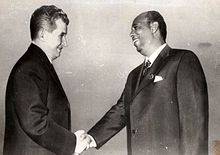 ](http://en.wikipedia.org/wiki/File:Muhammad_Siad_Barre_-_40866X9X9.jpg)
Barre withNicolae Ceaușescu in 1976

Styled the "Victorious Leader" (Guulwade), Siad Barre fostered the growth of a personality cult. Portraits of him in the company of Marx and Lenin lined the streets on public occasions.[14] He advocated a form of scientific socialism based on the Qur'an and Marx, with heavy influences of Somali nationalism.
Supreme Revolutionary Council:{:(style="margin-right:0px;margin-left:0px"):}:[edit:{]}:
The Supreme Revolutionary Council established large-scale public works programs and successfully implemented an urban and rural literacy campaign, which helped dramatically increase the literacy rate. In addition to a nationalization program of industry and land, the new regime's foreign policy placed an emphasis on Somalia's traditional and religious links with the Arab world, eventually joining the Arab League (AL) in 1974.[7] That same year, Barre also served as chairman of the Organization of African Unity (OAU), the predecessor of the African Union (AU).[15]
In July 1976, Barre's SRC disbanded itself and established in its place the Somali Revolutionary Socialist Party (SRSP), a one-party government based on scientific socialism and Islamic tenets. The SRSP was an attempt to reconcile the official state ideology with the official state religion by adapting Marxist precepts to local circumstances. Emphasis was placed on the Muslim principles of social progress, equality and justice, which the government argued formed the core of scientific socialism and its own accent on self-sufficiency, public participation and popular control, as well as direct ownership of the means of production. While the SRSP encouraged private investment on a limited scale, the administration's overall direction was essentially communist.[13]
A new constitution was promulgated in 1979 under which elections for a People's Assembly were held. However, Barre's Somali Revolutionary Socialist Party politburo continued to rule.[11] In October 1980, the SRSP was disbanded, and the Supreme Revolutionary Council was re-established in its place.[13]
Language and anti-clanism:{:(style="margin-right:0px;margin-left:0px"):}:[edit:{]}:
One of the first and principal objectives of the revolutionary regime was the adoption of a standard national writing system. Shortly after coming to power, Barre introduced the Somali language (Af Soomaali) as the official language of education, and selected the modified Latin script developed by the Somali linguist Shire Jama Ahmed as the nation's standard orthography. From then on, all education in government schools had to be conducted in Somali, and in 1972, all government employees were ordered to learn to read and write Somali within six months. The reason given for this was to decrease a growing rift between those who spoke the colonial languages, and those who did not, as many of the high ranking positions in the former government were given to people who spoke either Italian or English.
Additionally, Barre also sought to eradicate the importance of clan (qabil) affiliation within government and civil society. The inevitable first question that Somalis asked one another when they met was, 'What is your clan?'. When this was considered anathema to the purpose of a modern state, Somalis began to pointedly ask, 'What is your ex-clan?'. Barre outlawed this question and a broad range of other activities classified as clanism. Informers reported qabilists to the government, leading to arrests and imprisonment.
On a more symbolic level Barre had repeated a number of times, 'Whom do you know? is changed to: What do you know?', and this incantation became part of a popular street song.[16]
Nationalism and Greater Somalia:{:(style="margin-right:0px;margin-left:0px"):}:[edit:{]}:
Barre advocated the concept of a Greater Somalia (Soomaaliweyn), which refers to those regions in the Horn of Africa in which ethnic Somalis reside and have historically represented the predominant population. Greater Somalia thus encompasses Somalia, the republic of Djibouti, the Ogaden (in modern day Ethiopia) and the North Eastern Province (in Kenya) i.e. the almost exclusively Somali-inhabited regions of the Horn of Africa.[17][18][19] In July 1977, the Ogaden War broke out after the government sought to incorporate the various Somali-inhabited territories of the region into a Greater Somalia. The Somali national army invaded the Ogaden and was successful at first, capturing most of the territory. The invasion reached an abrupt end with the Soviet Union's shift of support to Ethiopia, followed by almost the entire communist world siding with the latter. The Soviets halted their previous supplies to Barre's regime and increased the distribution of aid, weapons, and training to the Ethiopian government, and also brought in around 15,000 Cuban troops to assist the Ethiopian regime. In 1978, the Somali troops were ultimately pushed out of the Ogaden.
Foreign relations:{:(style="margin-right:0px;margin-left:0px"):}:[edit:{]}:
Control of Somalia was of great interest to both the Soviet Union and the United States due to the country's strategic location at the mouth of the Red Sea. After the Soviets broke with Barre in the late 1970s, he subsequently expelled all Soviet advisers, tore up his friendship treaty with the Soviet Union, and switched allegiance to the West. The United States stepped in and until 1989, was a strong supporter of the Barre government for whom it provided approximately US$100 million per year in economic and military aid.
On October 17 and October 18, 1977, a Popular Front for the Liberation of Palestine (PFLP) group hijacked Lufthansa Flight 181 to Mogadishu, Somalia, holding 86 hostages. West German Chancellor Helmut Schmidtand Barre negotiated a deal to allow a GSG 9 anti-terrorist unit into Mogadishu to free the hostages.
Domestic programs:{:(style="margin-right:0px;margin-left:0px"):}:[edit:{]}:
During the first five years Barre's government set up several cooperative farms and factories of mass production such as mills, sugar cane processing facilities in Jowhar and Afgooye, and a meat processing house inKismayo.
Another public project initiated by the government was the Shalanbood Sanddune Stoppage. From 1971 onwards, a massive tree-planting campaign on a nationwide scale was introduced by Barre's administration to halt the advance of thousands of acres of wind-driven sand dunes that threatened to engulf towns, roads and farm land.[20] By 1988, 265 hectares of a projected 336 hectares had been treated, with 39 range reserve sites and 36 forestry plantation sites established.[21]
Between 1974 and 1975, a major drought referred to as the Abaartii Dabadheer ("The Lingering Drought") occurred in the northern regions of Somalia. The Soviet Union, which at the time maintained strategic relations with the Barre government, airlifted some 90,000 people from the devastated regions of Hobyo and Caynaba. New settlements of small villages were created in the Jubbada Hoose (Lower Jubba) and Jubbada Dhexe(Middle Jubba) regions. These new settlements were known as the Danwadaagaha or "Collective Settlements". The transplanted families were introduced to farming and fishing, a change from their traditional pastoralist lifestyle of livestock herding. Other such resettlement programs were also introduced as part of Barre's effort to undercut clan solidarity by dispersing nomads and moving them away from clan-controlled land.
Economic policies:{:(style="margin-right:0px;margin-left:0px"):}:[edit:{]}:
As part of Barre's socialist policies, major industries and farms were nationalised, including banks, insurance companies and oil distribution farms.
By the mid-to-late-1970s, public discontent with the Barre regime was increasing, largely due to corruption among government officials as well as poor economic performance. The Ogaden War had also weakened the Somali army substantially and military spending had crippled the economy. Foreign debt increased faster than export earnings, and by the end of the decade, Somalia's debt of 4 billion shillings equalled the earnings from seventy-five years' worth of banana exports.[14]
By 1978, manufactured goods exports were almost non-existent, and with the lost support of the Soviet Union the Barre government signed a structural adjustment agreement with the International Monetary Fund (IMF) during the early 1980s. This included the abolishment of some government monopolies and increased public investment. This and a second agreement were both cancelled by the mid-1980s, as the Somali army refused to accept a proposed 60 percent cut in military spending. New agreements were made with the Paris Club, the International Development Association and the IMF during the second half of the 1980s. This ultimately failed to improve the economy which deteriorated rapidly in 1989 and 1990, and resulted in nationwide commodity shortages.
Car collision:{:(style="margin-right:0px;margin-left:0px"):}:[edit:{]}:
In May 1986, President Barre suffered serious injuries in a life-threatening automobile collision near Mogadishu, when the car that was transporting him smashed into the back of a bus during a heavy rainstorm.[22] He was treated in a hospital in Saudi Arabia for head injuries, broken ribs and shock over a period of a month.[23][24] Lieutenant General Mohamed Ali Samatar, then Vice President, subsequently served as de facto head of state for the next several months. Although Barre managed to recover enough to present himself as the sole presidential candidate for re-election over a term of seven years on December 23, 1986, his poor health and advanced age led to speculation about who would succeed him in power. Possible contenders included his son-in-law General Ahmed Suleiman Abdille, who was at the time the Minister of the Interior, in addition to Barre's Vice President Lt. Gen. Samatar.[22][23]
Human rights abuse allegations:{:(style="margin-right:0px;margin-left:0px"):}:[edit:{]}:
Part of Barre's time in power was characterized by oppressive dictatorial rule, including allegations of persecution, jailing and torture of political opponents and dissidents. The United Nations Development Programmestated that "the 21-year regime of Siyad Barre had one of the worst human rights records in Africa."[25] The Africa Watch Committee wrote in a report that "both the urban population and nomads living in the countryside [were] subjected to summary killings, arbitrary arrest, detention in squalid conditions, torture, rape, crippling constraints on freedom of movement and expression and a pattern of psychological intimidation."[26] Amnesty International went on to report that torture methods committed by Barre's National Security Service (NSS) included executions and "beatings while tied in a contorted position, electric shocks, rape of woman prisoners, simulated executions and death threats." [27]
In September 1970, the government introduced the National Security Law No. 54, which granted the NSS the power to arrest and detain indefinitely those who expressed critical views of the government, without ever being brought to trial. It further gave the NSS the power to arrest without a warrant anyone suspected of a crime involving "national security". Article 1 of the law prohibited "acts against the independence, unity or security of the State", and capital punishment was mandatory for anyone convicted of such acts.[28]
From the late 1970s, and onwards Barre faced a shrinking popularity and increased domestic resistance. In response, Barre's elite unit, the Red Berets (Duub Cas), and the paramilitary unit called the Victory Pioneerscarried out systematic terror against the Majeerteen, Hawiye, and Isaaq clans.[29] The Red Berets systematically smashed water reservoirs to deny water to the Majeerteen and Isaaq clans and their herds. More than 2,000 members of the Majeerteen clan died of thirst, and an estimated 5,000 Isaaq were killed by the government. Members of the Victory Pioneers also raped large numbers of Majeerteen and Isaaq women, and more than 300,000 Isaaq members fled to Ethiopia.[30][31]
Rebellion and ouster:{:(style="margin-right:0px;margin-left:0px"):}:[edit:{]}:
After fallout from the unsuccessful Ogaden campaign, Barre's administration began arresting government and military officials under suspicion of participation in an abortive 1978 coup d'état.[32][33] Most of the people who had allegedly helped plot the putsch were summarily executed.[34] However, several officials managed to escape abroad and started to form the first of various dissident groups dedicated to ousting Barre's regime by force.[35]
A new constitution was promulgated in 1979 under which elections for a People's Assembly were held. However, Barre's Somali Revolutionary Socialist Party politburo continued to rule.[11] In October 1980, the SRSP was disbanded, and the Supreme Revolutionary Council was re-established in its place.[13] By that time, the moral authority of Barre's ruling Supreme Revolutionary Council had begun to weaken. Many Somalis were becoming disillusioned with life under military dictatorship. The regime was further weakened in the 1980s as the Cold War drew to a close and Somalia's strategic importance was diminished. The government became increasingly totalitarian, and resistance movements, supported by Ethiopia's communist Derg administration, sprang up across the country. This eventually led in 1991 to the outbreak of the civil war, the toppling of Barre's regime and the disbandment of the Somali National Army (SNA). Among the militia groups that led the rebellion were the Somali Salvation Democratic Front (SSDF), United Somali Congress (USC), Somali National Movement (SNM) and the Somali Patriotic Movement (SPM), together with the non-violent political oppositions of the Somali Democratic Movement (SDM), the Somali Democratic Alliance (SDA) and the Somali Manifesto Group (SMG).
Many of the opposition groups subsequently began competing for influence in the power vacuum that followed the ouster of Barre's regime. In the south, armed factions led by USC commanders General Mohamed Farah Aidid and Ali Mahdi Mohamed, in particular, clashed as each sought to exert authority over the capital.[36]
Death:{:(style="margin-right:0px;margin-left:0px"):}:[edit:{]}:
After leaving Mogadishu in January 1991, Barre temporarily remained in the southwestern Gedo region of the country, which was the power base of his Marehan clan. From there, he launched a military campaign to return to power. He twice attempted to retake Mogadishu, but in May 1991 was overwhelmed by General Mohamed Farrah Aidid's army, and was forced into exile.
Barre initially moved to Nairobi, Kenya, but opposition groups with a presence there protested his arrival and support of him by the Kenyan government. In response to the pressure and hostilities, he moved two weeks later to Nigeria. Barre died on January 2, 1995 in Lagos from a heart attack. He was buried in the Garbahaarreey district of the Gedo region in Somalia.