rogers, ed B G R
prev just lumped into bgr, but too interesting
atwater
drucker
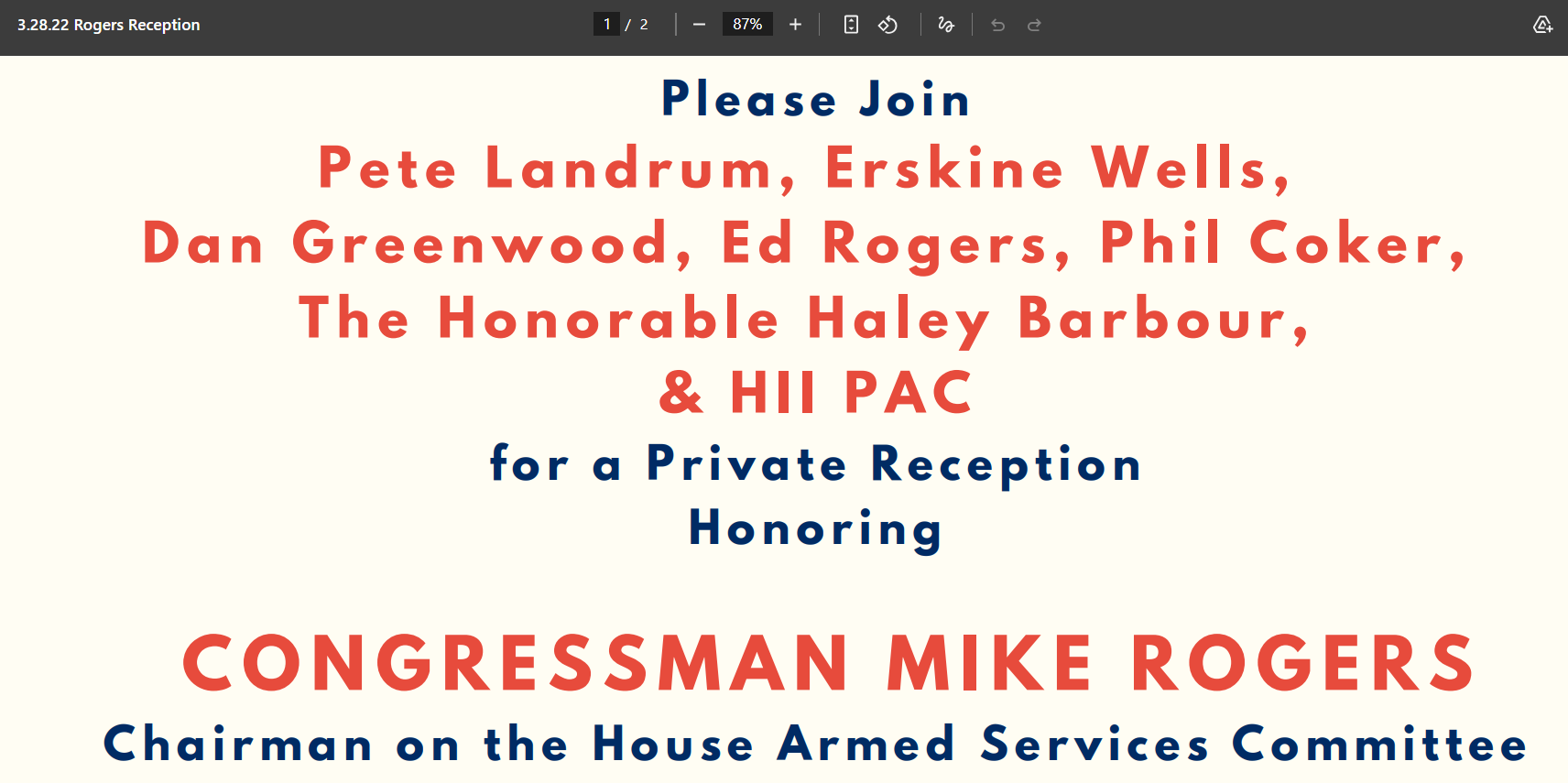
Paid for by Mike Rogers Victory, a joint fundraising committee authorized by and composed of Mike Rogers for Congress, American Security PAC, and NRCC. P.O. Box 131428, Birmingham, AL 35213
https://www.mediamatters.org/washington-post/wash-post-sidelines-contributing-opinion-writer-and-megalobbyist-ed-rogers-ahead
https://www.mediamatters.org/washington-post/wash-post-sidelines-contributing-opinion-writer-and-megalobbyist-ed-rogers-ahead
10/11/19
==
omg wapo==
Washington Post repeatedly allowed Hugh Hewitt to write columns praising Environmental Protection Agency (EPA) Administrator Scott Pruitt without disclosing that Hewitt’s law firm does work before the agency. Washington Post Editorial Page Editor Fred Hiatt told Media Matters that Hewitt would no longer write about Pruitt.
Hewitt is a conservative radio host who also works as a host for MSNBC and a contributing columnist for The Washington Post. Off air, he is a partner at the law firmLarson O’Brien.
That
law firm position presents numerous potential and real conflicts of
interest for Hewitt’s media roles. Larson O’Brien stated in a May 5,
2017, press release that
the firm will be opening a Washington D.C. office and “is currently
representing clients before the US Department of Justice, the Securities
and Exchange Commission, and the Environmental Protection Agency.” The
press release touted Hewitt’s relocation to the Washington area as a
reason for the firm to “have a permanent presence in the District”:
:{Larson O’Brien is
currently representing clients before the US Department of Justice, the
Securities and Exchange Commission, and the Environmental Protection
Agency.}:
Larson O’Brien partner Hugh Hewitt recently relocated to
the Washington area where he hosts an award winning radio show during
the morning drive-time hours. “With Hugh moving to Washington and our
significant client work in the Capital, it made sense for us to have a
permanent presence in the District,” said Stephen Larson.
Politicoreported on
May 7 that Hewitt brokered a meeting between Pruitt and lawyers at
Larson O’Brien concerning efforts of the firm’s client Orange County
Water District to get the EPA to devote resources to cleaning up a
polluted site in the district. From the report, which is based on
“emails released by EPA under a Freedom of Information Act lawsuit by
the Sierra Club”:
:{Hewitt, a resident of Orange County
whose son James works in EPA’s press office, emailed Pruitt in September
to set up a meeting between the administrator and the law firm Larson
O’Brien, which employs Hewitt and represents the Orange County Water
District. Pruitt had been planning to meet with the lawyers in }:
California a month earlier, but cancelled the trip to undergo knee
surgery.
“I’ll join if the Administrator would like me too or can
catch up later at a dinner,” Hewitt wrote in his Sept. 18 message.
Hewitt added that the issues surrounding the Superfund site were “Greek to me but a big deal in my home county.”
Pruitt’s aides responded within minutes and quickly confirmed an Oct. 18 meeting for the lawyers and a project director.
:{Six
weeks after that meeting, on Dec. 8, the Orange County North Basin site
appeared on Pruitt’s list of 21 contaminated areas to address. A month
later, Pruitt proposed listing the site on EPA’s National Priorities
List, a move that could make it eligible for long-term federal cleanup
funding from the federal government if the responsible polluters cannot
be identified and forced to pay for its remediation.}:
Politico noted that Hewitt has been a vocal defender of Pruitt on MSNBC. Several journalists have criticized MSNBC for the blatant conflict of interest; The New York Times’ Michael Barbarotweeted:
“Um, it's not okay for a cable news contributor to ask the EPA
administrator for favors like this and still be on TV talking about him.
At. All. CC: @MSNBC.”
Hewitt’s conflict of interest problem has also extended to The Washington Post, which repeatedly allowed Hewitt to praise the EPA and Pruitt in opinion columns for the paper.
:{Hewitt himself referenced his work on issues related to the EPA in the Post.
On January 4, 2017, he wrote: “I’ve worked for real estate developers
on huge projects for three decades. My law practice was built on helping
them figure out and comply with complex statutory and regulatory
regimes and knowing how the Environmental Protection Agency, Army Corps
of Engineers and U.S. Fish and Wildlife Service worked.”}:
The following are instances in which the Postallowed Hewitt to discuss the EPA without disclosing his conflict of interest:
- On January 19, 2017, Hewitt praised President Donald Trump’s nomination of Pruitt, writing, “Discount the rhetoric. ... Pruitt’s not a ‘climate denier.’”
- :{On March 1, 2017, Hewitt wrote:
“Trump’s repeated calls in many places for regulatory reform had been
foreshadowed earlier Tuesday with an executive order directing the
Environmental Protection Agency and its new and very able director,
Scott Pruitt, to move quickly to roll back the ruinous, overreaching
‘Waters of the United States’ rule of the Obama years.”}:
- On July 4, Hewitt wrote that Pruitt has become one of “the domestic policy stars of the Trump administration.”
- :{On August 19, Hewitt called Pruitt
and several other Trump administration officials “committed reformers”
who “are in strong and stable positions now as staffing of political
appointees accelerates.”}:
- On September 19, Hewitt praised the Trump administration and Pruitt for “pursuing ambitious and much-needed rollback agendas.”
- :{On February 22, Hewitt wrote:
“The United States is out of the one-sided Paris accord while open to
steps toward genuine protection of the climate. The EPA is refining its
rulemaking process in ways that rule-of-law conservatives hope will
conform the agency’s new rules to the designs and ends Congress intended
for them, reversing the warped power grabs of the administrative state
they had become.”}:
The Post did not disclose that
Hewitt’s firm works on issues related to EPA regulations in those
pieces. The paper has also not been consistent in disclosing that
Hewitt’s son works for the EPA. According to his LinkedIn page, James
Hewittjoined the agency in July 2017. Hewitt's July 4 and September 19 columns disclosed that connection while his August 19 and February 22 columns did not.
In an email to Media Matters, Editorial
Page Editor Fred Hiatt wrote: “I was disturbed to learn this morning
that Hugh Hewitt had intervened with EPA administrator Scott Pruitt on
behalf of Hewitt’s law firm as he was writing about Pruitt in a column
for The Washington Post. Hewitt, who has not written about Pruitt since
September, has agreed not to write about him going forward and has
assured us that similar incidents won’t occur in the future.”
The Washington Post also employs megalobbyist Ed Rogers as a contributor despite countless conflicts of interest relating to Roger’s lobbying firm. Over the years, the Posthas repeatedly allowed Rogers to tout his clients’ interests without disclosure.
==
http://ecowatch.com/2015/12/22/wash-post-ed-rogers/
In his latest column repeating his clients’ attacks on climate change policies, lobbyist and Washington Post writer Ed Rogersfinally disclosed to readers that his lobbying firm “represents interests in the fossil fuel [industry].”
Rogers is the chairman of BGR Group, a top lobbying firm that has received more than $700,000 from the energy industry in 2015. Rogers has personally lobbied this year for Southern Company, one of the largest electric utility companies in the U.S.—and one of the biggest opponents of the most significant U.S. policy to combat climate change.
Rogers’ disclosure, which was placed in a parenthetical in the middle of his Dec. 17 column, could help Post readers recognize that they should take his opinions on the United Nations’ historic Paris climate agreement with a grain of salt (he says it’s a “sham”). And it marks a stark contrast from Rogers’ past columns, in which the Post allowed him to dismiss the scientific consensus on climate change and echo his client’s attacks on climate policies without disclosing his firm’s fossil fuel ties.
The Post’s past failure to require Rogers to disclose his lobbying firm’s clients—both fossil fuel and otherwise—drew criticism from media ethicists. Among them was Ed Wasserman, dean of the Graduate School of Journalism at the University of California, Berkeley, who said it’s clear that “someone else is paying” Rogers to write his columns and urged the Post to provide “specific disclosure” of Rogers’ clients rather than a “blanket description of him as a lobbyist,” in order to make plain that he “has a horse to back” in his columns.
From Rogers’ Dec. 17 column for The Washington Post’s Post Partisan blog (emphasis added):
“The [Conference of Parties] 21 conference in Paris was the most predictable event of 2015. Of course an agreement was going to be reached and of course that agreement is a sham, but it all fits perfectly with what the climate issue has become.The topic of climate change has become manna for exhausted liberals who have nothing much to say and policy failures on almost every front. (Disclosure: My firm represents interests in the fossil fuel and nuclear power industries.)And let’s face it, global warming is an issue that perfectly suits Obama as he warms up for retirement. He doesn’t really have to do anything, there is never any day of reckoning and it lends itself to sanctimonious moralizing and generally lecturing everybody about how they should live.”
==
Mr. Rogers, the vice chairman who was a deputy assistant to the first President Bush and anexecutive assistant to the White House chief of staff, [b1]is also vice chairman of Barbour Griffith & Rogers, one of the best-connected Republican lobbying firms in the capital. Mr. Rogers founded it in 1991 with Haley Barbour, who became chairman of the Republican National Committee and is now running for governor of Mississippi.
Shortly after leaving the White House, Mr. Rogers was publicly rebuked by the first President Bush after he signed a $600,000 contract to represent a Saudi, Sheik Kamal Adham, who was a main figure under scrutiny in a case that involved the Bank of Commerce and Credit International. Mr. Rogers canceled his contract to represent the sheik, former head of Saudi intelligence.
==
--
http://www.post-gazette.com/news/nation/2015/08/17/BGR-Group-morphed-into-GOP-force-with-bridge-to-Democrats/stories/201508170009
Big lobbyist morphed into GOP force with bridge to Democrats
August 17, 2015 12:00 AM
By Rich Lord / Pittsburgh Post-Gazette
The day after this month’s Republican presidential debate, a top lobbyist opined in The Washington Post that Donald Trump was “wearing thin” and “a blackmailer” who is “all about himself.”
That lobbyist, Ed Rogers, and his colleagues have reason to hope that’s true. Their firm, BGR Group, has ties to current or former Republican governors who make up eight of the other 16 candidates. Traditionally a GOP firm, BGR even has built a bridge to Democratic front-runner Hillary Rodham Clinton.
BGR, founded by former Mississippi Gov. Haley Barbour, was once the epitome of the partisan lobbying shop, in which political and governmental veterans worked their party pals in officialdom to keep abreast of — and influence — decisions, all on behalf of clients.
In recent years it has morphed into a multi-pronged political powerhouse that raises money for numerous candidates in the same race, embeds its members in their super PACs, uses the resulting access for clients across the globe and even has a voice in the media.
This year, BGR’s employees or close associates have been involved with the presidential campaigns of three former governors — Jeb Bush of Florida, Rick Perry of Texas and Scott Walker of Wisconsin — and they have ties to Govs. Chris Christie of New Jersey and Bobby Jindal of Louisiana. The firm also has a representative in Ms. Clinton’s inner fundraising circle.
“Political activity by lobbyists in D.C. [or Harrisburg] is nothing new,” BGR’s government affairs principal, Loren Monroe, wrote in a brief email response to seven questions. He declined an interview request.
“That firm in and of itself is unusual because of those high-level connections, with a former governor heading up the firm,” said Timothy LaPira, an assistant professor at James Madison University, who has written extensively about lobbying.
He said the fundraisers held in the firm’s office and the deployment of lobbyists to super PACs are not “signaling that this firm is endorsing any given candidate at this point. They’re simply getting in under the door with numerous of the candidates. … They’re more or less hedging their bets.”
Barbour knows the ropes
It’s doubtful that anyone knows how governors interact with lobbyists better than Mr. Barbour.
He went from political operative to White House aide to lobbyist to chair of the Republican National Committee to two-term governor and, briefly, in 2011, to presidential contender. He rejoined BGR — for Barbour, (Lanny) Griffith and Rogers — in 2012, a year after he finished a term at the helm of the Republican Governors Association, or RGA.
Mr. Barbour, like any good lobbyist, “uses every connection he has,” said Heath Brown, an assistant professor of public policy at the City University of New York and author of the 2012 book “Lobbying the New President.”
“Haley Barbour is also very smart about who has won presidential campaigns in the past, and we know governors have been successful in lots of recent presidential campaigns.”
The firm’s chits to governors go far beyond the $87,800 it has donated to the RGA since 2011. Even as it sells its access to officials, it lends to candidates its access to the people who donate to campaigns.
BGR’s government affairs president, Bob Wood, “is a ‘raiser,’ ” an RGA executive wrote in a 2009 memo to Bob McDonnell, who was then running for governor of Virginia, “and can be very helpful in setting up meetings with his clients.” Mr. McDonnell won the race, and went on to chair the RGA starting in 2011.
McDonnell’s attorney, Noel J. Francisco, declined to make the former governor available to talk about BGR and the RGA. McDonnell is appealing a conviction and two-year prison sentence on federal corruption charges related to favors done for, and gifts received from, former Star Scientific CEO Jonnie Williams.
Contributions, questions
In July 2010, Mr. Christie and BGR hosted a Washington, D.C., fundraiser for the New Jersey Republican State Committee. A BGR client, AmgenInc., co-hosted the event, which aimed to raise around $45,000, according to documents obtained by the Pittsburgh Post-Gazette.
Mr. Rogers hosted a fundraiser for Mr. Christie in 2013, and BGR hosted another such event for him four months ago, according to NJ Advance Media, a newspaper chain.
“The employees of BGR, a bipartisan government and public relations firm, are welcome to participate in political activity on their own time with candidates they support,” wrote Mr. Monroe, the BGR government affairs principal.
Mr. Christie’s ties to BGR and the RGA drew scrutiny in 2012 and 2013 after a BGR client, Ashbritt Inc., got an emergency contract to remove debris after Hurricane Sandy. Ashbritt has also been a regular donor to both the RGA — including a $50,000 contribution a week after the hurricane — and the Democratic Governors Association.
“The state could’ve made that decision for very legitimate reasons,” said Larry Noble, senior counsel at the Campaign Legal Center who was formerly the top lawyer for the Federal Election Commission. “But when you mix in the political contributions it throws the whole thing into question.”
Embedded lobbyists
Sometimes BGR’s lobbyists take their talents as “raisers” and embed within campaigns or super PACs, including that of the Democratic front-runner.
Jonathan Mantz, one of a handful of Democratic principals at BGR, was the national finance director for Ms. Clinton’s 2008 campaign, and is now involved with her super PAC, called Priorities USA Action. He’s also on the finance committee of the Democratic Governors Association.
The diversification of BGR — which was a strictly Republican firm from 1987 until 2007 — reflects industry trends.
Lobbying firms “first and foremost are not ideologues,” Mr. Brown, the public policy professor, said. “For that reason, we see them spreading the money around, to Democrats and Republicans, and spreading the money around to different people in the same races.”
Recent Supreme Court decisions have made that much easier. A 2010 ruling set the stage for super PACs, a form of political action committee that can raise unlimited dollars from corporations, unions, associations and individuals, and spend them to help or hurt candidates.
“In theory, the super PACs are supposed to be independent of the candidates, but they’re not,” Mr. Noble said. “So what you have is a way for lobbyists and candidates to stay technically separate from each other, when actually they are not.”
Mr. Griffith, BGR’s CEO, is helping to raise money forRight to Rise, a super PAC backing Mr. Bush,on whose transition team the lobbyist served in 1998. Mr. Griffith is a longtime family friend. He served in George H.W. Bush’s administration and was a finance committee member for George W. Bush’s 2004 re-election bid, even while working at BGR.
According to Politico, BGR’s Mr. Wood in February helped introduce D.C. cognoscenti to Mr. Walker and his new super PAC, called Our American Revival. Two of Mr. Barbour’s nephews have been associated with Mr. Perry’s campaign, including Austin Barbour, who runs the former Texas governor’s super PACs.
“By helping fund these outside groups, they’re making connections that they could cash in on down the road," according to Chris Gates, president of the Sunlight Foundation, which tracks political fundraisers. The result: “The balance of power has shifted in favor of those who can open doors and write big checks.”
None of the campaigns responded to request for comment.
“When somebody wants to meet with the administration,” Mr. Noble said, “the administration is very aware of who their big supporters were, and it will get you in the door.”
A partisan platform
The firm’s “in” with Mrs. Clinton hasn’t spared her in Mr. Rogers’ column. For instance, he called her answers to questions about her handling of email as secretary of state “stale, musty and downright Clinton-esque.”
Mr. Rogers’ columns appear in The Washington Post’s PostPartisan blog. In recent months he has been the only contributor there who is not on the newspaper’s staff, other than left-leaning columnist E.J. Dionne Jr., of the Brookings Institution.
“Come to think of it, there are really not that many lobbyists who have that level of prominence in a public forum,” said Lee Drutman, a senior fellow with the reform group New America, and author of the book “The Business of America is Lobbying.” “Usually they have to work behind the scenes.”
Mr. Rogers is upfront about his GOP affiliation, and his role in BGR is disclosed in every column. Republicans — with exceptions including Mr. Trump and Rick Santorum, a former U.S. senator from Penn Hills — have generally gotten better reviews than Ms. Clinton (see chart).
“I doubt that he would ever pen anything that would hurt his potential to recruit future candidates,” said Mr. LaPira. “He’s representing the party orthodoxy and the party mainstream. He’s going to criticize … outsiders. He doesn’t win if Trump becomes the nominee.”
Rich Lord: rlord@post-gazette.com or 412-263-1542. Twitter@richelord.
==
==
LI BS
Ed Rogers has been involved in political campaigns, lobbying initiatives, private commercial transactions and various legal, media and market access challenges in the U.S. and in various international markets since the mid-‘90s. He regularly assembles teams of lobbyists, lawyers, PR specialists, investment professionals and private investigators to secure opportunities, solve problems, manage adversarial situations and achieve positive results for clients.
Prior to co-founding BGR Group in 1991, Ed served in the White House as Deputy Assistant to the President and Executive Assistant to the Chief of Staff.Ed also served as Senior Deputy to Bush-Quayle Campaign Manager Lee Atwater from 1987 through the general election in 1988.
From 1985 through February of 1987, Ed worked in the Reagan White House in the Office of Political Affairs, where he served as Haley Barbour’s deputyas Special Assistant to the President and Deputy Director of the Office of Political Affairs.
Since 2011, Ed has been an opinion writer for the Washington Post, where he writes about politics and the current state of affairs in Washington, D.C., from a Republican point of view.
He is a life member of the Council on Foreign Relations. He is a member of the International Council of the Belfer Center for Science and International Affairs at the Kennedy School of Government at Harvard University and he serves on the Board of Advisors of the Center for a New American Security (CNAS). Ed is a member of the advisory board of the 100,000 Strong Foundation, which was established by the U.S. State Department in 2012 to help answer President Barack Obama’s call to deepen Americans’ understanding of China.
Ed received hisJD from the University of Alabama, where he serves on the President’s Cabinet and is a visiting professor. He is a member of the Alabama & Washington D.C. Bar.
Ed, his wife Patti, and two of their children reside in McLean, Va.
Experience
Chairman
BGR Group
1991 – Present (24 years)Washington D.C. Metro Area
Education
University of Alabama
University of Alabama
J.D.
Activities and Societies: Member of Alabama Bar Association, Member of Washington D.C. Bar Association
scrape:
Lanny Griffith
Chief Executive Officer at BGR Group
Robert Wood
Robert Wood
President, BGR Group
Darby Bukowski
Darby Bukowski
Jonathan Mantz
Jonathan Mantz
Principal at BGR Group
Loren Monroe
Loren Monroe
COO at BGR
William Crozer
William Crozer
Policy Analyst at BGR Group
Josh Lamel
Josh Lamel
Vice President, BGR Group
Dave Boyer
Dave Boyer
Principal at BGR Group
Erskine Wells
Erskine Wells
Principal at BGR Group
Maya Seiden
Mr. Rogers, the vice chairman who was a deputy assistant to the first President Bush and an executive assistant to the White House chief of staff, is also vice chairman of Barbour Griffith & Rogers, one of the best-connected Republican lobbying firms in the capital. Mr. Rogers founded it in 1991 with Haley Barbour, who became chairman of the Republican National Committee and is now running for governor of Mississippi.
Shortly after leaving the White House, Mr. Rogers was publicly rebuked by the first President Bush after he signed a $600,000 contract to represent a Saudi, Sheik Kamal Adham, who was a main figure under scrutiny in a case that involved the Bank of Commerce and Credit International. Mr. Rogers canceled his contract to represent the sheik,former head of Saudi intelligence.
==