Weather Chaos 2 Bak
---
GLOBWEIRD224
an 224 spate
two only
---
GLOBWEIRD224
1219
see global weirding for earlier
NO MERRI
SEE 1.5 OVERSHOOT
SEE GLOBAL WARMING 4
see jet stream arctic
see EJ
see hurricane
see flood sea level rise
see heat/drought wildfire
BAK 2 24 CAPT 2
---
---
---
an 224 spate
Antarctic tipping point that occurred 8,000 years ago 'could happen again' - Alternet.org
thom 3 wisc winter hurric
Category 6? Scientists highlight 'growing inadequacy' of current hurricane scale - Alternet.org
---
---
10 23 cyclone in yemen 2nd in hist?
---
Rare ‘flesh-eating’ bacterium spreads north as oceans warm - Alternet.org
---
---
fox BS lomborg/shill, etc
https://www.mediamatters.org/tucker-carlson/tucker-carlson-says-its-factually-untrue-climate-change-impacts-hurricane-season
---
Extreme weather could burn many investment portfolios by mid-century - Alternet.org
---
an 8 23
David Stanway
SINGAPORE (Reuters) -Human-induced climate change has played an "absolutely overwhelming" role in the extreme heatwaves that have swept across North America, Europe and China this month, according to an assessment by scientists published on Tuesday.
Throughout July, extreme weather has caused havoc across the planet, with temperatures breaking records in China, the United States and southern Europe, sparking forest fires, water shortages and a rise in heat-related hospital admissions.
Over the weekend, thousands of tourists were evacuated from the Greek island of Rhodes to escape wildfires caused by a record-breaking heatwave.
Without human-induced climate change, the events this month would have been "extremely rare", according to a study by World Weather Attribution, a global team of scientists that examines the role played by climate change in extreme weather.
"European and North American temperatures would have been virtually impossible without the effects of climate change," said Izidine Pinto of the Royal Netherlands Meteorological Institute, one of the study's authors, during a briefing with journalists."In China it was around 50 times more likely to happen compared to the past."
The World Weather Attribution team estimated that risinggreenhouse gas concentrations made the European heatwave 2.5 Celsius (4.5 Fahrenheit) hotter than it would otherwise have been. They also drove up the North American heatwave by 2C and the one in China by 1C.
As well as directly impacting human health, the heat has caused large-scale crop damage and livestock losses, the scientists said, with U.S. corn and soybean crops, Mexican cattle, southern European olives as well as Chinese cotton all severely affected.
El Nino probably contributed to the additional heat in some regions, but rising greenhouse gases were the major factor, the scientists said, and heatwaves will become increasingly likely if emissions are not slashed.
They estimated that prolonged periods of extreme heat were likely to hit every two to five years if average global temperatures rise 2C above pre-industrial levels. Average temperatures are currently estimated to have risen more than 1.1C.
"The events we have looked at are not rare in today's climate," said Friederike Otto, a scientist with the Grantham Institute for Climate Change in London, speaking at the briefing. "It's not surprising from a climatological point of view, that these events are happening at the same time."
"As long as we keep burning fossil fuels we will see more and more of these extremes," she said. "I don't think there's any stronger evidence that any science has ever presented for a scientific question."
---
more heat dome, greece FIRES US midwest
jeff goodell bk kpfa 7/26/23 upfront hotter water quickly loses O2 see salmon
---
TIPPING POINT
https://www.alternet.org/ocean-temps/
100 degree fla, coral bleach
https://www.alternet.org/weve-fallen-off-a-cliff/
no lnx twt an 7 23
'We’ve fallen off a cliff': Scientists warn Atlantic currents could collapse as early as 2025
Brett Wilkinsand Common DreamsJuly 26, 2023
"It is very plausible that we've fallen off a cliff already and don't know it," said one researcher.
The system of Atlantic Ocean currents that drive warm water from the tropics toward Europe is at risk of collapsing in the coming decades, an analysis of 150 years of temperature data published Tuesday concluded.
"The Atlantic Meridional Overturning Circulation (AMOC), which includes the Gulf Stream, is a major tipping element in the climate system and a future collapse would have severe impacts on the climate in the North Atlantic region," states the study, which was published in the scientific journal Nature Communications.
Although the analysis notes that "assessments by the Intergovernmental Panel on Climate Change (IPCC), based on the Climate Model Intercomparison Project (CMIP) model simulations suggest that a full collapse is unlikely within the 21st century," the study's authors "estimate a collapse of the AMOC to occur around mid-century under the current scenario of future emissions."
"We show that a transition of the AMOC is most likely to occur around 2025-2095," the paper states with "95% confidence."
University of Copenhagen professor Peter Ditlevsen, who led the study, told The Guardian: "I think we should be very worried. This would be a very, very large change. The AMOC has not been shut off for 12,000 years."
Bill McKibben, co-founder of the climate action group 350.org, tweeted that "Gulf Stream collapse used to be viewed as a far-off and remote possibility... Less so now."
Meteorologist and climate journalist Eric Holthaus called the study's findings "incredibly worrying."
The Washington Post reports:
The new study adds to a growing body of evidence that this crucial ocean system is in peril. Since 2004, observations from a network of ocean buoys [have shown] the AMOC getting weaker—though the limited time frame of that data set makes it hard to establish a trend. Scientists have also analyzed multiple "proxy" indicators of the current's strength, including microscopic organisms and tiny sediments from the seafloor, to show the system is in its weakest state in more than 1,000 years.
For thousands of years, the Gulf Stream has carried warm waters from the Gulf of Mexico northward along the eastern North American seaboard and across the Atlantic to Europe. As human-caused global heating melts the Greenland ice sheet, massive quantities of fresh water are released into the North Atlantic, cooling the AMOC—which delivers the bulk of the Gulf Stream's heat—toward a "tipping point" that could stop the current in its tracks.
According to The Guardian:
A collapse of AMOC would have disastrous consequences around the world, severely disrupting the rains that billions of people depend on for food in India, South America, and West Africa. It would increase storms and drop temperatures in Europe, and lead to a rising sea level on the eastern coast of North America. It would also further endanger the Amazon rainforest and Antarctic ice sheets.
"It is very plausible that we've fallen off a cliff already and don't know it," Hali Kilbourne, an associate research professor at the University of Maryland Center for Environmental Science, toldThe New York Times. "I fear, honestly, that by the time any of this is settled science, it's way too late to act."
Other studies—including one published in March and another in 2021—have also concluded that the AMOC is at risk of collapsing this century.
Meanwhile in the Southern Hemisphere, Antarctic currents that enrich 40% of Earth's deep oceans with oxygen and nutrients essential for marine life have slowed dangerously in recent decades and could also collapse by mid-century, an Australian study released in May showed.
FROM YOUR SITE ARTICLES
New evidence that an extraterrestrial collision 12,800 years ago triggered an abrupt climate change for Earth ›
What was the 'catastrophic implosion' of the Titan submersible? An expert explains ›
Atlantic Salmon Is Basically Extinct: You’re Eating a Genetically Eroded Version ›
RELATED ARTICLES AROUND THE WEB
A major Atlantic current is at a critical transition point | NOVA | PBS ›
Is Atlantic Ocean current near collapse? Could be sooner than ... ›
A Stagnant Jet Stream Is Fueling Intense Heat Worldwide. Could ... ›
---
---
food threat
https://www.alternet.org/texas-agriculture-agency-climate-change/
---
---
https://ecowatch.us7.list-manage.com/track/click?u=214ab5fbb3f6015d74ffab4ec&id=28484cd158&e=c2e8fdabfa
12 22 ecowatch https://www.ecowatch.com/bomb-cyclone-winter-storm-us.html
arctic Air Brings Dangerous Cold to U.S., Could Test Texas Grid
A bomb cyclone of Arctic air is descending on the lower 48 states, bringing with it life-threatening extreme cold, heavy snow and rain, and blizzard conditions.
The National Weather Service office in Buffalo, NY — no stranger to extreme winter weather — described it as a “once in a generation winter storm.” The coldest temperatures in decades will send wind chills as low as -70°F in eastern Wyoming and the Eastern Seaboard will likely see its coldest Christmas since Taylor Swift was born.
The extreme cold will also likely, and tragically, illustrate the heavy toll of extreme weather on people experiencing homelessness.
In addition to driving methane gas prices even higher for families across the central U.S., the cold will also likely test the Texas electrical grid, which crashed catastrophically in 2021, mostly due to failure of the methane gas system. More than 7,300 megawatts of new wind, solar, and energy storage capacity has been added to the Texas grid in the past year, and could help keep the grid stable.
Research suggests the rapidly warming Arctic appears to be playing a role in creating more opportunities for cold air to dive south.
===
===
jrnl fail: heat wave = pix of kids w/ ice cream ; weather = climate
https://www.desmog.com/2022/07/29/extreme-weather-climate-disinformation-droughts-hurricanes-floods-wildfires/
===
https://insideclimatenews.org/news/16092022/pakistan-flood-displacement/
https://insideclimatenews.org/news/16092022/scientists-say-pakistans-extreme-rains-were-intensified-by-global-warming/
https://www.alternet.org/2022/09/alaska-pounded-by-rare-typhoon/
===
{{ mma 8 22
TUCKER CARLSON (HOST): The Europeans have discovered that the real threat to human civilization is not global warming, it never was global warming. The real threat to people is global cooling, otherwise known as winter. Far more people freeze to death every year than die of heat. In 2019, for example, four times as many people died of cold as of heat. That's according to the Institute for Health Metrics and Evaluation. So when temperatures in Europe begin to drop a few months from now, this is a huge problem and that will be obvious to everyone. It's not global warming, it's global cooling. That's what's going to kill your grandmother.
:{
}:
legit src but
https://www.wral.com/study-finds-very-concerning-74-increase-in-deaths-associated-with-extreme-heat-brought-on-by-the-climate-crisis/19834115/?version=amp
:{
}:
cNN — A pair of new studies out Thursday find a "very concerning" rise in the number of climate-related deaths and paint a picture of world where people struggle with regular temperature extremes.
One of the studies finds the number of deaths caused by high temperatures increased by 74% globally between 1980 and 2016. Deaths related to extreme cold increased 31% since 1990, a new report, the first of its kind, finds.
Human-caused climate change -- generated by carbon, methane and other greenhouse gas emissions from industry, transportation, and agriculture -- has led to a "new normal" with more days of extreme temperatures than in recorded history. The studies published Thursday provide more evidence that both hot and cold extremes can be deadly.
---
...Climate change deniers will tell you that more people die of the cold than heat, so warmer winters will be a good thing. This is deeply misleading. Vulnerable people die of the cold because of poor housing and not being able to afford to heat their homes. Society, not climate, kills them.
This argument is also factually incorrect.In the US, for example, heat-related deaths are four times higher than cold-related ones.This may even be an underestimate as many heat-related deaths are recorded by cause of death such as heart failure, stroke, or respiratory failure, all of which are exacerbated by excessive heat....
https://theconversation.com/the-five-corrupt-pillars-of-climate-change-denial-122893}}
===
yikes floods AND drought and glacier water?! and nukes?! pakistan
https://www.alternet.org/2022/08/climate-dystopia-at-our-doorstep/
===
===
an 8 22 almost a foot by 2100
The fossil fuel-driven climate emergency has already locked in so much ice melt in Greenland that sea levels will surge by nearly a foot in the coming decades, peer-reviewed research published Monday warns, underscoring the need to rapidly transform virtually all aspects of the global political economy.
Even if the world stopped emitting greenhouse gases today, the Greenland ice sheet is set to lose at least3.3% of its mass, or 110 trillion tons of ice, and that will cause almost a foot in global sea-level rise (SLR), says the study, published in Nature Climate Change. The authors don't specify a time frame for the melting and SLR, though they expect much of it to happen between now and 2100.
But rather than lead to despair, this projection of inevitable damage—made by scientists based at institutions in Belgium, Denmark, Finland, Norway, the Netherlands, Switzerland, and the United States—should catalyze immediate and robust climate action, experts stress. Without it, the life-threatening situation confronting humanity is destined to grow far deadlier.
Earlier this year, the National Oceanic and Atmospheric Administration predicted that sea levels along the U.S. coastline would rise by an average of 10 to 12 inches by 2050, drastically increasing the threat of flooding in dozens of highly populated cities.
By mid-century, 150 million people worldwide could be displaced from their homes just by rising sea levels, according to some estimates. The consequences of a one-foot SLR would be especially catastrophic for developing island nations, where low elevation and high poverty combine to increase vulnerability.
These countries, which have done little to cause the climate crisis now roasting the Greenland ice sheet, lack the financial resources for adaptation and face the prospect of being wiped off the map.
"Every study has bigger numbers than the last," William Colgan, a scientist at the Geological Survey of Denmark and Greenland and co-author of the new paper, told The Washington Post. "It's always faster than forecast."
As lead author Jason Box, also from the Geological Survey of Denmark and Greenland, told the newspaper, the finding that 3.3% of Greenland's ice sheet will be gone in a matter of decades regardless of what is done to halt planet-heating pollution represents "a minimum, a lower bound."
Things are all but guaranteed to get worse if humanity continues to burn fossil fuels. Should the record-breaking ice loss that occurred in 2012 become the norm, for example, the world is likely to see around two-and-a-half feet of SLR from Greenland alone, the study says.
By the same token, each fraction of a degree of warming that is avoided makes a difference.
If Greenland's ice sheet were to disintegrate completely, sea levels would rise more than 22 feet—"enough to double the frequency of storm-surge flooding in many of the world's largest coastal cities" by the end of the century, scientists have warned, so the stakes for adequate climate action are still immense even if a certain amount of melting and SLR has been deemed irreversible.
Greenland is located in the Arctic, which has been heating up for over a century and is one of the fastest-warming regions in the world. Dangerous feedback loops are of particular concern. The replacement of reflective sea ice with dark ocean water leads to greater absorption of solar energy, and the thawing of permafrost portends the release of additional carbon dioxide and methane—both leading to accelerated temperature rise that triggers further melting, defrosting, and destabilization.
In December, researchers estimated that the Arctic has been heating up four times faster than the rest of the globe over the past three decades. Another recent study found that 2021 was the 25th consecutive year in which Greenland's ice sheet lost more mass during the melting season than it gained during the winter. Rainfall is now projected to become more common in the Arctic than snowfall decades sooner than previously expected.
This context has a direct bearing on the new paper, which contains more dire predictions than other reports relying on different assumptions.
The United Nations' Intergovernmental Panel on Climate Change (IPCC), for instance, has projected that Greenland will lose roughly 1.8% of its mass and contribute up to half a foot of SLR by 2100 if humans continue spewing large amounts of greenhouse gases into the atmosphere.
"One reason that new research appears worse than other findings may just be that it is simpler," the Postexplains. "It tries to calculate how much ice Greenland must lose as it recalibrates to a warmer climate."
"In the past, scientists have tried to determine what Greenland's ongoing melting means for the global sea level through complex computer simulations," the newspaper continues. "They model the ice itself, the ocean around it, and the future climate based on different trajectories of emissions." The result, in general, has been "less alarming predictions."
As the Post reports:
The new research 'obtains numbers that are high compared to other studies,' said Sophie Nowicki, an expert on Greenland at the University at Buffalo who contributed to the IPCC report. Nowicki observed, however, that one reason the number is so high is that the study considers only the last 20 years—which have seen strong warming—as the current climate to which the ice sheet is now adjusting. Taking a 40-year period would yield a lower result, Nowicki said.
[...]
Box, for his part, argues that the models upon which the IPCC report is based are 'like a facsimile of reality,' without enough detail to reflect how Greenland is really changing. Those computer models have sparked considerable controversy recently, with one research group charging they do not adequately track Greenland's current, high levels of ice loss.
For example, the processes causing ice loss from large glaciers in Greenland "often occur hundreds of meters below the sea surface in narrow fjords, where warm water can flick at the submerged ice in complex motions," the newspaper notes. "In some cases, these processes may simply be playing out at too small a scale for the models to capture."
Pennsylvania State University professor Richard Alley, an ice sheet expert who was not involved in the study, told the Post that "the problems are deeply challenging, will not be solved by wishful thinking, and have not yet been solved by business-as-usual."
One thing that's certain, Alley added, is that higher temperatures will lead to greater amounts of SLR.
"[The] rise can be a little less than usual projections, or a little more, or a lot more, but not a lot less," he said.
===
===
https://www.mediamatters.org/broadcast-networks/gov-greg-abbott-refused-connect-texas-recent-devastating-rain-and-flooding
no lnx many vids
gov. Greg Abbott refused to connect Texas’ recent devastating rain and flooding to climate change. National TV networks largely stayed silent as well.
Special PROGRAMS
CLIMATE & ENERGY
WRITTEN BY TED MACDONALD
PUBLISHED 08/25/22
Between August 21 and August 22, nearly 15 inches of rain fell over the Dallas/Fort Worth area, leading to severe flooding and at least one death and marking the second-highest rainfall amount ever recorded at the area's airport. This record-breaking, extreme rainfall event was bad enough for Texas Gov. Greg Abbott to sign a disaster declaration on Tuesday. But he refused to connect the flooding to climate change, and in reporting on the event, national TV networks largely stayed silent as well.
Over a two-day period from August 22 to 23, news shows on TV networks ABC, CBS, NBC, CNN, and MSNBC aired 61 combined segments or weather reports on Texas’ extreme rainfall and flooding. Only 10 of them (16%) mentioned climate change.
This is despite the fact that the event is being talked about as a “1-in-1,000-year flood,” and scientists are linking this event to climate change. According to the Texas Tribune:
The rise in average temperatures brought by climate change can strongly affect extreme precipitation events by increasing the intensity of rainfall during storms, climate scientists have found. Such events could become more frequent in the coming decades as the effects of climate change worsen.
In Texas, rainfall intensity has increased by about 7% since 1960. And the risk of extreme precipitation events across the state is increasing even as the Western half of the state has generally seen a flat or declining trend in precipitation totals over the past century, according to a 2021 report by the state’s climatologist.
Texas could experience 30% to 50% more events of extreme rain by 2036 compared to 1950-1999, the report found.
In general, climate change has helped worsen precipitation and flooding worldwide.
NBC was the only corporate broadcast TV news network to mention climate change while reporting on Texas’ extreme precipitation event
NBC mentioned climate change in 4 of its 9 segments (44%) on Texas’ extreme precipitation event. Of those 4, 3 came on their morning news program Today, and one was on its evening news program NBC Nightly News. A good example came from the August 23 edition of the third hour of Today, where both NBC’s Sam Brock and NBC’s weather anchor Al Roker linked the event to climate change.
Video Citation From the August 23, 2022, edition of NBC's Today
ABC and CBS, meanwhile, aired 9 segments and 6 segments, respectively. None of these segments connected the event to climate change.
Cable news networks CNN and MSNBC aired only a combined 6 climate segments
MSNBC mentioned climate in only 3 of 11 segments (27%). A good example came during an interview with Beto O’Rourke on the August 23 edition of The ReidOut, where he stated, “We're there for those who are undergoing the worst flooding and the worst rainfall that we've seen in a thousand years in this part of Texas. But, Joy, to your point, these are the consequences of our emissions, our inaction in the face of the consequences of climate change, and our inability to take the right steps, the action necessary to confront this before it's too late.”
Video From the August 23, 2022, edition of MSNBC's The ReidOut
CNN mentioned climate change in only 3 of its 26 segments (12%) on Texas’ extreme precipitation event. Of those 3, 2 came on the August 22 and 23 editions of The Lead with Jake Tapper. The other came during the August 23 edition of New Day.
National TV networks do a much better job of connecting climate change to extreme heat and drought events than to other extreme weather
While all extreme weather events are deadly and carry their own climate connections, national TV news has done a much better job this year connecting climate change to extreme heat and drought events than to other extreme weather. Over a five-day period between August 12 and 16, 57% of combined segments on global extreme weather events mentioned climate change. The large majority of these climate mentions came in segments on extreme heat or drought. Additionally, over another five-day period between July 19 and 23, 40% of combined global extreme heat segments mentioned climate change.
Contrast this with extreme precipitation events. Over an eight-day period between June 14 and June 21, these same networks aired 49 combined segments on flooding in Yellowstone National Park. Only 7 of these Yellowstone segments (14%) mentioned climate change.
This discrepancy occurs even though over the past five weeks, there have been five 1,000-year rain events. All of these events have hit abnormally dry areas. Writing in The Washington Post, Matthew Capucci notes that “the weather facing the nation bears the fingerprint of a warming world. While it seems contradictory, both drought and flooding are closely tied to human-driven warming and are altering our environment and how we interact with it.”
These extremely rare precipitation events are not new, either. For example, extreme rainfall in Newark, New Jersey, last year due to Hurricane Ida was a 1,000-year event. Destructive Western European floods in 2020 were a 500-year event. Going further back, 2017’s Hurricane Harvey in Texas was a 1,000-year event. Given these facts, there’s just no excuse for TV news not to be connecting these extreme precipitation events to climate change.
National TV news also shows a bias toward the Northeast legacy media and power corridor when it comes to extreme precipitation events
While these extreme precipitation events are occurring all across the U.S., it’s generally the Northeast U.S., where major media outlets are located, that receives the brunt of coverage. Evlondo Cooper of Media Matters made this point last year while discussing Hurricane Ida:
Unlike coverage of Hurricane Ida’s landfall in Louisiana at the end of August -- which included few climate mentions, discussions about the need to shore up vulnerable infrastructure against the new climate normal, or calls for political action -- national cable news coverage of Ida’s impact on the Northeast was more substantive, and even included in-depth discussions about the need to improve and protect valuable infrastructure on the East Coast.
Cable news coverage on September 2 mentioned that climate change drove Ida’s destructiveness dozens of times, and 26 segments mentioned the storm’s impact on infrastructure or the need for climate resiliency. Throughout the day, cable news hosts featured public officials from impacted communities in New Jersey, New York, and Pennsylvania who made the case for why their areas needed more climate-resilient infrastructure.
It’s the poorest communities, and those that generally have contributed the least to climate change, that will be hit the hardest by climate-fueled weather events. TV networks are willing to make the rain and flooding connection to climate change in places like New York, and they need to do it in places like Texas and the Southeast too.
Greg Abbott is a climate denier. National TV news should not follow his lead on climate silence
Abbott, like many of his fellow Republicans in Texas, is a climate denier. It’s no surprise that he ignored the climate links to the recent flooding event. However, he holds office in a state that, in addition to the recent bout of rain and flooding, has suffered through climate-fueled drought and extreme heat this summer; suffered a polar vortex two years ago that proved that the state's electrical grid is not prepared for climate change; and suffered through the deadly Hurricane Harvey in 2017.
TV networks need to do a better job of linking the climate crisis to extreme weather events and also discussing how we can solve this crisis and better prepare for these events in the future. It should not be following the lead of someone who peddles antiquated climate denial views.
Methodology
Media Matters searched transcripts in the SnapStream video database for all original episodes of ABC’s Good Morning America and World News Tonight; CBS’ Mornings and Evening News; and NBC’s Today and Nightly News as well as all original programming on CNN and MSNBC for any of the terms “precipitation,” “storm,” “disaster,” or “weather” or any variations of either of the terms “flood” or “rain” within close proximity of any of the terms “Texas,” Dallas,” “Fort Worth,” or “Tarrant” from August 22, 2022, through August 23, 2022.
We counted segments, which we defined as instances when Texas’ historic rain and flooding event was the stated topic of discussion or when we found “significant discussion” of Texas’ rain or flooding event. We defined significant discussion as instances when two or more speakers in a multitopic segment discussed the rain or flooding event with one another. We also included weather reports, which we defined as instances when Texas’ rain or flooding event was the stated topic of discussion by a meteorologist in front of a green screen.
We did not include passing mentions, which we defined as instances when a single speaker mentioned the rain or flooding event, or teasers, which we defined as instances when the host or anchor promoted a segment about the rain or flooding event coming up later in the broadcast.
We then reviewed each segment or weather report for mentions of the terms “climate” or “global warming.”
IN THIS ARTICLE
Broadcast Networks. cable
National TV networks get better at linking climate change to extreme weather events, but still largely fail to mention solutions
08/18/22 2:42 PM EDT
National TV networks do a poor job of mentioning causes of (and solutions to) climate change in segments on global extreme heat
07/27/22 3:32 PM EDT
National TV networks mention climate change in 32% of segments on global extreme heat
07/19/22 3
===
===
FT 7 22
the deadly heatwaves that have fuelled blazes and caused transport disruptions in Europe, the US and China this month have one thing in common: a peculiar shape in the jet stream dubbed “wavenumber 5”.
Scientists are racing to understand whether the band of fast-moving air that controls weather in the mid-latitudes is changing in a way that makes heatwaves more frequent and persistent.
“The jet stream is the leading driver of our weather,” explains Paul Williams, professor of atmospheric science at the University of Reading. “The jet stream is like a conveyor belt, delivering storms to us one after the other.”
It can also generate heatwaves when it forms into a U-bend shape, called an “omega block” because it resembles the shape of the Greek letter omega.
Right now, a global pattern of five big waves is circling the world, leading to simultaneous heatwaves across continents. This pattern, known as wavenumber 5, can persist for weeks, causing hot areas to stay hot for a long time.
In China, more than 900m people are experiencing heatwaves, and more than 70 weather stations have broken records this month. In the US, Texas and Oklahoma are experiencing record-high daily temperatures, and more than 20 states have issued heat warnings.
The UK also recorded its highest-ever temperature this week — 40.3C — while France and Spain have been battling wildfires after an extreme heatwave that has lasted for weeks and set temperature records.
“As often happens in the atmosphere, it is connected: if we see an extreme event in one place, it can be connected to extreme events in another,” says Stephen Belcher, chief scientist at the UK Met Office. “The Met Office forecasters are looking very, very closely at this wavenumber 5 pattern to see how long it persists,” he added.
Belcher says three factors contributed to the heatwave over Europe: the wavenumber 5 pattern in the jet stream; the increase in global average temperatures; and the dry soils, particularly around the Mediterranean, resulting from prolonged hot weather.
Dim Coumou, a climate scientist at VU Amsterdam, says there aretwo important patterns in the jet stream in summer — with five waves, or with seven waves — that tend to remain in the same place when they form. “If such wave patterns become stagnant and persist over longer periods, then we typically see simultaneous heatwaves.”
A growing body of research is trying to answer the question of how exactly the jet stream is being changed by global warming and what this means for future weather patterns. Temperatures have already risen by about 1.1C since pre-industrial times due to human activity.
The jet stream itself appears to be changing its behaviour over the long term and slowing down in summer — which can make the “omega block” pattern more likely.
Jennifer Francis, an atmospheric scientist at Woodwell Climate Research Center, says the rapid warming of the Arctic region appears to be the cause of this slowdown.
“There is a general decrease in the winds in summer,” says Francis. “The reason there is a jet stream at all, is because it is cold to the north, and warm to the south, and that temperature difference creates [the condition for the jet stream],” she said.
Because the Arctic is warming much faster than the rest of the planet, there is less temperature difference between those air masses now.
Some of the jet stream behaviour is still unexplained: “Over the Atlantic, the jet has shifted south in summer,” says Tim Woollings, author of Jet Stream and professor of atmospheric physics at Oxford. “Whereas we were expecting it to shift north in response to climate change.”
The heatwave that the UK recently experienced is “just a little taster” of what the rest of Europe experienced, says Woollings. “The real event is over Spain and France,” he says.
The UK experienced two days of extremely high temperatures on Monday and Tuesday before the weather cooled off; Spain and France have seen elevated temperatures for weeks.
As global average temperatures increase, climate models show that heatwaves will get hotter. However, it could be years before researchers know precisely how global warming is influencing these patterns of the jet stream.
“We need a very long record of observation,” says Williams. “It might be decades, or even a century, before we convincingly detect any changes.”
===
===
sidney aus flood 4x in 16mos?!
https://www.alternet.org/2022/07/pain-climate-change-too-great/
===
2022 6 22 an
international delegates left Germany Friday following the Bonn Climate Change Conference, climate campaigners called the talks, which lasted 10 days this month, an "utter failure" for neglecting to establish plans to support the Global South in adapting to the planetary crisis—months after developing countries demanded aid at the United Nations Climate Change Conference in Scotland.
"It is unconscionable that developed countries continue to kick the issue of financing for loss and damage down the road—first COP26, now Bonn," saidJeni Miller, executive director of the Global Climate and Health Alliance, referring to the impacts of the climate crisis which developing nations have already suffered and demanding that the issue get badly-needed attention at upcoming talks.
"Such financing would enable countries to deal with the impacts on their people’s lives and livelihoods, homes and health systems, and must be a core component of the COP27 agenda," Miller added.
deepening campaigners' anger was the fact that European countries present at the Bonn conference are currently boosting fossil fuel imports to replace the gas shipments they previously received from Russia, which were largely discontinued after Russian President Vladimir Putin invaded Ukraine earlier this year.
"The E.U. completely misses the point of what it is to be a climate leader," said Chiara Martinelli, director of Climate Action Network Europe. "European countries also urgently need to massively ramp up their climate and energy targets, rather than displace oil and gas from Russia with those from developing countries, further locking them into fossil fuels. That's what climate leaders should do."
Focusing on sourcing new fossil fuels from overseas while "consistently" blocking discussions about loss and damage financing in Bonn "exposed [the E.U.'s] hypocritical stance," saidHarjeet Singh, the group's senior climate impacts advisor.
Patricia Espinosa, the outgoing executive secretary of the United Nations Framework Convention on Climate Change (UNFCCC), claimed the talks in Bonn took steps "in several technical areas" including a "global stocktake" mechanism, which will allow officials to assess international progress toward the target of limiting planetary heating to 1.5°C above pre-industrial levels.
That view,said Aurore Mathieu, international policy coordinator for Climate Action Network France, highlights "the huge disconnect between the urgency of the climate crisis and the inability to progress on concrete outcomes to respond to it."
"Climate impacts are worsening throughout the world, hitting the most marginalized communities, and rich countries are still refusing to acknowledge their climate debt by providing finance for loss and damage," said Mathieu.
Wealthy countries, added Sara Shaw of Friends of the Earth International, are "sleepwalking us all into catastrophe," noting that the Intergovernmental Panel on Climate Change (IPCC) has warned that the world only has three years at most to reach peak carbon emissions before they must begin reducing them.
"The disconnect between the accelerating climate crisisoutside the conference halls and the lack of concrete action inside is palpable," saidShaw. "Developed countries refuse to even discuss long owed and vital loss and damage finance. Instead of taking action, rich countries are trying to shift responsibility for action to developing countries, while expanding their own plans to extract fossil fuels and chasing unproven technofixes."
"We know the solution is a rapid and equitable phase out of fossil fuels and a shift to people-centered renewables," she added.
The climate talks took place as Delhi, India faced a severe heatwavein which meteorologists have recorded temperatures of 107°F and above for 25 days since the summer began.
Indian delegates were among those who demanded in Bonn that wealthy countries help provide "massive funding so the government can prepare for extreme weather events by building early warning systems."
The climate emergency has also pushed Madagascar toward the planet's first climate-fueled famine and is expected by 2050 to internally displace 86 million people in Sub-Saharan Africa, 40 million in South Asia, 19 million in North Africa, and 17 million in Latin America.
"One out of five people in Africa are suffering from hunger, and this is just one of countless ways the climate crisis is spurring devastation that is ripping through our communities," said Hellen Neima, Africa climate director for Corporate Accountability International. "We have had enough of rich, polluting countries silencing those trying to fight for justice."
"We have had enough of you offering crumbs with one hand while you starve the world with the other," Neima added. "We have had enough of our lives being valued as less worthy than Big Polluters' profits... Your empty words cannot fill our stomachs or protect our homelands. People in Africa are rising up and will continue to rise up, until the justice that is owed is delivered at COP27."
===
===
6 22 EU heat wave
an
The climate crisis continues to bite in the U.S. this week with nearly one-third of people in the country living under heat advisories and warnings on Tuesday as high temperatures were reported from the Gulf Coast to the Upper Midwest and across the Southeast.
More than 107 million people are being advised to stay indoors as possible to avoid record-setting heatwaves that have been reported across the country in recent days, moving eastward and expected to continue for at least the next two weeks.
The National Weather Service (NWS) posted a map showing the maximum temperature forecast for the next week, with South Texas and Georgia residents expected to face 102°F heat and temperatures reaching 105° in parts of South Carolina and Nebraska.
[map vid]
"Dangerous, record-setting heat to continue from the Upper Midwest to the Southeast through midweek," the NWS said.
The warning was indicative of "the new normal" created by the climate crisis, tweetedthe progressive advocacy group Roots Action.
As Common Dreams reported on Tuesday, the heatwave comes as the Yellowstone National Park area faces catastrophic floodingwhich swept at least one home into the Yellowstone River on Monday.
Last summer, a record-breaking heatwave waslinked to nearly 500 "sudden and unexpected" deaths in British Columbia as well as dozens of deaths in the United States' Pacific Northwest region.
Meteorologist Ryan Maue of Atlanta likened the coming extreme heat to a hurricane, which climate experts would watch closely as it was forming.
"Confidence/certainty is increasing for a brutal heatwave into next week," he tweeted. "Category 5 heatwave."
[twt]
humidity is also expected to make already-high temperatures feel five to 15° hotter.
Chicago officials began opening cooling centers Tuesday as a 105° heat index was expected in the coming days.
With the federal government continuing to support the fossil fuel industry and Republicans and right-wing Democrats refusing to pass far-reaching climate legislation, scientists including Peter Kalmus of NASA have expressed concern that heatwaves and other extreme weather events will continue to get worse each year.
"Dangerous heatwaves are getting worse and more frequent due to climate change," said Rep. Raja Krishnamoorthi (D-Ill.) on Tuesday. "We must act now to combat rising temperatures and extreme weather events."
===
===
icn 5 22
:{
}:
:{:{BY BOB BERWYN}:
Air pollution cuts in North America and Europe helped to increase tropical Atlantic hurricane activity, and may do the same in the western Pacific as Asia cuts emissions.}:
he's good w/ metaphor
https://www.alternet.org/2022/03/limiting-climate-change-life-support/
"The 1.5-degree goal is on life support. It is in intensive care."
So said United Nations Secretary-General António Guterreson Monday, as he stressed that a swift and just transition to clean energy is necessary to meet the Paris agreement's objective of limiting global temperature rise to 1.5°C above preindustrial levels—andwarned against using Russia's deadly assault on Ukraine as an excuse to ramp up fossil fuel production worldwide.
"The science is clear. So is the math," the U.N. leader said during a speech delivered at a Sustainability Summit hosted by The Economist. "Keeping 1.5 alive requires a 45% reduction in global emissions by 2030 and carbon neutrality by mid-century." And yet, "according to present national commitments, global emissions are set to increase by almost 14% in the 2020s."
"We are sleepwalking to climate catastrophe," Guterres continued. "Our planet has already warmed by as much as 1.2 degrees—and we see the devastating consequences everywhere. In 2020, climate disasters forced 30 million people to flee their homes—three times more than those displaced by war and violence."
Just this past weekend, scientists conveyed shock and alarm in response to reports that temperatures at both of Earth's poles reached more than 50°F above average last week.Peer-reviewed research published on Friday found that increasingly frequent and intense wildfires around the globe are exacerbating Arctic warming, which is worsening the conditions that make future blazes more likely.
"Two weeks ago," said Guterres, citing part two of the U.N.'s landmark climate assessment, "theIPCC confirmed that half of humanity is already living in the danger zone. Small island nations, least developed countries, and poor and vulnerable people everywhere areone climate shock away from doomsday. In our globally connected world, no country and no corporation can insulate itself from these levels of chaos."
"If we continue with more of the same, we can kiss 1.5 goodbye," he added. "Even 2 degrees may be out of reach. And that would be catastrophe."
Making matters worse, said Guterres, "the fallout from Russia's war in Ukraine risks upending global food and energy markets—with major implications for the global climate agenda."
The United States, United Kingdom, and European Union have moved to restrict imports of Russian fossil fuels in response to Moscow's military offensive. Although progressives have emphasized that the ongoing invasion should lead to an intensification of efforts to move away from dirty energy,profit-hungry proponents of oil, gas, and coal have seized on surging prices to push for boosting extraction and exports.
Guterres warned that "as major economies pursue an 'all-of-the-above' strategy to replace Russian fossil fuels, short-term measures might create long-term fossil fuel dependence and close the window to 1.5 degrees."
"Countries could become so consumed by the immediate fossil fuel supply gap that they neglect or knee-cap policies to cut fossil fuel use," he said. "This is madness. Addiction to fossil fuels ismutually assured destruction."
"As current events make all too clear, our continued reliance on fossil fuels puts the global economy and energy security at the mercy of geopolitical shocks and crises," added Guterres. "We need to fix the broken global energy mix."
Noting that "the timeline to cut emissions by 45% is extremely tight," the U.N. leader stressed that "instead of hitting the brakes on the decarbonization of the global economy, now is the time to put the pedal to the metal towards a renewable energy future."
His remarks came just hours before the Intergovernmental Panel on Climate Change (IPCC) kicked off a two-week meeting to validate part three of its report, which focuses on the need to drastically slash carbon pollution to avoid the most disastrous outcomes.
Guterres argued that cooperation between the developed and emerging economies of the G20—responsible for 80% of global emissions—is essential to addressing the planetary emergency.
"Accelerating the phase-out of coal and all fossil fuels and implementing a rapid, just, and sustainable energy transition," he said, is "the only true pathway to energy security."
===
https://www.alternet.org/2022/03/great-barrier-reef-bleaching-event/
===
https://www.alternet.org/2022/03/climate-change-surge-uncharted-territory/
j little tom dispatch
consider this perhaps the strangest thing of all in our all-too-strange world: the greatest crisis humanity has ever faced essentially never leads the news. Yes, the immediate crises of our world, most recently Vladimir Putin’s disastrous invasion of Ukraine, are 24/7 headlines for weeks at a time. And any set of events that sends millions of us into external or internal exile, as has become all too common on this planet of ours, should indeed be a focus of attention. But to put all of this in context, it’s estimated that within three decades up to a mind-boggling 1.2 billion human beings could be driven from their homes thanks to the burgeoning climate emergency.
Of course, climate change, as TomDispatch regular Jane Braxton Little, who still lives in the fire-devastated northern Californian town of Greenville, reminds us today, is already hard at work wrecking lives across our world. When it hits as fire or flood, as a dramatic weather disaster of some sort, the news often loves to show us the calamity at hand (and the all-too-photogenic weeping survivors). But the cause of it all, climate change itself? No such luck. The ongoing, never-ending, ever-worsening calamity that could someday simply destroy human life as we’ve known it gets remarkably little attention here (unless coal merchant Joe Manchin votes against its solution in some fashion).
Only recently the authoritative U.N. Intergovernmental Panel on Climate Change released its latest devastating report, produced by 1,000 scientists, on what we’re doing to ourselves. In the midst of the Ukrainian events, it got hardly a moment’s notice. Yet its version of the news to come should have been screaming headlines, given that, if the effects of the overheating of this planet aren’t mitigated soon, by 2050, at least 183 million more people could be going hungry and that’s just to start down a long list of possible nightmares to come. At least climate change makes headlines here at TomDispatch. Today, for instance, you can learn from Little, who has experienced its effects in an up-close-and-personal way, just how we’re going to be “whiplashed” by the weather that our eternally fossil-fuel-burning societies (and the https://tomdispatch.com/best-of-tomdispatch-engelhardt-the-biggest-criminal-enterprise-in-history/... big energy companies...Greenville, CA — Snow began falling on December 24th, big fluffy flakes that made lace on mittens before melting. Within hours it had coated the ashes, the brick chimneys that the flames had left behind, and the jagged remains of roofs strewn across my burned-out town. White mounds soon softened the look of charred cars that are everywhere, while even the scorched trees that stretch to the hilltops were coated in a forgiving winter wonder.
Any moisture would have been welcome. Over the seven months since the destroyed Greenville and several other rural communities in California’s northern Sierra Nevada mountains, the drought that led to the flaming disaster had only deepened. October brought brief, drenching rains, but November and December were dry again. Soil that should have been moist was as desiccated as the air, while the humidity hovered just above single digits. We watched bulldozers move the dilapidated walls — what had not long ago been homes — into gigantic dump trucks in a haze of grime. Even the trees that survived had a withered look. Now, it was snowing — for Christmas! We greeted it with hearts as wide as the open mouths of kids savoring falling flakes. [linx]
Greenville, my adopted town of 46 years, had been devastated by a climate-change disaster. Sparked by the ...https://s1.q4cdn.com/880135780/files/doc_downloads/wildfire_updates/2021/07/071821.pdf... , the Dixie fire scorched nearly one million acres, the distance, if you care to measure, from Philadelphia to New York City. On August 4th, a pyrocumulus cloud collapsed on the ridge above the tarnished old Gold Rush community where I worked, erupting into red-hot embers that fell over a several square-mile area. Trees were transformed into towering torches. Flames roared down the nearby mountain, racing through overcrowded forests left bone dry (after a century of ill-advised fire suppression) by a third year of drought. It took less than 45 minutes for that inferno to raze the historic 160-year-old downtown, including my journalism office on the second floor of the oldest building around. About 800 homes went up in flames. Over the next four months, we gathered in grief in twos and threes in the post offices and shops of neighboring towns, soothing one another.
Now, it was Christmas and snowing! We relaxed and rejoiced amid the ruins.
Little did we know that, driven by our overheated planet, we were about to be whiplashed from drought to deluge. Hotter days and hotter nights have corkscrewed our weather patterns into spiraling extremes, leaving entire regions around the world jerked from the hottest temperatures they’ve known to the coldest, from devastating fires to disastrous floods. This is uncharted territory and, scientists say, an all-too-grim preview of the future we’re creating for ourselves.
By the fourth day of non-stop snow our euphoria had waned. Electricity was flickering on and off. The Internet was mostly off. We shoveled our steps and then the paths to our cars, only to find them covered all over again. Driveways were challenging and roads treacherous (if open at all). Snow was piling up across the Sierra Nevada, the gigantic tilted block of granite that lies along the state line with Nevada.
At Lake Tahoe, 75 miles to the south, 18 feet of snow was dumped on luxury second homes, collapsing decks, and taxing municipal snow-removal crews gone soft after years of mild winters. Highway 80, the main route over the mountains, was closed for three days by storms that made December the third snowiest month on record and the snowiest December ever. Those storms catapulted the state’s precipitation to 258% of its average for that point in the year.California water officials were giddy with expectation, predicting that our three-year-old drought would be broken.
Then, of course, it ended. Precipitation of any kind simply stopped. January clocked in as the driest ever for some parts of the state, as well as most of Nevada, Utah, and western Colorado. Last month was the driest February in 128 years, according to a multi-agency partnership monitoring drought. And here’s the truth of it: if we keep letting greenhouse gases increase in the atmosphere from the burning of fossil fuels, we better get used to this sort of seesaw experience. Scientists say that, by century’s end, such abrupt transitions between wet and dry will increase by another 25% in northern California and possibly double that in southern California.
Weather Whiplash
While California may be a poster child for extreme weather events, they are occurring almost everywhere. Such wild swings from tinder-dry to inundation are known as climate or weather whiplash. What causes them is a matter of scientific speculation and the subject of much cutting-edge research, says Daniel Swain, a climate scientist at the Institute of the Environment and Sustainability at the University of California, Los Angeles. Some scientists cite a connection between the polar vortex, a wall of wind that circles the Arctic, and jet streams, the bands of strong winds that generally blow from west to east. As the Arctic warms — at as much as triple the average global rate — it seems to be destabilizing those jet streams and so, according to a study published in Environmental Research, provoking abnormal and extreme weather across the planet.
Swain thinks we should imagine it as a colossal tug of war involving complex atmospheric dynamics over the Pacific Ocean. Yes, he says, the world is definitely getting warmer as greenhouse-gas concentrations rise. That, in turn, means wet times will generally be wetter and dry times drier, especially in California. He’s also found emerging evidence, as he told me, of what he calls “a relatively weird” regional effect: the loss of Arctic sea ice might actually be counteracting the drying effect of the expanding subtropical zone, keeping California from becoming more arid still in a warming world.
People in my community know local weather and the land. Ranchers, loggers, and firefighters, they understand storms and seasons, soil, water, and trees in an up close and personal way. I’ve found my place among them over these years, writing about their work and their love of the landscape we share. We here in Greenville may not know anything about what the intersection of the polar vortex and jet streams or atmospheric dynamics are doing to our world, but we certainly know when our environment is off kilter. Being jerked from the drought that provoked the Dixie fire to that historic snowfall and back again has left us with little doubt: something with the weather is seriously bonkers.
The unexpected uncertainty of weather we once took for granted is spawning anxieties that add to the trauma of living through a town-destroying fire. Instead of one disaster and done, weather whiplash threatens us with disaster after disaster. Having somehow survived fire, we’ve been thrust into a deeply uncertain future. The forests we turned to for hiking, fishing, and birdsong no longer promise solace. The natural world that welcomed and kept us in this valley ringed by mountains has become unreliable. What can we trust?
A Is for Anthropocene
When it comes to weather whiplash, Australia is exhibit A for Anthropocene, the current geological epoch dominated by the human impact on the environment. Storms have been pounding that island nation’s southeast coast since late February, earning the moniker “rain bombs” for their severity. In just two days, the town of Doon Doon in New South Wales received 42 inches of rain, roughly Washington, D.C.’s annual precipitation. Flooding has killed 22 people so far, prompting Prime Minister Scott Morrison to declare a national emergency. This round of extreme wet weather follows the catastrophic bushfires of 2020 that killed 28 people and more than a billion animals, while scorching an area nearly the size of Connecticut in a fashion never before seen.
Worse yet, as we in California have discovered, the recovery time for communities between such climate disasters is shrinking. Simon Bradshaw, a researcher at the Australian Climate Council, summed things up simply enough: “New South Wales was hit hard by the 2019-20 Black Summer bushfires and now it is in the grips of another climate-driven disaster.”
Then there’s Texas. During the last decade that state has reeled from one of the most significant droughts since the 1950s to a series of deluges that have rivaled any period of flooding Texas has ever experienced. Rainfall in 2011 was 25 inches below average, forcing mandatory water restrictions. Meteorologist Jeff Lindner called the heat in Houston that August a 10,000-year event. Over the 2011 Labor Day weekend, vegetation primed by that drought combined with 40 mile-per-hour winds to produce the Bastrop fire, the single most devastating wildfire in that state’s history. It burned more than 35,000 acres and around 1,600 homes, while the Tricounty fire incinerated over 19,000 acres and 100 homes.
Then the weather seesawed. By the time Hurricane Harvey made landfall at Port Aransas on August 27, 2017, the area had rocketed from drought to deluge. Rainfall for the year was nearly 30 inches above the annual average. Netherland, a city on the Gulf of Mexico, recorded more than 60 inches. The devastation Harvey wreaked affected an estimated 13 million people and included at least 107 deaths, nearly 135,000 homes damaged or destroyed (one third of the total number in four counties), and up to a million wrecked cars.
Governor Greg Abbott, a veteran climate-change denier who has threatened to sue President Biden over policies addressing the crisis, conceded that something was changing dramatically. “We need to recognize that this is going to be a new normal. A new and different normal for the entire region,” he said. [bs cya on ercot?]
Even when such weather swings don’t create disasters, they have tangible consequences. Across the American Midwest, for instance, weather whiplash is driving a decline in municipal water quality. After excessive flooding followed a drought in 2012, researchers at the University of Kansas noticed a nitrogen spike in surface waters in the area. In dry times, the nitrogen fertilizer that farmers put in their fields doesn’t go into the plants it’s intended to enrich. A 2017 study found that the nitrogen stays in the soil, which acts like a sponge, holding it in place. “But as soon as you wet it,” Amy Burgin, one of its authors, points out, “like when you wring a sponge, the nitrogen can flood into the rivers.”
Such increasingly high nitrate levels in drinking water forced the Des Moines Water Works to construct a $4.1 million nitrate removal plant that costs $7,000 a day to operate. As weather whiplash becomes ever more the norm, scientists expect surface-water nitrate spikes to occur throughout the agricultural Midwest.
Elsewhere, the changing patterns of various kinds of wildlife are only exacerbating the problems caused by weird weather. In eastern Oregon, for instance, widespread drought followed by deep snow has caused elk to move out of the hills to feed on the haystacks that are ranchers’ paychecks. Conflicts between wildlife and humans are already common enough, but climate scientists expect them to increase as droughts, floods, and fires push animals off their normal ranges and into agricultural areas.
Who Drives the Climate Train?
As I’ve learned all too personally, climate disasters are profoundly destabilizing. They can wrench communities from their roots and turn them upside down. They are also profoundly unjust. Those with the fewest resources and least responsible for the climate crisis are going to continue to bear the brunt of its impact.
And here’s the only good news: climate change is a problem with a solution.We humans created it, which means it’s solvable. That, however, would require societal and political will of a kind we simply haven’t seen yet. And that’s the bad news. We haven’t mustered anything close to enough determination to halt the relentless increases in temperature driving the weather that’s whiplashing us ever more violently. As United Nations Secretary General António Guterres put it, a recent report by the Intergovernmental Panel on Climate Change is “a damning indictment of failed climate leadership… that reveals how people and the planet are getting clobbered by climate change.”
Swain, the UCLA climate scientist, put it this way: “We’re on a train going faster and faster down the tracks with perfectly functional brakes. But the drivers, for whatever reasons, are choosing not to engage the brakes.”
One of the great ironies of experiencing climate-change disaster may be that we are both its victims and its drivers. We could, at least theoretically, apply the brakes of the locomotive. In our fury over the forces of destruction beyond our control — the flames that incinerate and the floods that inundate our lives — perhaps we’ll find the political will and guts to bring meaningful change, at least on a very small scale right here in my town of Greenville.
In its charred devastation, we could now choose solar power over fossil fuels. (And if so, who would blame us for feeling smug about shunning PG&E?) We could choose community gardens over imported produce. All that, however, remains a distant future for a place with a single grocery store, a gas station, and little else. But if we must spend the rest of our lives healing, we can at least invest them in empowering one another and our community in a new way. We have so little left to lose.
===
yikes high temps 50 degrees?
https://www.alternet.org/2022/03/polar/
===
===
https://www.alternet.org/2022/03/climate-change-surge-uncharted-territory/
2 22 final?
https://www.scientificamerican.com/article/with-limited-amount-of-time-left-new-ipcc-report-urges-climate-adaptation/
no lnx
Climatewire
CLIMATE CHANGE
With ‘Limited Amount of Time Left,’ New IPCC Report Urges Climate Adaptation
Human and natural systems are already buckling under the influence of global warming, write the authors of a landmark report
By Chelsea Harvey, Sara Schonhardt, E&E News on February 28, 2022
The lowly Bramble Cay melomys, a small Australian rodent, wasn’t the kind of animal that often made the news. But in 2019, it splashed across headlines.
The reason? It was the first mammal to go extinct because of climate change.
Named for the island where it used to live, the little rodent had been declining for decades. Scientists had warned for several years beforehand that it was either already extinct or nearly there, blaming its demise on a combination of sea-level rise and increasing tropical storms.
Now almost certainly gone, the Bramble Cay melomys is a grim reminder that some consequences of climate change are forever—and that some of these irreversible impacts are happening today.
Those warnings are among the stark messages contained in a landmark climate report released today by the U.N. Intergovernmental Panel on Climate Change, composed of the world’s leading climate scientists. A rapidly warming world will hit humans and nature harder than expected, the report warns—and we’re far from prepared to deal with the fallout.
U.N. Secretary-General António Guterres called the report “an atlas of human suffering and a damning indictment of failed climate leadership.”
“With fact upon fact, this report reveals how people and the planet are getting clobbered by climate change,” he said. ARSON ON OUR HOUSE?
The report is the latest of three in a major ongoing climate assessment by the IPCC—the sixth since the organization was established more than 30 years ago. The first installment in August, which focused on changes to the atmosphere, water and land, found that the window for limiting temperature rise to dangerous levels was nearly closed and that some of the shifts now in motion—such as sea-level rise—are irreversible (Climatewire, Aug. 9, 2021).
Today’s report focuses on how those physical changes will affect humans and natural ecosystems, and the ability of both to respond to what’s coming.
Its primary takeaways include a mix of warning and hope. Human and natural systems already are buckling under the influence of global warming. Some of them are approaching the limits of their ability to adapt. Some of them will be changed forever and won’t be able to bounce back—even if rising temperatures eventually recede.
But it’s not all doom and gloom. Some places around the world still have time to put measures in place that can help them adapt to more extreme heat, severe storms, drought and flooding. But that will require more money and resources, better policies, understanding and involvement of local communities—and all of it without delay.
The Bramble Cay melomys is hardly the only irretrievable casualty of the warming world. Weather and climate extremes already have left some irreversible impacts as human and natural systems are pushed beyond their ability to respond, the report states.
Hundreds of other species around the world have gone locally extinct—not disappearing from the globe entirely but vanishing from some regions they used to call home. Some islands and other coastal areas are slipping beneath the rising seas, likely for good.
Within the last decade, residents of Louisiana’s rapidly shrinking island community of Isle de Jean Charles—many of whom belong to the Biloxi-Chitimacha-Choctaw tribe—have become widely recognized as the first U.S. climate refugees. Elsewhere around the world, entire island nations are facing the prospect of forced relocation as their homes disappear beneath the swelling ocean.
Many ecosystems that haven’t yet passed the point of no return are approaching the brink. Mass mortality events are plaguing forests and coral reefs around the world. Permafrost is thawing across the Arctic, releasing large quantities of carbon dioxide and methane, degrading the landscape and threatening buildings and other infrastructure. Mountain glaciers are melting and shrinking, threatening local water supplies.
And around the world, human suffering is increasing as global temperatures rise.
Wildfires, droughts, floods, hurricanes and other extreme weather events are growing more intense. Food and water insecurity is rising, particularly across parts of Asia, Africa, Central and South America and small islands. Malnutrition is affecting more children and expectant mothers. Small-scale farmers and fishermen are losing their livelihoods.
Extreme heat is killing people and damaging vital infrastructure, such as roads and power systems. Heat waves have reduced people’s ability to work outdoors in some places. Severe storms have dented or even decimated economic growth in countries that can often least afford to lose it.
And it will only get worse with each fraction of a degree of warming.
“We simultaneously need to reduce our greenhouse gas emissions, adapt to reduce the risks of climate change and also address losses and damages that are already being experienced,” said Adelle Thomas, a scientist at Climate Analytics and the University of the Bahamas and a co-author of the report. “And we have a very limited amount of time left to do this.”
‘MUCH MORE NEGATIVE THAN EXPECTED’
The world has warmed by just over 1 degree Celsius (that’s nearly 2 degrees Fahrenheit) since the onset of the Industrial Revolution, when humans began rapidly pumping greenhouse gases into the atmosphere. It doesn’t sound like much, but that small amount of warming already has wreaked havoc on Earth’s climate system.
“One of the most striking conclusions in our report is that we’re seeing adverse impacts as being much more widespread and being much more negative than expected in prior reports, than expected at the current 1.09 degrees that we have,” said Camille Parmesan, an ecologist at the University of Texas, Austin, and a co-author of the IPCC report.
The report, which synthesizes thousands of recent climate studies, reveals that some climate consequences are happening faster than scientists had expected at this level of warming.
Infectious diseases are spreading into new parts of the globe. Species are going extinct. Ecosystems are dramatically transforming.
Already, between 3.3 billion and 3.6 billion people around the world—nearly half the global population—are “highly vulnerable” to the impacts of climate change, the report finds. Climate change is taking its toll on both the physical and mental health of communities all over the world.
The findings suggest that even small amounts of future warming may have dire consequences for the planet, Parmesan noted.
In another half-degree Celsius, the world will exceed the 1.5 C warming threshold, the most ambitious target of the Paris climate agreement. If that happens, the report states, “then many human and natural systems will face additional severe risks,” including a growing danger of irreversible climate consequences.
Climate impacts around the world will grow even worse with additional warming. That’s a distinct possibility if global climate action doesn’t accelerate. At the moment, the climate policies enacted by world leaders put the world on track for around 3 degrees of warming by the end of the century.
“The good news is that the IPCC makes clear that we can limit the extent to which these climate impacts worsen if we meet the Paris targets, but so far the world—including the US—is not on track to meet those pledges,” said Dana Nuccitelli, a research coordinator with the nonprofit Citizens’ Climate Lobby, in an email to E&E News.
In land-based ecosystems, for instance, anywhere from 3 percent to 14 percent of all species may face a high risk of extinction at 1.5 C of warming. At 2 C, up to 18 percent may be threatened. At 3 C, it’s up to 29 percent—and the risk continues to grow with additional warming.
Sea-level rise will worsen as temperatures climb. And the coastal populations exposed to severe floods will increase as a result.
Both extreme rainfall events and severe drought are likely to increase in many places around the world. At 4 C of warming, around 10 percent of the entire global land area is likely to face a growing likelihood of both high river flows, increasing the risk of floods, and low river flows, increasing the risk of water shortages.
Hurricanes will grow more severe, likely causing more damage when they strike coastal communities. Wildfires will likely burn more land.
More people around the globe will suffer from extreme heat events. Heat is already the leading cause of weather-related death in the United States, and studies suggest it may cause hundreds of thousands of excess deaths around the world each year.
And food and water insecurity will continue to rise, as agriculture suffers and freshwater resources dwindle on a warming planet.
These impacts don’t affect all populations equally today, and they won’t in the future either. Certain parts of the world—particularly developing countries, small island nations and countries in tropical regions—are disproportionately at risk from many climate consequences, especially the effects of extreme heat and food and water insecurity.
And in nations all across the globe, including the United States, some populations are more vulnerable than others. These include lower-income communities, Indigenous communities and people of color, unhoused populations, and the elderly.
“Effective actions are those that reduce climate impacts and risks,” said Edwin Castellanos, a scientist at the University of the Valley of Guatemala and a co-author of the report. “And because these risks are different for different people, effective solutions need to provide site-specific actions. Putting vulnerable groups and countries at the heart of the decision-making process of how we respond to climate change can make societies more resilient.”
ADAPTATION: ‘CRITICAL TO OUR SURVIVAL’
Efforts to respond to climate impacts have improved and expanded. That’s particularly true for measures around water-related risks, such as the building of levees, early warning systems for flooding, wetland restoration and farm-based water management, the report states.
But progress on adaptation is uneven, driven in part by a lack of money needed to fund such efforts in places that face the greatest damage from rising temperatures.
Most adaptation efforts so far have been piecemeal and incremental—focused on reducing immediate climate risks rather than putting in place measures for long-term, transformational change, the report states.
They’re also small in scale and focused more on planning than implementation. And because those initiatives are geared toward current hazards, they are limited in their effectiveness as climate risks grow. And the warmer the world gets, the harder it becomes to adapt.
The report also finds that the gap between current adaptation efforts and what’s needed is widening and will only widen further if more action isn’t taken.
But there are feasible and effective adaptation options, according to the report. Heat health action plans can warn people of extreme temperatures and help protect them from exposure to prevent heat-related deaths. Restoring degraded forests can help them take in excess carbon rather than emit it. Protecting coastal or marine ecosystems, or creating corridors where threatened species can move to safer spaces, can help their survival.
But adaptation cannot prevent all the negative impacts of climate change, said Thomas, the Climate Analytics scientist and author.
In low-lying coastal communities, for example, the increasing intensity of tropical storms and hurricanes combined with sea-level rise will lead to losses that are irreparable. And the poorest and most vulnerable communities will be hit hardest, she said.
For some measures, such as water management, there is no amount of money or government support that can help with adaptation when there is no more water available.
The ability for human populations to respond to rising temperatures and try to hold them to the 1.5-degree limit also will depend on making sure natural systems are still capable of sucking carbon emissions from the atmosphere because reductions alone won’t be enough, said Parmesan from the University of Texas, Austin.
Yet the vast majority of climate finance goes toward efforts to reduce emissions, such as investments in clean energy infrastructure, rather than adaptation, Thomas said.
Another challenge? As climate damage dents economic growth, it can be harder for low-income countries to access the money needed to respond.
“Adaptation is critical to our survival in the face of climate change, but current financing schemes are underfunded and inaccessible to the majority of [small island developing states],” Gaston Browne, prime minister of Antigua and Barbuda, which holds the chair of the Alliance of Small Island States, said in a statement.
“The solutions are there, the report shows that adaptation works. It is particularly clearer now, given the implications and vulnerability outlined in this report, that financing for loss and damage is more crucial now than ever,” Browne added.
World leaders will gather in Egypt toward the end of this year to hammer out ways to respond faster and more effectively to impacts like those outlined in the report. Previous reports have served as the foundation for targets like the 1.5-degree temperature limit included in the Paris agreement.
U.S. climate envoy John Kerry said in a statement that while emissions reductions will continue to be crucial, “we must expand and expedite adaptation action.”
That matters since there also are limits to human adaptation—largely due to a lack of money and policies needed to support it. Those “soft limits” are currently playing out in low-lying coastal areas and among small-holder farmers who don’t have the resources to adapt further and will incur additional negative impacts from climate change as a result, Thomas said.
For coastal communities, what that means in practice is that installing sea walls, putting in sand dunes or restoring coral reefs or wetlands no longer will be financially feasible or may no longer be technically feasible, she explained.
But they can be overcome.
“If we put more resources toward adaptation, then additional adaptation options will open up,” Thomas said.
Time isn’t the only obstacle, either. Many countries that most need to respond to climate impacts are striving to develop and meet the needs of growing populations with limited resources. The report aims to show that adaptation and lower emissions can help with sustainable development.
But that will require increased international cooperation, especially a greater commitment to providing finance—which the report finds is currently insufficient—and also ensuring vulnerable countries have access to it.
It also will involve planning to respond to climate impacts when adaptation is no longer an option, such as relocating coastal communities when homes and livelihoods are eaten away by unstoppable rising tides.
Since the last report, there is further evidence that some adaptation can lead to unintended consequences that worsen the impacts of climate change—what’s known as maladaptation.
Examples include firefighting efforts in ecosystems that are adapted to fire and rely on it to prevent outbreaks of larger blazes or hard infrastructure that doesn’t allow for water runoff and can increase the likelihood of flooding. Sea walls that might protect coastal communities today might damage coral reef ecosystems offshore.
Maladaptation can exacerbate inequality and put communities at further risk, and it can be expensive to undo, the report states. What’s needed to avoid it is long-term planning that takes into account local contexts and works to integrate solutions across different areas.
“It really requires a systemic, comprehensive response—not just a piecemeal, standalone series of projects. [It takes] really thinking about how does the economy, climate resilience, food security, health all intersect and how a better understanding of climate change reshaping all of those sectors can help us build a more resilient, just and fair future,” said Shyla Raghav, vice president of climate change at Conservation International.
For adaptation to work, government support will be needed, the report finds. So too will clear, defined policies, better understanding of both climate impacts and solutions and access to the money to make them realities. Involving vulnerable communities, drawing on Indigenous knowledge and committing to climate justice is also vital, according to the report.
The fact that IPCC reports are endorsed by governments and provided to policymakers gives weight to their findings. And they do help influence policy, said Rachel Licker, a senior climate scientist at the Union of Concerned Scientists.
But so far it hasn’t been enough.
“We’ve had these reports coming out for decades, and we’ve known what the causes are, we know what the solutions are, and we’re just not implementing them,” Licker said.
Despite the dire conclusions, ramping up action could be harder at a time when the world remains locked in a global pandemic and as war embroils Ukraine, threatening stability in Europe.
“We will always have emergencies at hand that seem to be more urgent than climate change,” said Castellanos of the University of the Valley of Guatemala.
But that’s no reason to delay, he added.
“We need to start addressing these problems of climate change,” he said. “Otherwise it’s going to be more complicated or even impossible to do so in the future.”
POLITICO, LLC. Copyright 2022. E&E News provides essential news for energy and environment professionals.
===
gt baRrier reef bleach agIN
===
2 22
new big scary drought study on PBS, alternet; dry earth does not absorb wet years well so takes long to recover?
we will have more warm years than wet ones, trend is drier
noaa says 1 ft sea level rise by 2050
===
===
https://www.alternet.org/2021/12/hurricanes-ocean-heating/
===
===
an 10 21
A seminal assessment released by the Office of the Director of National Intelligence details the destabilizing risks of climate change and how it could heighten national security risks in the coming years.
The assessment, released on Thursday, October 21, warned of exacerbated national security risks for the United States and other countries due to increases in intensifying physical impact and the looming possibility of instability. The latest report is one of four that were released on Thursday.
While the United States and other considerably wealthy companies will likely have a better chance of handling climate-related costs, the assessment says, "impacts will be massive even if the worst human costs can be avoided."
It also warns that developing countries "are most at risk and the least adaptable to the physical effects of climate change." The problems these countries are plagued with which could lead to "instability and possibly internal conflict." Per the assessment, 5 out of 11 developing countries were deemed most at risk of climate change impacts are located in South and East Asia. The 11 most vulnerable developing countries are as follows: Afghanistan, Burma, India, Pakistan, North Korea, Guatemala, Haiti, Honduras, Nicaragua, Colombia, and Iraq.
"We assess that climate change will increasingly exacerbate risks to US national security interests as the physical impacts increase and geopolitical tensions mount about how to respond to the challenge," the document states. "Intensifying physical effects will exacerbate geopolitical flashpoints, particularly after 2030, and key countries and regions will face increasing risks of instability and need for humanitarian assistance."
The assessment also touched on the 2015 Paris Climate Agreement and the diminishing expectation that the participating countries will meet the projected goals. "The current pace of transition to low- or zero-emission clean energy sources is not fast enough to avoid temperatures rising above the Paris goal of 1.5 degrees C," it reads.
==
an 921 no lnx twt
Climate inaction leaves majority of young people believing humanity is 'doomed'
Julia Conley and Common Dreams September 15, 2021
Amidst a sharp increase in deadly wildfires and flooding, increasingly violent storms, and extreme heat, new research published Tuesday found that refusal by governments to act on the climate emergency is causing a widespread sense of hopelessness and eco-anxiety in teenagers and young adults worldwide.
The global advocacy group Avaaz joined researchers at the University of Bath in the United Kingdom and five other universities to survey 10,000 young people between the ages of 16 and 25—the first large-scale eco-anxiety survey of its kind—and discovered that majorities of the respondents were fearful for the lives and livelihoods of their families and the future of the planet.
As Luisa Neubauer, a 25-year-old leader of the global Fridays for Future movement in Germany, told the Thomson Reuters Foundation, while the climate extremes caused by the planetary emergency are frightening, inaction by world leaders "is too much to handle, too much to accept."
"Government is pushing us in front of a bus,"Neubauer told the outlet.
The mental health professionals who conducted the study spoke with young people in 10 countries including Nigeria, the Philippines, India, the U.K., and the U.S., finding that respondents in both wealthy countries and the Global South are facing "feelings of anger, fear, and powerlessness" as the climate crisis directly causes at least one famine, deadly flash flooding, and wildfires in multiple regions.
Nearly half of respondents said their worries about the climate crisis negatively affect their daily life and their ability to function, and more than half told the experts they feel humanity is "doomed."
Four in 10 said they would hesitate to have children in the future due to the state of the planet, while three-quarters of respondents described their futures as "frightening."
Avaaz reported that one of the most "shocking" findings was how respondents described their feelings about government inaction, including more than half who said they feel policymakers "are betraying them."
"If this isn't a wake up call for world leaders, what is?" asked Avaaz.
Young people in the cyclone-ravages Philippines andBrazil, where deforestation—driven by President Jair Bolsonaro's government—has become increasingly destructive in recent years, showed the most anxiety of the countries surveyed. More than nine in 10 respondents said they were frightened about the future. Caroline Hickman, lead author of the study, which was published in The Lancet on Tuesday, cautioned adults against telling young people it is up to them to save the future of the planet. "Thinking the way to cure eco-anxiety is eco-action isn't right," Hickman told Thomson Reuters, adding that what will solve the climate crisis is decisive action by world governments.
The survey "shows eco-anxiety is not just for environmental destruction alone, but inextricably linked to government inaction on climate change. The young feel abandoned and betrayed by governments," Hickman told the BBC. "Governments need to listen to the science and not pathologize young people who feel anxious."
The survey results were released less than two months ahead of the 2021 United Nations Climate Change Conference (COP 26), where policymakers will meet in Glasgow to discuss commitments to phase out fossil fuel subsidies, provide climate mitigation support for frontline communities across the globe, and rapidly transition to an emissions-free energy system.
Young people are "doing everything we can" to push for climate action, Neubauer told Thomson Reuters, "but that won't be enough."
"We won't fix it" through the Fridays for Future movement, she added. "We need everyone there." no lnx
===
https://www.alternet.org/2021/09/texas-freeze/
com dr
New research published Friday suggests that melting Arctic sea ice caused by global heating may be responsible for the deadly deep freeze that devastated much of North America and plunged millions of Texans into darkness in February.
While climate researchers have previously connected the phenomena of polar heating and mid-latitute freezes, a new study published in the peer-reviewed journal Scienceis the first to link Arctic warming and February's cold snap. Authorities said the four-day extreme weather event—which left millions of residents trapped in sub-freezing darkness as Texas' largely independent power grid failed. State officials said the freezing temperatures killed more than 150 people in Texas, though others estimate the true death toll was likely much higher.
Polar vortices—large areas of low pressure and cold air swirling around the North and South poles—usually keep icy air contained there. However, research suggests that polar heating and ice melt fueled by the worsening climate emergency is allowing the normally trapped Arctic air to flow far southward.
Reporting on the new study, New Scientist explains:
That link still isn't fully established. However, a group led by Judah Cohen at the Massachusetts Institute of Technology found that vanishing sea ice and greater snowfall in the Arctic over the past 40 years, effects caused by climate change, may be driving cold winter weather in North America and Eurasia via the stratospheric polar vortex, the cold winds high above the pole. The rapid warming in the Arctic appears to be disrupting—that is, stretching—this vortex in a way that has a knock-on effect on atmospheric circulations above North America, generating unusually cold spells in winter.
"If you expected global warming to help you out with preparing for severe winter weather, our paper says the cautionary tale is: don't necessarily expect climate change to solve that problem for you," Cohen told New Scientist. "This is an unexpected impact from climate change that we didn't appreciate 20 years ago."
Continuing a decadeslong pattern of Texas Republicans denying the climate emergency, Gov. Greg Abbott blamed solar and wind power for February's blackouts, while calling the proposed Green New Deal "deadly" as people in his state were actually dying in darkness.
Jennifer Francis, a climate scientist at Woodwell Climate Research Center in Falmouth, Massachusetts, told the Associated Press that "the Texas cold blast of February 2021 is a poster child" for the Arctic link theory. Francis, who was not involved in the new study, said the research "takes this controversial hypothesized linkage and moves it solidly toward accepted science."
"By analyzing both observations and model simulations," Francis told New Scientist, "the conclusions are well supported and help explain how extreme cold spells like the debilitating one in Texas this past February are still likely—and perhaps more so—as the climate crisis unfolds."
Writing in The Conversation, Cohen and Mathew Barlow, two of study's five authors, conclude that "our research reinforces two crucial lessons of climate change: First, the change doesn't have to occur in your backyard to have a big effect on you. Second, the unexpected consequences can be quite severe."
"In this case, large changes in the Arctic are not just a local concern—they also have wide-ranging impacts across North America and parts of Asia," they note. "And those impacts are not always what people are expecting. The results highlight another reason to rapidly reduce the greenhouse gas emissions that are driving global warming and at the same time theneed to develop better strategies for managing extreme weather events, both hot and cold."
===
===
circ affects sharks CA
===
https://science.howstuffworks.com/environmental/earth/oceanography/amoc-news.htm
Imagine a world where North America is locked in snow. Winter storms ravage Europe, while Australia bakes in permanent drought. This isn't just the plot of Roland Emmerich's 2004 disaster flick "The Day After Tomorrow." It's also what could happen if a crucial network of currents in the Atlantic Ocean were to shut down.
Unfortunately, research published Aug. 5, 2021 in Nature Climate Change suggests that these currents are weakening due to manmade climate change. And if nothing is done to prevent it, they may collapse completely.
The Pulse of the Ocean
The Atlantic Meridional Overturning Circulation, or AMOC, plays an essential role in regulating ocean temperatures. It is composed of a network of currents branching throughout the Atlantic Ocean like veins and arteries — some scientists compare it to the ocean's pulse.
The AMOC works like a perpetually turning conveyor belt. As water warms in the tropics, it "upwells," or rises to the surface, becoming more buoyant and less salty. This warm upwell rushes northward towards the polar regions, where it cools, becoming denser and saltier, before sinking once more. The cold, dense water is then whisked back to the tropics to start the cycle anew.
"The crucial ingredient is a positive feedback loop," says Niklas Boers, a researcher at the Potsdam Institute for Climate Impact Research in Germany. Salt water's density keeps the AMOC churning. However, "this also means that when large amounts of freshwater are added to the North Atlantic," Boers says, "the positive feedback might collapse."
Such an event is known as a "tipping point," a kind of ecological threshold that, once crossed, can take centuries or even millennia to stabilize. And evidence suggests that the tipping point is edging closer. In a 2019 report, the Intergovernmental Panel on Climate Change (IPCC) deemed the AMOC "very likely" to continue weakening under climate change.
The AMOC Run Amok
So, what would a world with a collapsed AMOC look like?
Since the AMOC has been "on" for all of recorded human history, it's difficult to say for sure. But Earth's ancient past offers some clues.
The last time the AMOC shut down was during a period known as the Younger Dryas, some 14,500 years ago. The most recent ice age was coming to an end; as temperatures rose, massive glacial melt off the North American landmass flooded into the Atlantic, disrupting the flow of oceanic currents. Then something strange happened: without a current to carry tropical waters to higher latitudes, the north polar warming trend reversed. The Northern Hemisphere was plunged into near-glacial conditions for the next 3,000 years.
If this were to happen again, Boers says, "we'll see much cooler temperatures in northern Europe." Certain regions could cool by as much as 14 degrees Fahrenheit (8 degrees Celsius). Unlike the Younger Dryas period, some of this freezing may be offset by global warming trends; however,AMOC collapse plus a warmer planet would permanently flood some cities along the United States' eastern seaboard.
In contrast, the Southern Hemisphere would experience even more warming, particularly around Antarctica. Many parts of Europe would also experience severe flooding and winter storms. "For Western Africa," Boers says, "it has been suggested that an AMOC collapse could lead to permanent drought conditions."
So, with that in mind, how close are we to "The Day After Tomorrow"?
A Real-life Disaster Movie?
Theoretically, the AMOC could be shut down by another massive influx of freshwater from a melted glacier the size of, say, Greenland. And the accelerated rate of glacial melt in that region does make this possibility alarming, to say the least.
That said, the effects wouldn't be as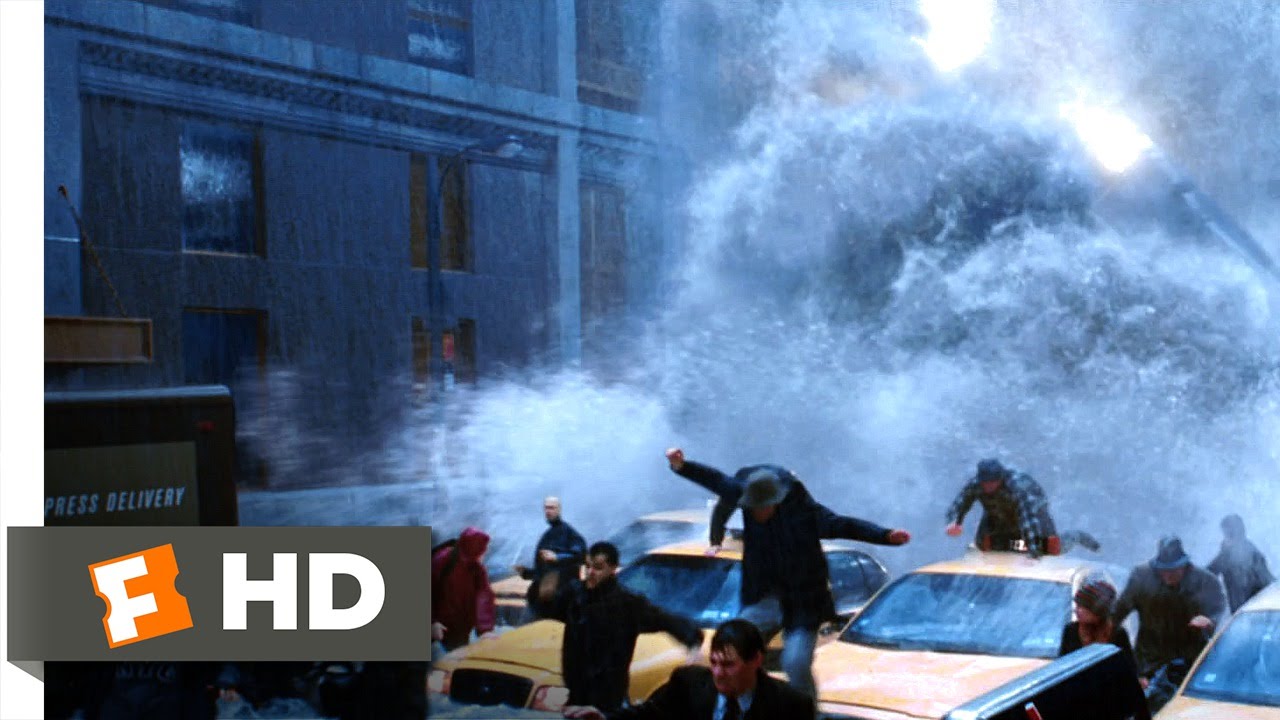 or
 as disaster movies portray. Many comprehensive climate models don't predict a total AMOC shut down for another 250-300 years under current emissions, though they predict a bevy of negative consequences as the currents slowly slide toward collapse.
Climate catastrophe is a slow-burn issue — but it's one that has a clear solution. "Avoid emitting greenhouse gases," says Boers. We live at a tipping point in Earth's history, one where our species faces a choice: We can either be the hero of the movie, or the disaster.
===
===
cf al gore Inc truth
https://www.alternet.org/2021/08/gulf-stream-collapse/
no lnx pix twt
'Unimaginably catastrophic': Researchers fear Gulf Stream system could collapse
Jessica Corbett and Common Dreams August 05, 2021
While heatwaves, fires, and floods produce warnings that "we are living in a climate emergency, here and now," a scientific study suggested Thursday that a crucial Atlantic Ocean current system could collapse, which "would have severe impacts on the global climate system."
The study, published in the journal Nature Climate Change, focuses on the Atlantic Meridional Overturning Circulation (AMOC), which includes the Gulf Stream. As the United Kingdom's Met Office explains, it is "a large system of ocean currents that carry warm water from the tropics northwards into the North Atlantic," like a conveyor belt.
Previous research has shown AMOC weakening in recent centuries. The author of the new study, Niklas Boers of the Potsdam Institute of Climate Impact Research (PIK), found that this is likely related to a loss of stability.
"The Atlantic Meridional Overturning is one of our planet's key circulation systems," Boers, who is also affiliated with universities in the U.K. and Germany, said in a statement.
"We already know from some computer simulations and from data from Earth's past, so-called paleoclimate proxy records, that the AMOC can exhibit—in addition to the currently attained strong mode—an alternative, substantially weaker mode of operation," he continued."This bi-stability implies that abrupt transitions between the two circulation modes are in principle possible."
In the absence of long-term data on the current system's strength, Boers looked at its "fingerprints," sea-surface temperature and salinity patterns. He said that "a detailed analysis of these fingerprints in eight independent indices now suggests that the AMOC weakening during the last century is indeed likely to be associated with a loss of stability."
"The findings support the assessment that the AMOC decline is not just a fluctuation or a linear response to increasing temperatures," he continued, "but likely means the approaching of a critical threshold beyond which the circulation system could collapse."
As The Guardian's Damian Carrington reports, the collapse of "one of the planet's main potential tipping points"would be devastating on a global scale:
Such an event would have catastrophic consequences around the world, severely disrupting the rains that billions of people depend on for food in India, South America, and West Africa; increasing storms and lowering temperatures in Europe; and pushing up the sea level in the eastern U.S. It would also further endanger the Amazon rainforest and Antarctic ice sheets.
The complexity of the AMOC system and uncertainty over levels of future global heating make it impossible to forecast the date of any collapse for now. It could be within a decade or two, or several centuries away. But the colossal impact it would have means it must never be allowed to happen, the scientists said.
"The signs of destabilization being visible already is something that I wouldn't have expected and that I find scary," Boers told the newspaper. "It's something you just can't [allow to] happen."
It is unclear what level of global heating would cause a collapse, "so the only thing to do is keep emissions as low as possible," he added. "The likelihood of this extremely high-impact event happening increases with every gram of CO2 that we put into the atmosphere."
Some climate action advocates responded to the study by highlighting a science fiction movie that, as famed film critic Roger Ebert wrote nearly two decades ago, "is ridiculous, yes, but sublimely ridiculous—and the special effects are stupendous."
"We all laughed at The Day After Tomorrow, back in 2004," said Guy Shrubsole, policy and campaigns coordinator at Rewilding Britain. "Turned out it was a documentary."
The environmental advocacy group 350 Tacoma responded to the findings with a call to action.
"There are warning signs that the Gulf Stream could collapse, an unimaginably catastrophic (and irreversible) impact of fossil fuel-caused climate breakdown," the group tweeted. "Scientists say we cannot allow this to happen. People in power stand in our way."
The study comes ahead of a United Nations climate summit in Glasgow set to begin October 31. Last month, U.N. Secretary-General António Guterres noted the upcoming event and reminded leaders of wealthy countries that "the world urgently needs a clear and unambiguous commitment to the 1.5-degree goal of the Paris agreement," and "we are way off track."
The Day After Tomorrow - Official® Trailer [HD]
www.youtube.com
RELATED ARTICLES AROUND THE WEB
The Gulf Stream is slowing to a 'tipping point' and could disappear ... ›
Slowing Gulf Stream current to boost warming for 20 years - BBC ... ›
Climate crisis: Scientists spot warning signs of Gulf Stream collapse ... ›
===
https://www.alternet.org/2021/06/climate-crisis-2653267213/
comm dr
New research by global insurance giant Swiss RE warns that the looming devastation of runaway greenhouse gas emissions and the climate crisis could result in economic retractions twice as potent as the global recession unleashed by Covid-19—a calamity, unlike the pandemic, which could go on for many years without end.
Analyzing the figures compiled in a research report (pdf) by Zurich-based Swiss RE, Oxfam International said while the world's poorest nations will be hardest hit, even the rich nations—like those of the G7 meeting this week in the United Kingdom—will not be spared from the economic pain that will come if world temperatures rise by 2.6ºC that some scenarios predict.
According to Oxfam, economies of the G7 nations could see an average loss of 8.5 percent annually by the middle of the century―equivalent to $4.8 trillion―if more urgent action to address global warming is not taken immediately.
The international aid and anti-poverty group said this potential drop in GDP is double that of the coronavirus pandemic, which resulted in an average 4.2% reduction among G7 nations, recessions that resulted "in staggering job losses and some of the largest economic stimulus packages ever seen." But, Oxfam added, "economies are expected to bounce back from the short-term effects of the pandemic, the effects of climate change will be seen every year."
The devastation for poor nations would be enormous.
"The economic turmoil projected in wealthy G7 countries is only the tip of the iceberg: many poorer parts of the world will see increasing deaths, hunger and poverty as a result of extreme weather," said Max Lawson, head of Inequality Policy at Oxfam, in a statement. "This year could be a turning point if governments grasp the challenge to create a safer more liveable planet for all."
As the group's analysis notes:
- India could lose 27% from its economy.
- Australia, South Africa and South Korea are projected to lose 12.5, 17.8 and 9.7% respectively.
- The Philippines is projected to lose 35%
- Colombia is projected to lose 16.7%
Jerome Haegeli, a chief economist at Swiss Re involved with the research, told the Guardian that: "Climate change is the long-term number one risk to the global economy, and staying where we are is not an option—we need more progress by the G7. That means not just obligations on cutting CO2 but helping developing countries too, that's super-important."
The research from Swiss RE, as Oxfam details,
modelled the economic impacts of climate change on 48 countries in four different temperature paths and used different impact scenarios to account for the large parameter uncertainty and missing climate impact channels usually present in the climate economics literature. The projections used in this press release assume high stress factors and global warming of 2.6°C by mid-century, which is a level of warming that could be reached based on current policies and climate pledges from all countries. All figures relate to real GDP. The GDP projections compare a warmer world with a world unaffected by climate change.
Ahead of the G7 summit in the U.K., global climate campaigners have continued to urge the world's richest and most powerful nations—also its largest emitters—to not only commit to stronger pledges on reducing fossil fuel pollution, but to increase their financial pledges to the developing world that have contributed far less to the climate crisis but continue to face its most devastating impacts.
From Your Site Articles
- Climate crisis is the primary cause of 98% of dead Florida coral reef ... ›
- Slashing methane emissions must play larger role in fighting climate ... ›
- Climate crisis and negligent policymakers blamed for 'record ... ›
===
===
biden 1b$ disaSter season
https://www.alternet.org/2021/05/western-fires/
many graf
The Western U.S. appears headed for another dangerous fire season, and a new study shows that even high mountain areas once considered too wet to burn are at increasing risk as the climate warms.
Nearly two-thirds of the U.S. West is in severe to exceptional drought right now, including large parts of the Rocky Mountains, Cascades and Sierra Nevada. The situation is so severe that the Colorado River basin is on the verge of its first official water shortage declaration, and forecasts suggest another hot, dry summer is on the way.
Warm and dry conditions like these are a recipe for wildfire disaster.
In a new study published May 24, 2021, our team of fire and climate scientists and engineers found that forest fires are now reaching higher, normally wetter elevations. And they are burning there at rates unprecedented in recent fire history.
While some people focus on historical fire suppression and other forest management practices as reasons for the West's worsening fire problem, these high-elevation forests have had little human intervention. The results provide a clear indication that climate change is enabling these normally wet forests to burn.
As wildfires creep higher up mountains, another tenth of the West's forest area is now at risk, according to our study. That creates new hazards for mountain communities, with impacts on downstream water supplies and the plants and wildlife that call these forests home.
Map showing how high-elevation forest fires advanced uphill.
Forest fires advanced to higher elevations as the climate dried from 1984 to 2017. Every 200 meters equals 656 feet.
Mojtaba Sadegh, CC BY-ND
Rising fire risk in the high mountains
In the new study, we analyzed records of all fires larger than 1,000 acres (405 hectares) in the mountainous regions of the contiguous Western U.S. between 1984 and 2017.
The amount of land that burned increased across all elevations during that period, but the largest increase occurred above 8,200 feet (2,500 meters). To put that elevation into perspective, Denver – the mile-high city – sits at 5,280 feet, and Aspen, Colorado, is at 8,000 feet. These high-elevation areas are largely remote mountains and forests with some small communities and ski areas.
The area burning above 8,200 feet more than tripled in 2001-2017 compared with 1984-2000.
One of Colorado's largest wildfires, 2020's East Troublesome Fire, crossed the Continental Divide and was burning at elevations around 9,000 feet in October, when snow normally would have been falling.
AP Photo/David Zalubowski
Our results show that climate warming has diminished the high-elevation flammability barrier – the point where forests historically were too wet to burn regularly because the snow normally lingered well into summer and started falling again early in the fall. Fires advanced about 826 feet (252 meters) uphill in the Western mountains over those three decades.
The Cameron Peak Fire in Colorado in 2020 was the state's largest fire in its history, burning over 208,000 acres (84,200 hectares) and is a prime example of a high-elevation forest fire. The fire burned in forests extending to 12,000 feet (3,650 meters) and reached the upper tree line of the Rocky Mountains.
We found that rising temperatures in the past 34 years have helped to extend the fire territory in the West to an additional 31,470 square miles (81,500 square kilometers) of high-elevation forests. That means a staggering 11% of all Western U.S. forests – an area similar in size to South Carolina – are susceptible to fire now that weren't three decades ago.
Can't blame fire suppression here
In lower-elevation forests, several factors contribute to fire activity, including the presence of more people in wildland areas and a history of fire suppression.
In the early 1900s, Congress commissioned the U.S. Forest Service to manage forest fires, which resulted in a focus on suppressing fires – a policy that continued through the 1970s. This caused flammable underbrush that would normally be cleared out by occasional natural blazes to accumulate. The increase in biomass in many lower elevation forests across the West has been associated with increases in high-severity fires and megafires. At the same time, climate warming has dried out forests in the Western U.S., making them more prone to large fires.
On average, fires have spread 826 feet (252 meters) higher into the mountains in recent decades, exposing an additional 31,400 square miles (81,500 square kilometers) of forests to fire.
Mojtaba Sadegh, CC BY-ND
By focusing on high-elevation fires, in areas with little history of fire suppression, we can more clearly see the influence of climate change.
Most high-elevation forests haven't been subjected to much fire suppression, logging or other human activities, and because trees at these high elevations are in wetter forests, they historically have long return intervals between fires, typically a century or more. Yet they experienced the highest rate of increase in fire activity in the past 34 years. We found that the increase is strongly correlated with the observed warming.
High mountain fires create new problems
High-elevation fires have implications for natural and human systems.
High mountains are natural water towers that normally provide a sustained source of water to millions of people in dry summer months in the Western U.S. The scars that wildfires leave behind – known as burn scars – affect how much snow can accumulate at high elevations. This can influence the timing, quality and quantity of water that reaches reservoirs and rivers downstream.
High-elevation fires also remove standing trees that act as anchor points that normally stabilize the snowpack, raising the risk of avalanches.
The loss of tree canopy also exposes mountain streams to the Sun, increasing water temperatures in the cold headwater streams. Increasing stream temperatures can harm fish and the larger wildlife and predators that rely on them.
Climate change is increasing fire risk in many regions across the globe, and studies show that this trend will continue as the planet warms. The increase in fires in the high mountains is another warning to the U.S. West and elsewhere of the risks ahead as the climate changes.
Mojtaba Sadegh, Assistant Professor of Civil Engineering, Boise State University; John Abatzoglou, Associate Professor of Engineering, University of California, Merced, and Mohammad Reza Alizadeh, Ph.D. Student in Engineering, McGill University
This article is republished from The Conversation under a Creative Commons license. Read the original article.
FROM YOUR SITE ARTICLES
The lasting impact of the 2020 Oregon wildfires - Alternet.org ›
How Californians came together to deal with wildfires during the ... ›
'Antifa arson' hoax rumors spread faster than wildfires in besieged ... ›
RELATED ARTICLES AROUND THE WEB
Six trends to know about fire season in the western U.S. – Climate ... ›
California and the West face severe wildfire season - The ... ›
Trump largely silent on historically devastating Western fires ... ›
===
===
no lnx graf
Russ Schumacher, Colorado State University and Becky Bolinger, Colorado State University
Anyone who listens to weather reports has heard meteorologists comment that yesterday's temperature was 3 degrees above normal, or last month was much drier than normal. But what does “normal" mean in this context – and in a world in which the climate is changing?
The National Oceanic and Atmospheric Administration has released updated “climate normals" – datasets that the agency produces every 10 years to give forecasters and the public baseline measurements of average temperature, rainfall and other conditions across the U.S. As the state climatologist and assistant state climatologist for Colorado, we work with this information all the time. Here's what climate normals are, how they've changed, and how you can best make sense of them
What are the new normals?
NOAA's National Centers for Environmental Information released the new set of normals, covering 1991-2020, on May 4, 2021. Climatologists have been performing calculations on data from long-term observing stations around the country for a wide range of parameters, including high and low temperature, precipitation and snowfall.
The data also includes more detailed statistics, like the normal number of days below freezing or those with more than an inch of snowfall. NOAA puts data from individual stations onto a grid to enable the creation of useful maps for the entire country, even in places with relatively few observing stations. This provides a wealth of information for anyone interested in the climate of a specific area.
Why are normals updated?
The World Meteorological Organization sets international standards for climatological normals, defined as a 30-year periods that are regularly updated. The idea is to have global consistency for analysis. The 30-year normals also create a benchmark that represents recent climate conditions and serves as a reference for assessing current conditions.
Climate change highlights the need for regularly updating these normals. For the past 10 years, weather professionals have used the 1981-2010 climate normals as our reference. But we've observed above-average temperatures much more frequently than below-average temperatures from 1991-2020 for much of the U.S. Updating the normals is a way to calibrate to our most recently observed climate.
And as the climate continues to change, the further away in time we get from the “normal" period, the less representative that period will become. Using a very long period of time, or not regularly updating the period, could lead to including observations that would be extremely unlikely in our climate today.
On the other hand, there are situations in which it makes sense to consider periods longer than 30 years – for example, to understand long-term changes to the climate or to monitor extremes.
Most of the U.S. had more months in 1991-2020 that were warmer than the 1981-2010 average than months that were colder.
Difference in the number of months that had above-normal vs. below-normal temperature by county for the period 1991-2020, with respect to the 1981-2010 normals. Areas in red and brown had far more months that were were warmer than normal.
Becky Bolinger, CC BY-ND
The concept of 'normal' in weather and climate
An old saying, often attributed to Mark Twain, asserts that “climate is what you expect, and weather is what you get." Calculations of normal climate conditions for particular locations show how this works.
For example, data from the long-term weather and climate observing station in Fort Collins, Colorado, where we work, shows that precipitation in summer (June, July and August) over the 30 years from 1991 to 2020 varied significantly from year to year. The lowest summer rainfall was 1.48 inches in 2002 and the highest was 14.79 inches in 1997. Most years, it's somewhere between 3 and 5 inches.
But few years match the average value, just shy of 5 inches. So even though we call this the “normal" amount of rainfall, in most years the total is higher or lower – sometimes by quite a bit.
Average summer precipitation in Fort Collins, Colorado, can vary by a factor of 10 from year to year.
Summer precipitation at Fort Collins, Colorado, for the years 1991-2020. The black circle indicates the 30-year average precipitation of 4.97 inches.
Russ Schumacher and Becky Bolinger, CC BY-ND
Looking at summer temperatures from the same station, let's compare the previous 30-year period, 1981-2010, with the most recent 30-year period, 1991-2020. The data shows a shift toward higher temperatures between the two time periods. The normal summer temperature increased by nearly 1 degree, from 69.6 to 70.4 F. This “new normal" for the past 30 years reflects climate warming that has occurred both locally and globally.
Comparing the 1981-2010 and 1991-2020 normals for Fort Collins, Colorado, shows how summers there are warming. The black circle indicates the average value for each time period. Credit: Russ Schumacher and Becky Bolinger.
What the new normals show
The key change that's reflected in shifting from the 1981-2010 normals to the new 1991-2020 set is dropping the 1980s and adding the 2010s. The climate has been warming, so the new normals show higher temperatures for most regions and most months of the year.
Across the continental U.S., the temperature rose by about 0.5 F on average from the 1981-2010 to 1991-2020 period. The new average is 1.2 F warmer than that of the 20th century. A couple of exceptions are cooling observed in the spring over the Northern Great Plains and cooling over the Southeast and Mid-Atlantic in November. December shows the greatest amount of warming.
Average temperatures were higher across most of the U.S. in 1991-2020 than in 1981-2010.
Difference between 1991-2020 average and 1981-2010 average temperatures for each month, with annual change in the bottom panel. Oranges and reds show where the new normals are warmer; blues and purples show where the new normals are cooler.
Russ Schumacher and Becky Bolinger, data from NOAA, CC BY-ND
Precipitation is more variable than temperature from year to year and decade to decade. As a result, the changes in normal precipitation represent a mix of effects from long-term climate change and natural variations.
Overall, the 2010s were very wet in much of the central and eastern U.S. and dry in the west, and the normals reflect that. Average annual rainfall in Houston increased by over an inch, to 55.6 inches per year, while at Phoenix, Arizona, it dropped from an already dry 8.02 inches to a parched 7.22 inches per year.
On a monthly basis, some of the most notable patterns to emerge are widespread drying in November, particularly over the Gulf states and along the Pacific Coast, and a wetter pattern over the eastern half of the country in April.
Most of the Central and Eastern U.S. was wetter in 1991-2020 than in 1981-2010, while most Western states were drier.
Difference between 1991-2020 average and 1981-2010 average precipitation for each month, with the annual change in the bottom panel. Browns shading shows where the new normals are drier; green shading shows where the new normals are wetter.
Russ Schumacher and Becky Bolinger, data from NOAA, CC BY-ND
Shifting to new climate normals can have counterintuitive effects. For example, in the next few years there may be a better chance that you'll see what are now described as cooler-than-normal temperatures in a given day or month. Using Fort Collins again as an example, before the update, a summer average temperature of 70 F would have been slightly warmer than normal. Now that same summer would go down as being slightly cooler than normal, even though it would still be warmer than around 100 of the 127 years in the history of that location.
Meteorologists and climatologists are already starting to incorporate these new normals into our work. But when you hear the term “normal," keep in mind that it reflects a 30-year snapshot and represents a different reality today than it did 30, 60 or 100 years ago.
[Get our best science, health and technology stories. Sign up for The Conversation's science newsletter.]The Conversation
Russ Schumacher, Associate Professor of Atmospheric Science and Colorado State Climatologist, Colorado State University and Becky Bolinger, Assistant State Climatologist and Research Scientist in Atmospheric Science, Colorado State University
This article is republished from The Conversation under a Creative Commons license. Read the original article.
FROM YOUR SITE ARTICLES
Climate crisis is the primary cause of 98% of dead Florida coral reef ... ›
An evangelical Christian explains why she fights climate change ... ›
Sudden and catastrophic glacier collapse shows the devastating ... ›
RELATED ARTICLES AROUND THE WEB
Understanding Climate Change - GlobalChange.gov ›
What is climate change? A really simple guide - BBC News ›
===
===
1b$ ~ Griddy TM texas freeze 221 class action lawsuit
==
===
https://www.alternet.org/2021/02/extreme-weather/
salon
The catastrophe that swept Texas last week was 90 years in the making. Its roots lie in a decision during the 1930s to escape federal regulation of power rates under the terms of Franklin D. Roosevelt's New Deal by forcing all Texas utilities to avoid importing or exporting power across state lines, thereby pretending that Texas electricity was not actually part of the national economy.
As the biggest oil and gas producer in the world, Texas had already set itself up in the business of regulating the global price of oil through the Texas Railroad Commission, which set limits on oil and gas production to keep oil prices artificially high. So going it alone on electricity prices seemed like a logical extension — except that in the case of electricity, Texas business wanted low prices, not high ones.
Implicit in the creation of what Texans call their "power island" was an understanding that cheap electricity was the only significant goal. Reliability came a distant second and clean air wasn't even on the radar screen. When Texas deregulated its electricity sector in 1999, it went further than most states. ERCOT, the Electric Reliability Council of Texas, kept prices low by refusing to pay utilities for keeping standby generation capacity in case of an extreme weather event. Since Texas also remained disconnected from other regions which might have provided backup power in the case of a shortage, the state denied itself any kind of safety net, either in-state or elsewhere.
Extreme heat waves were very much on the Texas radar, because high-demand summer days were frequent — and _{profitable for generators.}_ So money was made, and summer blackouts were few, for almost 20 years. As the climate spun out of control, however, even in summer Texas barely avoided resorting to rolling blackouts to manage record demand during worsening hot spells. (In fact, in El Paso, on the state's western border, they happened.)
Meanwhile, the pretense that it never gets cold in Texas _{kept obstructing efforts}_ to make the ERCOT grid winter-hardened. In _{1989, federal regulators}_ pointed out that Texas lacked simple weatherization measures common to more northern states.In 2011, winter storms triggered rolling blackouts. In 2014, the term "polar vortex" came into common use as Texas once again lost winter power. In 2018 and 2019, the polar vortex struck two years in a row.
Yet Texas business and political leaders kept insisting that the cost of winterizing the power system was simply not worth it. The state's major industrial power users didn't want to pay their share of the bill. Any conversation about providing backup by connecting the Texas grid to the rest of America remained totally off limits.
This year, of course, disaster became catastrophe. Those who doggedly opposed investments in reliability have had to find a new tune — their favorite being to blame renewable energy, in spite of manifest evidence that this is untrue.
Former Texas governor Rick Perry _{went to bat}_ for the state's electron isolationism: "Texans would be without electricity for longer than three days to keep the federal government out of their business." Perry went on to blame the state's reliance on wind power for the crisis, a richly ironic canard. It was Perry himself who led the campaign to create Texas's innovative and wind-power targeted CREZ transmission project, which was largely responsible for the fact that 2020 was the first year in which Texas got more electricity from wind than from coal.
Perry's scapegoating of his own wind revolution for the blackout was echoed by current Gov. Greg Abbott, who said, "Our wind and our solar got shut down, and they were collectively more than 10 percent of our power grid, and that thrust Texas into a situation where it was lacking power on a statewide basis." That was a lie. As the chart below shows, most of the collapse in power generation came from natural gas, coal and nuclear, since even in a normal winter Texas gets relatively little of its power from wind and solar. (Although Texas wind turbines lack simple weatherizing technology used by wind farms in other states to its north.) [grf]
as the disasters cascaded — no power, shut-down oil and gas production, no water, unreliable food — voices from urban communities suffering freezing homes flooded by burst pipes began to fire back, blaming the state regulators for their refusal to invest in winter-hardy generation for the state. It was "_{just horrible to see,"}_ said Dallas Mayor Eric Johnson. "The power and water outages in Texas have created a situation that's worse than even the early days of the pandemic," warned Rep. Joaquin Castro, a Democrat from San Antonio.
But deeply ingrained in the Texas power sector was the governor's belief that hard freezes didn't happen often enough to be worth preparing for. That misguided belief was os deeply ingrained that when _{the Texas Monthly asked}_ ERCOT CEO Bill Magness if the savings from failing to build resilience were worth it to consumers, he dismissed the question: "I am not aware that we have ever conducted a real cost-benefit analysis on that topic." That wasn't true. ERCOT had analyzed this, and it turned out that the agency's _{eight-year-old estimate}_ of the daily cost of such a blackout was $2.8 billion — enough to cover a lot of weatherization.The 2020 freeze brought a whole new class of costs to bear. Not only was electricity generation shut down, but as a result so were many oil fields. IHS Markit estimated that the Texas freeze had shut down at least 20% of the nation's oil and gas production, largely in the Permian Basin, which made it harder to get gas-fired electricity back on line.
As more and more voters got more and more upset, a new refrain was heard, even from Abbott: _{Texas needed to weatherize}_. The governor called for a special legislative session to get it done, and was suddenly outraged. "Everyone knows how challenging the past few days have been for our fellow Texans," Abbott said. "All of us in the state of Texas believe it is completely unacceptable that you had to endure one minute of the challenge that you faced."
So can we write off the Texas tragedy to Lone Star exceptionalism? A quasi-secessionist electricity island, with inadequate requirements for getting ready for winter, pays the price?
Up close it looks like it. But pull back and include the summer of 2020, and it's clear that what went wrong in Texas has a lot do with the fires that brought California to its knees six months earlier. The summers of 2017 and 2018 had made it clear that California didn't have nearly enough firefighters standing by for an event like the lightning strikes that rained down in August 2020. It was also clear the state had allowed PG&E and its other utilities to invest too little in fire hardening rural power lines. Worse yet, most communities in the fire-hazard areas had failed to adopt or enforce adequate fireproofing measures on homes and businesses. But California's politics are — in the American context — at polar opposites to Texas. (In fact, California's problem is significantly harder to fix than the polar vortex threat to Texas.)
To understand why neither red nor blue America can reliably and safely provide electricity to its population, we need to contrast the American attitude towards natural disasters — they happen, but we recover — with the Dutch approach to flooding, which is more like: We can't prevent the storms, but we can protect ourselves against the damages. Since the Dutch adopted this attitude as national policy 70 years ago, not a single citizen has died in a flood. Prevention has proven cheaper than rescue and repair: Even though a third of the nation lies below sea level, Holland's annual expenditures for flood prevention, at $1.5 billion, are a fraction of American costs for flood recovery, even on a per capita basis.
If President Biden is looking for another issue on which he can unite the country, starting a conversation on the need to massively invest in fire, flood and storm resilience in a climate-stressed world offers a promising opportunity. How about "Build it back safely" as a subset of "Build it back better"?
FROM YOUR SITE ARTICLES
- Why We Love Storms - Alternet.org ›
- Texas declared 'a failed state' as power outages and freezing ... ›
- How Texas repeatedly failed to protest its power grid against ... ›
RELATED ARTICLES AROUND THE WEB
- Extreme Weather | National Climate Assessment ›
- Extreme Weather on Earth | National Geographic Society ›
- Extreme weather - Wikipedia ›
===
===
https://www.alternet.org/2020/12/climate-change
JC cmn dreams
More than 250 scientists and scholars from 30 countries have issued an open letter calling on policymakers to "engage more with the growing risk of societal disruption and collapse due to damage to the climate and environment," arguing that only then "might communities and nations begin to prepare and so reduce its likelihood, speed, severity, harm to the most vulnerable, and to nature."
The letter, a version of which appeared GUK in The GuardianSunday, comes on the heels of a pair of United Nations reports warning of the dire direction in which the planet is headed. As U.N. Secretary-General António Guterres put it: "The state of the planet is broken. Humanity is waging war on nature. This is suicidal."
This weekend, world leaders will hold the Climate Ambition Summit 2020to mark the fifth anniversary of the Paris climate agreement. After failing in the years since then to cut greenhouse gas emissions in line with that accord, the letter says, "we must now face the consequences."
While "some armed services already see collapse as an important scenario, requiring planning," the letter notes that "the topic is not well reported in the media, and mostly absent from civil society and politics," even though such collapse "is already the experience or memory of many communities in the Global South."
The U.K. arm of Extinction Rebellion shared pieces of the letter on Twitter with photos of climate activists around the world demanding urgent action:
Denouncing media coverage that "typically cites people who condemn discussion of the topic," the letter says that "ill-informed speculations, such as on foreign misinformation campaigns, or impacts on mental health and motivation, will not support serious discussion. Rather, such claims risk betraying the thousands of activists and community leaders whose anticipation of collapse is part of their motivation to push for change on climate, ecology, and social justice."
The letter continues:
People who care about environmental and humanitarian issues should not be discouraged from discussing the risks of societal disruption or collapse. That could risk agendas being driven by people with less commitment to such values.
Some of us believe that a transition to a new form of society may be possible. That will involve bold action to reduce damage to the climate, nature and other people, including preparations for major disruptions to everyday life. We are united in regarding efforts to suppress discussion of collapse as hindering the possibility of that transition.
"We have experienced how emotionally challenging it is to recognize the damage being done, along with the growing threat to our own way of life," the letter concludes. "We also know the great sense of fellowship that can arise. It is time to invite each other into difficult conversations, so we can reduce our complicity in the harm, and be creative to make the best of a turbulent future."
Signatories and supporters of the letter shared it on social media with the hashtag #scholarswarning, offering their summaries of what the letter calls for and detailing why they signed on to it.
"We're saying we must confront the real possibility of climate collapse so that we can do our utmost to avoid it," American climate scientist Peter Kalmus, a signatory to the letter, saidin a tweet Sunday. "This is as far from 'doomerism' as you can get."
In a statement, University of Cumbria professor Jem Bendell, another signatory, explained that "we come from dozens of countries and subject disciplines and perceive a resistance by the establishment to serious engagement in adapting to the increasing disruptions to food, water, health, and the economy."
"It is time to listen to the scholarship," Bendell added, "and try to reduce harm from societal disruption and even collapse."
FROM YOUR SITE ARTICLES
- Trump faceplants with a scientifically illiterate claim about climate ... ›
- Pope Francis Gave Trump a Copy of His Climate Change Encyclical ... ›
- How We Can Use Psychology To Help Fight Climate Change ... ›
- 4 Reasons Climate Change Affects National Security - Alternet.org ›
RELATED ARTICLES AROUND THE WEB
- Nature Climate Change ›
- What is climate change? A really simple guide - BBC News ›
- Climate Change | United Nations ›
===
===
1120 ew
large landslide caused by torrential rains during Hurricane Eta buried half a small village's residents, leaving the other half searching for family members and neighbors in Guatemala on Tuesday, The Washington Post reported.
Officials deemed Queja, a farming community of a few hundred residents, "uninhabitable," and ended rescue operations, calling for the survivors to abandon the area now mostly covered in tons of rock and mud. 99 people were reported missing, with 44 confirmed deaths.
Mayor Ovidio Choc, representing the San Cristobal Verapaz region, including Queja, said the evacuated village would be declared a cemetery.
The former director of Guatemala's national disaster management agency said the country is ranked among the highest risk countries for natural disasters, based on data by the World Risk Index.
"It is a structural problem that is linked not only the threat or the probability of producing elements like Eta, but rather other factors that make us vulnerable and are directly tied to the development of the country," Alejandro Maldonado said, The Washington Post reported.
The inability to invest in mitigation plans, and deforestation were likely to be circumstances that caused the landslide, noted Maldonado.
The residents of Queja are the latest addition of what is being called the "great climate migration." Climate change is causing sea level rise and extreme weather conditions, such as intense heat, drought, wildfires and enlarged hurricanes and typhoons, which induce mudslides, landslides and flooding, forcing many to flee their homes, never to return.
And climate refugees are predicted to increase in number in the coming years as more natural disasters occur. According to Ecological Threat Register, a September 2020 report by the non-profit think tank Institute for Economics & Peace, one billion people live in areas were there is not enough infrastructure in place to combat ecological changes.
2020 already claims the largest number of hurricanes and wildfires ever recorded.
Eta first made landfall just south of Puerto Cabezas, a city on Nicaragua's Caribbean coast on Nov. 3, as a Category 4 hurricane, causing 140 mph winds, massive downpours and destructive flooding to several countries in Central America, including Panama, Costa Rica and Honduras.
Hurricane Eta is expected to hit Florida's Gulf Coast in its fourth landfall on Wednesday, as a Category 1 hurricane, bumped up from a subtropical storm with rains hitting southern Florida on Sunday and Monday. While diminished in intensity from its peak in Central America, landslides and flooding are expected.
- One Billion People May Become Climate Refugees By 2050 ... ›
- Louisiana's Vanishing Island: America's First Climate Refugees ... ›
- 'People are dying': how the climate crisis has sparked an exodus to ... ›
- How Climate Change Is Fuelling the U.S. Border Crisis | The New ... ›
- The Great Climate Migration Has Begun - The New York Times ›
===
https://www.alternet.org/2020/09/scientists-find-new-signs-of-climate-breakdown-in-study-of-warming-oceans
In a rare calm moment during a historically active Atlantic hurricane season, an international team of climate scientists on Monday published a new study in the journal Nature Climate Change showing that human-caused global heating is making the world's oceans more "stable"—which, as co-author Michael Mann explained, is "very bad news."
Mann, director of the Earth System Science Center at Penn State, detailed researchers' findings about ocean stratification in a piece for Newsweek. Using "more comprehensive data and a more sophisticated method for estimating stratification changes" than past studies, the scientists found that "oceans are not only becoming more stable, but are doing so faster than was previously thought."
The team—led by Guancheng Li of the Institute of Atmospheric Physics in China—specifically found that stratification globally increased by a "substantial" 5.3% from 1960 to 2018, mostly in the upper 650 feet or so of the world oceans. "This seemingly technical finding has profound and troubling implications," Mann noted.
"The more stable the upper ocean, the less vertical mixing that takes place. This mixing is a primary means by which the ocean buries warming surface waters. So the surface warms up even faster. It's what we call a 'positive feedback'—a vicious cycle," he wrote. "That's bad for a number of reasons."
Thank you to @MichaelEMann for patiently and clearly explaining to non scientists why increased ocean stabilizati… https://t.co/yW2BmQhKGp
— Dr Naomi Wolf (@Dr Naomi Wolf)1601306893.0
Noting the ongoing storm season and previous warnings from scientists—including him—that the increasingly devastating recent hurricanes "have fed off warmer surface waters," Mann explained that "a more stably stratified ocean potentially favors more intense, destructive hurricanes." Warmer waters also "absorb less atmospheric carbon dioxide" and "hold less dissolved oxygen."
In other words, the new study indicates that "humans have made the oceans more stable, and the result will be more extreme weather and the acceleration of climate change," as study co-author John Abraham wrote Monday for The Guardian. Like Mann, he detailed the research team's findings about the stratification of the oceans, and the implications. Then, he added:
It is not all doom and gloom. The good news is we know why the climate is changing and we know how the oceans are responding. We can do something about this problem—we have the ability to slow down climate change. We just lack the will and leadership.
But if 2020 has shown us anything, it has revealed that humans can change and adapt quickly to situations. There is hope that we can navigate the challenges resulting from a more stable ocean—but we must start immediately.
Both co-authors' pieces provoked calls for swift, bold, global efforts to address the climate crisis:
Canada has oceans on 3 sides-we can't ignore the climate news that The Oceans Appear to Be Stabilizing. Here's Why… https://t.co/SfWJWWRHr7
— Friends Of Halifax Common (@Friends Of Halifax Common)1601308426.0
"Das bedeutet, dass das CO2-Budget, das zur Vermeidung kritischer Erhitzung (z.B. 1,5°C) übrig bleibt, möglicherwei… https://t.co/675YBTSybJ
— Parents For Future #SystemChangeNotClimateChange (@Parents For Future #SystemChangeNotClimateChange)1601315583.0
Ending his piece on a similar note, Mann wrote that "in short, it's unwise to be complacent given the accumulating scientific evidence that climate change and its impacts may well be in the upper end of the range that climate scientists currently project. There is ever-greater urgency when it comes to acting on climate. But there is agency as well. Our actions make a difference—something to keep in mind as we head into a presidential election whose climate implications are monumental."
Mann is on the mounting list of climate experts and advocates supportingDemocratic presidential nominee Joe Biden in his effort to oust President Donald Trump—who has, at various points, ignored and exacerbated the climate emergency. Earlier this month, the editors ofScientific American as well as the political action arms of both 350 and Friends of the Earth also endorsed the former vice president.
"The stakes are clear and present," Tamara Toles O'Laughlin from 350 Action said of the general election, for which early voting is already underway in some states. "The planet cannot withstand four more years of Trump."
===
===
battered, Flooded and Submerged: Many Superfund Sites are Dangerously Threatened by Climate Change
BY: DAVID HASEMYER, INSIDECLIMATE NEWS, AND LISE OLSEN, TEXAS OBSERVER
The Obama administration directed the EPA to focus on climate-related threats. Now, the Trump administration refuses to even use the word.
===
===
icn 920
paying for Extreme Weather: Wildfire, Hurricanes, Floods and Droughts Quadrupled in Cost Since 1980 BY: BOB BERWYN A new report looks at the price of climate-linked natural disasters and how global warming is making them worse. |
| Read More |
===
random grab 820 icn
https://insideclimatenews.us2.list-manage.com/track/click?u=7c733794100bcc7e083a163f0&id=52e8c5cb54&e=06876ede6b
icn 820
California and Colorado Fires May Be Part of a Climate-Driven Transformation of Wildfires Around the Globe
BY: MICHAEL KODAS
Wildfires from Australia to Siberia are not just larger, hotter and faster, but burning in areas and seasons where they were previously rare
---
icn
with Wild and Dangerous Weather All Around, Republicans Stay Silent on Climate Change
BY: MARIANNE LAVELLE
GOP leaders ignored the topic. They also ignored the concerns of some Republicans—especially younger voters—who want to address global warming.
Fires May be in California, but the Smoke, and its Health Effects, Travel Across the Country
BY: MICHAEL KODAS AND EVELYN NIEVES
Fine particulate matter and ozone from wildfire smoke are associated with heart and lung diseases, compromised immune systems and even vulnerability to Covid-19.
Read More
Paying for Extreme Weather: Wildfire, Hurricanes, Floods and Droughts Quadrupled in Cost Since 1980
BY: BOB BERWYN
A new report looks at the price of climate-linked natural disasters and how global warming is making them worse.
===
==
https://insideclimatenews.org/news/01062020/extreme-rain-study-climate-change
620 icn
new Study Shows Global Warming Intensifying Extreme Rainstorms Over North America
BY BOB BERWYN
==
===
https://insideclimatenews.org/news/18052020/hurricane-tropical-storms-climate-change
New warnings of a global warming-driven increase in the most deadly and destructive tropical storms are especially scary in regions already hit hard, including the Southeastern U.S., where Hurricane Michael damaged 60,000 homes in 2018, and the Caribbean, where Hurricane Maria killed nearly 3,000 people in Puerto Rico and crippled the island's infrastructure.
There's more of the same ahead, recent federal research suggests. One study found that the chances of major tropical storms forming increased globally by 6 percent in each of the last four decades. A second shows the biggest increase in frequency in already storm-battered areas, including Florida, the Bahamas, eastern Africa, Japan, China and the Philippine Islands.
The results bolster "projections of increased (tropical cyclone) intensity under continued warming," the authors of the first study wrote. Those researchers focused on storms with winds greater than 115 mph (category 3 or above), because those cause the most damage.
The findings landed as residents are warily watching Tropical Storm Arthur spin toward the Carolina coast well ahead of the official start of the hurricane season, and with projections for above-average hurricane activity in the Atlantic this summer.
In the Bay of Bengal, Tropical Cyclone Amphan is projected to drive a deadly surge of flooding toward Bangladesh this week, with winds of more than 170 mph. Emergency responders are struggling to evacuate up to a million people, and provide them with emergency shelter during the global coronavirus pandemic, which requires evacuees maintain physical distancing to prevent the spread of the disease.
New tropical storm data from 2010 to 2017 showed that "the probability of a hurricane having wind speeds of at least 100 knots increased by approximately 15 percent between the early and latter halves of the 39-year record."
Overheated oceans caused by global warming are super-charging tropical storms, but year-to-year variations are also affected by short-term climate cycles like El Niño. The new study helps sort out the different influences, making it "95 percent certain" that oceans heated by global warming are brewing up bigger storms more often, according to National Oceanic and Atmospheric Administration (NOAA) hurricane scientist Jim Kossin, who led the study.
"This shows us there is a global trend of more stronger hurricanes," Kossin said. "It's consistent with our expectations, based on physics." Warmer oceans supply more energy for storms and the warmer atmosphere holds more moisture.Several recent studies show how those combine to cause more damage worldwide, and pin down the role of global warming.
Increasingly, such projections help city planners and coastal developers consider if they should abandon some areas, build seawalls or floodgates, or discourage development on the most vulnerable beaches and bluffs in the next few decades.
Tropical storm frequency has increased in the warm waters of the Atlantic hurricane belt, where dangerous storms often spin toward the Southeastern U.S. and the Caribbean, while decreasing in the southern Indian Ocean and Western North Pacific, according to the second study.
Hiroyuki Murakami, a climate scientist with the NOAA's Geophysical Fluid Dynamics Laboratory, led that research, which was published May 4 in PNAS. Murakami said the average annual number of tropical storms globally had held steady at 86 since 1980. The frequency increased in hotspots like the Arabian Peninsula and East Africa, Southeast Asia, around the Hawaiian Islands and especially in the eastern Atlantic.
...[graph]
==
Hurricane Dorian’s nightmarishly slow pace is linked to climate change
===
floods 1/20 // fires Oz
===
note aha hurricanes and floods are bad for toxic spills: pipelines and tanks break, coal ash ponds overflow; lagoon animal waste
5/20 massive flood (agw?) dow? chem superfund
https://insideclimatenews.org/news/21052020/michigan-dams-flooding-climate-change-storms-extreme-weather
The flooding disaster in Michigan this week emphasized, in stark reality, the warnings by scientists that climate change is causing heavier and more frequent rainstorms in many parts of the country, including the upper Midwest.
Old dams are at risk of failing under the pressure of torrential rains. And in the hours leading up to Tuesday's failure of two dams about 150 miles northwest of Detroit, about eight inches of rain fell in the watersheds that drain into the Tittabawassee River.
First the 1920s-vintage Edenville dam broke, sending water rushing down the river to Sanford Lake. That deluge overtopped and breached the Sanford Lake dam, officials said, prompting the evacuation of 11,000 people, the flooding of the city of Midland and the inundation of its sprawling Dow Chemical Company complex.
At the Dow plant, the water flooded a containment pond, prompting environmentalists to fear that a toxic brew could spill into the river. That could set back years of downriver cleanup of the pollution from more than a century of chemical production at Dow's chemical manufacturing plant, they said. ,...
==
===
omg risk asses not doing job?!
https://www.alternet.org/2020/02/extreme-weather-could-spark-an-economic-recession-the-likes-of-which-weve-never-seen-before/
no lnx
Extreme weather could spark an economic crisis the ‘likes of which we’ve never seen before’
Written by Jake Johnson / Common Dreams February 18, 2020
New research published Monday warns that extreme weather driven by the climate crisis could bring about an economic recession “the likes of which we’ve never seen before” if markets don’t do a better job assessing climate risks.
Paul Griffin, an accounting professor at the University of California, Davis Graduate School of Management, wrote in a paper for Nature Energy that financial markets have not sufficiently accounted for the major economic risks posed by the global climate crisis, even as extreme weather—from destructive hurricanes to prolonged drought—wreaks havoc across the globe.
“Unpriced risk was the main cause of the Great Recession in 2007-2008,” Griffin wrote. “Right now, energy companies shoulder much of that risk. The market needs to better assess risk, and factor a risk of extreme weather into securities prices… Without better knowledge of this risk, the average energy investor can only hope that the next extreme event will not trigger a sudden correction to the market values of energy firms.”
Griffin continued:
This past summer, the United States and Europe experienced record-breaking heat. Now linked reliably to climate change, excessive high temperature is among the deadliest of weather extremes. Not only can it disrupt agriculture, harm human health, and stunt economic growth, it can also overwhelm—and temporarily shut down—large parts of a state’s or a nation’s energy system, as in the case of the Pacific Gas and Electric Company (PG&E) in California.
Extreme heat events can create uncertain and longer duration power outages, threaten critical infrastructure, exacerbate energy supply and demand imbalances, and trigger significant legal liability for energy firms. Newer reports of an increase in the frequency and severity of extreme weather events, moreover, amplify those risks for energy firms.
Despite these obvious risks, investors and asset managers have been conspicuously slow to connect physical climate risk from extreme weather events to company market valuations.
Griffin is not the first financial expert to raise alarm about the potentially calamitous economic impacts of the climate crisis—which would come in addition to the emergency’s incalculable effects on humans, animals, plants, insects, and the planet as a whole.
The Switzerland-based Bank for International Settlements warned in a 115-page report (pdf) last month that the “increase in the frequency and intensity of extreme weather events could trigger non-linear and irreversible financial losses.”
“Climate change poses unprecedented challenges to human societies,” the report stated, “and our community of central banks and supervisors cannot consider itself immune to the risks ahead of us.”
===
===
9/17 belated?
neglected
sorta morphing to global warming in general?
see ocean warming
see drought
see flood
see CLIMATE REFUGEE 4 goes back at least to arab spring syria, but official disambig sep category 12/19
omfg see greenland
===
causes: loss of ice, water moves heat: TIP PT
https://insideclimatenews.org/news/27122019/climate-science-decade-2019-year-review-tipping-points-jet-stream-ocean-circulation
The 2010s may go down in environmental history as the decade when the fingerprints of climate change became evident in extreme weather events, from heat waves to destructive storms, and climate tipping points once thought to be far off were found to be much closer.
The sum of the decade's climate science research, compiled in a series of reports by the Intergovernmental Panel on Climate Change (IPCC), suggests global warming is pushing many planetary systems toward a breakdown.It was the decade when governments worldwide woke up to the risk and signed the Paris climate agreement, yet still failed to reduce the greenhouse gas emissions at the pace and scale needed. And when climate scientists, seeing the evidence before them, cast away their reluctance to publicly advocate for action.
New studies showed polar ice caps melting and sea level rising much faster than just 10 years ago. Ocean researchers showed how marine heat waves kill corals and force fish to move northward, affecting food supplies for millions of people in developing countries. They tracked changes to crucial ocean currents and concluded that hurricanes will intensify faster in a warming world.
Together, the research showed how important it will be to cap the global temperature rise as far below 2 degrees Celsius—the Paris Agreement goal—as possible.
Feedback Loops on the Greenland Ice Sheet
At the start of the decade, it was unclear how fast the Greenland and West Antarctic Ice Sheets would melt. As recently as the 1990s, melting of the Greenland Ice Sheet was balanced by the buildup of new snow and ice, offering some hope that sea level rise would be slow, allowing coastal communities time to adapt.
By the end of 2019, a study published in the scientific journal Nature showed the Greenland Ice Sheet was melting seven times faster than it had been in the 1990s. That's on pace with the IPCC's worst-case climate scenario, with Greenland alone contributing 2 to 5 inches of sea level rise by 2100. Another study, looking at evidence in fossilized shells, showed temperatures are very near a threshold that will melt most of the ice sheet.

Scientists discovered feedback loops and new ways earth's systems interact to melt the ice.Global warming is expanding ice slabs beneath Greenland's snowy areas, hastening runoff and sea level rise. In Antarctica, they showed how global warming is shifting winds and pushing warmer water under floating ice shelves—both of which could contribute to rapid disintegration of ice shelves with a subsequent surge of sea level rise.
"The rate and magnitude of Greenland Ice Sheet mass loss, and of ice loss globally, has been dramatic," said Twila Moon, a climate researcher with the National Snow and Ice Data Center.
How Sea Ice Loss Influences the Atmosphere
Many studies in the second half of the decade showed how important it is to keep the global temperature rise as far below 2 degrees Celsius as possible to avoid triggering tipping points that would have cascading consequences. Arctic sea ice is one of the big concerns.
Even now, in its diminished state, the summer Arctic sea ice is a 1.6 million square-mile shield that reflects incoming solar radiation back to space. The more it melts, the more darker-colored ocean can absorb heat, speeding up the planet's overall warming.
At 2 degrees Celsius warming, Arctic Ocean sea ice will probably melt completely, said National Snow and Ice Data Center climate researcher Walt Meier. "Some ice probably will persist if warming is limited to 1.5 degrees Celsius," Meier said. He noted that researchhas suggested the ice could recover fairly quickly—if greenhouse gas concentrations are reduced enough to drop the temperature.

One intriguing question has been how the loss of Arctic sea ice will affect weather patterns in North America, Europe and Asia.
Melting that much of Earth's icebox could alter wind patterns that shunt weather systems around the Northern Hemisphere, scientists reasoned early in the decade. A study in 2012 suggested a mechanism: Sea ice melt alters the jet stream by reducing the temperature contrast between the Arctic and the mid-latitudes. As the jet stream weakens, it enables areas of rainy weather or hot, dry conditions to linger longer over a given area, leading to extreme rainfall or heat waves and drought.
As the decade ended, studies seemed to support that early conclusion. Research published by Michael Mann, Stefan Rahmstorf and others showed how heat waves, floods and wildfires are linked with a jet stream pattern that, in turn, is related to an over-heated Arctic. In a climate warmed by greenhouse gases, the jet stream is more likely to set up in a pattern that causes extremes to linger longer over Europe and North America.
Arctic Melting Also Effects Ocean Currents
Another major advance in climate research this decade relates to how the melting Arctic will affect a key Atlantic Ocean current that balances Earth's climate by carrying warm, salty water north in the upper layers of the ocean and colder water southward in the ocean depths.
Early in the decade, scientists were still speculating about whether such a slowdown was happening, but now, "for the first time the IPCC has confirmed that the AMOC has slowed down, as predicted by models," Rahmstorf said.
Slowing of the AMOC, the Atlantic Meridional Overturning Circulation, has been identified as one of the main tipping points in the planet's climate system. Changes in the circulation "have been responsible for some of the strongest and most rapid climate shifts during the Quaternary Period (the past 2.6 million years)," one study said.
[graf/ map currents]
There are already signs that the weakening of the Atlantic circulation is having an effect on U.S. fisheries and storms. Ice melting off Greenland as the Arctic warms is believed to play a key role. Credit: NASA]
Total collapse of the current, still seen as unlikely, would raise sea level by 30 inches around the North Atlantic, but even a slowdown will have a similar effect, to a lesser degree.
"The current is balanced, in part, by the slope of the sea surface as it climbs away from the East coast toward the center of the North Atlantic Ocean gyre," explained Penn State climate scientist Michael Mann. "If the current slows, that slope must decrease, which is accomplished by the sea surface rising along the coast. That can add as much as an extra foot to sea level rise over the next century over parts of the East Coast."
The slowdown will likely push tropical rainfall belts southward, disrupting agriculture and ocean ecosystems. A study in 2016 showed how global warming is shifting other currents in ways that could bring more intense storms to land areas, like the rainstorms that brought record flooding to Japan.
Marine Heat Waves Drive Ecosystem Tipping Points
Scientists have long known that the oceans are absorbing about 93 percent of the heat trapped by greenhouse gases, but it wasn't until the last few years that they showed how that's manifesting in marine heat waves that are driving some ocean ecosystems to tipping points.
The most visible might be the mass die-offs of coral reefs in 2015 and 2016 as the oceans seethed at near record warmth for months on end.
The impacts of another marine heat wave, known as the Pacific warm blob, cascaded through Pacific Ocean ecosystems in 2014 and 2015, causing widespread disruption to the food chain and promoting toxic algae blooms. Another began forming in the Pacific in 2019.


Marine heat waves don't just affect the water. The Pacific warm blob was also linked with California's extreme drought that pushed some inland forest ecosystems past the brink. The large area of stagnant heat over the ocean blocked cooler marine air from reaching the coast, enabling the heat to build up.
Since the 1920s, marine heat waves have become 34 percent more frequent, and research shows about 87 percent of them can be attributed to human-caused global warming.
Potential for West Antarctic Ice Sheet Collapse
At the start of the 2010s, scientists were just beginning to understand how vulnerable parts of Antarctica are to human-caused global warming. New studies this past decade showed that what was once considered a nearly invincible fortress of ice is crumbling at the edges.
Just a little more warming could push parts of the Antarctic ice sheets past a tipping point that would raise sea level faster and higher than anticipated by the climate assessments commonly used for coastal planning around the world.
"I'd say one of the big things this decade includes the potential collapse of West Antarctica, based on new research," said University of Colorado climate scientist Mike MacFerrin. "Just this year, we have evidence that Antarctica's recent speedup of ice loss is, in fact, human-caused."
[graf]
Concerns about an abrupt collapse of parts of Antarctica's ice shelves intensified in 2016 with a study suggesting that water from surface melting could seep deep into the ice, refreeze and split off huge slabs of the shelves in a relatively short time. Radar surveys showing the thinning of the Thwaites Glacier helped trigger a massive international research effort to track the melting in that area, and scientists are also watching the Pine Island Glacier for signs of disintegration.
The worst-case tipping point scenarios shouldn't be off the table, said Jason Box, a climate scientist with the Geological Survey of Denmark and Greenland.
Box said the research showing destabilization of the West Antarctic Ice Sheet is a key climate science advance of this past decade "that should have been like a real wake-up call moment," he said.
Connecting Climate Change to Weather Extremes
Only a few years ago, scientists were reluctant to connect any specific extreme weather event to global warming.
In 2011 and 2012, Rahmstorf and other scientists triggered debates when they wrote that there was strong evidence linking specific events or an increase in their numbers to the human influence on climate. Since then, scientists who specialize in attribution research have found global warming fingerprints on nearly every heat wave they've studied.
"Looking back over the past decade, it's astonishing how firmly we've moved out to the tails of the probability distribution. Extremes are common and are commonly attributed to human activities," said Oregon State University climate researcher Philip Mote. "We're living the worst-case scenario."

One area of research during the 2010s with ominous findings was how global warming affects the intensity tropical storms, including North Atlantic hurricanes that affect the densely populated East Coastof the U.S. A 2016 study tracked a persistent shift of storm tracks toward that area.
"We've seen extreme events, with every major ocean basin having at least one big, catastrophic hurricane in the last few years," said NOAA climate scientist Deke Arndt. "We had Dorian and Michael, with rapid intensification so early in its development and close to the equator," he said. "Every basin has come up with monstrous storms."
Seeing the Risks, More Scientists Are Speaking Out
The 2010s may also be remembered as the decade when scientists cast away their reluctance to advocate for political and social changes.
The research on global warming is now so compelling that "a growing number of scientists are starting to make increasingly direct, pointed, and public statements about climate change risks to society," said Daniel Swain, a climate scientist with UCLA and the National Center for Atmospheric Research.
"My sense is that a key reason for this is the widening gap between physical reality and political reality," he said. "There is a growing sense that society is careening toward the abyss while we're collectively arguing about whether we should hit the brakes.
"Scientists who work in the climate domain are particularly, sometimes painfully, aware of the consequences that lie ahead if we continue on our current trajectory. And we're also aware that the emissions targets set forth in the Paris Agreement remain largely aspirational; we're currently still on a path to blow right past them."
Read this next from our decade in review series: Earth's Hottest Decade on Record Marked by Extreme Storms, Deadly Wildfires
===
===
https://www.democracynow.org/2019/12/13/climate_refugees_climate_fueled_drought_sea
new report reveals how long-term disasters, including sea level rise and desertification, and short-term disasters, such as storms and fires, are especially threatening to people living in the Global South and island nations. We speak with the co-author of a new study that finds the climate crisis is already leading to a massive increase in the number of refugees being displaced around the world. Hossein Ayazi is a policy analyst with the Global Justice Program at the Othering & Belonging Institute at the University of California, Berkeley. We’re also joined at the U.N. Climate Summit in Madrid by Saleemul Huq, climate scientist and the director of the International Centre for Climate Change and Development in Bangladesh. He is advising the bloc of Least Developed Countries in the climate negotiations.
sandy?
===
===
Appalachia’s Strip-Mined Mountains Face a Growing Climate Risk: Flooding
BY: JAMES BRUGGERS
A new analysis of satellite images shows how the area of West Virginia with the most strip-mine damage is also the most susceptible to increased stream flow as the planet warms
:{
}:
:{
}:
==
---
icn 719
Ravaged by Drought, a Honduran Village Faces a Choice: Pray for Rain or Migrate
https://insideclimatenews.org/news/08072019/climate-change-migration-honduras-drought-crop-failure-farming-deforestation-guatemala-trump
==
India Set to Lower ‘Normal Rain’ Baseline as Droughts Bite
==
Global Warming Is Messing with the Jet Stream. That Means More Extreme Weather.
BY BOB BERWYN
===
https://www.ecowatch.com/arctic-climate-change-2634032427.html
by Jon Queally
A new research paper by American and European climate scientists focused on Arctic warming published Monday reveals that the "smoking gun" when it comes to changes in the world's northern polar region is rapidly warming air temperatures that are having — and will continue to have — massive and negative impacts across the globe.
The paper new paper — titled Key Indicators of Arctic Climate Change: 1971–2017 — is the work of scientists at the International Arctic Research Center at the University of Alaska Fairbanks and the Geological Survey of Denmark and Greenland in Copenhagen (GUES).
"The Arctic system is trending away from its 20th century state and into an unprecedented state, with implications not only within but beyond the Arctic," said Jason Box of the GUES, lead author of the study. "Because the Arctic atmosphere is warming faster than the rest of the world, weather patterns across Europe, North America and Asia are becoming more persistent, leading to extreme weather conditions. Another example is the disruption of the ocean circulation that can further destabilize climate: for example, cooling across northwestern Europe and strengthening of storms."
John Walsh, chief scientist at AUF's research center, was the one who called arctic air tempertures the "smoking gun" discovered during the research — a finding the team did not necessarily anticipate.
"I didn't expect the tie-in with temperature to be as strong as it was," Walsh said. "All the variables are connected with temperature. All components of the Arctic system are involved in this change."
The study, published Monday as the flagship piece in a special issue on Arctic climate change indicators published by the journal Environmental Research Letters, is the first of its kind to combine observations of physical climate indicators — such as snow cover, rainfall and seasonal measurements of sea ice extent — with biological impacts, such as a mismatch in the timing of flowers blooming and pollinators working. According to Walsh, "Never have so many Arctic indicators been brought together in a single paper."
This three-and-a-half minute video put together by the research team, explains its methodology and findings in detail: [vid]
The new study comes as temperature records in the polar regions continue to break record after record. Last week, climatologists said Alaska experienced the highest March temperatures ever recorded.
Statewide temperatures averaged 27°F degrees last month, a full 4 degrees higher than the record set in 1965. Brian Brettschneider, a climatologist with the International Arctic Research Center at University of Alaska Fairbanks, told the Anchorage Daily News, "We're not just eking past records. This is obliterating records."
Also last month, as Common Dreams reported, the UN Environment Programme (ENUP) warned in a far-reaching report that winter temperatures in the Arctic are already "locked in" in such a way that significant sea level increases are now inevitable this century.
Rising temperatures, along with ocean acidification, pollution, and thawing permafrost threaten the Arctic and the more than four million people who inhabit it, including 10 percent who are Indigenous. But, as UNEP acting Executive Director Joyce Msuya noted at the time, "What happens in the Arctic does not stay in the Arctic."
That warning was echoed by the researchers behind the new study out Monday. Their hope, they said, is that the findings about air temperatures and the delicate interconnections between the climate and other natural systems in the Arctic will "provide a foundation for a more integrated understanding of the Arctic and its role in the dynamics of the Earth's biogeophysical systems."
Reposted with permission from our media associate Common Dreams.
RELATED ARTICLES AROUND THE WEB
- CO2 Levels Are Now at a 3 Million-Year High - EcoWatch ›
- Early Forecasts Suggest 'Quiet' 2019 Hurricane Season - EcoWatch ›
-
==
==
ew 319
UN Report: Extreme Weather Displaced 2 Million People in 2018
==
https://theconversation.com/extreme-weather-news-may-not-change-climate-change-skeptics-minds-112650
The year 2018 brought particularly devastating natural disasters, including hurricanes, droughts, floods and fires – just the kinds of extreme weather events scientists predict will be exacerbated by climate change.
Amid this destruction, some people see an opportunity to finally quash climate change skepticism. After all, it seems hard to deny the realities of climate change – and object to policies fighting it – while its effects visibly wreck communities, maybe even your own.
News outlets have hesitated to connect natural disasters and climate change, though these connections are increasing, thanks to calls from experts combined with more precise data about the effects of climate change. Media voices like The Guardian advocate for more coverage of the weather events “when people can see and feel climate change.” Harvard’s Nieman Foundation dubbed 2019 “The Year of the Climate Reporter.” Even conservative talk radio host Rush Limbaugh worried that media predictions about Hurricane Florence were attempts to “heighten belief in climate change.”
But a recent study from Ohio State University communications scholars found that news stories connecting climate change to natural disasters actually backfire among skeptics. As someone who also studies scientific communication, I find these results fascinating. It’s easy to assume that presenting factual information will automatically change people’s minds, but messages can have complex, frustrating persuasive effects.
The flooded Platte River in Nebraska is one example of a recent extreme weather event. AP Photo/Nati Harnik]
Investigating how skeptics hear the news
Social scientists have an unclear understanding of how climate change news affects public opinion, as not enough research has specifically explored that question. To explore the question, researchers from Ohio State recruited 1,504 volunteers. They divided them into groups who read news stories about natural disasters – fires, hurricanes or blizzards – that either emphasized or omitted the role of climate change.
Cleverly, the researchers recruited participants from geographic areas most likely to experience the disasters they read about; for instance, participants in hurricane-prone areas read the news articles about hurricanes. Further, the researchers ran the study in fall 2017, during hurricane and wildfire season, when these sorts of disasters are presumably top of mind.
After reading, participants answered 11 questions meant to measure their resistance to the article, including “Sometimes I wanted to ‘argue back’ against what I read” and “I found myself looking for flaws in the way information was presented.”
It turned out that climate change skeptics – whether politically conservative or liberal – showed more resistance to the stories that mentioned climate change. Climate change themes also made skeptics more likely to downplay the severity of the disasters. At the same time, the same articles made people who accept climate change perceive the hazards as more severe.
The study findings suggest that reporting the relationship between climate change and hazardous weather may actually increase the skepticism of skeptics, even in the face of blatant contrary evidence. Psychologists call this the boomerang effect, because the message ultimately sends people in the opposite direction.
Who’s hearing the message matters
The boomerang effects seen in this latest study are less surprising than you might think. Researchers have tried a variety of strategies, including emphasizing scientific consensus around climate change and describing the negative health impacts of climate change on people near and far, only to find that skeptics often end up more entrenched after reading attempts to persuade them.
Messages can work when they use place to increase people’s concern and willingness to act on climate change, but individual studies show inconsistent results. One new study gave Bay Area participants maps showing the increased flood risk in their zip code due to projected sea level rise. The maps made no difference in people’s concern about the effects of climate change on future generations, developing countries or the Bay Area. But the maps did make people who accept climate change less concerned that it would personally harm them. These participants may have replaced their abstract, apocalyptic assumptions about climate change threats with the more tangible predictions, causing them to feel less vulnerable.
Another study, also involving Californians, generated slightly more success for place-based climate change news, but only among participants who were already concerned about climate change. Study participants read news articles explaining that climate change would increase droughts either globally or in California. The global message made people more likely to want policy changes, while the local messages made people more likely to say they would change their personal behavior.
Place-based appeals often have some positive effect on people’s willingness to act on climate change and environmental issues.
But most studies about local messaging suggest that you cannot persuade everyone with the same message. A complex relationship of factors – including previous beliefs on climate change, political affiliation, and attachment to place and gender – can all play a role.
And psychologists offer compelling reasons why persuasive attempts sometimes backfire. Messages about the local impact of climate change might actually replace people’s abstract, altruistic values with utilitarian concerns. In the case of skeptics resisting news about climate-driven disasters, the researchers from Ohio State suggest that these people are engaged in motivated reasoning, a cognitive bias where people force new and threatening information to conform to their pre-existing knowledge.
More and more info doesn’t necessarily convince. AP Photo/Jay Reeves
More news may not convince
Resistance to news about climate change disasters might be frustrating, but even the media often ignore the role of climate change in disasters, according to an analysis by the nonprofit consumer advocacy organization Public Citizen. They found only 7 percent of American news stories about hurricanes mentioned climate change in 2018. Percentages increase for stories about wildfires (27.8 percent of stories), extreme heat (34 percent of stories) and drought (35 percent of stories). But an overwhelming amount of extreme weather news coverage never mentions climate change.
Some omissions are particularly striking. Liberal research organization Media Mattersfound only one mention of climate change in 127 broadcast news stories during two weeks of extreme heat in 2018. Only about 4 percent of stories about Hurricane Irma and Harvey mentioned climate change, according to an academic analysis that included The Houston Chronicle and the Tampa Bay Times.
Despite these low numbers, U.S. climate change coverage related to extreme weather and disasters actually rose in 2018, according to the report from Public Citizen. This increase aligns with a trend of news slowly improving its climate reporting. For instance, U.S. print media has dropped some of the skepticism from its climate change reporting, both in terms of outright skepticism of the basic science and a subtler version that involved creating a false balance by including voices which both affirm and deny the reality of climate change.
Even if the media continues to increase and improve its climate change coverage, it might not change skeptics’ minds. Of course, the media has a responsibility to report the news accurately, regardless of how some people process it. But those hoping that climate change news will convert skeptics might end up disappointed.
Given this resistance to news, other approaches, such as avoiding fear-inducing and guilt-based messaging, creating targeted messages about free-market solutions, or deploying a kind of “jiu jitsu” persuasion that aligns with pre-existing attitudes, may prove more effective at influencing skeptics. In the meantime, social scientists will continue to investigate ways to combat the stubborn boomerang effect, even as the consequences of climate change intensify all around us.
:{
}:
==
mojo ala
In fact, there is no scientific consensus on how climate change affects tornadoes, though generally, global warming is believed to make extreme weather events—from hurricanes to cold snaps—more deadly for reasons that do not necessarily apply to tornadoes. “No known scientific studies have established a cause-and-effect relationship between tornadoes and climate warming,” E&E News reported Tuesday. “But scientists do say they are witnessing macro-scale changes in tornado frequency and variability across the United States.” The site noted that “in the 1980s, tornadoes damaged an average of nine counties per year,” but between 2007 and 2016, “tornadoes damaged an average of 21 counties annually.”
===
https://www.mediamatters.org/research/2019/03/11/How-broadcast-TV-networks-covered-climate-change-in-2018/223076
JRNL FAIL
many graphs
no lnx
How broadcast TV networks covered climate change in 2018
Research ››› March 11, 2019 9:11 AM EDT ››› TED MACDONALD & LISA HYMAS
Broadcast TV news coverage of climate change plummeted 45 percent from 2017 to 2018, even as the climate crisis steadily worsened. The major news programs on the broadcast networks aired a combined total of just 142 minutes of climate coverage in 2018, or less than two and a half hours. Almost three-quarters of that coverage aired in just the last three months of the year. The networks did a particularly poor job of explaining how climate change exacerbates extreme weather; none of the networks' news reports on the major hurricanes of 2018 even mentioned climate change. The networks’ coverage was also lacking in diversity: Only 9 percent of the people featured in climate segments were people of color, and only 19 percent were women.
Melissa Joskow / Media Matters
For this study, Media Matters examined 2018 news coverage of climate change on broadcast TV networks, counting and analyzing segments devoted to climate change and segments in which an employee of the network incorporated climate change. We analyzed coverage on the nightly news programs and Sunday morning political shows on ABC, CBS, and NBC. We also analyzed Fox Broadcasting Co.’s syndicated Sunday morning political show, Fox News Sunday. Fox Broadcasting Co. (which is separate from the Fox News cable channel) does not have a nightly news program, so overall there was far less Fox airtime to analyze.
Top trends from a year of broadcast TV news climate coverage
Key findings:
There was a 45 percent drop in climate change coverage on the broadcast networks’ nightly news and Sunday morning political shows from 2017 to 2018 -- from a total of 260 minutes in 2017 down to just 142 minutes in 2018.
Nearly a third of the time that the networks spent covering climate change in 2018, or 46 minutes, came from a single episode of NBC's Meet the Press on December 30 that was dedicated to discussion of climate change.
NBC was the only network that aired more minutes of climate coverage in 2018 than in 2017 -- an increase of 23 percent. CBS' time spent on climate coverage fell 56 percent from 2017 to 2018, Fox News Sunday's fell by 75 percent, and ABC's fell by 81 percent.
People of color made up only 9 percent of those who were interviewed, featured, or quoted in the networks’ climate coverage, and women made up only 19 percent.
None of the broadcast TV networks' news reports on hurricanes Florence or Michael mentioned climate change. Only nine of their segments reporting on other weather disasters of 2018 mentioned that climate change exacerbates extreme weather.
Almost three-quarters of 2018’s climate coverage occurred in the last three months of the year. Much of it focused on major climate science reports released by the United Nations and the U.S. government.
The links between national security and climate change were discussed only once in 2018, in an NBC segment. ABC and CBS did not mention that climate change poses serious threats to national security.
Solutions or actions offered in response to climate change were mentioned in only a fifth of climate segments aired on ABC, CBS, or NBC.
Climate change coverage fell significantly from 2017 to 2018
Coverage of climate change on the major broadcast networks declined 45 percent from 2017 to 2018. The programs aired a combined 142 minutes of climate coverage in 2018 -- less than two and a half hours. In 2017, the programs spent a combined 260 minutes on climate change. The decline would have been even steeper if not for the December 30 episode of NBC's Meet the Press, which devoted more than 46 minutes to discussing climate change.
...
===
===
'Scary': Warming of Oceans Is Equivalent to 1.5 Atomic Bombs Every Second Over Past 150 Years
By Julia Conley
Carbon emissions are affecting life in all of Earth's ecosystems—contributing to drought, flooding and the melting of ice in the Arctic and Antarctic regions. But a new study by researchers at Oxford University details how the planet's oceans are by far the climate crisis's biggest victim, with implications for the global population.
...
The Guardian made that calculation after examining the report, which was published in the Proceedings of the National Academy of Sciences—and alarmed the study's lead author, who confirmed it was accurate.
"I try not to make this type of calculation, simply because I find it worrisome," Prof. Laure Zannat told the Guardian. "We usually try to compare the heating to [human] energy use, to make it less scary."
But Zannat's preferred calculation was hardly less troubling, with the study finding that the heating of the oceans from 1871 to the present day is also equivalent to 1,000 times the energy used by the entire global population every year.
With carbon emissions rising in recent decades, up 60 percentsince 1990, the warming oceans can be compared to the effects of three atomic bombs, like the ones that decimated Hiroshima and Nagasaki in 1945, per second since that year.
As researchers have reported in recent years, the world's oceans absorb more than 90 percent of the carbon emissions caused by oil and gas drilling, agriculture, and other human activity.
Most of the heat the Oxford University researchers studied is being stored deep in the world's oceans, causing sea level rise and making hurricanes and tsunamis stronger and more destructive.
"Obviously, we are putting a lot of excess energy into the climate system and a lot of that ends up in the ocean. There is no doubt," Zanna told the Guardian.
==
===
11/18 oceans have absorbed more heat than thot
===
https://insideclimatenews.org/news/31102018/jet-stream-climate-change-study-extreme-weather-arctic-amplification-temperature
...reenhouse gases are increasingly disrupting the jet stream, a powerful river of winds that steers weather systems in the Northern Hemisphere. That's causing more frequent summer droughts, floods and wildfires, a new study says.
The findings suggest that summers like 2018, when the jet stream drove extreme weather on an unprecedented scale across the Northern Hemisphere, will be 50 percent more frequent by the end of the century if emissions of carbon dioxide and other climate pollutants from industry, agriculture and the burning of fossil fuels continue at a high rate.
In a worst-case scenario, there could be a near-tripling of such extreme jet stream events, but other factors, like aerosol emissions, are a wild card, according to the research, published today in the journal Science Advances. The study identifies how the faster warming of the Arctic twists the jet stream into an extreme pattern that leads to persistent heat and drought extremes in some regions, with flooding in other areas.
The researchers said they were surprised by how big a role other pollutants play in the jet stream's behavior, especially aerosols—microscopic solid or liquid particles from industry, agriculture, volcanoes and plants. Aerosols have a cooling effect that partially counteracts the jet stream changes caused by greenhouse gases, said co-author Dim Comou, a climate and extreme weather researcher at the Potsdam Institute for Climate Impacts Research and the Vrije Universiteit Amsterdam.
"The aerosols forcing was a bit of a surprise to us," Comou said. "Those emissions are expected to decrease rapidly in the mid-latitude regions in the next 10 to 30 years" because of phasing out of pollution to protect people from breathing unhealthy air.
In recent decades, aerosol pollution has actually been slowing down the global warming process across the Northern Hemisphere's mid-latitude industrial regions. If aerosol emissions drop rapidly, as projected, these regions would warm faster.
That would change the temperature contrast between the Arctic and mid-latitudes, which would dampen the warming effect of greenhouse gases on the jet stream. By how much depends on the rate, location and timing of the reductions, and the offset would end by mid-century, when man-made aerosols are expected to be mostly gone and no longer reflecting incoming solar radiation, said Pennsylvania State University climate scientist and study lead author Michael Mann.
Repeats of the Summer of 2018?
The jet stream is a powerful high-altitude wind that shapes and moves weather systems from west to east. Different branches of the jet stream undulate from the subtropics to the edge of the Arctic. In the past 15 years at least, the jet stream has been coiling up more, slithering farther north and south. When it gets stuck in the extreme pattern identified by the scientists, it leads to more deadly and costly weather extremes.
That extremely wavy pattern, called "quasi-resonant amplification," was evident during the extreme summer of 2018, Mann said.
...
arctic matters....
==
https://www.ecowatch.com/banksy-artwork-auction-2611413729.html
==
https://www.alternet.org/environment/hurricane-florence-climate-policy-has-also-dangerously-stalled
Call it “The Great Stall.” Hurricane Florence lingered over the Carolinas for four days, dumping some 30 inches of rain. Flood waters are still rising, even as Typhoon Mangkhut, a superstorm 500 miles across, rakes the Philippines, Hong Kong and crashes into China. Florence is just the latest in a long series of catastrophic events generated by stalled weather patterns -- slow-moving systems which occur when one of the jet streams that flow around the Earth pinches off a massive section of air from normal wind flows for an prolonged period of time. The National Oceanic and Atmospheric Administration (NOAA) has compiled a long list of severe weather events in the US, and most of them are linked, in one way or another, to stalled weather systems.
Just in the past few months, NOAA has reported that “wildfires are burning larger and more intensely than before,” and that “unusually persistent harmful algal blooms” are plaguing Florida. The Western US is baking under high temperatures, while the Eastern US is “getting increasingly soggy.” NOAA has even reported that land areas in 2017 “recorded more than 60 days of extreme daytime heat worldwide, nearly double the 1961-1990 average.”
Whether it’s record heat, torrential rain or slow-moving currents, stalls can be catastrophic. Last year, Hurricane Harvey stalled out over Houston, dropping as much as 60 inches of rain in some areas and inflicting an estimated $125 billion in damages on the area.
Just last month, one of the leading climate research institutes, the Potsdam Institute for Climate Impact Research, cautioned that the warming of the Arctic is “messing” with the giant airstreams that encircle the Earth and contributing to a slowdown in weather patterns in the mid-latitudes. As Dim Coumou, an Institute researcher, noted just a few weeks ago, these changes in airstreams can, together with other factors, create “extreme extremes.”
So long as the stalls continue to worsen, so will the resulting extremes. Hurricane Florence may be a sign, just as Hurricane Harvey was last year, of worse things to come. Meteorologists are now projecting that Florence could dump up to 18 trillion gallons of water on North Carolina before it moves out of the state.
The growing frequency of extreme weather events is not a matter of bad luck; it is bad environmental policy made manifest. Nature, as it turns out, imitates politics. The critically needed political momentum has stalled, and politicians contribute to stalling weather patterns by stalling on climate change action.
Despite the 2015 Paris climate agreement, officially ratified in November 2016, we have yet to reach “global peaking” of greenhouse gas emissions. Global energy-related carbon emissions rose to a record high of 32.5 gigatons in 2017. With the Trump administration’s repudiation of the Paris agreement and India and China’s continued reliance upon coal, the hope of keeping the rise in global temperatures to less than 2 degrees Celsius—let alone to 1.5 degrees—is rapidly fading.
The Environmental Protection Agency (EPA) has proposed rules that would give states far more leeway in regulating carbon emissions from coal-fired plants. Market forces will continue to reduce the US’s reliance upon coal-fired plants, but the proposed rule, if adopted, would almost certainly slow the rate at which such plants are retired. The EPA also just announced rules that would roll back regulation of methane emissions from the natural gas industry.
But it’s not just the US that is stalling on curbing emissions. After declines in 2015 and 2016, the International Energy Agency reported earlier this year that global demand for coal rose 1 percent in 2017, principally due to rising demand in Asia.
Population growth and rising consumer demand for energy are working against us. The United Nations projects that the world population will increase nearly 50 percent, from 7.6 billion today to 11.2 billion by the end of the century. At the same time, the size of the world’s middle class and resulting resource consumption will likely expand at an even faster rate.
Political action is urgently required. Renewable energy is economically competitive in many parts of the globe, but unless the world’s political leaders—not just Trump—take steps to close down outdated fossil fuel plants, efforts to curb greenhouse gas emissions will fall far short of what is required to avoid more extreme extremes.
It is widely believed that Republicans in Congress are gradually awakening to the reality of human-induced climate change, and there are encouraging signs in China that the political leadership in response to domestic concerns about pollution will, at long last, get serious about curbing carbon emissions from coal-fired plants. But before long, it may be too late.
Stalls, whether political or meteorological, can be costly, dangerous, even life-threatening. It’s time to break the “great stall” on climate change.
This article was produced by Earth | Food | Life, a project of the Independent Media Institute, and originally published by Truthout. Reprinted with permission.
===
===
https://www.alternet.org/new-study-refutes-trumps-climate-change-denial-and-highlights-threat-corn-crops-around-world
==
https://insideclimatenews.org/news/25012018/air-pollution-climate-research-weather-data-aerosol-particles-water-cycle-rainfall
===
==
China’s Breadbasket Could Suffer the Worst of Climate Change’s Deadly Heat Waves
Deadly heat waves are breaking records and making headlines around the world this summer, but they have nothing on the heat waves that the North China Plain is likely to see in the future if we don't act now to combat climate change.
==
https://www.ecowatch.com/polar-vortex-climate-change-2522395530.html
Polar Vortex,' 'Winter Storm Grayson' and 'Bombogenesis': What Do They Mean?
By Brenda Ekwurzel
Forecasters are trotting out "polar vortex" and atypical terms like "Nor'easter bomb" and "bombogenesis." These words signal the unusual and dangerous conditions forecast for winter storm Grayson and their implications for the southeast U.S., mid-Atlantic, and eventually New England and beyond. What do they mean?
Meteorologists use the phrase bombogenesis to describe a sudden and extreme drop in barometric pressure of at least 24 millibars over 24 hours, which leads to rapid intensification of a mid-latitude cyclone. We are used to hearing about North Atlantic cyclones during summer and fall—it's the meteorological term for hurricanes—and now winter storm Grayson is drawing moisture from a similar cyclonic circulation that will bring blizzard conditions as it moves northeast just offshore of the U.S. east coast.
Winter weather and global warming
With cold temperatures and icy conditions leaving the continental U.S. reeling over the New Year, it might seem counter-intuitive to say that we're still experiencing global warming. But as my colleague Peter Frumhoff puts it, saying that climate change isn't occurring because of the cold in the eastern U.S. is "like saying if everyone around me is wealthy then poverty is not a problem ... local weather is not an indicator of changes in climate."
Global warming is exactly that: global. The total area of the U.S., including Alaska and Hawaii, is only about 2 percent of the surface area of Earth. This map from the University of Maine Climate Change Institute showing the deviations from average temperature for this time of year demonstrates this concept well—much of the continental U.S. may be unusually cold right now but most of the rest of the world is well above average (Figure 1).
---