honor the earth
---
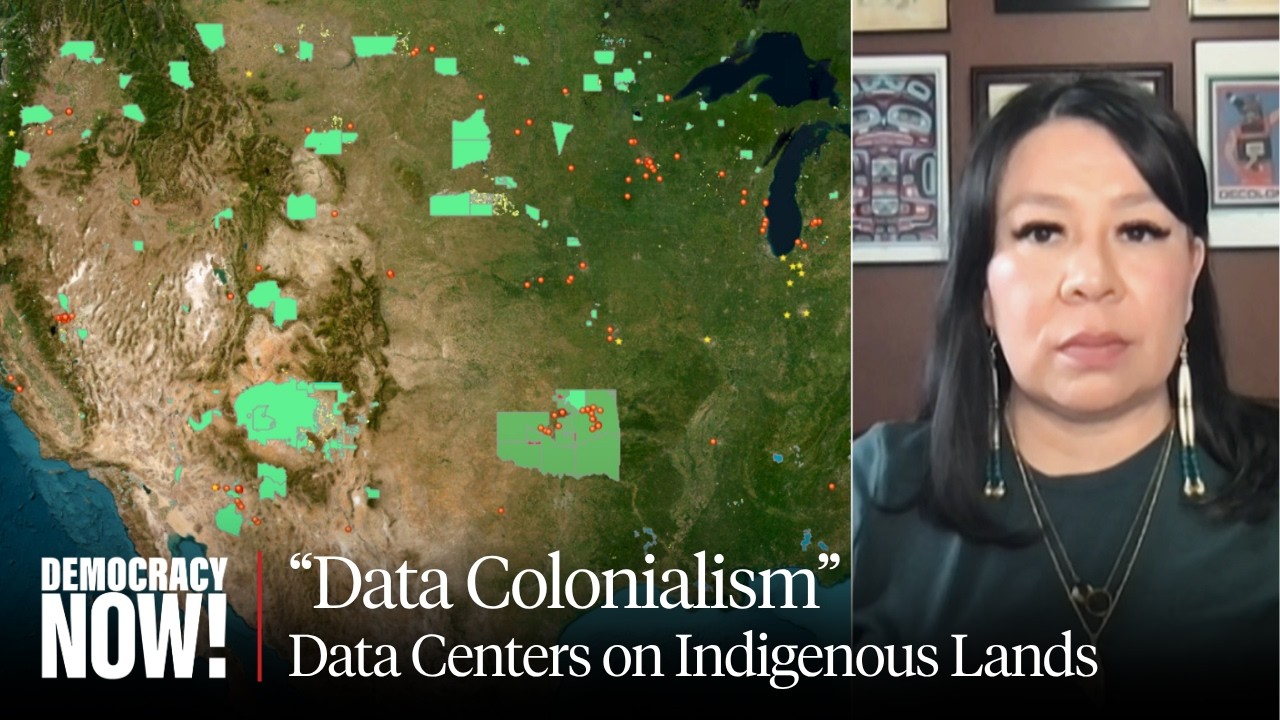
“Data Colonialism”: Native Communities Fight AI Data Centers on Indigenous Land

DANGLE SOLAR, NDA TO GAG SACRIFICE ZONES
Apr 22, 2026 Latest Shows
Support our work: https://democracynow.org/donate/sm-de...The artificial intelligence industry's data center boom is the latest chapter in a long history of environmental racism and resource exploitation in vulnerable Native communities, says Oglala Lakota and Northern Cheyenne activist Krystal Two Bulls, the executive director of Honor the Earth, an Indigenous-led environmental justice organization that is tracking over 100 proposed data center projects on tribal and rural lands. We speak to Two Bulls about the myriad impacts of what she calls a "modern-day iteration" of "settler colonialism," including noise pollution, cancers and respiratory illnesses, water depletion, energy grid overload and even "ecological collapse." As tech companies set their sights on Indigenous lands, Two Bulls says, "We're always the one that ends up having to sacrifice our relationship to land, air, water, our communities and our nonhuman relatives."
1120
For seven years, we have fought this project in the regulatory process of Minnesota, and despite almost 70,000 people testifying against the pipeline, and the clear need to deny this project on environmental, social and economic grounds, Minnesota's Governor Tim Walz approved the final permits for the pipeline. This leaves tribes, Honor the Earth, and citizen groups to uphold the interests of the water and wild rice in Court. (We are, however, joined in our appeal by another state agency- the Minnesota Department of Commerce seeks to overturn the pipeline approvals as not meeting the requirements for a certificate of need, nor meeting route permit requirements.) The appeals will grow, as will the resistance. But we need your support right now to stand for our water. We stand with our lawyers, and we stand with our people. Please make your gift to now help our cause.
It's ironic that one day after Minnesota Governor Tim Walz approved the final state permits for Line 3, Michigan Governor Gretchen Whitmer revoked the 1953 easement that allows Enbridge to operate pipelines through the Straits of Mackinac. Governor Whitmer, acted under the state's public trust doctrine, which requires state authorities to protect the Great Lakes. The pipeline in question, known as Line 5, has been in operation since the 1950s. It carries the oil which would move in Line 3.
“Enbridge has imposed on the people of Michigan an unacceptable risk of a catastrophic oil spill in the Great Lakes that could devastate our economy and way of life,” Whitmer said in a statement. “That's why we're taking action now, and why I will continue to hold accountable anyone who threatens our Great Lakes and fresh water.” Two different Governors, same company.
pipelines
on October 16, JPMorgan Chase, Wells Fargo, Crédit Agricole and 91 other global banks met in Washington, DC, to revise the Equator Principles, industry-led due diligence standards meant to prevent banks from supporting environmentally and socially harmful projects.
On the very same day, in a bitter irony, many of those same banks**re-upped their support for Enbridge,** the Canadian company behind the Line 3 tar sands pipeline, which tramples Indigenous rights and is flatly incompatible with the goals of the Paris climate agreement. They did so just days after the publication of a landmark United Nations report showing the desperate urgency of taking concrete steps to tackle the climate crisis. It’s as if the banks wanted to supply their own headline example of exactly why the Equator Principles are broken and in dire need of repair.
The current round of soul-searching around the Equator Principles dates back to the Dakota Access Pipeline (DAPL) and the Indigenous-led campaign calling out the banks behind the project. DAPL was a crisis for those banks, and it was a scandal for the Equator Principles Association. How did such an obviously flawed project pass muster?
In response to activist pressure, in 2017, the Equator Principles Association agreed to a revision process, including examining how the principles deal with the internationally accepted standard that projects cannot be built unless directly impacted Indigenous communities give their free, prior and informed consent. The Equator Principles currently ignore these principles in rich countries like the US — and ignore climate impacts everywhere.
It’s astonishing that the banks were discussing those revisions on exactly the same day that many of them reaffirmed their support for Enbridge, when the Line 3 pipeline — the company’s largest new investment — is in danger of becoming DAPL 2.0. In a clear echo of DAPL, Enbridge has failed to secure the free, prior and informed consent of Indigenous communities impacted by Line 3: three Ojibwe tribes in the Minnesota portion of the pipeline’s proposed path remain staunchly opposed. There’s been a steady and growing drumbeat of Indigenous-led legal and direct action, up to and including peaceful civil disobedience.
Of course, all this comes on the heels of the historic report recently released by the Intergovernmental Panel on Climate Change that describes food shortages, growing wildfires and massive coral reef destruction by 2040 unless we take immediate action to curb greenhouse gas emissions.
We urgently need to stop expanding and start phasing out fossil fuels to have any chance of meeting the goals of the Paris climate agreement. Flying in the face of these facts, the Line 3 pipeline would increase extraction and burning of tar sands, one of the dirtiest forms of oil. Enbridge is a company going in exactly the wrong direction: Last year, it even sold off a huge wind farm to free up capital to build Line 3.
JPMorgan Chase, Wells Fargo and Crédit Agricole are the lead banks behind two key Enbridge credit facilities, loans that act like giant credit cards for Enbridge to use as it pleases. They are crucial for Enbridge’s ability to build Line 3. When these loans are set to mature, banks have a choice: They can let them expire, or they can renew their support. One of Enbridge’s credit facilities was renewed recently, with another scheduled for renewal in December. At the beginning of October, Minnesota-based Native rights group Honor the Earth and a coalition of Indigenous and environmental organizations sent a letter to those three banks laying out the case against Line 3 and calling on them not to renew their support.
Because Enbridge is funding Line 3 from its general corporate coffers, the pipeline illustrates another fundamental shortcoming of the Equator Principles: Since the standards only cover direct finance for projects, Line 3 is outside of their scope, despite the project’s clear impacts on Indigenous rights and the climate. This is a litmus test for the current revision of the Equator Principles, which should cover projects like Line 3 if they’re going to be worth anything. As a start for companies sponsoring harmful projects, the Equator Principles evaluation should be triggered when these companies are up for credit renewals as well.
But JPMorgan Chase, Wells Fargo and Crédit Agricole can’t hide behind the revision of the Equator Principles. They should immediately end their support for Line 3 by dropping their financing for Enbridge, so long as the company is pushing forward this destructive project. The December credit renewal will serve as another test. This time they should make sure they pass it.
This article was produced by Earth | Food | Life, a project of the Independent Media Institute, and originally published by Truthout
==