stanley, Jason How Fasc Wks
---
expert advisor to jan 6 comm
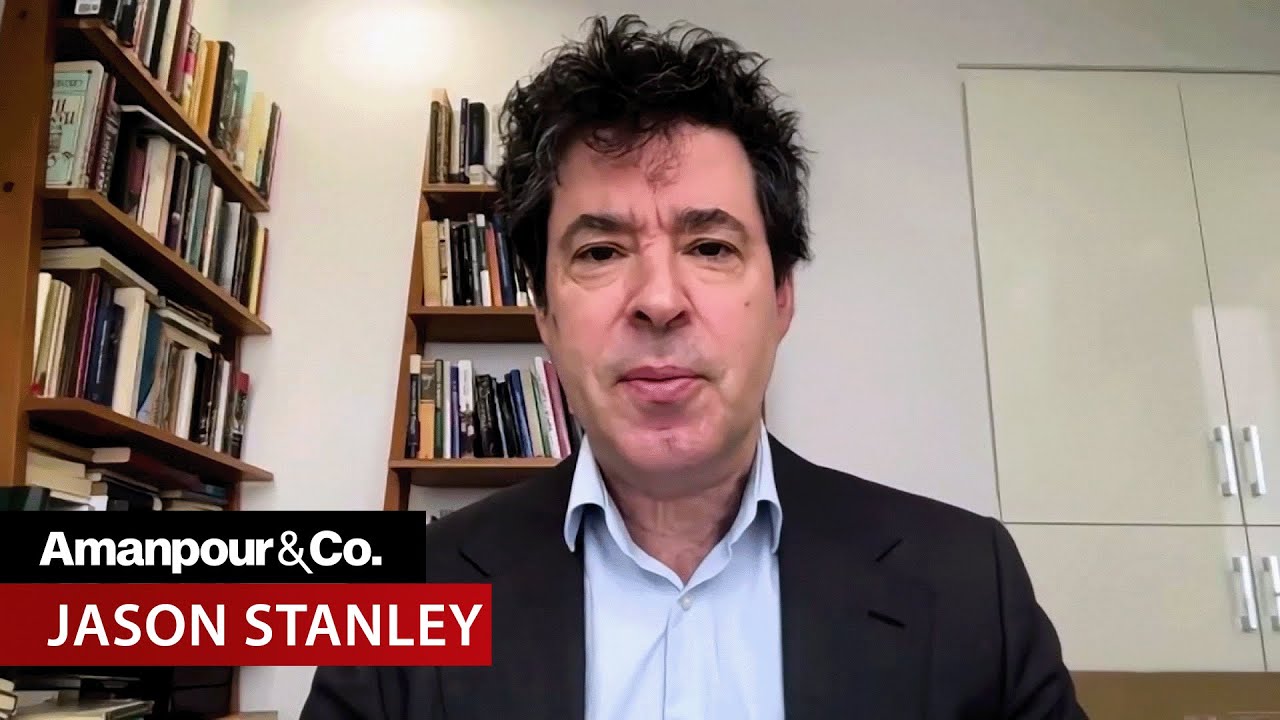
On the fifth anniversary of the January 6 attack on the U.S. Capitol, author and University of Toronto professor Jason Stanley takes stock of the actions of the Trump administration and the Supreme Court in the ensuing years. He argues that both have veered sharply to the right and are doing everything in their power to consolidate right-wing influence, with recent U.S. moves in Venezuela standing out as a vivid example of this strategy. Originally aired on January 6, 2026
...
3:11
possible way. And Putin is uh is in has
3:15
destroyed his own country, killed
3:17
hundreds of thousands of his own
3:19
citizens in a pointless war. Uh killed
3:22
thousands of Ukrainians. Uh there are
3:24
plenty of death spots. But what's the
3:27
difference here? The difference here is
3:28
that Trump can uh there's oil in
3:32
Venezuela and Trump can benefit uh those
3:36
who support him. Trump can benefit uh
3:39
can benefit uh companies. Look, this
3:42
connection between oligarchical
3:45
interests and autocrats is well known
3:47
from history and the current moment. Uh
3:50
if you support the oligarchs, uh the if
3:53
you support the autocrat, he will enrich
3:56
you. So, uh so that's what we're seeing
3:59
now. uh presumably uh there are oil
4:02
companies, oil executives uh who are
4:05
going to profit from this uh as well as
4:08
people close to the president. So the
4:12
motivation here uh is clear. It's...
:56
The the response from most people when
5:59
they hear you and and as you draw these
6:01
parallels and these comparisons, they're
6:03
going to say, "Look, it's not fair to
6:05
compare the United States to a place
6:07
like Hungary or wherever.
6:10
We have these institutions that are
6:14
checks and balances on the White House.
6:16
So, let's first let's talk a little bit
6:18
about the Supreme Courts. What layer of
6:22
confidence do you have that the Supreme
6:25
Court is going to be able to be any sort
6:28
of a check on a rise in executive power?
6:31
No. Because the Supreme Court seems
6:34
fully committed to keeping this
6:37
far-right machine in power. So even well
6:40
after Trump uh we can expect the
6:43
supermajority the conservative
6:45
supermajority many of whom were
6:47
appointed by presidents who are not
6:49
elected by the popular vote. We can
6:52
expect this conservative supermajority
6:54
to uh to to legislate in such a way that
7:00
keeps uh the machine behind Trump in
7:03
power. We've seen that with the use of
7:06
uh the shadow docket. uh the shadow
7:09
docket. They have ruled again and again
7:11
and again and again for the Trump
7:14
administration. Uh this Supreme Court
7:16
was a block on the Biden administration.
7:20
They halted the Biden administration uh
7:23
policies uh across the board. Uh most
7:28
one of the most notable examples would
7:30
be uh the attempt to forgive student
7:33
loans. So uh so the disparity between
7:37
their relationship to the Trump regime
7:40
and their relationship to the Biden
7:42
administration is notable. Uh that
7:44
disparity shows that this is uh simply a
7:47
partis partisan really underells what
7:50
we're what we're seeing here. This is
7:52
the Supreme Court that's going to block
7:55
anything any Democratic administration
7:57
is going to do. They blocked uh so much
8:01
of what the Biden administration was
8:02
trying to do and they're going to use
8:05
the shadow docket. They're going to use
8:07
various methods to simply uh overrule uh
8:12
lower courts decisions that find
8:15
problems with the Trump with what Trump
8:18
the Trump administration is doing. uh
8:21
and they're just going to keep uh keep
8:23
handing this uh administration what they
8:26
want and they'll keep on doing that for
8:29
whoever is in power uh as long as they
8:32
are uh on part of this far-right
8:36
machine. So that's a problem that's
...
8:36
machine. So that's a problem that's
8:38
going to extend well past Trump.
8:41
Are there not lower courts that are
8:44
handing losses to the Trump
8:46
administration?...
9:54
think I think several things here along
9:56
the general question of institutions uh
9:59
that you are that you're framing here. I
10:02
think that this administration thinks
10:05
that no Democrat will ever be in power
10:08
again. It's the only way to make sense
10:10
of their actions. The only way to make
10:12
sense of the actions of MAGA Republicans
10:16
is that they believe that Democrats will
10:19
never be in power again. However, I
10:21
think that's incorrect. I think that
10:23
they have overplayed their hand. I think
10:26
they no longer have public opinion
10:28
behind them. And I think that
10:30
institutions
10:31
uh you know they don't they don't have
10:34
they they haven't been able to target
10:37
successfully all the people they tried
10:40
to target. You know, this was part of
10:43
the reason when we spoke last time about
10:47
why you had personally chosen to move to
10:50
Toronto, move to a university there
10:53
because you felt like the views that you
10:55
express uh could be targeted....
:30
you're like wow legally they could
12:32
target this huge swath of people. Uh and
12:36
uh and that might include me or
12:38
definitely could include me because I'm
12:40
definitely calling the Trump
12:42
administration fascists. Uh so uh but
12:46
they can't target everyone and there's a
12:49
lot of incompetence here. So, does that
12:52
mean you're safe? Does it mean you're
12:53
not safe? Who knows? And and I think
12:57
people in the United States are learning
12:58
to live with that situation. And so, you
13:01
see this incredible normalization, which
13:04
is kind of remarkable to me. Uh there's
13:07
a term that's emerging, sane, that I
13:10
think you find the media doing. Uh that
13:13
is uh a related but different concept
13:16
than normalization.
13:18
uh sane-washing is sort of representing
13:21
what this administration is doing, the
13:23
extreme actions they're taking as saint
13:25
trying to find some rationale for that.
13:28
Uh the normalization seems to me
13:30
something sort of more in the air when I
13:33
go to the United States. People are more
13:35
careful about what they say. Um uh
13:38
people are are sort of accepting the
13:41
craziness of the situation. Uh and the
13:43
situation does seem crazy from the
13:46
outside. Um but personally ...
as things have emerged uh one year}:
13:57
later uh you know are they targeting
14:01
regime critics uh as harshly uh as as
14:05
they could have. Um not now and the
14:08
incompetence uh blocks them from doing
14:11
it. I mean Kash Patel is not Brendan
14:14
Carr. uh he's not as effective of a uh
14:18
of of a of a person. The Justice
14:21
Department people have not been as
14:24
effective uh at targeting uh the broad
14:27
swath of Americans that that they've now
14:30
said they can target. So, so I go back
14:33
and forth about my decision. I mean, my
14:36
decision had multiple elements. I It's
14:38
been very hard. It's been it's it's
14:41
really hard at the age of 56 to uproot
14:44
yourself from your home to separate
14:47
yourself from all of your friends. Uh to
14:50
start a new in a completely new place.
14:53
Uh that has been much harder than I
14:55
accepted. Uh and I meant my decision
14:58
less to be a decision about myself more
15:00
and more to be an expression of a
15:04
political statement about the United
15:07
States. And I think it was a political
15:09
statement about an effective political
15:11
statement about the United States. It
15:13
did express to the world, okay, when
15:16
when people leave, uh that is that is
15:20
concerning, probably more effective than
15:23
any other political statement uh I've
15:25
made. You know, we've also witnessed the
15:28
sort of dismantling of certain agencies,
15:30
the Consumer Financial Protection
15:32
Bureau, for example, or even just in the
15:34
last couple of weeks, we had Donald
15:36
Trump add his name to the Kennedy Center
15:39
building. And you know when you're
15:40
talking about normalization I I guess do
15:43
you see this sort of
15:46
whether it's collusion marriage
cooperation
between state and corporate interests
getting any better? Because it seems
like if it has essentially four years at
least two years plus two more to flesh
itself out that we might be at a point
of no return.
16:08
I don't we are at a point of no return.
There is no return from and right the
merging of state and corporate interests
is is of course a s signature uh sign of
fascism but we are at a point of no
return. What are we going to return to?
I mean how would you reimpose uh you
know I mean any future president can
become a you know make billions of
dollars now. What are you going to say?
You're going to say you know you
suddenly the rules apply again. uh you
know uh the future of the United States
is very very unclear. The reputation of
the United States is in tatters. Uh
America is very unpopular. America will
never stand for democracy again. America
stands for cruelty and white supremacy
right now in the world. uh America uh
inside America the uh the banks uh you
know Jaime Diamond it was reported
today has made over 700 has something
like $700 million in compensation. uh
the the billionaire, you know, people
are just gobbling up the money, the the
the profits. Uh and we have this
classical structure of throwing, you
know, uh cultural meat to uh to poor men
and uh and then just the the
corporations and the oligarchs gobbling
up the money. How do you return from
17:31
this level of corruption? I don't see
17:33
how you can return return from it. Uh
17:36
the question is just um how we build
something new. There's got to be
something new that is built. Uh Mamdani in
New York is kind of possibly sketching
17:47
that. It's got to be something that
17:50
stands up to this merging of state and
17:52
corporate interests, but it's got to be
17:54
something new. There is no return. There
17:57
has to be some future politician will
17:59
have to sketch a a new vision uh for
18:03
America and really some kind of new
18:05
country. Professor Jason Stanley from
18:08
the University of Toronto. Thanks so
18:09
much for joining us.
18:10
Thank you.
18:13
[Music]
18:21
[Music]
---
an 5 25 the conv
In the most non-controversial and basic sense, the rule of law means formal legality. The law binds citizens and governments. When it comes to nation states, law is enacted by democratically elected legislatures; legal statutes are openly available and sufficiently clear to follow. State actions can be judicially reviewed for compliance with a constitution.
In its more ambitious conceptualization, the rule of law can also be understood to include substantive human rights and equity. In Canada, The Constitution Act of 1982 references the rule of law in its preamble.
The modern Canadian iteration of the rule of law — which includes substantive ideas about human rights as well as Indigenous treaty rights — is based on liberal ideas shared by many countries, including, historically, the United States. What distinguishes a rule-of-law state from an authoritarian one to a large extent is whether state actions can be judicially reviewed for compliance with a constitution.
Although rule of law scholars debate the parameters of the concept of the rule of law, few would debate that what is happening during U.S. President Donald Trump’s second term presents anything other than a wholesale attack on the rule of law both domestically in the U.S and internationally.
I am a rule of law researcher, educator and lawyer. Since Trump was elected to his first term in 2016, I’ve relied on American scholars, from a variety of disciplines, to understand what is happening.
These include two prominent Yale professors, philosopher Jason Stanley and historian Timothy Snynder, both of whom have recently announced they’re moving to the Munk School of Global Affairs at the University of Toronto.
Authoritarian impulse
In their scholarship, Stanley and Snyder have sought to explain the authoritarian impulses of the first Trump administration and how to resist it.
Stanley’s father, a German Jew who fled Germany for America in 1939, carries the remembrance of fascism.
Both Stanley and Snyder explore the similarities between what is occurring in Trump’s America, Viktor Orban’s Hungary, Vladimir Putin’s Russia, Xi Jinping’s China and, equally chillingly, between Trump’s America and Adolf Hitler’s Germany. Even prior to the first Trump presidency, Stanley already asked in his 2015 book, How Propoganda Works, whether the U.S., “the world’s oldest liberal democracy,” might already have become a liberal democracy “in name only?”
Examination of propaganda, rhetoric
In his 2018 book, The Road to Unfreedom: Russia, Europe, America, Snyder described Trump as a “sado-populist, whose policies were designed to hurt the most vulnerable people of his own electorate.”
Stanley’s focus on propaganda and rhetoric were especially useful for framing the politics of Trump.
Similarly, Snyder’s focus on the similarities between Trump and other authoritarian leaders, through their attachment to extreme illiberal ideologies, helped frame public discourse in the U.S. during the first Trump presidency. “Illiberal” does not imply conservative in opposition to “being liberal” (with the resonance of “leftist”); rather, it denotes a repudiation of liberal democracy, in the words of political scientist Thomas J. Main.
Both Stanley and Snyder are on the public record explaining their decision to immigrate to Canada, on the basis that they can no longer continue their scholarly activities in an American university, even a premier one like Yale. Jason Stanley speaks with Amanpour and Company.
Improper interference
This is an admission by important thinkers that civil society, intellectuals and critical scholars, in particular, are under assault.
It comes as no surprise given other developments. Trump’s executive orders, threats to some university funding and crackdowns on activists and academics — as well as the attempted deportations of those without U.S. citizenship — have used the idea of combatting campus antisemitism as cover for an attack on free expression, academic independence and student activism.
From my perspective as a Jewish person, a post-secondary teacher and as someone with a legal education, all of these developments have hit hard, especially alongside accounts of some of America’s most prestigious law firms caving to improper interference by the Trump administration.
What ‘fascism’ means
In the introduction to his bestselling 2020 book, How Fascism Works, Stanley wrote: “In recent years, multiple countries across the world have been overtaken by a certain kind of far-right nationalism; the list includes Russia, Hungary, Poland, India, Turkey and the United States.”
He explains the choice of the word “fascism” to speak about each of these countries, despite their differences of degree and context:
“I have chosen the label ‘fascism’ for ultra nationalism of some variety (ethnic, religious, cultural), with the nation represented in the person of an authoritarian leader who speaks on its behalf. As Donald Trump declared in his Republican National Convention speech in July 2016, ‘I am your voice.’”
In his similarly bestselling book, On Tyranny, published in 2017, Snyder wrote: “To abandon facts is to abandon freedom. If nothing is true, then no one can criticize power, because there is not basis upon which to do so. If nothing is true, then all is spectacle. The biggest wallet pays for the most blinding lights.”
Now that Trump is back in office, Stanley and Snyder, as well as Snyder’s Yale colleague and spouse, Marie Shore, the celebrated author of The Ukrainian Night, are leaving Yale for Canada with good reason. Author Timothy Snyder speaks about Democracy and the Risk of Tyranny with Public Policy Forum.
Shared mutual concern
While the departure of a handful of prominent academics is hardly a trend, it raises questions about whether there will be an accelerated academic “brain drain”, or more American students in Canada.
As a Canadian, I would like to say America’s loss is our gain, and I wish these scholars well. I am also aware that narratives of flight to Canada as refuge have historically bolstered national myths while obscuring Canadian inequities. My hope is that Canadians will not observe the arrival of U.S. scholars with smugness, but instead with shared concern.
We should not be blind to this unique moment in which Canada is called to revisit why we care about Canada and keep watch on the rule of law. Yet, we must also recognize our own profound historical blind spots.
For example, while an overt threat to sovereignty is new for some Canadians, it is nothing new for Canada’s Indigenous Peoples. Today it’s important to understand the distinctively Canadian importance of Indigenous law to any reaffirmation of the rule of law tradition in Canada in the 21st century.
Too much cynicism might prevent us from acknowledging the importance of these three scholars’ decisions to leave their country and come to ours at this particular time in history. However, my hope is also that we are also inspired by their considerable truth-telling skills to demand Canada also do better.
Jeffrey B. Meyers, Instructor, Legal Studies and Criminology, *Kwantlen Polytechnic University
This article is republished from The Conversation under a Creative Commons license. Read the original article.
---
---
https://www.publicnotice.co/p/jason-stanley-interview-fascism-erasing-history
11 24
Fascist politics invokes a pure mythic past tragically destroyed,” Jason Stanley wrote at the very beginning of his 2018 book, “How Fascism Works: The Politics of Us and Them.” Six years later, Stanley — a philosophy professor at Yale — is publishing a kind of prequel.
“Erasing History: How Fascists Rewrite the Past to Control the Future,” released this month, is a study of how authoritarian regimes create their mythic past through silencing and erasing anyone who questions the myth. The book chronicles the right-wing attack on education and memory in K-12, in universities, in public discourse, in the US and abroad.
“Authoritarianism’s great rival, democracy, requires the recognition of a shared reality that consists of multiple perspectives,” Stanley writes. He then explains, systematically, how the right is working to undermine that shared reality, often with frightening success.
It's not a cheerful book, but it’s a necessary one. As Stanley told me by phone, with a rueful laugh, “You know, people are like, ‘Oh, fascism threatens!’ And I’m like, fascism has always threatened.”
Fighting the right is nothing new, and we do know how to oppose it — in part by remembering the past that authoritarians want us to forget. Stanley’s book, therefore, is both about the effort to erase history and a chronicle of a history that the right wants erased. It calls for, and inscribes, public remembering.
The interview below has been edited for length and clarity.
Noah Berlatsky
Why are fascists threatened by historical memory?
Jason Stanley
First of all, quite clearly, authoritarian regimes must erase any history of social movements for democracy.
In China you're not allowed to talk about Tiananmen Square. In the Soviet Union, you had to erase the history of Ukrainians or Jewish people, their particular route through history, because you wanted to represent World War II as just an attack on communism.
So, you have certain myths that you want to promulgate, myths that underlie whatever version of authoritarianism is at issue. In the case of a version of authoritarianism that's fascist, you would want to glorify the dominant group and erase the perspectives of non-dominant groups. You want to enforce rigid gender roles, so you'd make it seem that gender fluidity or LGBT relationships are not normal. In this way, when there is any challenge to the dominant group, people won't understand those challenges.
Democracy is not about everybody being the same, but it's about everybody understanding each other's perspectives. In a democratic culture, everyone has equal voice. But you can't hear someone's voice if you don't know their history....
---
“The real fascist”
That’s when we witnessed the “memeification” of Biden – endless Hitler comparisons that got #PedoHitler trending on Twitter.
Tucker Carlson said Biden stood in front of a “blood-red Nazi background.” Marjorie Taylor Greene layered a Hitler video over the speech to create a “deep fake” of Biden looking like Hitler.
Texas state representative Briscoe Cain gave a subtler Hitler reference by saying he couldn’t understand Biden’s speech, because it was in German. Others just called Biden satanic or lunatic.
Robert Paxton described five stages of fascism in an article published in 1998 (he wrote an op-ed calling Trump a fascist in 2021).
These include:
- Group primacy over individual rights.
- Group purity.
- Group victimhood justifying attacks on enemies.
- Fear of “cosmopolitan liberalism.”
- Faith in authority of “natural male leaders.”
Jason Stanley writes of three essential features of fascism. They include “conjuring a mythic past” that the enemy has somehow destroyed, sowing division and attacking the truth with propaganda. This propaganda is usually particularlyanti-intellectual.