Susquehanna BAK Invest gp
see yass
==
aha 6 22
i had not fully connected financialization and extraction
funny how milton provides holy rationale for greedy theft
i had sorta hoped pandemic trump had forever banished libtard BS
https://www.alternet.org/2022/06/billionaire-tax/
Inside the Tax Records of the .001%
One day in July 1985, three young men from Philadelphia, their lawyer and a burly Pinkerton guard arrived at a horse track outside Chicago carrying a briefcase with $250,000 in cash.
Running the numbers on a Compaq computer the size of a small refrigerator, Jeffrey Yass and his friends had found a way to outwit the track’s bookies, according to interviews, records and news accounts. A few months earlier, they’d wagered $160,000, gambling that, with tens of thousands of bets, they could nail the exact order of seven horses in three different races. It was a sophisticated theory of theracing odds, honed with help from a Ph.D. statistician who’d worked for NASA on the moon landing, and it proved right. They bagged $760,000, then the richest payoff in American racing history.
But that summer day, when they presented their strikingly long list of bets at the track window, they were turned away. Their appeal to the track owner got them ejected. Yass, just 27, then sued for the right to place the bets. The track’s lawyer fumed to a federal judge that the men were trying to corner the betting market “through the use of their statistics and numbers.”
Yass lost, but that year he and his friends repeated variations of the strategy at horse and greyhound tracks around the country. Then they decided to turn their focus from a world of hundreds of thousands of dollars to a world of billions: Wall Street.
Four decades later, the firm he and his friends founded, Susquehanna International Group, is a sprawling global company that makes billions of dollars.Yass and his team used their numerical expertise to make rapid-fire computer-driven trades in options and other securities, eventually becoming a giant middleman in the markets for stocks and other securities. If you have bought stock or options on an app like Robinhood or E-Trade, there’s a good chance you traded with Susquehanna without knowing it. Today, Yass, 63, is one of the richest and most powerful financiers in the country.
But one crucial aspect of his ascent to stratospheric wealth has transpired out of public view. Using the same prowess that he’s applied to race tracks and options markets, Yass has taken aim at another target: his tax bill.
There, too, the winnings have been immense: at least $1 billion in tax savings over six recent years, according to ProPublica’s analysis of a trove of IRS data. During that time, Yass paid an average federal income tax rate of just 19%, far below that of comparable Wall Street traders.
Yass has devised trading strategies that reduce his tax burden but push legal boundaries. He has repeatedly drawn IRS audits, yet has continued to test the limits. Susquehanna has often gone to court to fight the government, with one multiyear audit battle ending in a costly defeat. The firm has maintained in court filings that it complied with the law.
Yass’ low rate is particularly notable because Susquehanna, by its own description, specializes in short-term trading. Money made from such rapid trades is typically taxed at rates around 40%.
In recent years, however, Yass’ annual income has, with uncanny consistency, been made up almost entirely of income taxed at the roughly 20% rate reserved for longer-term investments.
Congress long ago tried to stamp out widely used techniques that seek to transform profits taxed at the high rate into profits taxed at the low rate. But Yass and his colleagues have managed to avoid higher taxes anyway.
The tax savings have contributed to an explosion in wealth for Yass, who has increasingly poured that fortune into candidates and causes on the political right. He has spent more than $100 million on election campaigns in recent years. The money has gone to everything from anti-tax advocacy and charter schools to campaigns against so-called critical race theory and for candidates who falsely say the 2020 election was stolen and seek to ban abortion.
ProPublica has pieced together the details of Yass’ tax avoidance using tax returns, securities filings and court records, as well as by talking to former traders and executives. (The former employees spoke on condition of anonymity, with many citing a desire to avoid angering Yass.)
Through a spokesperson, Yass declined to be interviewed for this article. The spokesperson declined to comment in response to a long list of questions for Susquehanna and the firm’s founding partners.
Gregg Polsky, a University of Georgia law professor and former corporate tax lawyer who was retained by ProPublica to review Susquehanna’s tax records, said the tax agency may have more to scrutinize. The strategies revealed in Yass’ records, he said, were “very suspicious and suggestive of potential abuse that should be examined by the IRS.”
More than 35 years after he was booted from the racetrack outside Chicago, Yass still lives to gamble. Not just on horses, but on poker and on the market. He sheepishly admitted, in a podcast discussion, that he has even placed wagers on his children’s sports games.
Asked to describe his approach to trading at Susquehanna, Yass once reached for a poker analogy. “If you’re the sixth-best poker player in the world and you play with the five best players, you’re going to lose,” he said. “If your skills are only average, but you play against weak opponents, you’re going to win.”
That philosophy along with, Yass freely admits, a lot of luck, has made him a billionaire many times over.
Compared to many of his fellow billionaires — he’s richer than Hollywood mogul David Geffen, retail brokerage king Charles Schwab and “Star Wars” creator George Lucas — Yass doesn't seem particularly interested in the trappings of extreme wealth.
Yass and his wife, Janine, raised four children in the leafy college town of Haverford, on the Main Line outside of Philadelphia. Their large but unremarkable house could easily be the home of a successful doctor rather than one of the richest men in the country. In his quarter-zip pullover sweater, Nikes and no-nonsense rimless glasses, he’d be impossible to pick out of a crowd at the suburban country club where he plays golf.
If Yass collects expensive art or maintains a megayacht, he has managed to do so in complete secrecy. What comes closest to an identifiable trophy asset is a house in the ultra-exclusive Georgica Association beach neighborhood of East Hampton on New York’s Long Island. Even that property, purchased for $12.5 million in 2005 and held through an LLC, is in an area known as “bucolic and understated.”
Those who have worked with Yass say he lives less for spending money than for the competition of the market and the thrill of taking calculated risk. Yass softens any impression of ruthlessness by deploying a practiced humility and comedic timing. “Some people like art history,” he once explained, “I like probabilistic analysis.”
Yet when it comes to his philosophical outlook, he eschews the jokes. He speaks of capitalism in religious terms. Making new markets, he likes to say, is a “mission from God.”
Like many religious stories, his begins with a conversion experience.Born in 1958 to two Queens CPAs, Yass said reading the economist Milton Friedman’s “Capitalism and Freedom” as a young man delivered him from an early flirtation with socialism.
By the time Yass graduated from the State University of New York at Binghamton in 1979, he was already captivated by trading. (His father had also helped nurture Yass’ love of horse racing by taking him to local tracks to see harness racing, according to Forbes.) Yass’ college thesis weighed whether the budding market in stock options could be justified as socially useful. “I concluded that it should exist,” Yass later cracked. “I got a B.”
After college, he moved to Las Vegas for a year and a half to play poker professionally. Then he returned to the East Coast and settled in Philadelphia, where he began trading options. The previous decade had seen aburst of academic interest in the financial instruments, including a pioneering model of how to more accurately price them.Yass later called the model, and its broader implications for how to make mathematically sound decisions, “the most revolutionary idea in a long, long time.”
A share of stock is a relatively simple concept: It’s a small ownership stake in a company. An option, by contrast, is a contract that confers the right to buy or sell a given stock at a particular price and time in the future.
Options attract mathematically minded traders since a complex set of variables, including the underlying stock price, volatility, time and interest rates, determine how much one of the contracts is worth.
Options are a versatile tool. They can appeal to the risk-averse:Traders can use them as insurance to guarantee they will be paid at least today’s price when they sell in the future. They are also useful to the risk-embracing — gamblers who want to place outsized bets on how a stock will perform. (Here’s how a speculator would use an option: In early June, shares of Netflix were trading at below $200. If the speculator thinks the company’s fortunes will improve dramatically this summer, they could pay just $4.50 each for options to buy the stock at $250 in mid-August. If the stock soars over that figure, they could make a mint.)
In options Yass found more than a finan...
==
==
https://www.exposedbycmd.org/2020/03/16/right-wing-super-pac-runs-pro-sanders-ad-after-running-anti-sanders-ad/
alex k
right-wing, billionaire-funded Club for Growth Action super PAC has a message for liberal voters: Billionaires behind Joe Biden are helping the Democratic Party rig the presidential primary against Bernie Sanders.
“After Mike [Bloomberg’s] $600 million couldn’t get it done, now the billionaires are propping up Joe Biden…because they own him,” says the narrator of the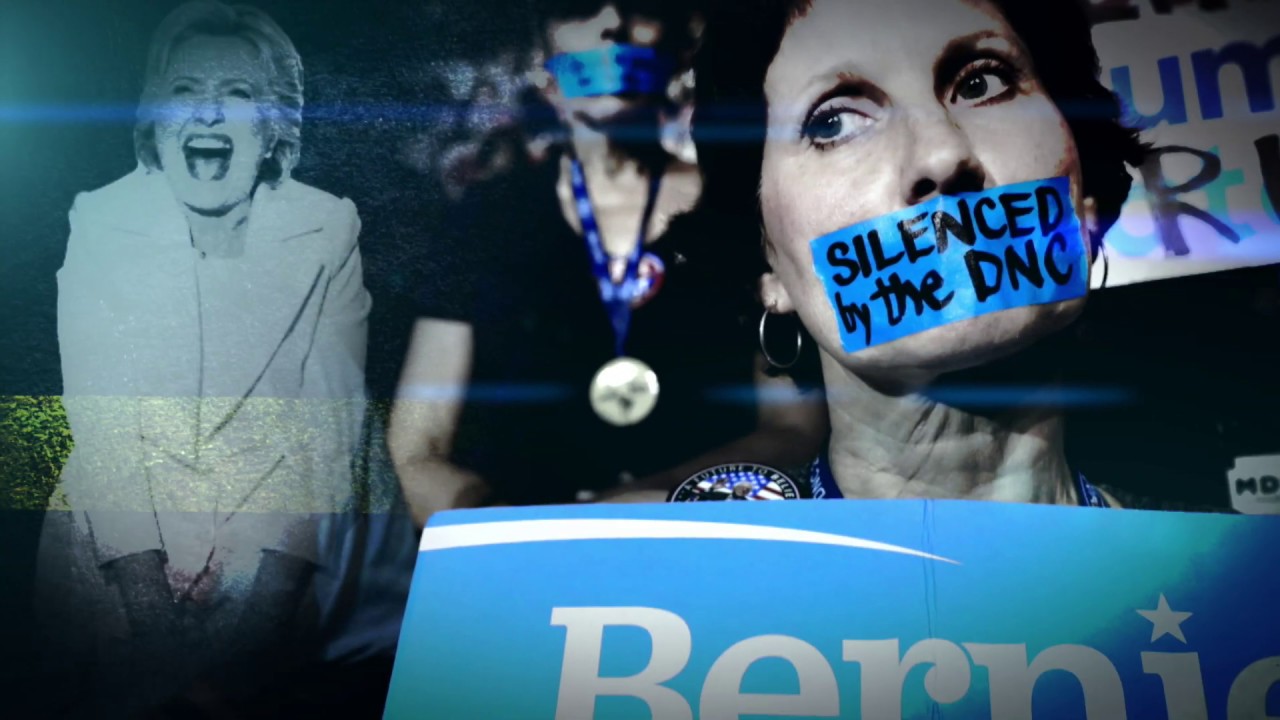 . “Don’t let them steal it.”
Just weeks ago, the same super PAC ran an ad attacking Sanders for his progressive positions on health care and climate change.At the time, the Center for Media and Democracy (CMD) reported that Club for Growth Action’s biggest donors included billionaires Richard Uihlein, owner and CEO of shipping supplies company ULINE, Jeff Yass, managing director and co-founder of financial firm Susquehanna International Group, and private equity owner John Childs.
A March 10 Club for Growth Action press release says the group will spend five figures on the digital ad, which will run in the four states set to vote on Tuesday, March 17: Arizona, Florida, Illinois, and Ohio.
“Remember” is the fourth ad that Club for Growth Action has released in the Democratic presidential primary. The group has also run an ad attacking former candidate Beto O’Rourke and another criticizing Biden for working with “racist Dixiecrats” to oppose school busing integration. The super PAC has spent a total of nearly $180,000 on ads against Democratic presidential contenders Biden ($86,000), Sanders ($59,000), and O’Rourke ($35,000), according to Federal Election Commission data.
Club for Growth Action has made over $5 million worth of independent expenditures in the 2020 elections so far, much of it going towards Republican congressional primaries, according to the Center for Responsive Politics.
Other conservative super PACs have made independent expenditures opposing Biden and Sanders, as CMD recently reported. As of March 4, The Committee to Defend the President had spent nearly $900,000 against Biden, while the Republican Jewish Coalition Victory Fund spent $69,000 against Sanders. Additional conservative groups have spent smaller amounts attacking both candidates.
Club for Growth, the 501(c)(4) social welfare nonprofit linked to Club for Growth Action, with an annual revenue of $6.7 million, is also reliant on conservative billionaires. For example, the Charles Koch-backed trade association now called The Seminar Network Chamber of Commerce donated $175,000 to Club for Growth in 2017. A few years before, the group received over $1 million from the Koch-backed Center to Protect Patient Rights.
==
==
https://www.factcheck.org/2020/01/club-for-growth-action-5/
1/20
political leanings: Conservative
2018 total spending: $19.6 million
Club for Growth Action, the super PAC of the conservative Club for Growth, was launched in August 2010. On its website, the organization declares its mission is to “take on any Member of Congress on policy who fails to uphold basic economic conservative principles … regardless of party.”
The PAC targets some Republican incumbents in primary elections in order to replace them with “pro-growth, limited government conservatives.” Club for Growth Action states on its website that it has been “instrumental” in helping to elect conservatives such as Sen.Ted Cruzof Texas, Sen.Marco Rubioof Florida andSen.Tim Scottof South Carolina.
As of Dec. 31, 2019, the group had raised $7.7 million in the 2020 election cycle.
Its independent expenditures — spending for or against identified candidates, without coordination with candidates or parties —totaled about $2.5 million as of Feb. 10. Club for Growth Action spent more than $550,000 against Democrat Dan McCready in North Carolina. McCready lost to Republican Dan Bishop in North Carolina’s 9th Congressional District special election in 2019. In the Democratic presidential primaries, the group has so far spent almost $67,000 against former Vice President Joe Biden, $59,000 against Sen. Bernie Sanders and a little more than$34,000 against former Rep. Beto O’Rourke of Texas. O’Rourke dropped out of the Democratic race on Nov. 1.
The bulk of Club for Growth Action’s money thus far in the 2020 cycle has come from three donors. Richard Uihlein, thechief executive officer of Uline, a shipping, packaging and industrial supplies company, gave the PAC $2.5 million in May. The two other major donors are Jeff Yass, cofounder of the financial firm Susquehanna International, and Virginia James, a conservative investor and former spouse of Club for Growth co-founder and stockbroker Richard Gilder. They have donated $2 million and $1 million to the PAC, respectively.
In the 2018 cycle, Club for Growth Action spent $19.6 million. The PAC spent $1.2 million in the Texas senatorial race against O’Rourke, who lost in his bid to unseat Cruz. The group also spent more than$1.1 million to defeat Republican candidate Russell “Russ” Fagg in the Montana Senate Republican primary.
The PAC also focused onspecial House elections in Georgia and Pennsylvania. During the last election cycle,the group found itself at odds in the Georgia House race with a pro-Trump group called 45Committee.Club for Growth Action endorsed RepublicanBob Gray — one of 18 candidates, including 11 Republicans, running in what was known as a “jungle primary.”
45Committee ran TV ads opposing Gray, claiming voters could not “trust him” because he “stands with the Club for Growth.” Gray did not survive the primary.Karen Handel, a Republican, won the special election in a runoff against Democrat Jon Ossoff.
A large chunk of the PAC’s money in the 2018 election cycle came from Uihlein, who has donated to Club for Growth Action since2010. Uihlein gave the PAC $6.7 million. Jeff Yass, co-founder of global trading firm Susquehanna International Group, gave the PAC a little over$3.8 million. Yass also serves on the board of directors at the Cato Institute, a libertarian think tank.
In the 2016 cycle, Club for Growth Action spent a little over $20 million. On the presidential election alone, the group spent nearly $8 million — including more than$7 million against Donald Trump during the Republican primary. The group, for example, accused Trumpin TV adsof supporting higher taxes. Once in office, Trump signed the Tax Cuts and Jobs Act, which reduced individual and corporate income tax rates, among other things. (See our story, “A Guide to the Tax Changes.”)
-=-=
-=-=
BAK MAIN 11 26
==
BALLROOM
KALSHI CNBC GOAT GREENWASH
funds dirty tricks BUY ELECTION
FASCISM 5
LONSDALE PALANTIR
NO MERRI
TRUMP FUNDER
SEE TIKTOK BYTEDANCE
ELSASS NASTY POL OP OPIOID RX
LIBTARD GRAMM
PVT PAROCHIAL SCHOOL
SCOTT PERRY?
BAK 11 26 INVEST GP
beat by summer lee
===
LIL SIS TOOL 4 25
There are now more than 3,000 billionaires worldwide according to Forbes’ 2025 world billionaires list released earlier this month. Of those, 902 live in the US, where they use their immense power over our lives and our democracy to rig the rules in their favor and enrich themselves.
While their wealth keeps increasing, so does our cost of living. Ranked 25th, Jeff Yass’ net worth increased 125% in one year. Across the country organizers are launching campaigns to challenge billionaire influence and make the ultra-rich pay their fair share to contribute to society; such as the #AllEyeOnYass campaign led by a coalition of diverse Pennsylvania based organizations.
Earlier this month we launched our Meet the Rich series where we’ll dive into their corporate connections and their impact on our climate, politics and labor rights. Follow us for more.
goat herder greenwash ads cnbc
-=-=
rww 9 26
- Sean Kitchen @ The Keystone: Right-wing operative brags that this Big Tech billionaire controls Pa. Republicans
A political operative funded by Jeffrey Yass bragged about the influence the Big Tech billionaire has over the Pa. Republican Party.
-=-=
-=-=
DEFECTOR? AN 12 25
FRANKFORT — A super PAC supporting U.S. Rep. Thomas Massie has won crucial backing from one of the biggest Republican mega-donors — a man who has the wherewithal to offset millions of dollars that Republican President Donald Trump is trying to raise to beat Massie in the spring primary elections.
That man is Jeff Yass, who recently — and indirectly — gave $1 million to a new super PAC that in recent weeks has been advertising in support of Massie’s reelection, according to records filed with the Federal Election Commission. Those records show Yass has set aside millions more in what could potentially be used for additional independent spending to help reelect Massie.
Trump recruited and has endorsedShelbyville Republican Ed Gallrein, a former Navy Seal, to challenge the incumbent Massie who drew the president’s ire by differing with him on several high profile issues and House votes.
Yass is co-founder of the Philadelphia-based trading firm Susquehanna International Group. Bloomberg reports he is worth $63 billion, making him the 27th wealthiest person in the world. Politically conservative with a libertarian streak, Yass has backed Kentucky U.S. Sen. Rand Paul since Paul’s failed bid for the 2016 Republican nomination for president. And, according to the campaign finance watchdog group OpenSecrets, Yass has made more than $100 million in contributions to super PACs in the 2023-24 election cycle.
Massie, a Republican from Vanceburg, has won election to the U.S. House in Kentucky’s 4th District by wide margins seven times, but now is a target of the Republican president because he has strayed from the Trump line on several important votes. Most significantly, Massie opposed Trump’s showcase public policy proposal, the Big Beautiful Bill Act, over concerns about the bill’s impact on the national debt. Massie drew widespread media attention over the summer and fall as the key Republican who successfully pushed to force a vote to require the Justice Department to release its records of convicted sex offender Jeffrey Epstein. Trump opposed releasing the Epstein files until it became clear Congress would vote for their release.
In June a new anti-Massie super PAC was created by Trump supporters, and it reported quickly raising $2 million that funded a media campaign attacking Massie over the summer.
But reports filed recently with the FEC show that a new super PAC called Kentucky First PAC countered with a pro-Massie advertising campaign in late October.
Those reports show the following steps:
- On Oct. 20 Yass contributed a whopping $7.5 million to a super PAC called Protect Freedom Political Action Committee. This super PAC was created in 2017 by political advisors to Paul that for the past five years has gotten 95% of its money (about $35 million) from Yass. Its cash on hand was down to about $114,000 until Yass provided the $7.5 million on Oct. 20.
- On Oct. 23 Protect Freedom donated $1 million to the new pro-Massie Kentucky First PAC.
- On Oct. 31 Kentucky First reported paying a bit over $1 million ($1,006,986 to be exact) to a company called Maverix Media, for the pro-Massie media campaign now going on in the district.
Massie’s campaign declined to comment for this story.
But in an article published by Roll Call on Monday, Massie said he is ready for an onslaught of attack ads from super PACs aligned with Trump.
And he referred to some of the recent activity by super PACs in the campaign.
“The state of play now is that the anti-Massie super PAC has gone dark and has been dark for a few months, and a pro-Massie super PAC is spending a million dollars on ads right now in the congressional district,” Massie told Roll Call.
Gallrein’s campaign on Monday released a two-minut introducing him to voters as a three-decade Navy SEAL officer and showing him working on his Shelby County farm. It accuses Massie of trying to undermine Trump’s “plan to save America.”
Michael Biundo, the spokesman for Protect Freedom, did not respond to a list of questions sent to him by the Kentucky Lantern.
Deanna Hayes, treasurer for Kentucky First, did not return a phone message.
No one at Susquehanna International Group returned an email seeking comment from Yass about his contribution to Protect Freedom.
Yass may have funded additional support to help Massie through Protect Freedom beyond the $1 million contribution it made to Kentucky First PAC.
Protect Freedom also listed in its recent report to the FEC that it had two major expenses: $508,000 paid to Maverix Media for a media buy and $500,000 for get out the vote efforts. However, the report does not identify the candidate who was supported, or opposed, by that independent spending.
Protect Freedom reports having more than $5 million on hand.
Yass surfaced as a player in elections involving Kentuckians in 2015 when he helped fund super PACs supporting Paul’s presidential bid.
In 2017 he started making regular contributions to the Paul-affiliated Protect Freedom PAC, which initially had several wealthy donors but since 2021 has almost exclusively been funded with contributions from Yass.
In more recent years he has spent millions on independent advertising campaigns on Kentucky elections, including supporting the so-called “school choice” constitutional amendment last year and Republican Daniel Cameron’s 2023 campaign for governor. The school choice amendment was defeated and Cameron lost to incumbent Democratic Gov. Andy Beshear.
AN 11 25
A little over a year since he was reelected,the New York Times reports that the list of donors for President Donald Trump's transition efforts has finally seen the light of day. The list is notable for the presence of various billionaires, lobbyists, and future administration appointees, with one expert summing it up as a rundown of "who is buying the government."
In the past, prior incoming presidential administrations, including Trump's first, signed an agreement pledging to disclose their list of transition donors within 30 days of their inauguration in exchange for $7 million in federal funding and support from the General Services Administration. The second time around, however, Trump refused to sign the agreement, leaving the list shrouded in secrecy.
The agreement would have also capped donations at $5,000 and blocked donors from foreign countries. At the time, Trump's chief of staff Susie Wiles said the decision to forgo the agreement was made to “save taxpayers’ hard-earned money," while also pledging to release the list at a later date and ensure that no non-citizen donations were accepted.
On Wednesday, the New YorkTimesreleased a report finally delving into the 46 names now disclosed by the Trump administration, roughly 10 months after the inauguration. The report highlighted two notable billionaires included in the list, Jeff Yass and Paul Singer. Yass is the co-founder of the trading firm Susquehanna International Group and an investor in TikTok. He has been credited with convincing Trump to soften his stance on a ban of TikTok in the U.S. Singer is a venture capitalist who founded Elliott Management, where he works as co-CEO.
Elsewhere on the list are numerous names of individuals who went on to receive appointments to key positions in the Trump administration. This includes former WWE executive and first-term cabinet member Linda McMahon, who now serves as Secretary of Education, leading the charge to try and disband the Department of Education altogether. There is also Howard Lutnick, who now serves as Trump's secretary of commerce.
"Steve Witkoff, Mr. Trump’s special envoy to the Middle East, donated, as did Stanley Woodward Jr., the third-ranking official in the Justice Department," the Times report explained. "Dominick Gerace II, who was sworn in as the U.S. attorney for the Southern District of Ohio in August, is also listed as a donor."
The report also noted several names on the list that match those of known lobbyists, but could not reach them to confirm.
“They claimed they were saving taxpayers money, but what they were doing was hiding the ball about who is buying the government,” Max Stier, the president of the nonprofit watchdog group Partnership for Public Service, said in a statement about the list to the Times.
---}:
2024 KTY
:{:{POLITICS & GOVERNMENT}:
:{Ousted KY official who championed psychedelic to treat addiction lands similar job in Ohio By Alex Acquisto and Austin Horn Updated February 26, 2024 2:38 PM Gift Article
Bryan Hubbard, chair of the Kentucky Opioid Abatement Advisory Commission, has proposed the state use opioid lawsuit settlement money to conduct clinical research into the psychedelic drug, ibogaine, as a potential therapeutic to treat opioid addiction. Alex Acquisto The recently ousted director of Kentucky’s commission charged with distributing opioid lawsuit settlement money, who championed a proposal to invest those funds into researching the efficacy of a psychedelic drug to treat opioid addiction, has accepted a similar role in Ohio. }:
Bryan Hubbard, former executive director of the Kentucky Opioid Abatement Advisory Commission, has signed a contract with the state of Ohio. TOP VIDEOS His job: To help build public-private partnerships for potential projects “related to the treatment of Traumatic Brain Injury, Post-Traumatic Stress Disorder and other related and unrelated mental health and substance use conditions,” according to a spokesperson in the office of Ohio Treasurer Robert Sprague. “In part, the work is set to assist the Treasurer’s office with determining the feasibility of potential solutions with ResultsOHIO and other pay-for-success models,” Brittany Halpin, Prague’s press secretary, said in an email. ResultsOHIO is a state government initiative that uses a combination of public and private funding to pursue “innovative” ways to address Ohio’s “most pressing social and public health challenges,” according to the Treasurer’s website.
Hubbard will be paid $45,000 for his independent contracting services, according to his contract, which was reviewed by the Herald-Leader. The Treasurer’s office has asked him to detail how Ohio can best seek “stakeholder-based coalitions to establish and provide feedback and support, including private and public financial support” for future ResultsOHIO projects to treat traumatic brain injuries, PTSD and addiction that have yielded “results-based solutions.” While working with the state to “deliver novel treatment access and research opportunities for veterans and opioid dependent individuals,” Hubbard told the Herald-Leader, he’s also partnering with the Ohio-based REID Foundation to “create the framework for ibogaine clinical trials in Ohio.”
In a press release last week announcing that partnership, REID Foundation said Hubbard will work to create an “implementation framework that he hopes will lead to the execution of FDA-approved clinical research trials with ibogaine in Ohio for the treatment of opioid dependence.” Hubbard was in the process of similar work in Kentucky as head of the Opioid Abatement Advisory Commission when he was asked to resign in late December by incoming Republican Attorney General Russell Coleman. Coleman appointed Chris Evans, a former chief operating officer for the Drug Enforcement Administration, in Hubbard’s place. The REID Foundation was created by Rex Elsass, who lost his son to addiction in 2019. Elsass is also one of the nation’s premier Republican operatives. In 2016, GQ Magazine dubbed him “The Most Powerful Man in the GOP (And You’ve Never Heard Of Him).”
His political media and consulting firm is called The Strategy Group. Elsass has been close to Kentucky Sen. Rand Paul, serving as a key adviser in Paul’s 2016 bid for president. As senator, Paul has spearheaded efforts into seeking alternative therapies to treat addiction. A donor with close connections to Paul, Jeff Yass, was the primary funder of outside groups that aided former Attorney General Daniel Cameron in his gubernatorial race against Democratic Gov. Andy Beshear. Elsass’ political firm has performed work for those groups. Yass’ investment firm, he became a billionaire through the stock market, also has some interest in biopharmaceutical companies with a focus on psychedelic addiction treatments like Ibogaine. Elsass’ advocacy for ibogaine can be traced back to Hubbard’s time in Kentucky.
Elsass was one of several people who showed up at an Opioid Abatement Advisory Commission meeting to advocate for use of the experimental psychedelic. And while the commission’s work was under way, a former executive assistant at Elsass’ political operation started a group called the Kentucky Ibogaine Initiative. Elsass and the current president of The Strategy Group, Ryan Rodgers, are still listed as directors on the nonprofit’s filing with the Kentucky Secretary of State’s Office. These ties were examined in a Daily Beast story published in the lead-up to Cameron’s race for governor. Created in 2022, the Kentucky commission is charged with doling a portion of the state’s nearly $900 million in opioid lawsuit settlement money to addiction prevention and mitigation efforts. Hubbard was appointed to the commission at the time by Cameron.
Last May, alongside Cameron in a news conference, Hubbard unveiled his idea to pull $42 million of that sum, to be matched in private contributions, to make Kentucky the first state to research ibogaine as a therapeutic for opioid addiction by helping fund and oversee clinical trials with the goal of securing U.S. Food and Drug Administration approval to distribute it widely. Controversial in part because ibogaine is a Schedule 1 drug in the United States, the commission hosted multiple public hearings and listened to several personal ibogaine success stories, but its members never formally voted on the proposal. Evans, the new commission head, has been publicly non-commital about whether he plans to continue Hubbard’s work on ibogaine.
Likewise, Coleman has not said much publicly about his support or opposition to the proposal, but when announcing Evans as Hubbard’s replacement, he remarked, “There’s been a lot of ink spilled on ibogaine. My concern is that we are not focused as intently as we should be on the prevention piece of this.” Roughly a week later, in late December, Hubbard submitted his letter of resignation, implying Coleman forced him to resign. “New leadership has been requested,” Hubbard wrote. Hubbard, in his comments to the Herald-Leader about his new post, said he was “saddened that a lack of courage and vision from (Coleman) has deprived Kentucky of its opportunity to lead the nation in the development of ibogaine’s revolutionary therapeutic potentials. However, I am strongly encouraged that genuine leaders exist across the river to ensure that ibogaine’s promise has an opportunity to be fulfilled for all who may choose to seek it.” Coleman’s office did not respond to emailed questions for this story.}:
Read more at: https://www.kentucky.com/news/politics-government/article283978063.html#storylink=cpy
Trump and GOP Got Financial Help From Another Donor Linked to TikTok - MSN
The wife of ByteDance board member William Ford has contributed $1.4 million to Donald Trump and other GOP campaign groups in recent months. MOLLY B ? NOT ANYMORE?
===
Trump’s TikTok deal could face hitch over billionaires’ stakes in China parent ByteDance: sources
NY Post
Charles Gasparino
:{Tue, September 16, 2025
President Trump’s much touted TikTok deal could be facing a last-minute hitch – and it has to do with billionaires, taxes and China hawks in Congress, On The Money has learned.
Billionaire Jeff Yass – a major Trump backer in the 2024 election who heads the giant investment firm Susquehanna partners – is among those who could face the wrath of Congress or a major US tax levy if they are forced to sell their current stakes in TikTok’s Beijing-based owner, ByteDance, in order to buy into a new, US-controlled TikTok, according to insiders.
So are Bill Ford of General Atlantic Partners and private equity powerhouse KKR. All were big investors in ByteDance and they have been planning to “roll” their shares into the new US-controlled company to avoid hefty capital gains taxes.
China hawks in Congress have said in recent days that they will carefully review the “framework” for a US-led TikTok that President Trump announced earlier this week. AFP via Getty Images
China hawks in Congress have said in recent days that they will carefully review the “framework” for a US-led TikTok that President Trump announced earlier this week. AFP via Getty Images
Susquehanna is said to hold a 15% stake in ByteDance and General Atlantic is seen holding an equally large position. KKR’s stake is around 1.7%.
The question is whether a roll-over comports with the current law demanding that the US majority controls TikTok. At least on paper, the Chinese shares could end up as most of the equity in the new company when you throw in the 19.9% stake promised to the mainland that will be held by ByteDance.
The White House, for its part, believes the deal comports with the law. “There is no way the law prevents US investors from controlling the new company using their Chinese shares,” one White House insider told me. “They are US investors, Under the law that does not constitute further Chinese ownership that has to stop at 19.9%.”
Others involved in the deal aren’t so sure. Congressional concerns are mounting that the deal still violates legislation designed to ban TikTok if it’s not totally divorced from China.
Billionaire Trump backer Jeff Yass of Susquehanna Partners is among those who could face the wrath of Congress or a major US tax levy if they are forced to sell their current stakes in TikTok’s Beijing-based owner, ByteDance. yassprize.org
Billionaire Trump backer Jeff Yass of Susquehanna Partners is among those who could face the wrath of Congress or a major US tax levy if they are forced to sell their current stakes in TikTok’s Beijing-based owner, ByteDance. yassprize.org
So are Bill Ford of General Atlantic Partners (above) and private equity powerhouse KKR. Bloomberg via Getty Images
So are Bill Ford of General Atlantic Partners (above) and private equity powerhouse KKR. Bloomberg via Getty Images
“If these guys who hold ByteDance stock want in, they are probably going to have to sell,” one prospective equity investor told On The Money. “If this thing looks like it’s going to be majority owned or even close to it by the Chinese, Congress is going to go nuts.”
“I just don’t see how they sell a company that is controlled using mostly ByteDance stock as equity,” the equity investor added.
A rep for General Atlantic had no comment. Reps for Susquehanna and KKR had no immediate comment.
China hawks in Congress have said in recent days that they will carefully review the “framework” for a US-led TikTok that President Trump announced earlier this week. Many want TikTok shut down because in addition to spying, they believe it serves up filth to users in the US who are mostly young adults and children.
China President Xi Jinping has agreed to allow US tech giant Oracle control and rewrite the app’s all-important algorithm, the secret sauce that curates videos based on user preferences. POOL/AFP via Getty Images
China President Xi Jinping has agreed to allow US tech giant Oracle control and rewrite the app’s all-important algorithm, the secret sauce that curates videos based on user preferences. POOL/AFP via Getty Images
Yass, Ford and the people at KKR could, of course, keep their ByteDance shares and make a new investment in the US company said to be worth approximately $50 billion to appease Congress.
Another possible solution is that they don’t sell all their shares and roll some into the new company, which would mean the ByteDance shares could comprise as much as 49% of the equity, which might satisfy China hawks and their concerns over ownership.
Or they could roll over their Chinese shares and let President Trump argue the deal passes legal muster.
As reported by On The Money this week, China President Xi Jinping has agreed to allow US tech giant Oracle control and rewrite the app’s all-important algorithm, the secret sauce that curates videos based on user preferences, but which lawmakers claim is used by the Chinese to spy on US users. Oracle is also a likely top investor in the new company.
That algorithm issue was considered a major hurdle in getting a deal – until the possible ByteDance share issue emerged on Tuesday.
cmd
Billionaire Megadonors Push State Courts Rightward
by Juliana Broad | November 26th, 2024
Elon Musk, Richard Uihlein, and Jeff Yass are among the billionaire Republican megadonors who aimed extensive resources at this year’s state court races.
==
think tank
bibi ct BS
https://theintercept.com/2023/02/16/israel-jeff-yass-kohelet/
SOLE DONOR to a political action committee created to bolster the Democratic Party’s establishment flank is also funding a conservative Israeli think tank at the helm of the country’s rightward lurch.
Pennsylvania billionaire and Republican megadonor Jeffrey Yass is a key benefactor behind both the Moderate PAC, which fights progressive primary challengers in the United States, and the Kohelet Policy Forum, which is working to reshape the political system in Israel.
Prime Minister Benjamin Netanyahu’s new administration has taken unprecedented steps to undermine democratic checks and balances, weaken the country’s Supreme Court, and further entrench the power of far-right politicians, all while ramping up violence against Palestinians. Those moves have been guided in part by Kohelet — at least one of whose members is also trying to influence congressional activity in the U.S.
Kohelet’s stated aims are to “secure Israel’s future as the nation-state of the Jewish people” and “broaden individual liberty and free-market principles in Israel.” Pulling from the playbook of the American Legislative Exchange Council — a Koch-backed group that writes model legislation for conservative lawmakers across the U.S. — Kohelet’s founder helped draft the law that became Israel’s Basic Law on the Nation-State in 2018. The controversial policy established Jewish people as having the sole right to self-determination, downgraded Arabic from its status as an official language, and declared the development of Jewish settlement a “national value.” Kohelet also drafted a new law that gives Israel’s Parliament the power to override Supreme Court decisions, grants the government complete control over judicial appointments, and abolishes the courts’reasonableness doctrine, which was most recently used to disqualify a thrice-convicted criminal and Netanyahu ally from serving as health and interior minister.
“A couple of conservative American billionaires are devoting bottomless resources to undermine democracy,”wrote Debra Shushan, director of policy at J Street, in a recent brief on Kohelet’s work to reconfigure the Israeli judiciary.
But Kohelet’s aims are not restricted to Israel’s domestic politics. Lara Friedman, president of the Foundation for Middle East Peace, noted that the group’s director of international policy has supported U.S. legislation that would make boycotts against Israel illegal and has worked “to effectively change U.S. laws so that we no longer view boycotts of Israel or settlements as a legitimate form of protest.”
Eugene Kontorovich, head of Kohelet’s international law department and director of the Center for the Middle East and International Law at George Mason University’s Antonin Scalia Law School, has been involved in efforts to pass domestic legislation opposing protests of Israel. Kontorovich has helped provide policy drafts and counsel for state and federal legislation opposing the boycott, divestment, and sanctions movement against Israel. He has testified in at least eight congressional hearings on issues including antisemiticdomestic terrorism, the relocation of the U.S. embassy in Israel to Jerusalem, Israel’s control over theGolan Heights, and Palestinian attempts to join the International Criminal Court. Kontorovich isactive in conservative political circles in the U.S. and overseas, appearing on stage at the Conservative Political Action Conference in Budapest, Hungary, last year. According to Friedman, he has been instrumental in Kohelet’s push to reframe all criticism of Israel in the U.S. as antisemitic.
“My involvement in anti-BDS legislation issues is not in my capacity at Kohelet, but rather part of the participation in American public life that is common among law professors,” Kontorovich said in a statement to The Intercept. Kontorovich also said he had assisted in drafting amicus briefs as part of his work at George Mason. He did not respond to a question about why his work with Kohelet is not mentioned in his university bio.
WHILE ISRAEL’S NEW GOVERNMENT works with Kohelet to push the country further to the right, the group’s benefactor is undertaking similar aims in the U.S. It’s not a coincidence, Friedman said, that one of Kohelet’s sponsors is now funding a new PAC targeting progressive candidates.
[ Related
Centrist Democratic PAC’s Sole Funder Is a Republican Megadonor
https://theintercept.com/2023/01/25/jeff-yass-megadonor-moderate-pac/)
Yass, a libertarian and one of the country’s biggest GOP donors, is the only contributor to the Moderate PAC. The group is led by operatives with no political experience who are little known in Washington: Ty Strong, a former financial and business analyst, serves as president alongside his mother, the chief financial officer. With President Joe Biden’s former campaign manager as its sole consultant, the PAC pledged last month to raise $20 million to defeat progressive primary challengers this cycle and “scare off” progressive groups like Justice Democrats. Yass did not respond to a request for comment.
The billionaire’s support for radicalizing conservative politics in Israel is well known, but his domestic political ventures have only recently involved tamping down on progressives in Congress, who have consistently been the only elected officials willing to criticize U.S. support of Israel. His bankrolling of the Moderate PAC comes as international good governance groups are increasingly recognizing Israel as an apartheid state, and officials in Congress are censuring members who speak out against Israeli violence. The House of Representativesvoted earlier this month to remove Rep. Ilhan Omar, D-Minn., one of the body’s most vocal critics of Israel’s human rights abuses in Palestine, from the House Foreign Affairs Committee.
Kohelet and the Moderate PAC are both part of a broader project to silence criticism of Israel in Congress and bolster institutional support for the Netanyahu regime, Friedman said. Kohelet has been behind many of Israel’s illiberal policies, she noted, adding that Congress has stifled critiques of the same policies, which have been condemned by Human Rights Watch and Amnesty International. “Now the common refrain in Congress is, ‘Oh, this is antisemitic,’ which is then used to shut down critics of Israel like Ilhan Omar. There’s something rather elegant about this.”
“It suggests that on this issue, we all stand together arm in arm on what it means to be pro-Israel today,” Friedman said. “This is why they’re so worried about progressive candidates coming up in the ranks. You’ve gotta nip this in the bud.”
===
just survived primary against yass money? 4 24
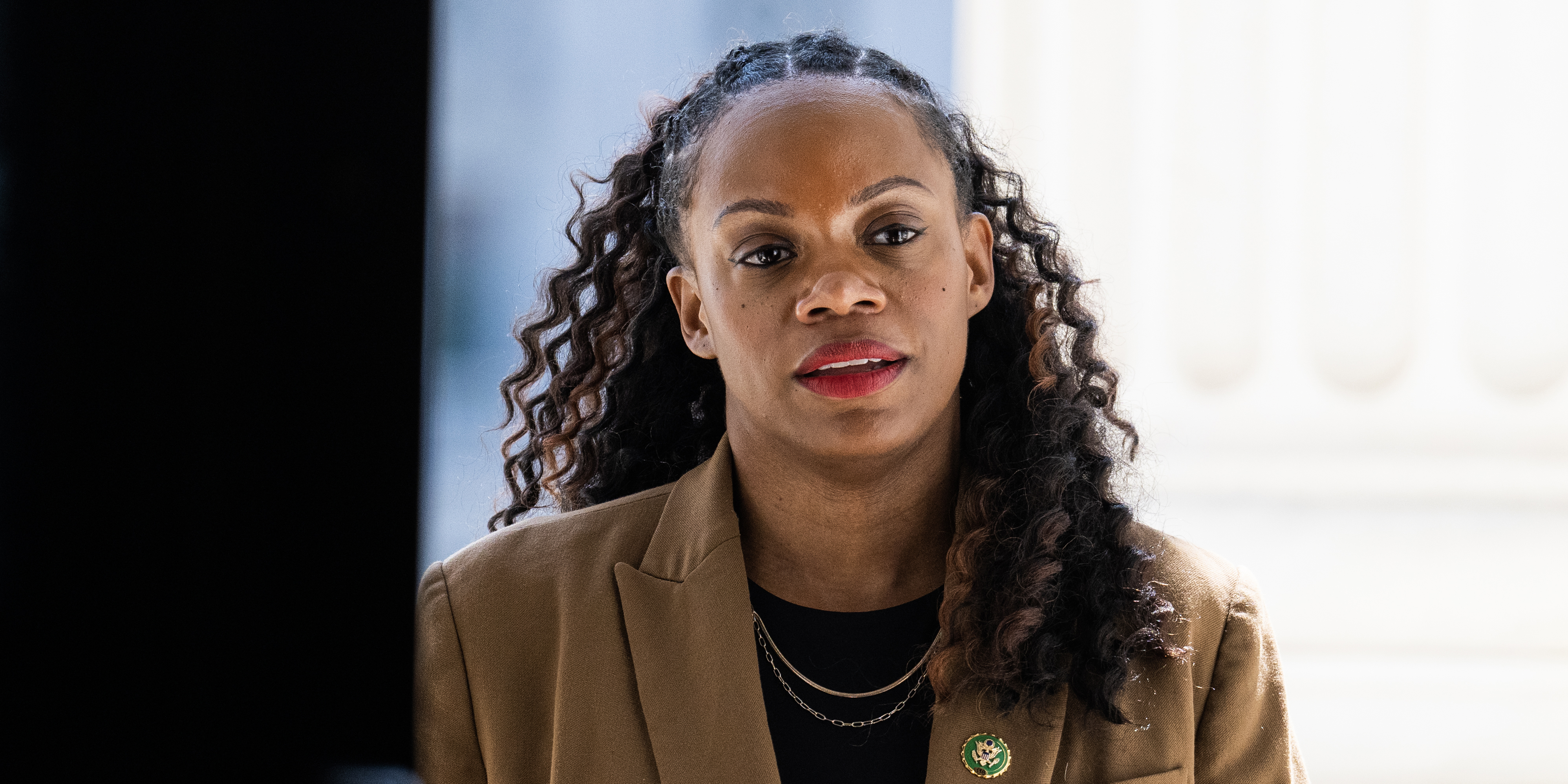
a POLITICAL ACTION committee funded by a Republican megadonor is running the first ads of the Pennsylvania primary season by an outside group attacking Rep. Summer Lee, D-Pa.
The group, Moderate PAC, launched in January 2023 to target progressives in Democratic primaries. It’s doing so with Republican money.
The ads back the candidate recruited by the American Israel Public Affairs Committee to run against Lee, Bhavini Patel, in hopes of making it to a general election against Republican candidate Laurie MacDonald.
Although Moderate PAC has employed Democratic consultants, including former Ohio Rep. Tim Ryan, its primary funder is Jeffrey Yass, one of the richest man in Pennsylvania and a major donor to the GOP. Yass, though formally registered as a libertarian, is one of former President Donald Trump’s picks for Treasury secretary should he win election in 2024.
Yass, a co-founder of a large hedge fund, has become increasingly involved in spending against progressives, aimed at keeping a regressive tax code in place and cutting funding for public schools in Pennsylvania.
“Take a cue from Laurie McDonald and just run as a Republican.”
“If you have to rely on a Super PAC bankrolled by Pennsylvania’s richest Republican — who has made it his mission to defund public education and ban abortion in PA — you’re not just unfit to run in a Democratic primary, you’re actively anti-democracy too,” said Usamah Andrabi, communications director for Justice Democrats, which is backing Lee. “Take a cue from Laurie McDonald and just run as a Republican.”
Moderate PAC Donors
Moderate PAC president and founder Ty Strong told The Intercept that other Pittsburgh area donors, including labor unions, had given to the PAC to fund ads against Lee in the race for the Pennsylvania’s 12th Congressional District.
“All the money raised for the ads in PA-12 were received from members of that community and Pittsburgh labor unions,” Strong said.
Though he didn’t identify the labor unions, Strong named six individual Democratic donors. Among them were private equity and venture capital executives Todd Reidbord and Gregg Perelman, who run the Pittsburgh private equity firm Walnut Capital; Richard and Arlene Weisman, who are active philanthropists in Pittsburgh’s Jewish community; and Evan Segal and Andy Rabin of the 412 Venture fund.
Strong said the names of other donors would be revealed in the PAC’s next filings with the Federal Election Commission, which is due on April 15.
[## Join Our Newsletter ## Original reporting. Fearless journalism. Delivered to you.
I'm in](https://theintercept.com/newsletter/?source=Article-In&referrer_post_id=463898)
One of those donors, Segal, a Democrat who worked in the administration of former President Barack Obama, told The Intercept he hardly agreed with Yass on anything, including his reasons for funding the PAC in the first place.
“Mr. Yass’s reasons for funding this are in support of a very, very ultra-right-wing group of crazies who despise Summer Lee,” he said. Though he is supporting Yass’s PAC, Segal said, “I don’t support people on the extremes.”
Segal said he gave to Yass’s PAC not because he believes the enemy of his enemy is his friend, but that observers are anticipating further outside spending to back Lee. “We firmly believe that there will be money that will come in from the outside — from people who also hate marginalized communities — to support Summer Lee, as well as people from the right like Mr. Yass who want to run these Machiavellian games with their billions of dollars,” Segal said. (The other five identified donors did not respond to a request for comment.)
Segal said he’s backing Patel because she’ll support Democratic leaders including President Joe Biden, Senate Majority Leader Chuck Schumer, D-N.Y., and House Majority Leader Hakeem Jeffries, D-N.Y., to fight for issues like reproductive freedom and women’s equality.
Past Spending Against Lee
For her part, in a press statement last week, Lee said, “Republican-funded Super PACs and their chosen candidate couldn’t stop us last cycle, and they won’t stop us this time.”
Lee faced an onslaught of spending from pro-Israel lobbying groups in 2022. AIPAC and its ally, Democratic Majority for Israel, spent millions against her.
[
Related
Summer Lee’s Primary Foe Wants Pro-Israel and Right-Wing Hindu Supporters to Take Down the Squad
https://theintercept.com/2024/02/01/summer-lee-primary-bhavini-patel-republican/)
It’s also not the first time Lee’s opponents have claimed she’s not really a Democrat — while themselves taking money from Republicans. Patel and her campaign have strategized about how to encourage Republicans to get involved in the primary, how Patel’s campaign appeals to Republican voters, and how the campaign can encourage Republicans to switch parties to vote in the April 23 primary.
Moderate PAC’s Strong compared the donors who funded the new ads to one of Lee’s donors. “This is in contrast to Rep. Summer Lee, who receives money from people condemned by the White House,” Strong added.
Strong said he was referring to Nihad Awad, executive director of the Council on American-Islamic Relations, whom the White House denounced in December after he said he was happy to see the people of Gaza breaking the long-running siege against the territory on October 7. Awad has explicitly condemned the Hamas attack and clarified that his comments were in support of Palestinians’ fight against Israel’s illegal occupation, not in support of Hamas.
Yass is also a major donor to a far-right Israeli think tank that has tried to reconfigure the country’s judicial system and suppress criticism of human rights abuses by the Israeli government.
intercept
===
===
FOR IMMEDIATE RELEASE
Contact: Annie Stone, 703-217-1169
astone@constitutioncenter.org
Philadelphia, PA (September 19, 2022) - Through the National Constitution Center’s (NCC) Constitution Drafting Project, teams of conservative, libertarian, and progressive scholars today revealed five proposed constitutional amendments they debated and drafted during a virtual constitutional convention held this past summer. At an event hosted by the NCC, Caroline Fredrickson, senior fellow at the Brennan Center for Justice leading team progressive, Ilan Wurman, associate professor at the Sandra Day O'Connor College of Law at Arizona State University, leading team conservative, and Ilya Shapiro, senior fellow and director of constitutional studies at the Manhattan Institute, leading team libertarian, presented their proposed amendments, which include granting veto abilities to Congress, changing the impeachment process, and imposing term limits for Supreme Court justices. A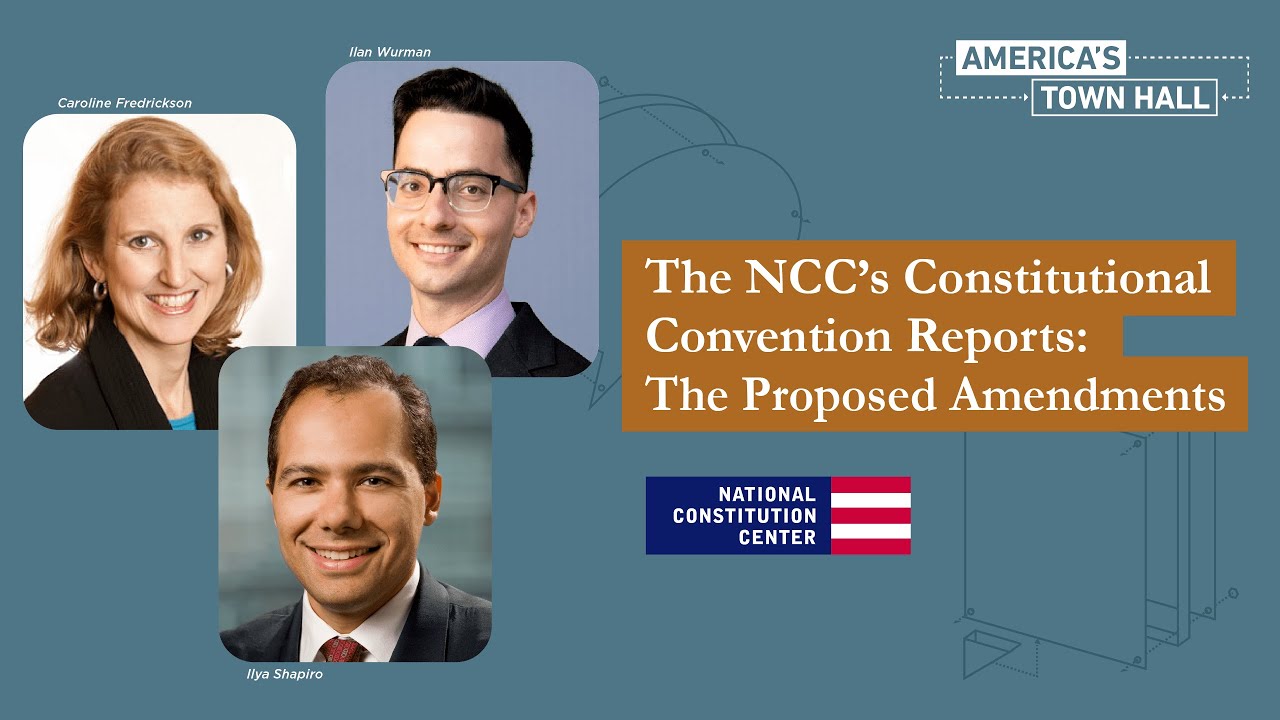 is available on the Center’s YouTube channel, and the amendments are available on the Center’s website.
Below is a brief summary of each proposed amendment:
- Amendment XXVIII: Eliminates the natural-born citizen requirement by stating that a president does not have to be born in the United States but must be a citizen having resided in the United States for at least 14 years. elon musk?!
- Amendment XXIX: Creates a legislative veto, whereby Congress can veto executive actions with majority votes in both the House and the Senate.
- Amendment XXX: Amends the current impeachment process by raising the standard for impeachment in the House but lowering it for conviction in the Senate; and clarifies that, in the six months after leaving office, a former officer can be impeached, and that the bar against future officeholding applies to both the presidency and vice presidency.
- Amendment XXXI: Imposes term limits on Supreme Court justices, fixes the number of justices at nine, and makes appointments automatic if the Senate does not act within three months to approve or disapprove.
- Amendment XXXII: Revises the process for proposing and adopting new constitutional amendments, making it easier by lowering the threshold for ratification from the current two-thirds of Congress and three-quarters of the states to three-fifths of Congress and two-thirds of the states.
The teams convened via Zoom over two days this August, to debate and deliberate various proposals, agreeing on the five resulting amendments. Earlier this year, the same three teams had drafted and presented their ideal constitutions.
“It’s so meaningful that three teams of scholars of different perspectives were able to agree on five proposed amendments to the Constitution,” said Jeffrey Rosen, president and CEO of the National Constitution Center. “The surprising consensus of the NCC’s virtual Constitutional Convention is a tribute to the possibilities for Madisonian deliberation and compromise in a polarized age.”
As part of the Constitution Drafting Project, team conservative includes Ilan Wurman, Robert P. George of Princeton University, Michael McConnell of Stanford Law School, and Colleen A. Sheehan of Arizona State University. Team libertarian includes Ilya Shapiro, Timothy Sandefur of the Goldwater Institute, and Christina Mulligan of Brooklyn Law School; and team progressive includes Caroline Fredrickson, Jamal Greene of Columbia Law School, and Melissa Murray of New York University School of Law.
The Constitution Drafting Project was generously launched with support from Jeff Yass.
===
khan academy NCC legit pro ukraine?
Yass Foundation for Education commits $9 million to free civics course
News Itempublished November 7, 2022
===
===
https://www.alternet.org/2022/06/billionaire-tax/
Inside the Tax Records of the .001%
One day in July 1985, three young men from Philadelphia, their lawyer and a burly Pinkerton guard arrived at a horse track outside Chicago carrying a briefcase with $250,000 in cash.
Running the numbers on a Compaq computer the size of a small refrigerator, Jeffrey Yass and his friends had found a way to outwit the track’s bookies, according to interviews, records and news accounts. A few months earlier, they’d wagered $160,000, gambling that, with tens of thousands of bets, they could nail the exact order of seven horses in three different races. It was a sophisticated theory of theracing odds, honed with help from a Ph.D. statistician who’d worked for NASA on the moon landing, and it proved right. They bagged $760,000, then the richest payoff in American racing history.
But that summer day, when they presented their strikingly long list of bets at the track window, they were turned away. Their appeal to the track owner got them ejected. Yass, just 27, then sued for the right to place the bets. The track’s lawyer fumed to a federal judge that the men were trying to corner the betting market “through the use of their statistics and numbers.”
Yass lost, but that year he and his friends repeated variations of the strategy at horse and greyhound tracks around the country. Then they decided to turn their focus from a world of hundreds of thousands of dollars to a world of billions: Wall Street.
Four decades later, the firm he and his friends founded, Susquehanna International Group, is a sprawling global company that makes billions of dollars. Yass and his team used their numerical expertise to make rapid-fire computer-driven trades in options and other securities, eventually becoming a giant middleman in the markets for stocks and other securities. If you have bought stock or options on an app like Robinhood or E-Trade, there’s a good chance you traded with Susquehanna without knowing it. Today, Yass, 63, is one of the richest and most powerful financiers in the country.
But one crucial aspect of his ascent to stratospheric wealth has transpired out of public view. Using the same prowess that he’s applied to race tracks and options markets, Yass has taken aim at another target: his tax bill.
There, too, the winnings have been immense: at least $1 billion in tax savings over six recent years, according to ProPublica’s analysis of a trove of IRS data. During that time, Yass paid an average federal income tax rate of just 19%, far below that of comparable Wall Street traders.
Yass has devised trading strategies that reduce his tax burden but push legal boundaries. He has repeatedly drawn IRS audits, yet has continued to test the limits. Susquehanna has often gone to court to fight the government, with one multiyear audit battle ending in a costly defeat. The firm has maintained in court filings that it complied with the law.
Yass’ low rate is particularly notable because Susquehanna, by its own description, specializes in short-term trading. Money made from such rapid trades is typically taxed at rates around 40%.
In recent years, however, Yass’ annual income has, with uncanny consistency, been made up almost entirely of income taxed at the roughly 20% rate reserved for longer-term investments.
Congress long ago tried to stamp out widely used techniques that seek to transform profits taxed at the high rate into profits taxed at the low rate. But Yass and his colleagues have managed to avoid higher taxes anyway.
The tax savings have contributed to an explosion in wealth for Yass, who has increasingly poured that fortune into candidates and causes on the political right. He has spent more than $100 million on election campaigns in recent years. The money has gone to everything from anti-tax advocacy and charter schools to campaigns against so-called critical race theory and for candidates who falsely say the 2020 election was stolen and seek to ban abortion.
ProPublica has pieced together the details of Yass’ tax avoidance using tax returns, securities filings and court records, as well as by talking to former traders and executives. (The former employees spoke on condition of anonymity, with many citing a desire to avoid angering Yass.)
Through a spokesperson, Yass declined to be interviewed for this article. The spokesperson declined to comment in response to a long list of questions for Susquehanna and the firm’s founding partners.
Gregg Polsky, a University of Georgia law professor and former corporate tax lawyer who was retained by ProPublica to review Susquehanna’s tax records, said the tax agency may have more to scrutinize. The strategies revealed in Yass’ records, he said, were “very suspicious and suggestive of potential abuse that should be examined by the IRS.”
More than 35 years after he was booted from the racetrack outside Chicago, Yass still lives to gamble. Not just on horses, but on poker and on the market. He sheepishly admitted, in a podcast discussion, that he has even placed wagers on his children’s sports games.
Asked to describe his approach to trading at Susquehanna, Yass once reached for a poker analogy. “If you’re the sixth-best poker player in the world and you play with the five best players, you’re going to lose,” he said. “If your skills are only average, but you play against weak opponents, you’re going to win.”
That philosophy along with, Yass freely admits, a lot of luck, has made him a billionaire many times over.
Compared to many of his fellow billionaires — he’s richer than Hollywood mogul David Geffen, retail brokerage king Charles Schwab and “Star Wars” creator George Lucas — Yass doesn't seem particularly interested in the trappings of extreme wealth.
Yass and his wife, Janine, raised four children in the leafy college town of Haverford, on the Main Line outside of Philadelphia. Their large but unremarkable house could easily be the home of a successful doctor rather than one of the richest men in the country. In his quarter-zip pullover sweater, Nikes and no-nonsense rimless glasses, he’d be impossible to pick out of a crowd at the suburban country club where he plays golf.
If Yass collects expensive art or maintains a megayacht, he has managed to do so in complete secrecy. What comes closest to an identifiable trophy asset is a house in the ultra-exclusive Georgica Association beach neighborhood of East Hampton on New York’s Long Island. Even that property, purchased for $12.5 million in 2005 and held through an LLC, is in an area known as “bucolic and understated.”
Those who have worked with Yass say he lives less for spending money than for the competition of the market and the thrill of taking calculated risk. Yass softens any impression of ruthlessness by deploying a practiced humility and comedic timing. “Some people like art history,” he once explained, “I like probabilistic analysis.”
Yet when it comes to his philosophical outlook, he eschews the jokes. He speaks of capitalism in religious terms. Making new markets, he likes to say, is a “mission from God.”
Like many religious stories, his begins with a conversion experience.Born in 1958 to two Queens CPAs, Yass said reading the economist Milton Friedman’s “Capitalism and Freedom” as a young man delivered him from an early flirtation with socialism.
By the time Yass graduated from the State University of New York at Binghamton in 1979, he was already captivated by trading. (His father had also helped nurture Yass’ love of horse racing by taking him to local tracks to see harness racing, according to Forbes.) Yass’ college thesis weighed whether the budding market in stock options could be justified as socially useful. “I concluded that it should exist,” Yass later cracked. “I got a B.”
After college, he moved to Las Vegas for a year and a half to play poker professionally. Then he returned to the East Coast and settled in Philadelphia, where he began trading options. The previous decade had seen aburst of academic interest in the financial instruments, including a pioneering model of how to more accurately price them.Yass later called the model, and its broader implications for how to make mathematically sound decisions, “the most revolutionary idea in a long, long time.”
A share of stock is a relatively simple concept: It’s a small ownership stake in a company. An option, by contrast, is a contract that confers the right to buy or sell a given stock at a particular price and time in the future.
Options attract mathematically minded traders since a complex set of variables, including the underlying stock price, volatility, time and interest rates, determine how much one of the contracts is worth.
Options are a versatile tool. They can appeal to the risk-averse:Traders can use them as insurance to guarantee they will be paid at least today’s price when they sell in the future. They are also useful to the risk-embracing — gamblers who want to place outsized bets on how a stock will perform. (Here’s how a speculator would use an option: In early June, shares of Netflix were trading at below $200. If the speculator thinks the company’s fortunes will improve dramatically this summer, they could pay just $4.50 each for options to buy the stock at $250 in mid-August. If the stock soars over that figure, they could make a mint.)
In options Yass found more than a financial instrument. He found a way to view the world. Everything — each decision, each interaction — can be judged based on how much it will cost in money, time or negative consequences and compared with the reward. Then action is taken or avoided accordingly. To Yass’ way of thinking, it’s always worth paying $19 for a 20% chance to win $100 but it’s never worth $21.
Along with his college friends, Yass founded Susquehanna, named after the river that connects Binghamton to Pennsylvania, in 1987. The firm benefited from explosive growth in options markets. Yass later played it down to the Philadelphia Inquirer: “We got lucky being in the right place at the right time.”
One of Susquehanna’s landmark moments — involving perhaps both skill and luck — occurred soon after the firm launched: the Black Monday stock market crash on Oct. 19, 1987. Thanks to an option bet that would pay out if stocks went down, Susquehanna was one of the few firms that made money on one of the worst days in stock market history.
From early on, Yass cultivated Susquehanna’s brand as a home for the biggest brains in finance, hiring Ph.D.s and top students. But the firm wasn’t just looking for raw IQ points. It also wanted instinct. It held poker tournaments to teach traders the idea that taking the measure of your opponents is as important as understanding the odds.
The Binghamton buddies ran a freewheeling office full of arguments and gamesmanship. The office had Super Bowl pools and an officewide lottery. Everyone bet on everything. One time, as recounted in Philadelphia magazine, traders bet on whether Yass could name the last Plantagenet king of England. They called Yass. He spat out “Richard III” and then, according to a witness, yelled, “Get back to work!” But he liked the hijinks.
Still, the firm had an inside vs. outside mentality. If you weren’t with the firm, you were the enemy. When traders left to join a competitor, Susquehanna often sued them for allegedly violating non-compete clauses. Susquehanna stood out for its aggressiveness in trading even by the standards of Wall Street. “If he thinks you’re dumb, he’s betting against you,” one former Susquehanna trader said of Yass. “That’s what makes his blood flow.”
Susquehanna developed a specialty in arbitrage, or finding low-risk profit opportunities in mismatched prices of securities, like stocks or bonds. An early adopter of computers to measure risk and test trading strategies, the firm flourished.
In addition to making his own bets, Yass built his firm into one that stands at the very center of the market and takes bets from other traders. On Wall Street, this job is known as market making.
At its simplest, making a market means offering to buy or sell a thing. The jewelry shop on the corner that will sell you a gold ring and has a “We Buy Gold” sign in the window is making a market in gold. If the store buys a gold coin from a customer for $300, then sells it for $320 to the next person who walks in, the store has made a quick $20.
Susquehanna does the same thing, but with securities. Running a market making firm isn’t always as easy as quickly matching a buyer and a seller. A market maker is expected to post its prices and buy and sell to all comers. If a particular stock has more sellers than buyers, the firm might find itself holding too much, exposing the market maker to losses if the stock price drops. It’s a business that thrives when there’s lots of trading volume but can be dangerous if markets crash.
The market making business in stock options, Susquehanna’s specialty, requires juggling a huge number of trades while constantly keeping an eye on all the various bets to make sure that the firm is protected from unexpected market moves.
In 1996, the year Yass turned 38, he made $71 million, tax records show. By then, the firm was employing hundreds of people. Not long before, Susquehanna staff had gathered in Las Vegas for an annual company celebration. Traders brought their families. The firm’s employees watched the Kentucky Derby together. A Marilyn Monroe impersonator interviewed Yass’ father with some tame double-entendres. The highlight was a skit with a junior trader performing as “Jeff Yass Gump,” after Forrest Gump. “Momma always said I was like the other kids,” the trader said. “But the other kids, they went to Harvard and Yale and the University of Pennsylvania and I said: ‘Momma, why am I at the SUNY Binghamton?’ She said it was because I was special.” The crowd roared, Yass the loudest of all.
Despite losing some star traders in the late 1990s, Susquehanna continued to produce massive profits. Yass and the other co-founders managed to keep their enormous wealth a secret. Even by 2005, when Yass had collected at least $1 billion of lifetime income, he was nowhere to be found in the Forbes list of the richest Americans.
That’s in part because Susquehanna is privately held and trades only its own money, meaning it doesn’t have to publicly disclose much about its business. Like many financial firms, Susquehanna itself is not a single company but a complex and shifting web of legal entities whose profits flow to Yass and a small set of partners.
It has been a remarkably consistent profit machine for the partners, except in 2008, the year of the global financial crisis. Yass alone lost $470 million that year, tax records show.Former Susquehanna traders believe the firm risked going out of business. The danger the firm faced “sent chills through everyone,” said one. Like other big trading complexes that did huge business with investment banks,Susquehanna benefited from the massive federal bailout of Wall Street, which propped up the giant firms that were among its biggest trading partners.
Yass, the free market true believer, now owed the survival of much of his fortune to the U.S. government. On a personal level, Yass also received an extra bonus from the government: a $2,000 child tax credit because he reported losing money that year.
Susquehanna quickly bounced back to profitability. In recent years it has supplanted major banks as one of the firms that sits in the middle of massive daily financial flows in stock and other markets. A Bloomberg profile in 2018 reported that Susquehanna trades 100 million exchange-traded fund shares daily. The firm is a prominent player in cryptocurrencies like bitcoin and, in a throwback to Yass’ origins, the exploding business of sports betting. Susquehanna has also branched out into venture capital. One of those investments came through spectacularly: a large stake in ByteDance, the Chinese company behind the social media app TikTok.
By the 2010s, Yass had become one of the richest Americans. But his ultralow profile meant that almost nobody knew that. At least two of Susquehanna’s other co-founders, Arthur Dantchik and Joel Greenberg, have each made billions of dollars themselves, according to ProPublica's analysis.
Yass hit a new milestone in 2012, pulling in more than $1 billion in a single year, according to tax records; by 2018, his income was $2 billion. In the six years ending in 2018, Yass had the sixth-highest average income in the entire country, according to IRS data.
Court filings and ProPublica’s analysis of tax records suggest that, as of 2018, Yass owned around 75% of Susquehanna, with co-founders Dantchik owning around 19% and Greenberg around 3%. (Greenberg retired in 2016.)
Yass was finally added to the Forbes list last year. The magazine put his worth at $12 billion, which would make him the 58th-richest American. ProPublica estimates his true wealth is likely at least $30 billion — based solely on his income over the decades and stake in ByteDance — which would place him in the top 25.
On a Friday afternoon in April 2010, a Susquehanna trader in Pennsylvania emailed his counterparts at Credit Suisse to make a big bet in the stock market. The email instructed the Swiss bank to buy about $70 million worth of shares in some of Switzerland’s biggest companies on Susquehanna’s behalf.
Three minutes later, the trader sent out a second email, this time to Morgan Stanley.He placed a second bet, now wagering against the exact same stocks in the exact same amounts he’d just ordered from Credit Suisse.
The payoff from such a trade might seem to be nothing at all. But there was a winner and a loser. The winner was Susquehanna. The loser was the U.S. government: Susquehanna had managed to slash its tax bill through the trade. The emails come from an ongoing U.S. Tax Court case filed in 2020. There are rules designed to block clever traders from using offsetting bets to conjure tax savings, and the IRS argues Susquehanna broke them. (More on that case later.)
The firm’s willingness to push the boundaries of tax law is not surprising to people who know Yass and his partners. One former Susquehanna executive recalled Yass acknowledging using a trading strategy in which a main goal was not to make profitable trades, but to avoid taxes. Taxes, according to Yass’ former colleagues, are an obsession for the billionaire. As one former employee put it, “They hate fucking taxes.”
It doesn’t matter how seemingly trivial it is. Susquehanna once petitioned the state of Pennsylvania to demand “a refund of taxes paid on repairs to ice machines.” The petition was denied.
Indeed, the firm has a habit of shaping deals that slash its tax bill and then daring the IRS to intercede. Sometimes, the agency successfully challenges them, as when Yass and his two main partners were hit with a total of $121 million in back taxes in 2019. That was the single biggest such payout in ProPublica’s database of IRS records,which includes thousands of audits of the wealthiest people in the country. Susquehanna paid only after losing a long-running battle with the agency, one the firm appealed all the way to the Supreme Court.
Despite periodically tripping IRS wires, the firm’s aggressiveness seems to have paid off. Susquehanna’s tax avoidance has gone on for years, resulting in a strikingly low tax rate for Yass and his partners, according to ProPublica’s analysis.
The strategy behind that trade back in 2010 is key to understanding how they’ve done it. Similarly to how Susquehanna has taken advantage of small differences in prices of options or stocks, it has found ways to exploit a gap in tax rates to save hundreds of millions of dollars in taxes every year.
For someone like Yass, the U.S. system offers an almost irresistible proposition. If you earn the wrong sort of income — the kind that comes from a short-term trade — you’ll pay a relatively high tax rate. But if you earn the right kind — gains on long-held investments — you’ll pay half as much in taxes.
But what is considered “long-term” involves a bright, arbitrary line. Hold a security for less than 366 days, and you are on the wrong side of that line.
The result is that by the arithmetic of the U.S. tax code, $100 made from a sale on the 365th day is worth around $60 after taxes. And $100 made on the 366th is worth around $80.
Short-term, high-frequency traders like Susquehanna often hold securities for less than 365 seconds. As the company itself put it in one recent court filing, the firm “trades securities, commodities, and derivatives, seeking to earn returns from short-term appreciation and arbitrage profits.”This has been the firm’s consistent self-description. Back in 2004, a staffer was more frank in testimony: “We are not, by our nature, into holding stocks.”
With such an approach, long-term gains should be forever out of reach.
And yet, Yass and his partners have managed, year after year, to report that the vast majority of their net income came in the form of long-term capital gains. In several recent years, 100% of their income was taxed at the lower rate.
How do they do it?
One strategy, in simplified form, works like this: Make two bets that should move in opposite directions. Think of, say, both betting on and against Coca-Cola’s stock. Towards the end of the year, one bet will be up, and one will be down. At 365 days, the last day a trade is considered short-term, sell the one that’s down. A day later, sell the one that’s up.
Of course, if you consider the trade as a whole, it makes no money. But that isn’t the point. You’ve found a risk-free way to generate two valuable commodities: short-term losses and long-term gains.
On their own, these losses and gains aren’t of much use. But to someone like Yass, who separately generates an enormous pile of short-term gains each year, they work a kind of magic.
That’s because of how taxes are calculated. Short-term and long-term results are accounted for in separate buckets: Short-term losses are applied first to short-term gains. So the losses from the Coke trade reduce the existing pile of short-term gains. The money made from the Coke trade, meanwhile, goes in the long-term bucket.
In the end, the trader has essentially transformed short-term gains into long-term gains, the type taxed at the special lower rate. From 2003 through 2018, the difference between the two rates ranged from 17 to 20 percentage points. So, for every $100 run through this process, the trader would net from $17 to $20 in tax savings.
So why isn’t everyone using this strategy?
Because as laid out here, it would be illegal.
For decades, traders have devised strategies that looked something like the Coke trade, known as a “straddle” because the trader is taking both sides. Over the years, Congress passed laws and the IRS imposed intricate rules to stop them, taking away the tax benefit of simultaneously betting for and against the same stock.
And yet, Yass and his partners built a machine that produced much the same result.
Since 2011, IRS records show, a partnership called Susquehanna Fundamental Investments has been the source of the majority of long-term gains for Yass and his partners. Every year, it channeled hundreds of millions in long-term gains to them, while also providing hundreds of millions in short-term losses.
Year after year, the gains and losses rose and fell roughly in tandem, as if one were a near reflection of the other. In 2015, for example, Susquehanna Fundamental produced $774 million in long-term gains and $787 million in short-term losses for Yass. In 2017 it was $940 million in long-term gains and $902 million in short-term losses.
Regulatory filings give a glimpse of the fund’s trading.
Susquehanna Fundamental has to disclose a snapshot of certain holdings with the Securities and Exchange Commission a few times each year, though many types of trades are exempt from disclosure.
Over several years, the fund’s disclosed positions resembled a complex version of the Coke trade. Instead of betting for and against a single stock, the firm bet for and against the entire market.
Susquehanna Fundamental held billions of dollars of individual stocks such as Google, Wells Fargo and, as it happens, Coca-Cola. These stocks were among the largest companies in the S&P 500 index.
Meanwhile, the fund also held a large bet against the S&P 500. In essence, it held a bet against many of those exact same stocks.
On its face, the fund actually lost money for Yass: Over eight years, it registered $5.4 billion in losses against $5 billion in gains — a net loss before taxes. But by transforming the tax rate on so much income, it delivered $1.1 billion in tax savings, and Yass came out way ahead.
It’s not clear whether the IRS has ever challenged the firm’s trading inside Susquehanna Fundamental Investments.
But the trading pattern has similarities to the 2010 Swiss stock trades, which involved betting for and against the exact same stocks. The IRS deems those to have been illegal under tax law.
Those trades were part of a larger deal worked out by Susquehanna and Morgan Stanley that called for the Philadelphia firm to buy $1.4 billion of the stocks and simultaneously bet against them, court records show. (Morgan Stanley declined to comment.) Over the next three years, the deal kicked out at least $365 million in low-rate income to the firm, while generating massive losses that could be used to wipe out other high-rate income, according to the IRS.
When IRS auditors scrutinized the deal, they found that Susquehanna had violated rules against betting for and against the exact same stocks. The agency demanded the firm pay tens of millions of dollars in back taxes.
Yass and his partners refused, arguing that the firm had broken no rules, and sued the IRS in U.S. Tax Court in 2020. They asserted that the deal was supposed to be profitable and wasn’t primarily intended to avoid taxes. But the firm also acknowledged the deal was tailored with an eye to “tax efficiency.” The case is still pending, with Susquehanna currently resisting requests to turn over more documents.
Susquehanna’s ability to manufacture the right kind of income has helped Yass and his partners minimize their taxes for decades. Since 2001, Yass hasn’t paid over 20% in a single year. In 2005, a year when he made what was for him the modest sum of $66 million, he paid $0 in federal income tax.
For Yass’ primary competitors, the story is far different. Citadel and Two Sigma are both huge firms that, like Susquehanna, do a mix of lightning-fast trading and market making. The heads of these firms, like Yass, reported incomes larger than almost anyone else in the country from 2013 to 2018.
But the tax returns of these Wall Street titans — Ken Griffin from Citadel, and John Overdeck and David Siegel from Two Sigma — have no mystifying source of low-rate income.
They also differ from Susquehanna in another telling respect. These firms voluntarily classify their trading activity as ordinary income, according to ProPublica’s analysis of tax records. Doing this makes sense for a firm that specializes in short-term trading and doesn’t expect to generate many long-term gains. That’s why many high-frequency firms make this “Section 475 election,” as it’s called in the tax jargon. If Susquehanna elected to treat its trading this way, its ability to generate long-term gains would be constrained.
Susquehanna also stands apart in how its taxes are prepared, ProPublica’s records show. Unlike his billionaire peers, Yass does not have his tax returns prepared by outside accountants. Instead, they’re prepared in-house at Susquehanna. Avoiding an outside accountant can offer more leeway in filing returns that test the boundaries of the law and might be challenged by the IRS later on, experts say. Several former employees told ProPublica that details of the firm’s tax strategy are closely guarded, even inside the company.
From 2013 to 2018, Griffin, Overdeck and Siegel paid average income tax rates ranging from 29% to 34%. (Representatives for the three men declined to comment.) Yass averaged 19%. ProPublica estimates that if Yass’ tax returns had resembled those of his competitors, he would have paid $1 billion more in federal income taxes during this period alone.
Yass does have one peer who achieved even lower tax rates and did so for years. Billionaire Jim Simons is one of the founders of Renaissance Technologies,one of the premier hedge funds known for high-frequency trading. His rates were often in the single digits between 2009 and 2018, never exceeding 14%. One reason Simons paid so little are deductions from charitable donations, averaging hundreds of millions of dollars each year; Yass doesn’t give nearly as much to charity. But another reason was Renaissance’s ability to create long-term gains over a decade.
That, however, didn’t last. A 2014 congressional investigation and IRS audit concluded the Renaissance scheme to generate such gains was illegal. Simons himself ultimately paid the IRS at least $670 million to resolve the case. Collectively, fund executives and investors paid an undisclosed amount, reportedly in the billions, in back taxes and penalties. A spokesperson for Simons declined to comment.
Having slashed his income tax bills, Yass has already taken steps to protect his fortune from the government for years to come.
He created special trusts designed to sidestep the estate tax when passing money to heirs at death, court records show. In using these grantor retained annuity trusts, or GRATs, Yass joins dozens of other billionaires, as ProPublica has reported.
That suggests that Yass’ adult children, two of whom work at Susquehanna, stand to someday inherit multibillion-dollar fortunes — tax-free.
Over decades of TV appearances and speeches promoting his libertarian gospel, Milton Friedman often liked to say he was “in favor of cutting taxes under any circumstances and for any excuse, for any reason, whenever it’s possible.” Friedman died in 2006. Today, Yass, who reveres the economist, is trying to bring Friedman’s ideas to fruition.
Yass has not only worked assiduously to lower his own taxes but has poured millions into political efforts to eliminate them for his class. In recent years he has given $32 million to the anti-tax stalwart Club for Growth. This money paid for TV ads attacking candidates who were seen as wobbly on Friedman’s tax-cuts-anytime-anywhere philosophy.
In Pennsylvania, where Yass is the richest person in the state and a kingmaker in local politics, his favored candidates have shaped tax policy. He is a longtime financial patron of aDemocratic state senator,Anthony Williams, one of the creators of a pair of tax credits that allow companies to slash their state tax bills if they give money to private and charter schools. Susquehanna is, in turn, a major user of the tax credits. (Williams did not respond to requests for comment.)
The programs limited the state tax credits a single company could receive, but Yass and the others found a way to sidestep the limits. Yass, Dantchik and Greenberg simply applied for the tax credits through individual companies each had formed, the Philadelphia Inquirer reported in 2015. In all, the credits have saved Yass and the others at least $53 million in state taxes, records show.
Yass’ views on taxes, along with another stance inspired by Friedman, school privatization, seem to have informed his shifting opinion of Donald Trump.
Yass had opposed Trump during the 2016 Republican presidential primary, instead donating large sums to Rand Paul of Kentucky, the de facto leader of the party’s libertarian wing, and to Libertarian Party nominee Gary Johnson.
A week after Trump won the presidency that November, Yass took the stage at a theater in Philadelphia. Even though Trump had not been his candidate, Yass seemed to relish the long-odds election win, joking that those who “didn’t like Tuesday’s results” could move to Canada.
He used the rest of his remarks at the event, part of a local TED Talk-style series, to promote his passion for charter and private schools and attack Philadelphia teachers.:{ “All we ever hear about is how underpaid they are and how abused they are,” Yass } :{. “}::{Well, the shocking fact is that the average school teacher in Philadelphia with benefits makes $117,000 a year.”

Over the next four years, Trump delivered both a historic tax cut for the rich and an education secretary who was a champion of charter schools.
Yass has since backed a range of pro-Trump candidates. In Pennsylvania, he has poured money into this year’s Republican effort to take the open gubernatorial seat, which many expect, if successful, will lead to an abortion ban in the state. The Club for Growth also backed a losing candidate for the state’s open U.S. Senate seat, Kathy Barnette, whose campaign centered on her hard-line opposition to abortion, even in cases of rape. Yass is the second biggest donor to the Club (which did not return ProPublica’s requests for comment).
He is also the largest donor to the Rand Paul-affiliated Protect Freedom PAC,giving $2.5 million of his more than $12 million in recent donations just days after the 2020 election. The group’s website says of Democrats: “Of course, they stole the election.”
Yass is looking to harness discontent with public schools during the pandemic to push privatization of the system. He has given $15 million as the sole funder of a political action committee, the School Freedom Fund, that says “school closures, mask mandates, critical race theory, and more” have created “a unique opportunity to promote School Choice as the structural solution to dramatically improve education in America.”
If Yass came to politics motivated by his libertarian ideology, he now has an acute material reason — beyond taxes — to have a voice in Washington.
Late in the Trump administration, Susquehanna’s prize investment came under threat. President Trump announced on July 31, 2020, that he was considering banning TikTok in the United States. (Backers of the ban cited national security concerns over Americans’ private data being controlled by the Chinese firm behind the app, ByteDance.) Susquehanna's multibillion-dollar stake in ByteDance accounts for a major part of Yass’ fortune.
There’s no record of Yass having given to Trump before. But on Aug. 4, 2020, just a few days after the president’s TikTok announcement, Yass gave $5 million to the Club for Growth.Two days later, the group deviated from its normal practice of funding congressional races and announced an ad campaign in the presidential race: $5 million against Joe Biden. The group didn’t mention Yass, but the ads attacked Biden on Yass’ pet issue, charter schools. Later that month, Yass gave the group another $5 million, and more ads ran against Biden.
At the same time, Trump and other administration officials were personally involved in trying to broker a deal to avoid finalizing the TikTok ban. At one point in September, Trump publicly announced his support for a deal in which U.S. companies would buy stakes in ByteDance and a new board would be formed. Among the proposed members of the board: Dantchik, Yass’ partner at Susquehanna.
It’s not clear if Yass or Dantchik talked to the White House about the deal, which ultimately fell through. Courts later blocked the proposal to ban the app.
Yass hasn’t spoken much publicly about how he thinks about his engagement in politics. A rare glimpse came after the Jan. 6 riot, when a Philadelphia political activist named Laura Goldman emailed Yass to question his donations to the Club for Growth. One of the candidates the group backed, Sen. Josh Hawley, R-Mo., had objected to certifying the presidential election results just days earlier.
“To be clear — I don’t think the election was stolen,” Yass responded in a Jan. 15, 2021, email, first reported by the Guardian. “I gave the club money a year ago. Do you think anyone knew Hawley was going to do that? Sometimes politicians deceive their donors.”
Yass appears to have overcome any doubts about the Club for Growth, which has continued to back candidates who say the election was stolen.
Since he sent that email, he has given the group another $5.5 million.
===
https://www.exposedbycmd.org/2020/03/16/right-wing-super-pac-runs-pro-sanders-ad-after-running-anti-sanders-ad/
alex k
right-wing, billionaire-funded Club for Growth Action super PAC has a message for liberal voters: Billionaires behind Joe Biden are helping the Democratic Party rig the presidential primary against Bernie Sanders.
“After Mike [Bloomberg’s] $600 million couldn’t get it done, now the billionaires are propping up Joe Biden…because they own him,” says the narrator of the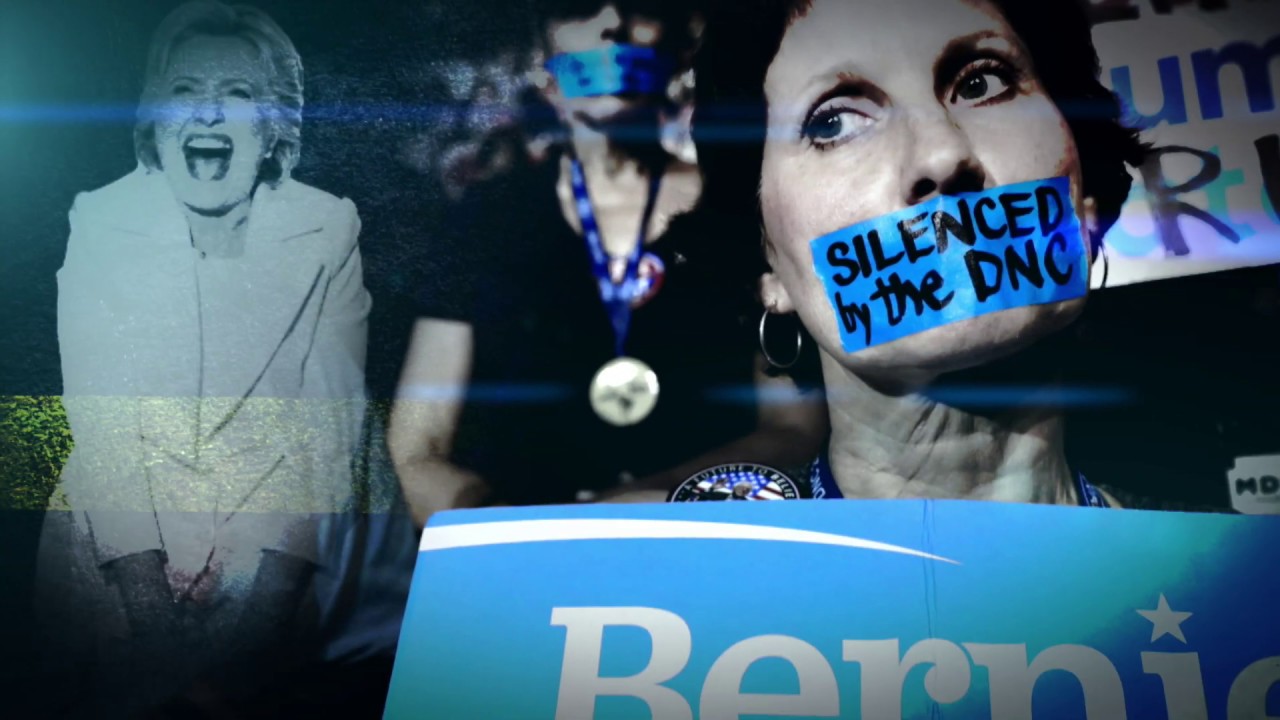 . “Don’t let them steal it.”
Just weeks ago, the same super PAC ran an ad attacking Sanders for his progressive positions on health care and climate change.At the time, the Center for Media and Democracy (CMD) reported that Club for Growth Action’s biggest donors included billionaires Richard Uihlein, owner and CEO of shipping supplies company ULINE, Jeff Yass, managing director and co-founder of financial firm Susquehanna International Group, and private equity owner John Childs.
A March 10 Club for Growth Action press release says the group will spend five figures on the digital ad, which will run in the four states set to vote on Tuesday, March 17: Arizona, Florida, Illinois, and Ohio.
“Remember” is the fourth ad that Club for Growth Action has released in the Democratic presidential primary. The group has also run an ad attacking former candidate Beto O’Rourke and another criticizing Biden for working with “racist Dixiecrats” to oppose school busing integration. The super PAC has spent a total of nearly $180,000 on ads against Democratic presidential contenders Biden ($86,000), Sanders ($59,000), and O’Rourke ($35,000), according to Federal Election Commission data.
Club for Growth Action has made over $5 million worth of independent expenditures in the 2020 elections so far, much of it going towards Republican congressional primaries, according to the Center for Responsive Politics.
Other conservative super PACs have made independent expenditures opposing Biden and Sanders, as CMD recently reported. As of March 4, The Committee to Defend the President had spent nearly $900,000 against Biden, while the Republican Jewish Coalition Victory Fund spent $69,000 against Sanders. Additional conservative groups have spent smaller amounts attacking both candidates.
Club for Growth, the 501(c)(4) social welfare nonprofit linked to Club for Growth Action, with an annual revenue of $6.7 million, is also reliant on conservative billionaires. For example, the Charles Koch-backed trade association now called The Seminar Network Chamber of Commerce donated $175,000 to Club for Growth in 2017. A few years before, the group received over $1 million from the Koch-backed Center to Protect Patient Rights.
==
===
https://www.factcheck.org/2020/01/club-for-growth-action-5/
1/20
political leanings:Conservative
2018 total spending: $19.6 million
Club for Growth Action, the super PAC of the conservative Club for Growth, was launched in August 2010. On its website, the organization declares its mission is to “take on any Member of Congress on policy who fails to uphold basic economic conservative principles … regardless of party.”
The PAC targets some Republican incumbents in primary elections in order to replace them with “pro-growth, limited government conservatives.” Club for Growth Action states on its website that it has been “instrumental” in helping to elect conservatives such as Sen. Ted Cruz of Texas, Sen. Marco Rubioof Florida andSen.Tim Scott of South Carolina.
As of Dec. 31, 2019, the group had raised $7.7 million in the 2020 election cycle.
Its independent expenditures — spending for or against identified candidates, without coordination with candidates or parties —totaled about $2.5 million as of Feb. 10. Club for Growth Action spent more than $550,000 against Democrat Dan McCready in North Carolina. McCready lost to Republican Dan Bishop in North Carolina’s 9th Congressional District special election in 2019. In the Democratic presidential primaries, the group has so far spent almost $67,000 against former Vice President Joe Biden, $59,000 against Sen. Bernie Sanders and a little more than$34,000 against former Rep. Beto O’Rourke of Texas. O’Rourke dropped out of the Democratic race on Nov. 1.
The bulk of Club for Growth Action’s money thus far in the 2020 cycle has come from three donors. Richard Uihlein, the chief executive officer of Uline, a shipping, packaging and industrial supplies company, gave the PAC $2.5 million in May. The two other major donors are Jeff Yass, cofounder of the financial firm Susquehanna International, and Virginia James, a conservative investor and former spouse of Club for Growth co-founder and stockbroker Richard Gilder. They have donated $2 million and $1 million to the PAC, respectively.
In the 2018 cycle, Club for Growth Action spent $19.6 million. The PAC spent $1.2 million in the Texas senatorial race against O’Rourke, who lost in his bid to unseat Cruz. The group also spent more than$1.1 million to defeat Republican candidate Russell “Russ” Fagg in the Montana Senate Republican primary.
The PAC also focused onspecial House elections in Georgia and Pennsylvania. During the last election cycle,the group found itself at odds in the Georgia House race with a pro-Trump group called 45Committee.Club for Growth Action endorsed RepublicanBob Gray — one of 18 candidates, including 11 Republicans, running in what was known as a “jungle primary.”
45Committee ran TV ads opposing Gray, claiming voters could not “trust him” because he “stands with the Club for Growth.” Gray did not survive the primary.Karen Handel, a Republican, won the special election in a runoff against Democrat Jon Ossoff.
A large chunk of the PAC’s money in the 2018 election cycle came from Uihlein, who has donated to Club for Growth Action since2010. Uihlein gave the PAC $6.7 million. Jeff Yass, co-founder of global trading firm Susquehanna International Group, gave the PAC a little over$3.8 million. Yass also serves on the board of directors at the Cato Institute, a libertarian think tank.
In the 2016 cycle, Club for Growth Action spent a little over $20 million. On the presidential election alone, the group spent nearly $8 million — including more than$7 million against Donald Trump during the Republican primary. The group, for example, accused Trumpin TV adsof supporting higher taxes. Once in office, Trump signed the Tax Cuts and Jobs Act, which reduced individual and corporate income tax rates, among other things. (See our story, “A Guide to the Tax Changes.”)
===
==
“I.R.S. enforcement is either absent or diminished” in certain areas, he said. Mr. Owens added that his former department — which provides some oversight of money used by charities and nonprofits — has been decimated.
Groups like FreedomWorks and Americans for Tax Reform, which are financed partly by the foundations of wealthy families and large businesses, have called for impeaching the I.R.S. commissioner. They are bolstered by deep-pocketed advocacy groups like the Club for Growth, which has aided primary challenges against Republicans who have voted in favor of higher taxes.
In 2014, the Club for Growth Action fund raised more than $9 million and spent much of it helping candidates critical of the I.R.S. Roughly 60 percent of the money raised by the fund came from just 12 donors, includingMr. Mercer, who has given the group $2 million in the last five years. Mr. Mercer and his immediate family have also donated more than $11 million to several super PACs supporting Senator Ted Cruzof Texas, an outspoken I.R.S. critic and a presidential candidate.
Another prominent donor is Mr. Yass,who helps run a trading firm called the Susquehanna International Group. He donated $100,000 to the Club for Growth Action fund in September. Mr. Yass serves on the board of the libertarian Cato Institute and, like Mr. Mercer, appears to subscribe to limited-government views that partly motivate his political spending.
But he may also have more than a passing interest in creating a political environment that undermines the I.R.S. Susquehanna is currently challenging a proposed I.R.S. determination that an affiliate of the firm effectively repatriated more than $375 million in income from subsidiaries located in Ireland and the Cayman Islands in 2007,creating a large tax liability. (The affiliate brought the money back to the United States in later years and paid dividend taxes on it; the I.R.S. asserts that it should have paid the ordinary income tax rate, at a cost of tens of millions of dollars more.)
In June, Mr. Yass donated more than $2 million to three super PACs aligned with Senator Rand Paul of Kentucky, who has called for taxing all income at a flat rate of 14.5 percent. That change in itself would save wealthy supporters like Mr. Yass millions of dollars.
Mr. Paul, also a presidential candididate, has suggested going even further, calling the I.R.S. a “rogue agency” and circulating a petition in 2013 calling for the tax equivalent of regime change. “Be it now therefore resolved,” the petition reads, “that we, the undersigned, demand the immediate abolishment of the Internal Revenue Service.”
==
https://www.opensecrets.org/orgs/summary.php?id=D000030211&cycle=A
- Susquehanna International Group to Brendan Boyle (D) in 2016
- Susquehanna International Group to Charlie Dent (R) in 2016
- Susquehanna International Group to Jeff Flake (R) in 2016
- Susquehanna International Group to Juan Vargas (D) in 2016
- Susquehanna International Group to Kathleen Rice (D) in 2016
- Susquehanna International Group to Lee Zeldin (R) in 2016
- Susquehanna International Group to Marlin Stutzman (R) in 2016
- Susquehanna International Group toPat Toomey (R) in 2016
- Susquehanna International Group to Ryan Costello (R) in 2016
- Susquehanna International Group to Ted Deutch (D) in 2016
- Susquehanna International Group to Tim Scott (R) in 2016
- Susquehanna International Group to Mark Sanford (R) in 2014
- Susquehanna International Group to Michael G. Fitzpatrick (R) in 2014
- Susquehanna International Group to Patrick Meehan (R) in 2014
- Susquehanna International Group to Ron Wyden (D) in 2014
- Susquehanna International Group to Scott Perry (R) in 2014
- Susquehanna International Group to Eric Cantor (R) in 2012
- Susquehanna International Group to Allyson Schwartz (D) in 2010
- Susquehanna International Group to Jason Altmire (D) in 2010
- Susquehanna International Group to John H. Adler (D) in 2010
- Susquehanna International Group to Michael N. Castle (R) in 2010
- Susquehanna International Group to Paul E. Kanjorski (D) in 2010
- Susquehanna International Group to Paul W. Hodes (D) in 2010
- Susquehanna International Group to Richard E. Neal (D) in 2010
- Susquehanna International Group to Robert A. Brady (D) in 2010
- Susquehanna International Group to Shelley Berkley (D) in 2010
- Susquehanna International Group to Robert E. Andrews (D) in 2008
- Susquehanna International Group to Evan Bayh (D) in 2006
- Susquehanna International Group to Rick Santorum (R) in 2006
- Susquehanna International Group to James C. Greenwood (R) in 2004
- Susquehanna International Group to James W. DeMint (R) in 2004
- Susquehanna International Group to Jim Gerlach (R) in 2004
- Susquehanna International Group to Jim Saxton (R) in 2004
- Susquehanna International Group to Dennis Moore (D) in 2002
- Susquehanna International Group to Gregory W. Meeks (D) in 2002
- Susquehanna International Group to Joseph M. Hoeffel (D) in 2002
- Susquehanna International Group to Phil Gramm (R) in 2002
- Susquehanna International Group to Richard C. Shelby (R) in 2002
===
Party Split, 1990-2014
Top Candidate Recipients, 2013-2014
| Candidate | Amount |
|---|---|
| Toomey, Pat (R-PA) |  $20,800 |
| Scott, Tim (R-SC) |  $15,600 |
| Boyle, Brendan (D-PA) |  $10,400 |
| Fitzpatrick, Michael G (R-PA) |  $10,400 |
| Cantor, Eric (R-VA) |  $8,743 |
Average Contributions to Members of Congress, 1990-2014 
includes contributions to members' presidential cmtes
==
-=-=
-=-=