ICONOGRAPHY
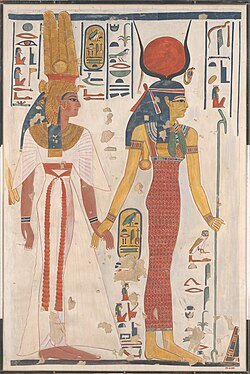
In Ancient Egyptian art, Isis was most commonly depicted as a woman with the typical attributes of a goddess: a sheath dress, a staff of papyrus in one hand, and an ankh sign in the other. Her original headdress was the throne sign used in writing her name. She and Nephthys often appear together, particularly when mourning Osiris's death, supporting him on his throne, or protecting the sarcophagi of the dead. In these situations their arms are often flung across their faces, in a gesture of mourning, or outstretched around Osiris or the deceased as a sign of their protective role.[77] In these circumstances they were often depicted as kites or women with the wings of kites. This form may be inspired by a similarity between the kites' calls and the cries of wailing women,[78] or by a metaphor likening the kite's search for carrion to the goddesses' search for their dead brother.[77] Isis sometimes appeared in other animal forms: as a sow, representing her maternal character; as a cow, particularly when linked with Apis; or as a scorpion.[77] She also took the form of a tree or a woman emerging from a tree, sometimes offering food and water to deceased souls. This form alluded to the maternal nourishment she provided.[79]
Beginning in the New Kingdom, thanks to the close links between Isis and Hathor, Isis took on Hathor's attributes, such as a sistrum rattle and a headdress of cow horns enclosing a sun disk. Sometimes both headdresses were combined, so the throne glyph sat atop the sun disk.[77] In the same era, she began to wear the insignia of a human queen, such as a vulture-shaped crown on her head and the royal uraeus, or rearing cobra, on her brow.[55] In Ptolemaic and Roman times, statues and figurines of Isis often showed her in a Greek sculptural style, with attributes taken from Egyptian and Greek tradition.[80][81] Some of these images reflected her linkage with other goddesses in novel ways. Isis-Thermuthis, a combination of Isis and Renenutet who represented agricultural fertility, was depicted in this style as a woman with the lower body of a snake. Figurines of a woman wearing an elaborate headdress and exposing her genitals may represent Isis-Aphrodite.[82]
The tyet symbol, a looped shape similar to the ankh, came to be seen as Isis's emblem at least as early as the New Kingdom, though it existed long before.[84] It was often made of red jasper and likened to Isis's blood. Used as a funerary amulet, it was said to confer her protection on the wearer.[85]