ANCIENT EGYPT
In Egypt and Nubia
Name and origins
Whereas some Egyptian deities appeared in the late Predynastic Period (before c. 3100 BCE), neither Isis nor her husband Osiris were mentioned by name before the Fifth Dynasty (c. 2494–2345 BCE).[5][6] An inscription that may refer to Isis dates to the reign of Nyuserre Ini during that period,[7] and she appears prominently in the Pyramid Texts, which began to be written down at the end of the dynasty and whose content may have developed much earlier.[8] Several passages in the Pyramid Texts link Isis with the region of the Nile Delta near Behbeit el-Hagar and Sebennytos, and her cult may have originated there.[9][Note 2]
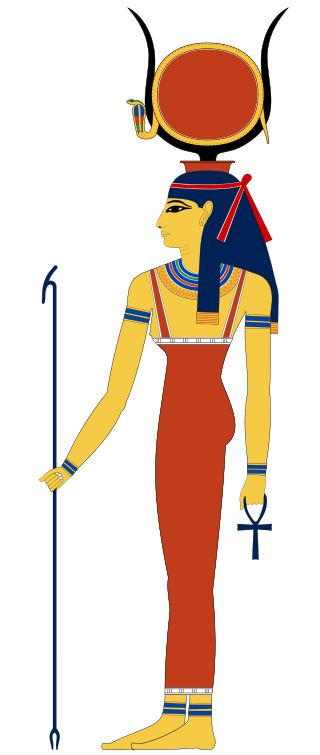
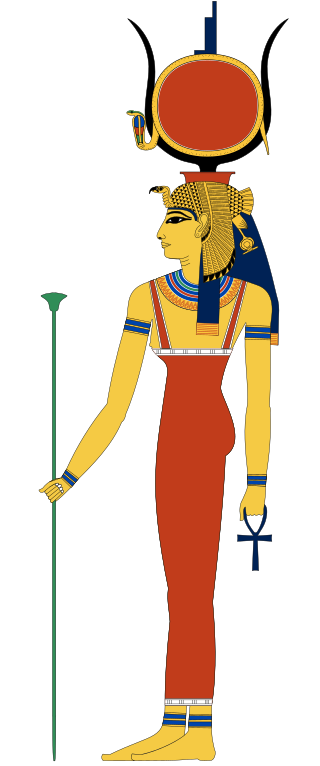
Isis could be depicted either wearing a headdress of the horns and a sun disk, similar or identical to how Hathor was depicted, or a throne symbol used in her name, or a headdress that includes both; she was also sometimes depicted wearing a vulture crown.
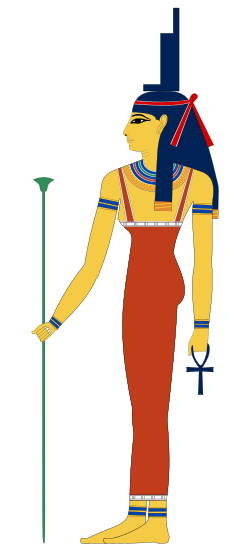
Many scholars have focused on Isis's name in trying to determine her origins. Her Egyptian name was written as 𓊨𓏏𓆇𓁐 (ꜣst), the pronunciation of which changed over time: Rūsat > Rūsaʾ > ʾŪsaʾ > ʾĒsə,[2] which became ⲎⲤⲈ (Ēse) in the Coptic form of Egyptian, Wusa in the Meroitic language of Nubia, and Ἶσις, on which her modern name is based, in Greek.[14][Note 3] The hieroglyphic writing of her name incorporates the sign for a throne, which Isis also wears on her head as a sign of her identity. The symbol serves as a phonogram, spelling the st sounds in her name, but it may have also represented a link with actual thrones. The Egyptian term for a throne was also st and may have shared a common etymology with Isis's name. Therefore, the Egyptologist Kurt Sethe suggested she was originally a personification of thrones.[15] Henri Frankfort agreed, believing that the throne was considered the king's mother, and thus a goddess, because of its power to make a man into a king.[16] Other scholars, such as Jürgen Osing and Klaus P. Kuhlmann, have disputed this interpretation, because of dissimilarities between Isis's name and the word for a throne[15] or a lack of evidence that the throne was ever deified.[17]