Lesson 3 - A Missing Message?
Let’s take a look at another one of the challenges we face with climate change. This will help explain why we are where we are today after decades of trying to do something about climate change. Many communications experts would argue that climate change is perhaps the biggest communications challenge that we have yet faced.
This goes back to some of the psychological variables that we talked about. I'll show you an interesting cartoon in a couple of minutes, but when it comes to the messaging of climate change and climate breakdown one of the key issues is, “what do you call it?”
We've already talked about that. Is it climate emergency? Is it climate breakdown? Is it climate disruption? Is it climate change? Is it global warming? Even figuring that out is not easy. There are literatures around that question -- and everybody says something different. So, one problem is that there is not a consistent message around why we should be worried about climate change and how we should be thinking about solving climate change.
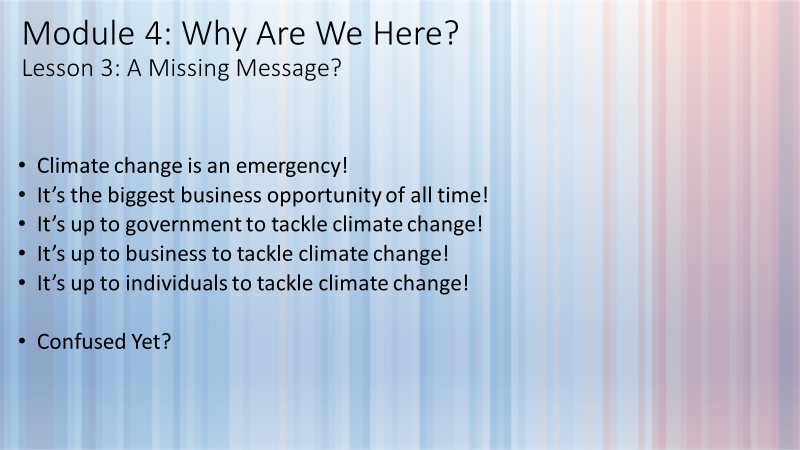
What I want to refer to here is what some of the messages are that people are constantly hearing. One message obviously is that climate change is an emergency and we need to act on climate change right away and do all kinds of things to tackle climate change.
Then we'll hear that climate change is the biggest business opportunity of all time -- that if we transition to a low carbon economy, it will create all kinds of opportunities for businesses. It'll create all kinds of jobs. It will be the greatest thing since sliced bread.
When you have the juxtaposition of the messaging of 1) it's an emergency and 2) it's the greatest opportunity of all time, that ends up being a real problem because people don't get it. When they hear that it's a huge opportunity, people tend to downplay the idea that it's an emergency because if it's an opportunity, how can it be an emergency? Thus, the fact that we throw out these different messages is a problem in generating the response that we need for tackling the problem.
But it's not just how are we characterizing the nature of the problem, it's also who are we saying should be doing something about it? By one line of argument -- and you'll see this in many places -- it's up to government to tackle climate change. Arguably, that's the obvious answer. Climate change is the result of an economic externality where we are not pricing greenhouse gas emissions, and as a result we are emitting too many greenhouse gas emissions. That's the role of government -- to internalize economic externalities and to tackle problems like climate change.
Because, in part, government has not tackled climate change, we have this line of argument that it's up to business to tackle climate change. This is a bit problematic because generally speaking you think of business as profit maximizing and being responsible to shareholders. You don't necessarily think of business setting out to tackle society's wicked problems. The private sector certainly hasn't done that in in any other case that I can think of. But that is a big line of argument that we hear today.
Lastly, and also very frequently, we hear that it's up to individuals to tackle climate change because it is individuals at the end of the day who make decisions. It is individuals who consume all the products and services that lead to greenhouse gas emissions. We drive the cars, etc. And yes, individuals are key, but is it up to individuals to tackle climate change?
So, we can't decide what we're going to say about the problem. We can't decide who is supposed to fix the problem. We shouldn't be surprised that people end up fundamentally confused and to some extent ambivalent about seriously tackling the problem.
That's another reason we are where we are today. We have not figured out the right message and we're missing the right message when it comes to tackling climate change.