Lesson 3 - Your Consumption
When we talk about consumption in the context of your money, it is not so much where to spend your money as opposed to perhaps where not to spend your money. Some people would argue that we should all voluntarily, stop traveling, never get on an airplane, stop driving a car, get rid of your car, stop eating meat -- certainly beef. Basically that we should go to a minimalist lifestyle.
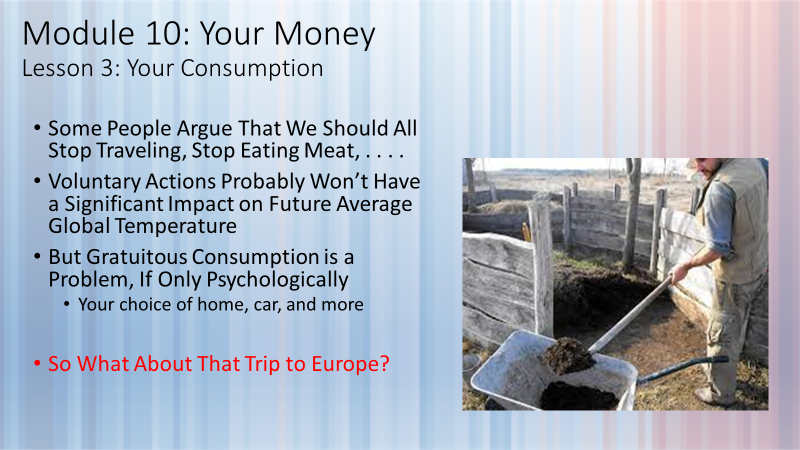
There's all sorts of interesting discussions around alternative economic models like the circular economy and economic degrowth. Both are interesting conversations, a little bit outside of our scope here, but some people would say we should voluntarily really do everything we can as individuals to reduce our emissions. Some people, as shown in the photo in the slide, carry it to quite the extreme, for example, composting their human, waste as one way to reduce their carbon footprint.
As we have talk about before, if everyone did these kinds of voluntary actions, it would have a big impact. If 3% or 5% or 10% of people do them, their impact is probably pretty modest in terms of overall future average global temperature -- unless it psychologically spurs them to do some of the other things that we've talked about, like using your voice. As we noted, it only takes 5% or 10% of people talking about climate breakdown to have a big impact on the conversation nationally.
All these things are tied together. It is worth remembering that. But the individual voluntary actions and carbon footprint reduction actions in and of themselves probably won't have a huge impact on average global temperature. That doesn't mean, however, that gratuitous consumption makes sense.
If you gratuitously consume, it’s a problem. Consider a 7,000 square foot house, driving a Hummer, or flying everywhere all the time. As we mentioned early on, that top 10% of carbon footprints in the U.S. come in at about 75 tons of CO2, several times the average for the US and some people's carbon footprints are much higher than that.
If you're seriously concerned about climate change, I tend not to subscribe to the idea that we should all sit at home cold and not do anything that might release greenhouse gases. But I also subscribe to the idea that gratuitous consumption is a problem and is totally counterproductive. We have a development near where I live that is part of the local fossil gas utility’s Street of Dreams project; the houses built on that “street of dreams” are gargantuan. Some of them have two kitchens. It is quite remarkable.
As long as we're building those kinds of houses, we're not taking climate change seriously and we're not going to tackle climate change. So, what about that trip to Europe? Well, it’s a judgment call. I certainly hope to take additional trips to Europe in coming years. Some people have totally sworn off getting on an airplane. Flight shaming is an active thing, trying to shame people for their air travel.
There is no right answer here, but we all should be thinking more about our consumption on a day-to-day basis, if we're concerned about climate breakdown.