MCT Personal

Thanks for clicking through to this page. We’re among that group of people who have been working on climate change for a very long time. Doing a lot of the first work on natural climate solutions more than 30 years ago, and working on the first carbon footprints and carbon offsets, seems like a lifetime ago. And while it wasn’t ERM or McKinsey, growing Trexler Climate and Energy Services to 15 people doing exclusively climate advisory work during the 1990s was an accomplishment!
Today, however, climate-related conversations are evolving at an amazing pace. For a long time climate risks were pretty much discussed as synonymous with “policy risk” - you may remember the 2011 Mercer Consulting report characterizing climate policy as potentially material, while characterizing potentially material physical impacts as still being decades away (Mercer’s 2015 report reversed course on that point!).
Today, climate risk is widely discussed as a function of physical risk, systemic risk, brand risk, investor expectations, transition risk, liability risk . . . . the list could go on. And that’s not all. Decision-makers are expected to be tracking the grey rhinos and black swans of climate change, climate uncertainties and tipping points, alternative low-carbon transition pathways, the likelihood and timing of technology disruptions, and the role of natural climate solutions and net zero targets. And hanging over it all, with huge implications, is whether average global temperature change will remain below 2o C, as everyone agrees it should, or exceed 3.5o C, as many observers think it will.
But while it’s easy to describe the “perfect storm” climate change has become for business and societal risk assessment and management, it’s abundantly obvious that we haven’t been able to manage that perfect storm. Even getting our heads around all the variables and trends is difficult, not to mention trying to keep up with their pace of change.
My view, as suggested by E.O. Wilson in the quote below, is that decision-makers need new decision-support capabilities and tools with which to respond to the perfect storm of climate change. That’s what I have been focused on for the last decade, and that’s what I would like to explore with you through my thoughts below.

I mindmapped my dissertation defense long before there was any software for that, and have remained interested in knowledge management ever since. I was Director of Climate Risk at DNV in Oslo when I decided to explore how knowledge management could promote better climate change decision-making and risk management. (**I discuss knowledge management in more detail here if you’re interested - right click on the link to keep this page open too**).
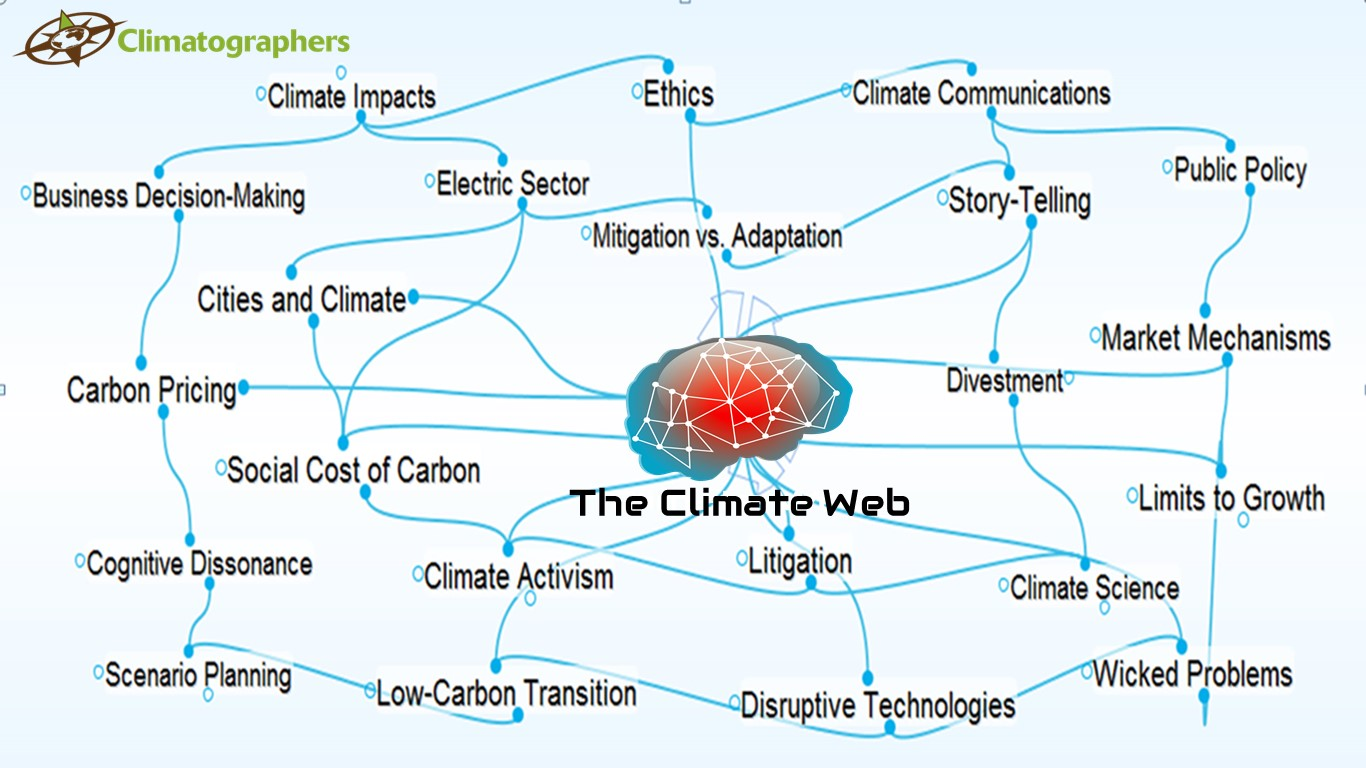
The Climate Web today is arguably the closest thing to a collective climate change intelligence out there, using a powerful but easy to use knowledge management software called **TheBrain** to allow instant access to thousands of books, reports, journal papers, PPTs, news and opinion pieces, websites, videos, and more.
But that’s just for starters. The image below, for example, shows how we’ve gone through Mark Lynas’ recently updated book “Our Final Warning: Six Degrees of Climate Emergency,” extracting dates, facts, arguments, graphics, and more (just one of hundreds of such examples).
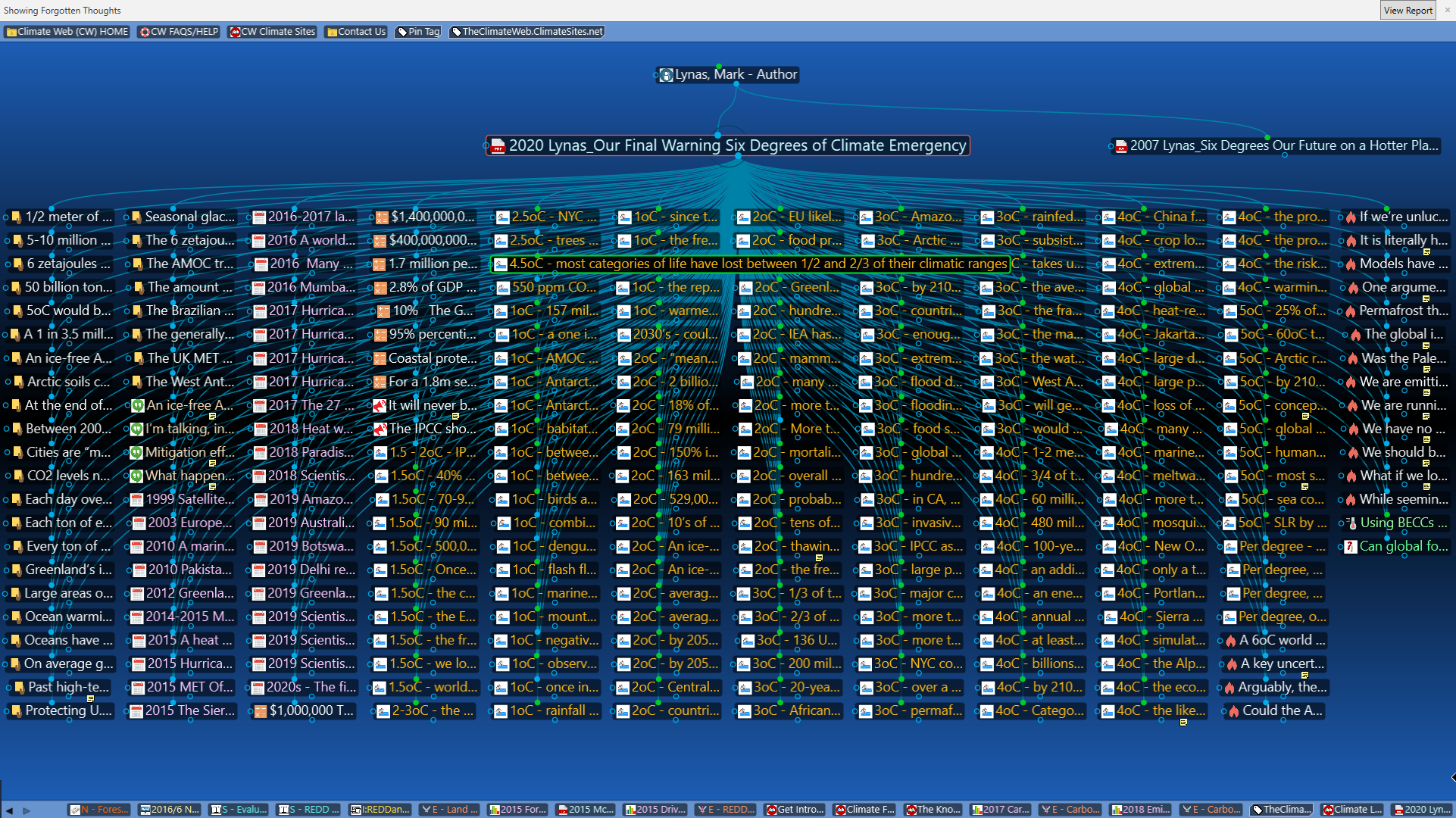
Why do that? Try thinking of all the individual “thoughts” as climate LEGO blocks that can be organized into all kinds of curated knowledge collections to promote access to actionable knowledge, and better climate change decision-making. The Climate Web today has more than 120,000 such thoughts and 500,000 links between thoughts, which gives you a sense of its scope and depth.
Here’s a quick look at what’s possible with the Climate Web. You can dig deeper through our **Climate Web Overview Climate Site:
- Instantly access topical materials organized by more than 3,500 Index Entries.
- Quickly use more than 2,500 Topical Headings to explore topical collections of books, reports and journal papers, news and opinion pieces, videos, websites, and more. You can access 20,000 PDFs representing reports and open-access journal articles, and instantly open up most other things just by hovering your mouse over individual thoughts.
- Understand how the thinking on hundreds of important topics has evolved by scanning the chronological and topical organization of 30,000 news and opinion stories.
- Instantly access more than 1,000 Topical Dashboards, each of which represent many hours of knowledge curation, covering everything from carbon pricing for a 2o C target, to individual action, to air capture technologies, to the psychology of climate change. Topical Dashboards are where you’ll find a lot of the graphics and ideas extracted from original source materials like Mark Lynas’ book.
- Create your own Dashboards and knowledge collections to share with others.
While the Climate Web can be used as an **open access resource**, it’s not time- or cost-effective compared to the alternatives. For example (right click on the links to keep this page open):
- Your Climate Brain is the ultra low-cost way to get instant access to 15,000 hours of climate knowledge curation, and you can build on it for your own knowledge management system (climate and otherwise), even with the FREE version of **TheBrain software**. We’ve priced Your Climate Brain for easy access, but if you’re serious about climate change and **Your Climate Brain** is financially out of reach, please contact us.
- Premium Access is the most cost-effective way to gain fast and powerful access to the entire 25,000 hours of knowledge curation in the Climate Web, including Topical Dashboards and Insights Pages, with ongoing access to all updates and improvements. It’s like having your own climate change research assistant, and it too works with the FREE version of TheBrain software.
- **Climate Roadmaps** help users navigate complicated topics, saving dozens to hundreds of hours, and Your Climate PhD does the same across the universe of topics you might want to rapidly access.
- It’s even possible to access Climate Web content without having to enter the Climate Web. We can turn such content into external websites for easy use and reference **through Climate Sites**.
I know we share the goal of working to mitigate climate change, and I’d really appreciate your help in getting the word out about the Climate Web.
I’d also welcome your feedback and suggestions as to how you think the Climate Web’s almost infinite information resources can be deployed to best effect. Whether by email, or 503-913-0025, or **scheduling a Zoom call** .
Thanks!
Mark
The Climatographers