Why Prioritize Actionable Knowledge
Why Prioritize Actionable Knowledge?
Concern over climate change is increasing, and according to the Yale Project on Climate Communications, more than 100 million adult Americans fall into segments of the Six Americas that could plausibly be engaged to support a range of climate change actions and initiatives.
But there's a big problem. For any individual to really engage on any topic, that person has to be able to answer 2 questions for themselves. It doesn't matter whether we're talking about quitting smoking or launching nuclear weapons, the questions are the same.
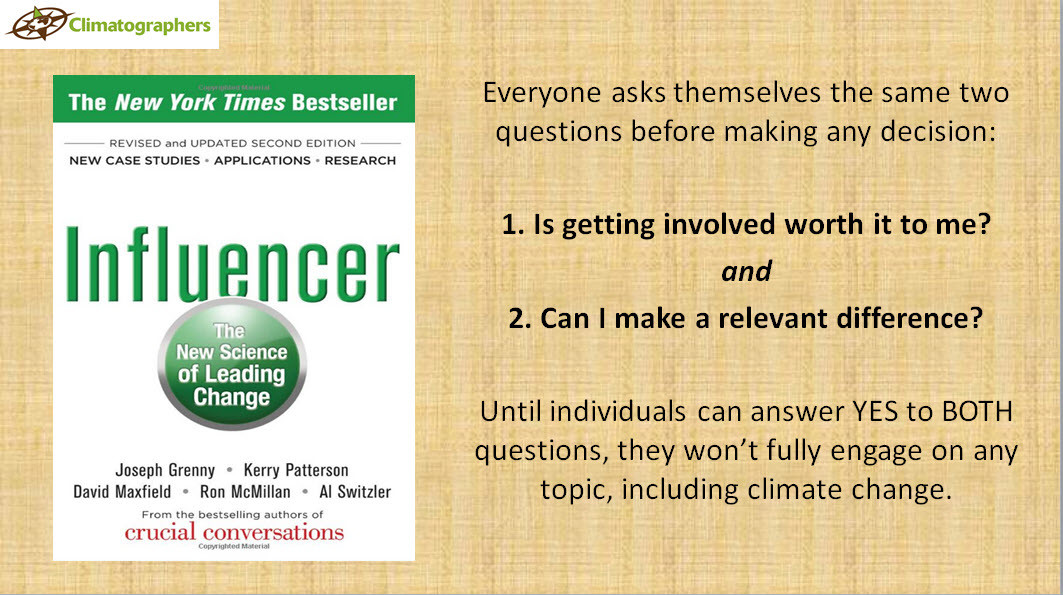
We know there are quite a few people who are alarmed by climate change, and who can reasonably be assumed to have answered Question 1 in the affirmative. We also know that very few people have any real idea what they can do about climate change as individuals. The net result is close to 100 million people largely sitting on the climate change sidelines.
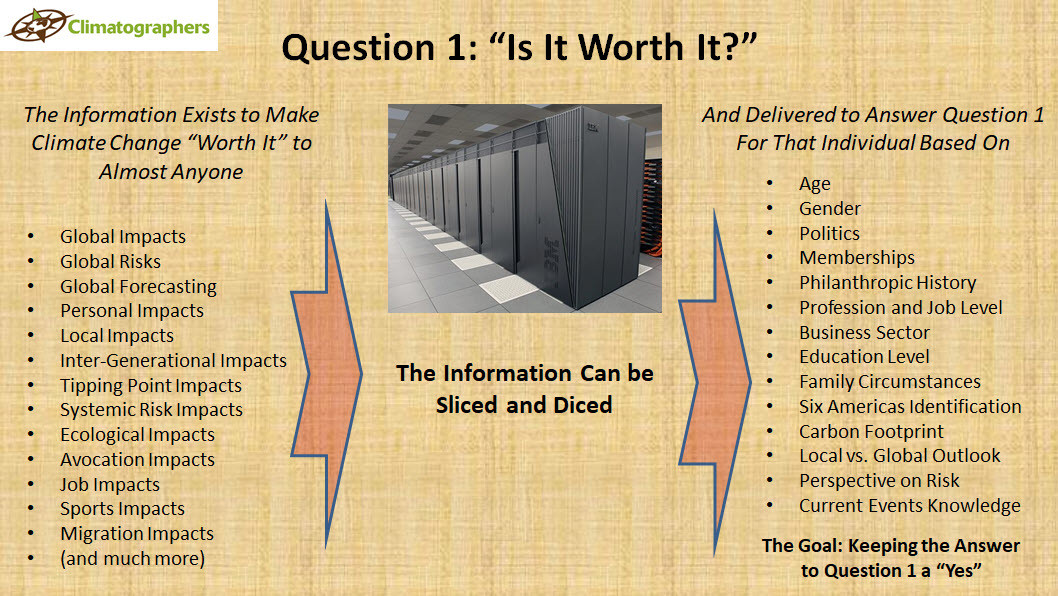
The question we should be grappling with is how to activate those 100 million Americans, or a significant fraction of them, to much more effectively combat climate change. What's missing isactionable knowledge.Actionable knowledge as to why getting involved is worth it, and even more importantly actionable knowledge as to how individuals can contribute to efforts to limit future climate disruption.
It's not as if the necessary information doesn't exist! We have almost infinite climate-related information to draw from. And there's no reason we can't deliver the right information to the right person at the right time (the definition of actionable knowledge).
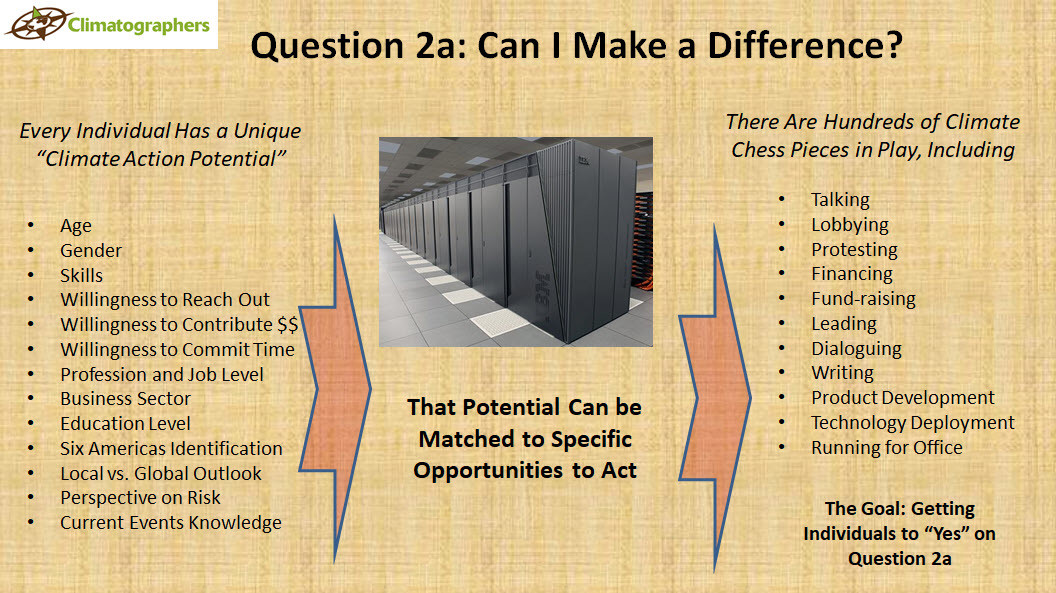
Much more challenging is the idea of convincing people that they can make a meaningful difference. But again, there's no reason we can't code the Climate Action Potential (CAP) of individuals, based on the information they're willing to share with us, and correlate that CAP to different kinds of climate action. The slide below uses the metaphor of Climate Chess to describe the many activities that people could engage in to valuable effect.
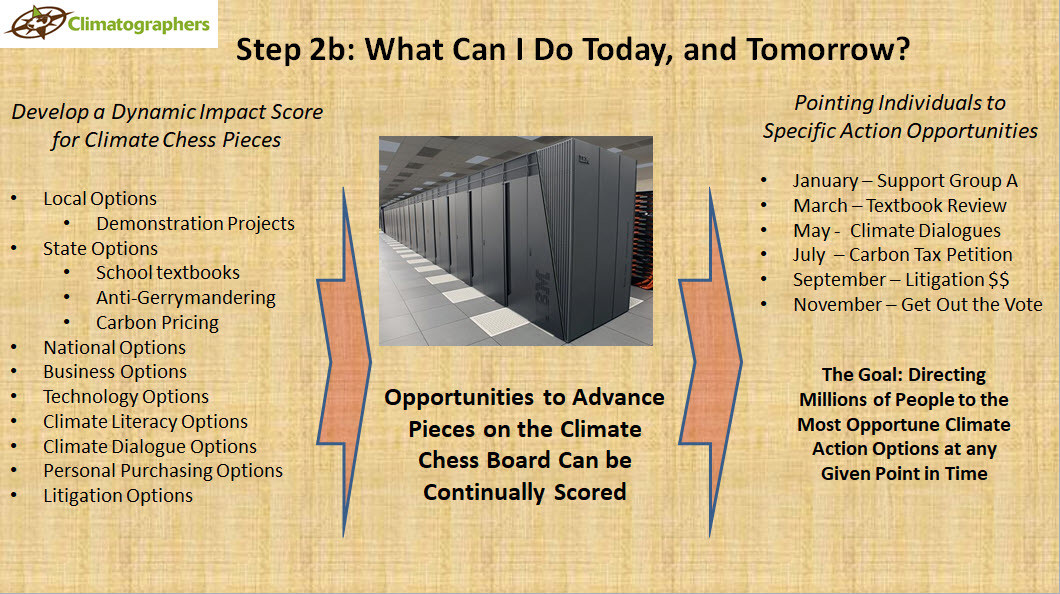
But to really operationalize the idea of individuals becoming effective in tackling climate change we have to go a step further. We have to get specific about the opportunities available to them at any given time. And that means thinking through and prioritizing all the different ways individuals can engage on climate change, and how those options are changing week to week and month to month. Again, there's no reason this can't be done; in fact this kind of messaging was key to the election of Donald Trump in 2016, Why not apply the same tools to tackling climate change?
Going into a lot more detail is beyond the scope of this thought. Suffice it to say that this strategy is not happening, and 100 million people are sitting on the climate sidelines in the United States alone, waiting for someone to provide them with the actionable knowledge they need.