2011 A risk based climate strategy
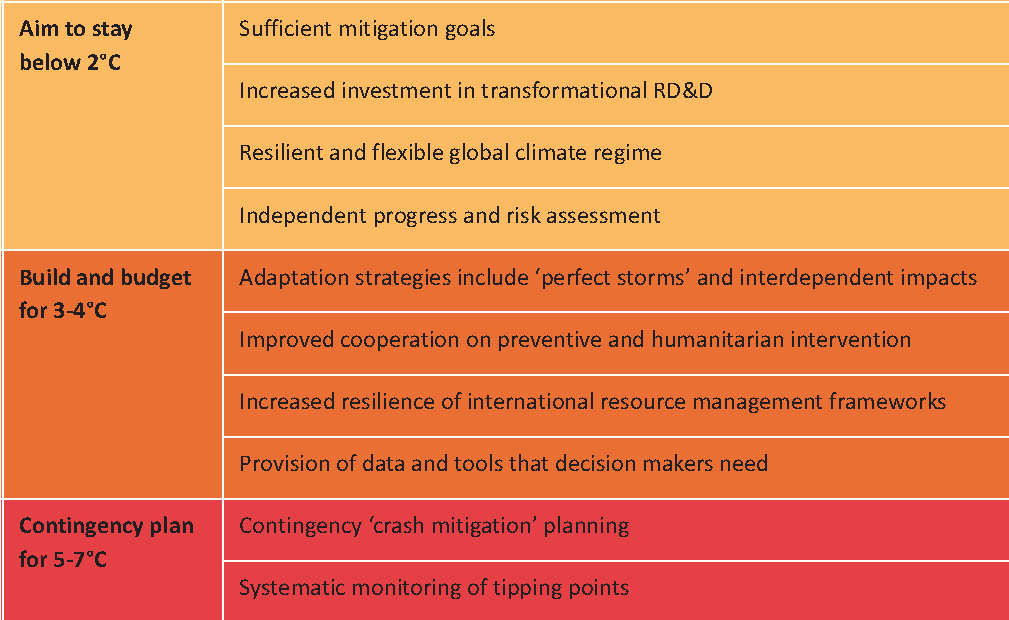
All countries must undertake a process to explicitly identify the level of climate risk they
consider acceptable, based on a holistic risk assessment of national and human security
impacts and the risk of extreme scenarios. Only explicit national goals can provide the
political support necessary to underpin an effective global climate change control
regime. However, explicit national goals alone are not sufficient to drive global cooperative
agreement given potential differences in country risk exposure and vulnerability;
this will require a parallel investment in effective climate diplomacy and political leadership
to construct a regime which delivers climate security for all.272
Governments are increasingly aware of the need to scale-up support for technology RD&D.
The Major Economies Forum countries have already committed to double public RD&D
spending by 2015. However, this is not sufficient to meet the scale of the challenge. Analysis
by the IEA and European Commission suggests public spending may need to rise to four or
five times current levels by 2020.276 In addition to scaling-up domestic spending, countries
should also ensure that there is support for international cooperation. New institutions such
as ARPA-E in the United States and a Green Investment Bank in Britain are being created
to support scaled up innovation and finance. International cooperation is also moving
forward slowly with new cooperative agreements, on a range of technologies, launched at the
Clean Energy Ministerial in 2010.277 Technology cooperation mechanisms are being negotiated
as part of the UNFCCC process. However, the scale and pace of these efforts is not
sufficient to meet the needs and risks that surround achieving aggressive emissions reductions.