COURSE INTRODUCTION
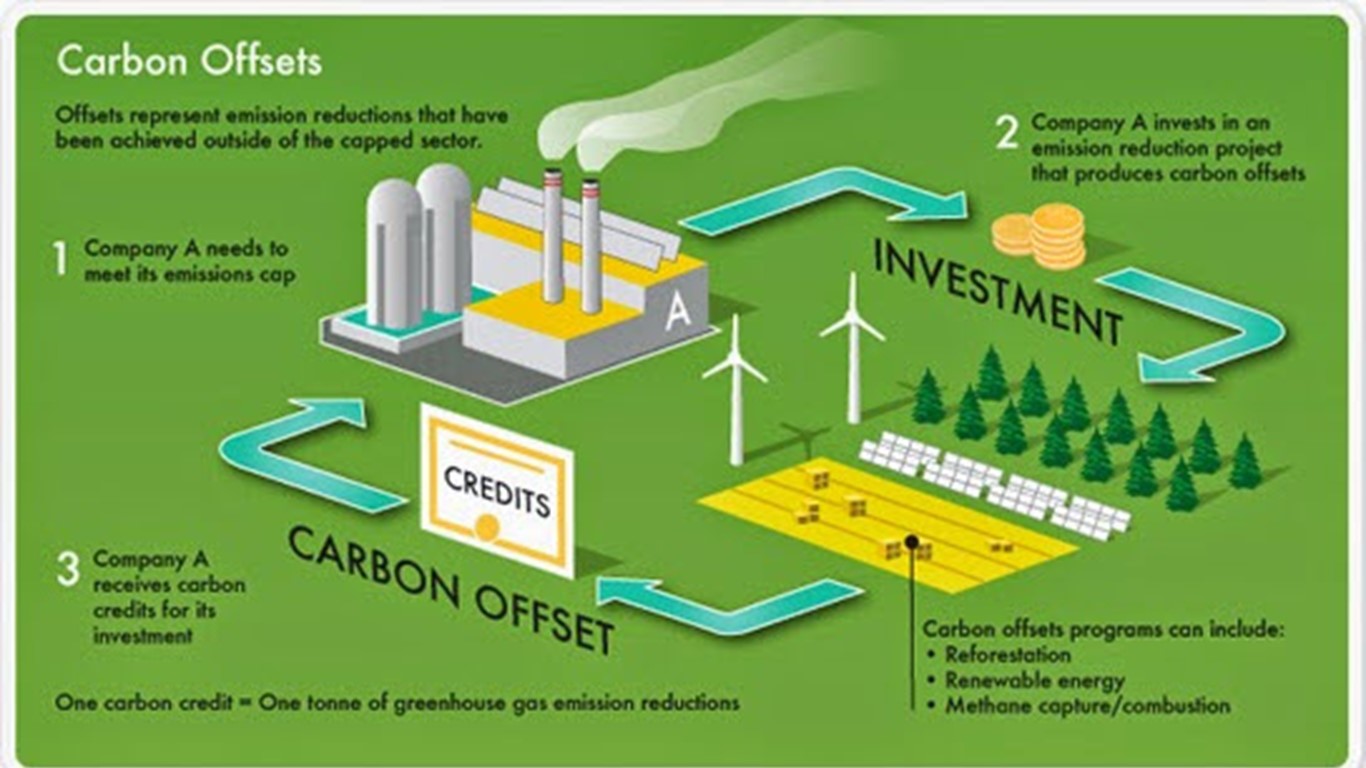
The image above summarizes the idea of carbon offsets. Someone emitting greenhouse gases (GHGs) in one place, by spending money on projects that avoid or remove GHGs in another place, can shrink their carbon footprint and even render themselves “carbon neutral.” It sounds very simple, but when it comes to ensuring the climate change mitigation benefit of carbon offsets, it’s anything but.
The first carbon offset project dates back to 1988, a project in which the Climatographers’ Dr. Mark Trexler was integrally involved. Carbon offset markets have had their ups and downs since then, but offset markets have remained small in the context of other global commodities; for example, the voluntary carbon offset markets is about 10% of the size of the global toothpaste market.
But given the general failure of national and international policy to effectively tackle climate change, in 2021 the Task Force on Scaling Voluntary Carbon Markets came up with the idea of expanding voluntary carbon markets to make up for missing policy. The Task Force suggested that a 10x to 100x increase in the use of voluntary carbon offsets could generate tens to hundreds of billions of dollar per year, the “climate capital” needed to meet global climate targets.
Not surprisingly, this call to radically expand voluntary carbon markets got the attention not just of companies with net-zero targets, but also investors looking to make a profit. And a lot of money will likely be made. But companies and investors should recall that carbon offsets have been a controversial and volatile commodity since the first carbon offset in 1988, and the overall carbon market has collapsed before (in 2010-2011). So the stakes are high for anyone buying carbon offsets, for investors putting money into carbon offsets, and indeed for climate change outcomes.
At the end of this course, you'll understand how offsets have performed over the last 35 years when it comes to mitigating climate change. You will better understand how to evaluate claims that offset markets will grow by orders of magnitude in coming years, and claims that offsets are critical to positive climate outcomes. You'll also be in an excellent position to decide whether you want to purchase or invest in carbon offsets.
We'll go over the requirements of carbon offsets, including the core criteria of additionality, permanence, and lack of leakage. We'll explore why offsets have been SO controversial, in particular when it comes to offset additionality, and how offset scoring can help improve offset markets.
This course is designed for the many people relatively new to the development and marketing of carbon offsets, for journalists covering the anticipated explosive growth of the industry, and for anyone looking to purchase or invest in carbon offsets in order to advance their financial or climate change goals.
I encourage you to take advantage of this course to rapidly come up to speed on the complexities of carbon offset markets, and I look forward to your suggestions and feedback on the course.
What Came Before Offsets
Carbon offsets can be traced back to the perceived success more than 40 years ago of the sulfur allowance trading program under the U.S. Clean Air Act. When the Clean Air Act was passed with the goal of reducing the acidification of lakes and rivers by reducing sulfur emissions from coal-fired generation in the United States, it included a limited cap-and-trade program for sulfur. Many forecasts suggested that sulfur allowances under the cap-and-trade program would be very expensive. Those forecasts were based on the assumption that coal-fired power plant operators would have to install expensive sulfur scrubbers to comply with the Act. In reality, allowances ended up being much cheaper than anticipated, leading to the storyline that the existence of a trading market for sulfur credits was in and of itself responsible for the substantial cost savings. In other words, “trading lowers costs.”
In reality, what was happening is that after the passage of the Clean Air Act, people realized that shipping low-sulfur coal from the Western United States to powerplants in the East was an effective and much cheaper way to comply with Clean Air Act requirements than installing expensive sulfur scrubbers on each powerplant. It wasn’t as much the ability to trade sulfur credits as it was the discovery that Clean Air Act compliance was just a train ride away.
Nevertheless, the “trading lowers costs” storyline stuck. When the climate change conversation got going in the late 1980’s, it was common to hear that “trading carbon emissions cab radically reduce climate change mitigation costs, just like trading sulfur emissions radically reduced acid rain mitigation costs.” In practice, there are no substantive similarities between the two markets, and the experience of the acid rain market should never have been seen as having predictive value for carbon offset markets. But it did.
GHGs - The Ultimately Tradable Pollutants?
Although creation of a market for tackling acid rain ultimately led to creation of a market for tackling climate change, that’s where the analogy ends. Sulfur dioxide is a hazardous air pollutant that once emitted, tends to come down somewhere else in the same airshed. So you have to worry about hot spots of sulfur pollution, and any trading of credits had to occur within the same airshed. That inherently limited the tradeability of sulfur dioxide credits or allowances.
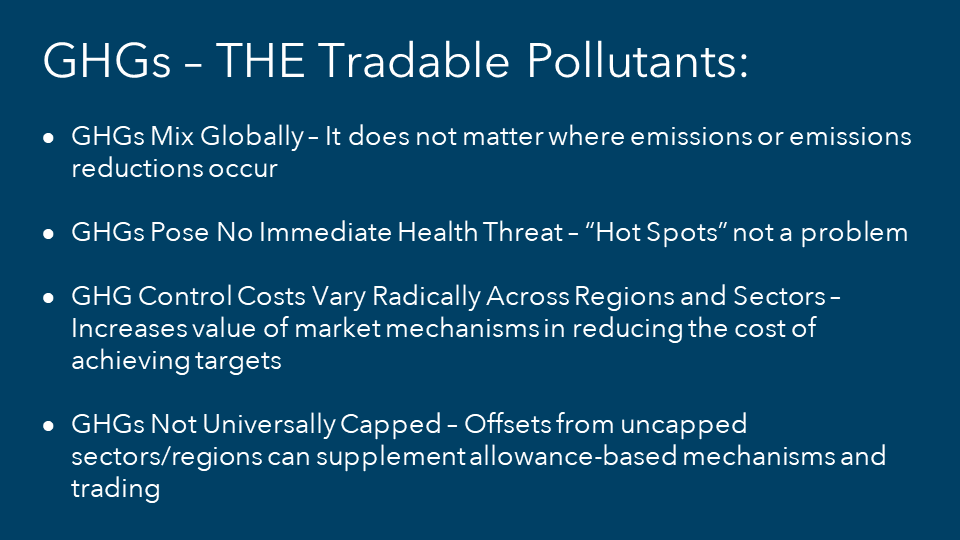
CO2 and the other main greenhouse gases (GHGs), on the other hand, are global gasses. Any given molecule of CO2, emitted in one part of the world, can be anywhere else on the planet within about a week. CO2 concentrations are somewhat higher over industrialized areas, but winds are always mixing CO2 across the atmosphere. CO2 , and GHGs generally, don’t create localized health or environmental hot spots. As a result, it doesn’t matter to climate change where GHGs are emitted, where they’re avoided, or where they’re removed.
These characteristics made GHGs ready-made for establishing a global emissions trading market, thus taking advantage of radically different GHG marginal abatement cost curves across sectors and regions. The potential for trading, and the associated monetary savings, promised to be huge.
The First Carbon Offset
The first carbon offset project was undertaken in 1988. Applied Energy Services (now just AES) planned to build small coal-fired powerplants around the United States, selling the electricity to local utilities. But the CEO of AES, Roger Sant was concerned about climate change. He approached the World Resources Institute in Washington D.C. to explore whether AES could do anything to mitigate the potential climate change impacts of the AES business model. AES CEO Roger Sant noted at the time “as much as I would like to be building windfarms, the economics just don’t work.”
To remove and sequester the carbon dioxide from the stack of a coal-fired power plant at the time would have cost hundreds or even thousands of dollars per ton. But what if AES could pay someone else, anywhere in the world, to avoid emitting a ton of CO2 they would have otherwise emitted, or to remove a ton of CO2 from the atmosphere that otherwise would have remained in the atmosphere? It would probably cost a small fraction of the cost of removing the CO2 at the source, and that’s what AES chose to do.
The first offset project AES funded was an agroforestry project in Guatemala that would increase farm productivity and generate more biomass for rural energy needs. The project would thereby reduce deforestation pressures on the surrounding forest. The cost of that first carbon offset project was estimated at about two cents per ton of CO2 , for a total cost to AES of $2 million dollars to offset the emissions of a (small) coal-fired power plant.
By funding the first carbon offset, AES led the entry of concerned businesses into the world of climate change mitigation, and effectively launched the first voluntary carbon market.
Offsets Offered Something for Everyone
The voluntary use of inexpensive carbon offsets expanded rapidly after AES’ initial foray into the field. At the time, offsets seemed to offer something for everyone.
- Environmental groups saw offsets as facilitating companies’ engaging on climate change, and make it more difficult for them to downplay climate change in the future. Offsets were a slippery slope.
- Companies saw a near-term and inexpensive opportunity to demonstrate their climate change bona fides inexpensively, and the opportunity to prove out what they saw as a longer term low-cost compliance option.
- Policy makers saw the ability to lower compliance costs by allowing offsets as a good way to reduce company opposition to climate change policies and measures.
- Individuals saw a low-cost way to reduce their carbon footprints. Today, carbon offsets are also increasingly used as a consumer branding tool. Your credit card company may already be buying offsets to make your purchases "carbon neutral," and that's just one of many examples. All at potentially no cost to you.
- Many environmental and social welfare groups also embraced offsets as a means of funding initiatives ranging from poverty reduction to endangered species conservation.
- Everyone liked the co-benefits. Removing and storing a ton of CO2 from a U.S. powerplant, for example, would have had no social or environmental co-benefits. Carbon offset projects, however, whether focused on tropical forest conservation, on efficient cookstoves, or on promoting renewable energy in developing countries, promised substantial social and environmental co-benefits.
It’s also important to remember that the concept of GHG offsets got underway at a time when no regulatory GHG emissions reduction mandates were in place or even under serious policy consideration. It was one of the few “games in town” when it came to encouraging companies to start thinking about climate change mitigation.
Electric utilities in particular quickly and enthusiastically embraced the idea of offsets. They were an inexpensive way to respond to growing stakeholder concerns over climate change, and they were expected to provide a cost-effective way for utilities to comply with potential future climate change policies and regulations, without having to disrupt their operations. It’s worth remembering that many electric utilities in the United States anticipated in the early 1990’s that their emissions of carbon dioxide would be regulated withing just a few years.
Offsets Took Climate Policy by Storm
Although offsets got their start as a voluntary market mechanism, offset buyers and sellers saw a huge potential for incorporating offsets into national climate policy framework as they started to evolve. And that’s what happened.
In the U.S., virtually every piece of proposed federal climate legislation aimed at mitigating climate change has incorporated the market mechanism of cap and trade with offsets. Although such legislation has never passed, there was extensive discussion of offsets in designing the legislation. At the state level, offsets are a key element in California’s Global Warming Solutions Act, a cap and trade system (more commonly known by its legislative bill number, AB 32). In the Northeast, the multi-state Regional Greenhouse Gas Initiative (RGGI) also has an offset component.
International policy to address climate change began to gather steam with the signing of the United Nations Framework Convention on Climate Change (UNFCCC) in 1992 and its entry into force in 1994. Offsets were woven into the structure of the UNFCCC, but it had no enforceable provisions mandating reductions. That had to wait until the Kyoto Protocol to the UNFCCC, which was signed in 1997 but did not enter into force until 2005.
The Kyoto Protocol established an emissions cap for industrialized countries, and two different carbon market mechanisms to help them stay within the cap: Joint Implementation (JI) allowed for carbon to be traded between industrialized country Parties to the Protocol, whereas the Clean Development Mechanism (CDM) provided for offset-based trading between developed and developing countries.
The Kyoto Protocol and its emissions cap approach ultimately failed, and was replaced in 2015 by the Paris Agreement. Article 6 of the Paris Agreement allows countries to voluntarily cooperate with each other to achieve emission reduction targets set out in their voluntary Nationally Defined Commitments (NDCs). Although Article 6 rules are still being written, countries will ultimately be able to trade carbon credits under the mechanism.
At this point, it is likely that any national or international legislation or agreement to tackle climate change will incorporate offsets; the economic and political advantages are simply too great to do otherwise. What is much less clear is whether the inclusion of offsets in these initiatives will actually end up mitigating climate change.
The intangibility of the offset commodity lies at the heart of the radical uncertainty facing the future of offset markets. Notwithstanding the industry’s aggressive growth expectations, anyone with a material interest in the future of carbon offsets should want to understand the answers to questions that include:
- Why did offsets get so contentious after the World Resources Institute and other leading environmental groups originally promoted them as a technically and economically sound tool for advancing climate change mitigation objectives?
- Why have we been having the same arguments about offsets and seeing the same front-page exposes for 20+ years?
- Why are offset markets having so much trouble delivering a consistently “quality product” after 35 years of practice?
- Why have efforts to “fix” carbon offsets failed, and will the proposed Assessment Framework of the Integrity Council for the Voluntary Carbon Market (ICVCM) finally turn the corner toward a quality market?
- Are carbon offsets plausibly fit-for-purpose with respect to current offset-optimism?
These questions in one way or another all come back to the intangibility of carbon offsets and the failure of offset markets to effectively adapt offset markets to that intangibility.