Solving Climate Change as a Wicked Problem
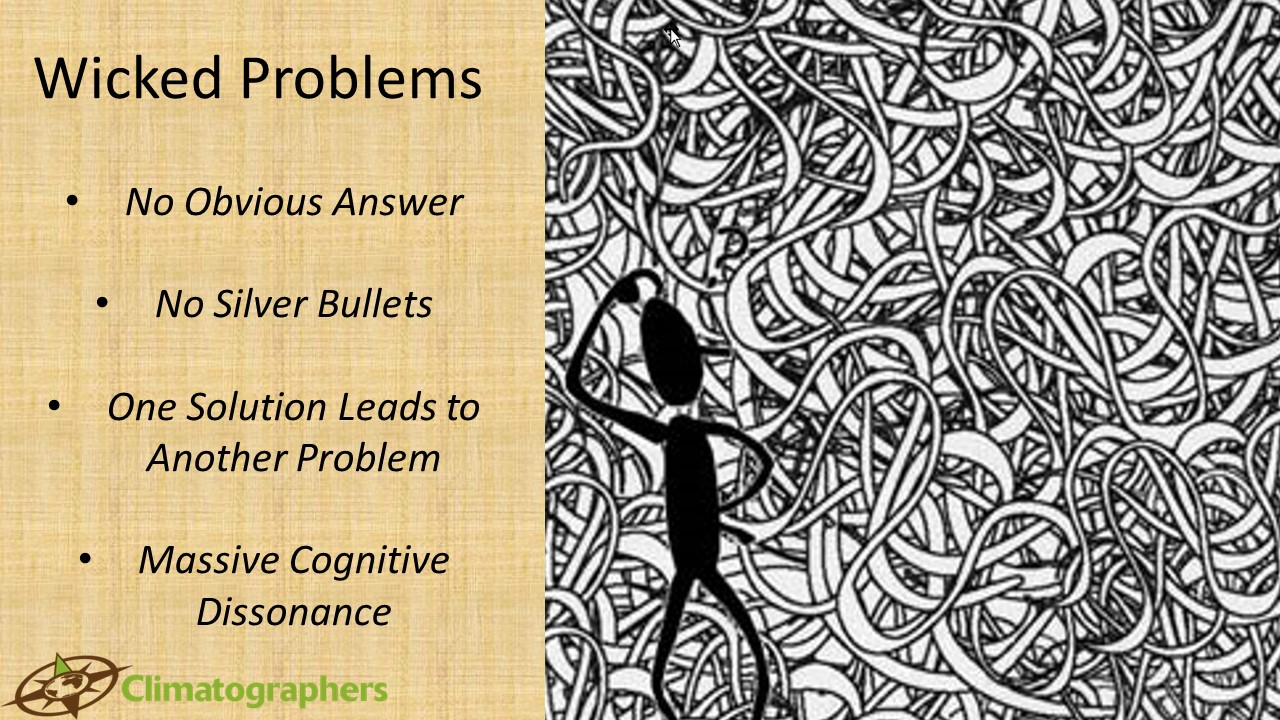
To understand climate change as a wicked problem, check out Why is Climate Change a Wicked Problem?.
It is easy to pay lip service to climate change as a “wicked problem,” and you can find it referred to that way almost every day. That said, thousands of books, papers, blogs, and news stories approach climate change every year through the eyes of individual disciplines and silos, and to focus on “solutions.” For economists climate change is an externality problem, for engineers it’s a technology problem, for psychologists it’s a cognitive perception problem. Most of us are tied to individual disciplines; we are neither prepared nor incentivized to tackle the wickedness of the problem. And even if we wanted to, where would we turn for help?
We would do well to heed Albert Einstein’s conclusion that “we cannot solve our problems with the same thinking we used to create them.” We have not heeded that advice in our constant search for solutions to the climate change problem. There are good reasons for that failure.
The problem is not a general lack of relevant information. New climate books appear every month. Numerous reports and journal publications appear every week, and dozens of climate stories circulate through our listserve, Facebook, Twitter, and LinkedIn networks every day. Collectively we know a great deal about climate change, but as individuals we’re much more limited. As John Naisbitt puts it, “we are drowning in information but starved for knowledge.”
The Climate Web uses innovative TheBrain software to tackle the challenge, helping individual users access “actionable knowledge” from disciplines as wide-ranging as climate science, risk perception and risk management, climate modeling and forecasting, business decision-making, technology innovation, and communications theory. It does not advocate particular solutions, or provide “the” answer to questions. Rather, it pulls together the arguments and thinking from hundreds of experts and thought-leaders across the spectrum of issues that make climate change such a wicked problem. The Climate Web can be thought of as a time-saver, a training tool, or as a doorway for exploring the wickedness of the climate problem.
The Climate Web is easy to explore, as you can jump from idea to idea with clicks of the mouse. But just as climate change is the ultimate wicked problem, the Climate Web does not pretend to offer instant gratification. What it does do is point you to information you are looking for, as well as information you might not have thought to look for. Not only does it encompass tens of thousands of published sources and links to news stories, blogs, websites, and other resources, but the curators of the Climate Web have extracted and organized the key messages, the best tables and figures, and more, for easy access. No longer are you limited to the insights of the first blog or article you happen to come across.
The Climate Web is structured around A Systems Look at Climate Progress, and so is structured around the whole topic of solving climate change. To dig a lot more deeply into the strategies and tactics required, check out Climate Chess.
The Climate Web already reflects a very large knowledgebase, but we’ve only scratched the surface of what it can ultimately deliver to support understanding of and action on the wicked problem of climate change. We encourage you to explore it, and to help us continue to expand it.