Partb
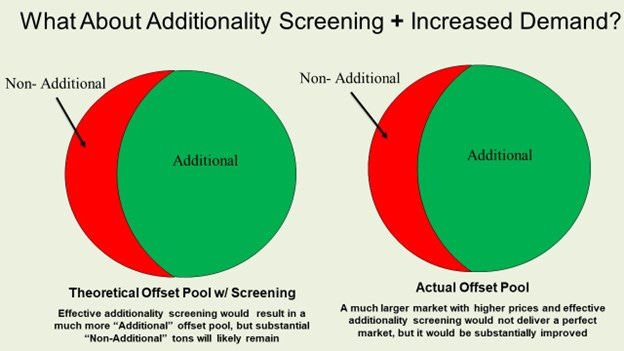
- Conversely, just improving the quality of the “potential pool” by carefully screening for the sectors and projects allowed to participate in the market won’t be enough if there is a substantial imbalance between supply and demand. The greater the imbalance between supply and demand, the easier it will be to satisfy demand with non-additional tons from the “potential pool.”

- Creating and maintaining a quality offset market requires balancing the size of the “potential pool” with offset demand. Successfully maintaining offset quality while scaling that market requires keeping supply and demand in balance. As demand increases, for example, additional sources of offsets can be added to the “potential pool.” As previously noted, a 100% additional offset market will never be possible -- but careful attention to what “additional sources of offsets” are allowed into the pool can maintain adequate environmental integrity.
How to Fix Offset Markets
As one carbon offset expert summarizes today’s situation: “at the project level, everyone kind of has an incentive to see how much they can get away with without raising alarm bells among buyers - but the systemic outcome is a crash.”
The good news is that there are several key steps we could take to substantially improve offset market outcomes.
- Decide how the goals of offset cost-effectiveness and environmental integrity are to be balanced in evaluating and approving offsets. Only then can “appropriate” rules for implementing the additionality, permanence, and leakage criteria be developed.
- Since a “perfect” offset pool is out of reach, decide “how good is good enough.”
- In creating the “potential offset pool” through the approval of offset methodologies, each methodology should be required to evaluate the potential for non-additional tons to use that methodology to qualify as offsets.
- Anticipate the inevitability of gaming and write offset rules accordingly.
- Use third-party “quality due diligence” reviews to inform offset buyers about how much confidence they should have when purchasing offsets.
The relatively recent launch of multiple offsets ratings agencies represents progress on at least one of these steps. And the question really isn’t whether one could “fix” today’s offset markets, it’s whether market participants have any interest in doing so given the market implications -- a topic we’ll come back to below.
The Bad News – Once “Fixed,” Offsets Markets Won’t Scale to Meet Today’s Overly-Ambitious Market Expectations
With careful attention to how offset markets are structured, those markets could significantly scale. The challenge comes in assuming that offsets can scale to the point of playing a major role in achieving global climate targets, as assumed by offset optimists.
The problem is two-fold. First, as more offset sources are added to the potential pool in order to meet rising demand, it inevitably gets harder to manage the number of false positives making it into the pool. Second, the intangibility of the offset commodity, as explored in Part 2, makes it harder to limit gaming, fraud, and corruption in the market as the market gets larger and encompasses more and more offset sources. We’ve seen both of these problems even with the relatively modest scaling of carbon offset markets attempted to date, which is a far cry from the massive scaling proposed by offset optimists.
Alternative Offset Scenarios
So where does that leave us when thinking about the future of carbon offsets? I’ll briefly explore a few of the potential scenarios.
Scenario 1: We Fix Offset Markets
I’ve noted that the question really isn’t whether one could “fix” today’s offset markets; we could. But do we really want to? Most of today’s offset market participants would object for one reason or another to the likely implications of a quality offset market, including:
- Greater centralization, since the idea that anyone can set up their own offset standards organization and market undermines efforts to deliver a quality commodity.
- Greater business risk, as the ability of market participants to game offset rules declines.
- Fewer categories of qualifying projects, e.g. due to stricter application of qualifying criteria, permanence and leakage in particular.
- Fewer qualifying projects in each category, e.g. due to stricter application of qualifying criteria, additionality in particular.
- Smaller size, with less growth potential.
- Substantially higher market prices.
Whether because of greater business risk, limited growth potential, or substantially higher market prices, there is something for everyone to hate about the design parameters of a quality offset market. And because offset market stakeholders dominate efforts to “fix” offset markets, we are far more likely to continue to see efforts that nibble around the edges of the problems as opposed to solving them.
Even the ICVCM’s proposed Assessment Framework does little to address the challenges we explored in Part 2 of this series. The ICVCM makes no mention of the problems created by scaling offsets beyond their “small world model,” for example, nor does it discuss the reality that we can’t be certain of an intangible commodity’s quality (just more or less confident). Finally, the ICVCM doesn’t address the need to explicitly balance the objectives of cost-effectiveness and environmental integrity. The ICVCM is dominated by current market participants and stakeholders and is trying to improve the existing carbon offset “mousetrap.” It’s not trying to rethink the system in order to deliver a consistently quality offset commodity.
For these reasons, Scenario 1 is pretty unlikely.
Scenario 2: Full Speed Ahead on Offsets
Many offset market participants and investors are banking on a “full speed ahead” future for voluntary offsets and offset markets. This scenario includes many of the elements described in Scenario 1 when it comes to nibbling around the edges of the problem. Nevertheless, this scenario requires arguably heroic assumptions about the ability of market participants to continue to distract attention from the structural problems with carbon offsets. Admittedly, as Margaret Heffernan notes, our proven potential for “willful blindness” is huge.

Given the commonly cited “need” for carbon offsets to tackle climate change, this scenario is quite likely in the short- to medium-terms. That said, willful blindness cannot succeed forever as a market strategy. If offsets scale rapidly under Offsets Round 2, all other things being equal, the result is likely to be the same kind of crash that ended Offsets Round 1.
Scenario 3: From Projects to Programs
Some offset market observers suggest that the problem with today’s offset markets is the focus on a myriad of individual projects, each delivering a relatively small quantity of offsets. They suggest that a “programmatic approach” based, for example, on public policies intended to generate qualifying reductions and removals could be much simpler to implement and ultimately more effective.
But there is nothing about a programmatic approach that inherently solves the “intangibility” problems discussed in Part 2 of this blog series. Indeed, the Kyoto Protocol’s Clean Development Mechanism experimented with programmatic offset methodologies; the problems encountered didn’t differ much from the project-based approach.
Scenario 4: From Carbon Offsets to Carbon Contribution Claims
Recently, there has been discussion of moving away from focusing on “carbon offsets” to the alternative idea of “carbon contributions.” Carbon contributions are different because the funder in a contribution claims model doesn’t claim ownership of any emissions reductions or carbon removals resulting from the “contribution.” As a result, those emissions reductions or removals can’t be applied against the funder’s carbon footprint-related claims, e.g. climate neutrality or net zero.
“Carbon contributions” could fund many of the same types of initiatives being funded by carbon offsets, but could also apply to activities that wouldn’t be able to qualify as offsets, e.g. climate education and policy advocacy. In effect, carbon contribution claims would encourage companies to spend money on what will most advance global climate objectives, as opposed to focusing on their individual carbon footprints.
To the extent carbon contribution claims aren’t counted against your emissions footprint, do things like additionality, leakage, and permanence still matter? They certainly matter less since you are not implicitly justifying an emission somewhere else with a contribution claim, as you are with a carbon offset. That said, if you’re going to give contribution claim money to someone to mitigate climate change, you would still want to fund something that wouldn’t have otherwise happened – i.e., the importance of additionality still exists. Moreover, you would still want to promote activities that might have a permanent impact and which don't leak. So, in a very real sense, additionality, permanence, and leakage are just as conceptually important, but arguably pose much less of a greenwashing problem than they do for today’s carbon offsets.
A growing number of carbon offset market participants are promoting the substitution of contribution claims for carbon offsets. Whether individuals, companies, or countries will have any interest in funding “contribution claims” that can’t be applied against their footprints or net zero targets, however, remains an untested proposition.
Conclusion
In this blog series I’ve laid out in some detail the challenges of building a quality commodity market around an intangible commodity like carbon offsets. Offset optimists assert that offsets can be scaled by 10x to 100x to help meet global climate targets, with no discussion of the challenges I’ve discussed. Nor is there any such discussion in the more recent work of the Integrity Council for the Voluntary Carbon Market. Instead, offset advocates state the “need” for carbon offsets, assume that there are simple technical fixes that can be implemented for carbon markets, and assume that offsets can be massively scaled. These are completely unproven assumptions and should be treated skeptically unless demonstrated otherwise.
The future of offset markets, and the ability of investors to profit from them, can only be characterized as radically uncertain. Offset markets could evolve in many different ways, with the “explosive growth” scenario being both the most likely and the most risky. These markets have collapsed before, and if we simply continue with offsets business as usual, including ineffective efforts to “fix” offset markets, they probably will again. If you’re banking on carbon offsets, tread carefully.