A Context for Climate Scenario Planning
Establishing the Context for Climate Scenario Planning
Societal alarm bells began to ring for climate change more than 50 years ago. Business alarm bells began to ring in the offices of major greenhouse gas (GHG) emitters more than 20 years ago. Now, the ringing has reached levels likely to impair the hearing of anyone listening. You can hear the alarms across the business landscape.
Climate change is cited as a risk that keeps some business executives "up at night." Climate change and associated risks (e.g., water scarcity and extreme events) consistently rank toward the top of the “10 Year Business Risks” published annually by the World Economic Forum. In 2018 (shown below) extreme weather events were characterized as both the highest likelihood and highest impact risk. That said, the Global Risk Report rankings do not necessarily represent expert views.
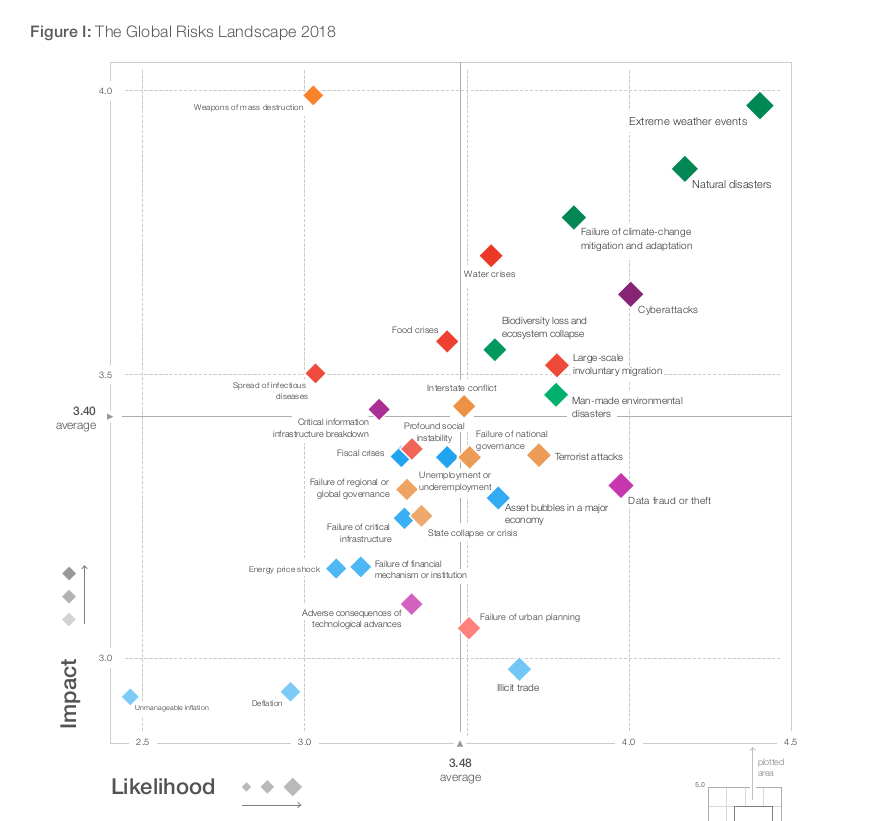
Source: 2018 Global Risk Report
Note: The complete Guidebook lets you review how the World Economic Forum's Global Risk Reports have treated climate change and climate-related variables over time.
What does this mean for business strategic planning and decision-making? Policy makers have failed so far to act to keep climate change from crossing thresholds considered dangerous; what climate change impacts should business anticipate, and by when? Should business decision-makers assume that societal policy-makers will eventually act to limit average global temperature change to 2°C, as they have said they will do? How would that be done? What would be the implications for business? Is it the role of business to take up the slack of inadequate global policy in tackling climate change? Will investors avoid companies perceived as climate-exposed and punish private sector failures to take climate change seriously? Will “stranded investments” leave corporate management and boards of directors on the hook for having failed to anticipate a changing business risk environment?
These are huge questions. They suggest just how much uncertainty exists regarding the future of climate change and climate policy. There is no way to predict the future, but perhaps business decision-makers can better prepare their companies for the uncertainty through tools such as scenario planning. Can companies become more resilient to potential climate-related outcomes and exert competitive advantage over competitors who fail to do the same?
The short answer is "yes." That short answer hides a lot of diversity of company circumstances, however. There is no “one size fits all” when it comes to assessing companies' exposure and vulnerability to climate risks (and opportunities). There is no "right answer" to how companies should respond to climate risks and opportunities. But business prudence does dictate that many companies at least understand how the variables introduced above could materially affect their operations and future business models. Scenario planning is the right tool to accomplish that goal.
This chapter helps explain how we've gotten to the situation in which we find ourselves today at the societal and business levels. It sets the stage for thinking about climate scenario planning in subsequent chapters.