Climate Chess - Summary
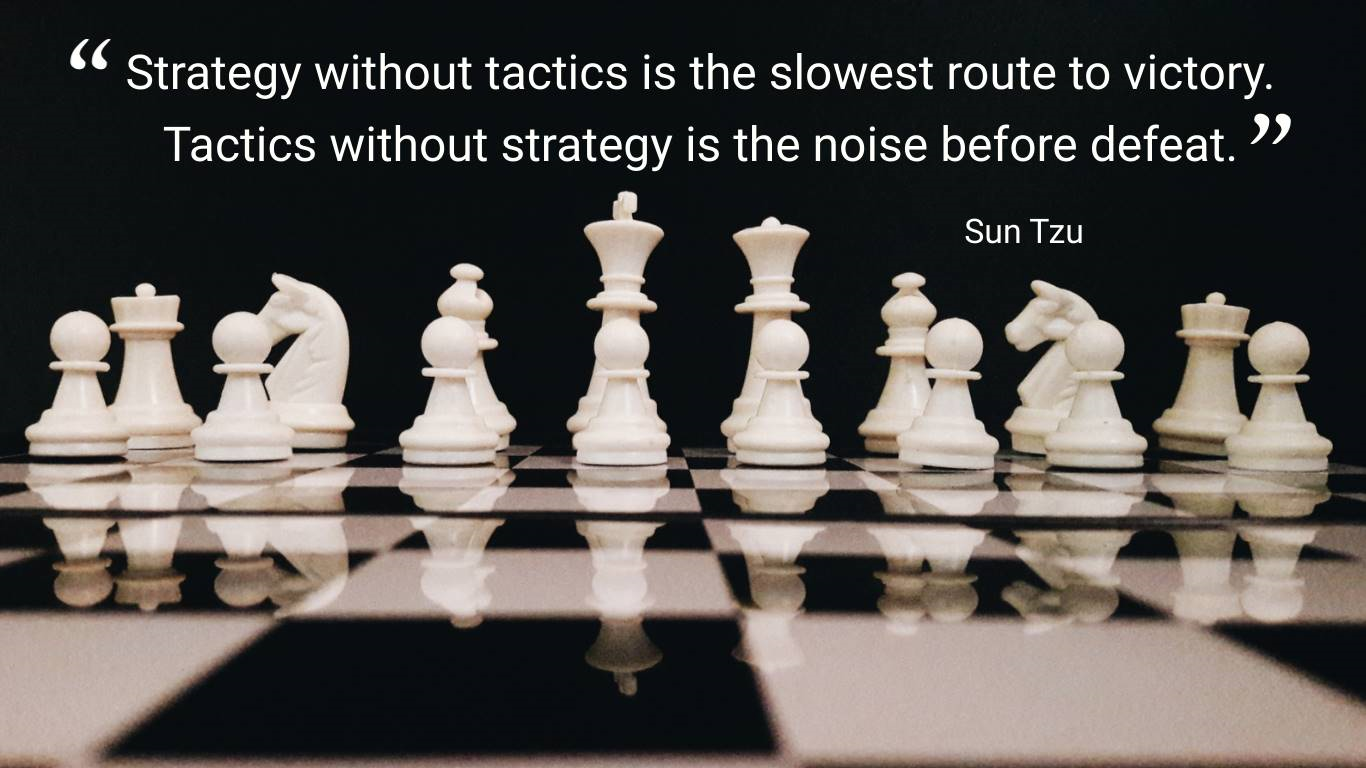
Sun Tzu's quote in the slide above is famous, and it certainly applies to tackling a problem with the characteristics of climate change.

One way to think about climate change is as the ultimate planetary boardgame, Climate Chess. The characteristics of climate change suggest that a combination of strategic and tactical responses will be critical to success (if success is possible), not unlike how you might approach a normal game of chess.
Let's compare some of the characteristics of conventional chess and Climate Chess.
Chess is characterized by:
- Two opposing teams.
- Each team has different pieces with different capabilities in terms of the moves available to them.
- There are always lots of possible moves, and millions of game permutations. You have no idea at the outset what the winning move of the game will actually be.
- Players always need to be looking for opportunities to take advantage of a weakness or mistake on the part of the opposing team, and
- Winning against a talented opponent depends on taking advantage of all the pieces on the board to execute a successful strategy. Pawns in chess, for example, generally have a lot less power than Bishops. But in the right place at the right time a Pawn can checkmate the other team's King. But that never happens if the Pawn is not part of a coordinated strategy on the board.
Tackling climate change can be characterized similarly:
- People worried about climate change are seeing their efforts countered by an "opposing group." (Team No Urgency)
- Different organizations and individuals have different skill sets, capabilities, and resources they bring to their climate activities.
- The opportunities for making a difference on climate change are numerous. They include influencing city or state decision-makers, voting in a local, state, or national election, supporting campaigns against gerrymandering, influencing how textbooks in Texas talk about climate change, or even just talking to your neighbor. But most of these opportunities are time and geography-specific, and require different skill sets and resources.
- We can't say for sure what might constitute a successful climate change strategy, since so far there hasn't been one. But it's a safe bet that not taking advantage of all the skill sets and opportunities at our disposal will reduce the likelihood of success, just like on the typical chess board.
The analogies between chess and tackling climate change are strong enough to suggest that what we're really engaged in when it comes to climate change is the ultimate planetary board game of Climate Chess.
Unfortunately, there is little coordination or collaboration today between players and pieces on todays Climate Chessboard, at least with respect to Team Urgency. You could even conclude that while Team No-Urgency knows it is playing Climate Chess, and is actively engaging, Team Urgency isn't! And as a result Team Urgency is losing the game.
Today's climate change conversations are distributed across dozens of narratives and hundreds of climate silos. Most of us are firmly anchored to one of those narratives or silos. In chess terms we're focused on "our" chess piece; we think of it as the most important piece, and try and convince everyone else to focus on that piece.

It hasn't been a winning strategy because it fails to recognize that Climate Chess is not your typical chess game. Yes these is an opposing team, but there are numerous players, hundreds of pieces, and even more potential moves. Failing to recognize the nature of the game is a recipe for failure, and helps explain why Team Climate Urgency has been losing for more than 30 years.
In all fairness, Team Climate Urgency started out in a weaker position on the chessboard than Team Climate No-Urgency. It's always much harder to change the status quo than it is to defend it. But it's also true that Team No-Urgency has long understood that it's engaged in playing Climate Chess, and has played the game more strategically than has Team Urgency.
What would happen if that changed, and Team Urgency started playing Climate Chess with an even better strategic and tactical mind-set than that of Team No-Urgency?
The Climate Web organizes a huge amount of information relevant to understanding and playing Climate Chess. If you are interested in the idea, you might want to start with our Free eBook on the topic.