MODULE 9 - USING YOUR VOTE
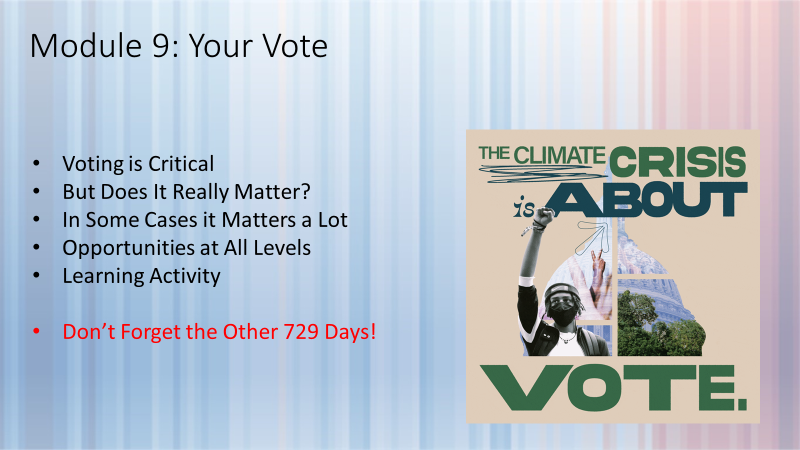
We've covered reducing your footprint. We have covered using your voice and time. Now, we're going to move into using your vote.
Some people will tell you, and you'll read it in a lot of different books, that voting is the most important thing you can do because if more people voted climate we would have the policies and measures that we need to tackle climate change.
Unfortunately, it is a little more complicated than that.
Don't get me wrong, I'm certainly not saying you shouldn't go out and vote. Voting is critical in many ways. It’s sort of similar to your carbon footprint in the sense that if you're not willing to vote and to vote for climate change, what are you really willing to do? Do you take the problem seriously?
So voting is critical, but where does it really matter? Where doesn't it really matter? In some cases it matters a lot. But our system is currently designed so that in many cases it doesn't matter much, or at least for 90% of the people in the United States, our votes don't matter that much, just given how the system is currently set up.
That isn't to say that there aren't more local and more state opportunities for voting. One of the key aspects of voting is that no matter how important voting is, if it's only happening every two years, which would be relatively normal, then there are 729 other days (approximately) during those two years when you should be thinking about and doing some of the other things as opposed to just focusing on voting and saying, well, I've done my part because I voted for an environmental candidate. We'll get into the learning activity and I'll point you to some organizations and some resources that you might want to use to dig a little bit more deeply into this area.
I obviously don't need to teach you how to vote -- that is something that you already know how to do!