10.2 Underestimating Risk Deeper Dive - Risks.mp4
So after the whirlwind tour of underestimated climate risk that we saw in the last video, this video digs a little bit deeper into a couple of the topics, and in particular looks at why and how the intergovernmental panel on climate change may be contributing to our underestimation of climate risk, which is key because that's where everyone tends to go for their climate science and risk information.
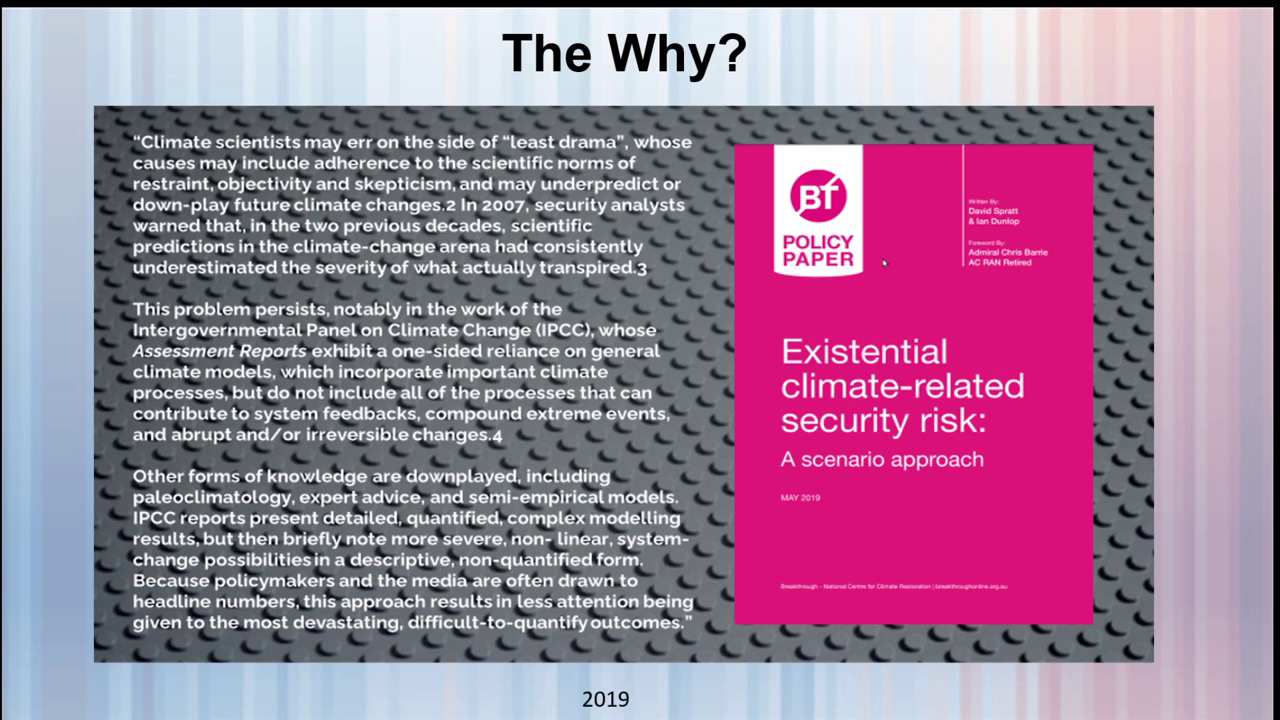
So let's take a look at the question of the why of underestimating climate risk, which I've taken from a report existential climate related security risk, A scenario approach, very interesting paper by David Sprat and Ian Dunlap. And they note that climate scientists may err on the side of least drama for a whole series of reasons and may under predict or downplay future climate changes. In 2007, security analysts warned that scientific predictions in the climate change arena had consistently underestimated the severity of what actually transpired.
And they note that this problem persists in the work of the IPCC whose assessment reports exhibit A one-sided reliance on general climate models, which do not include all the processes that can contribute to system feedbacks and that can compound extreme events and lead to abrupt and or irreversible changes. They also argue that other forms of knowledge are downplayed, including paleoclimatology expert advice, semi empirical models. The IPCC reports present detailed, quantified complex modeling results. But then briefly note, more severe non-linear system change possibilities in a descriptive, non quantified form. Because policymakers and the media are often drawn to headline numbers, this approach results in less attention being given to the most devastating, difficult to quantify outcomes. So that's a very good overview of the why behind
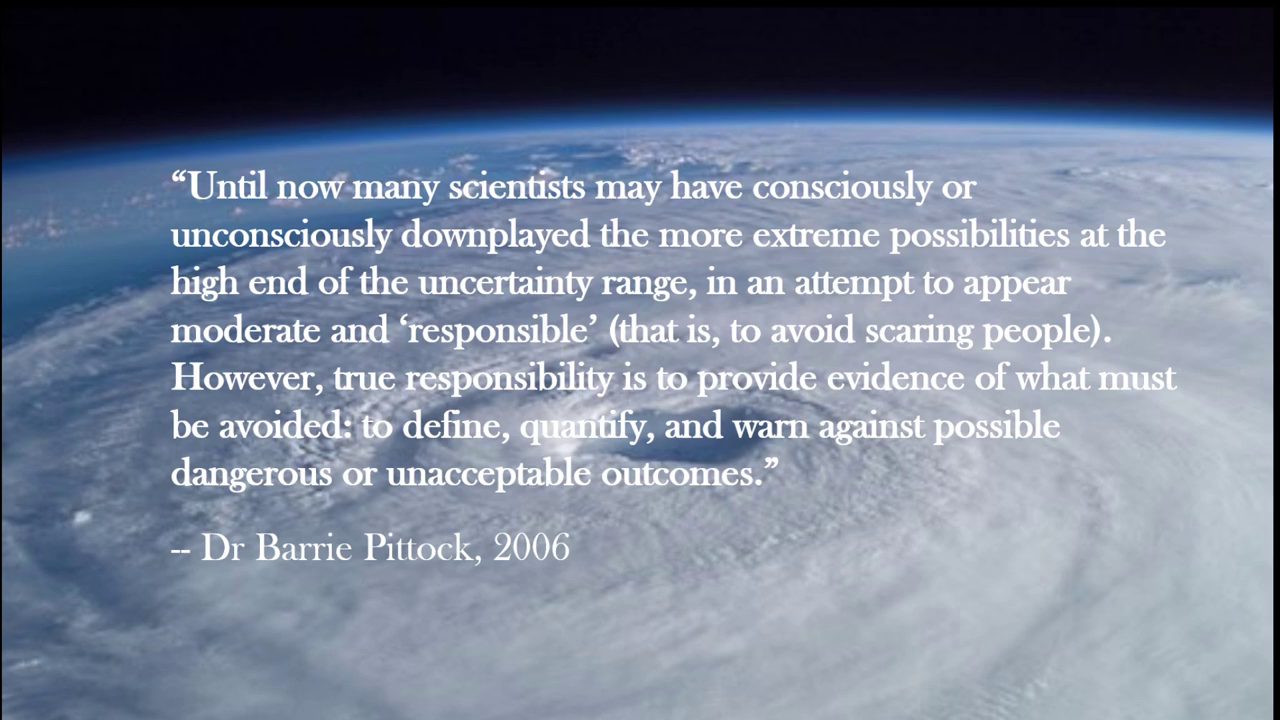
climate risk underestimation. And this topic has been around for a long time. One climate scientist, Barry Pitek in 2006 talked about many scientists consciously or unconsciously downplaying the more extreme possibilities in an attempt to appear moderate and responsible.
That is to avoid scaring people. He argued in 2006 that true responsibility is to provide evidence of what must be avoided to define quantifying and worn against dangerous or unacceptable outcomes.
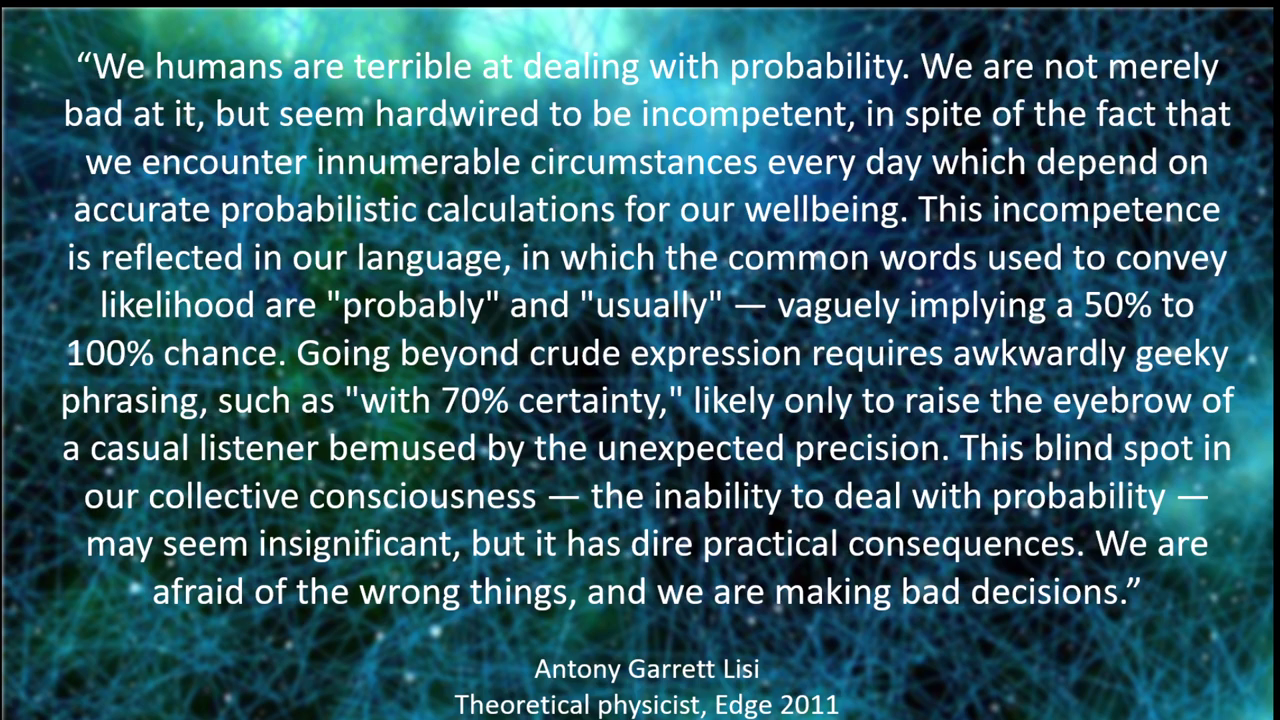
We've talked before about the topic of probabilities, but this quote from a theoretical physicist, Anthony Garey, talks about the problem that we have with communicating probability. We are not merely bad at probabilities, but seem hardwired to be incompetent in spite of the fact that we encounter innumerable circumstances every A which depend on accurate probabilistic calculations for our wellbeing. The incompetence is reflected in our language, in the common words we use to convey likelihood, like probably or usually vaguely implying. A 50% to 100% chance going beyond crude expression requires geeky phrasing such as with 70% certainty, likely only to raise the eyebrow of a casual listener. The M by the unexpected precision, this blind spot in our collective consciousness, the inability to deal with probability may seem insignificant, but it has dire practical consequences.
We are afraid of the wrong things and we are making bad decisions.
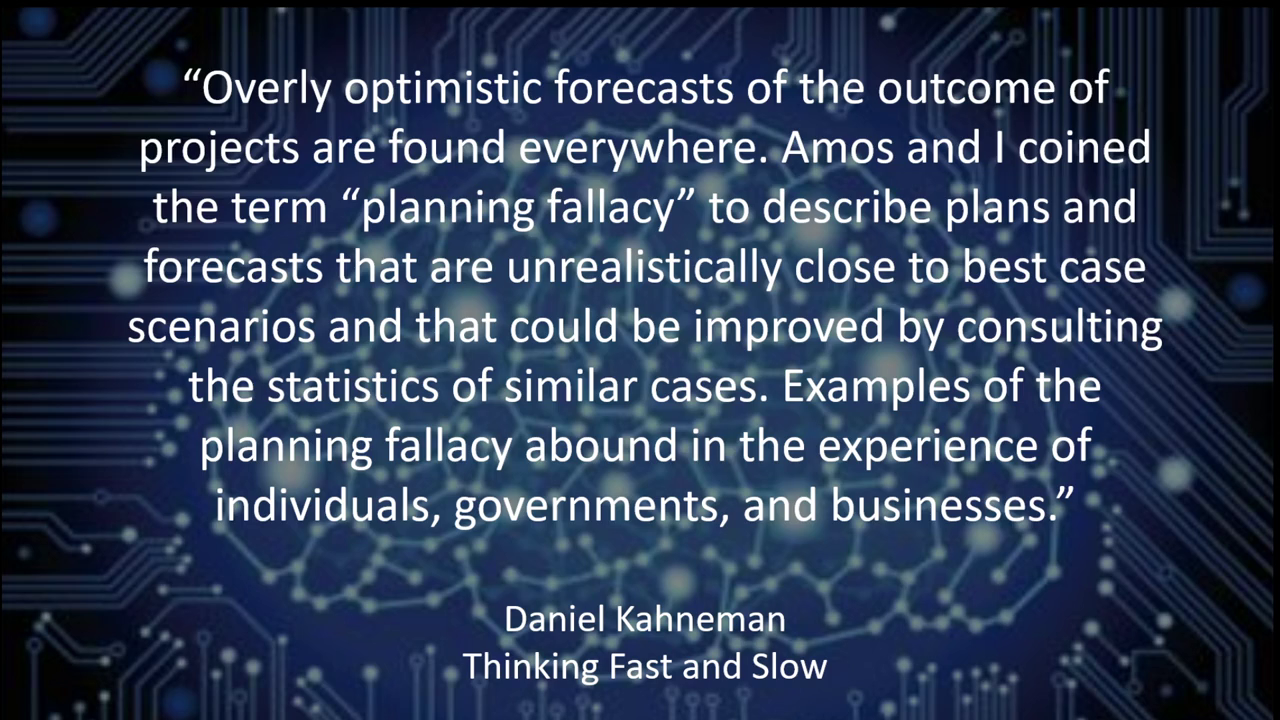
And coming back to Daniel Kahneman, behavioral economists for our last quote, overly optimistic forecasts of the outcome of projects are found everywhere. Amos and I coined the term planning fallacy to describe plans and forecasts that are unrealistically close to best case scenarios. And that could be improved by consulting the statistics of similar cases. Examples of the planning fallacy abound in the experience of individuals, governments, and businesses. And that certainly comes into play when we're talking about a low carbon transition, for example.
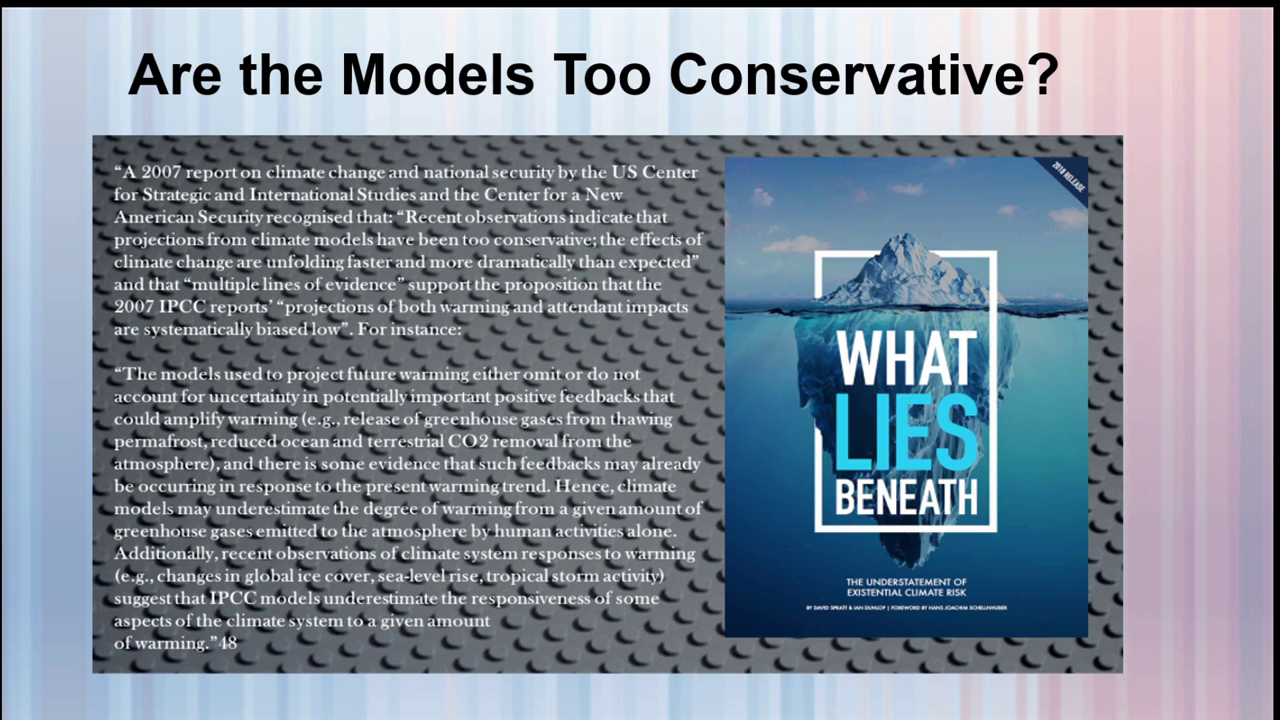
And the big question is, are the models to conservative one 2007 study concluding that projections of both warming and attendant impacts are systematically biased low.
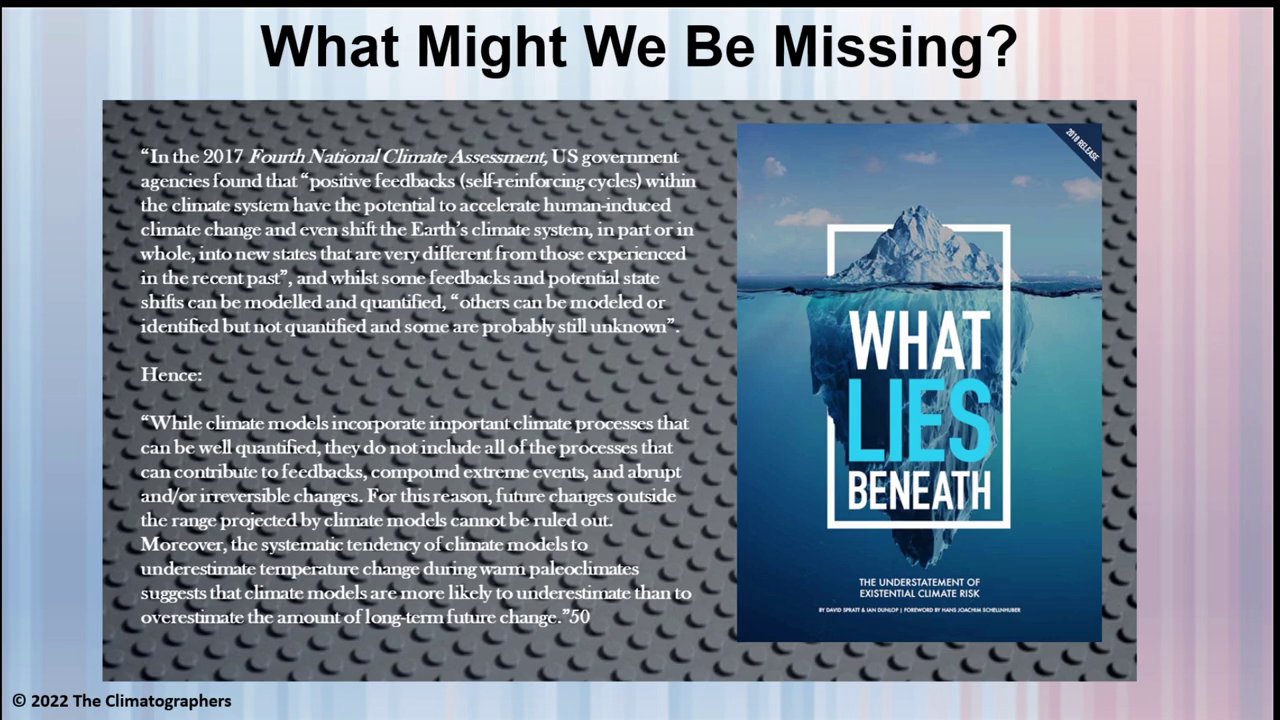
In the 2017 fourth National Climate Assessment done by the US government, the agencies found that positive feedbacks within the climate system have the potential to accelerate human-induced climate change and even shift the Earth's climate system into new states that are very different from those experienced in the recent past.
And while some of those can be modeled and quantified, others can be modeled or identified but not quantified, and some are probably still unknown. And if you think back to some of the quotes from George Baus risk expert, that points to a lot of risk. And the authors note that future changes outside the range projected by climate models cannot be ruled out. Moreover, the systematic tendency of climate models to underestimate temperature change during warm paleo climates suggest that climate models are more likely to underestimate than to overestimate the amount of long-term future change.
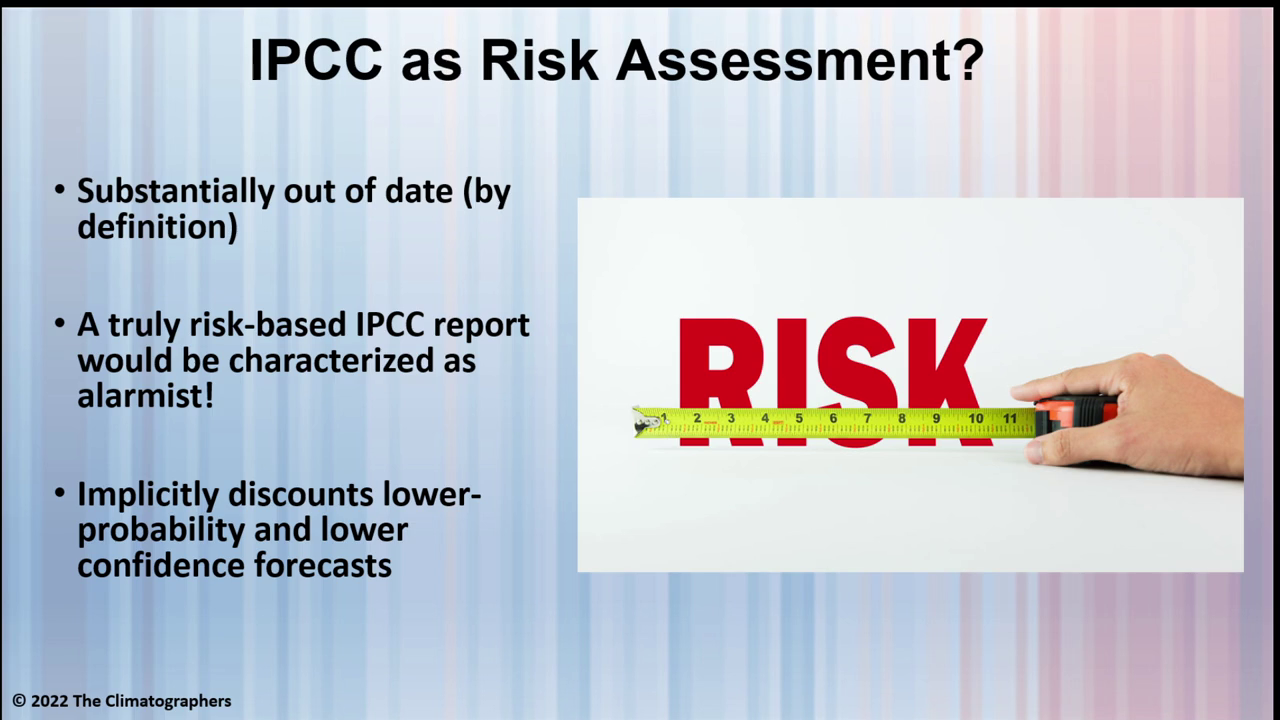
So let's zero in on the topic of the IPCC just a bit since the IPCC is the go-to source for almost anything to do with climate science, including the private sector. When you think about the IPCC process, you have to understand
That it is out of date by definition because it relies on only on peer reviewed literature. And so there is a lot of cutting edge stuff in the climate space that doesn't make it into the IPCC reports for several years after it's actually been done. And if the IPCC really did write its report from a risk-based perspective and emphasizing the unknowns and the unknown unknowns and the potential risks associated with them, it would be characterized as alarmist. And you have to remember that the IPCC reports to the world's governments. It was set up as an advisory body to the world's governments, not necessarily as an independent scientific agency. And given that government audience, you're likely to see implicit discounting of lower probability and lower confidence forecasts, even though as we've already talked about, low confidence forecast cannot be equated to a low risk forecast.
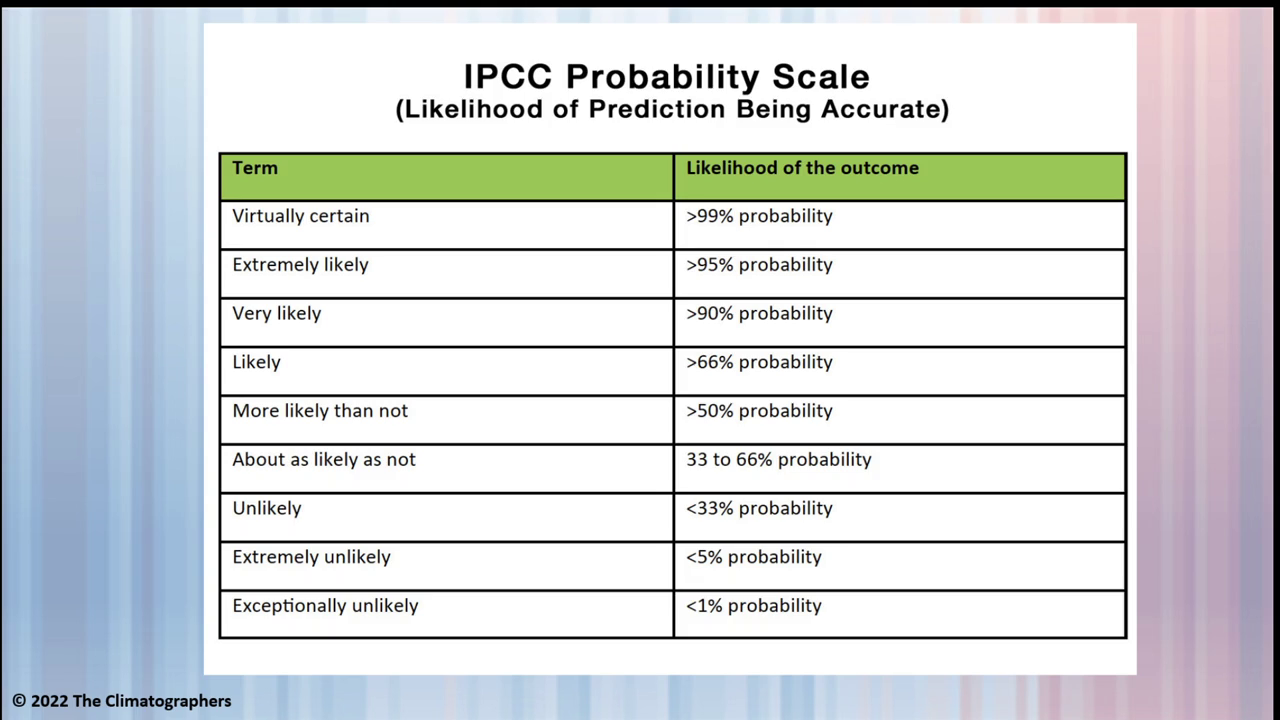
And even the IPCCs probability scale that you can see here is problematic in terms of how it is communicating risk.
So for example, when you get down to the less than 33 probability, which remember is still one outta three chance or very close to one out of three chance characterizing it as unlikely, less than 5% probability, which is still one out of 20 times, and we're only going to get one roll at the dice, extremely unlikely. You would never get on a plane with less than 5% probability or with anything remotely close to 5% probability or even remotely close to 1% probability, you would never get on a plane, even though the chance of that plane going down is categorized as exceptionally unlikely. The actual probability of a plane crash today is far less than 1%.
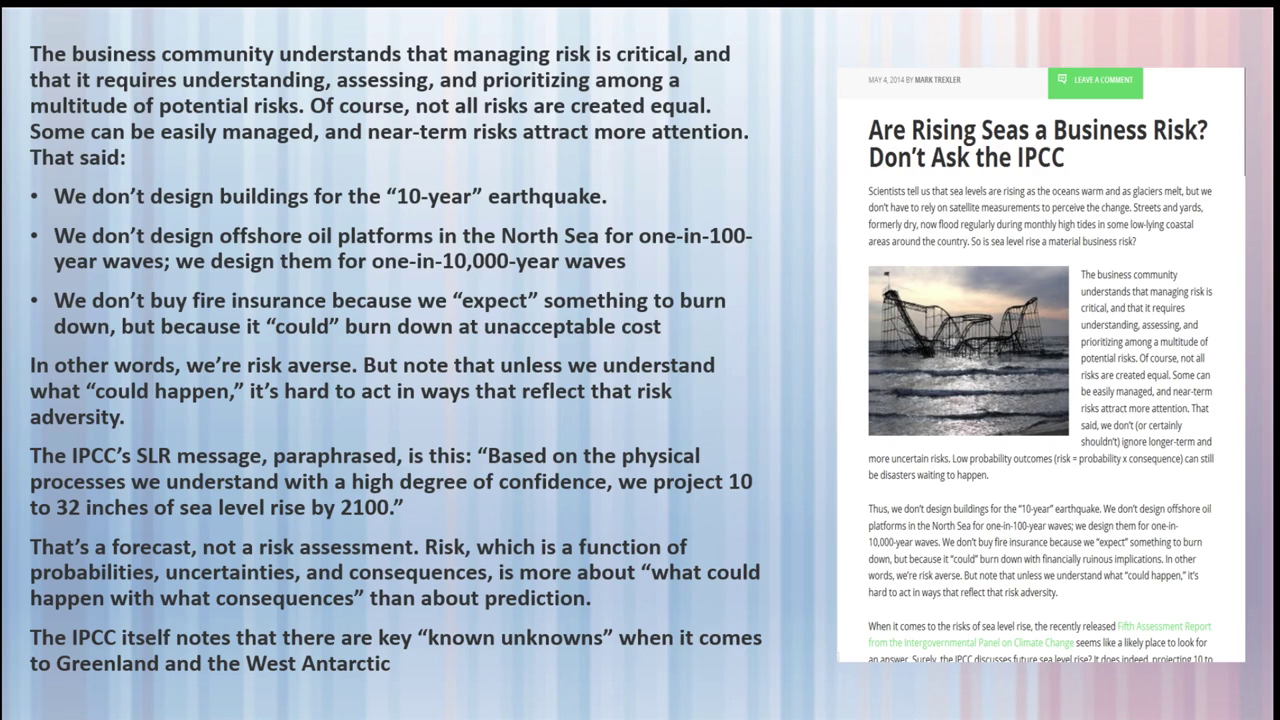
And these notes are from a piece I worked on a number of years ago, juxtaposing the IPCC process with the idea of risk in terms of rising sea levels.
And the point being made there is that we don't design buildings for the 10 year earthquake. We design buildings for the thousand year earthquake. We don't design offshore oil platforms in the North Sea for one in 100 year waves, even though platform is likely to only be operational for a hundred years. They're actually designed for one in 10,000 year rogue waves because it would be so big of a problem for the platform if it got hit by a wave that it was in no way prepared for. And we don't buy fire insurance because we expect our house to burn down, but because it could burn down at unacceptable cost.
So in other words, in a lot of our decision making and business decision making, we're risk averse and that's critical. But when we focus on expected climate risk, we're not being risk averse. And so when the IPCC says based on physical processes, we understand with a high degree of confidence we project 10 to 32 inches of sea level rise by 2100. But that's a forecast, not a risk assessment because there are a lot of things we don't understand with a high degree of confidence. And that contributes to risk. Risk when it comes to sea level rise is more about what could happen given uncertainties and consequences than forecasting what is most likely to happen. And even the IPCC notes that there are key known unknowns when it comes to the rate of melting of Greenland and the West Antarctic. So the basic point here is that if you are risk averse, you want to be very careful of taking numbers like that 10 to 32 inches of sea level rise by 2100 and designing your infrastructure around it.
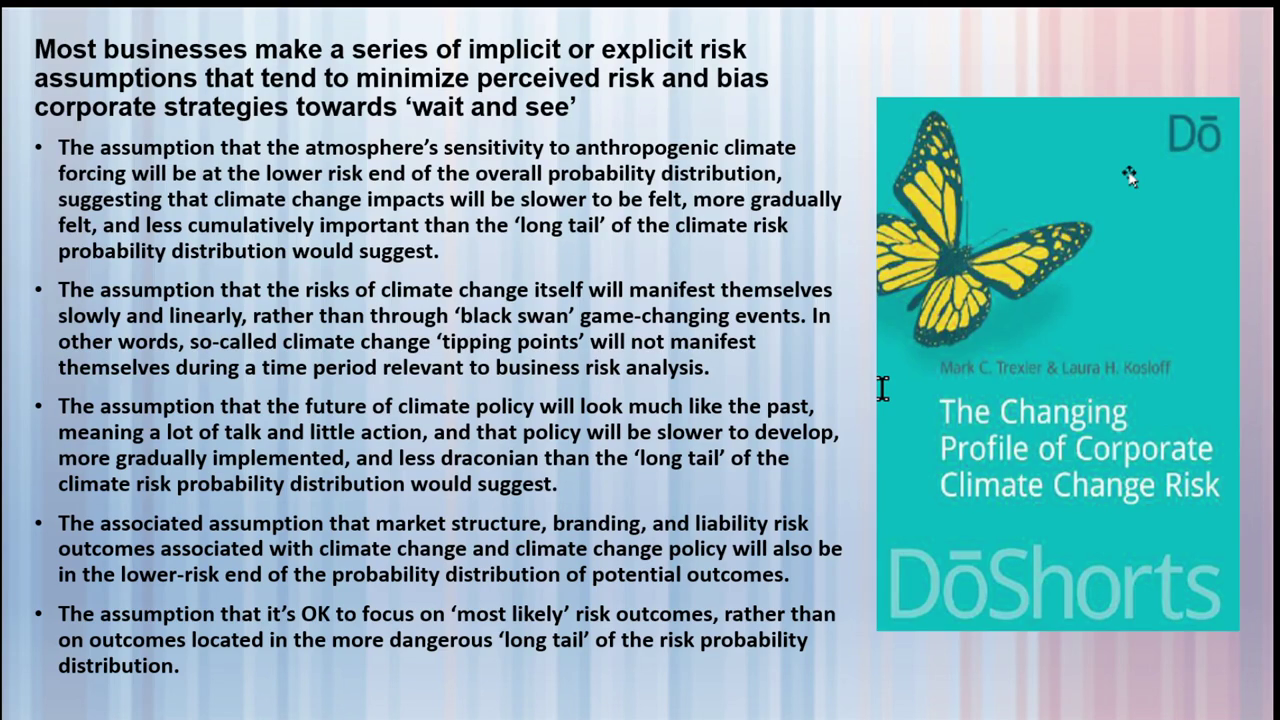
But I don't want to end with the impression that this is all the fault of scientists, for example, in how they write the IPCC reports. In my work with companies over many years, I've also seen a series of implicit or explicit assumptions that a lot of companies tend to make that have the effect of minimizing perceived risk and bias corporate strategies towards a wait and see approach for climate change. So assuming for example, and optimism bias plays into this, that the atmosphere sensitivity to forcing will be at the lower risk end of the distribution, suggesting that climate impacts will be slower to be felt and less cumulatively important than the long tail of the risk distribution would suggest also the assumption that risks will manifest themselves slowly and linearly rather than through gray Rhino or black swan game changing events. In other words, businesses tend to downplay the idea of tipping points that manifest themselves during a time period relevant to business risk analysis. The assumption that climate policy will not suddenly evolve in a big way, but that it will continue to look much like it has in the past, which is very slow and gradual. And similarly, the idea that market structures branding issues, liability risks, will also be on the lower risk end of the probability distribution. And a lot of this is amplified by the idea of having to disclose climate risks because the last thing companies want to do is
Portray an alarming picture of climate risk, even if it would be justified based on looking at the long tail of the risk distribution. And finally, the idea that it's okay to focus on the most likely risk outcomes rather than outcomes located in the long tail of the risk probability distribution.
So from a climate assumption standpoint, are you underestimating climate risks for any of the reasons that we've talked about? And are you applying the kinds of due diligence thinking to climate decision making that you apply in other areas where risk-based analysis might be more prevalent?
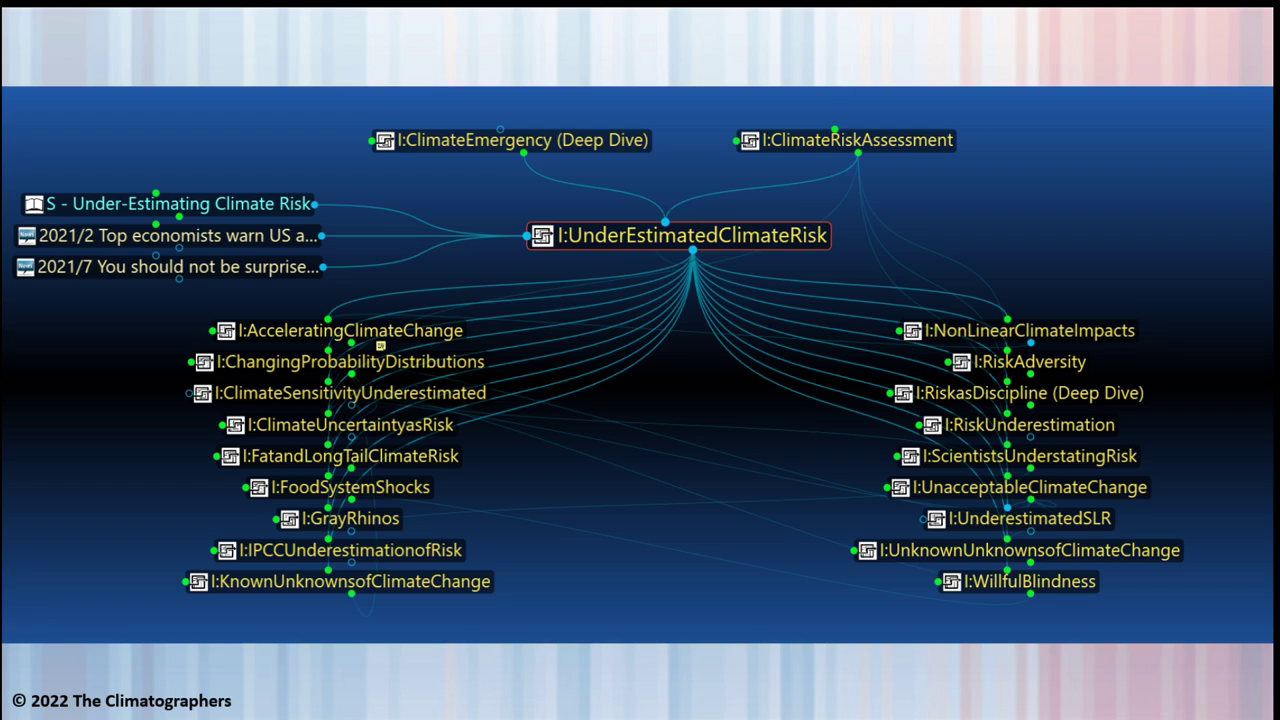
If you wanna dig into these topics, the index entry for underestimated climate risk in the climate web contains a great deal of information.
In the next video, we'll switch gears a bit and ask a somewhat heretical question. Will we really decarbonize.