Ethanol
For the use of ethanol as a drug or medicine or fuel, see Alcohol (drug), Alcohols (medicine), and Ethanol fuel.
Not to be confused with Ethenol, Ethynol, Ethanal, or Methanol.
Ethanol (also called ethyl alcohol, grain alcohol, drinking alcohol, or simply alcohol) is an organic compound with the chemical formula CH3CH2OH. It is an alcohol, with its formula also written as C2H5OH, C2H6O, or EtOH, where Et is the pseudoelement symbol for ethyl. Ethanol is a volatile, flammable, colorless liquid with a pungent taste.[11][12] As a central nervous system (CNS) depressant, it is the active ingredient in alcoholic beverages, and the second most consumed drug globally behind caffeine.[13]
Ethanol is naturally produced by the fermentation process of sugars by yeasts or via petrochemical processes such as ethylene hydration. Historically it was used as a general anesthetic, and has modern medical applications as an antiseptic, disinfectant, solvent for some medications, and antidote for methanol poisoning and ethylene glycol poisoning.[14][15] It is used as a chemical solvent and in the synthesis of organic compounds, and as a fuel source for lamps, stoves, and internal combustion engines. Ethanol also can be dehydrated to make ethylene, an important chemical feedstock. As of 2023, world production of ethanol fuel was 112.0 gigalitres (2.96×10¹⁰ US gallons), coming mostly from the U.S. (51%) and Brazil (26%).[16]
The term "ethanol", originates from the ethyl group coined in 1834 and was officially adopted in 1892, while "alcohol"—now referring broadly to similar compounds—originally described a powdered cosmetic and only later came to mean ethanol specifically.[17] Ethanol occurs naturally as a byproduct of yeast metabolism in environments like overripe fruit and palm blossoms, during plant germination under anaerobic conditions, in interstellar space, in human breath, and in rare cases, is produced internally due to auto-brewery syndrome.
Ethanol has been used since ancient times as an intoxicant. Production through fermentation and distillation evolved over centuries across various cultures. Chemical identification and synthetic production began by the 19th century.
Name
Ethanol is the systematic name defined by the International Union of Pure and Applied Chemistry for a compound consisting of an alkyl group with two carbon atoms (prefix "eth-"), having a single bond between them (infix "-an-") and an attached −OH functional group (suffix "-ol").[18]
The "eth-" prefix and the qualifier "ethyl" in "ethyl alcohol" originally came from the name "ethyl" assigned in 1834 to the group C
~2H
~5− by Justus Liebig. He coined the word from the German name Aether of the compound C
~2H
~5−O−C
~2H
~5 (commonly called "ether" in English, more specifically called "diethyl ether").[19] According to the Oxford English Dictionary, Ethyl is a contraction of the Ancient Greek αἰθήρ (aithḗr, "upper air") and the Greek word ὕλη (hýlē, "wood, raw material", hence "matter, substance").[20] Ethanol was coined as a result of a resolution on naming alcohols and phenols that was adopted at the International Conference on Chemical Nomenclature that was held in April 1892 in Geneva, Switzerland.[21]
The term alcohol now refers to a wider class of substances in chemistry nomenclature, but in common parlance it remains the name of ethanol. It is a medieval loan from Arabic al-kuḥl, a powdered ore of antimony used since antiquity as a cosmetic, and retained that meaning in Middle Latin.[22] The use of 'alcohol' for ethanol (in full, "alcohol of wine") was first recorded in 1753. Before the late 18th century the term alcohol generally referred to any sublimated substance.[23]
Uses
Main article: Alcohol (drug)
As a central nervous system depressant, ethanol is one of the most commonly consumed psychoactive drugs.[24] Despite alcohol's psychoactive, addictive, and carcinogenic properties,[25] it is readily available and legal for sale in many countries. There are laws regulating the sale, exportation/importation, taxation, manufacturing, consumption, and possession of alcoholic beverages. The most common regulations are excise, and prohibition for minors.
In mammals, ethanol is primarily metabolized in the liver and stomach by ADH enzymes.[26] These enzymes catalyze the oxidation of ethanol into acetaldehyde (ethanal):[27]
CH3CH2OH + NAD+ → CH3CHO + NADH + H+
When present in significant concentrations, this metabolism of ethanol is additionally aided by the cytochrome P450 enzyme CYP2E1 in humans, while trace amounts are also metabolized by catalase.[28] The resulting intermediate, acetaldehyde, is a known carcinogen, and poses significantly greater toxicity in humans than ethanol itself. Many of the symptoms typically associated with alcohol intoxication—as well as many of the health hazards typically associated with the long-term consumption of ethanol—can be attributed to acetaldehyde toxicity in humans.[29]
The subsequent oxidation of acetaldehyde into acetate is performed by aldehyde dehydrogenase (ALDH) enzymes. A mutation in the ALDH2 gene that encodes for an inactive or dysfunctional form of this enzyme affects roughly 50% of east Asian populations, contributing to the characteristic alcohol flush reaction that can cause temporary reddening of the skin as well as a number of related, and often unpleasant, symptoms of acetaldehyde toxicity.[30] This mutation is typically accompanied by another mutation in the ADH enzyme ADH1B in roughly 80% of east Asians, which improves the catalytic efficiency of converting ethanol into acetaldehyde.[30]
Medical
Main article: Alcohol (medicine)
Ethanol is the oldest known sedative, used as an oral general anesthetic during surgery in ancient Mesopotamia and in medieval times.[14][15] Mild intoxication starts at a blood alcohol concentration of 0.03–0.05% and induces anesthetic coma at 0.4%.[31] This use carries the high risk of deadly alcohol intoxication, pulmonary aspiration and vomiting, which led to use of alternatives in antiquity, such as opium and cannabis, and later diethyl ether, starting in the 1840s.[32]
Ethanol is used as an antiseptic in medical wipes and hand sanitizer gels for its bactericidal and anti-fungal effects.[33] Ethanol kills microorganisms by dissolving their membrane lipid bilayer and denaturing their proteins, and is effective against most bacteria, fungi and viruses. It is ineffective against bacterial spores, which can be treated with hydrogen peroxide.[34]
A solution of 70% ethanol is more effective than pure ethanol because ethanol relies on water molecules for optimal antimicrobial activity. Absolute ethanol may inactivate microbes without destroying them because the alcohol is unable to fully permeate the microbe's membrane.[35][36] Ethanol can also be used as a disinfectant and antiseptic by inducing cell dehydration through disruption of the osmotic balance across the cell membrane, causing water to leave the cell, leading to cell death.[37]
Ethanol may be administered as an antidote to ethylene glycol poisoning[38] and methanol poisoning.[39] It does so by acting as a competitive inhibitor against methanol and ethylene glycol for alcohol dehydrogenase (ADH).[40] Though it has more side effects, ethanol is less expensive and more readily available than fomepizole in the role.[41]
Ethanol is used to dissolve many water-insoluble medications and related compounds. Liquid preparations of pain medications, cough and cold medicines, and mouth washes, for example, may contain up to 25% ethanol[42] and may need to be avoided in individuals with adverse reactions to ethanol such as alcohol-induced respiratory reactions.[43] Ethanol is present mainly as an antimicrobial preservative in over 700 liquid preparations of medicine including acetaminophen, iron supplements, ranitidine, furosemide, mannitol, phenobarbital, trimethoprim/sulfamethoxazole and over-the-counter cough medicine.[44]
Some medicinal solutions of ethanol are also known as tinctures.
Energy source
See also: Food vs. fuel
Main article: Ethanol fuel
The largest single use of ethanol is as an engine fuel and fuel additive. Brazil in particular relies heavily upon the use of ethanol as an engine fuel, due in part to its role as one of the world's leading producers of ethanol.[45][46] Gasoline sold in Brazil contains at least 25% anhydrous ethanol. Hydrous ethanol (about 95% ethanol and 5% water) can be used as fuel in more than 90% of new gasoline-fueled cars sold in the country.
The US and many other countries primarily use E10 (10% ethanol, sometimes known as gasohol) and E85 (85% ethanol) ethanol/gasoline mixtures. Over time, it is believed that a material portion of the ≈150-billion-US-gallon (570,000,000 m3) per year market for gasoline will begin to be replaced with fuel ethanol.[47]
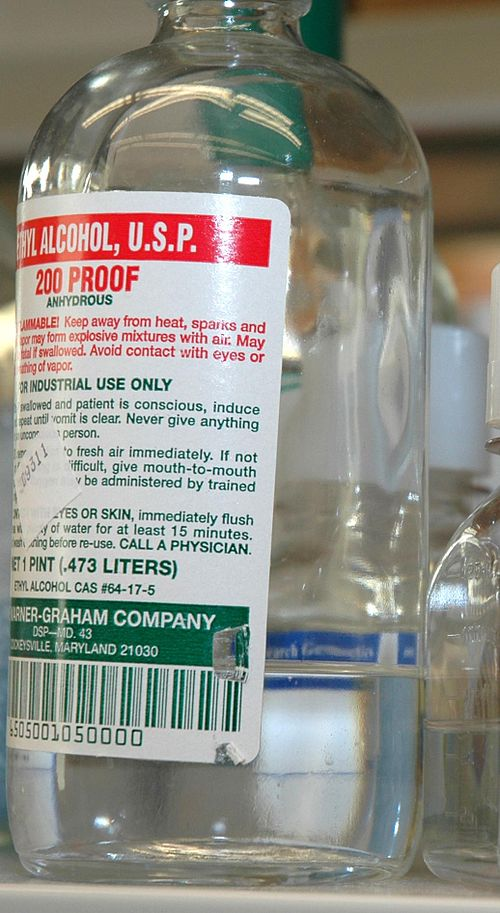
USP grade ethanol for laboratory use
Australian law limits the use of pure ethanol from sugarcane waste to 10% in automobiles. Older cars (and vintage cars designed to use a slower burning fuel) should have the engine valves upgraded or replaced.[48]
According to an industry advocacy group, ethanol as a fuel reduces harmful tailpipe emissions of carbon monoxide, particulate matter, oxides of nitrogen, and other ozone-forming pollutants.[49] Argonne National Laboratory analyzed greenhouse gas emissions of many different engine and fuel combinations, and found that biodiesel/petrodiesel blend (B20) showed a reduction of 8%, conventional E85 ethanol blend a reduction of 17% and cellulosic ethanol 64%, compared with pure gasoline.[50] Ethanol has a much greater research octane number (RON) than gasoline, meaning it is less prone to pre-ignition, allowing for better ignition advance which means more torque, and efficiency in addition to the lower carbon emissions.[51]
Ethanol combustion in an internal combustion engine yields many of the products of incomplete combustion produced by gasoline and significantly larger amounts of formaldehyde and related species such as acetaldehyde.[52] This leads to a significantly larger photochemical reactivity and more ground level ozone.[53] This data has been assembled into The Clean Fuels Report comparison of fuel emissions[54] and show that ethanol exhaust generates 2.14 times as much ozone as gasoline exhaust.[55] When this is added into the custom Localized Pollution Index of The Clean Fuels Report, the local pollution of ethanol (pollution that contributes to smog) is rated 1.7, where gasoline is 1.0 and higher numbers signify greater pollution.[56] The California Air Resources Board formalized this issue in 2008 by recognizing control standards for formaldehydes as an emissions control group, much like the conventional NO~x and reactive organic gases (ROGs).[57]
More than 20% of Brazilian cars are able to use 100% ethanol as fuel, which includes ethanol-only engines and flex-fuel engines.[58] Flex-fuel engines in Brazil are able to work with all ethanol, all gasoline or any mixture of both. In the United States, flex-fuel vehicles can run on 0% to 85% ethanol (15% gasoline) since higher ethanol blends are not yet allowed or efficient. Brazil supports this fleet of ethanol-burning automobiles with large national infrastructure that produces ethanol from domestically grown sugarcane.
Ethanol's high miscibility with water makes it unsuitable for shipping through modern pipelines like liquid hydrocarbons.[59] Mechanics have seen increased cases of damage to small engines (in particular, the carburetor) and attribute the damage to the increased water retention by ethanol in fuel.[60]
Ethanol was commonly used as fuel in early bipropellant rocket (liquid-propelled) vehicles, in conjunction with an oxidizer such as liquid oxygen. The German A-4 ballistic rocket of World War II (better known by its propaganda name V-2),[61] which is credited as having begun the space age, used ethanol as the main constituent of B-Stoff. Under such nomenclature, the ethanol was mixed with 25% water to reduce the combustion chamber temperature.[62][63] The V-2's design team helped develop U.S. rockets following World War II, including the ethanol-fueled Redstone rocket, which launched the first U.S. astronaut on suborbital spaceflight.[64][65] Alcohols fell into general disuse as more energy-dense rocket fuels were developed,[63] although ethanol was used in recent experimental lightweight rocket-powered racing aircraft.[66]
Commercial fuel cells operate on reformed natural gas, hydrogen or methanol. Ethanol is an attractive alternative due to its wide availability, low cost, high purity and low toxicity. There is a wide range of fuel cell concepts that have entered trials including direct-ethanol fuel cells, auto-thermal reforming systems and thermally integrated systems. The majority of work is being conducted at a research level although there are a number of organizations at the beginning of the commercialization of ethanol fuel cells.[67]
Ethanol fireplaces can be used for home heating or for decoration. Ethanol can also be used as stove fuel for cooking.[68][69]
Other uses
Ethanol is an important industrial ingredient with widespread uses as a precursor for other organic compounds such as ethyl halides, ethyl esters, diethyl ether, acetic acid, and ethyl amines. As ethanol also has a low boiling point, it is easy to remove from a solution that has been used to dissolve other compounds, making it a popular extracting agent for botanical oils.
Ethanol is found in paints, tinctures, markers, personal care products such as mouthwashes, perfumes and deodorants, and wet specimen preservatives.[73] Polysaccharides precipitate from aqueous solution in the presence of alcohol, and ethanol precipitation is used for this reason in the purification of DNA and RNA.[74] Because of its low freezing point of −114 °C (−173 °F) and low toxicity, ethanol is sometimes used in laboratories (with dry ice or other coolants) as a cooling bath to keep vessels at temperatures below the freezing point of water.[75] For the same reason, it is also used as the active fluid in alcohol thermometers.
Ethanol is also used in removing several stains, as it is considered a universal solvent. Its molecular structure allows for the dissolving of both polar, hydrophilic and nonpolar, hydrophobic compounds. It can be used to dissolve oils,[76] inks,[77] and other substances.
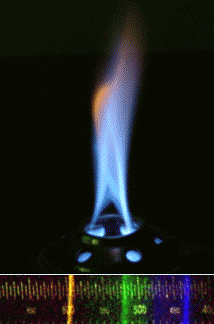
Ethanol burning with its spectrum depicted
Solvent properties
Ethanol is a versatile solvent, miscible with water and with many organic solvents, including acetic acid, acetone, benzene, carbon tetrachloride, chloroform, diethyl ether, ethylene glycol, glycerol, nitromethane, pyridine, and toluene. Its main use as a solvent is in making tincture of iodine, cough syrups, etc.[80][82] It is also miscible with light aliphatic hydrocarbons, such as pentane and hexane, and with aliphatic chlorides such as trichloroethane and tetrachloroethylene.[82]
Ethanol's miscibility with water contrasts with the immiscibility of longer-chain alcohols (five or more carbon atoms), whose water miscibility decreases sharply as the number of carbons increases.[83] The miscibility of ethanol with alkanes is limited to alkanes up to undecane: mixtures with dodecane and higher alkanes show a miscibility gap below a certain temperature (about 13 °C for dodecane[84]). The miscibility gap tends to get wider with higher alkanes, and the temperature for complete miscibility increases.
Ethanol-water mixtures have less volume than the sum of their individual components at the given fractions. Mixing equal volumes of ethanol and water results in only 1.92 volumes of mixture.[80][85] Mixing ethanol and water is exothermic, with up to 777 J/mol[86] being released at 298 K.
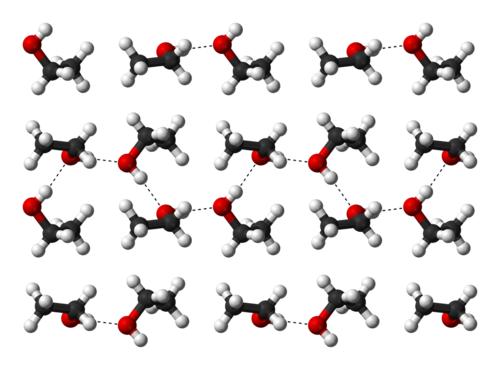
Hydrogen bonding in solid ethanol at −186 °C
Hydrogen bonding causes pure ethanol to be hygroscopic to the extent that it readily absorbs water from the air. The polar nature of the hydroxyl group causes ethanol to dissolve many ionic compounds, notably sodium and potassium hydroxides, magnesium chloride, calcium chloride, ammonium chloride, ammonium bromide, and sodium bromide.[82] Sodium and potassium chlorides are slightly soluble in ethanol.[82] Because the ethanol molecule also has a nonpolar end, it will also dissolve nonpolar substances, including most essential oils[87] and numerous flavoring, coloring, and medicinal agents.
The addition of even a few percent of ethanol to water sharply reduces the surface tension of water. This property partially explains the "tears of wine" phenomenon. When wine is swirled in a glass, ethanol evaporates quickly from the thin film of wine on the wall of the glass. As the wine's ethanol content decreases, its surface tension increases and the thin film "beads up" and runs down the glass in channels rather than as a smooth sheet.
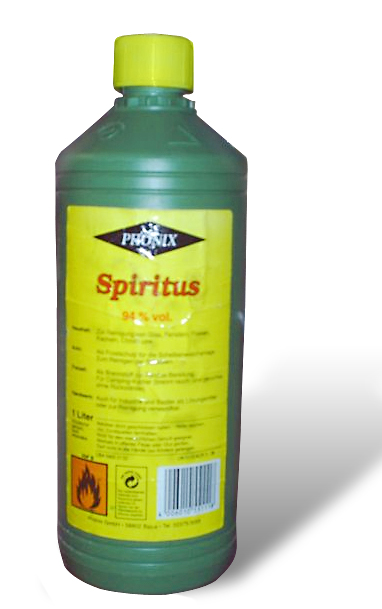
94% denatured ethanol sold in a bottle for household use
Ethanol is produced both as a petrochemical, through the hydration of ethylene and, via biological processes, by fermenting sugars with yeast.[105] Which process is more economical depends on prevailing prices of petroleum and grain feed stocks.
See also
- Ethanol-induced non-lamellar phases in phospholipids
- Methanol
- 1-Propanol
- 2-Propanol
- Rubbing alcohol
- tert-Butyl alcohol
- Butanol fuel
- Timeline of alcohol fuel
See PDF for complete article downloaded
Monday, June 22, 2026 09:39AM