Ann’s Dr. Marvin Notes
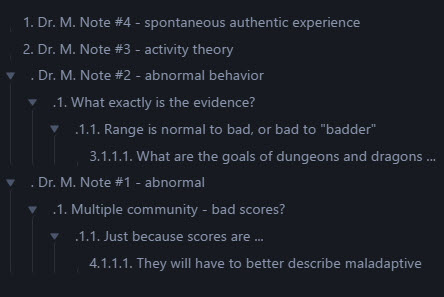
Dr. M. Note #4 - spontaneous authentic experience
Dr. Marvin,
This is the 2nd phrase we were wondering about - found last night. Does this have common day assertions today? I've never been real sure of object-relations ... it would seem that a perspective under "internal dynamics" explains dissociation with a:
false self - there is a part who could be forced through trauma to become more "unnaturally" oneself (premature maturation).
true self - there is a part who could be through natural environments become more of an authentic self through "normal" experiences.
false self is a rigid/obscure version of the true self?
Can I go back to the point of it being perfectly "natural" when attacked to dissociate? Even if less angelic?
[See ... spontaneous authentic experience (below)]:
[[spontaneous authentic experience (the “true” self)]] ~Winnicott 1 (1965, 1971). [[Object-relations perspectives]] [[conceptualize the psychological phenomenon of dissociation]] in terms of [[internal dynamics]] whereby [[trauma necessitates the premature maturation of a “false” self]] that [[rigidifies and obscures]] more [[spontaneous authentic experience (the “true” self)]].
Dr. M. Note #3 - activity theory
Dr. Marvin ... this is the phrase we were thinking of the other day we were talking to you. Key Points being:
1). primary unit of analysis
a) an activity that orientates oneself
b) system = a routine behavior of little thought that accomplishes something (action such as "planning").
c) could at minimum be meaningful to better understand how the individual interacts within the world.
2). This "activity psychology" is a theory emphasizing
a) hierarchy in activity structure
b) object orientation - (can an idea be an object?)
c) internalization v. externalization (explains relating)
d) mediation (utilizing tools, etc.)
e) leads to continuous development
3). THEN JUMPS to ... proposing that:
a) old age is an experience that is lively and creative, and shows:
- social roles are maintained - which becomes:
- activities, and
- relationships
- (or we start new ... of the same)
SOOOO ... can my activities such as doing this kind of Obsidian "Brain Forest" work mean:
1) I am old ;)
2) that I'm old enough to create my own inner and outer relationship rules to the world, and that
3) It can be a productive activity in itself that is developmental, meaningful, and could be of a worthy accomplishment ... again all by itself?
[See ... activity theory (below)]:
[[activity theory]] ~(https://dictionary.apa.org/activity-theory) (2020). 1. a school of thought, developed primarily by Soviet psychologists, that focuses on activity in general—rather than the distinct concepts of behavior or mental states—as the primary unit of analysis. In this context, an activity is a nonadditive unit that orients an organism in the world; it is essentially a system comprising an operation (a routine behavior requiring little thought, e.g., typing) that serves to accomplish an action (a behavior that involves planning, e.g., creating a bibliography) in the minimum meaningful context that provides understanding of the function of the individual in interacting with the environment (e.g., preparing a paper for a university course as part of a network of students). The theory emphasizes a hierarchical structure of activity, object-orientedness, internalization and externalization, mediation (by tools, language, and other cultural artifacts or instruments), and continuous development. Also called activity psychology. 2. a theory proposing that old age is a lively, creative experience characterized by maintaining existing social roles, activities, and relationships or replacing any lost ones with new ones. Compare continuity theory; disengagement theory.]]
Dr. M. Note #2 - abnormal behavior
[](<abnormal behavior ~ (https://dictionary.apa.org/abnormal-behavior) (2020). behavior that is atypical or statistically uncommon within a particular culture or that is maladaptive or detrimental to an individual or to those around that individual. Such behavior is often regarded as evidence of a mental or emotional disturbance, ranging from minor adjustment problems to severe mental disorder[.]
What exactly is the evidence?
if it is not maladaptive behavior to the individual (or do those (test takers - recalling Santa being tested on 34th street) only deciding what is normal). This is subjective enough it shouldn't be considered "evidence".
Range is normal to bad, or bad to "badder"
- "normal" behavior to severe behavior - typical
- maladaptive, detrimental, emotionally disturbed - minor adjustment problems to severe mental disorder - statistically uncommon
What are the goals of dungeons and dragons ...
Dissociation is considered a mental & emotional disturbance, maladaptive, or detrimental --%3E ranging from/toward
- Levels of "treatment" needed?
- Minor adjustment 'problems' ---> to severe mental disorder (need for treatment due to level of problems --> Danger?)
|
Ann's Adapt - Dr. Marvin says too!>)
Dr. M. Note #1 - abnormal
abnormal ~(https://dictionary.apa.org/abnormal) (2020). adj. relating to any deviation from what is considered typical, usual, or healthy, particularly if the deviation is considered harmful or maladaptive. In statistics, for example, abnormal scores are those that are outside the usual or expected range. The term, however, is most often applied to behavior that differs from a culturally accepted norm, especially when indicative of a mental disorder. —abnormality n. —abnormally adv.[]
Multiple community - bad scores?
facing a "different" culture with accepted norms - but many in the Multiple community disagree with their having a mental disorder label/stigma. Again dissociation is a normal expression or adaptation due from an abnormal forceful behavior.
Just because scores are ...
outside a "normal" range, doesn't mean it is a negative ... perhaps it is an exceptional score and new tests need to be developed inclusive of Multiples in the community and a broader range of acceptable test scores. And, a question as to are the tests based in "emotions, behaviors, thoughts, or other?"
They will have to better describe maladaptive
- adaptive - what is adaptive (do people who don't seek out help count here?)
- maladaptive (possibly harmful)
- does it have to be all one way or the other (Is there an acceptance for triggers)
- can it be sometimes (like most the time people are coping)
- where does abilities fit in ... if higher ability, than naturally less "disabled?"