Ether
For the substance whose common name is ether, see Diethyl ether. For the digital asset, see Ethereum. For other uses, see Aether (disambiguation).
:{In organic chemistry, ethers are a class of compounds that contain an ether group, a single oxygen atom bonded to two separate carbon atoms, each part of an organyl group (e.g., alkyl or aryl:{:{).}:
They have the general formula R−O−R′, where R and R′ represent the organyl groups.
Ethers can again be classified into two varieties: if the organyl groups are the same on both sides of the oxygen atom, then it is a simple or symmetrical ether, whereas if they are different, the ethers are called mixed or unsymmetrical ethers.[1]
A typical example of the first group is the solvent and anaesthetic diethyl ether, commonly referred to simply as "ether" (CH3−CH2−O−CH2−CH3).
Ethers are common in organic chemistry and even more prevalent in biochemistry, as they are common linkages in carbohydrates and lignin.[2
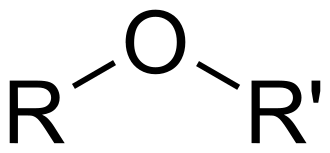
The general structure of an ether. R and R' represent most organyl substituents.
See also
- Ester
- Ether lipid
- Ether addiction
- History of general anesthesia
- Inhalant
- Chemical paper pulping processes: Kraft process (and Soda pulping), Organosolv pulping process and the Sulfite process
SEE PDF for complete article downloaded
Monday, June 22, 2026 09:10AM