Goddess
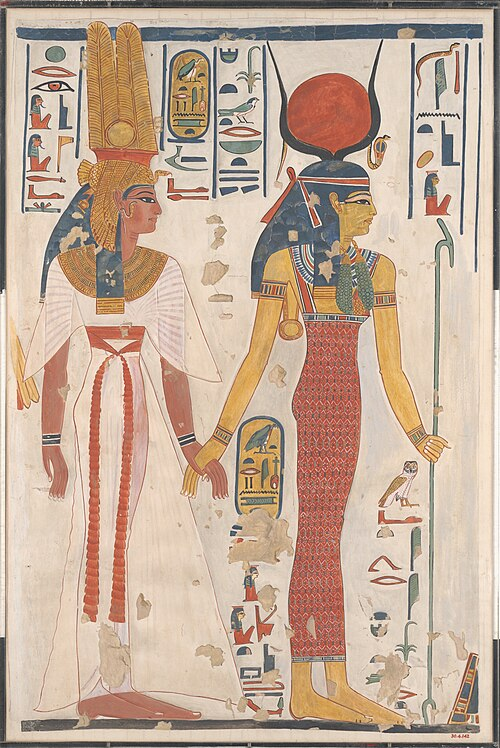
Queen Nefertari being led by Isis, the ancient Egyptian mother goddess of magic
A goddess is a female deity.[1] In some faiths, a sacred female figure holds a central place in religious prayer and worship. For example, Shaktism (one of the three major Hindu sects), holds that the ultimate deity, the source of all reality, is Supreme Goddess (Mahaiia) and in some forms of Tantric Shaivism, the pair of Shiva and Shakti are the ultimate principle (with the goddess representing the active, creative power of God).
Meanwhile, in Vajrayana Buddhism, ultimate reality is often seen as being composed of two principles depicted as two deities in union (yab yum,) symbolising the non-duality of the two principles of perfect wisdom (female) and skillful compassion (male).[2]
A single figure in a monotheistic faith that is female may be identified simply as god because of no need to differentiate by gender or with a diminutive.
An experiment to determine the effect of psychedelics on subjects composed of leaders from diverse religious groups revealed a general experience that the divine which the subjects encountered was feminine.[3]
Polytheist religions, including Polytheistic reconstructionists, honour multiple goddesses and gods, and usually view them as discrete, separate beings. These deities may be part of a pantheon, or different regions may have tutelary deities.
In many known cultures, goddesses are often linked with literal or metaphorical pregnancy or imagined feminine roles associated with how women and girls are perceived or expected to behave.
This includes themes of spinning, weaving, beauty, love, sexuality, motherhood, domesticity, creativity, and fertility (exemplified by the ancient mother goddess cult).
Many major goddesses are also associated with magic, war, strategy, hunting, farming, wisdom, fate, earth, sky, power, laws, justice, and more. Some themes, such as discord or disease, which are considered negative within their cultural contexts also are found associated with some goddesses. There are as many differently described and understood goddesses as there are male, shapeshifting, devilish, or neuter gods.
Etymology
The noun goddess is a secondary formation, combining the Germanic god with the Latinate -ess suffix.
It first appeared in Middle English, from about 1350.[4]
The English word follows the linguistic precedent of a number of languages—including Egyptian, Classical Greek, and several Semitic languages—that add a feminine ending to the language's word for god. Occasionally, one finds the root term being applied without the secondary ending.
Mesopotamia
Main articles: Assyro-Babylonian religion and Sumerian religion
Inanna was the most worshipped goddess in ancient Sumer.[5][6][7]
She was later syncretised with the East Semitic goddess Ishtar.[8]
Other Mesopotamian goddesses include Ninhursag, Ninlil, Antu and Gaga.
Ancient Africa (Egypt)
Main article: Netjeret
- Goddesses of the Ennead of Heliopolis: Tefnut, Nut, Nephthys, Isis
- Goddesses of the Ogdoad of Hermopolis: Naunet, Amaunet, Kauket, Hauhet; originally a cult of Hathor
- Satis and Anuket of the triad of Elephantine
Canaan
Further information: The Hebrew Goddess
Goddesses of the Canaanite religion: Baalat Gebal](https://en.wikipedia.org/wiki/Ba%60alat_Gebal "Baalat Gebal"), [Astarte, Anat.
Greco-Roman
Main articles: Religion in ancient Greece and Religion in ancient Rome
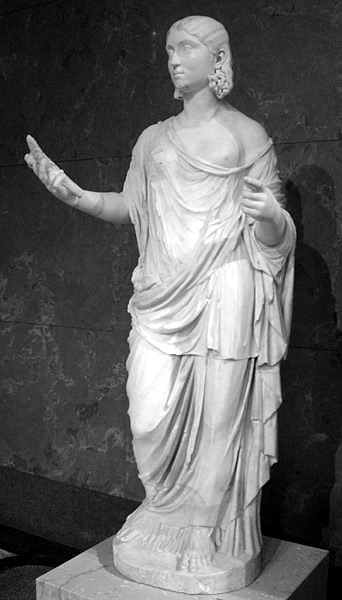
 Statue of an unknown woman as Ceres, Roman goddess of agriculture and motherly relationships
- Eleusinian Mysteries: Baubo (goddess of mirth), Demeter (goddess of the harvest) and Persephone (goddess of spring, queen of the Underworld as the wife of Hades).
- Greek muses: Calliope (goddess of epic poetry), Clio (history), Erato (love poetry), Euterpe (music, song, and lyric poetry), Melpomene (tragedy), Polyhymnia (sacred poetry), Terpsichore (dance), Thalia (comedy and pastoral poetry), and Urania (astronomy).
- Aphrodite: Goddess of love and beauty.
- Artemis: Virgin goddess of the wilderness and the hunt.
- Athena: Virgin goddess of strategy, warfare, and crafts.
- Eris: Goddess of chaos.
- Gaia: Primordial goddess of the Earth. Most gods descend from her.
- Hecate: Goddess of sorcery and crossroads. Often considered a chthonic or lunar goddess. She is either portrayed as a single goddess or a triple goddess (maiden, mother, crone).
- Hera: Goddess of womanhood, marriage and childbirth, queen of Olympus as the wife of Zeus.
- Hestia: Virgin goddess of the hearth, domesticity and family.
- Iris: Goddess of rainbows.
- Leto: Titan goddess of childhood.
- Nike: Goddess of victory. She is predominantly pictured with Zeus or Athena and sometimes Ares.
- Selene: Titan goddess of the Moon.
- Rhea: Titan goddess of motherhood.
See also
 Religion portal
- Anima (Jung)
- Gavari
- Gender of God
- Goddess movement
- Heavenly Mother
- List of goddesses
- Matriarchy
- Mother goddess
- The Myth of Matriarchal Prehistory
- Ochre
- Oshun
- Sophia
- Tree deity
- Venus figurines
- The White Goddess

See PDF for complete article downloaded:
Friday, July 17, 2026, 09:22 AM