Solidarity
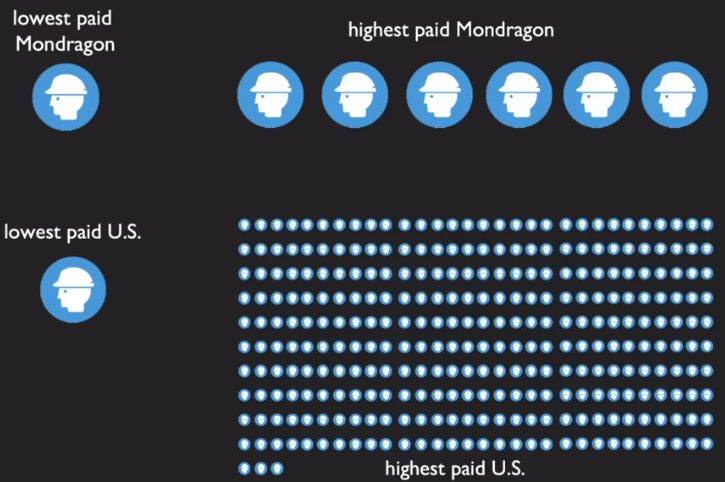
So one big take away for me from visiting Mondragon has to do with a question of solidarity. What does it mean? how is it operationalized? And what difference does it make? and so I'll start with the question of internal or wage solidarity and what I mean by that is what does the distance between the lowest and highest paid workers in a company look like? And at Mondragon, for the most part - there's exceptions,but for the most part that distance is about 6 to 1, meaning that even in really big cooperatives, the highest paid worker does not earn more than six times the lowest.
So one big take away for me from visiting Mondragon has to do with a question of solidarity. What does it mean? how is it operationalized? And what difference does it make? and so I'll start with the question of internal or wage solidarity and what I mean by that is what does the distance between the lowest and highest paid workers in a company look like? And iat Mondragon, for the most part - there's exceptions,but for the most part that distance is about 6 to 1, meaning that even in really big cooperatives, the highest paid worker does not earn more than six times the lowest.
In corporate America, that ratio is closer to 300 to 1. In fact Amazon's CEO, Jeff Bezos, in his case, he makes about $2,500 a second. It only takes him around 12 seconds to earn the annual salary of one of his lowest paid staff.
So what difference does that the way Mondragon does it -what difference does that make? So once you have a ceiling on the highest wages, it means that you aren't paying a CEO millions of dollars, and therefore you have money to invest otherthings. And, for example, some of the things that Mondragon invested in were fifteen research centers that support the development of new product lines and markets and cooperative companies in sectors that share common interests - all in the interests of creating a more stable economy and good jobs.
Or they also created Lagun Aro, a social welfare system that offers unemployment benefits, among other things, to worker-owners. Like here, business owners and cooperators are business owners don't get unemployment insurance. So Mondragon has its own system.
Or, they also invested in worker training and cooperative education as well as universities like the culinary school in this photo or the 4-year co-op creation undergraduate program of Mondragon Team Academy, where over half of the graduates end up asworker -owners of companies that they created while they were students in the school.
And when workers are the key decision-makers, we can make different, even if difficult, decisions about how to take care of our own. So, let's take the case of Fagor Electrodomestico. And that's a co-op that manufactured home consumer home appliances in and they were one of the first cooperatives thatMondragon ever started. After the financial crisis of 2008, which really hit Spain hard, Fagorhad been experiencing heavy losses for several years noone was buying domestic appliances when their houses were getting foreclosed on.
So, in 2012, they went to the annual Congress of all the Mondragon co-ops, and they decided on a wage cut --all the workers decided on a wage cut of 3% of all the other worker owners in the whole system for the next 5 years in order to prevent a plant closure and loss of 2200 jobs.
So indulge me for a second. Let me stop here for a minute and please bear with me as I reflect back on my own experience in the 1980s in L.A.,when I was an activist in the movement to stop plant closures when all of the core industrial plants in the region rubber, auto, and steel once powerhouses all of them shut down leaving in their wake decimated communities and workers. And at that time, there was no place, there was no system, there was no planet where even a conversation like the one between FagorElectrodomestico workers and the other workers in the Annual Congress could even occur.