Fourth Amendment to the United States Constitution

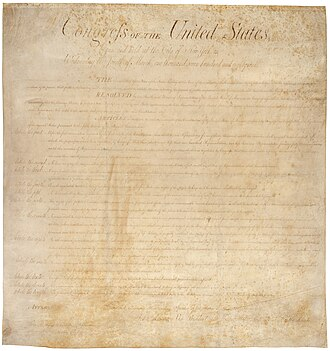
The hand-written copy of the proposed Bill of Rights, 1789, cropped to show just the text that would later be ratified as the Fourth Amendment
The Fourth Amendment (Amendment IV) to the United States Constitution is part of the Bill of Rights. It prohibits unreasonable searches and seizures and sets requirements for issuing warrants: warrants must be issued by a judge or magistrate, justified by probable cause, supported by oath or affirmation, and must particularly describe the place to be searched and the persons or things to be seized (important or not).
Fourth Amendment case law deals with three main issues: what government activities are "searches" and "seizures", what constitutes probable cause to conduct searches and seizures, and how to address violations of Fourth Amendment rights. Early court decisions limited the amendment's scope to physical intrusion of property or persons, but with Katz v. United States (1967), the Supreme Court held that its protections extend to intrusions on the privacy of individuals as well as to physical locations. A warrant is needed for most search and seizure activities, but the Court has carved out a series of exceptions for consent searches, motor vehicle searches, evidence in plain view, exigent circumstances, border searches, and other situations.
The exclusionary rule is one way the amendment is enforced. Established in Weeks v. United States (1914), this rule holds that evidence obtained as a result of a Fourth Amendment violation is generally inadmissible at criminal trials. Evidence discovered as a later result of an illegal search may also be inadmissible as "fruit of the poisonous tree". The exception is if it inevitably would have been discovered by legal means.
The Fourth Amendment was introduced in Congress in 1789 by James Madison, along with the other amendments in the Bill of Rights, in response to Anti-Federalist objections to the new Constitution. Congress submitted the amendment to the states on September 28, 1789. By December 15, 1791, the necessary three-fourths of the states had ratified it. On March 1, 1792, Secretary of State Thomas Jefferson announced that it was officially part of the Constitution.
Because the Bill of Rights did not initially apply to state or local governments, and federal criminal investigations were less common in the first century of the nation's history, there is little significant case law for the Fourth Amendment before the 20th century. The amendment was held to apply to state and local governments in Mapp v. Ohio (1961) via the Due Process Clause of the Fourteenth Amendment.
Text
The right of the people to be secure in their persons, houses, papers, and effects,[a] against unreasonable searches and seizures, shall not be violated, and no Warrants shall issue, but upon probable cause, supported by Oath or affirmation, and particularly describing the place to be searched, and the persons or things to be seized.[2]
The Bill of Rights in the National Archives
Like many other areas of American law, the Fourth Amendment finds its origin in English legal doctrine. In Semayne's case (1604), Sir Edward Coke stated: "The house of every one is to him as his castle and fortress, as well for his defence against injury and violence as for his repose."[3] Semayne's Case acknowledged that the King did not have unbridled authority to intrude on his subjects' dwellings, but recognized that government agents were permitted to conduct searches and seizures under certain conditions when their purpose was lawful and a warrant had been obtained.[4]
The 1760s saw a growth in the intensity of litigation against state officers, who were using general warrants, conducted raids in search of materials relating to John Wilkes's publications. The most famous of these cases involved John Entick whose home was forcibly entered by the King's Messenger Nathan Carrington, along with others, pursuant to a warrant issued by George Montagu-Dunk, 2nd Earl of Halifax authorizing them "to make strict and diligent search for ... the author, or one concerned in the writing of several weekly very seditious papers entitled, 'The Monitor or British Freeholder, No 257, 357, 358, 360, 373, 376, 378, and 380'", the search resulting in seizure of printed charts, pamphlets and other materials. Entick filed suit in Entick v Carrington, argued before the Court of King's Bench in 1765. Charles Pratt, 1st Earl Camden ruled that both the search and the seizure were unlawful, as the warrant authorized the seizure of all of Entick's papers—not just the criminal ones—and as the warrant lacked probable cause to even justify the search. By holding that "[O]ur law holds the property of every man so sacred, that no man can set his foot upon his neighbour's close without his leave",[5] Entick established the English precedent that the executive is limited in intruding on private property by common law.[4]
Colonial America
Homes in Colonial America, on the other hand, did not enjoy the same sanctity as their British counterparts, because legislation had been explicitly written so as to enable enforcement of British revenue-gathering policies on customs; until 1750, in fact, the only type of warrant defined in the handbooks for justices of the peace was the general warrant.[4] During what scholar William Cuddihy called the "colonial epidemic of general searches", the authorities possessed almost unlimited power to search for anything at any time, with very little oversight.[6]
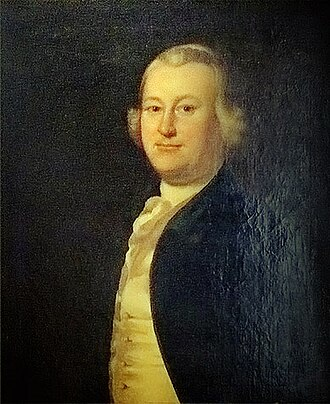
Massachusetts lawyer James Otis protested British use of general warrants in the American colonies.
In 1756, the colony of Massachusetts barred the use of general warrants. This represented the first law in American history curtailing the use of seizure power. Its creation largely stemmed from the great public outcry over the Excise Act of 1754, which gave tax collectors unlimited powers to interrogate colonists concerning their use of goods subject to customs.[7] The act also permitted the use of a general warrant known as a writ of assistance, allowing tax collectors to search the homes of colonists and seize "prohibited and uncustomed" goods.[8] A crisis erupted over the writs of assistance on December 27, 1760, when the news of King George II's death on October 23 arrived in Boston. All writs automatically expired six months after the death of the King, and would have had to be re-issued by George III, the new king, to remain valid.[9]
In mid-January 1761, a group of more than fifty merchants represented by James Otis petitioned the court to have hearings on the issue. During the five-hour hearing on February 23, 1761, Otis vehemently denounced British colonial policies, including their sanction of general warrants and writs of assistance.[10] However, the court ruled against Otis.[11] Future President John Adams, who was present in the courtroom when Otis spoke, viewed these events as "the spark in which originated the American Revolution".[12]
Because of the name he had made for himself in attacking the writs, Otis was elected to the Massachusetts colonial legislature and helped pass legislation requiring that special writs of assistance be "granted by any judge or justice of the peace upon information under oath by any officer of the customs" and barring all other writs. The governor overturned the legislation, finding it contrary to English law and parliamentary sovereignty.[13]
Seeing the danger general warrants presented, the Virginia Declaration of Rights (1776) explicitly forbade the use of general warrants. This prohibition became a precedent for the Fourth Amendment:[14]
That general warrants, whereby any officer or messenger may be commanded to search suspected places without evidence of a fact committed, or to seize any person or persons not named, or whose offense is not particularly described and supported by evidence, are grievous and oppressive and ought not to be granted.[14]
Article XIV of the Massachusetts Declaration of Rights, written by John Adams and enacted in 1780 as part of the Massachusetts Constitution, added the requirement that all searches must be "reasonable", and served as another basis for the language of the Fourth Amendment:[15]
Every subject has a right to be secure from all unreasonable searches, and seizures of his person, his houses, his papers, and all his possessions. All warrants, therefore, are contrary to this right, if the cause or foundation of them be not previously supported by oath or affirmation; and if the order in the warrant to a civil officer, to make search in suspected places, or to arrest one or more suspected persons, or to seize their property, be not accompanied with a special designation of the persons or objects of search, arrest, or seizure: and no warrant ought to be issued but in cases, and with the formalities, prescribed by the laws.[16]
By 1784, eight state constitutions contained a provision against general warrants.[17]
Proposal and ratification
Main article: United States Bill of Rights
After several years of comparatively weak government under the Articles of Confederation, a Constitutional Convention in Philadelphia proposed a new constitution on September 17, 1787, featuring a stronger chief executive and other changes. George Mason, a Constitutional Convention delegate and the drafter of Virginia's Declaration of Rights, proposed that a bill of rights listing and guaranteeing civil liberties be included. Other delegates—including future Bill of Rights drafter James Madison—disagreed, arguing that existing state guarantees of civil liberties were sufficient and that any attempt to enumerate individual rights risked implying that other, unnamed rights were unprotected. After a brief debate, Mason's proposal was defeated by a unanimous vote of the state delegations.[18]
For the Constitution to be ratified, nine of the thirteen states were required to approve it in state conventions. Opposition to ratification ("Anti-Federalism") was partly based on the Constitution's lack of adequate guarantees for civil liberties. Supporters of the Constitution in states where popular sentiment was against ratification (including Virginia, Massachusetts, and New York) successfully proposed that their state conventions both ratify the Constitution and call for the addition of a bill of rights.[19] Four state conventions proposed some form of restriction on the authority of the new federal government to conduct searches.[17]