First Amendment to the United States Constitution
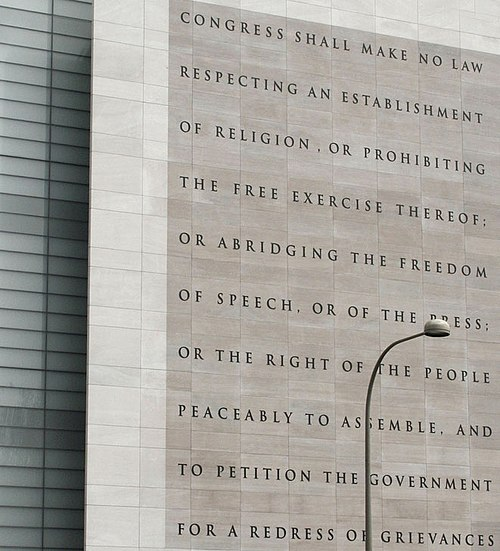
The Newseum's depiction of the five freedoms guaranteed by the First Amendment in Washington, D.C.
The First Amendment (Amendment I) to the United States Constitution
prevents Congress from making laws respecting
prohibiting the free exercise of religion; or
abridging the freedom of speech,
the freedom of the press,
the freedom of assembly, or
the right to petition the government for redress of grievances.
It was adopted on December 15, 1791, as one of the ten amendments that constitute the Bill of Rights. In the original draft of the Bill of Rights, what is now the First Amendment occupied third place. The first two articles were not ratified by the states, so the article on disestablishment and free speech ended up being first.[1][2]
The Bill of Rights was proposed to assuage Anti-Federalist opposition to Constitutional ratification. Initially, the First Amendment applied only to laws enacted by the Congress, and many of its provisions were interpreted more narrowly than they are today.
Beginning with Gitlow v. New York (1925), the Supreme Court applied the First Amendment to states—a process known as incorporation—through the Due Process Clause of the Fourteenth Amendment. The First Amendment applies only to state actors.[a][3]
With regard to religious freedom, the Court has frequently cited Thomas Jefferson's call for "a wall of separation between church and State", a metaphor for the separation of religions from government and vice versa as well as the free exercise of religious beliefs that many Founders favored.
Speech rights were expanded significantly in a series of 20th- and 21st-century court decisions which protected various forms of political speech, anonymous speech, campaign finance, pornography, and school speech; these rulings also defined a series of exceptions to First Amendment protections.
The Free Press Clause protects publication of information and opinions, and applies to a wide variety of media. In Near v. Minnesota (1931) and New York Times Co. v. United States (1971), the Supreme Court ruled that the First Amendment protected against prior restraint—pre-publication censorship—in almost all cases.
The Petition Clause protects the right to petition all branches and agencies of government for action. In addition to the right of assembly guaranteed by this clause, the Court has also ruled that the amendment implicitly protects freedom of association.
Text
Congress shall make no law respecting an establishment of religion, or prohibiting the free exercise thereof; or abridging the freedom of speech, or of the press; or the right of the people peaceably to assemble, and to petition the Government for a redress of grievances.[4]
The hand-written copy of the proposed articles of amendment passed by Congress in 1789, cropped to show just the text in the third article that would later be ratified as the First Amendment

The right to petition for redress of grievances was a principle included in the 1215 Magna Carta, as well as the 1689 English Bill of Rights. In 1776, the second year of the American Revolutionary War, the Virginia colonial legislature passed a Declaration of Rights that included the sentence "The freedom of the press is one of the greatest bulwarks of liberty, and can never be restrained but by despotic Governments." Eight of the other twelve states made similar pledges. However, these declarations were generally considered "mere admonitions to state legislatures", rather than enforceable provisions.[5]
After several years of comparatively weak government under the Articles of Confederation, a Constitutional Convention in Philadelphia proposed a new constitution on September 17, 1787, featuring among other changes a stronger chief executive. George Mason, a Constitutional Convention delegate and the drafter of Virginia's Declaration of Rights, proposed that the Constitution include a bill of rights listing and guaranteeing civil liberties. Other delegates—including future Bill of Rights drafter James Madison—disagreed, arguing that existing state guarantees of civil liberties were sufficient and any attempt to enumerate individual rights risked the implication that other, unnamed rights were unprotected. After a brief debate, Mason's proposal was defeated by a unanimous vote of the state delegations.[6]
For the constitution to be ratified, however, nine of the thirteen states were required to approve it in state conventions. Opposition to ratification ("Anti-Federalism") was partly based on the Constitution's lack of adequate guarantees for civil liberties. Supporters of the Constitution in states where popular sentiment was against ratification (including Virginia, Massachusetts, and New York) successfully proposed that their state conventions both ratify the Constitution and call for the addition of a bill of rights. The U.S. Constitution was eventually ratified by all thirteen states.
In the 1st United States Congress, following the state legislatures' request, James Madison proposed twenty constitutional amendments, and his proposed draft of the First Amendment read as follows:
The civil rights of none shall be abridged on account of religious belief or worship, nor shall any national religion be established, nor shall the full and equal rights of conscience be in any manner, or on any pretext, infringed. The people shall not be deprived or abridged of their right to speak, to write, or to publish their sentiments; and the freedom of the press, as one of the great bulwarks of liberty, shall be inviolable. The people shall not be restrained from peaceably assembling and consulting for their common good; nor from applying to the Legislature by petitions, or remonstrances, for redress of their grievances.[7]
This language was greatly condensed by Congress, and passed the House and Senate with almost no recorded debate, complicating future discussion of the Amendment's intent.[8][9]
Congress approved and submitted to the states for their ratification twelve articles of amendment on September 25, 1789. The revised text of the third article became the First Amendment, because the last ten articles of the submitted 12 articles were ratified by the requisite number of states on December 15, 1791, and are now known collectively as the Bill of Rights.[10][11]
While its meaning is not clarified in the Constitution, the Establishment Clause is often understood as mandating the separation of church and state.[32]
The founder of Rhode Island Roger Williams coined the metaphor, and Thomas Jefferson famously used it in an 1802 letter to the Danbury Baptists:[32] "[I believe] with you that religion is a matter which lies solely between Man & his God, that he owes account to none other for his faith or his worship, [and] that the legitimate powers of government reach actions only, and not opinions, ... thus building a wall of separation between Church & State."[33] This metaphor was introduced as a judicial doctrine in Everson,[34]: 146 and to this day, it defines discussion on the Establishment Clause.[35]
The Petition Clause protects the right "to petition the government for a redress of grievances".[67] The right expanded over the years: "It is no longer confined to demands for 'a redress of grievances', in any accurate meaning of these words, but comprehends demands for an exercise by the government of its powers in furtherance of the interest and prosperity of the petitioners and of their views on politically contentious matters."[191] The right to petition the government for a redress of grievances therefore includes the right to communicate with government officials, lobbying government officials and petitioning the courts by filing lawsuits with a legal basis.[174] According to the Supreme Court, petitions on behalf≥ of private interests seeking personal gain[192] and those calling for peaceful legislative change are also protected.[193]
The Petition Clause first came to prominence in the 1830s, when Congress established the gag rule barring anti-slavery petitions from being heard; the rule was overturned by Congress several years later. Petitions against the Espionage Act of 1917 resulted in imprisonments. The Supreme Court did not rule on either issue.[191] Today, this right encompasses petitions to all three branches of the federal government—the Congress, the executive and the judiciary—and has been extended to the states through incorporation.[191][193] In Borough of Duryea v. Guarnieri (2011), the Supreme Court declared that the Free Speech Clause and the Petition Clause are mutually integral to the democratic process as both foster the exchange and expression of ideas.[194]
The right of assembly is the individual right of people to come together and collectively express, promote, pursue, and defend their collective or shared ideas.[195] This right is deemed equally important as those of free speech and free press, as observed by the Court in De Jonge v. Oregon (1937).[191] The right of peaceable assembly was originally distinguished from the right to petition.[191] In United States v. Cruikshank (1875),[196] the first case in which the right to assembly was before the Supreme Court,[191] the court broadly declared the outlines of the right of assembly and its connection to the right of petition: "The very idea of a government, republican in form, implies a right on the part of its citizens to meet peaceably for consultation in respect to public affairs and to petition for a redress of grievances."[197]
Justice Morrison Waite's opinion for the Court carefully distinguished the right to peaceably assemble as a secondary right, while the right to petition was labeled to be a primary right. Later cases, however, paid less attention to these distinctions.[191] An example of this is Hague v. Committee for Industrial Organization (1939), where it was decided that the freedom of assembly covered by the First Amendment applies to public forums like streets and parks.[198][191] In Hague the right of assembly was given a broad meaning, because the right of assembly can be used "for communication of views on national questions"[199] as well as for "holding meetings and disseminating information whether for the organization of labor unions or for any other lawful purpose."[200]
Freedom of association
Further information: Freedom of association § United States Constitution
Although the First Amendment does not explicitly mention freedom of association, the Supreme Court ruled in NAACP v. Alabama (1958) that this freedom was protected by the amendment and that privacy of membership was an essential part of this freedom.[201] In Roberts v. United States Jaycees (1984), the Court stated that "implicit in the right to engage in activities protected by the First Amendment" is "a corresponding right to associate with others in pursuit of a wide variety of political, social, economic, educational, religious, and cultural ends".[202] In Roberts the Court held that associations may not exclude people for reasons unrelated to the group's expression, such as gender.[203]
However, in Hurley v. Irish-American Gay, Lesbian, and Bisexual Group of Boston (1995),[204] the Court ruled that a group may exclude people from membership if their presence would affect the group's ability to advocate a particular point of view.[205] Likewise, in Boy Scouts of America v. Dale (2000),[206] the Court ruled that a New Jersey law, which forced the Boy Scouts of America to admit an openly gay member, to be an unconstitutional abridgment of the Boy Scouts' right to free association.[207]
See Also:
- Canadian Charter of Rights and Freedoms
- Censorship in the United States
- First Amendment audits
- Free speech zone
- Freedom of speech
- Government speech
- List of amendments to the Constitution of the United States
- List of United States Supreme Court cases involving the First Amendment
- Marketplace of ideas
- Military expression
- Photography Is Not a Crime
- Section 116 of the Constitution of Australia
- United States Postal Service
- United States free speech exceptions
- Williamsburg Charter
Tuesday, January 27, 2026 08:11AM
First Amendment to the United States Constitution - Wikipedia