Minutemen
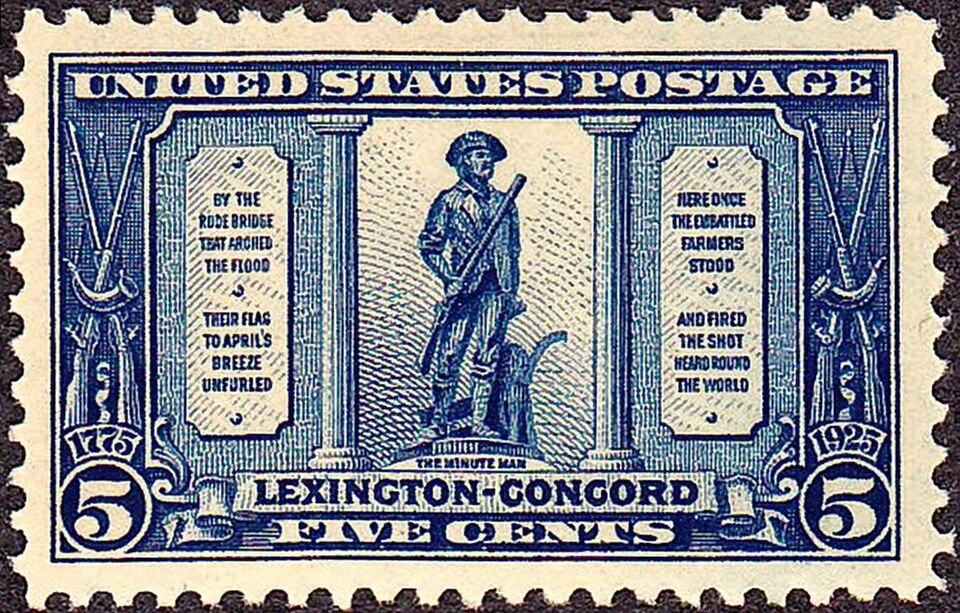
This stamp is one of a set of three issued in 1925; the poem on the plaques was authored by Ralph Waldo Emerson.
In 1770, Samuel Adams had begun agitating for a reform and update of the militia in the provincial legislature. Hutchinson, the Royal Governor, had ignored him, but as tensions mounted, that tactic became less effective. Adams and his like-minded friends were gaining more traction. In May 1774, Hutchinson was relieved by General Thomas Gage, the new Governor of Massachusetts, who arrived with orders to close the port of Boston. Instead of tamping down disagreement between the colonists and the Crown, it escalated them. That same month, Parliament passed "An Act for the better regulating the Government of the Province of Massachusetts-Bay" and "An Act for the more impartial administration of justice in said Province," otherwise known as the Intolerable Acts, which were designed to remove power from the towns.[13]
This brought many more citizens to Samuel Adams's side, and he pressed the Committees of Correspondence to hold County Conventions to revamp the militia. Gage tried to seat his own court in Worcester, but the townspeople blocked the court from sitting. Two thousand militiamen marched to intimidate the judges and get them to leave. This was the first time that the militia was used by the people to block the king's representatives from acting on royal orders and against popular opinion. Gage responded by preparing to march to collect munitions from the provincials. For 50 miles around Boston, militiamen were marching in response. By noon the next day, almost 4,000 people were on the common in Cambridge. The provincials got the judges to resign and leave. Gage backed off from trying to seat a court in Worcester.
The colonials in Worcester met and came up with a new militia mobilization plan in their County Convention. The Convention required that all current militia officers resign; the motive being that ranking officers in the militia could be considered strong Loyalists.[14] Officers were then elected by their regiments. In turn, the officers then appointed one third of their militia regiment as Minutemen. Other counties followed Worcester's lead, electing new militia officers and appointing Minutemen.[15]
The British practiced formations with their weapons, focusing on marching formations on the battlefield. It is a myth that the British and other professional armies of the 1700s did not practice marksmanship with their muskets; the military ammunition of the time was made for fast reloading and more than a dozen consecutive shots without cleaning. Accuracy of the musket was sacrificed for speed and repetitive loading.[16]
The militia prepared with elaborate plans to alarm and respond to movements by the king's forces out of Boston. The frequent mustering of the minute companies also built unit cohesion and familiarity with live firing, which increased the minute companies' effectiveness. The royal authorities inadvertently gave the new Minuteman mobilization plans validation by several "show the flag" demonstrations by General Gage through 1774.[further ^explanation ^needed]
The royal authorities in Boston had seen these increasing numbers of militia appearing and thought that the militia would not interfere if they sent a sizable force to Concord to seize munitions and stores there (which they considered the King's property, since it was paid for to defend the colonies from the American Indian threat). The British officers were proven wrong. Shooting erupted at Lexington. There is still a debate as to whether it was a colonist or a British soldier who fired the first shot.[17] The militia left the area, and the British moved on. The British then moved to Concord and faced a larger number of militia. The British were rapidly outnumbered at Concord, with the arrival of the slower moving militia; they had not counted on a long fight, and so had not brought additional ammunition beyond the standard issue in the soldiers' cartridge boxes. This then forced a strategic defeat on Colonel Smith, forcing him back to Boston.
A "running fight" began during the retreat. Militiamen knew the local countryside and were familiar with "skulking" or "Indian warfare". They used trees and other obstacles to cover themselves from British gunfire and pursuit by British soldiers, while the militia were firing and moving. This kept the British under sporadic fire, and caused them to exhaust their limited ammunition. Only the timely arrival of a relief column under Lord Percy prevented the annihilation or surrender of the original road column.
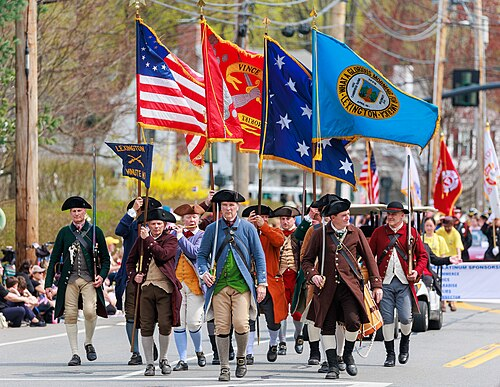
The Lexington Minute Men march in Lexington's 2025 Patriots' Day parade
Post Revolution
The organization was re-chartered ahead of an 1874 visit by Ulysses S. Grant.[18] A charter granted May 5, 1910 by Governor Eben S. Draper permanently established the Minute Men (spelled as two words) as an independent, unattached military command in Massachusetts.[18] In the 20th and 21st Centuries, the Minute Men serve as honor guards, march in parades (including eight Presidential inaugurations), and perform in re-enactments and living history programs.[18]
The Minuteman model for militia mobilization married with a very professional, small standing army was the primary model for the United States' land forces up until 1916 with the establishment of the National Guard.[25]
In commemoration of the centenary of the first engagement of the American Revolution, Daniel Chester French, in his first major commission, produced one of his best-known statues (along with the Lincoln Memorial), The Minute Man. Inscribed on the pedestal is the opening stanza of Ralph Waldo Emerson's 1837 "Concord Hymn" with the words, "Shot heard 'round the world". The statue's likeness is not based on Isaac Davis as is widely asserted, the captain of the Acton militia and first to be killed in Concord during the Battles of Lexington and Concord on April 19, 1775, but rather French used live models in the study of the anatomy and facial expression.[26] The Minute Man statue is still the symbol of the National Guard, featured prominently on its seals. It was also the symbol of the former Boston and Maine Railroad.
Minutemen are portrayed in "Paul Revere's Ride", a poem by Henry Wadsworth Longfellow. Although historians criticize the work as being historically inaccurate, Longfellow understood the history and manipulated it for poetic effect.[27]
The 1925 Lexington-Concord Sesquicentennial half dollar features a sculptural portrayal.
The athletic teams of the University of Massachusetts Amherst are nicknamed the Minutemen and Minutewomen. Until the 2003 rebranding featuring a modernized Sam the Minuteman, the logo featured the Concord Minute Man statue prominently.
The U.S. Air Force named the LGM-30 Intercontinental Ballistic Missile the "Minuteman", which was designed for rapid deployment in the event of a nuclear attack. The "Minuteman III" LGM-30G remains in service.
The U.S. Navy VR-55 Fleet Logistic Support Squadron is named "Minutemen" to highlight the rapid deployment and mobility nature of their mission.
One of the factions in Bethesda's 2015 video game Fallout 4, which is set in Massachusetts, is called the "Commonwealth Minutemen". The inspiration for their namesake comes from the requirement to be ready "at a minute's notice" to defend any settlement in danger.[28]
Sinclair Lewis portrays Minute Men as paramilitary forces of Buzz Windrip's despotic government in his 1935 book It Can't Happen Here. In the book, the fascist-like militia is called "Minnie Mouses" by the populace.
In Alan Moore's Watchmen graphic novel the first masked vigilantes assembled are titled the Minutemen.
The Minutemen was a militant anti-communist organization in the early 1960s.
The Minuteman Civil Defense Corps was a militant anti-Mexican immigrants volunteer group formed in 2005.
The Minuteman Project is a 2004 organization that opposes Mexican immigration to US.
Minutemen are also featured in 2010 strategic video game Civilization V by Firaxis. They can only be recruited by the American Civilization and production is only available after researching the Gunpowder technology in the Renaissance era.
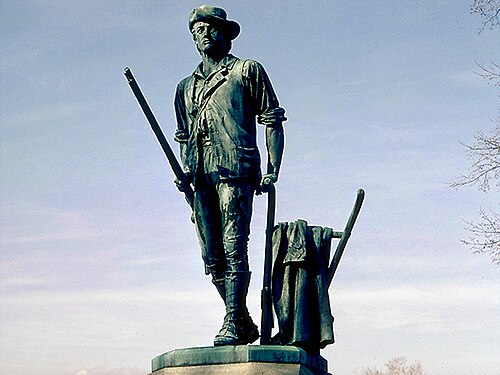
The Minute Man by Daniel Chester French, erected in 1875 in Concord, Massachusetts, depicting a typical Minuteman
- Captain Robert K. Wright Jr. *Massachusetts Militia Roots: A Bibliographic Study*. (1986) 116th Military History Detachment Virginia Army National Guard. Available at the United States Army Center of Military History
- Who Were the Minutemen? (ushistory.org)
- Organization of the Minute-Men
- Minute Man National Historical Park
See PDF for complete article downloaded from Wikipedia
Monday, January 26, 2026 05:50PM