Saul Alinsky
Friday, January 23, 2026 06:13PM
"THE SORES OF DISCONTENT"
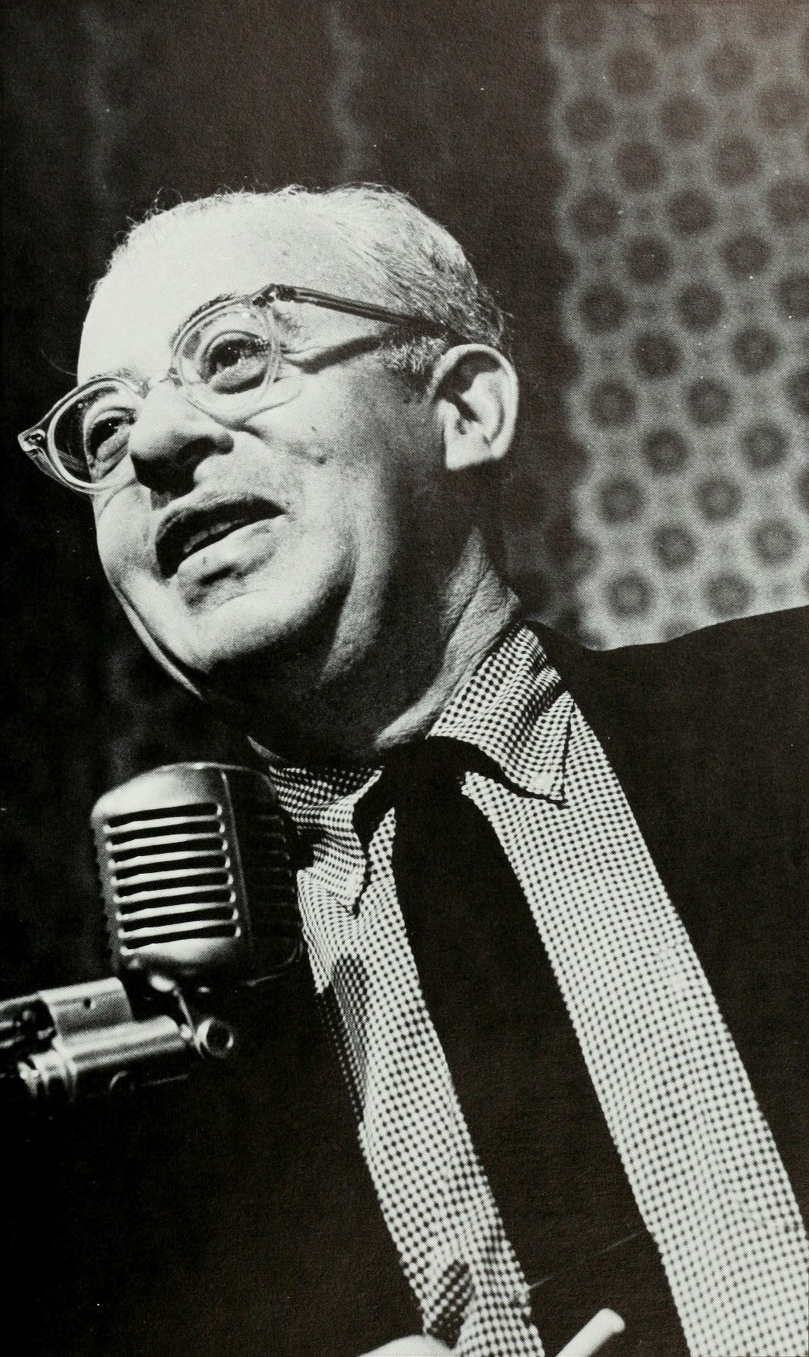
ALINISKY IN 1963
Saul David Alinsky (January 30, 1909 – June 12, 1972) was an American community activist and political theorist. His work through the Chicago-based Industrial Areas Foundation helping poor communities organize to press demands upon landlords, politicians, bankers and business leaders won him national recognition and notoriety. Responding to the impatience of a New Left generation of activists in the 1960s, Alinsky – in his widely cited Rules for Radicals: A Pragmatic Primer (1971) – defended the arts both of confrontation and of compromise involved in community organizing as keys to the struggle for social justice.
Beginning in the 1990s, Alinsky's reputation was revived by commentators on the political right as a source of tactical inspiration for the Republican Tea Party movement and subsequently, by virtue of indirect associations with both Hillary Clinton and Barack Obama, as the alleged source of a radical Democratic political agenda. While criticized on the political left for an aversion to broad ideological goals, Alinsky has also been identified as an inspiration for the Occupy movement and campaigns for climate action.
Saul Alinsky was born in 1909 in Chicago, Illinois, to Lithuanian Jewish emigrant parents from Vilnius, Russian Empire. He was the only surviving son of Benjamin Alinsky and his second wife, Sarah Tannenbaum Alinsky, from what was then Vilna, (now Vilnius, the capital of Lithuania).[5][6][7] His father started out as a tailor, then ran a delicatessen and a cleaning shop.
Both parents were strict and observant Orthodox. Alinsky describes himself as being devout until the age of 12, the point at which he began to fear his parents would force him to become a rabbi. Although he had "not personally" encountered "much antisemitism as a child", Alinsky recalled that "it was so pervasive ... you just accepted it as a fact of life." Called up for retaliating against some Polish boys, Alinsky acknowledged one rabbinical lesson that "sank home." "It's the American way . . . Old Testament . . . They beat us up, so we beat the hell out of them. That's what everybody does." The rabbi looked at him for a moment and said quietly, "You think you're a man because you do what everybody does. But I want to tell you something great: 'where there are no men, be thou a man'". Alinsky considered himself an agnostic,[8][9][10] but when asked about his religion would "always say Jewish."[11]
In 1926, Alinsky entered the University of Chicago. He studied in America's first sociology department under Ernest Burgess and Robert E. Park. Overturning the propositions of a still ascendant eugenics movement, Burgess and Park argued that social disorganization, not heredity, was the cause of disease, crime, and other characteristics of slum life. As the passage of successive waves of immigrants through such districts had demonstrated, it is the slum area itself, and not the particular group living there, with which social pathologies were associated.[12] Yet Alinsky claimed to be "astounded by all the horse manure [sociologists] were handing out about poverty and slums, playing down the suffering and deprivation, glossing over the misery and despair. I mean, Christ, I’d lived in a slum, I could see through all their complacent academic jargon to the realities."[13][11]
The Great Depression put an end to an interest in archaeology: after the stock-market crash "all the guys who funded the field trips were being scraped off Wall Street sidewalks." A chance graduate fellowship moved Alinsky on to criminology. For two years, as a "nonparticipant observer", he claims to have hung out with Chicago's Al Capone mob (he explains that, as they "owned the city", they felt they had little to hide from a "college kid"). Among other things about the exercise of power, he says they taught him was "the terrific importance of personal relationships".[14] Alinsky took a job in the Illinois, Division of the State Criminologist, working with juvenile delinquents and at the Joliet Correctional Center. He recalls it as a dispiriting experience: if he dwelt on the contributing causes of crime, such as poor housing, racial discrimination, or unemployment, he was labelled a "red."[15]
In 1938, Alinsky gave up his last employment at the Institute for Juvenile Research, University of Illinois at Chicago, to devote himself full-time as a political activist. In his free time he had been raising funds for the International Brigade (organized by the Communist International) in the Spanish Civil War and for southern sharecroppers, organizing for the Newspaper Guild and other fledgling unions, fighting evictions, and agitating for public housing.[14] He also began to work alongside the CIO (Congress of Industrial Organizations) and its president John L. Lewis. (In an "un-authorized biography" of the labor leader Alinsky wrote that he later mediated between Lewis and President Franklin D. Roosevelt in the White House).[16]
Alinsky's idea was to apply the organizing skills he believed he had mastered "to the worst slums and ghettos, so that the most oppressed and exploited elements could take control of their own communities and their own destinies. Up until then, specific factories and industries had been organized for social change, but never whole communities."[17]
In the belief that if his approach succeeded in these neighborhoods, it could do so anywhere, Alinsky looked to the back of the Chicago Stockyards (the area made infamous by Upton Sinclair's 1905 novel The Jungle). There with Joseph Meegan, a park supervisor, Alinsky set up the Back of the Yards Neighborhood Council (BYNC). Working with the archdiocese, the Council succeeded in rallying a mix of otherwise mutually hostile Catholic ethnics (Irish, Poles, Lithuanians, Mexicans, Croats . . .) as well as African Americans to demand, and win, concessions from local meatpackers (in January 1946 the BYNC threw its support behind the first major walkout of the United Packinghouse Workers),[18] landlords and city hall. This, and other efforts in the city's South Side to "turn scattered, voiceless discontent into a united protest" earned an accolade from Illinois governor Adlai Stevenson: Alinsky's aims "most faithfully reflect our ideals of brotherhood, tolerance, charity and dignity of the individual."[19]
In founding the BYNC, Alinsky and Meegan sought to break a pattern of outside direction established by their predecessors in poor urban areas, most notably the settlement houses. The BYNC would be based on local democracy: "organizers would facilitate, but local people had to lead and participate." Residents had to "control their own destiny" and in doing so not only gain new resources but new confidence as well.[20] "Some of Saul's real genius," according to one observer, was "his sense of timing and understanding how others would perceive something. Saul knew that if I grab you by the shoulders and say do this, do that and the other, you're going to resent it. If you make the discovery yourself, you're going to strut because you made it".[21]
Organizing the middle class
For Alinsky, the real limitation of his organizing experience was that it had not extended into the middle-class majority:[74]
Christ, even if we could manage to organize all the exploited low-income groups – all the blacks, chicanos, Puerto Ricans, poor whites – and then, through some kind of organizational miracle, weld them all together into a viable coalition, what would you have? At the most optimistic estimate, 55,000,000 people by the end of this decade – but by then the total population will be over 225,000,000, of whom the overwhelming majority will be middle class. . . . Pragmatically, the only hope for genuine minority progress is to seek out allies within the majority and to organize that majority itself as part of a national movement for change.
The middle classes may be "conditioned to look for the safe and easy way, afraid to rock the boat," but Alinsky believed "they're beginning to realize the boat is sinking." On a wide range of issues, they feel "more defeated and lost today than the poor do." They were, Alinsky insisted, "good organizational material:" "more amorphous than some barrio in Southern California", so that "you're going to be organizing all across the country," but "the rules are the same."[74]
In 1968 he secured a year's funding in Chicago from the Midas International Corporation to train white middle class suburban activists. As understood by corporate president Gordon Sherman, the proposition was that "lack of organization in white neighborhoods can be as harmful to the total society as lack of organization in the black community. We all live in our own ghettos".[75] Alinsky, however, never predicted exactly what form or direction middle-class organization would take. In Horwitt's sympathetic view he was "too empirical for that." He did suggest that "the chance for organization for action on pollution, inflation, Vietnam, violence, race, taxes is all about us," making it clear that he envisaged organization based on a community of the interest rather than on the dubious neighborliness of the suburb.[76]
In 1969 in Chicago, Alinsky and his IAF trainees helped initiate a city-wide Campaign Against Pollution (later to become the Citizens Action Program to Stop the Crosstown—a billion-dollar expressway).[77] Alinsky was not beyond believing that such initiatives, scaled-up nationally, could "move on to the larger issues: pollution in the Pentagon and Congress and the board rooms of the megacorporations." Challenging, but the alternative, Alinsky warned, was for the "impotence" of the middle classes to turn into "political paranoia." This would make them "ripe for the plucking by some guy on horseback promising a return to the vanished verities of yesterday."[74]
Death and family
On June 12, 1972, three months after the publication of the Playboy interview, Alinsky died, aged 63, from a heart attack while walking near his home in Carmel, California.[25]
Alinsky's parents divorced when he was 18. He remained close to his mother, Farah Rice, who survived him. She acknowledged his national notoriety but not his politics. "As a Jewish mother, she begins where other Jewish mothers leave off. . . it was all anti-climatic after I got that college degree."[78]
Alinsky was married three times. His first wife, Helene Simon, whom he had met at the University of Chicago, drowned in 1947 while trying to save two children. Alinsky mourned her death for many years.[79] His second marriage to Jean Graham was also to take a tragic turn. A diagnosis of multiple sclerosis proved to be the onset of serious mental health problems and led to her hospitalization. Alinsky ended the marriage after several years but maintained regular contact. In the year before his death, he married Irene McInnis. He had two children from his first marriage, Kathryn Wilson and Lee David Alinsky.[79][80]
Legacy
Industrial Areas Foundation
Main article: Industrial Areas Foundation
It has been suggested that "Alinsky is to community organizing as Freud is to analysis." Having written about it, "philosophized about it, and provided the first set of rules", he was the first to call attention to community organizing "as a distinct program, with a life and literature of its own, separate from any particular cause such as the union movement or Populism."[20] His biographer Sanford Horwitt credits Alinsky "more than anybody ... for demonstrating that community organizing could be a lifelong career."[81]
The Industrial Areas Foundation still claims to be "the nation's largest and longest-standing network of local faith and community-based organizations."[22] They report "victories" on, among other issues, housing and neighborhood revitalization, public transport and infrastructure, living-wage jobs and workforce development, support for local labor unions, criminal justice reform, and tackling the opioid crisis.[82]
When Alinsky died, Edward T. Chambers became the IAF's executive director. Hundreds of professional community and labor organizers and thousands of community and labor leaders have been trained at its workshops.[83] Fred Ross, who worked for Alinsky, was the principal mentor for Cesar Chavez and Dolores Huerta. Other organizations following in the tradition of the Congregation-based Community Organizing pioneered by IAF include PICO National Network, Gamaliel Foundation, Brooklyn Ecumenical Cooperatives, founded by former IAF trainer Richard Harmon, and Direct Action and Research Training Center (DART).[83][84] Such had been their role in the IAF and its projects that on his Firing Line television program William F. Buckley introduced Alinsky as "the pet revolutionary of the church people of America".[67]
"Alinskyism"
Among political activists on the left, Alinsky’s legacy continues to be disputed. Cautions against looking to Alinsky for "a road map" to "rebuild power in the age of Trump" repeat the warning of the New Left: "'Alinskyism' — apolitical 'single-issue' campaigns that focus on 'winnable demands' run by a well-oiled, staff-heavy organization—shut the door to more democratic and transformational forms of working-class mobilization."[95]
At the same time, Alinsky has been rediscovered and defended as an inspiration for the Occupy movement in 2011-12, and the mobilization for climate action.[96] Activists for Extinction Rebellion (XR), founded in Britain, cite Rules for Radicals as a source of inspiration as to "how we mobilise to cope with emergency", and "strike a balance between disruption and creativity".[97] XR co-founder, Roger Hallam, has been clear that the strategy of public disruption is "heavily influenced" by Alinsky: "The essential element here is disruption. Without disruption, no one is going to give you their eyeballs".[98]
The Israeli journalist and pro-Settler activist David Bedein viewed Alinsky as a major influence on his own form of occupation politics.[99]
Appropriation by the Tea Party movement
In the 2000s, Rules for Radicals did develop as a primer for middle-class mobilization, but it was of a kind and in a direction—the return to "vanished verities"—that Alinsky had feared. As did William F. Buckley in the 1960s, a new generation of libertarian, right-wing populist, and conservative activists seemed willing to admire Alinsky's disruptive organizing talents while rejecting his social justice politics. Rules for Radicals, and adaptations of the book, began circulating among Republican Tea Party activists. According to spokesman Adam Brandon, the conservative non-profit organization FreedomWorks distributed a short adaptation of Alinsky's work, Rules for Patriots, through its entire network. Former Republican House Majority Leader Dick Armey is also reported to have given copies of Alinsky's book to leaders of the Tea Party movement.[100] In Rules for Conservative Radicals (2009) Michael Patrick Leahy, an early Tea Party leader, offered "sixteen rules for conservative radicals based on lessons from Saul Alinsky, the Tea Party Movement, and the Apostle Paul".[101]
Linked to Hillary Clinton and Barack Obama
Once it appeared that links could be drawn between Alinsky and two major Democratic-Party presidential hopefuls, Senator Hillary Clinton and Senator, later President, Barack Obama, conservatives were interested less in appropriating from the organizing tactician, than in profiling Alinsky as a far-left radical. Alinsky, it was discovered, had been the subject of then Hillary Rodham's senior college thesis.[63] Clinton had not been uncritical. Alinsky believed that community leaders who generate pressure on the system from the outside could produce more effective change than the lofty lever-pullers on the inside. But Clinton argued that suburbanization and a federal consolidation of power meant change needed to be achieved at levels that Alinsky's model was not designed to target. Nonetheless, her conclusion allowed that Alinsky "has been feared – just as Eugene Debs or Walt Whitman or Martin Luther King has been feared, because each embraced the most radical of political faiths — democracy."[102]
For three years, from June 1985 to May 1988, Obama was the director of the Developing Communities Project (DCP), a church-based community organization on Chicago's far South Side.[103][104] Alinsky biographer Sanford Horwitt, saw the influence of Alinsky's teaching not only on Obama's work in Chicago but also on his successful 2008 presidential run.[105] Yet Obama too commented on having seen "the limits of what can be achieved" at the community level. He also expressed the view that "Alinsky understated the degree to which people's hopes and dreams and their ideals and their values were just as important in organizing as people's self-interest." Sen. Dick Durbin (D-Ill.), a friend of Obama's, saw another difference. "If you read Alinsky's teachings, there are times he's confrontational. I have not seen that in Barack. He's always looking for ways to connect."[106]
In his 1996 biography of her, The Seduction of Hillary Rodham, David Brock dubbed Hillary Clinton "Alinsky's daughter."[107] Barbara Olson began each chapter of her 1999 book on Clinton, Hell to Pay, with a quote from Alinsky, and argued that his strategic theories directly influenced her behavior during her husband's presidency.[108] In 1993, Clinton asked Wellesley College to seal her thesis on Alinsky for the duration of her husband's presidency.[109]
As his candidacy gained strength, and once he had defeated Clinton for the Democratic Party nomination, attention shifted to Obama's ties to Alinsky.[110][111] Monica Crowley, Bill O'Reilly, and Rush Limbaugh repeatedly drew a connection, with the latter asking, "Has [Obama] ever had an original idea — by that, I mean something not found in The Communist Manifesto? Has he? Has he simply had an idea not found in Saul Alinsky's Rules for Radicals?" In Barack Obama's Rules for Revolution: The Alinsky Model (2009) David Horowitz argued "the roots" of his administration's "effort to subject America to a wholesale transformation" were to be found in the teachings of "the guru of Sixties radicals"—an Alinsky admonition to be "flexible and opportunistic and say anything to get power."[112]
Donald Trump as the "Alinsky president"
In 2016, Glenn Beck produced a four-part radio series to expose Alinsky's "vision for a Godless, centrally controlled utopia."[113] Yet he proposed that, in tactical terms, it was not Obama but his nemesis, then presidential candidate Donald Trump, who "is Saul Alinsky": "[Trump] will isolate you and polarize you and he will take you out".[114] The same argument has been advanced by Wall Street Journal editor James Taranto: it is Trump, not Obama, who has proved to be the "Alinsky President". Both in his (2015-2016) campaign and, subsequently, in using the "bully pulpit of the presidency", Trump followed "a lot of Alinsky's rules".[115]
In the wake of the January 6, 2021 assault the U.S. Capitol (and of the descent of vaccine-mandate protesting truckers upon the Canadian capital, Ottawa, in February 2022), Politico credited President Trump's "hard-ball ways" with schooling a new generation of right-wing activists in the delivery of "Alinskyesque shock blows to the system.[116]
Epitaph
As an epitaph for Alinsky, his biographer Sanford Horwitt wrote:
Alinsky was a true believer in the possibilities of American democracy as a means to social justice. He saw it as a great political game among competing interests, a game in which there are few fixed boundaries and where the rules could be changed to help make losers into winners and vice versa. He loved to play the game...[117]