When Did the Torah Become Authoritative?, Transcript
Transcript for When Did the Torah Become Authoritative? By CentrePlace
(3) When Did the Torah Become Authoritative? - YouTube
https://www.youtube.com/watch?v=4KbyYFl5n7g
Transcript:(00:03) our topic this evening is when did the Torah become authoritative so we are looking at uh the first five books of the Hebrew Bible the Christian Old Testament
- Genesis
- Exodus
- Leviticus
- Numbers
- and Deuteronomy
um traditionally known as the five books of Moses and of course are at the center of uh Judaism Jewish religion today rinic Judaism and they were also Central to uh Jewish religion at the time of Jesus at the very end of the second temple period but they weren't always uh at the center uh even though tradition would maybe have us believe
(00:56) that they were at least dating back to the time when Moses uh hypothetically would have lived if if he has been if he were a historic figure so if we look much later uh a much later time period to the time period between the Old and New Testaments where there are the books of the Apocrypha um the books of mccabes which we've had lectures on tell stories of the Judean revolt against the helenistic kingdom of Syria one of the successor states to Alexander the greats Empire the seusd kingdom and that Revolt led to a
(01:45) short-lived Jewish Kingdom that was really only fully independent between the years 104 and 63 before the Comm era so just over 40 years so the first book of mccabes portray the initial Revolt in the year 167 as a rejection of forced helenismo Greek culture and religion and so this is led by Jewish priests Judas macabus romantically pictured here so according to First macbes the seusd King Antiochus ivth epiphanies provoked the Revolt by attempting to Li eliminate Jewish distinctiveness through a program of forced heniz essentially assimilation
(02:37) wanting to bring all of his peoples together as one uh Greek Kingdom so we read in the book of mccabes then the King Antiochus IV wrote to his whole Kingdom that all should be one people and that all should give up their particular Customs all the nations accepted the command of the king many even from Israel gladly adopted his religion they sacrificed to idols and they profaned the Sabbath so if we highlight a couple things here we're seeing that this is a multicultural Empire this Lucid Empire that they're in the kingdom and the
(03:18) different peoples had their own particular Customs including Israelites who had distinctive customs and part of the Israelite Customs just highlight here include a kind of a Sabbath observance although it doesn't say precisely what that is but every on the seventh day some sort of observance is done and it avoids sacrificing to Idols so um that's an icon part of the uh part of the distinctive of the religion is Iconic clastic so we do not worship God or make an image of God so the king the the Greek Kings sent
(04:01) Letters by Messengers to Jerusalem and the towns of Judah he directed them to follow Customs strange to the land to forbid burnt offerings and sacrifices and drink offerings in the sanctuary he commanded them to profane sabbaths and festivals and to defile the sanctuary and the holy ones to build altars and sacred PR precincts and shrines for Idols to sacrifice pigs and other unclean animals and to leave their sons uncircumcised they were to make themselves abominable by everything unclean and profane so that they would
(04:43) forget the law and change all the ordinances uh the king added and whoever does not obey the command of the king shall die so we're seeing here other distinctives that were already well in place so they are offering burnt offerings in the sanctuary in Jerusalem that's where those are had again there are festivals that are observed along with the sabbaths particular festivals they are opposed to these Idols they also um uh opposed to consuming or consuming pork and there is also OBS observance of circumcision male
(05:25) circumcision so all of this is U part of the law and law Torah is a is the word for law so the author gives a list of things the Lucid King intends to ban and this gives us a sense of what constituted Jewish distinctiveness at the time the text was written which is around the year 100 before the Common Era so as we saw those include things like s Sabbath observance male circumcision avoiding pigs and other ritually unclean animals rejecting idols and observing particular festivals and their sacrifices and then
(06:09) also remembering the law the Torah and so this is a again a romantic painting of the cusd king desecrating the Jerusalem Temple so many judeans refused to assimilate and then instead began a rebellion against the Lucid rule so waging a war for these Judean rebels in support of Torah observance quickly raised the question are soldiers permitted under the law to fight on the Sabbath so we've been talking here about Sabbath observance and that part of that is refraining from certain activities is fighting one of those activities so we
(06:50) read in the book of mccabes it was reported to the Lucid King's officers and to his occupying troops in Jerusalem the city of David that those who had rejected the King's Command had gone down into hiding places in the wilderness so they all fled to the countryside um there's uh opponents to his decrees in the rural areas of Judah so many pursued them and overtook them and they encamped opposite them and prepared for a battle against them on the Sabbath day so the Greek army has found these uh Rebels and and they're
(07:30) intending to come to battle with them on the Sabbath they said to them enough of this come out and do what the king commands and you will live but they said we will not come out nor will we do what the king commands and so profane the Sabbath day then the enemy quickly attacked them but they did not answer them or hurl a stone at them or block up their hiding places for they said let us all die in our innocence Heaven and Earth testify for us that you are killing us unjust ly so the Greeks attacked them on the Sabbath and they
(08:04) died with their wives and children and livestock to the number of a thousand persons so mcb's book here records a Sabbath day uh Massacre so this is clearly not a winning strategy in the physical world there's obviously um there was an appeal to Heaven There and the uh the people massacred or Martyrs who maybe felt Justified but one of the rebels uh despite the fact that they are rebelling in favor of Torah observance a priest named matatas and his neighbors come to a decision about fighting on the Sabbath so again we read in the mcab
(08:45) book when Mattias and his friends learned of this sabbath day massacre they mourned for them the martyrs deeply and all said to their neighbors if we all do as our Kindred have done and refused to fight with the Nations for our lives and for our ordinances they will quickly destroy us from the earth so they made the decision that day let us fight against anyone who comes to attack us on the Sabbath day let us not all die as our Kindred died in their hiding places so um you know that's not a unexpected response so um and there's not all of
(09:26) these ideas are not unexpected so matatas position is followed by his sons including Judas macabus uh Yehuda hakabe so Judah the hammer who took control of the Revolt defeated a seusd army and successfully took control of Jerusalem so first macbes presents Jewish distinctiveness that remain familiar including again this Prat pragmatic response to a Sabbath Day Massacre so it's just a very small territory that is deao under deao control of the Rebel leader at this stage in the Revolt so what is perhaps unexpected in
(10:06) that story that we just read is why the issue of a Jewish Army needing to defend itself on the Sabbath had not come up before so it's not as though um there are not stories of wars in the preceding many many centuries that are recorded in biblical books like Joshua Judges Samuel in Kings indeed um books like Joshua books like Jud actually all of those narrate almost continual Warfare so why didn't Mattias simply look to all of the biblical precedents about fighting on the Sabbath all of the stories in those books about what did
(10:48) those armies do when they were attacked on the Sabbath so the answer unexpectedly and perhaps seemingly amazingly is that there aren't any such biblical precedents so the issue of Sabbath observance for Jewish armies which comes up immediately in chapter 1 of first mccabes never seems to come up when Joshua or Gideon or David are leading the armies of Israel um so why is this Central issue of identity absent from the text so the answer unexpected answer is that the Torah itself um is not Central for all of the
(11:34) biblical authors authors of books like uh Joshua um judges Kings and Samuel so if the Torah the five books attributed to Moses were as ancient and as Central to Israelite religion as you know tradition claims it would stand to reason that distinctives of Mosaic law like Sabbath observance always top of the Mind in texts that are written after the 2 Century BCE uh they would also be Central to the Hebrew Bible and instead they don't appear anywhere outside the Torah itself so this does not mean that ancient Israelite religion didn't exist
(12:19) or didn't have distinctives it did have a whole first temple period um that the biblical texts are not histories of but point us to the actual underlying histories and there's also uh archaeological evidence for example for the prohibition of pork and also male circumcision seems to have been an early practice um there are many examples of obedience to the idea of law in general so in part an issue here is that the Torah has the same since it's named the law it also has the same name as law and so there was a sense of
(13:02) having to obey law before the Torah existed in its uh present form so even when though some of these Customs uh and religious prohibitions may have been in force those don't necessarily mean that we um have uh Torah as Central to uh Judaism of the time and indeed when we get to uh the book of Ezra and Nehemiah so this is the book that is all the way after you know the first temple period's over after the Babylonian captivity after they um have returned to Jerusalem and built in the second temple period uh
(13:48) when Ezra gets on a platform and reads the law that reading of the Torah is really presented as a new practice and when the people hear the law they hear new things that they had never never heard before so we've seen many times uh what I've just said that so that when Ezra leads reads the law to the community in Jerusalem that has returned from Exile has rebuilt the temple and is now living under Persian Rule and a little Persian province of yood the information he reads seems to be news to everybody so we read in the book of
(14:24) Nehemiah all the people were gathered together into the square before the Watergate they told Ezra The Scribe to bring the book of the law of Moses which the Lord had given to Israel accordingly Ezra the priest brought the law before the assembly both men and women and all who could hear with understanding on the second day when Ezra was reading the law still the heads of all the ancestral houses of all the people with the priests and the Levites they came together to Ezra the Scribe in order to study the words of the
(15:01) law and they found it written in the law that the Lord had commanded by Moses that the Israelites should live in booths during the Festival of the seventh month and that they should publish and Proclaim in all their towns and in all Jerusalem as follows go out to the hills and bring branches of olive Wild Olive mle Palm and other leafy trees to make booths as it is written so the people went out and brought them and made booths for themselves each one on the roofs of their houses and in the courts and the courts of the house of
(15:37) God and in the Square at the water gate and in the Square at the Gate of Ephraim and all the Assembly of those who had returned from captivity made booths and lived in them for from the days of Joshua son of nun to that day Israelites had not done so and there was very great rejoicing um it was always at the end of the under of the reading in the monip python the Holy Grail says and there was great rejoicing that reminds me of that so anyway this commandment um this is a Commandment that they read in the Torah
(16:13) so observing the Festival of the booth that hadn't been known or practiced since Mythic times so the time of Joshua uh a Mythic figure indicating that in other words time immemorial they had never they had never practiced this indicating that if Ezra were reading from a Torah substantially similar to what we have now this is the first moment or the earliest moment that Torah is widely known since its Commandments um are not haven't been read and haven't been practiced so we've seen previously that
(16:48) Ezra might have been the editor or redactor who brought the Torah close to his present form or he might have just been around at the time when that was happening but if he had the Torah uh even if he had the Torah and had begun to make it central to Jewish practice in and around Jerusalem during the Persian period other contemporary sources actually illustrate that this wasn't immediately seen as authoritative by all Israelites so it may have been the focus of what Ezra and his group are doing in the center but actually more judeans
(17:27) more Israelites are actually not at the center already at this point because it's only a small group of Exiles that have returned and the majority are all living in diaspora across the Persian Empire in Mesopotamia as well and also in Egypt so in our previous lecture where we contrasted the book of Ezra and the Book of Ruth we saw um that Ezra had found another law in the Torah uh which they implemented which they hadn't known of before so in the book of Nehemiah we read on that day they read from the book
(18:07) of Moses in the hearing of the people and it was found written that no ammonite or moabite should ever enter the Assembly of God because they did not meet the Israelites with bread and water but hired balum against them to curse them yet Our God turned the curse into a blessing and when the people heard the law they separated from Israel all those of foreign descent so they got rid of the foreigners this passage uh quotes from Deuteronomy so one of the five books of the Torah so the passage in Deuteronomy reads no one this is about people who
(18:51) you're not allowed into the assembly So It Begins no one whose testicles are crushed or whose penis is cut off shall come into the assmbly of the Lord so it's a Prohibition against unic those born of an illicit Union shall not come into the Assembly of the Lord even to the 10th Century none of their descendants shall come into the Assembly of the Lord so no bastards or their descendants no ammonite or moabit shall come into the Assembly of the Lord even to the tth generation none of their descendants
(19:24) shall come into the Assembly of the Lord forever because they did not meet you with food and water on your journey out of Egypt and because they hired balam son of Bor from pathor of Mesopotamia to curse you so you can see with that detail that this is being quoted out of Deuteronomy this uh law that they read for the first time in Ezra's day so Ezra and the Persian Governor Jewish Persian Governor Nehemiah used this newly found Law to force the judian men to divorce all of their non- judan wives and also
(19:59) renounced their children uh which caused substantial anguish and so we know at the time there were other people in the community who had the opposite perspective including the author of Ruth as we saw who instead tells a story of a righteous moabit woman who has been admitted into the congregation who has uh begun to worship the god of Israel you know your God is m my God she says and she follows her her mother-in-law back to Judah where she ultimately marries a Judean man and the two of them become an ancestor of King
(20:40) David So this directly contradicts the law in Deuteronomy which would have prevented David from being admitted into the assembly since it is within 10 Generations he has himself a moabit ancestor according to the Book of Ruth that is written around this time so the author of Ruth is not alone among biblical voices that are opposed to Ezra and this new reading of the Torah this new laws that they're finding or hadn't been aware of from the Torah so the community for example that continued to rever the prophet
(21:17) Isaiah so a person who had been a historical Prophet operating uh in the first temple period um they Community continued to rever his work and was in fact adding new writings in Isaiah's name in the Persian period so there had already been more writings that had occurred during the uh the Exile period dudor Isaiah and now chapters 55-66 of the book of Isaiah as we now have are called Treo Isaiah by Scholars because they're an a new edition written in Isaiah's name but uh during the Persian period so this group uh this part of
(21:58) Isaiah never writes I'm sorry never quotes the Torah and in fact has an opposing view of who should be admitted into the congregation of Israel so I read that whole deuteronomic prohibition against against unics against bastards against foreigners um but in Isaiah we read thus says the Lord maintain Justice and do what is right for soon my salvation will come and my Deliverance be be revealed happy is the Mortal who does this the one who holds it fast who keeps the Sabbath not profaning it and refrains from doing any evil so there's agreement
(22:41) here that part of the distinctives that we all have here as as judeans in the second temple period is includes Sabbath observance we're not profaning the Sabbath but there's a focus here also on on doing Justice and things that's also part of this according to uh the Lord in Isaiah so do not let the Foreigner joined to the Lord say the Lord will surely separate me from his people so don't let foreigners who have come and started to uh follow the lord don't let say the Lord will separate me from his
(23:19) people do not let the unic say I am just a dry tree for thus says the Lord to the Unix who keep my Sabbath who choose the things that please me and hold fast my Covenant I will give in my house and within my walls a monument and a name better than Sons and Daughters I will give him an everlasting name that shall not be cut off and the foreigners who join themselves to the Lord to minister to him to love the name of the Lord and be his servants all who keep the Sabbath and do not profane it and hold fast to my Covenant these I will
(23:59) bring to my Holy Mountain Mount Zion Jerusalem the temple and make them joyful In My House of Prayer the temple their burnt offerings and their sacrifices will be accepted on my Altar for my house shall be called a house of prayer for All Peoples thus says to the Lord God who gathers outcasts of Israel I will gather to them others to them besides those already gathered so to these Exiles returning who are saying that you have to separate yourself from Unix and foreigners I say no that is not what we're saying that
(24:39) this Isaiah um uh declaration is saying quite the opposite foreigners are are being called by God to be part of the community and their sacrifices in the temple will be accepted
Second Temple Period Chronology
!!Second Temple Period Chronology: (https://youtu.be/4KbyYFl5n7g?t=1534)
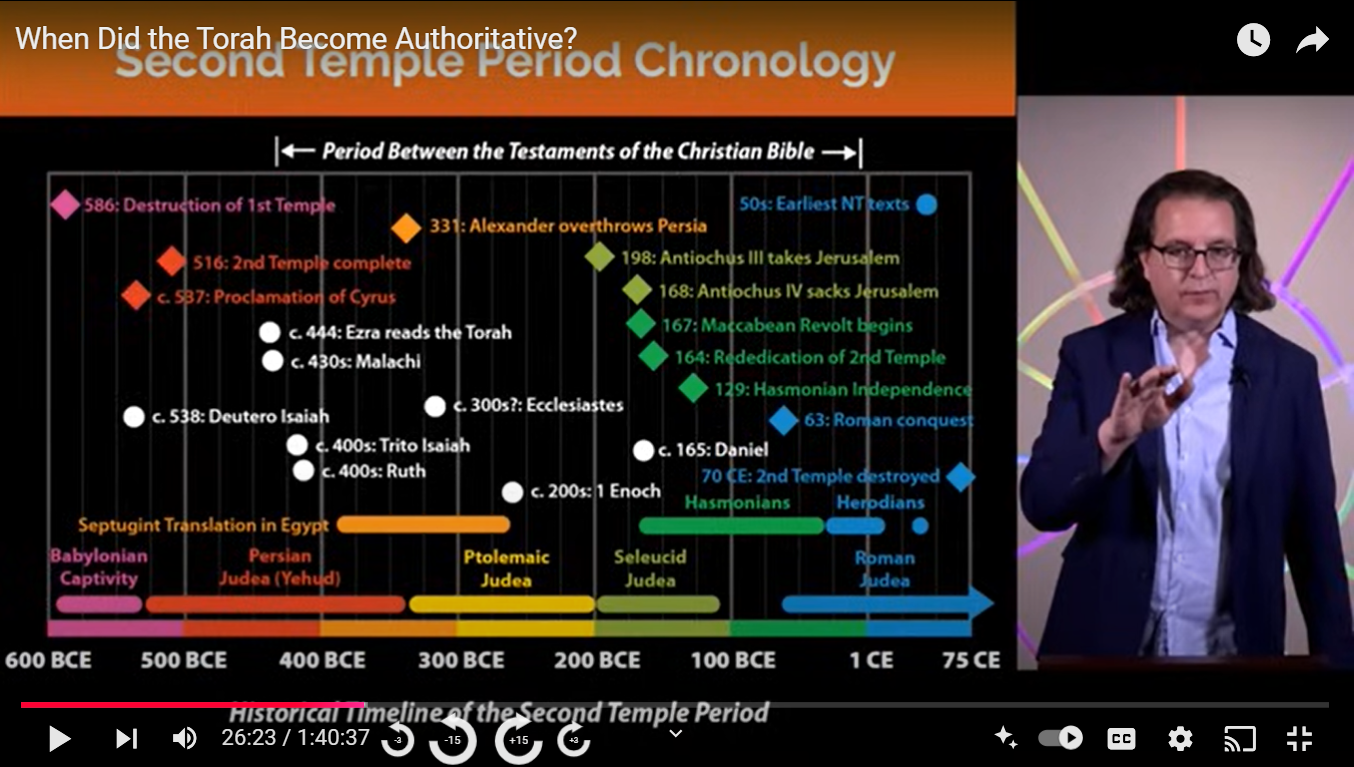
so in contrast to the law found by Ezra in the Torah which forbids moabites and ammonites other foreigners the Lord welcomes all who keep the Covenant as far as the Isaiah Community is concerned so let's ground ourselves here in the chronology of the second temple period so we have beginning uh in the pink in 586 the destruction of the first
(25:22) temple so that um along with the Babylonian captivity then the proclamation of Cyrus the Persian emperor that allowed the Exiles to return home and the completion then in 516 of the second temple period that begins the second temple period which is going to end at the other end in blue in the year 70 when the Romans 70 of the Common Era when the Romans destroy the second temple and then in the meantime we can kind of see uh some of the dates of when this um later or when these biblical texts are being composed so the original Isaiah is
(26:06) composed uh the source of it anyway is composed in the first temple period dudo Isaiah is right at the end of the Babylonian captivity and then tro Isaiah maybe in the 400s Ezra is doing this reading of the law maybe around the year 444 before the Common Era and tro Isaiah and Ruth are perhaps responding to that the author of Ruth um this is all in the Persian period you can see in the orange in 331 when Alexander the Great overthrows Persia that gives us brings us into the helenistic period and for Judea that is divided
(26:50) between the early part where the tmes of Egypt are ruling Judea and then later the celus SDS of Syria are uh ruling and that is where you see all of the activities of the maban Revolt that we were talking about so U Antiochus the fourth Antiochus the fourth sacking of Jerusalem the maban revolt and ultimately the independence of this hasmonean Kingdom you can see the the activity of the hasmonean dynasty the middle part of which is D when it's independent and in the blue period after the kind of the power vacuum of the Fall
(27:28) of the helenistic kingdoms that allowed that brief flourishing uh that's when the Romans come in and fill that power of acuum and the remaining part of this period is the Roman period so that grounds us and you can kind of see when some of these texts are coming so um there are uh there were other second temple Israelites as should say here without the Torah and so there was a diversity um of Judean or Israelite religion in the second temple period and one of the places we've seen where there are a remnant of a kind of
(28:14) first temple Israelite religion is in the uh the the diaspora community at the Egyptian city of elephanttine which is at the southern frer of Egypt so it was built by a community of exiled Juda ites possibly the escaping Army that fled uh Jeremiah went with them for a while and they were exiled after the destruction of their Kingdom in 586 BCE by Babylon so the elephantine judan were probably employed by Pharaoh as a part of a mercenary Forest to guard his Southern frontier and they maintained a Temple completely
(28:59) separate from obviously the Jerusalem Temple temple with sacrifices so they seem to have preserved an earlier version of Israelite religion and in building their own Temple they seem to have had no awareness of the torah's prohibition of offering sacrifices anywhere except Jerusalem so again in Deuteronomy we read take care that you do not offer your burnt offerings at any place you happen to see but only at the place the Lord will choose in one of your tribes there you shall offer your burnt offerings and there you shall do
(29:40) everything I command you so again because Deuteronomy is set in the time of Moses and is um therefore before the people have entered the land um the designated spot doesn't happen yet um but there's going to be one place in the future and it's going to be Mount Zion Jerusalem where where the temple will be that is the only place you can have offerings according to the Torah um the elephantine judeans um have left a collection of Papyrus and ostria uh that give us some of the some of the indications of of how they lived and the
(30:27) kind of uh the the how they're the distinctiveness of their aversion of Israelite religion and so among other things in addition to their own Temple uh to Yahweh where they offered sacrifices they also contributed to the shrines of other aramean deities including anath bethl and ashem bethl and they swore Oaths by other gods than just Yahweh so they would say by anath yahu um in their swearing and that combination seems reminiscent of the biblical phrase Yahweh and his ashra that we've seen and talked about in our
(31:08) Ashera lecture so Asher is one of the main um canite goddesses that is worshiped uh by judeans throughout the first temple period um but is part of the part of the um the reforms that the last kings of Judah were trying to Stamp Out Asher worship um and centralize it to monolatry so it does seem that maybe the elephantine judeans um are preserving maybe even a Prem monolit uh Israelite religion um we have all of these uh like I say papy and and ostria and none of the text include the Torah or any quotation from it so they don't seem to
(31:55) have it um the elephant texts do make reference to many other distinctive practices including Sabbath observance but oddly in this case no references to circumcision so it's not clear whether they are practicing that down there although they observe many of the distinctive festivals including the Passover Festival the Feast of the unleavened bread they don't apparently connect Passover to The Exodus Story the way it's connected now despite the fact that in Egypt and maybe it seems especially uh po poignant that they're in Egypt
(32:33) when they're celebrating Passover so we've talked before about how Passover may have been uh an earlier Festival that is relating to the substitution um uh to the essentially the ending of the the Canaanite Pagan practice of uh of child sacrifice and instead uh you are you are warding off the the the god of death from entering your household and killing your firstborn because you show with Lamb's blood that you have after a substitute sacrifice you have offered an animal sacrifice instead of uh an infant human
(33:12) sacrifice and so that may be the actual origin that later has uh an association in the Torah with uh The Exodus story so um if the Torah really was only becoming known in Jerusalem in the 400s the time of Ezra it's not necessarily very surprising that it wouldn't be known and it certainly wouldn't be authoritative to judeans living in distant diaspora at the other uh side of Egypt at elephant time but we have indications in texts and other places that the same may be true for judeans living in the Eastern diaspora and
(33:55) Mesopotamia and in the heartland of Persia and the capital in Souza one of the capitals so this is a um a map here all of the colored in areas are part of the Persian Empire as it expanded over time at different time periods in the Persian period um and elephantine is at the very uh bottom of Egypt the orange there um and Souza which is one of the capitals is in one of the pink areas next to um Mesopotamia so the book of of Esther is set in the court of the Persian king of kings aurus who is probably meant to be Xerxes
(34:40) Xerxes the first although a case has been made that AR Xerxes is who is meant the king falls in love with and Mar is a beautiful Judean cordier Noble class person in from the judian Exile Community or diaspora community in Souza one of the Persian C capitals so uh this Judean woman is named Esther and she becomes in the course of this um you know uh dramatic story I don't know it's like it's not a is this not a historical story historians agree it's a it's like a um action romance novel um so she
(35:21) becomes influential in stopping the evil plot of the king's Grand vizer a guy named hmon who is seeking uh to kill all of the judeans in the Empire and um I haven't watched South Park in a whole long time but in an Old South Park episode they're they are um they're having they're having a very contorted uh telling of U Jewish background and U Moses is is fighting his his Evil Nemesis and it's hmon and this is where hmon comes from um this uh story of Esther so hmon describes the judeans to
(36:01) the King of Persia um he says to King aurus there is a certain people scattered and separated from among all the peoples in all the provinces of your kingdom there's a big diaspora these guys their laws are different from those of every other people and they do not keep the king's laws so it is not appropriate for the king to tolerate them if it please the king let a decree be issued for their destruction and I will pay 10,000 Talons of silver into the hands of those who have charge of the king's
(36:39) business so that it may be put into the King's treasuries and so the king is going to give be paid a a princely sum by his chief vizer if he um has a decree to execute uh judian people all through the Empire so um what we see about them is their laws are different from those of every other people in this vast multiethnic Empire but unfortunately the text does not say what these laws are and there isn't any particular indication um that that any there's no quotation from the Torah or an understanding that the laws that they're
(37:16) talking about are Torah are actually the Torah as read by Ezra as opposed to Simply some other customary law um as I say the book doesn't actually quote from the Torah and it doesn't even reference God so that's why I say it's sort of more like a action adventure novel um and in the text there is no mention for example of Esther needing to um keep kosher so to have some sort of different dietary restrictions after she marries um you know the King of Persia so a foreigner so she marries a foreigner there's nothing about um about
(37:56) that going on and so while judeans at the Persian Court in the capital Souza maintain a very distinct identity just like the judeans do in alftine in Egypt um and they are separated out as a distinct people in other words they have their own identity the Torah doesn't seem to be their religious Focus it's not mentioned nor the main observance is mentioned so the Book of Daniel is another interesting example of a character living in in the Eastern diaspora um in this case the book is set during the Babylonian captivity but it's
(38:36) actually written much much later during the helenistic period of the second temple period so the helenistic part the second half um nevertheless although Daniel and his companions um in this case they they're not intermarrying they're not marrying Royal people or anything like that they're able to maintain their own distinctive Judean practice practices um these are again don't quote the Torah and they're not actually drawn from the Torah so this little image here Daniel and his companions are refusing
(39:07) to eat the Babylonian King's rations of food and wine so Daniel is a young Judean nobleman uh during the Exile living uh at the court of the king of Babylon in Babylon uh in the city of Babylon he's given a Babylonian name belto shazar he's given in a place in the Royal Court and he's assigned a daily ration of food and wine what we read in the Book of Daniel Daniel resolved that he would not defile himself with the Royal rations of food and wine so he asked the palace Master to allow him to not defile
(39:44) himself and so we might think that it's going to be you know all about pork or or eating meat that had been sacrificed to the gods or something like that that would be a um sacrifice before idols and so that there would be some reason that this was impure food that would relate to the law but instead actually Daniel asked to be given vegetables and water and so while the story might seem to be appear to be about some kind of kosher rules the Torah does not forbid wine consumption so there's no reason why he
(40:13) shouldn't be able to be drinking wine and has to switch to water and it also doesn't insist or demand a vegetarian diet um you know to eat pork and unclean animals but not vegetarian so so whatever Daniel is doing here um it's an unrelated practice or at least can't be drawn out of the Torah um in addition uh in terms of the diversity of the way Israelite religion is understood in the second temple period closer even to home uh or to Jerusalem to the center were the Samaritans who uh represented
(40:47) their own variety of Israelite religion already in this period so these are Israelites who um were not taken way who continued to live in the area that had been the northern kingdom U the Kingdom of Israel uh which was destroyed by the Assyrians but almost the bulk majority of the people had stayed and were continued to live there just like the um Babylonian exile only brought just the top Elite of Jerusalem away but the majority of the people had continued to live in Judea so by maintaining their own temple on Mount gazim uh the
(41:25) Samaritans were also violating uh that commandment in Ezra's Torah the same way that the elephantine Temple did uh and we saw in our lecture that we had on the Samaritans at some stage when Torah observance or when the Torah became Central to uh the judeans um the Samaritans around that time also um developed their own version of the Torah uh which specifies that that place that Deuteronomy identifies is actually Mount gazim so that it is the chosen Place location for the sacrifice and and Torah becomes Central
(42:05) to um Samaritan religion but it's their version of the Torah uh later on here so as we're looking around uh at these different diversities so just as members of that prophetic tradition that we saw so the authors of tro Isaiah third Isaiah are maintaining a Judaism that is independent of the authority of the Torah so that is looking to the prophetic voice as opposed to uh written law laws uh that are authorized or G or claiming their Authority because they're from Moses um the wisdom tradition the
Judean wisdom tradition
Judean wisdom (42:48) tradition is represented by books like Proverbs job and Ecclesiastes that also presents a Judean tradition that is not focused on the authority of the Torah instead of the prophetic word the way the prophetic tradition has the wisdom tradition focuses on the authority of the sage the teacher so the earliest of these collections is Proverbs um has includes the earliest components of the judan wisdom tradition but the text that we have of Proverbs the way we have it now we're probably I haven't think we've done a lecture on
(43:29) Proverbs but we should um the text today is a collection of earlier Collections and so a part in the middle large section between chapters 22 and chapters 24 is actually a um Hebrew translation that recasts an ancient Egyptian text called the instruction of amena mope so this had been written in the second millennium BCE having nothing to do with Judaism is simply a um you know a Proverbs and wisdom tradition that exists in Egypt that is U brought in so there is a broader International wisdom tradition that the
(44:12) Judean wisdom tradition is uh tapping into um and then in that collection there is more recent uh Proverbs and in fact the first section of the book which is attributed to Solomon is probably among the most recent part of the Book of Proverbs and it's probably dating from the end of the Persian period or the beginning of the it's probably the end of the Persian period um so uh We've looked before about uh Solomon so Solomon is proverbial for wisdom uh and so he is referenced here so that at least is
(44:50) known um uh this legends about Solomon who is again a figure not in the Torah but in uh the deuteronomic histories so traditionally uh it's been proposed um that this actually the first uh section of the of of Proverbs in terms of the order of How It's collected but actually the last to be written um composed in the second temple period may be referencing um the torah's Commandment um that uh judeans are required to wear pH factories or tein so you have little a little piece of the scripture that you wear in a little box
(45:33) or you wrapped around your or wrapped around your arms so you shall put it says in dur Army you shall put these words of mine on your heart and on your soul you shall tie them for a sign on your arms and they shall be as a Toof between your eyes so and another place it says you shall bind them as a sign upon your arm and they shall be as a toot between your eyes and so um this is like when You' see felter one so there's a something that sounds very reminiscent of that in um this last part of Proverbs to be written the part
(46:09) attributed to Solomon my child keep your father's commandment this is the word mitzvot and forsake do not forsake your mother's teaching her Torah bind them upon your heart always tie them around your neck when you walk they will lead you when you lie down they will watch over you when you wake they will talk with you for the Commandment the mitzvot is a lamp and the teaching the Torah is a light and reproofs of discipline are a way of life so um although um again like I say some Scholars I mean traditionally this
(46:47) has been interpreted as being maybe an echo of that commandment to have in the Torah to have Flores um John J Collins who uh has an excellent uh book on this entire uh period and this process called The Invention of Judaism Torah and Juda Jewish identity from Deuteronomy to Paul I very much recommend um he says here really Proverbs when they're talking about Torah and Commandments these are not presented as the Torah of Moses so this book that Ezra has read but rather they're presented here as teachings or
(47:28) instructions of your father and your mother your parents your these are the teachings that are are leading you around like a lamp uh and either that you know the same teachings are sometimes presented by a sage who is acting uh in place of parents uh the teacher who you're coming to so Proverbs are authoritative teaching not because they're Divine Law brought down from Mount siani by Moses but rather because they represent the wisdom of human teachers
Ecclesiastes Epilog by different author
so although some readers take heart that Ecclesiastes ends with an
(48:06) epilog that includes this very hard right turn that calls readers to fear God
as it says and keep his Commandments for that is the whole duty of everyone for God will bring every deed into judgment including every uh secret thing whether good or evil and a couple uh um readers called called that out when I was talking about um we had a whole lecture on Ecclesiastes recently where which I was calling um uh the Bible's agnostic book or the Bible's uh skeptical book um and they point out well at the very end it says you know
(48:46) fear God and keep his Commandments but like the Happy Ending we have in the Book of Job where a later author writes that after the whole thing was over job God gave job new children to place replace all the children that had gotten killed you know and new cattle to replace all the cattle that had gotten killed and so on um that is not by the original author of The Core Book of Job that is a an addition to the Book of Job we've had a lecture on that as well this epilogue in Ecclesiastes is almost certainly the work of a different author
(49:20) than the sage who assures us throughout the whole bulk of his text that everything is is Vanity um that we that um this is not you know part of what his Central message so um so this is just some of the um one of the other independent Traditions the wisdom tradition uh which doesn't have to be uh again Torah focused in in the first second temple period um so are there additional alternate communities in addition to um you know these remnants of pre tor Israelite religion in the diaspora prophetic writers and sages who
(50:03) promoted non- Torah visions of Judean religion there may have been additional alternate communities in the second temple period so we've also had several lectures on uh the books of Enoch um and so the community that produced the Enoch tradition especially um the First Book of Enoch um so while this collection is very clearly aware of the Torah The Book of Enoch actually recasts the entire tradition and and changes it and so um in part by focusing on this uh anti- deluvian that it means to say Before the Flood Mythic character of
(50:50) Enoch that's saying essentially looking back to an even more you know an earlier and potentially more authoritative figure than Moses and so this community may actually be claiming a a Primacy above what the the the other communities that are focusing on the Torah and Moses are um one of the things that we saw when we looked at the Book of Enoch is that it includes a completely different calendar
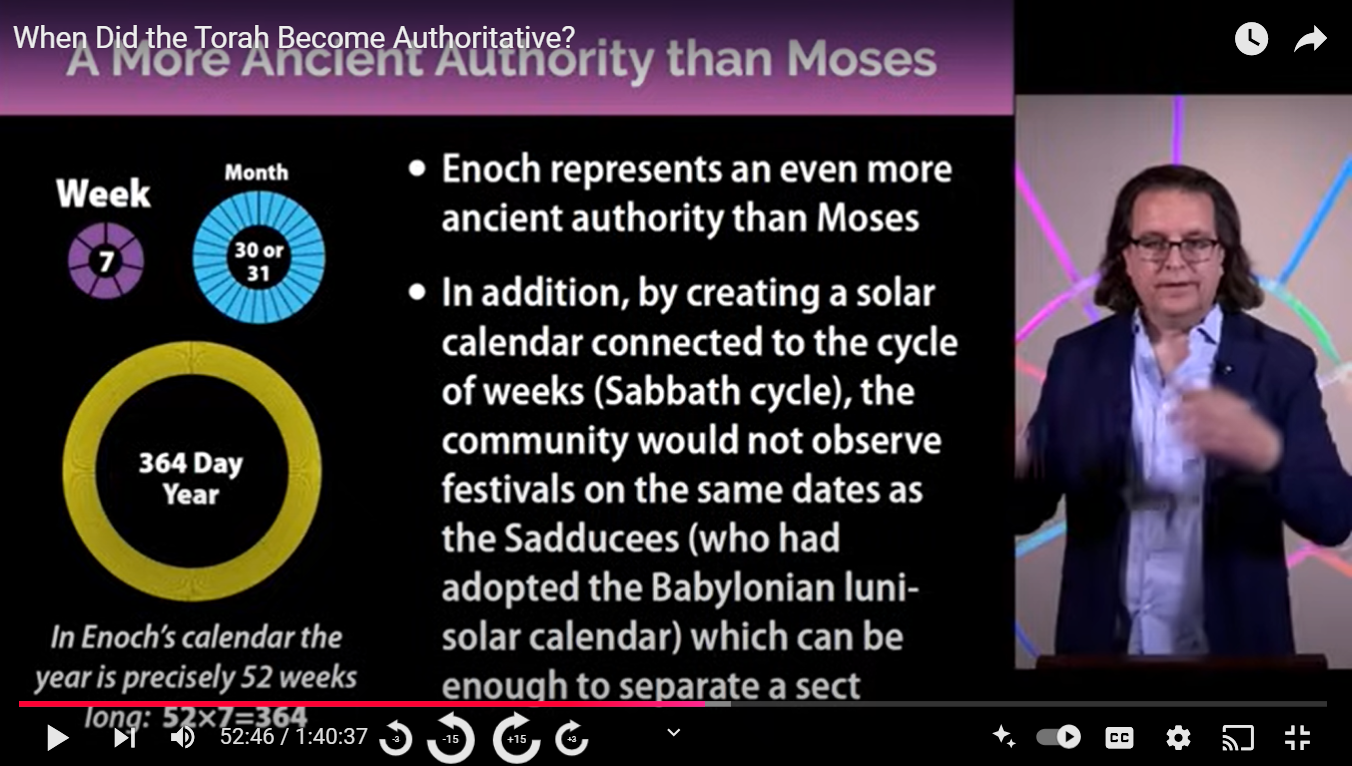
so the Sadducees the folks in Jerusalem um had adopted the Babylonian Luna solar C and so that would be deciding when the different you know all
(51:31) of the different festivals would be the Enoch Community by having their own uh solar calendar that is actually not very well fixed uh on the solar year so the year is 364 days so you can see that that will that will get off become get off at a certain point because um as we know the year is 365 and a quarter or so days and has to have leap leap year days and um and other uh ways so that we don't get off uh don't get our our calendar off from the actual solar year this one would get off a little bit every single year because it's
(52:15) especially focused on the 7-Day week so um it h it's a year of 52 weeks and of course Sabbath observance is so important so this community that uh has this completely different calendar would obviously be um celebrating the festivals at different times and we know for example in an equivalence in Christianity um how sism works that uh you know Eastern Orthodox Easter and Christmas are different times than uh than Catholic and Protestant Easter and Christmas and so you can see that you would potentially be in sism too if you
(52:57) have a different calendar in addition to this community we also had a lecture on the book of jubilees and if there was a community that had actually adopted jubilees as their calendar it might just be a potential or it might be a theoretical calendar but if anybody was doing that they also would have a different calendar and have the festivals at different times than everybody else so you know if we go back to then to hear our question when uh did the Torah become author ative you know we can see all of these communities
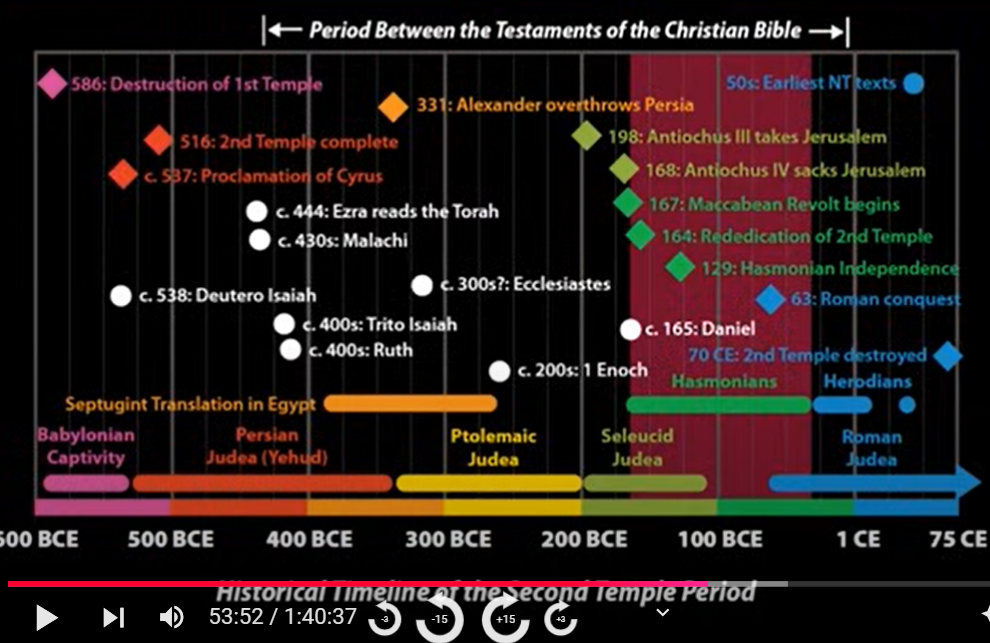
really
(53:32) flourishing uh and not being very Torah focused all through for example the first half of the uh second temple period all through um the Persian period And even through in the beginnings of the helenistic period into theic period and really it seems like this is going to become um really important or or takes Primacy in the religion kind of at the end of the second temple period during the cusd and especially the the maian period the time period of the hasmoneans so after Alexander the Great after Alexander the Macedon conquered
(54:15) Persia Judea and Samaria became provinces of the helenistic successor kingdoms so they initially fell under the tmes of Egypt but in one 98 they were incorporated into the seusd kingdom of Syria so Elites in both provinces were heavily influenced by helenismo um they were exposed to these even before there had been contacts with the Greek world before Alexander's conquests but afterwards it becomes the policy uh of um the helenistic Kings the toames and the cusd Kings to promote um Greek ideas and the Greek
(55:05) language. so the cusd kingdom was originally the most powerful helenistic successor State and controlled almost all of the Persian Heartland and most of Anatolia. uh the solids lost Anatolia now we now think of as turkey to Rome and her allies and lost Persia and Mesopotamia to the parthians which are a successor to the Persians leaving only really a rump state in Syria by the end of the 2 cent I'm sorry the second century before the Common Era. and this was ultimately annexed by Rome in ' 63 before the Common (55:51) Era. so the decline of saluci power provided the context for the revolt and the relatively short-lived Hasan Kingdom of Judea the mabes. so the maban Revolt we saw at the very beginning of this lecture broke out as a reaction against helenismo King Antiochus IV decided to suppress Jewish religion at least according to the book of mccabes. um marching on Jerusalem he set up an idol or altar to Zeus in the temple as part of the general henis policy of syncretism so saying you worship your God Yahweh Yahweh is the same God as ba he is the same God as
(56:35) Zeus and so we can worship him as Zeus Yahweh here in uh Jerusalem and we'll all be together as one people this as we saw sparked a Revolt led by Judas mavas in 167 which successfully took Jerusalem and then rededicated the temple. so having taken control of Jerusalem the hasman cleanse the Temple of pagan idols and altars so we read in the book of mccabes
then Judas and his brothers said see our enemies are crushed let us go up and cleanse the sanctuary and dedicate so all the Army assembled and went up to
(57:16) Mount Zion there they saw the sanctuary the temple uh desolate The Altar profaned and the gates burned so Judas chose blameless priests devoted to the law uh so again Torah has become important here and they cleanse the sanctuary and removed defiled stones to an unclean place
so while acknowledging uh cusd suty they had to in order to U maintain control the mccabes the Haans were able to win a large degree of autonomy for Judea which they began to rule as ethnarch and also as the high priests and so as high priests um they took over that role that
(58:04) Ezra had had under the Persians and so now the Haans are aligned uh with them and with uh the Torah and its Temple Focus so as seusd power continued to decline the hasman an successfully expanded their territory conquering Samaria in the North and iduma the kingdom of Eden Edom in the South so at this point um as the people in control of the Jerusalem temper Temple they enforced their torah's prohibition of sacrifice anywhere except that Temple and so the house manans in taking control of Samaria destroyed the Samaritan temple
(58:54) on Mount gazim around the Earth 111 according to the Jewish Roman historian Josephus John heris the ethnarch of um the Haans also forcibly converted the idiman so this is the that we were talking about not being allowed into um previously hadn't been allowed by Ezra into the congregation because of the prohibition in I'm sorry the weren were were allowed it's the moabites and the ammonites but anyway the are the other Kingdom the ones that actually are allowed anyway so when heris heard of the death of
(59:36) Antiochus he made uh an expedition against the cities of Syria hoping to find them destitute of fighting men and of such as were able to defend them haranas also took Dora and Marissa cities of idima and subdued all the emans and permitted them to stay in that country if they would circumcise their genitals and make use of the laws of the Jews and the were so desirous of living in the country of their foref flutters they didn't want to get kicked out they submitted to the use of circumcision and of the rest of the
(1:00:15) Jewish ways of living at which time therefore this befell them that they were Hereafter no other than Jews so the now all become judeans all the Ed Ed idumeans become judeans they become Jews so in this way the Hasan Dynasty promoted a religious policy that went hand inand with their military and political Authority it's all uh it begins as a Revolt promoting Judaism against helenismo seems to Cor respond also though with the promotion of Torah and its rise to centrality in the second temple period John heran son Ulus I
(1:01:07) first successfully asserted Hasan independence from the saluci and he finally assumes the title basus the Greek word for King so becomes essentially a helenistic king further conquests in Galilee saw similar judaizing or conversion iions to Judaism Jud Jewish colonies planted in Galilee uh which is why it has a mixed um G uh Jewish and Gentile uh population by the time Jesus was born so while in between Judea and Galilee Samaria resisted um Juda judaizing and so instead became uh a separate Israelite sect in sism with the Jews um and under
(1:01:58) arbus's brother Alexander Janus the kingdom then reached its greatest extent so in just a couple Generations um they went from ethnarch a Sub sub Kingdom the Lucid Kingdom to uh their own independent uh Kingdom uh and they also assumed a lot of the trapping so it's ironically as the Kings as they became Kings the hasm monans themselves increasingly adopted all the trappings of the helenistic kingdoms all around them the only way you know how to be a king at a certain point is how all the other kings are around you and they uh
(1:02:35) also adopted Greek names like erbulus which means best advising and they're named things like Alexander as you may be seen so Alexander janas that means you know you're you're being named after Alexander you're kind of helenistic King at this point so so although you know there's an IR irony there that the people who became started off as anti-h helenic uh rural priests became the City Elite and became heniz themselves um the brief period that that was happening and that their independence was happening
(1:03:10) corresponded you know with the promotion of Torah to centrality in second temple period Judaism and so
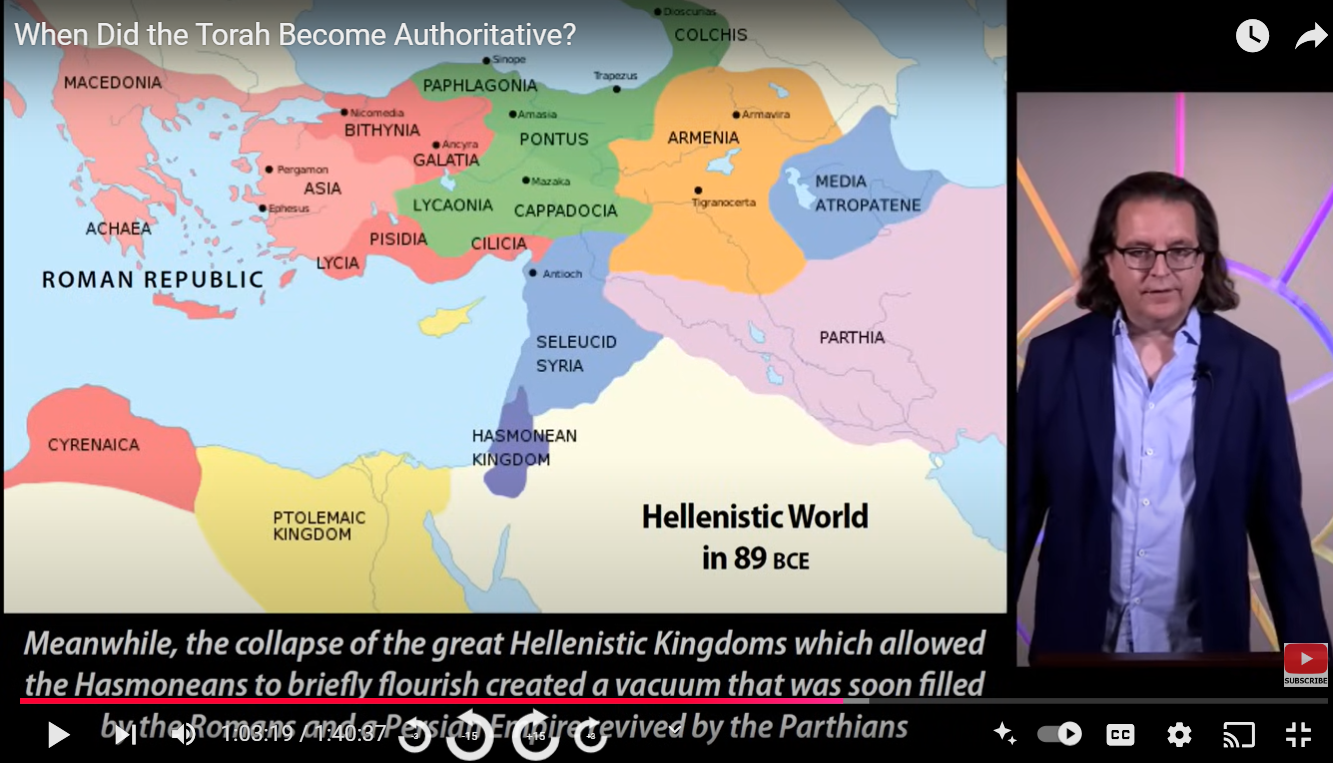
meanwhile as the helenistic kingdoms then continued their power continued to wne um that allowed like I say the H Ians to briefly flourish but it also then created this vacuum that Rome soon filled as we said annexing cusd Syria and later annexing toic Egypt and on the other side uh the parthians became the successors to the Persians and that became then the new um the new reality and the context ahead
so pompy the great
(1:03:51) one of Rome's leading senators and the greatest generals and of among the greatest generals obviously defeated by Caesar conquered the seusd kingdom and Annex Syria as a Roman province and later that same yeary lay Siege to Jerusalem sacked the city in the Temple and so the hasmonean king heris a second was forced to agree to become a Roman client which ended uh judea's brief Independence and hasman and Judea instantly fell from its height back to poor rump Kingdom that now required Roman Improv approval for important
(1:04:27) decisions the Romans deposed her canis but later allowed him to resume his position as high priest and again they took the title King from him but he was allowed to be called ethnarch again the Roman Republic ultimately chose to replace the Hasan Dynasty with some loyalists uh a leading family of idumean nobles who converted to to Judaism the herodians so Herod later became known as Herod the great was named King of Judea by the Senate around the year 37 before the Common Era and was ultimately given an expanded client Kingdom and so that
(1:05:07) provides then the immediate context for the historical Jesus of Nazareth by the time of Jesus then the Torah had taken on a very Central role among nearly all the sects of second temple Judaism but it's pretty recent that that has come to be the case and certainly how you should interpret it how it should be lived was very new and still open to debate and so it is really no surprise that Jesus and his movement do not agree with the other sects about Torah observance so he's always arguing for example in the gospels with the
(1:05:50) Pharisees one of the other sects at the time we read in the gospel of Matthew
Jesus went through the grain fields on the Sabbath and his disciples were hungry and they began to pluck heads of grain and eat and when the Pharisees saw it they said to him see look your disciples are doing what it is not lawful to do on the Sabbath
so there is a conflict here about how sa what should Sabbath observance should be um Jesus faces similar complaints from the Pharisees about his own actions so
he left that place and entered their
(1:06:28) synagogue a man was there with a withered hand and they asked him is it lawful to cure on the Sabbath so that they might accuse him he said to them suppose one of you has only one sheep and it falls into a pit on the Sabbath will you not lay a hold of it and lift it out how much more valuable is a human being that is sheep so it is lawful to do good on the Sabbath then he said said to the man stretch out your hand and he stretched it out and it was restored as sound as the other
so we know from the Dead Sea Scrolls that um
(1:07:05) the essin who were even much more strict about Sabbath observance had a Prohibition about taking animals that have fallen into pits out of the pulling them out of pits on the Sabbath that's not something you can do on the Sabbath and so Jesus seems to be aware of that uh essene restriction and is perhaps suggesting that the Pharisees are not as strict as the essenes here but nevertheless they are more strict than he wants to be you know and so and he is not focusing on especially um the literal rules of Sabbath observance but rather uh he and
(1:07:46) his followers are focused on on doing good at all times and that that is um perable permissible on the Sabbath no matter what the the literal text says so in the end then what we can kind of see is there is a very a vast diversity of uh Jewish religion in the second temple period different communities that um saw Authority differently prophetic tradition the wisdom tradition uh alternate Traditions like for example the Enoch Community um but then also uh remnants in diaspora of people practicing earlier forms of the religion and galvanized
(1:08:33) into all of this uh Ezra's Focus or on or the the temple returning Exiles focus on Torah um which is perhaps galvanized during this maban period um brings that to the four and the center for all of these communities who then have different ways of of interpreting it and working with that as we enter into the postc temple period and that is my thinking on how and when the Torah became authoritative and we'll ask um Leandro for the questions as I could drink water um
Julie bazooki says uh what does it mean um that the
(1:09:24) solids defiled the holy ones does that mean the priests um I'd have to look at that quote where we were so they defiled the sanctuary uh and then yes it probably means that uh that also then the priests the people who were in the in the sanctuaries so I'd say probably I just have to look at the quote again um
Ricky palasio said did um the slusd impose helenistic beliefs on the Jews wasn't the maban Revolt a response to heniz being imposed on the Jews so uh that's definitely the uh position of the
(1:10:04) first book of mabes uh but the second book of mabes tells a little bit of a different story which is that um that Jews were very much embracing a lot of helenismo hadn't you know been hammered down in every single way and so there is a conflict according to the second book of mccabes really between um Jews that were interested in in continuing to be Jewish but adopting more uh helenistic uh practices and customs and ones that were very much opposed to that and wanting to reject particular uh helenistic practices and so some I think
(1:11:00) some helenistic Jews at the time might have been prepared even for even syncretism so in other words deciding like everyone uh that like all of the pagans you know it's not Zeus is not the same God as Jupiter until the Romans and the Greeks decided that he was and so in that same way um you know the the chief God of Egypt are lined up with Greek gods and same thing the uh the Syrian and Canaanite gods and so perhaps Yahweh could also be seen as the chief God or the one God you know or something like that in in some kind of syncretism but
(1:11:40) no some of it's certainly the the macbes themselves um were opponents of uh both the soloed kings that were promoting helenismo um Civic Elites uh in Judea in Jerusalem that were also uh in favor of helenismo no I don't think so so I think that that's a different earlier group I think it's um that's too early instead that they are um probably a remnant of like I say Judean Exiles who fled when um when Babylon conquered uh the first uh the Iron Age Kingdom of Judah so the first Kingdom of Judah and destroyed
(1:12:34) Jerusalem in the first temple so there had been factions uh within the judite kingdom uh there been the pro Egyptian and the pro Mesopotamian factions and so some of the people who had probably been siding with or who had been wanting more influence with Egypt they they fled when the Babylonians uh were conquering and destroying uh Jerusalem and some of those then maintained Exile in um and in Egypt and we think that in their re there it's described in the Bible that some of this is remnants of the judite army and so it
(1:13:11) would be a normal practice for um an ancient Kingdom like Pharaoh uh in in the Kingdom of Egypt to take uh take an army like that if you're if you're having an army come in they become mercenaries for you you don't ever leave them on the frontier next to their Homeland because then they might conquer conquer your that part of the frontier you want to instead put them on the other side uh of your Empire to fight so um you know the later Roman Empire when they uh when they start recruiting German mercenaries to be uh Germanic
(1:13:48) mercenaries to be uh fight for the Roman Empire and put them on the inside of the frontier against Germany that's not the place you would be wise to put them if if instead you put them against the Persians and get all of the I don't know the Armenians off and and have them against Germanic people they're less likely to take over your Empire so you put them on the other end of the frontier and so that's why they're at the other side of Egypt probably so they're probably um uh from that time
(1:14:13) period
Qseeking something says
um is there any evidence that Myan groups had interaction or influence on Israel or if they potentially influenced their culture so um so potentially so the uh so the means um uh break up during the whole movement of the um uh of the sea peoples so the whole collapse the Bronze Age collapse and and so there's evidence potentially that the sea peoples uh include you know former means and that that includes people that ended up settling uh in philistia and so the Philistines which is where the word Palestine and
(1:14:58) Palestine Palestinians comes from um so the so already um you know when you read in the deuteronomic histories like the story of David and Goliath or the different stories of the Philistines Goliath is described almost like a you know like a homeric hero or homeric Warrior and so there does seem to be you know kind of an an idea or an A membrance of if not Myans at least very early protog Greeks um uh connecting all the way back uh to that time and and certainly long before Alexander conquers the Persian Empire um
(1:15:41) Greeks have been mercenaries and and fighting units within the Persian Empire so so there and and so these ideas are also being spread so so there is there is interaction and influence on Israel uh hel you know helenistic um you know Greek ideas before before the the helenistic conquest but then it really accelerates once um Alexander conquers the the Persian Empire
um I want to thank Ron Wagner and Mark long and James Sweeney and Daryl Scott and Mike R for all of your support really appreciate it uh
Ron asks
is it possible uh that the Torah (1:16:25) was only only read by the priesthood and not by the general uh public much like the Christians before the Reformation yes so I think that that's probably the case so there there's the public readings of it that are happening in um in Ezra and Nehemiah but it's it's possible again that it isn't it isn't Central and it isn't read by as many people uh subsequently and that's why I'm suggesting that it isn't whereas by the time of Jesus it has become you know Central and authoritative to the
(1:16:58) religion and that's what everybody's focused on what seems to be clear is that it's it's not that way for much longer than we might think and so like you say it's uh it's a component of the religion but not the core component and maybe it's because it's only the central scribes in Jerusalem and a few other places that uh that have access to it for a lot for the earliest part of its existence um
rain Weber says
a week or two we reflected on the Muslim views of Jesus what are their views on Torah on (1:17:32) Kim on the talud ETC so when they say people of the book what book are we talking about um so there is as we saw when we were reading um we're reading some of the passages of the Quran about uh Jesus that included words like um uh Psalms and gospel and I think Torah and so there is um there is some sense of those there are Traditions that are from the talmood that like know's stories um like the story of Abraham uh breaking up the idols his father's Idols that end up making it into Quran it doesn't mean (1:18:14) that they recognize those as the book so um I don't know that when we say people of the book it it's a it's that's a phrase that doesn't have like a a set list of exactly what book is meant but essentially what it's trying to refer to there is especially Jews and Christians but there's a broader interpretation of who people of the book are that sometimes also then includes um zor asrian and uh mandans and and and other uh monotheist monotheist religions especially um
Qames Sweeny says
did the Romans (1:18:56) inherit the tradition of religious syncretism from the helenistic kingdoms or was that just something that all ancient civilizations did also why did some Empires lack syncretism like the Persians so I think it is um something that becomes especially the focus uh in the helenistic time period so um the Persians the Persians were early to have uh kind of a policy of General tolerance religious tolerance so like the Assyrians had a policy of um we beat you because our God is better than your God and so we are going to humiliate your
(1:19:32) God and destroy your shrines and show that our God is the best so that um at a certain point there's a limit to how big your Empire can be when you have that kind of a policy unless you assimilate everybody uh the Persians had a um very successful system of kind of Tolerance and having people have their own laws and customs in different places and their own Rel in different places um and just having the major officials the SE traps and and other be um appointed by and officials directly of the Imperial Court um and then
(1:20:10) helenismo um uh an attempt to syncretize everything so the goal was I think ultimately to to see um to see commonalities but to kind of accept that the the Topline culture is really uh the Greek ideas uh and the Romans bought into that a little bit in terms of some of the culture they um Romans you know there's a you know there's there different things about how the um the the Romans were conquered by the people they conquered in a way you know that they themselves uh liked Greek culture and thought of it as uh being
(1:20:50) more sophisticated in a lot of ways but in a lot of ways they also didn't like and they thought that they there therefore though had you know the reason why they' conquered everybody was because they had more military capacity and more virtue and were better at law and administration and things like that so so they had their own way that they um were able to feel culturally Superior despite adopting so much of um the Greek policy including like syncretism um
Q: tabuk cat
is there a Samaritan is the Samaritan Torah useful
(1:21:24) in textual critic ISM or understanding uh the evolution of the Hebrew Torah the way the dead Scrolls have been so um the way the Dead Sea Scrolls are useful is that we are able to see um uh very ear in a very early manuscripts just so many so much earlier than anything that we' had by by centuries in terms of the Hebrew um and uh and so and that it also includes in a lot of cases not as many variants as you might effect so it's actually closer to what we have anyway as you might expect there is more drifting but also seeing
(1:22:00) some of the variants and so that's also very uh important the um the Samaritan uh Torah doesn't have that in terms of the early um manuscript tradition of it so instead though it does have um it does have a lot of variance and so in that sense it is more like the um the the septu the early Greek translation because the sepan also has a lot of variations and so it's showing that at the time period that the Samaritan Torah became fixed and the um the Hebrew Torah became fixed and the Greek New Old Testament became fixed the SAT again
(1:22:47) that there was still variation in how the text was um and in some cases the Samaritan Torah agrees with the aant against the Hebrew or Jewish uh Torah so it isn't so it is useful um for all that uh
Q: Mike R
Jewish art of scripture debate was and continues to be an important tradition was this adopted when the books were compiled why do you think uh it died off in Christianity
so so there is a um there is a very specialized way uh the debate continued to happen among the rabbis and that has been um like you say formalized in how
(1:23:33) uh all of the commentaries end up working where you have text and then you have commentary and commentary on it and so it's a long-standing um historical debate and that that debate continues um I wouldn't say though that um that this is died off in Christianity there is a very serious um debates over over the texts in Christianity but where we are now primarily is so from from the side of it where I'm at this is all viewed through um mostly all viewed through an academic lens so the modern academic disciplines of of history and
(1:24:16) literary criticism you know are actually largely uh created by originally by Christians in order to study the Bible and to to get at uh handle on all of these things textual criticism and so on uh and so and so that's the the primary prism through which lots of Christians um see that and the other half of it is all the Christians that don't want to be informed by by the academic disciplines that would rather um read these in a fundamentalist way and so they have their own debates and takes on how how
(1:24:53) to understand the text that you know that aren't based on the academic tradition or they use it a little bit but don't like a lot of it has an apologetic U recasting of some of it um
QJosh Bedford
is it reasonable to think of the early days of Torah authority to be closer uh to a category of constitution than what moderns think of as a holy text
h that's an interesting idea so so um could be uh you know I guess so in the sense that um um you know so we we have a modern idea of what a holy text is in part
(1:25:40) based on in a great part based on um over over 2,000 years of seeing the Torah as holy text and the fact that that has gone on for so long and and has been um U so Central to all of the ways the abrahamic religions have uh our vision of holy text is based on how Christians seee the Bible how Muslims see the Quran how uh Jews see Torah and so um and so I think that what things were like 2,200 years ago is very very different because they are at the other end of that that time period you know so they're they're
(1:26:19) dealing with a a text that they thought was very ancient which was what way less ancient at the time than they thought it was um but and that was important to um let's say the identity like almost you're saying the Constitution maybe of the hasmonean Kingdom this is this is the thing that we have that we're anchoring we are a little very little kingdom and we're uh on in between great powers that we're sometimes at their mercy of but we have this thing like you say that constitutes who we are as a
(1:26:52) people um and so maybe that is kind of the case um
Dave Anderson thank you for your support Paul Hayworth says
Qwhat did the differences found in the Dead Sea Scrolls uh show us about this topic?
um well so so the Dead Sea Scrolls are uh like you say are maintained by the Essen sect so in kumran they have a um they have their own essentially compound where are living Torah observance in a much more strict and pure way and so that it is a sect by the time you get to the essenes that is is focused on Torah and does see that as Central although (1:27:39) they also are um have access to some of these other texts like jubilees that are from uh alternate communities as well um they have access to the other Traditions like wisdom tradition and so on and so what we're seeing is that they have their own interpretation they don't like um they don't like the interpretation of the Hasan the the elites that have control of the temple in Jerusalem because they would prefer to have for example a davidic king and a um a Zite high priest you know and and the hasman (1:28:13) an are neither of those things and so they have decided that they have their own better way of of doing this and they are hoping for um in a time period perod when when a messiah will come so that the bad Hasan the mccabes and the herodians will be cleansed and instead the people who should be uh leading in Jerusalem will be leading in Jerusalem and they'll be doing it right according to the way that we think it should be done the essenes um
Q: Mando says:
was Jesus sent for the world or the world of Jews because (1:28:53) he referred to the Canaanite Woman as a dog and the disciples who uh requested to call fire on the Samaritans town
so um so I think that the the the part of the samarit the part about the Samaritans I think that uh we we're showing what we see there is that um the background context of uh judeans who live in Galilee like Jesus and his disciples uh was that they um viewed the Samaritans as having a rival sect that was wrong and was was their enemy but that um but that Jesus actually has multiple places where you know he says no the you know
(1:29:42) the Samaritans in fact are our neighbor if we if you were to love your neighbor Ian he also says to love your enemy um and so I think that this would be an example of the disciples being wrong to want to um continue emnity with with the Samaritans um in terms of the um uh Jesus you know calling the the Canaanite woman a dog this is a um I would call that it's a rare and kind of a troubling um passage in the gospels that seems to be counter type to what uh what Jesus normally does and so I mean I wouldn't
(1:30:24) take any one little verse like that to um uh to be you know like the the central thing about Jesus's call um I'm not I'm saying we should dismiss that verse I think we should read uncomfortable texts and uh Ponder them but I wouldn't call that like Central to the mission so I think he's um calling is to as Christian as Christianity interprets it in the gospels um uh the calling of Christianity is to all peoples not simply to people of of one birth of one birth line or lineage so uh in that sense it is actually just U
(1:31:03) building upon what we read in in in third Isaiah where the the Isaiah Community tradition was also inclusive of everybody not just um people who were of uh Judean lineage um
Q: Michelangelo says
uh this may be a bit off topic but when uh was was the chapter and verses notation System created and by whom is it the same everywhere or are there different notations
um so I think it is actually in I think it's it's a fairly modern thing so I think it's in it's coming about in modern printing so I I think
(1:31:42) that I think we have largely been able to agree um in terms of in terms of the the citations but it isn't always true so uh so for for example you'll sometimes find um that verse numbers uh of the Psalms let's say translated into French will be off because um because perhaps the uh the the notation the title will actually be you know so there's usually like a thing that says a Psalm of David and that might be numbered in the French version and not numbered in yours and so so therefore they do get off and so it's (1:32:20) not they're not Universal but they're pretty good and so usually you're you'll be able to find and that's why I include the notations in the slides okay um so some more off topic questions so
John Phelps says
uh when did the 613 laws um of rinic Judaism uh Commandments What did those come into Force how many of how many uh laws were there in the early Christian church
so this is all um the idea that there's that many command ments is all the work of um the rabbis and so actually renic
(1:32:58) Judaism organizes in the centuries following the um uh the destruction of the second Temple and so it's really only in 200 and 500 that the whole talmud is um is compiled and and and the way to interpret um Jewish law in Judaism um becomes much more fixated after the sism with Christian so um so these aren't none of these are uh necessarily there during like the early church so the early church we mean to say by that maybe is um Christianity from the time of uh of Jesus up through when um the gospels are
(1:33:42) starting to be written so this kind of early diversity of christianities so the Jewish Christian communities would have had um initially you know you know some kinds of this second temple period observances so circumcision Sabbath observance and so on but it was um it was kind of very clear that uh teachings that Jesus had was not to go through and try to enumerate um Commandments and to follow them literally like that but instead to um work through like the gift of the spirit that is going to tell you how to live you know kind of the higher
(1:34:21) law I think is already fairly early on and then um already by the time of Paul Paul is arguing within Christianity just in its first decades um that uh observance Jesus has fulfilled the law and if You observe the law if you keep the Sabbath uh the Saturday as uh and and and you if you circumcise your children or adult converts then uh Paul says then Christ died for nothing so there is already a rejection in the emerging uh lead faction of Christianity to abandon um Torah observance of any kind fairly early on
Fast wall plakes um
how many(1:35:07) people that are firm Believers are just unwilling or to discuss or listen to uncomfortable texts if they believe they have the truth why would such discussions Shake um their Foundation of Faith
well people don't like uncomfortable things so you know I don't like like I said that um uh how Jesus comes off in in uh this uh this uh discussion he has with this canite women where uh where he is rejecting her for her her ethnicity um but that doesn't mean we don't go and focus on it I've had a
(1:35:45) um um a great mentor who simp passed away but who um uh was a leader in in my church who was also one of the great Scholars he had a PhD from Princeton and had was a great preacher as well and um he preached a uh sermon on the biblical text uh from the Old Testament uh the rape of Tamar which is not a um happy story but he did it to say we also have to we can't just pull out of the Bible all the happy parts we have to consider um un very uncomfortable texts as well and and that shouldn't Shake uh foundations of our faith but
(1:36:27) nevertheless people in general don't like to be challenged even though that should probably be the the purpose of of uh church is challenging your assumptions and challenging your um uh base convictions and things like that so that you actually are thinking about these things but it's not always that way um
K Tempest Bradford asks
have I watched Satan's Guide to the Bible I have not seen that um
some people have asked what is uh my church Community of Christ Take On The Works versus Faith questions so
(1:37:08) um so so we are definitely I guess in the in the camp of um you know so Works The Works question if it's framed as you do good things and then you earn a place in heaven so in other words if you if you sin uh you're you punished for that and you go to hell because of that or if you um if you're constantly doing good deeds or something like that that you're earning a place in heaven we don't um that's not how we see that so the idea of it is um we be on the other side in terms of the grace side which is um uh
(1:37:46) our enduring principle is Grace and generosity and so um God the source is uh continuously creating and continuously giving and forgiving and so uh anything that you would anything you would have like that isn't something that you earn there's the parable of the um the sheep and the goats where at the end of it um you know the people have done good work so they they they've they fed uh you know they fed the the Lord and you know when they didn't but they didn't know it and so they're doing it without um
(1:38:24) they're doing those kinds of things but not as a not as not with the motivation of wanting reward so so we our position I think on this is um you want to be motivated um out of love you want to be acting um because you love good and you want good things to occur and the closer you align yourself to that The Closer you're align yourself to uh the source of love and goodness and so then uh and so that's what's happening not um and and good works maybe result but it's not uh that you're motivated from good works
(1:39:03) or afraid um of Hellfire in order to um have your motivation that's a negative motivation that we wouldn't be um that we that it's not what we're going for um another question that's come up is are we an offshoot of the Mormon church so we are a related um denomination so the Mormon church and our church have the same origin we're not an offshoot of them and they're not an offshoot of us we um separated in 1844 and so they've gone in a very very different direction um um they would
(1:39:41) have the ex traditionally they would have the exact opposite answer to that Faith versus Works question um although I don't know where they are now on that they've been changing some of their Doctrine on that kind of a thing but I traditional they would be a Works church for sure um and that's it right oh there's another thank you uh Mason fips thank you and um don't forget to like and share this subscribe to our Channel you can also consider a donation in the chat directly or on our website um next week we're
(1:40:24) going to be talking about what uh the Lost sayings gospel Q says about some of Jesus earliest followers see you