The Invention of Hell, Transcript
Transcript:
(00:00) there is in the uh the Gate of Hell uh in Dante's Inferno the uh motto abandon all hope ye who enter here and I think that we have um uh a kind of a collective image of what hell is supposed to look like or be like whether it's literal Hellfire in some people's conception or whether this is all a metaphor and that's neither here nor there maybe uh but the idea is brimstone fire pools torture demons torturing uh Souls um not U not a happy place by any means but kind of a consistent uh um Viewpoint of How It's portrayed maybe in
(00:44) the imagination and also in popular culture uh even in in different religious imagery um so here in the pop culture uh from from South Park the South Park movie Satan is a fairly major character and I think this is actually a pretty reasonable um approximation the cartoon here of the popular version of of Satan a big red being with horns a little beard and and so on uh goats you can't see it here it's cut off but anyway like uh uh goats legs and hoofs and that kind of thing a tail so I'm going to suggest that the image that we have right now of
(01:27) both uh hell and Satan are actually substantially influenced by two great epic Poets of the Middle Ages and then early modern period Dante who we already just referenced and and Milton and so um let's look at those for a second so Dante um in the early 14th century uh Dante published an epic poem called The Divine Comedy um it's divided into three major parts you know The Inferno which is to say hell the purgatorio the per Purgatory the space where uh The Departed are purged of their sins before being able to move on to paradise and
(02:15) the Paradiso heaven and so it's a um a kind of a descri long description uh an allegory and so on and so forth of the Christian afterlife um to my thinking this in some way is a novelization of Thomas aquinus uh who is the great uh philosopher and theologian of the Middle Ages who has taken um the major project of the chist intellectual project of the Christian Middle Ages which is uh taking the rediscovery of Aristotle um uh this philosopher who has who held sway intellectually uh over the Western World for a while over a thousand
(03:07) years as Aristotle was recovered in the Christian West um taking and uh taking all of Aristotle's idea challenges and christianizing them in order to make it consistent with Christian theology which had been much much closer Focus to uh Aristotle's U teacher Plato prior to this time ultimately aquinas's uh philosophy and theology are a synthesis of Plato Aristotle and Christianity um and he essentially creates a uh an entire uh cosmological system uh and The Inferno the purgatorio the Paradiso of Dante sort of popularize
(03:55) that by setting it all to poetry um and so of of these three books in The Divine Comedy The Inferno is by far in a way the most popular um uh it turns out that when you are describing you know heaven and everything is you know nice and wonderful and everybody's uh there and one with God and praising God and this sort of thing it's not as as exciting dramatically so when you try to create literature um where there's no conflict uh it's not as good of literature as when there is conflict and and problems and characters that are are less than
(04:34) perfect and indeed um Dante uh has a fun uh program of taking all of the figures of History including um very near contemporaries to him and assigning to them whether they're in paradise and Purgatory or more often in hell and why they're in hell and what's happening to them in hell and so that became quite a popular um you know to this day uh genre uh of kind of Christian fantasy or something so um again the popular conception continues one of the things that uh Dante uh shows is this idea is that there are um people who did certain
(05:21) things in life they're they're punished uh accordingly and so uh this is portrayed in The Simpsons where Homer sold his soul and is spending a day in hell and uh he has has to go to the ironic punishments Division and so one of the things that Homer is of course is a glutton uh and loves donuts and so uh the demon here is more or less saying oh you like donuts do you will have all the donuts in the universe and so and so they're just force feeding home or donut after donut after donut after donut and and he doesn't have more than a second
(05:58) but was they reload uh and when they reload every single time he still says more more and so it's unfortunately the irony here for the little demon that is trying to um uh punish Homer ironically uh you know the the double irony here is that that's no punishment at all Homer is pretty much in his own Paradise from this punishment all right so we talked about what does that mean when I'm saying it's a novelization or of of of a and Plato well so the the cosmology here we sometimes call this cosmology toic so tmy clus tmy is the late um uh Greco
(06:41) Roman philosopher scientist uh who essentially created the what had been the Aristotelian scheme but he systematizes it a lot more of how the universe works uh essentially tm's Universe it has Earth at its Center and the then there are these Celestial spheres that have um the seven Celestial planets and the planets are essentially when you go out in the night sky we don't do this as much or the day sky and you see objects that are moving around against the uh the backdrop and they move in an orderly way like for example
(07:20) the sun which goes by observation morning it goes up and it goes down and at the night and and then is and then is hidden from view throughout the night uh uh essentially the idea of it here is that planets are uh those bodies that wander around the night sky or day sky like that so they're Moon Mercury Venus Sun Mars Jupiter and Saturn those are the uh the unfixed bodies that are visible to naked eye observation and they move against then the field of the fixed stars that all move together um as far as we can see from the earth
(07:56) obviously we know um that that's not how it actually operates but this is how tmy was able to create a system based on observation that predicted the movements uh of all of those bodies quite effectively and so the cosmology of Dante and indeed underneath that aquinus is sort of a Christian addon of that earlier Pagan natural philosophy the essentially ancient science the cosmology of tmy that tmy developed in the 2 Century based on on earlier work of Aristotle so in this particular Vision then Paradise uh the idea Heaven is
(08:39) placed above the Stellar Stellar sphere so outside of all of these Crystal spheres so above uh even or outside of that zone where the fixed stars are uh and and then beneath the surface of the Earth the Earth we'll just mention everybody in the Middle Ages understood that the Earth was a sphere the the way this whole universe works is the Earth is a sphere and it's surrounded by spheres uh the idea that anybody thought that the world was flat the idea that Columbus uh thought the world was flat or you know Columbus was proving the
(09:14) world was round round is is a 19th century myth that's not the case at all so they understood the world Earth as a sphere and then what they understand is that there are within the sphere of Earth uh Nine Circles of hell that are um this this idea that we're talking about tonight so this area uh that is ruled over by the devil and the demons where souls are punished all right so that's uh Dante and Paradise I'm sorry and The Inferno uh a second poem here in the early modern time period that was very influential especially in English is
(09:55) John Milton's poem Paradise Lost published in 1667 um and so Paradise Lost is envisioned as and in some way becomes the great English language epic uh and Milton uh writes it begins with with a a story of a war in heaven so prior to uh Adam and Eve prior to uh the creation of the world or before anyway it gets going um there is a fight among the different angels and there is an expulsion of Lucifer and the Fallen Angels uh and this is drawn from um a description he Milton is getting this from uh The Book of Revelation but it's actually a
(10:49) misreading of the Book of Revelation we've had a um different lecture of this um this is not actually something that happens in a pre-existence according to the Book of Revelation but rather it's a a it's a a future event but in any event um it becomes the backdrop uh for the story of creation and then Milton in doing it again in the same exact way that The Inferno is the most popular uh component of Dante's work because again Perfect characters and people that don't have challenges people that are living in Paradise there's
(11:26) there's nothing to that dramatically it's not going to make for good literature um and so in that same exact way the character of Lucifer the character of the angel that Rebels against God uh leads this Rebellion is an exp is is expelled in the war in heaven and goes down to earth um this character becomes actually pretty sympathetic in Milton as a because we understand maybe why the character acts that way within this epic and so um that's a there's a very famous quote it's better to reign in Hell than serve
(11:59) in heaven and um that isn't entirely an alien idea uh to Modern individualists a lot of folks are not big on serving and so and so in other words even if you're in a in a terrible place you're it's better to be in the lead position than it is to be in a servant position in paradise and so um whether or not that's the case uh that's certainly um the case that Lucifer makes in Paradise Lost okay so both of these um ideas Dante and Miltons are actually based on a medieval conception of hell um I have here in the illustration just a a
(12:45) beautiful um uh illumination from a medieval manuscript from the 12th century uh always think these are always amazing where you have all the little demons and Devils that are doing all of these horrible torture things to uh all of the souls of the Damned and then of course it's very accentuated with fire that's um um doesn't come out of nowhere it's certainly how people in the Middle Ages are picturing hell and so what are some of these bullet points so it contains Souls who are damned they're tortured it's full of all this fire
(13:20) imagery it's where demons are it's ruled over by the devil and it's Eternal and it lasts forever and so um both of these are are highlight I think in Dante and Milton and they draw completely to our modern conception that we may have of this whether we take it literally or not this is our vision maybe of Hell uh the devil this is also a medieval uh image so the devil um we've had a whole lecture before called a brief biography of the devil the devil evolved a little bit more than maybe the conception of hell um we now
(13:59) really have U this idea of this red guy with the horns and the Goat legs and things like that which is in some ways um got swapped out from the uh the Roman god uh and Greek god Pan um and so the imagery in fact in the Middle Ages you can kind of see um in this particular um illumination of the devil is is much more wacky I'd say uh than that in other words this strange cacophony this chaos being um is what they're trying to portray here um and so that's that's more what things were looking like U let's say a thousand
(14:42) years ago and it's subsequently um that this kind of Greek god pan most of his attributes were uh brought across and we now kind of picture the devil in this kind of U um alternate way uh nevertheless um what is consistent is the idea of the devil is that uh the devil is the Incarnation of the force of evil the idea the platonic idea of evil the idea here also um that's been consistent is that the devil rules over hell and indeed wants to actually win souls for hell um is getting something out of bringing people
(15:25) down with him um and is that thereby also so the source of Temptation there's a bunch of alternate names and so uh the devil is called
- Satan which means the adversary or
- Lucifer which means son of the morning or
- Beelzebub which means Lord of the Flies
- and also titles like the old Serpent
and um already in the Middle Ages and all through that is considered a fallen angel so this um we've also had a lecture and we're probably going to return to it um this idea of angelology um in the uh judeo Christian um cosmology there is the idea that angels
(16:09) are actually a separate creation from animals humans Angels is a different thing um more recently there is an idea it's very popularized in um uh movies like Miracle on 34 Street or whatever no no no it's um what's it called uh it's another Christmas movie uh I can't remember it's a movie where uh where um Jimmy Curtis is and I can't remember his name anyway I can't remember this movie but anyway the point of it is is that the Angels get their wings and the angels are U Souls of The Departed you guys are going to be able
(16:48) to tell me this in the in the comments I don't know why I'm having this brain uh problem but anyway the idea of it is uh you know Jimmy Stewart is has a has a uh uh a credit union and and he dies uh and or he wishes he would never have lived and an angel prevents him from dying and this is like a lower tier Angel who is actually just a ghost who is earning his wings that's totally different from um the classical and medieval conception of angels which are totally separate from Humanity uh humans aren't angels in this
(17:25) in that in the original idea and so in this different conception um there was a time period when there are angels and uh and Devils I I me sorry angels that are all that have free will they make decisions and the ones that make the wrong decision become the Fallen Angels so thank you someone in the comments has said it's a wonderful life that's what I'm trying to get at so thank you so much okay so
the devil and the gospels
the devil and the gospels so if we draw our line backwards then from those our modern conception to to our medieval and early
(18:00) modern epics uh backwards we get to the gospels we get to the New Testament and it does turn out that in the um in the New Testament there the both uh the devil and also Hell exist in New Testament a lot so for example our earliest gospels are Mark um which is the earliest gospel we have intact and then Q uh which is the Lost gospel the Source gospel for the sayings of Jesus that exist in Matthew and Luke so those early gospels yeah everybody every Everybody every one of you are saying it's a wonderful wife I I I'm I'm sorry that I
(18:42) couldn't remember that at the in the in the moment so yeah um and so um anyway so both um our earliest gospels that survive um cues lost but is preserved in Matthew and Luke they have stories that Jesus is tempted by the devil while fasting in the wilderness after the episode with uh John the Baptist and immediately prior to his own public Ministry so it's a very early episode in in the gospels and important um and so one of the other things that happens very routinely in all the gospels is that Jesus performs
(19:20) um healing Miracles that include casting out various demons and then also Jesus does talk about about in the gospels Satan and Satan's kingdom and so those are definitely very clear episodes that are happening uh in the gospels and in the words that the gospel evangelists attribute to Jesus so Jesus has numerous teachings that include the idea of hell so for example uh from
Matthew 5:29 he says
if your right eye causes you to sin tear it out and throw it away it is better for you to lose one of your members than for (20:01) your whole body to be thrown into hell
um we also have the idea that is um uh especially popularized in the Apostles Creed so very early Christian uh credle um uh U idea about what it means what the kind of things that you need to believe in order to be a Christian um that after Jesus was uh crucified and before um he was resurrected there's the phrase that he descended into hell um and so the idea of that is um and well there's a lot of artwork of this of the harrowing of hell that Jesus goes then uh to bring Salvation to uh all the
(20:46) souls of the Dead that had existed prior to the resurrection um so that they are also uh given the option and the opportunity uh for salvation and ultimately for for resurrection and so again that souls are in hell and Jesus descended into hell um and we don't have to even you know we even come to the apocalypse so the uh The Apocalypse of John the apocalypse that made it into the New Testament um it's one of the richest sources of imagery in general in Christianity um because it's such a uh elaborate Visionary word paintings that exist in
(21:27) it um and so as a result of that it's also one of the richest New Testament sources for imagery of both the devil and of hell um that are kind of found in the book of the apocalypse and then also um inspired medieval and and frankly early modern modern um people to make artwork um of hell and what hell might might be like as from their reading of it okay so we do have um then a a pretty elabor I mean there's been changes as we sort of have seen but there's a kind of a dotted line that takes us all the way back to uh the time of Jesus or at least
(22:08) to the time of the Christians who are uh writing down U what Jesus said um
The Devil and Hell in the Old Testament
but what about the idea of devil and Hell in the Old Testament. so we have a real wellestablished modern conception of the devil in hell. we have the New Testament. and we might expect um because we might expect Christianity to be consistent with what went before. um or that and that indeed uh the way the cosmos Works maybe is the same from the moment of creation and even before on until the present and to the Future. uh we might expect therefore to find a
(22:49) similar conception and emphasis in the Old Testament. but contrary to that expectation in fact the Old Testament doesn't read like Milton or or Dante and in fact both the devil and hell are conspicuously absent from the Hebrew Bible uh which is dates several centuries anyway before the time of Jesus.
Serpent in the Garden of Eden
so for example um when we start at the beginning with Genesis um Genesis doesn't begin uh the way Milton's Paradise loss does with the pre-existent Lucifer and the war in Heaven um none of that is existing in the Bible that
(23:31) doesn't happen in the Old Testament um although the New Testament writers identify the serpent in the Eden story with the devil this is actually a much later interpretation of the story.
so there is actually no indication that the author of this portion of Genesis and we've talked about that as as one of the one of the creative stories of the Jay or yahwist author of the Book of Genesis. there's no idea that this author had any idea that the serpent is anything other than a snake. um the original story really here is
(24:09) more like a fable than anything else. and and certainly if this is meant to be um The Cosmic incarnation of evil what's quite striking is that this character does not recur.
so even though right after um uh you know one of the very next stories in the J narrative is the story of Cain and Abel. it's not that a serpent or the devil in a different form now um comes and temps Cain to murder. uh in fact that doesn't exist at all there is no no mention of any such thing. and so the character does not recur at all it is simply character of a snake who um in
(24:50) the case of the the Adam and Eve the Eden uh Fable here it isn't the snake doesn't actually even um I don't know isn't necessarily even evil. if you read the story um it's it's actually pointing different things out that may that U aren't aren't anyway is not what you might expect of the worst force of evil uh altogether.
so you might go and say well wait a second Satan um as you remember is in the Book of Job. so yes um the word the Satan which is a translation uh or not translation unrated it means the adversary um it exists in the Book of
(25:31) Job uh which is a later book uh actually written over the course of a couple centuries in different component chunks um the character occurs there but that character is very clearly not the devil in the sense of the devil as an incarnation of evil because um the Satan in the Book of Job is very clearly part of the Heavenly Court um so we read in job6 now there was a a day when the sons of God came to be came to present themselves before the Lord and Satan also came among them so he's one of the sons of God here and he is part of the
(26:11) Court specifically he's the part of the Court uh the adversary or the accuser who's essentially operating uh let's say in a like in a parliamentary system as the loyal opposition the head of the opposition party uh the Senate minority leader whatever you want to call it and so um in the course of this uh you know Satan
in the course of the Book of Job wagers with God that job who is um very righteous and blameless person uh that God points out to Satan uh is only righteous because God has given him so many blessings. and so although it's very
(26:49) clear uh from The Narrative that job is entirely blameless, god um gives job over to the the Satan in order to prove um that the Satan is wrong. in other words that he would still be uh uh very righteous regardless. and so um if Satan here was the devil the force of cosmic evil um this seems like a pretty bizarre thing for God to be doing. so um I think that this definitely paints a different kind of picture a pre- uh development of the idea picture uh of a different character here.
um primarily in job the idea of the
(27:32) Satan is the accuser adversary it also um occurs in the writings of just one of the prophets Zechariah and in one Psalm so there's not even a lot for this I it's in in job certainly and then one other a couple other mentions here there's certainly no imagery such as horns or clo and hoofs they not saying that that's what the guy would look like it's he's not represented as the cosmic power of evil simply a member of of the Heavenly court and as I mentioned more like a independent Council that God appoints
okay what about Lucifer you say
(28:06) well Lucifer that exists in the Old Testament right so there is a mention of Lucifer in Isaiah and I want to look at that kind of closely here and so
Isaiah 14:12-17 reads
how you have fallen from Heaven Morning Star
(which is to say Lucifer son of the Dawn this sounds like again that imagery that we have from Milton of the um the war in heaven uh this the Fallen Angel being cast out)
You have been cast down to earth you who once laid low the Nations you said in your heart I will Ascend to the heavens I will raise my (28:42) throne above the stars of God I will sit enthroned on the Mount of assembly on the utmost Heights of Mount Zan I will Ascend above the tops of the clouds I will make myself like the most high but you are brought down to the realm of the Dead to to the depths of the pit those who uh see you stare at you and Ponder at your fate is this the man who shook the Earth and made kingdoms travel tremble the man who made the world a Wilderness who overthrew its cities and would not let his captives go home
so this is a um there's a bunch of mixture
(29:20) here and you can kind of see we're again being thrown down from the heavens the the equiv equivalence here of the morning star of Lucifer um of the this front um reference here to being the in the realm of the Dead in the depths of the pit um you can kind of see that this is the source of a lot of Satan imagery and yet very clearly in this um passage which is where this imagery actually comes from this passage is very clearly talking about a man this is a man who shook the Earth who made the kingdoms tremble a man who overthrow cities and
(29:55) would not let captives go home specifically the captives uh of Judea the Jews who were captive in Babylon the Babylonian captivity um this is in fact a very direct and explicit taunting of somebody who had been a king the one of the kings of Babylon um who had in fact compared himself to one of the Gods who had said that he was the planet Venus which as you can if you can imagine in in ancient times the reason why we call Venus Venus after the Roman goddess of love and we call Mars Mars after the Roman god of war and Jupiter
(30:38) after the Roman King of the Gods is that the planets are felt as equivalent of gods and the king of Babylon was calling himself a God on Earth and calling him and specifically equating himself with the Morning Star the evening star that which is to say Venus which is the brightest of the uh object in the light night sky other than the um other than the moon uh the brightest of the moving stars uh the planets and and so what he's more or less saying here is you died so you you might have called yourself a God but you're just a moral
(31:12) man and now you're dead and you're in the realm of the dead it's not that you're ruling over the realm of the dead because you're a fallen angel or any such thing this is just talking about uh a king but this is the image this is where the word Lucifer comes from in the biblical conception and this is where the these images that get pulled into uh The Book of Revelation and ultimately into Milton that this is where this actually comes from a misreading of this passage
so although Isaiah is Lucifer uh and then when we have Lucifer
(31:43) here lightbringer is that that means in Latin um it's the Latin version of the original Hebrew here helel Ben Shahar um this is an explicit condemnation of a Babylonian King nevertheless le as we've seen Isaiah's imagery is the source for much of the New Testament imagery of Satan and so this idea um of being cast down from Heaven to Hell to sha as it would be called in the Hebrew here to the pit as it's called in Revelation. and again there's an attempted idea that he's attempting to rival God in heaven and that's uh
(32:21) certainly what the motivation is Anyway by the time we get to Milton.
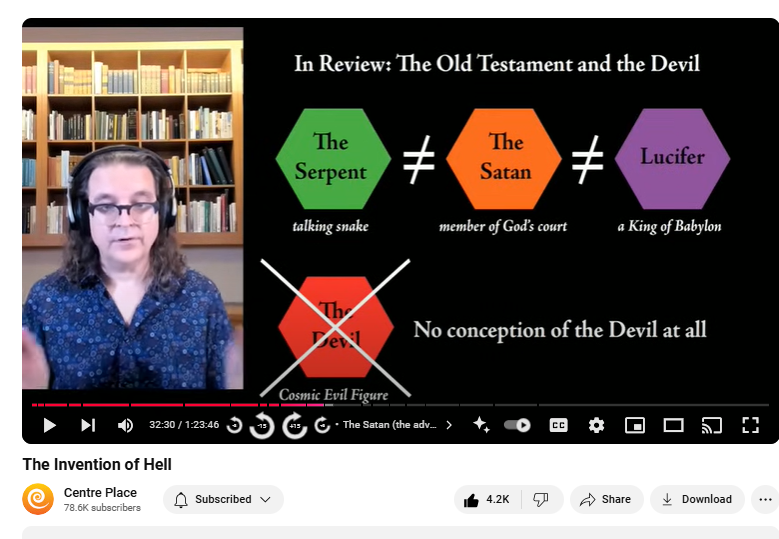 so just to review as we're looking at the Old Testament and the Old Testament conception of De of the devil um we have these ideas serpent Satan Lucifer the devil but the serpent really in only exists in Genesis in the very beginning of Genesis and not recurring as an actually a talking snake. that is not the equivalent of the Satan who is a member of God's Court, one of the sons of God essentially one of the Angels but not a fallen angel. and that is not the same as
(33:01) Lucifer who is a king of Babylon. and indeed in none of those three uh who are all different things in those different component sources of the Hebrew Bible uh do we find a cosmic evil figure the devil. there's really no conception of the devil at all to be found in the Old Testament.
all right so that's the devil but what about hell so Old Testament author um envisioned a three-part cosmology with the heavens above uh the Earth in the middle and Shaw 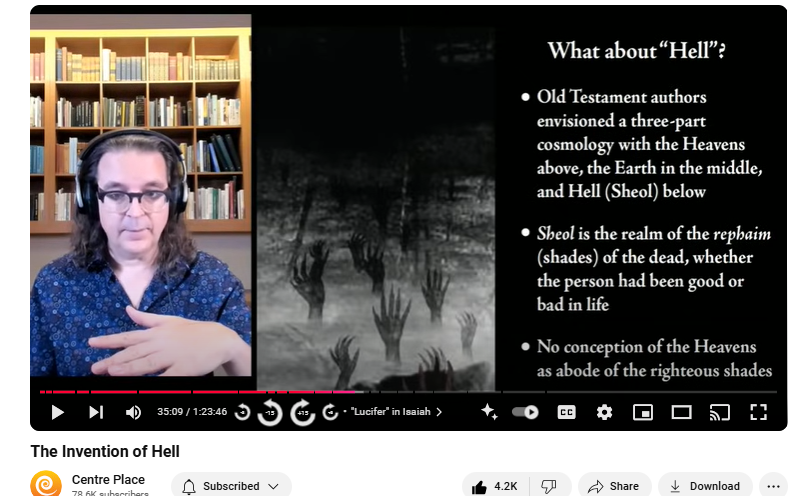 below um I said before that uh Columbus wasn't teaching medieval people that uh uh that
(33:42) the world was not flat uh in the middle in the in ancient Greece and all of its successors the Romans the medieval people they all understood uh that the world was a sphere and so on but before that people really did think the world um some people did think the world was flat and most of the Old Testament writers have that cosmology in mind. and so this is before um ancient Greek natural philosophers ancient Greek scientists um both proved that the world was round and also measured it quite accurately. uh and so again the um
(34:20) conception of the world is a world of Flat Earth with four corners that's floating on Waters. there's Waters below there's Waters abov. e there's what's called a firmament which is a like a bowl a transparent Bowl uh that's keeping the waters above from getting into the air part. and then below the surface of the Earth is Hell or sha um and so sh is the realm of the shades the refin of the Dead whether a good person has been good or bad in life. so there is no conception actually of Heaven as an abode for righteous
(35:01) Shades so in the Old Testament whenever they're talking about sleeping with the Dead uh all the dead are essentially sleeping in the earth uh buried in the earth and nobody is going up and living in heaven or anything like that there's no mention of that. also in the Old Testament so as a result actually there's neither Heaven Nor Hell and if we just think about it for a second um nobody's God isn't when he's God is making covenants with the early Patriarchs like Abraham God isn't promising Abraham boy if you if you are (35:36) righteous if you uh do what I say here if we um if you uh adhere to this Covenant you're going to get eternal life you're going to live eternally with me in heaven. um no such promise uh is made in Genesis or Exodus or anywhere to any of the Patriarchs or uh uh Old Testament figures. so Abraham rather is promised to be the father of many nations. he's blessed with health with wealth long life posterity. um uh there's a limit uh that the J author says that uh that humans are set. it's like 110 years and Abraham gets to live all the way up until the
(36:22) time limit and then he dies and he sleeps with his ancestors in in in Hell. uh but not hell the kind of um fiery punishment hell or anything like that it's simply portrayed as sleeping.
Afterlife
and so really the Old Testament lacks a developed conception of afterlife there is no idea of um Spirits living on or bodies getting resurrected or any any such thing uh in in either heaven or hell it's equated essentially when it's talked about it all with this a kind of unending Eternal sleep sleep that you have with all of everybody who went
(37:00) before so how do we get from that Old Testament uh lack of conception for either a devil or Hell or Heaven even um to all the time all of the way things are by the time you get to the time of Jesus.
Between the Teastament
and so in the four centuries uh between when the last Old Testament Prophet Malachi who is writing let's say in the fifth century BC and we get to Jesus in maybe the year 30 ad um so the ancient Israelites the ancient Jews went from a limited conception of afterlife that did not include the devil or Hell to a rather elaborated developed sense
(37:49) of afterlife um and so that either included a spiritual or physical um afterlife in a resurrected body um and their ideas also were became were already dualistic and so it had separated into a heaven and a hell so there's two different ways you can do good and evil uh good and evil ends and so the latter there hell included a cosmic devil.
um um this was much more um popular throughout uh second temple Judaism um than modern rabinic Judaism. and so Christianity actually um takes a snapshot of a general Jewish idea that
(38:36) existed at Jesus's time uh and then develops it and takes it on its own path. whereas with most of rinic Judaism the emphasis on afterlife is much much less. and so most of these later ideas that are making their way into uh second temple Judaism are much less relevant anymore to renic Judaism which turned back to focusing on uh the earlier texts. these later texts didn't end up getting canonized into uh the Jewish scripture.

so let's just look at kind of the difference that's separating that you know 5 about whatever 400 years
(39:15) spread between um the last text of the Hebrew Bible the Old Testament for Christians and the and the Christian texts of the New Testament so in the earlier time period be when the bulk of the Old Testament texts are set and are being um written. um before the original destruction of Jerusalem in 587 BC by the Babylonians, um when that happened uh there had always been an influence over um this transitional Kingdom of Judah from either Egypt which was the superpower to the west or from Mesopotamia Assyria or Babylon which is
(39:57) the superpower to the East. and when Judah was destroyed. when um Exiles independently fled the Army for example and Jeremiah and others uh fled in diaspora to Egypt. and Ever After uh there was a large Jewish community in Egypt. and then um the Babylonians took a bunch of nobles including the Last Kings and the and the last bits of the royal house and brought them to their Capital Babylon and that became known as the Babylonian captivity.
and so as a result of that um the two Elites of this community are off in Exile in diaspora
(40:37) which is to say not from in their Homeland but moved around as refugees and now living in uh courts of majority other people. as a result the diaspora community in Egypt is very influenced by um what's going on in Egypt Egyptian ideas. and then likewise the uh the ones that are off in Babylon are are very much influenced by Babylonian ideas. and it only takes a generation or two uh before the um the heir of the House of David um already has as his name zerubabel which is a Babylonian name uh and it actually has the word Babel in in
(41:17) the name and so in other words that they are already being uh Babylonian ised while they're there and likewise the folks in Egypt are being egyptianizing ultimately when we get to the second temple period when the Exiles from Babylon are allowed to come back when they are allowed by the emperor of the Persians who conquers the Babylonian Empire uh to rebuild the Temple and to create uh a a minor Persian Province centered on Jerusalem um then at that point there there is a major influence from Persian ideas and also Mesopotamian ideas as on
(41:57) second temporal Israelites and then meanwhile what ends up happening on the other side um ultimately the Persian Empire is overthrown by Alexander the Great and there are these helenistic Empires and in Egypt um uh becomes the center of uh Greek uh intellectual activity with the founding of Alexandria and so there's all of these ideas from the West that are impacting um both the diaspora community and also uh the people that are in the province of Judea and so um essentially there is a long period of time here where Greek
(42:36) ideas are being introduced into uh second temple Judaism. and also uh Persian ideas and both of them have conceptions of afterlife and they both have kinds of dualism. uh but in both cases they're a little bit different and so they end up fighting each other out in uh what gets adopted or what develops in Judaism.
why do people need an idea of hell
okay so why do people need an idea of hell so you know as we've talked about um uh and at first they're perfectly able to have a religion in first temple Judaism that doesn't have uh a developed conception
(43:20) of hell why is that why do people see that as a lack and so I'm going to suggest that the reason why people um wanted to have a an idea of hell is that it is an interrelated solution for two key questions and so one of the things that develops um um both from the Greeks philosophically and also from the Persians in terms of their own uh monotheistic dualistic religions or asianism is the idea that God is not simply the god of your own own little Community God is not simply the god of Babylon or uh the god of Greece or
(44:03) something like not simply Zeus and there's all these other gods but actually there is one God that is the source of all of these gods and the Greeks even start to have this even though they continue to see the other minor Gods as being emanations of that the philosophers um in ancient Greece are proposing that there's essentially one source of meaning God uh and so so if God is universal if God is omnipotent and good and if God blesses the righteous and punishes the wicked um the question that arises then is why is it that the wicked often seem
(44:40) to prosper uh while the righteous often suffer and um if that seems to be happening every day in our lives you know as the righteous continue to suffer and the wicked continue to prosper um and then another thing that happens is there is a um a development in this time period of an ancient idea of the individual and people now as they remove themselves from kin group and so it used to be all right if maybe you have as an individual have passed on or sleeping with your ancestors because um as that promise went to Abraham you have become
(45:22) the father of many nations in other words your kin group continues on and that's all that really matters well now in Antiquity people are pulled away from um fullon identification with being with a kin group and are now really starting to focus on their own uh individual um identity and so then they're starting to ask well wait a second what happens to me though you know so yeah sure um the hivites are all going to continue the kenites are going to continue because of the many nations that are going to be going on but what about what about me
(45:55) what happens to me after death I'm just going to be sitting down in Shaw sleeping forever and so um when we were back uh in in terms of this is classically called the problem of evil the first of these questions so when we were back in first temple Judaism uh in the in the core components of the Hebrew Bible the Old Testament um what we can kind of see is that the worship of Jehovah of Yahweh evolved from polytheism which is to say um a Pantheon of many gods where Yahweh was one God among many to henotheism which is to say the sole worship of a
(46:33) chief God who has other Rivals there's more Gods but really we should be worshiping this God um to ultimately the development of monotheism uh into second temple Judaism the worship of one Cosmic Universal Eternal God and so that's where this problem of evil really develops as a logical consequence if you have all of these other gods and bad things happen to you you can blame it on them so that's um you know that's that's it's not because of your God that necessarily the did it um so the deuteronomic answer the answer that is posed in both the
(47:11) pentat the first five books of the Bible and then in the damic history the next books of the Bible which is to say Joshua Judges uh Samuel Samuel Kings Kings that component um of the Old Testament um the answer that is always kind of brought about is the problem of evil is that Yahweh blesses those who obey God's laws and punishes those who are disobedient for example those who forget that God is the god of Israel Yahweh is the god of Israel and then start worshiping the other gods this happens just again and again and again
(47:47) for example in the Book of Judges which formulaically talks about um how uh the children of Israel go and start worship worshipping the gods of the moabites uh and when that happens uh God uh brings the moabites brings you know people into conquer them and and set all kinds of Trials on them and things like that then they all cry out uh they want to be delivered and so God sends a judge the judge is able to rescue them then they remember that God is their God and then they remember that for 40 years until the next time when when it's the
(48:20) midianites or the Philistines um so that's essentially the deuteronomic um um answer to the problem of evil which is uh God's God's testing you uh and so if God Yahweh is a just God with Rivals the suffering of the righteous can potentially be be dismissed though as resulting from sources other than Yahweh however if Yahweh is the one universal God there really aren't any other Rivals that can defy Yahweh and so already in the Book of Job um uh which is written later than these other books that I was just mentioning the authors
(48:56) of the text are understanding that this traditional deuteronomic answer doesn't really hold up um they really explicitly point out here job is an entirely righteous man and yet he's made to suffer and so they realize okay it's not just because you're disobedient that you suffer um nevertheless job's friends um cons continue to believe the old argument so they're making that case they constantly are telling him uh you've done something wrong you need to repent uh and so that you can so that you can get back into God's favor um but it
(49:31) turns out they're not correct and job holds his ground so there are several proposed answers um The Book of Job isn't the most coherent book because it actually has multiple different authors that have different ideas nevertheless there's a couple answers and so one is you can't understand the big picture of what the cosmic God is doing and so this is the speech that occurs at the end of U The Book of Job as we have it now God from the Whirl when who is essentially saying there's a lot going on here in the cosmos the cosmos is bigger than you job
(50:01) and you think you can understand it for a second no you don't know what's going on um and so this is the idea that if uh I don't know if God stopped this or that from happening then some other worse thing would happen uh and so that could potentially lead ultimately to um the LI nitan philosophy that we're living in the best of all possible worlds because um even though there's horrible things happening uh it any other world uh would be worse in other words anything that got changed by what God is doing so that's one of the proposed answers that
(50:33) occur already in the Book of Job another one is uh that go that two that suffering is resulting from God testing the righteous uh and certainly um that seems to be kind of what the wager is uh uh as Satan the tempter um is or I'm sorry the um advoc uh the opposition position here that is is actually uh doing which is um causing the kind of suffering in order to see um whether job is really righteous or if he's just responding to Blessings all right so in the same exact way then um in terms of the problem of evil
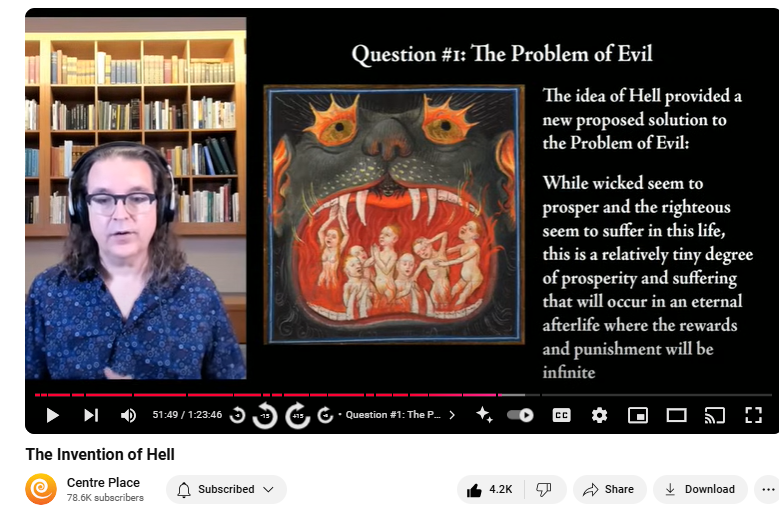
the idea of Hell provides a new
(51:16) proposed solution to the problem of evil so um one of the things that people were able to point to and they say well look the righteous seem to suffer in this life um uh nevertheless you have to realize that this is just a relatively tiny degree of prosperity and suffering compared to that which could occur in the Eternal afterlife so you know obviously mortal life is is inconsequential in terms of the time frame over the above eternity uh and so the idea now um is that with afterlife being Eternal um the rewards and
(51:52) punishment will become infinite
Question of Afterlife
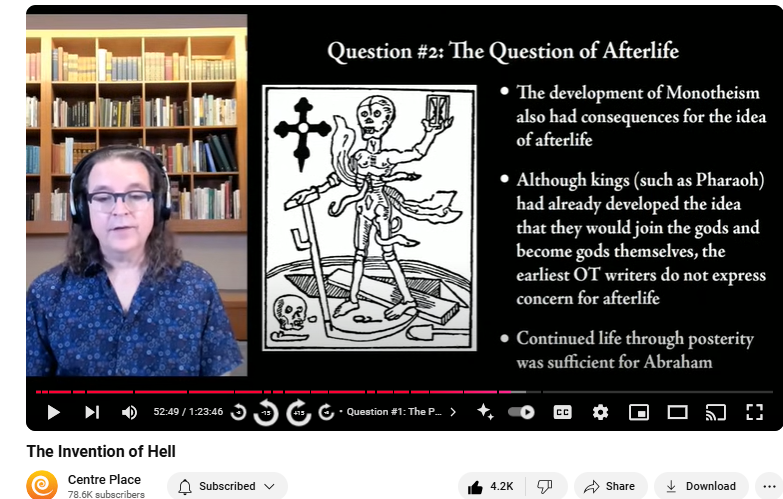
okay so for the second question uh the question of afterlife the development of monotheism also has consequences for the idea of afterlife so although um previously Kings like pharaoh of Egypt had already developed the idea that they would get to join the gods and become Gods themselves um as we already saw the earliest Old Testament writers don't really Express a lot of concern for afterlife there's really no mention of it almost it's just talking about sleeping with the Dead uh the one
(52:25) exception is when um uh uh King Saul goes and uh wakes the spirit of Samuel that has been sleeping using by going to a witch going to a necromancer uh who was able to wake up the up the spirit of the Dead Prophet. um but he just wants to tell off Saul and go right back to sleep. so there's really very little U examples.
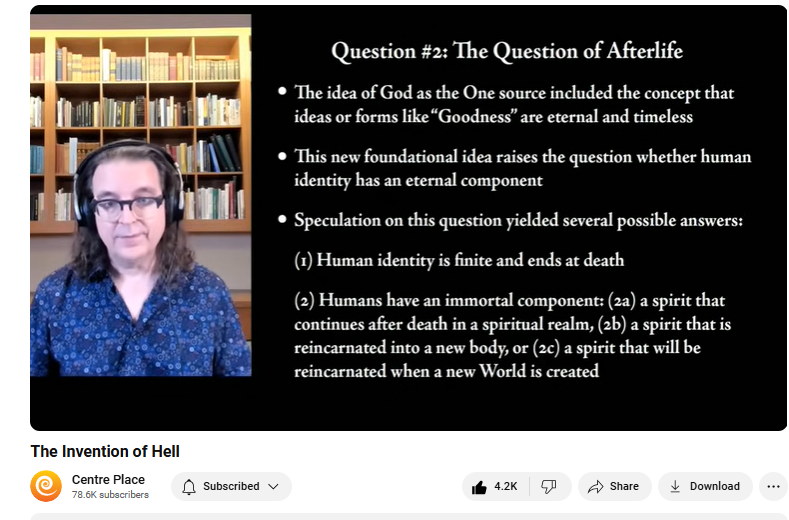 so continued life um through Prosper posterity was really sufficient to Abraham in other words this idea of identifying with kin group that continues on so the idea though of the God As One Source included the concept
(53:09) that ideas or forms like goodness are Eternal or Timeless um and so that gets fully developed uh by Plato and his successors neoplatonist mod neoplatonist and everybody else uh but in general it's just a general idea I think as well um of dualism of fighting good versus evil is a conception that there is such a thing as good that is an eternal and Timeless concept and so this new um foundational idea raises the question um of whether human identity has an eternal component. and so speculation on this question yielded several possible
(53:46) answers:
- that human identity is finite and ends at death you can imagine not everybody likes that idea
- or that humans have have an immortal component
- and so then what happens right and so there were several different proposals so one there's a spirit to a I'm calling it here
- a spirit that continues uh after death in a spiritual realm
- 2B a spirit that is reincarnated into a new body or
- 2C a spirit that will be reincarnated
um when a whole new world is created resurrected essentially uh and all of these were um are proposed in
(54:26) various places um in what we call the axial age and so obviously uh the idea of reincarnation gets very much popularized uh in Hinduism and Buddhism in the Indian subcontinent but it also existed um in Greece among the uh uh the pythagoreans for example it just never took off really Plato talks about it um likewise the idea that a spirit continues after death death in a spiritual realm that becomes kind of the Greek mainstream and then the idea that a spirit will be reincarnated into a new body when a new world is created that's
(55:06) really um uh the zoroastrian religion. uh and that becomes um the which is to say the Persian religion. and since uh Judaism the uh was essentially existing in a province of the Persian Empire um this is the kind of the the one that was more influential and became more adopted in second tal Judaism by the time of Jesus.
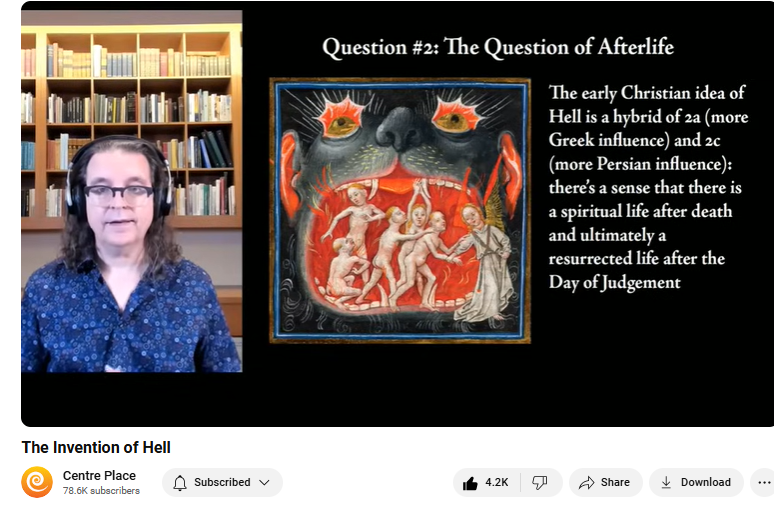 so the early Christian idea um that evolves after Jesus's time is sort of a hybrid of that first Greek idea uh of a spirit that lives on um in heaven after the death of the body and then the 2C idea that Persian influen this idea
(55:54) that there's going to be a bodily Resurrection so it's a little confusing I think actually in in how Christians normally portray this there's a sense that there is a spiritual life after death that maybe happens um immediately uh and then there's this idea though that ultimately is going to be a resurrected life that occurs uh after the day of judgment and and so I I think that Christians sometimes have a fairly muddled view about when does when is Heaven and Hell actually taking place. is are people immediately upon death are
(56:28) they up in heaven and and down in Hell. or is nobody in Heaven or Hell yet and they're waiting for the day of judgment. um anyway so that's uh that is a little bit that portion is a little bit muddled I think just because of those hybrids.
An emergent problem of evil eternal punishment
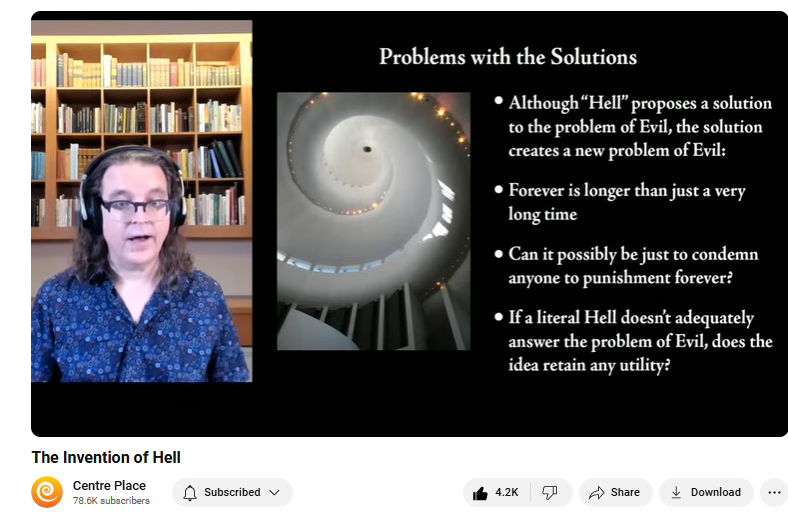 okay so so there's some problems with the solutions I think so I think that although hell proposes the solution to the problem of evil the solution also kind of creates a new problem of evil so it turns out that forever is longer than just a very long time and so one of the questions that has emerged um certainly
(57:07) in modern times uh philosophically and ethically is is it ever possible uh how could it possibly be just to condemn anybody to punishment forever no matter how bad they are I mean in other words any horrible thing that you would have done in this finite amount of time is still going to be finite and the punishment is is eternal and is is that possible uh for a just God to U punish everyone Eternal eternally uh and so certainly in um modern times a de a religion developed uh of Christian out of Christianity called universalism uh ultimately the ER
(57:49) is the Unitarian Universalist but uh other Christians are still universalists the idea that at some point or other salvation is is universal which is to say nobody is going to be uh condemned to Hell forever nobody faces Eternal punishment because it would be totally unjust that said uh the counterargument to U that ever is if you're going to make the case that uh that salvation and uh Eternal reward ultimately are Universal to everybody then you're a to say you're more or less saying that means means Hitler's you know ultim because you have
(58:28) to take the that worst example right and so that mean ultimately everybody is universally saved right. and so that's always the the counter argument here to this um Universal uh argument against this solution to the problem of evil.
so my uh my question at the end of this exploration as we've seen um hell as an idea um that didn't originally exist exist within judeo Christianity Judaism that eventually becomes U has the Christianity launches itself out of um if it didn't actually exist and we can see how it arose as a um need to
(59:11) answer this philosophical question uh through the influence of Greek philosophical and Persian zor asrian uh religious ideas if it doesn't actually answer the problem of evil adequately does the idea still retain any utility
and um I'm going to leave that open to all of you as uh we go into a question phase um and so this is my idea anyway of the intervention of the idea of hell and its development and some of my musings on that and I'm interested to hear your musing as well um I'll I'll I'll also going to mention just for um
(59:52) the folks of you who are joining uh from the the local history theology philosophy uh lecture group we often have a um a zoom meeting afterwards for the uh just to catch up and everything like that I'm just not going to be able to do that uh this week because we are preparing for um our um hym Festival that we're having on Friday. um so we'll catch in with you guys next week. um but I want to invite uh uh any your feedback and your questions and comments. uh hell what's it good for kind of thing but also um um what your thoughts are have (1:00:31) you did you were you raised in an idea where you were taught to believe in a very literal hell or do you believe in a very literal hell now. and um what is that how did that uh affect your um worldview? have you changed your ideas as you've gotten older? or um are you are we pretty well done with the idea of hell? um we don't talk about it anywhere near as much as we once did certainly in my um uh my denomination and Community of Christ I was visiting with just a dear friend and and Mentor um uh Barb Howard I was at the dick and Barb Howard's
(1:01:10) house and Barb was um doing a she had the sermon for her congregation the following Sunday and she said uh it was going to be difficult because it was on the um The Temptations of the devil uh that the devil of Jesus and she says and the trouble is I don't believe in the devil. and so uh which I think is not an uncomon position um within ministers uh leaders in Community of Christ all right so a question we have here is uh
Ron Wagner asks:
can you expand on your thoughts on zor asrian influence over Judaism and the idea of
(1:01:53) hell?
so yes certainly yeah I I we got a lot of shorthand in the course of of this lecture we have had um had whole um whole lectures in the past on Zoroastrianism and so I invite people to look at that in uh uh in our archives um but the idea of it is is that Zoroastrianism is sometimes um cited as the first world religion. which is to say a religion that emerges uh Beyond um the kind of the the polytheist the pantheon of gods style to have sort of a big picture cosmological um uh View, and so the Prophet zarathustra The (1:02:38) Prophet Zorra who's really um prehistorical so somebody who we only know of through um uh the texts that we have the most ancient scriptures of the zor asrian um um is already talking about um essentially a a a one God kind of concept. there is one great God Aur Mazda who is uh uh light and wisdom. and and and then orur Mazda is opposed by uh one Cosmic force of evil that angry mindu uh and so this is really early and so there is a cosmic you know Universal God and then there is a cosmic incarnation of of evil. and
(1:03:29) there is also a um a conception in zorran ISM of a cosmic battle between the two. uh there's the idea that uh that history is finite that there's going to be that other words that this Cosmic uh battle is going on and on but it will end. and at that time arura Mazda God the good God will defeat evil will defeat uh the zor asrian devil um at that point there will be a a day of judgment there will be a savior uh a day of judgment and that the um and of resurrection. and that uh the spirits of the people who were just and good will be resurrected
(1:04:06) and live in a paradise. Paradise is actually a Persian lone word into English. uh and that uh the um the people who are judged to have not been righteous will be consigned uh into hell.
and so it predates uh presumably we we we can't say for sure because we don't the the written record is um is missing. and so we can we can say based on linguistic evidence these conceptions within Zoroastrianism predate their appearance in um second temple Judaism. and so zor asianism is generally understood to have had a pretty significant effect and certainly
(1:04:46) what's tantalizing is ideas of Heaven, hell, savior, um judgment, end of the world afterlife, all of these are existent in the zor asianism and become PR don't exist in first temple Judaism. and then become very prominent in second temple Judaism and then its its child uh Christianity
so Maggie hopefully that answers that a little bit Maggie writes
my question uh uh always was growing up about Hellfire and brimstone um Baptist if God is uh omnipresent and omnipotent how can a devil and hell even exist?
um and so and
(1:05:29) so in that sense so Maggie's got a good point here and so in the um in zor asianism so zor asianism is sometimes called as dualist religion because uh you essentially angry mindu is super powerful it's not simply a fallen angel but it's also just a dark a god of evil right and and so there is a um a a real full-on Divine um uh cage match going on here. ultimately hamda is going to win but but it's not because of U because there's so much more powerful God and so much little or devil kind of thing. um and so um to Maggie's Point um so the to
(1:06:09) the extent that um God really has become understood in the in Christianity and in Judaism in the west as as omnipotent, omniscient, all of the different uh understandings of the one God then no matter how big you try to make the devil a fallen angel who is simply a creation of that God it doesn't actually absolve um God of any of the responsibility for any of the things uh that the devil is doing. because ultimately God is allowing uh those things to happen. since God is all powerful and uh and anything that the devil is doing is through inaction
(1:06:47) at least on God's part. uh and so to Maggie's point I'm not sure that it does provide a perfect solution to the um uh to the problem of evil. because in fact God has to be allowing it. and so there's therefore additional explanations uh for the problem of evil that Christian theologians and philosophers have tried to make other than simply um a fight with a very powerful Cosmic Force. rather um generally it's understood something to do with the exercise of free will necessitates uh allowing evil to continue into the world? or or or so on
(1:07:26) uh and so um
Maggie Fel also asks
if Jesus went to hell to save the souls there um doesn't that lean towards a Universalist idea
and so yeah certainly that's one of the ways that um uh that's one of the ways that the universalists were able to um draw out that idea um this idea that um ultimately Jesus's um Jesus's atonement is infinite and so the that Grace is infinite that ultimately everybody no matter where they are is are going to be able to participate in in that kind of a Grace and there's that that precedent. um but
(1:08:03) then there's other kinds of different ways that um that people have argued against that. um certainly in the latterday Saint conception um that existed in the early restoration continues in in some of the forms um is that um that the death and spirit world uh is a different is a different than the the ultimate um Heaven and Hell con uh conception that'll happen after in the after judgment. U that this is simply uh a a a momentary period of spirit paradise and prison and uh and essentially Jesus is entering the spirit
(1:08:39) prison to release the spirits so that they're um but but judgment is still coming so so it's not that everybody agrees but that's certainly one of the ways the people went
U Bell song writes hi John Andro um
can you comment on Modern Jewish and zoroastrian concepts of hell
oh it's good um and so uh um so modern Zoroastrianism as I've gone and visited U the zor asrian temple here in Toronto several times with um encounter world religions we've asked I've asked them a bunch of times so the modern zor estrian definitely don't
(1:09:18) consider themselves to be dualists they consider themselves to be monotheists and so um auras God is God um and so I have not asked them about whether they're universalists at all um uh so I don't know the I don't know that particular answer um I think that in terms of Judaism there is a bunch of different conceptions. um I think not all uh not all Jewish people um believe in afterlife. and there is a um persistent um um ideas even through second temple Je Judaism uh when we get to the for example the books of macbes the
(1:09:58) Sadducees they um specifically also are not uh don't see that uh that afterlife exists as a as an idea in the earliest parts of the Bible so um so in that sense I think there's substantially less focus on afterlife in Judaism. and in that sense it would be more similar to Community of Christ where we we really don't focus on afterlife and don't talk about it a lot. I mean we talk about maybe becoming one uh with God in the eternities and not being in a place of division and that kind of a thing. but I think are not really focusing on um if
(1:10:34) you're going to have wings and and a little robe and play the harp and this kind of thing I think is not um really you know like a part of our major focus. and we don't aren't specifically talking about Hellfire all the time or at least not in my congregation very that I can remember. um and I think that it's going to be more similar in lots of components of Judaism where it's not a point of emphasis. um need to get see that Brian is Brian Carana is watching and so I'm very happy and Brian is in the middle of encounter world (1:11:07) religions uh uh virtual week. and so we're hoping that's going very very well um not seeing this question though. oh here it is um so
in the Canaanite religion uh there was no hell uh but the idea of desolation of sea and desert life was fragile in between these two Barren domains that are conquered by Baal who actually dies there to what extent do you think that this um influenced the concept of Hell in early Christianity
well um so the it's hard to know exactly um so I I'd say that obviously Canaanite religion is in the
(1:12:07) background uh certainly of what's going on so I mentioned there's this um these major uh intellectual forces that are happening from the Persians and the Egyptians but the kind of the backdrop I'm sorry Egyptians and Greeks uh but what's happening as a backdrop is the native religion of of Syria Palestine Israelites. and indeed um Israelite Pantheon and the first temple is emerging out of the Canaanites. um but what I would say here in terms of um um in terms of this in that that there is uh a difference between the
(1:12:45) cultivated Zone, the part of the world that they're living in and then they're on the edge of of a desert and someplace where that life came can't be and grow or anything like. that um and certainly in terms of for Christians um the the main encounter that Jesus has with uh the devil in the gospels as we mentioned is him wandering in the in the wilderness; wandering uh in the in the desert to be tempted uh by the devil. and so I think that there is probably you know some overlap of the conceptions. we have um this idea of this extremely hot
(1:13:22) and barren and desolate place. um I think that uh if Christianity had emerged in um in Scandinavia uh out of growing out of uh Norse and and Viking religions I don't think that they would be talking about um you know hell as this really nice and warm and hot place. I think that the um uh the Viking uh hell is essentially being frozen to death. you know because that's how they're seeing the edge of of their universe that the warmth is actually a positive thing the paradise thing when you're up in that kind of a climate. so um so I think that (1:13:59) that uh probably in terms of the environment here um in terms of our conception of hell that the fact that it's emerging out of you know this Canaanite desert Zone um is is one of the reasons why we have all this fiery imagery. but the other idea of it is the um is the cosmological part which is um this idea that the Earth is uh you know that the hell is existing under the surface of the Earth and we are aware because of volcanoes and and hot springs and all these other things in in certain places. that that there's fiery stuff
(1:14:33) that's going on down there. and so um I think it's um the awareness of natural phenomenon like volcanos and things like that that make um people uh imagine hell as having those kinds of um physical attributes. okay uh
Elizabeth writes U
both Philip pman and Ursula lewinn uh have what are in Christian terms a harrowing of hell but for both of them uh the souls from the afterlife which is a dreary Place dissolve into the life of the world she also writes um
I also pulled out my Robert Frost to look at his play about God and job and Joe's
(1:15:17) wife and God in this play admits to job that he was just showing off to the devil
so so yeah um I would say you know here that this idea that um so that's a solution uh in the first place that Elizabeth is talking about that uh rather than be punished for all eternity and and that just is never going to end um that there would be a um a dissolution uh where you simply are no longer experiencing like an ongoing consciousness of torture but rather are um are dissolving into to essence or whatever of uh of of Eternity. um there's (1:16:00) been a lot of uh a recent um exploration of that where people are arguing um that all humans human consciousness style um eternal life so if you're going to be living on for all eternity no matter what um is going to be no matter how wonderful it is is going to end up being um uh torture in at some point in infin in infinity and so for example there's a great um philosophical thought experiment comedy series that ended a year or so ago called the good place. uh and so I guess I shouldn't do a spoiler but anyway the idea of It ultimately
(1:16:43) that they are proposing is um that you may not want to live in even the best Heaven forever. and they have an argument against against that that they play out dramatically in some of the episodes um and that also uh was recently a case that they just argued in in the latest Star Trek show Star Trek Picard where Picard you know anyway has the option essentially of being uh in a body R live forever and that and that decides that and so did data and so they decide that that's also not something that they want to do. that there that mortality gives
(1:17:18) meaning so that's an argument that people have proposed. um they haven't convinced me that yet but anyway so that's something that uh is certainly an option uh something for philosophical exploration.
uh Maggie F oh writes um
are Israelites emerging from Canaanite background or from Persian background
so most all um uh archaeologists at this point and linguists determined that um that there really is no genetic or um linguistic or cultural difference between the ancient Canaanites and Israelites, their neighbors. and the
(1:17:57) identity is um simply kind of one of labeling and one of deciding and and one of grouping around um political and religious uh leaders and practices and activities. uh and so uh they are emerging in the first temple period out of the Canaanite background. Canaanite is just a word with it's the same kind of thing we say we say the word Greek Greek is the Roman word for Greeks um Greeks don't call themselves Greeks they call themselves Helens um but if you read the um the Greek national epic the The Iliad they're called everything from the danin
(1:18:37) to you know there's a a bunch of different names for it. so Canaanite is just the most prevalent Old Testament um word for what we also could just simply call Western Semitic peoples um Syrian Syrio phenicians these are all um same people and the Israelites are also part of that people.
the Persians are a different people the Persians are so the all of those people the West the Canaanites the Israel Syria Phoenicians all of those people aramit all those kind of things are are um they're citic people and they're part of the citic
(1:19:14) language group that includes uh Arabic and Babylonian and Egyptian. um but the um uh uh the Persians are from the Indo European language group and so they are the people that are from Persia, from Iran and from that Iranian Plateau.
they are able to conquer turkey and Iraq and Syria and U and Israel Palestine and ultimately even Egypt. and so they create the first great world Empire uh where the uh Persian king is the king of kings the shahan Sha. um and so he is this first great uh king of this multiethnic state that includes a tolerance for
(1:20:00) local religion including um including second temple Judaism. and so it's not that um that the Israelites are emerging from the Persians but they are rather allowed to flourish under the Persians.
um there's a question uh
was Lucifer always identified with hell
so as we [Music] um so the word the name Lucifer as we saw is derived ultimately from um Isaiah where Isaiah is talking about a king of Babylon and in that passage where we originally see that first that title appearing um uh Isaiah is talking about that King getting cast into hell getting
(1:20:47) cast into the pit you know so in other words he's dead he's not a God after all um and so in that sense yeah yes because it's always um associated with that um uh with that uh passage. in terms of um so in terms of other other places that's just the name Lucifer right so then there's also the cosmic idea of the devil is is the cosmic incarnation of evil always associated with the underworld and the dead. um I would say not always so um the uh in in the Greek world the Greek pantheon the guy's name is Hades is the king of the underworld (1:21:30) and I don't think he's specifically associated with evil at all that's not really. uh it's not a wonderful place it's not something that you want to be and that the afterlife is not seen as good um but it's not because uh you're being down there punished it's simply it's simply what happens. um and so I would say that Hades even though we use Hades as a as a synonym for hell uh Hades is is the god who is the ruler over hell and so therefore in some senses is the devil and Satan and Lucifer um is not viewed in that same
(1:22:01) way by the ancient Greeks and I also don't necessarily think that um uh Angry minu the um the the devil the cosmic devil and Zoroastrianism I don't necessarily think is uh got specifically control over the afterlife and and The Souls of the dead and and the underworld or anything like that although I don't know that for sure we have to so i' have to see if that is also part of the picture um so that's a good question in terms of th those sources but what i' say is in terms of the name Lucifer yes that's right right
(1:22:32) there at the beginning.
see if there are other questions all right I am not seeing any more questions um I think there's a lot of great engagement and so hopefully found this topic as interesting as I did and um um oh maybe there's one more we'll see but in any event uh oh no more questions um and I just want to remind uh the folks who are from the the local group we'll have our we'll have a local Zoom meeting next week um not able to do it this week because there's just a lot going on this week but anyway um we
(1:23:16) invite everybody to join us on Friday we're going to have a a hym festival which is um it's just a lot of fun so it's a lot of hym singing and it's our historic Heritage hymns out of the restoration and we'll have uh speakers and lessons coming from around the world so thank you so much and remember um next week we're going to uh dive into um lost books that didn't make it into the uh Christian New Testament so thank you very much