Slides
###
###
Who Was Paul
(00:01) Our topic tonight is why Paul's churches won, and so we're going to look at both who Paul is, who the Apostle Paul is, his relationship with the rest of early Christianity, and as we look at the diversity of the early Christian churches, we'll examine why Pauline Christianity became the dominant strain. We'll explore why people continue to look to Paul in the bulk of Christianity as a major and most influential early Christian thinker after Jesus.
The “Second Founder of Christianity"
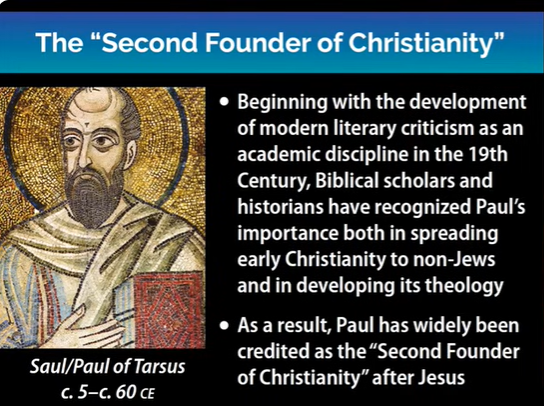 When the academic discipline of modern literary criticism really began to develop and take off in the 19th century, biblical scholars, especially in Germany, and academic historians began to recognize Paul's importance both in spreading early Christianity, leapfrogging the religion out of being simply a Jewish sect within Second Temple Judaism to converting people who were not Jewish, the Gentiles, as they're referred to in the New Testament texts, primarily Greek-speaking pagans but also other Aramaic-speaking pagans, and so forth. In addition to that, Paul played a really important role in the development of early Christian theology. As a result, Paul has widely been credited as the second founder of Christianity after Jesus. In fact, this kind of moniker is so frequently quoted that I don't think it necessarily even has someone who coined that phrase; it's simply repeated all the time: the second founder of Christianity. When I was a kid in high school, we had a chart in the history class on the wall that was a survey of historians about the most influential people in the whole history of the world. Of course, this was a Western school in Minnesota, and it was therefore very focused on Western civilization and so forth. What they had ended up with, these historians in their survey, was that the most influential single person in human history was Muhammad because, even though Islam was, let's say, the second biggest and most important religion after Christianity, Muhammad was so much more individually important both in formulating it and spreading it that Muhammad was then more important than the next two people, who were Jesus and Paul, because they had to split credit for Christianity. That was something that was a new idea that struck me back when I was a teenager, this kind of survey that was done.
Early Christianity: Oversimplified Model
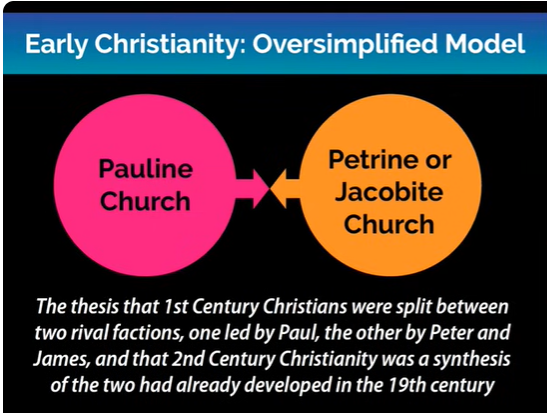 So let's look at Paul and his important role. We sometimes have made this slide with an oversimplified model where we talk about, at the beginning of Christianity, a rivalry with what we sometimes call Paul's Church, the Pauline church, and then the church that's led by the actual apostles who knew the historical Jesus and had been disciples of the historical Jesus during his lifetime: Peter, James, and John, the Petrine or Jacobite church. Jacobite is just a term; it's hard to know exactly how to define it as there are a lot of different meanings of what a Jacobite is throughout history. This would be referring to members or followers of James, the brother of Jesus, so of Peter and James. The thesis is that first-century Christians were split between these two rival factions, one led by Paul and the other by Peter and James, and that it was then the second-century Christians who synthesized the two. This idea already developed and took hold in the 19th century. As always with models, you draw a thumbnail picture, and it conveys an idea that has some truth to it, but whenever you try to take history and simplify it, you're also oversimplifying the reality.
A Diversity of Early Christianities
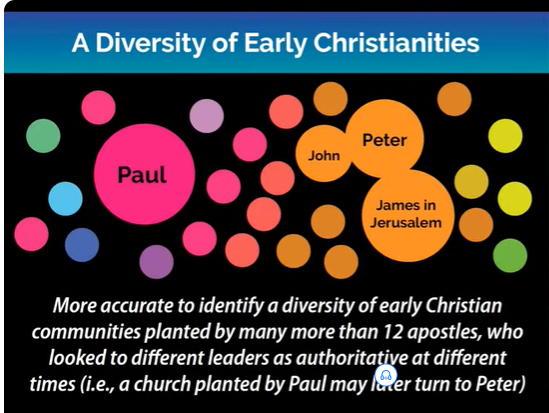 In fact, there was a diversity of early Christianities in the middle of the first century. Certainly, James, the brother of Jesus in Jerusalem, and two other known historical apostles of the historical Jesus, Peter and John, were very influential, and Paul was very influential. However, there was a diversity of early Christian communities planted by many more than 12 apostles. An apostle was a much bigger role than we sometimes think when we limit it to those 12. Those different communities looked to different leaders as authoritative at different times. As we'll see in this presentation, many times Paul planted a bunch of churches or started Christian communities. He went to a town where there were no Christians, started preaching, went to the synagogues, and converted a few Jews from the synagogues. More frequently, he gathered a community of people called the God-fearers, pagans who liked to go to synagogue and were very intrigued with Jewish rituals, especially Jewish scripture. They would like to join and be full members, but it's very difficult to become Jewish. If you're a man, you have to undergo circumcision, start adhering to all Jewish laws, and go through many rituals to become a full member of the community. Paul said, "No, you don't have to do all of those things. You can be a part of the same faith, the same faith that looks to the God of the Bible, without going through all of that adherence to the law." Paul would start those churches and planted many of them. Later, many of them would receive apostles more in keeping with Peter's teachings or John's or James's. Indeed, Peter and John might go to them and start to convert those Christians that Paul had planted to adhere more to the Jamesian model. There was a lot of diversity in these early Christianities, and they were not all in one camp or the other.
Paul’s Unexpected success
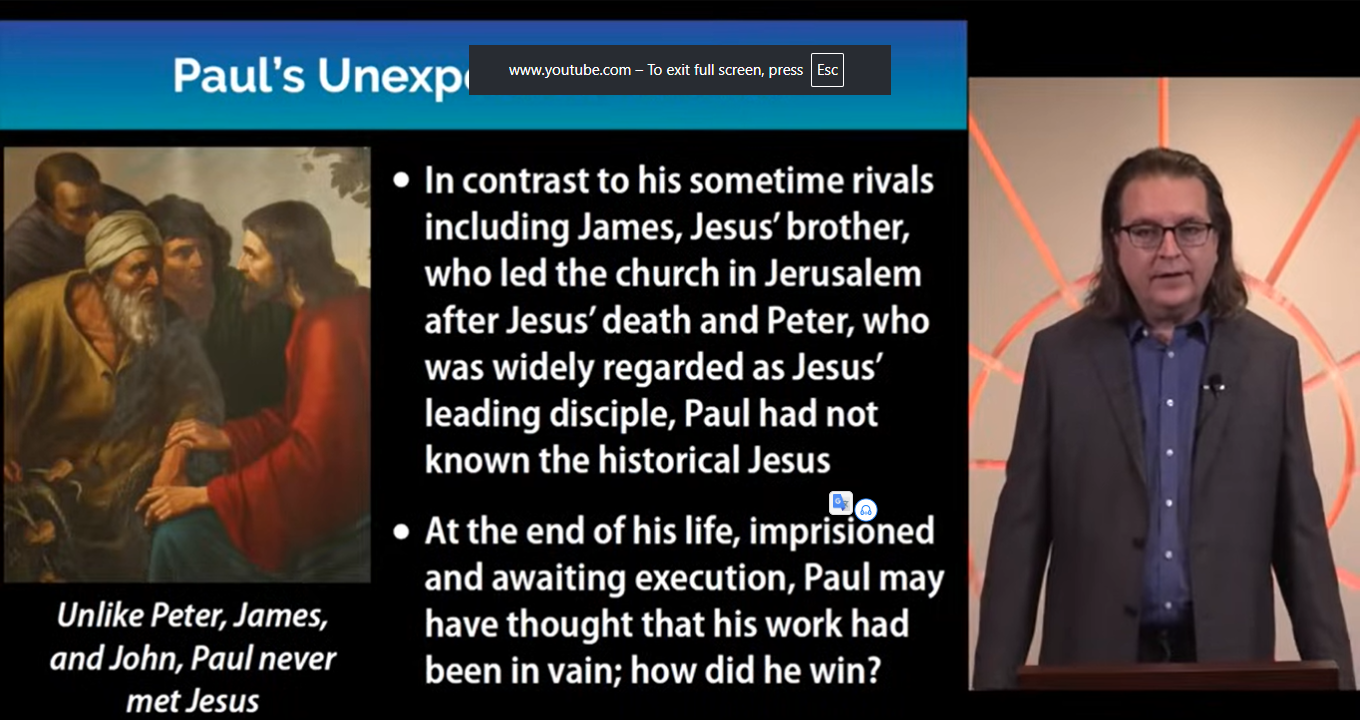 In contrast to his sometime rivals, like James, who was Jesus's brother and led the Church in Jerusalem after Jesus's death, and Peter, who was widely regarded as Jesus's leading disciple and the head of the Apostles, Paul had not actually known the historical Jesus. At the end of his life, as we'll see, imprisoned and awaiting execution, Paul may have thought that all of his work had been in vain; that the other Apostles had countered almost all of his arguments, that he'd been kicked out of all the churches he'd planted, and now his last hope to make peace had been for naught, and indeed now he's awaiting execution. There was a very good chance that he did not think he would have won this thing—in other words, that his entire life's work may have been extinguished and a different identity of Christianity that doesn't include Paul's theology might have won out. Instead, the opposite happened, and so this lecture is going to look at how that happened and why that is.
Three keys to paul’s Success
And so, I am just going to start by identifying essentially three key ingredients to Paul's success, both in life and, more importantly, his ultimate success.
Three Keys to Paul’s Success - First Christian Writings that survive
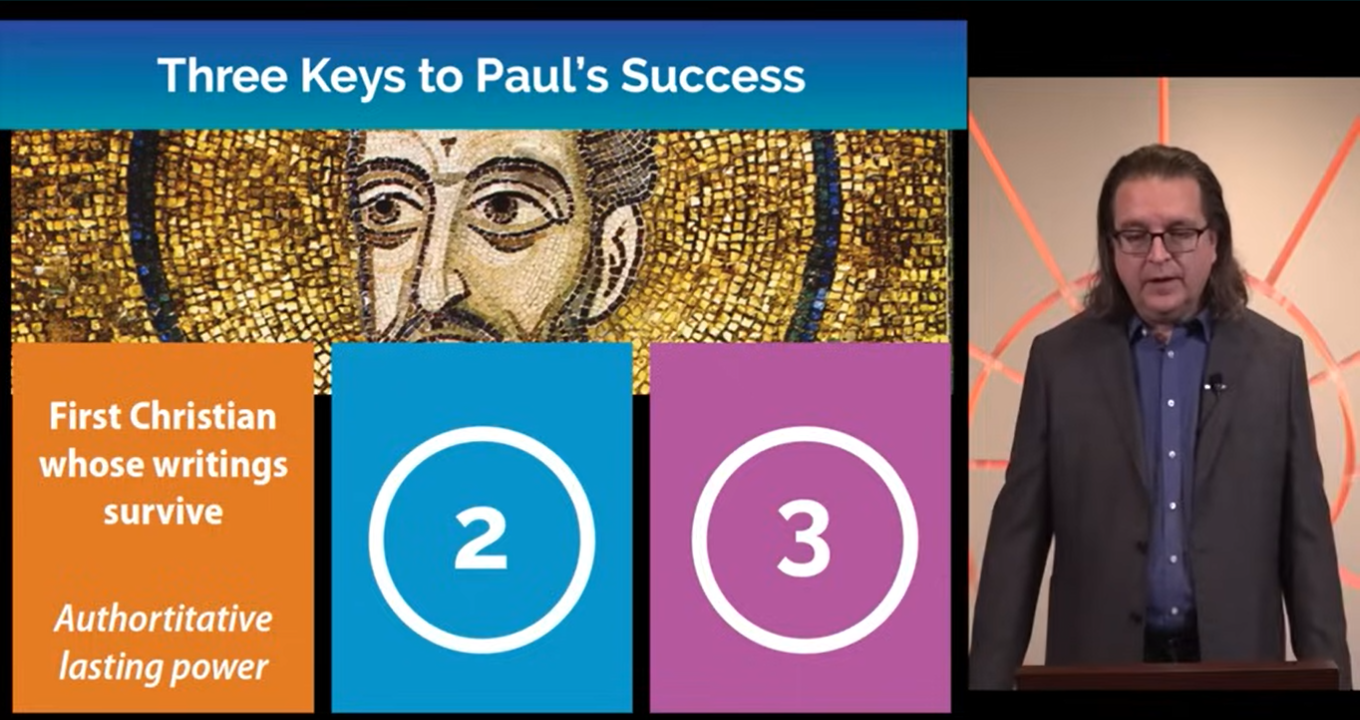 So, Paul, as we know, is the first Christian whose writings survive. It's not clear whether any of Jesus's first disciples actually wrote any writings. Most scholars agree that all of the writings attributed to people like Peter, James, and John were not written by them at all, and that none of the New Testament texts are by eyewitnesses. We've had other lectures about that.
Paul, in some ways, when competing against living persons as a living person, is at a disadvantage because he was not Jesus's brother or a person who walked around and followed Jesus when Jesus was on Earth. However, after he and they died, having not left any writings, he has this staying power because writing lasts. His texts become authoritative, which gives them lasting power. Even when some of Paul's ideas have declined in parts of Christianity, he can suddenly undergo a big renaissance, like during the Protestant Reformation, when he becomes key to Martin Luther's theology. He revives all of the Pauline teachings that then infuse Protestantism as a result.
Three Keys to Paul's Success Earliest Formulation of a High Christology
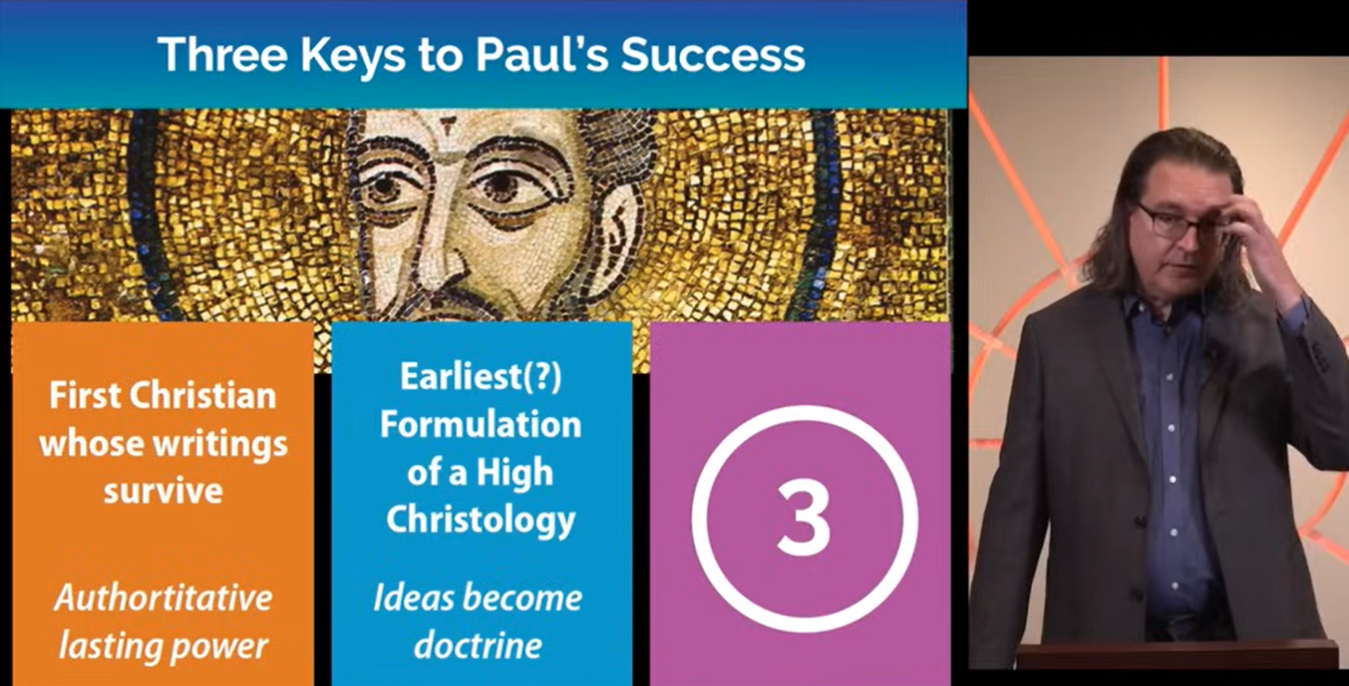 It's so, two, um, Paul also is, I think, maybe our earliest. We don't know because we don't have all of the writings, and so we can't know what everybody was preaching. He might have heard it from somebody else and simply wrote it down for the first time. But what we possibly have from Paul is the earliest formulation of a high Christology. We've talked about Christology before. Christology is the answer to the question Christians answer.
Various answers to the question: Who is Christ? How do we understand Christ? Um, and overall, the, uh, the Orthodox answer becomes: Christ is the second person of the Trinity. Christ is fully human and fully divine. Christ is the Son of God, the Logos, God's glory made visible, God among us, and so forth. Um, that is an idea that ultimately wins out. That's a relatively high Christology. There were many early Christians who thought of Jesus as being a very important prophet. They might have even decided he was some.
They didn't necessarily think so, but they decided he became the Messiah or became the Son of God because he had lived a very pure and perfect life. And so then, either at his baptism or at the moment of his resurrection, he was raised up by God and sat at God's right hand and becomes essentially the Son of God that way via adoption. That was also certainly an understanding that many early Christians had, which, you know, later becomes condemned as heretical, but represents essentially a lower Christology; a Christology that emphasizes Jesus' humanness. And for many of the earliest Christians who actually knew the historical Jesus, they were very focused on the Jesus that they'd known as a human in life. Paul, who wasn't focused on that, formulated a very high Christology very early.
Three Keys to Paul's Success - Converts non-Jews to Crhristianity - Explosion in Growth
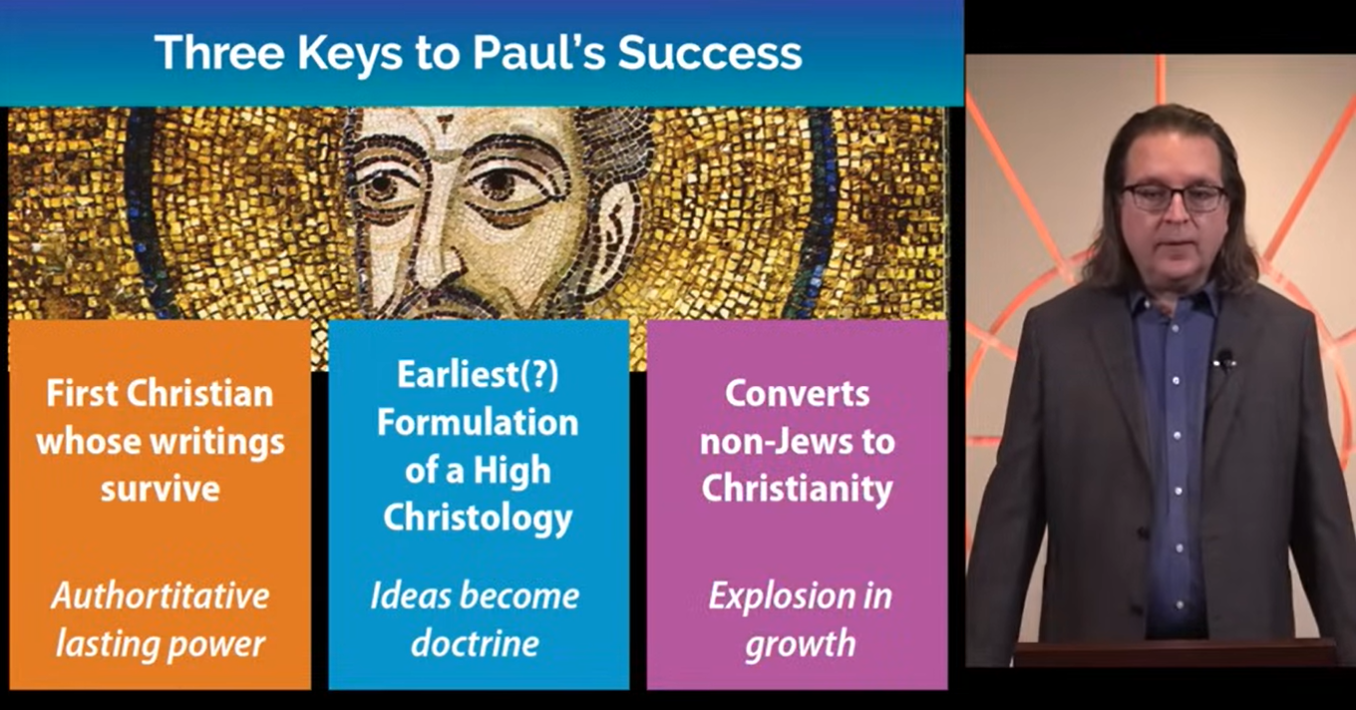
Finally, Paul is responsible for the explosion in growth that early Christianity experienced. He is not the only one running around planting churches, but he is especially effective at it. His ideas about lowering the barrier to entry for non-Jews who want to become converts to Christianity—by not having to adhere to various tenets of Jewish law—allow his groups to flourish. I think all three of these factors lead to both the successes Paul had during his lifetime and especially after his death.
Timeline of Paul’s Ministry
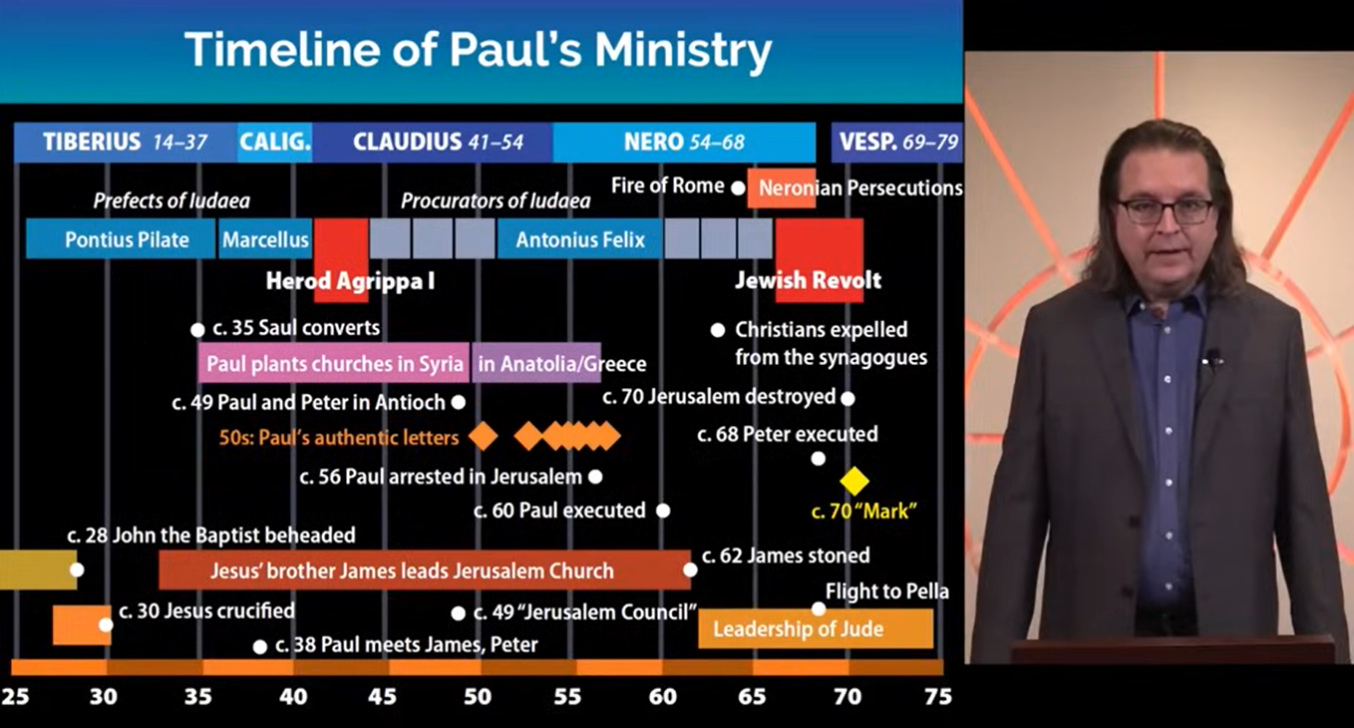
So I put together a bit of a timeline today so that we can look at, you know, Paul's ministry in the context of early Christianity with a backdrop of what's going on, for example, in terms of the Roman administration. I ran across the top of this the Roman emperors over the course of the first century of the Common Era and also the local rulers in Judea, such as Pontius Pilate, and then later when we're dealing with Paul, Antonius Felix, who's mentioned in the book of Acts, up to the end of the normal province of Judea in the Jewish Revolt, which causes all sorts of things to happen. If we go along the bottom of this, we have up until maybe none of these dates, you know, circa—we don't know for sure; these are our best guesses for these dates. Maybe John the Baptist is beheaded in the year 28. Prior to that, he had baptized Jesus, and Jesus had begun his own movement and was maybe himself crucified in the year 30. Jesus' movement and also John the Baptist's movement continue to have disciples. There is going to be some intermixing between those. Jesus continues to have disciples.
Jerusalem Church aka Poor of Jerusalem
Some of Jesus' disciples gather together or continue to be in a group in Jerusalem, the Jerusalem Church, sometimes called the Poor of Jerusalem, which is led by Jesus' brother James for many decades until 62 when James himself is executed. After that, James's group probably passes to the leadership of his brother Jude. Ultimately, when the whole Jewish revolt breaks out and Jerusalem is destroyed, the Christians do not revolt; they are instead expelled from Jerusalem. The Jerusalem Church flees to a town called Pella in Palestine, where it becomes less influential than it had been when it was in the holy city.
We can see within this time frame around the year 35, Saul, his original name, converts. He begins his own ministry as an apostle, planting churches in Syria and Cilicia. A few years after his conversion, Paul goes to Jerusalem and meets James, the brother of Jesus, and Peter, maybe around the year 38. After many more years of Paul working like that, Paul has a confrontation with Peter and James, maybe around the year 49, where they are concerned that he is teaching new Gentile converts that they don't have to obey Jewish law. They don't agree about that. They try to have a conference, and there is some kind of agreement patched together, yet we can also see that the agreement is uncertain. In response to that, Paul abandons the original churches that he might have been planting in Syria, Cilicia, and Arabia. He now moves west to Anatolia and Greece, where he does his most famous missionary planting. It's most famous because, as he's doing this, he is also writing his letters. We can see there in the 50s that Paul is writing all of the letters that are viewed as authentic by scholars. This leads up to the very end of his life when Paul goes back to Jerusalem in an attempt to reconcile with James and James's church but is instead arrested there by Roman authorities and, within a few years, is executed. Just a couple of years after that, James is himself executed, and the whole thing starts to fall apart in the Jewish Revolt, as we mentioned. Peter is executed, and there are persecutions localized by Nero after the fire of Rome in Rome and elsewhere.
So this is sort of the context of the development of the earliest Christianities, and you can see here that even out of the gate, Paul has a very high Christology that he's developed. He's already been preaching, teaching, and planting churches for maybe over a decade before he starts writing, so he has a lot of time to formulate his ideas once they appear.
Sources of the Life of Paul
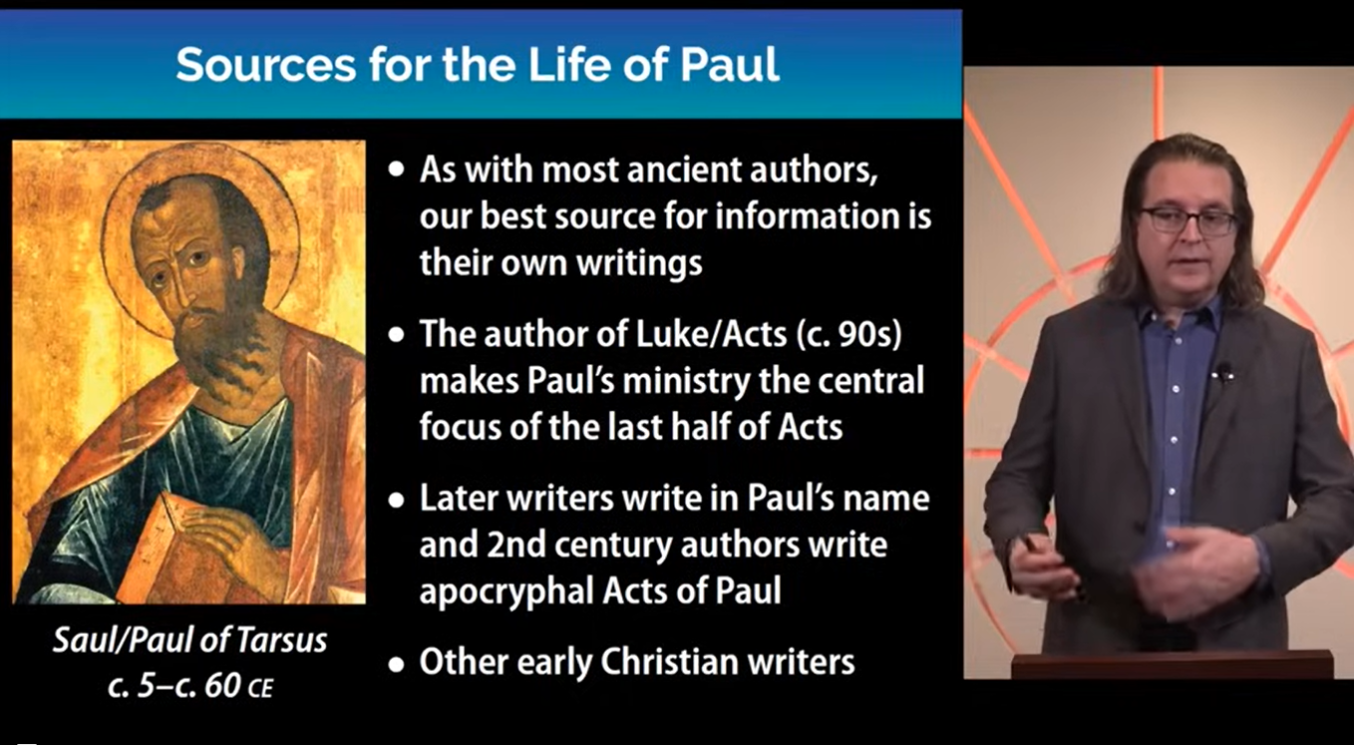 (19:07) As with most ancient authors, our best source for information is essentially their own writing. Sometimes they don't tell us much, but a lot of times, if a writer is writing long after the fact, a generation or two later, the traditions they include for us are fairly suspect. In addition to Paul's writings, the author of Luke, who is also the author of Acts, writing at the end of the first century, maybe in the 90s, makes Paul's ministry the (19:47) central focus of the last half of Acts. Paul becomes a major figure in the Acts of the Apostles. There are other later writers who are writing epistles in Paul's name. Some of these letters of Paul, which are in the New Testament, are thought by many scholars not to have been written by Paul; they think they are anachronistic, written in Paul's name. Indeed, we also have other apocryphal books of Acts of Paul, which are much later than the first century. In (20:27) addition to this, other non-biblical early Christian writers mention Paul, although they don't provide a lot of detail, especially in the earliest texts.
Sources for the Life of Paul - late and limited
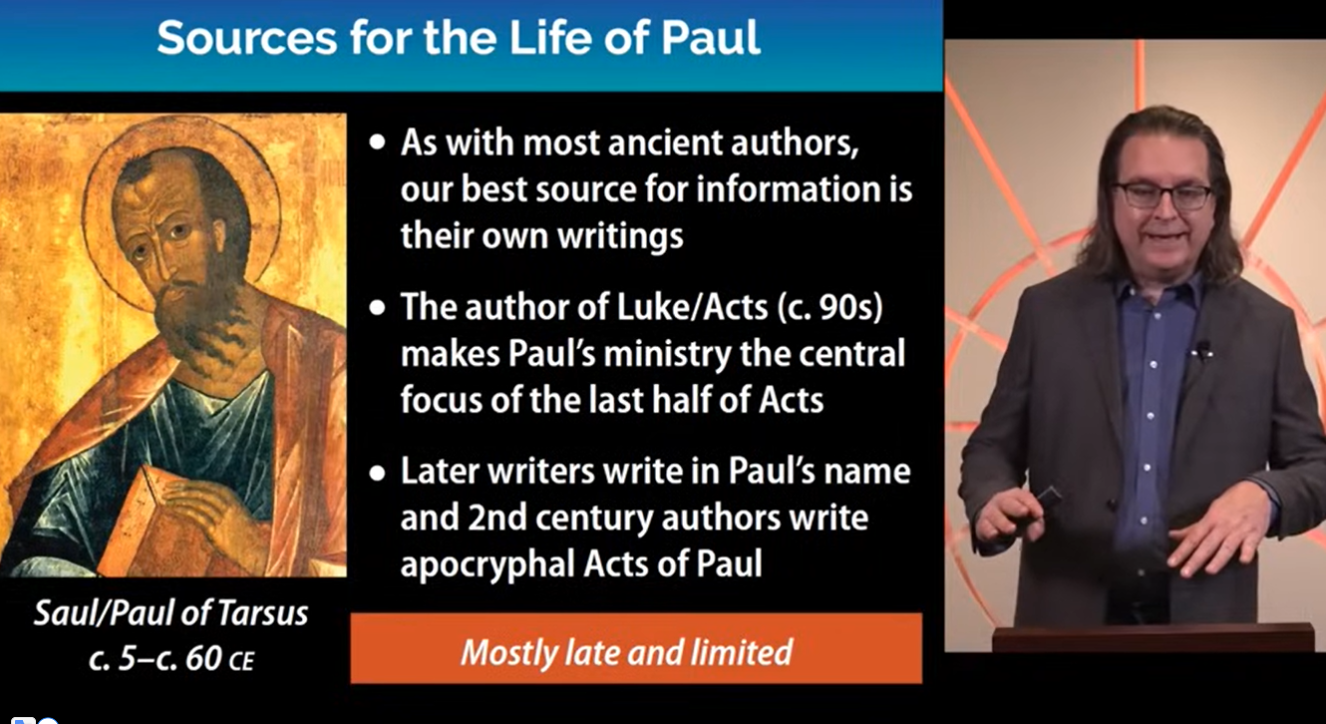 As we look at the sources for Paul's life, these other Christian authors are mostly late and limited, and they do not provide us with many important details. The best source, and the only contemporary source, are Paul's own writings, but he is not really writing a biography or an autobiography.
Sources for the Life of Paul - Paul’s followers
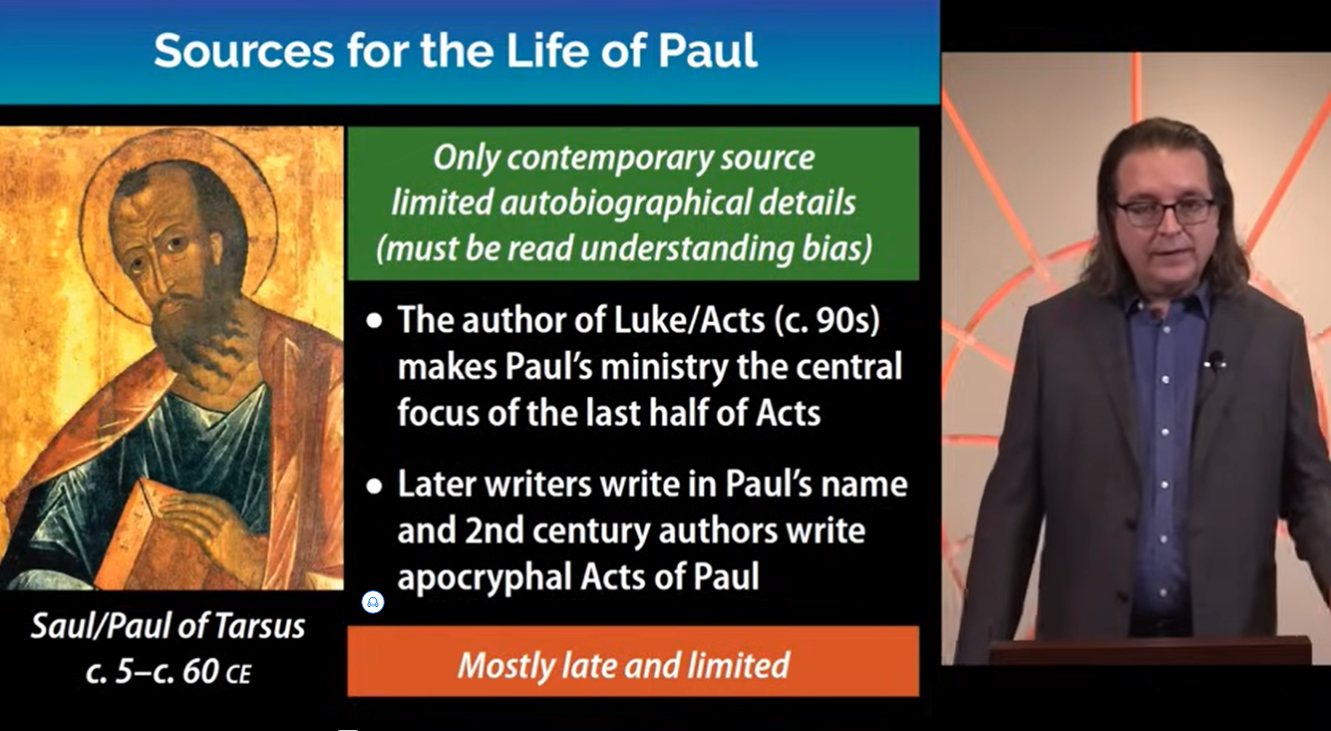
The (21:04) details he shares with us about his own life are actually fairly limited. As always, when we have a contemporary author and their own text, we must be aware that they have an agenda when writing. We've talked about this before when we looked at the writings of Josephus. Josephus has his own agenda about what he's saying about himself, especially, but really has an agenda for his entire work while writing a history of the Jewish people or several histories of (21:40) the Jewish people to be consumed by Romans for various purposes, to change Roman attitudes about him. Likewise, Julius Caesar is a great author, but he writes with the idea of justifying all the things he's doing. One reason he comes off very well in history is that he wrote a lot of the history. Similarly, Churchill also wrote a lot of history, which helped in how he's appraised.
Sources for the Life of Paul - Luke / Acts
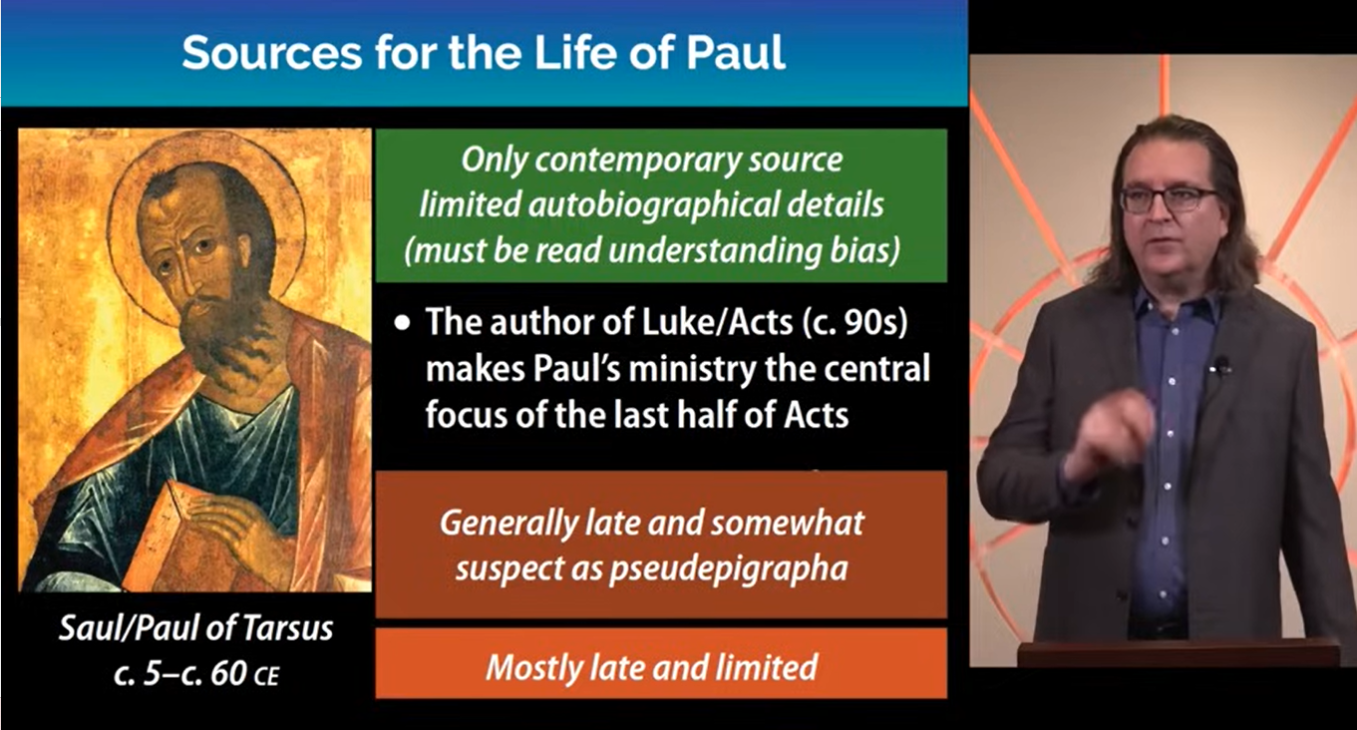
Anyway, these later writers
(22:14) who write in Paul's name are late, and because these are pseudepigrapha, if a person is pretending to be Paul, it's suspect. They are trying to honor Paul's memory, but they are also pretending to be Paul. You have to read into it that way.
Sources for the Life of Paul
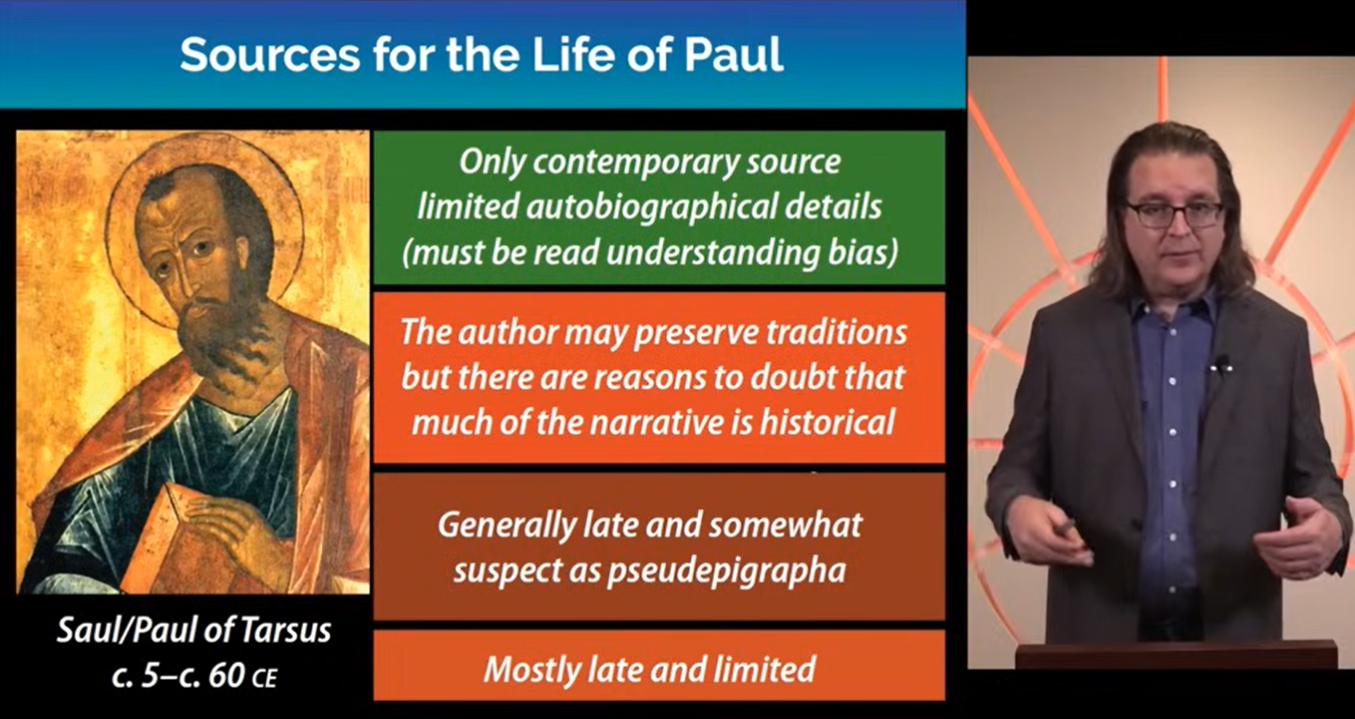
Finally, because we lack other sources, New Testament scholars frequently follow the account
(22:50) in Acts as if it's essentially accurate history. It's our only narrative of the life of Paul, and because we have a whole narrative, people like to believe that's the narrative. However, while I think the author of Acts may preserve traditions that their community inherited, they may have ultimately come from a community originally planted by Paul, although it was not necessarily a Pauline community anymore. I think there are reasons to doubt that
(23:29) much of the narrative of Acts, especially the part about Paul and what he's doing, is less historiographically accurate. We have some problems as we reconstruct Paul's life.
Multiplicity of Sources vs. One Source
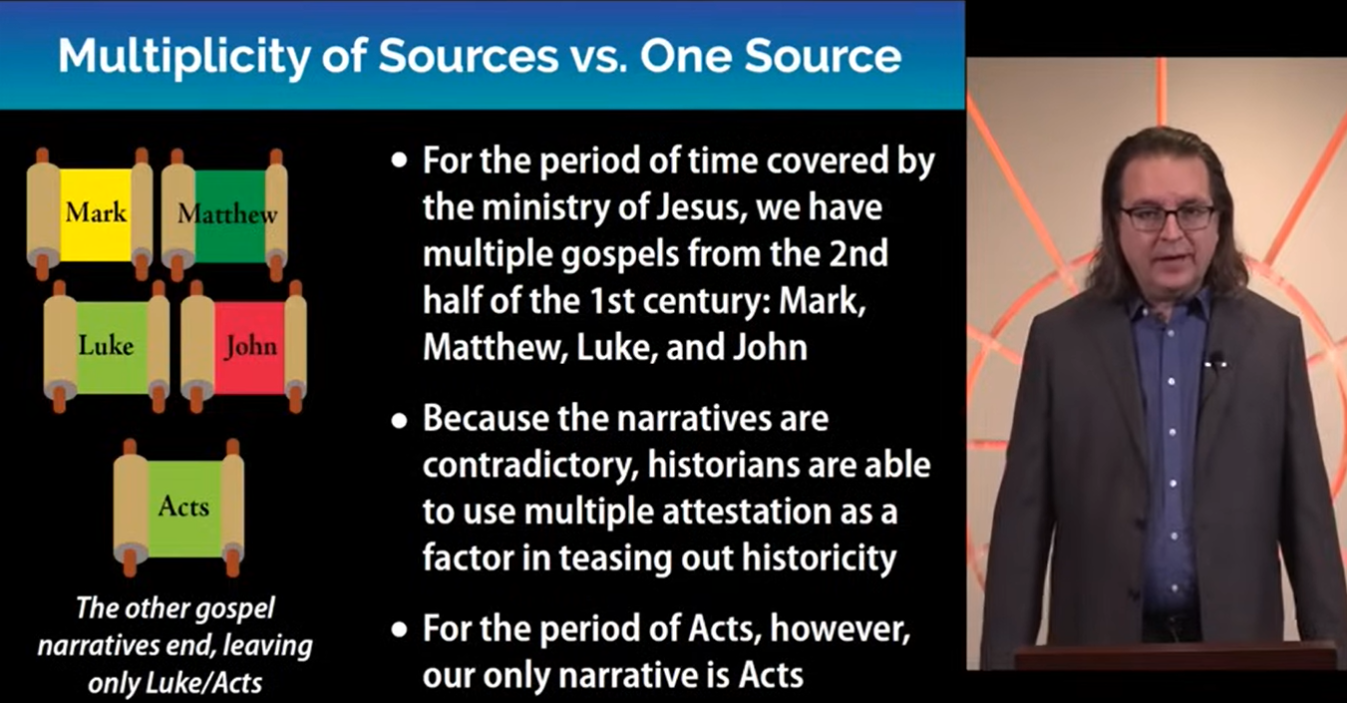 For the period of time covered by the ministry of Jesus, we've done a variety of lectures on the historical Jesus and how we try to understand what may go back to the historical Jesus. We have the great advantage of having multiple gospels from the second half of the first century, such as the Gospels of Mark, Matthew, Luke, and John, which offer different perspectives and sometimes contradict each other. This has always been a problem for literalists who want to do a poetics and pretend that all the gospels are identical and convey the same message. However, the fact that they preserve different views has actually helped historians reconstruct events, as we have the benefit of multiple attestations and different narratives that we can weigh against each other.
Often, for example, elements that Mark includes in the narrative are viewed as more likely to be historical than those in John, which are generally considered less historical overall.
However, the problem we face for the period covered by Acts is that our only narrative is Acts itself. We don't have multiple attestations, and as a result, we can't weigh it against other sources. Acts is the second half of the Book of Luke, but we don't have a second half of John, Matthew, and Mark with competing stories that might say, "No, no, no, Peter and Paul aren't important; it's John and James who are important," or whatever they might be saying in those other books. We simply don't have an alternate book to weigh Acts against. As a result, Acts tends to be taken more at face value by historians, and also because there's less at stake. People are much more concerned about Jesus than about what happens after Jesus, so Jesus receives much more scrutiny. However, this period needs a lot of scrutiny too.
Who Was Paul (Saul of Tarsus?)
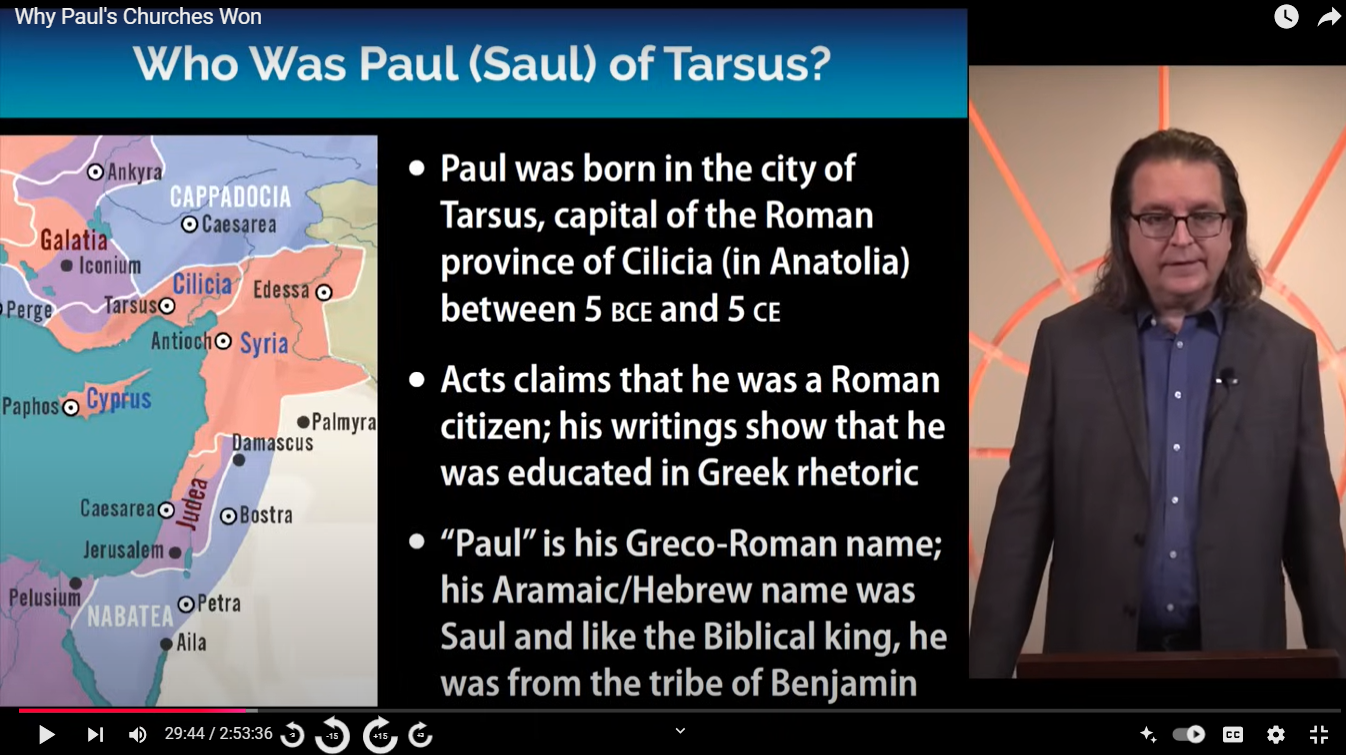
So, who is Paul, who is Saul of Tarsus? Paul was born in the city of Tarsus. You can see on my little map here that it's one of the capitals in Cilicia, which is one of the provinces colored in peach. At the time of Paul's birth, these were the provinces of the Roman Empire. The purple areas represent client kingdoms governed by Roman clients, and at that time, they were still allied states.
Cilicia is one of the provinces in Anatolia, modern-day Turkey. Paul was born somewhere between 5 BCE and 5 CE. We don't know the exact date, but based on his age later, the Book of Acts claims he was a Roman citizen. This is not impossible, but we don't have multiple attestations for it. Roman citizenship at this time was relatively limited. A whole city might be granted citizenship as a reward for something incredible they had done for the Roman Republic or later for the Empire. Individuals might also have been granted it, and it made a significant legal difference, especially at this time. Centuries later, as more people gained Roman citizenship, everyone in the Empire essentially became a citizen. However, at this time, it was a big deal and rare for someone like Paul to have it, but not impossible.
One thing we can tell from his writings is that he was somewhat educated in Greek rhetoric. He was a good writer and knew how to use Greek rhetorical devices. These make him come across as a very personal writer, sharing his emotions and other things with us. This is part of how you're supposed to write rhetorically and persuade according to the standards of Greek rhetoric. Paul is his Greco-Roman name. It was common for Jewish people to have their own name given at birth in Aramaic or Hebrew. In this case, his name would have been Saul, named after the famous biblical King Saul. According to Paul, like the biblical King Saul, he is from the Tribe of Benjamin. Most Jews are from the Tribe of Judah, but some are from Benjamin and some from the Priestly tribe, the Levites. There might be some from Simeon still around, but most of the tribes are lost because of the ten tribes, with few from the other tribes. However, the line of Benjamin still continues, and Paul claims that lineage.
From Perscutor to Adherent
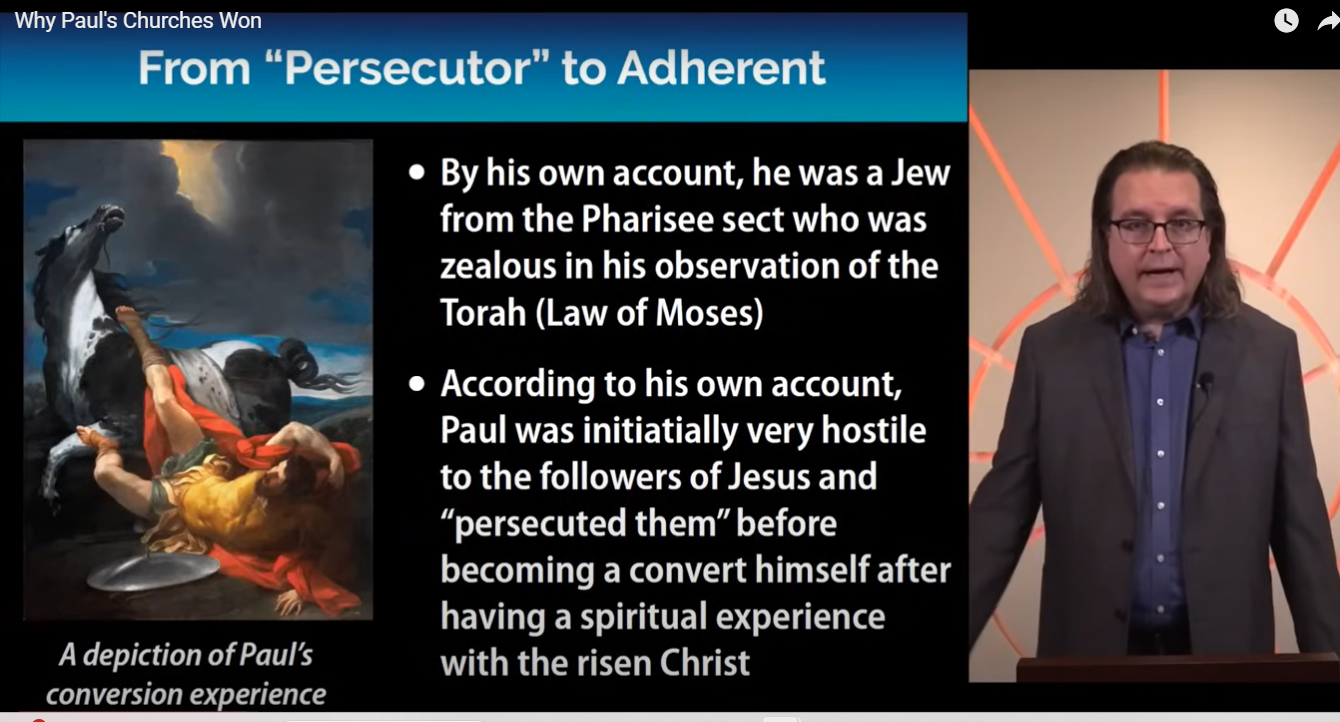
By his own account, Paul was a Jew from the Pharisee sect who was zealous in his observance of the Law of Moses, or Torah. He adhered strictly to Jewish law and was initially very hostile to the followers of Jesus. By his own account, he persecuted them before he himself became a convert after having a spiritual experience with the Risen Christ. He went from being a persecutor to an adherent and Apostle.
The Anonymous Author of Luke / Acts
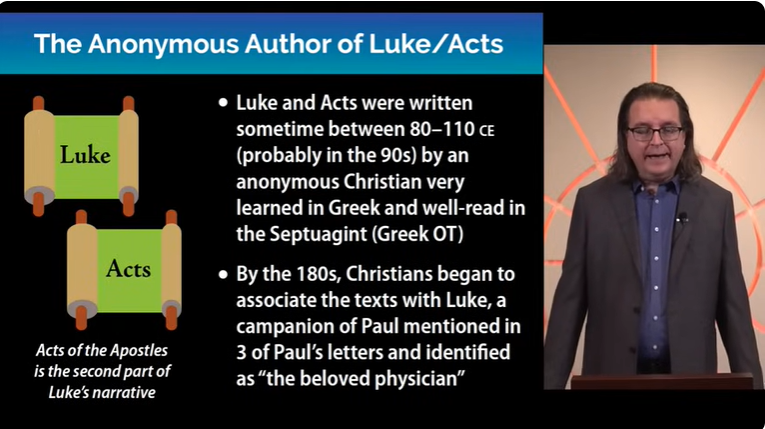 Luke and Acts were written sometime between, as I say, the year 80 and 110, so maybe in the '90s, by an anonymous Christian who was also very learned in Greek and well-read in the Hebrew Bible as it had been translated into Greek, the Septuagint. By the 180s, Christians began to associate these anonymous texts written in the 2nd century.
Luke and Acts began to be associated with Luke, who had been a companion of Paul mentioned in three of Paul's letters. Although a couple of these letters are not authentic, it's probably only one time in an authentic letter. There are two other letters based on Paul's letters that reuse the name Luke, and in one of those, Luke is identified as the Beloved Physician. Therefore, there is a whole bunch of Christian tradition regarding the author of these two books as being Paul's companion, Luke, a physician. This has even informed some people's analysis of the text, where they think, "Well, Luke is the author of Luke here," because, as a physician, they are especially interested in these kinds of things. It's not likely that there is anything to it; this is a late association that doesn't have a historical basis.
The Auhthor’s Relationship with Paul
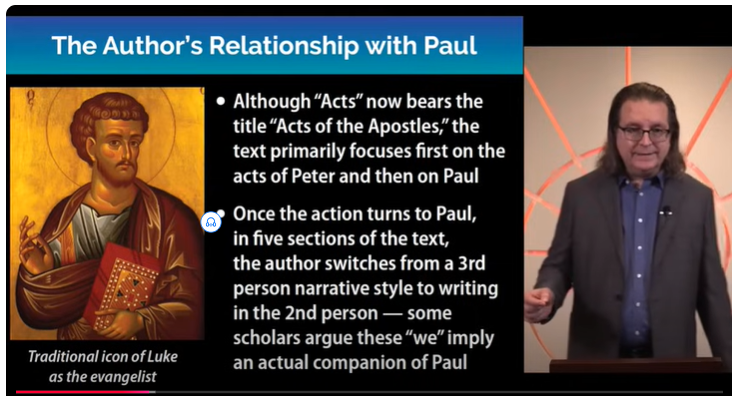
Although the text now bears the title "Acts of the Apostles," it does not follow the twelve apostles of Jesus. Instead, the text primarily focuses on Peter. It starts with the eleven apostles, and then they find a replacement for Judas, so there are twelve for a while.
Then, the action focuses on Peter before switching over to follow Paul, who is not one of the twelve. Once the narrative turns to Paul, there are five segments in the text where the author of Acts switches from a third-person narrative style to writing in the first person. Previously, the text would say "Paul and his companions did this and that," but then it suddenly changes to "we did this."
Some scholars have argued that these five "we" passages imply that the writer was an actual companion of Paul and is recounting events from a time when the author was with Paul. I've mentioned this before as an explanation or a point regarding why, for example, the Gospel of Matthew is not actually written by Matthew or any companion of Jesus. When Matthew appears in the text, it doesn't say, "Then Jesus came to me, Matthew, a tax collector, and I did this and that, and then Jesus asked me to follow him," or anything like that. This is a counterexample because now we are suddenly getting "we" passages.
Shift in Persons: “We passages”

And so, let's look at an example of the shift from third to second person that occurs in Acts chapter 16. We read:
- Paul and his companions traveled throughout the region of Phrygia and Galatia. They passed by Mysia and went down to Troas. During the night, Paul had a vision of a man from Macedonia standing and begging him, "Come over to Macedonia and help us." After Paul had seen the vision, we got ready at once to leave for Macedonia, concluding that God had called us to preach the gospel to them.
So again, it starts with Paul and his companions doing this, and then after this vision, we got ready, and God is calling us. For a while, it stays in this second person.
Contradictions between Acts and Paul
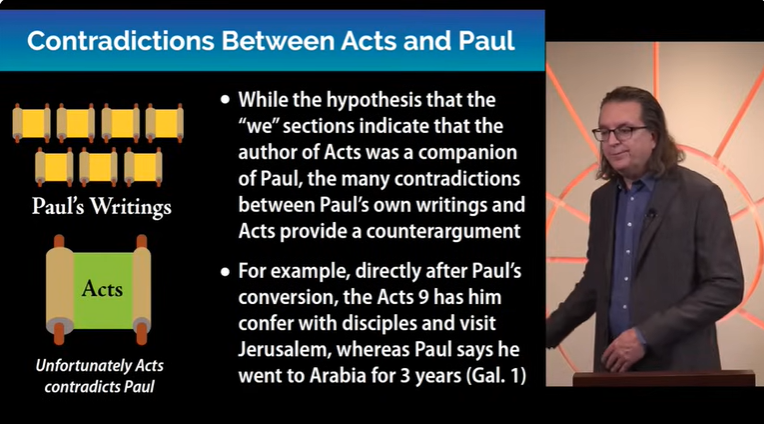
So, while the hypothesis that these "we" sections indicate that the author of Acts was a companion of Paul, there are a bunch of problems with this. One of them is that there are really a lot of contradictions between Paul's own writings and what we read about in Acts. The fact that the author of Acts seems to be ignorant of Paul's chronology, the order in which Paul is doing things, and some of the basic teachings that Paul wants to present, is a counterargument to the idea that this was written by a companion of Paul. For example, directly after Paul's conversion in Acts chapter 9, he goes and confers with the disciples and then visits Jerusalem, where he talks to Peter and James, and so on. By contrast, in his own writings, Paul says that right after his conversion, he went to Arabia for three years before visiting Jerusalem.
Paul vs. The Paul in Acts
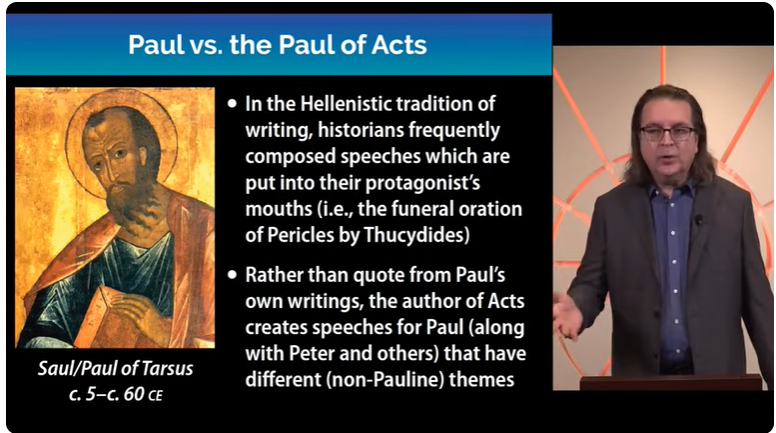
So in the Hellenistic tradition of writing, historians frequently compose speeches that are put into their protagonist's mouth. We've had a whole lecture on Herodotus and Thucydides and the beginnings or the invention of history in the Western tradition.
The ancient tradition of history included the principle that the goal of the historian is to say what the general would have said on the occasion, even though no notes survive and we don't know what the actual speech was. Thucydides, the historian of the Peloponnesian War, has this amazing funeral oration by Pericles, which everyone agrees is written by Thucydides, not by Pericles.
This same kind of historical writing is what the highly trained Greek writer of Acts does for writing the Acts of the Apostles. The author of Acts creates speeches for Paul, Peter, Stephen the protomartyr, and a lot of other people. However, the speeches from Paul have very non-Pauline themes; Paul isn't saying the kind of things that he says in all of his other writings. Interestingly, the author of Acts doesn't quote Paul anywhere. We have all of these writings of Paul, yet they are not quoted and put into Acts.
Paul's Writings Are Not a Source
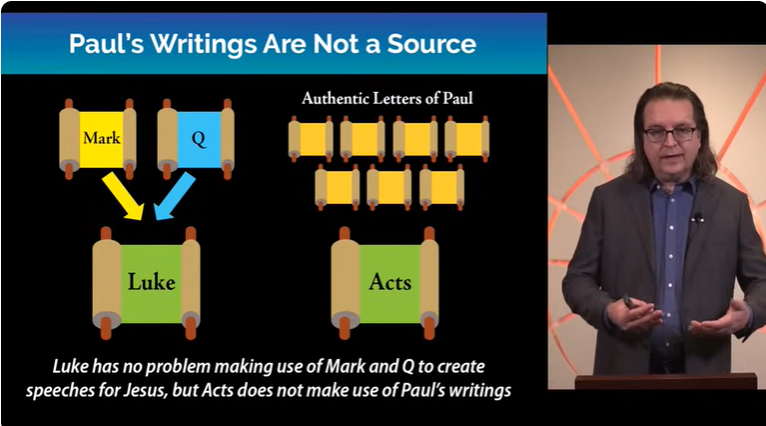
Paul's writings don't seem to be a source, so the author of Acts, who is Luke, has Mark for sure and is reworking Mark continuously to create the narrative of Luke. The author of Luke has another source of Jesus's sayings, which scholars hypothesize is called Q, for the missing source. The author of Luke is also editing those and has no problem making use of them. However, none of the authentic letters of Paul or even the inauthentic ones are used in Acts to quote Paul. The conclusion is that the author of Luke-Acts doesn't have those letters or access to them. If they are a Greek-speaking Christian, one of the God-fearers who has converted and is in a church that maybe Paul originally planted, it's not a church that's still looking back to Paul and isn't reading Paul's letters as authoritative since the author here doesn't seem to have them or use them. The implication is that they are not available to the author of Acts.
No Consensus on the “We" Sections
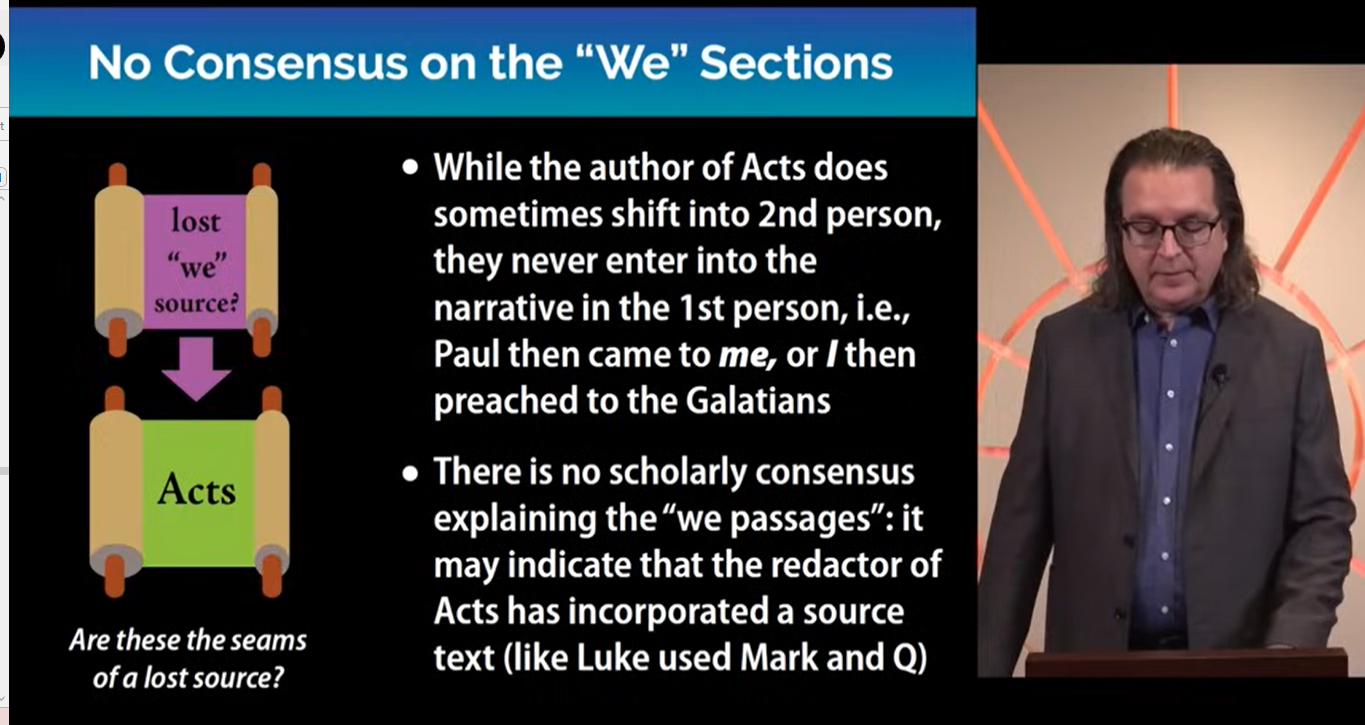
There's no consensus among scholars about these "we" sections. I wanted to bring it up because it is something that people wonder about and think that possibly this does make a case for Luke as a companion of Paul. While the author of Acts does shift into the second person and talk about "we go and do this," it never actually gets to the first person, so it never makes the direct case that Paul came to me and then I went and preached to the Galatians or something like that. There are these "we" passages, and unfortunately, there's no consensus. There are a bunch of different things that it could be. An idea that I'm sort of taken with is that there may be an underlying source here that the author of Acts hasn't gotten a hold of and has incorporated into Acts. Maybe there's a second-person account that's now lost, a lost "we" source that has been used and expanded by the author of Acts as an editor-redactor to create a larger account, just the way that Luke also used Mark and Q, but we can't know that for sure. Bart Ehrman, I think, just makes the case that by saying "we" every once in a while, the author of Acts is pretending to be a companion of Paul and is therefore a fraud. There are different cases that can be made academically about what these "we" sources are. We just leave it at that.
Historical Reliability of Acts
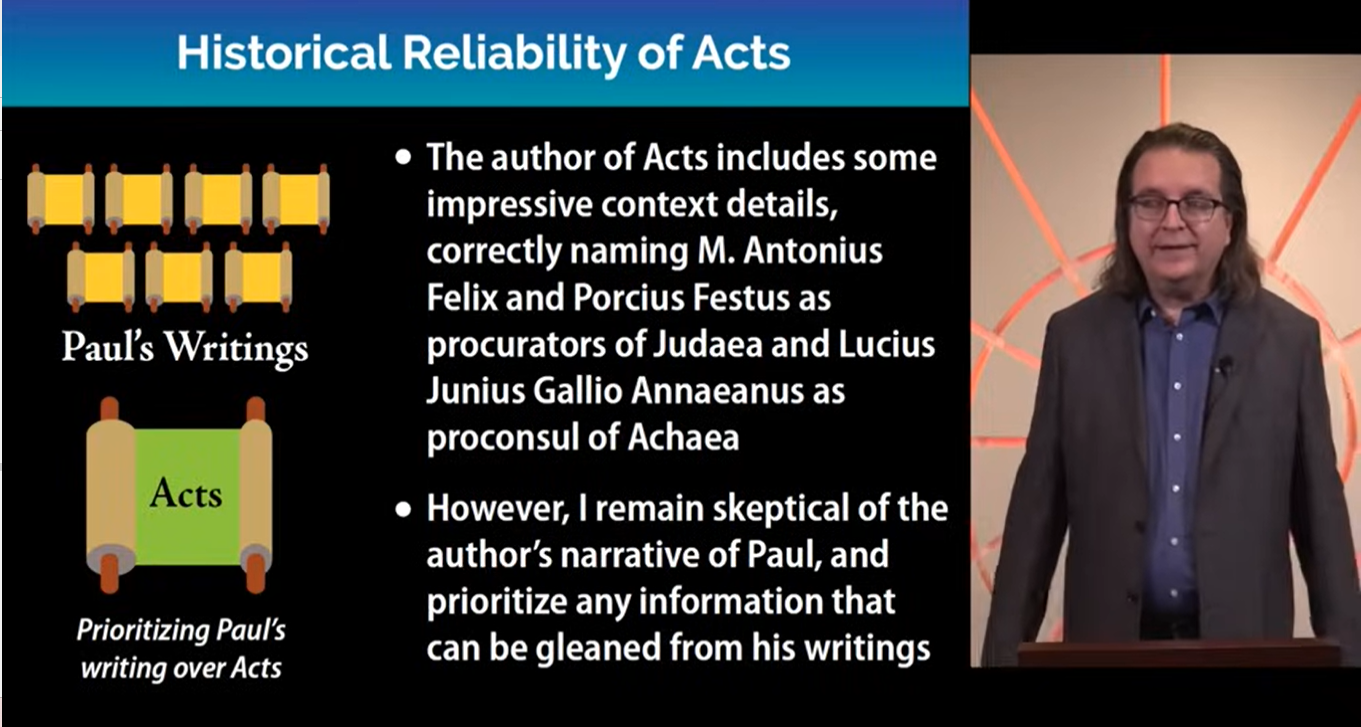 The author of Acts includes some impressive contextual details. In addition to being trained in Greek rhetoric and how Hellenistic history works, there are contextual elements from Roman history that are pretty impressive. For example, the author of Acts correctly names two of the procurators for Judea: Marcus Antonius Felix and Porcius Festus. The author of Acts also correctly identifies, just again in the exact right time period, a proconsul of Achaia in Greece, Lucius Junius Gallio. There are some impressive aspects in terms of access to broader history and the context that Luke is writing into. However, I remain skeptical of the author's narrative of Paul because of some of the contradictions that are there. Therefore, when I'm reconstructing this history of Paul, I rely way more on Paul's own writings than some New Testament reconstructions will do.
Writings of Paul (and Pseudo-Pauls)
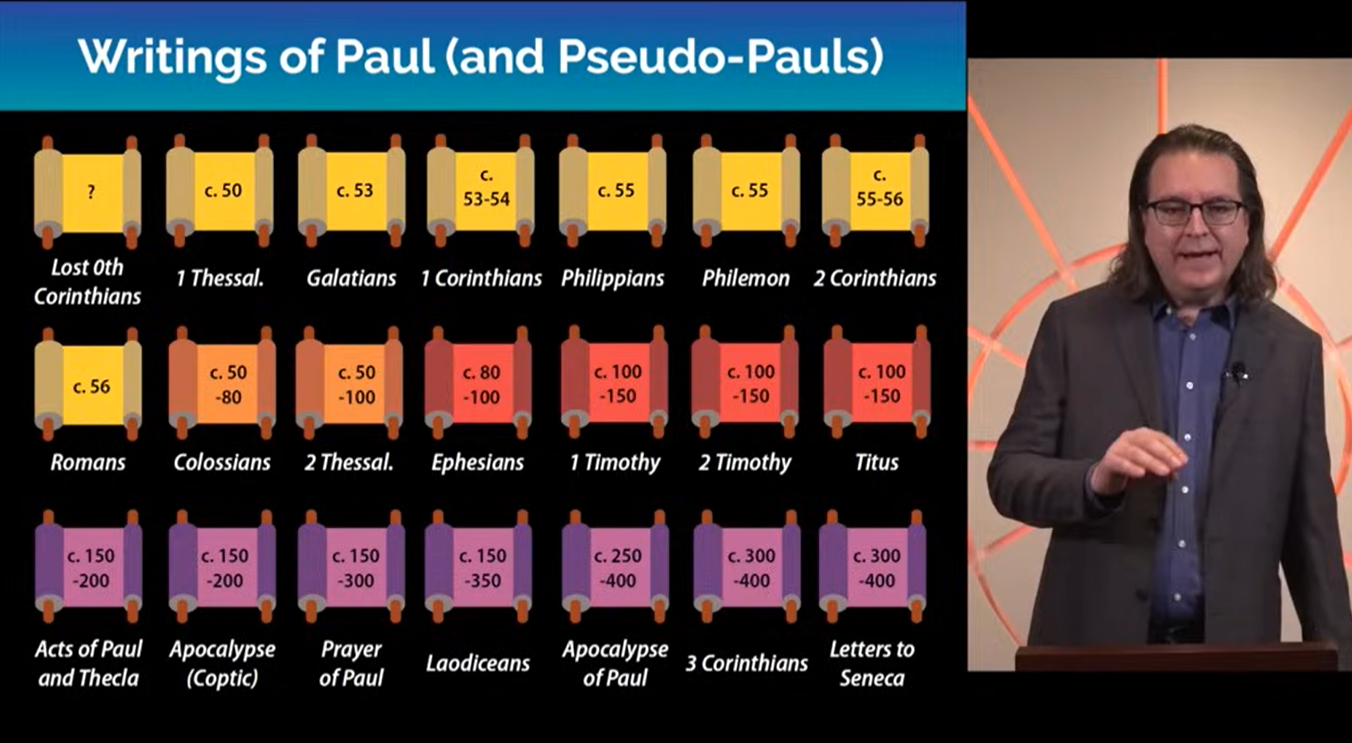 Let's go to the writings of Paul and then also what we might call the pseudo-Pauline writings, people writing in Paul's name. We have here, across the top in yellow, the ones that pretty much all scholars agree are authentic writings of Paul. There is a lost zeroth letter to the Corinthians. We know about that as authentic because in the later authentic first letter to the Corinthians, Paul talks about "when I last wrote to you," and so that never made it into the canon, but it is a letter that presumably Paul wrote that we don't have. Then, 1 Thessalonians, Galatians, 1 Corinthians, Philippians, Philemon, 2 Corinthians (which might be a composite of a couple of Paul's letters), and then Romans. Those are the ones where we can be pretty confident. Scholars have mixed views on Colossians and 2 Thessalonians, and then I think most scholars think Ephesians, 1 and 2 Timothy, and Titus are probably not written by Paul because they contain too many anachronisms and reflect a development in Christianity post-Paul's death.
Finally, there's a lot of other people who sometimes are upset that any of the letters are disputed, and they say, "Well, why would anybody have done this and written in Paul's name and pretended to be Paul?" Well, we have a whole bunch of other letters from antiquity from the 2nd century and a little later where people are doing just that, which nobody believes Paul wrote. We have another book of Acts, the Acts of Paul and Thecla, his female missionary companion who is still viewed as a saint in the Eastern Orthodox Church. We have a Coptic Apocalypse of Paul, a Greek Apocalypse of Paul, a Prayer of Paul, a Letter to the Laodiceans, a third letter to the Corinthians, and then we have a whole back and forth of letters that Paul and the philosopher Seneca are writing, which are interesting but absolutely not authentic. That's sort of what we have in terms of the array of Paul's writings within the New Testament.
Paul's Share of the New Testament
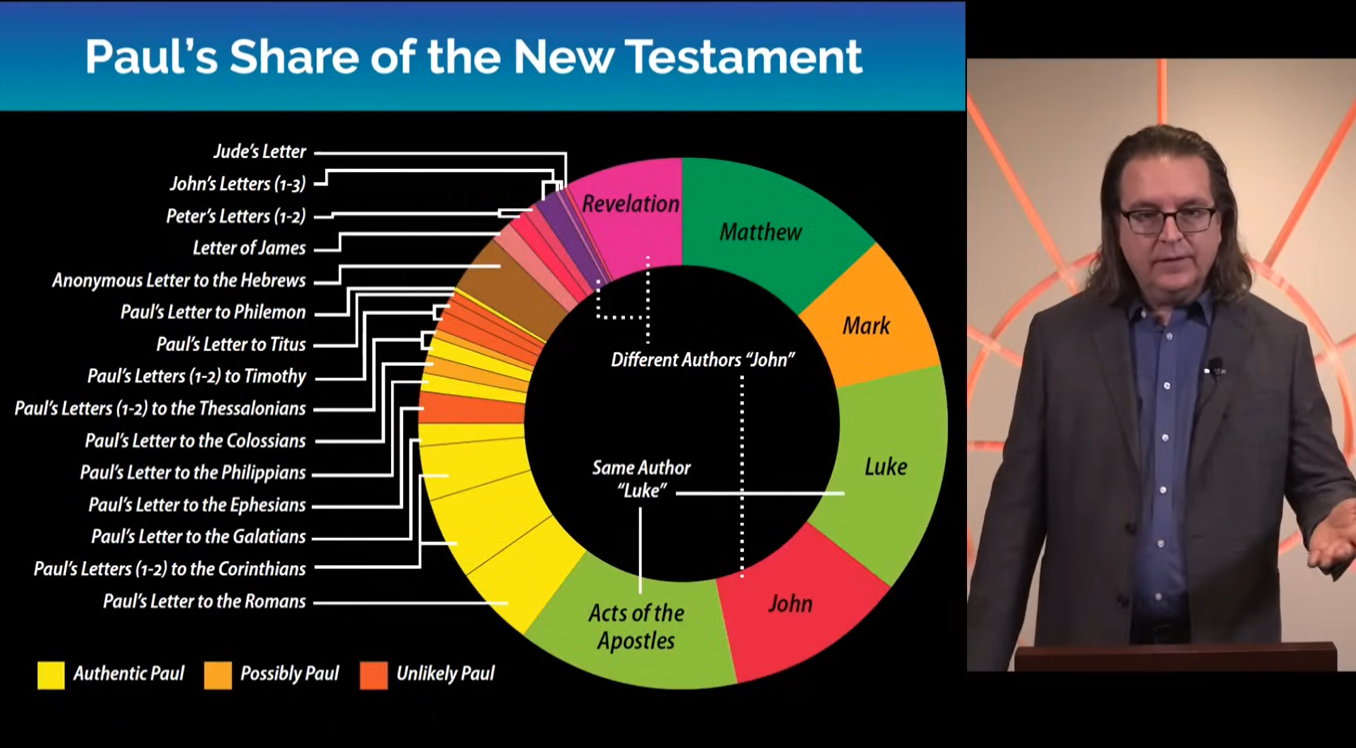 Paul's writings here are all of those kind of in yellow, so it's a fairly significant chunk, one of our two largest authors in the New Testament, the second one being the author of Luke and Acts. Then we have the other gospel writers, the writer of the Book of Revelation, and the smaller writers of the Epistles.
So what could we know about Paul with that kind of background? What do the writings tell us about him? I mentioned that slide's already been used.
Paul was a Jew from the Pharisee sect. He was very zealous in his observation of the law according to his own account. He was very hostile to the followers of Jesus, and he persecuted them before having that experience. We had those two slides out of place before, so now this is where they go. We mentioned anyway he's from Tarsus, a Benjamite, educated in Greek, a Pharisee, zealous in Torah, and had a spiritual experience.
The Road to Damascus
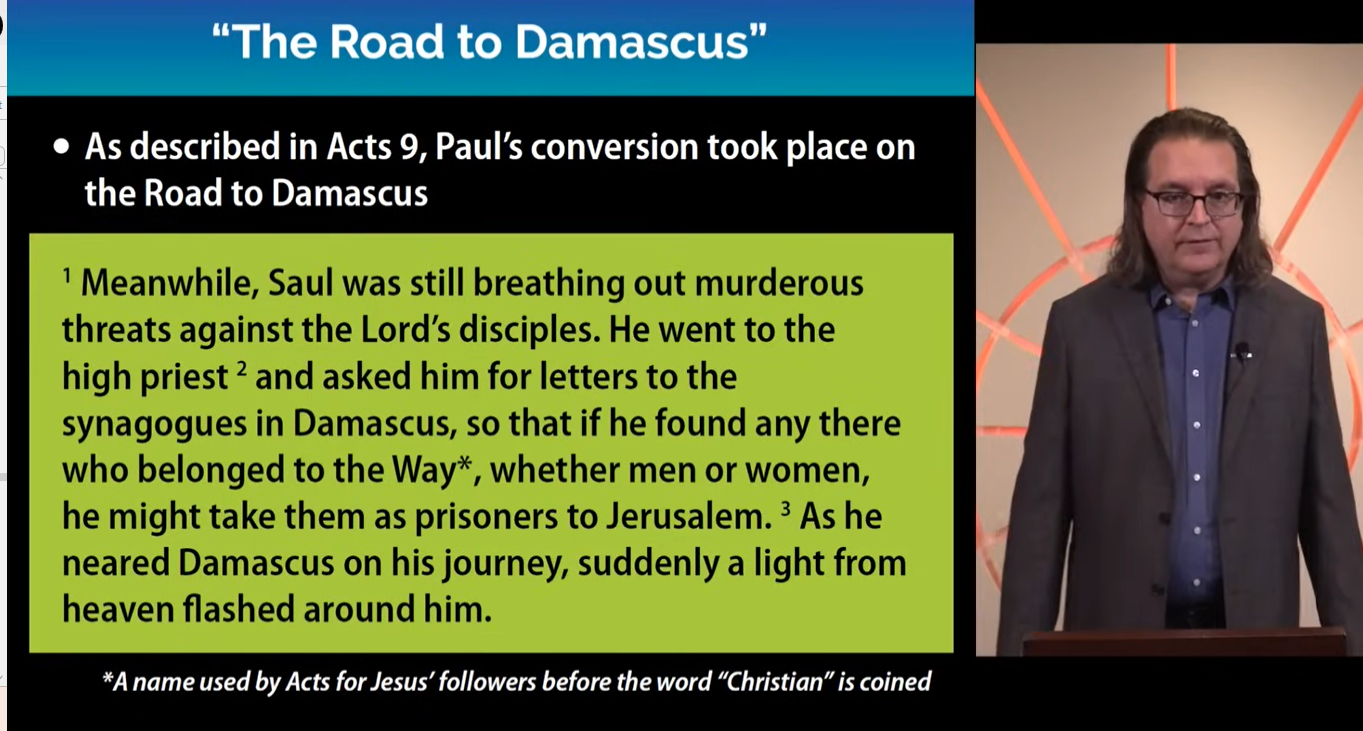 In the book of Acts, we have one of the explanations or descriptions of that conversion in Acts 9. Paul's conversion takes place on the road to Damascus, and as a result of that, a "road to Damascus" experience is a way that we just becomes a euphemism we have in the language generally now for a life-changing experience.
Meanwhile, Saul was still breathing out murderous threats against the Lord's disciples. He went to the high priest of the Jews of Jerusalem and asked him for letters to the synagogues in Damascus so that if he found any who belonged to the Way (this is a euphemism that the author of Acts is using for the followers of Jesus before the word Christian is even coined), he might take them as prisoners to Jerusalem. As he neared Damascus on his journey, suddenly a light from heaven flashed around him. He fell to the ground and heard a voice say to him, "Saul, Saul, why do you persecute me?" "Who are you, Lord?" Saul asked. "I am Jesus, whom you are persecuting," he replied. "Now get up and go into the city, and you will be told what you must do." The men traveling with Saul stood there speechless; they heard the sound but did not see anyone. Saul got up from the ground, but when he opened his eyes, he could see nothing. So they led him by hand into Damascus. For three days he was blind and did not eat or drink anything.
>
“The Road to Damascus”
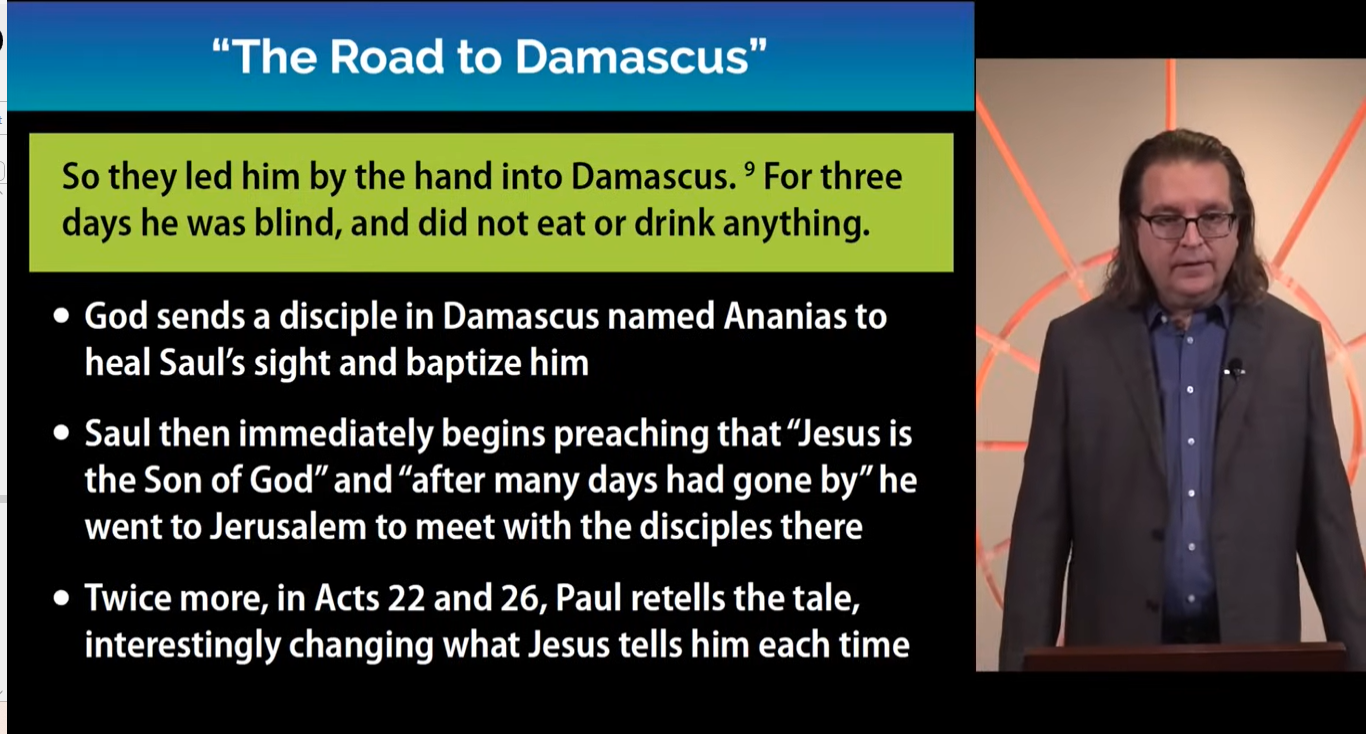 As the story continues in Acts, God sends a disciple in Damascus named Ananias to heal Saul's sight, and he also baptizes Saul. Saul then immediately begins preaching that Jesus is the Son of God, and after many days had gone by, he goes to Jerusalem to meet with the disciples there. That happens very quickly in the Acts narrative. Twice more in Acts 22 and Acts 26, Paul retells the tale, and interestingly, in each case, he changes what Jesus tells him.
Paul's Calling in Acts 26
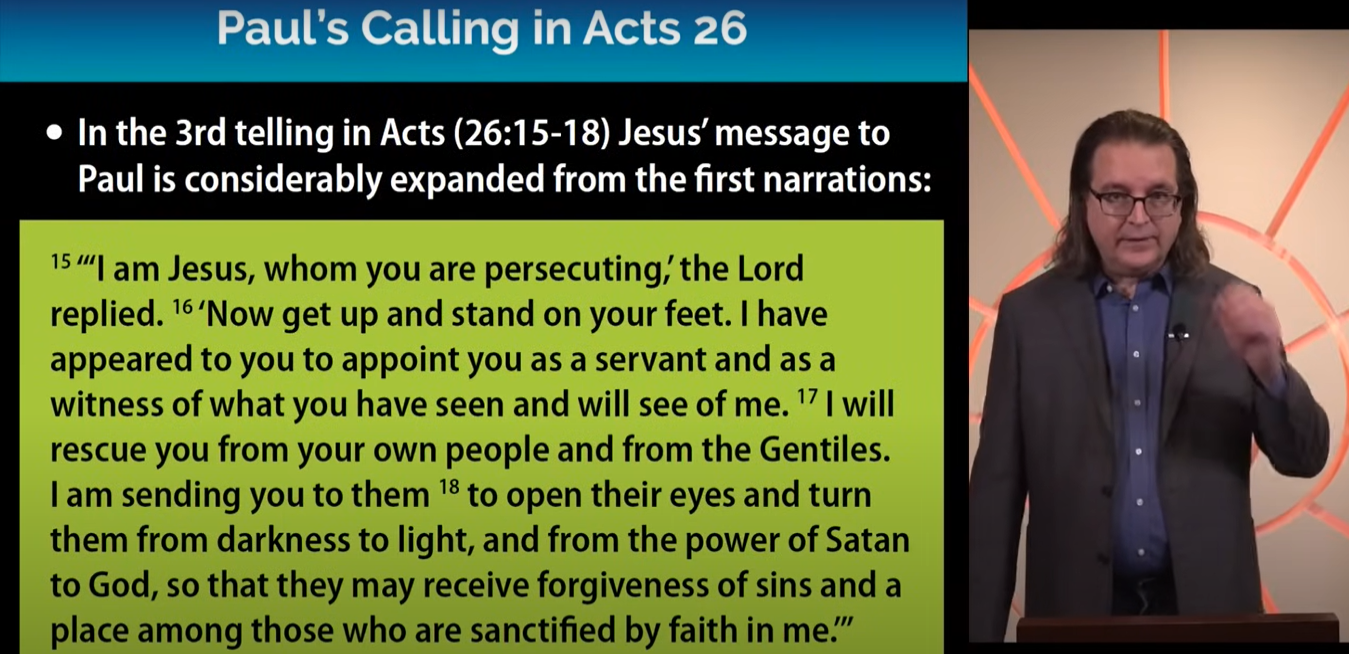
When we get to the third telling in Acts 26, Jesus' message to Paul is considerably expanded from the first two narrations. We hear Jesus this time say,
"I am Jesus, whom you are persecuting," the Lord replied. "Now get up and stand on your feet. I have appeared to appoint you as a servant and as a witness of what you have seen and will see of me. I will rescue you from your own people and from the Gentiles. I am sending you to them to open their eyes and turn them from darkness to light and from the power of Satan to God, so that they may receive forgiveness of sins and a place among those who are sanctified by faith in me."
Paul's Own Account of His Conversion
That's interesting; it's a much bigger calling and visionary statement than what the author of Acts actually gives the first two times they recount this calling.
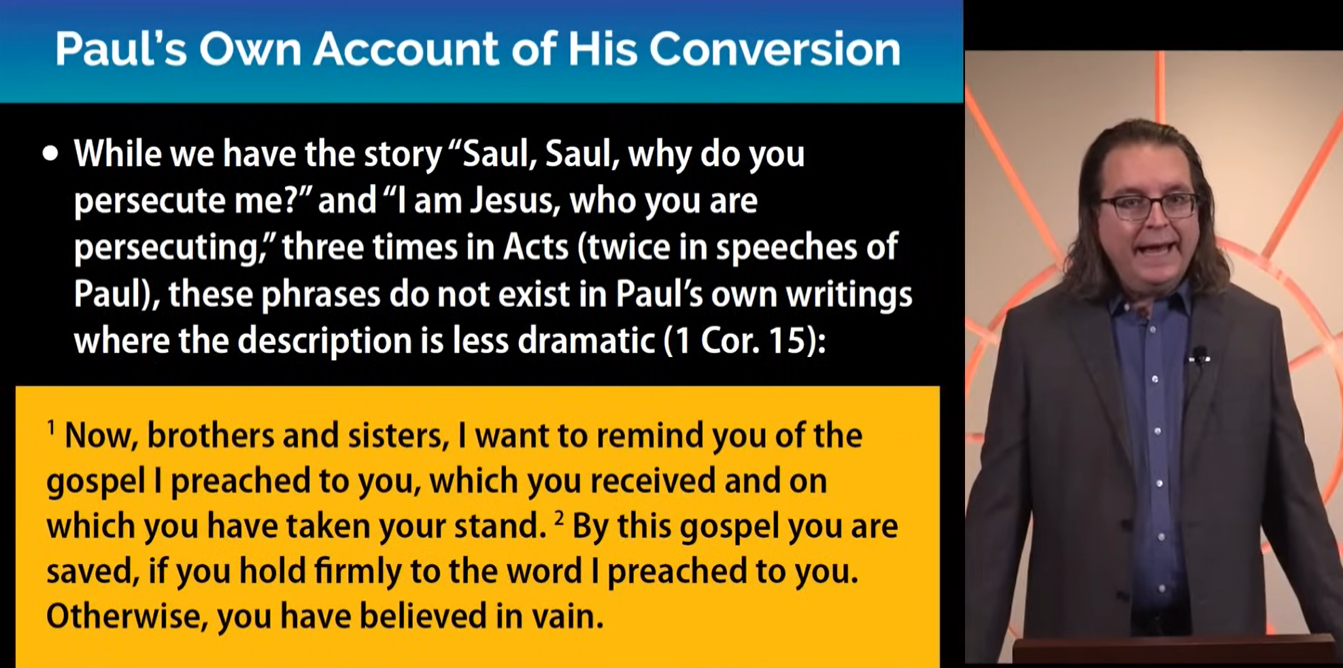 While we have the story "Saul, Saul, why do you persecute me?" and "I am Jesus, whom you are persecuting," that's three times listed in Acts—twice and once when it happens, twice more times when Paul is telling the story in various speeches that the author of Acts writes for Paul—those phrases, those details do not exist in Paul's own writing. He does talk about this experience in his letter to the Corinthians, his first letter to the Corinthians, but he does it in a much less dramatic way. Writing to those members of the church, he says,
"Now, brothers and sisters, I want to remind you of the gospel I preached to you, which you received and on which you have taken your stand. By this gospel you are saved if you hold firmly to the word I preached to you. Otherwise, you have believed in vain. For what I received I passed on to you as of first importance: that Christ died for our sins according to the Scriptures, that he was buried, that he was raised on the third day according to the Scriptures, and that he appeared to Cephas, that is, to Peter, and then to the Twelve. After that, he appeared to more than 500 of the brothers and sisters at the same time, most of whom are still living, though some have fallen asleep. Then he appeared to James, then to all the apostles, and last of all he appeared to me also, as to one abnormally born. For I am the least of the apostles and do not even deserve to be called an apostle because I persecuted the church of God. But by the grace of God, I am what I am, and his grace to me was not without effect. No, I worked harder than all of them, yet not I, but the grace of God that was with me."
While Paul talks about having persecuted the church, the same as we hear in Acts, and testifies that "Christ appeared to me also," and those are both very consistent with the Acts story, he doesn't give a place for when that happened. He doesn't say, "Oh, that happened on the road to Damascus," which is such an important location for talking about this conversion story. Nor does he mention things like seeing a bright light or being struck blind for three days. He also doesn't use this very memorable quotation from Jesus: "Saul, Saul, why do you persecute me?"
Paul's Understanding of His Calling
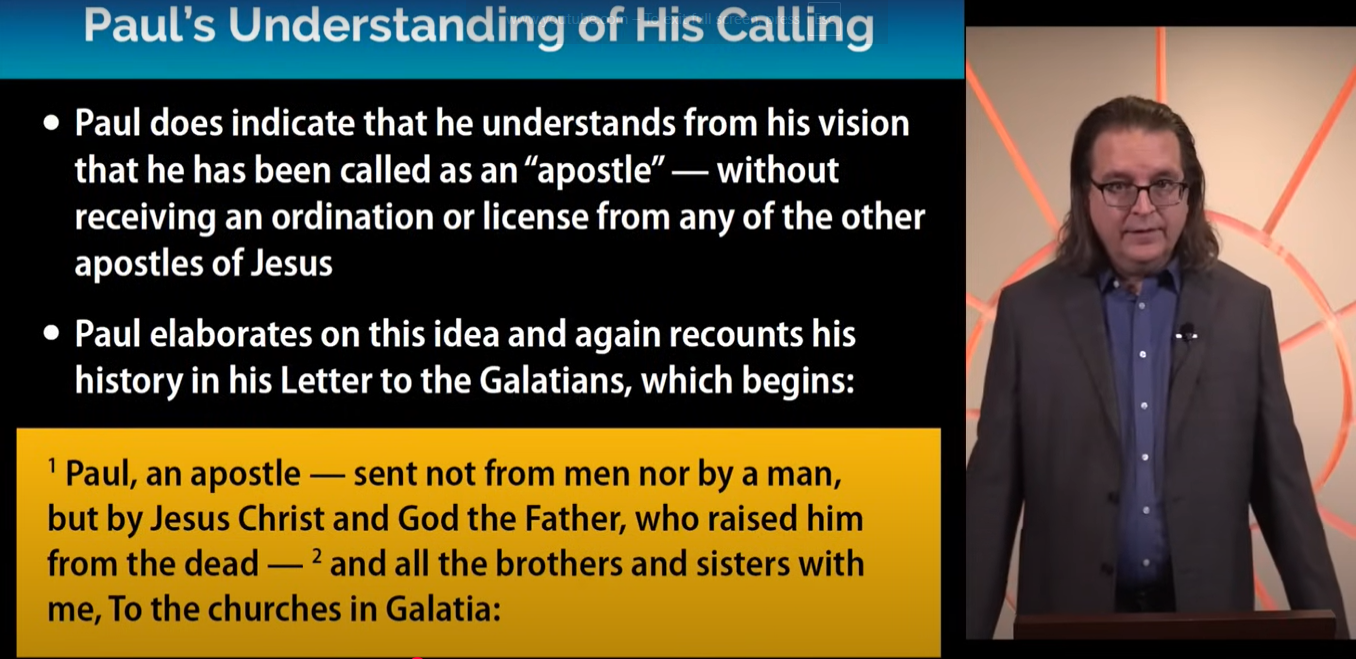 Paul does indicate that he understands that as a result of his vision, he has been called as an apostle, and that has taken place without him, for example, receiving an ordination from any of the other apostles. Nobody's laid their hands on him and given him that calling, and he also doesn't have a license or a letter of recommendation, a card-carrying member or whatever, from any of the other apostles of Jesus.
Paul elaborates on this idea of his calling again in his letter to the Galatians, among his first letters, and that begins,
"Paul, an apostle sent not from men nor by a man," so it's not one of these other apostles who called me and who put his hand on me and made me an apostle, "but by Jesus Christ and God the Father, who raised him, who raised Jesus from the dead." So Paul, an apostle, and all the brothers and sisters with me, so all of Paul's companions in his churches, to the churches in Galatia.
While Paul had originally planted the church in Galatia, rival leaders have come to the community, sowing doubt about whether Paul is a true apostle. As a result, in this text, Paul gives us his own account of his calling and the relationship he has with the other apostles. He says to the Galatians,
"I am astonished that you are so quickly deserting the one who called you to live in the grace of Christ and are turning to a different gospel, which is really no gospel at all. Evidently, some people are throwing you into confusion and are trying to pervert the gospel of Christ."
So I'm the one who converted you guys; I taught you the gospel. Now you're learning a different gospel, but guess what, guys? There is no other gospel. I told you the only gospel there is. There are some people who are trying to pervert the gospel and confuse you.
Paul Meets Peter & James after 3 Years
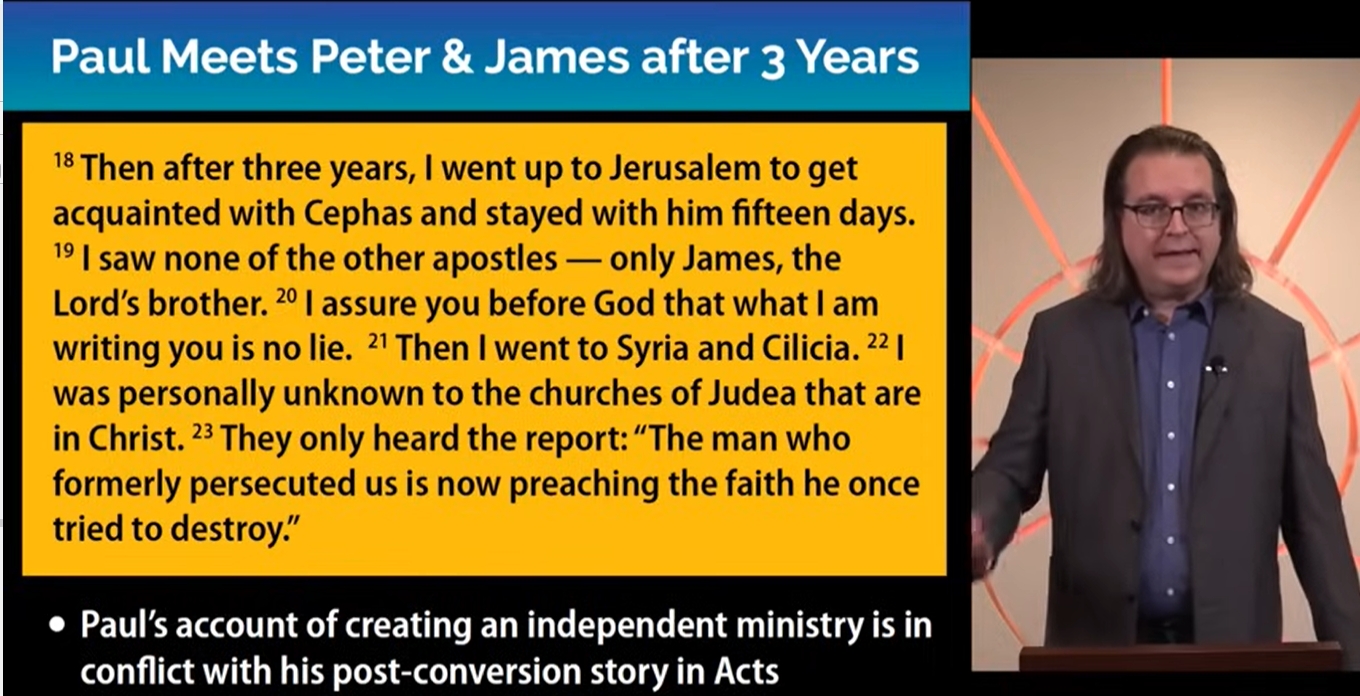 I'm missing a slide. Okay, so anyway, we'll just go back and say there's a what ends up happening here is that after his conversion, after he has that experience where he says that he saw Jesus, he says, "After three years, I went up to Jerusalem to get acquainted with Cephas, and I stayed with him 15 days." In other words, only after he was initially had that visionary experience, the way he tells it, he went away to Arabia for three years, and he started planting churches. Then he went finally after the three years to Jerusalem, where he met Peter, and he stayed with Peter. "I saw none of the other apostles, only James, the Lord's brother." So he met Peter and James. "I assure you before God that what I am writing to you is no lie. I then went to Syria and Cilicia." That's where I started planting churches: Arabia, Syria, and Cilicia. "I was personally unknown to the churches of Judea that are in Christ. They had only heard the report: 'The man who formerly persecuted us is now preaching the faith he once tried to destroy.'" So Paul's account here is that he created an independent ministry, and so that's pretty much in conflict with the story of his post-conversion in Acts, where he immediately is baptized by and encountering all of these other disciples and goes and meets with people in Jerusalem after a few days. It's operating a little differently here.
Paul's Limited Contact with Jerusalem
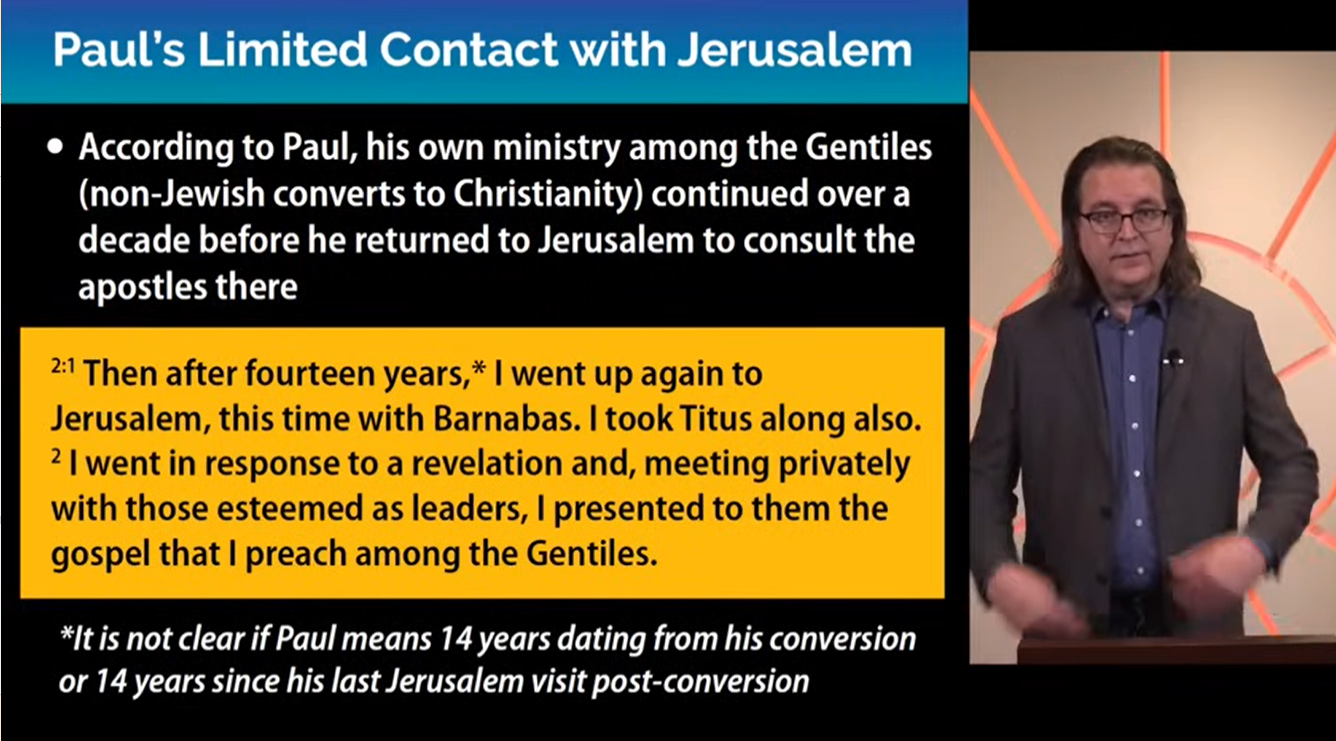 According to Paul, his own ministry among the Gentiles, converting non-Jewish converts to Christianity, continued for a decade before he returned to Jerusalem to consult the other apostles there. He says, then, and continuing his letter here to the Galatians,
"Then after 14 years, I went up again to Jerusalem, this time with Barnabas. I took Titus also along. I went in response to a revelation, and meeting privately with those esteemed leaders in Jerusalem, the leaders of the Jerusalem church, I presented them with the gospel that I preach to the Gentiles."
So, you know, this is a next visit in his own writings. It's not clear if Paul means that this is 14 years from his conversion or 14 years from the last time he visited Jerusalem. It probably, to make the math work, it probably means 14 years from his conversion.
Timeline of Paul’s Ministry
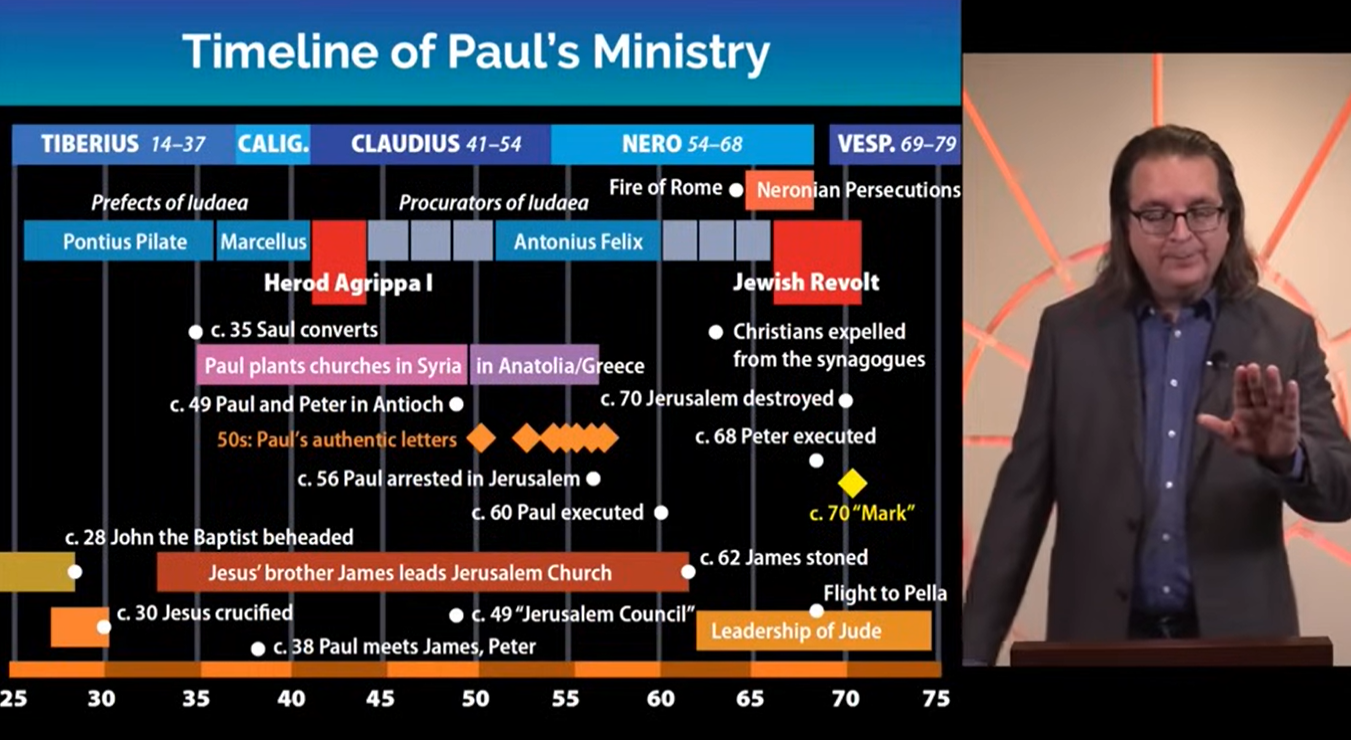 If we look then at kind of how this is going on, we had said here Paul has this conversion experience in 35. He then begins planting churches in Arabia. Then in 38, you can kind of see at the bottom right here, Paul goes to Jerusalem. He meets only with, he lives with Peter for a few days, and he meets only with James. He doesn't see any other apostles, according to his own account. Then he goes back and goes to Syria and Cilicia, planting more churches. Then maybe around the year 49, he has this period where he has to go to Jerusalem, or he describes how he went there in response, he says, to a revelation, and he meets with those esteemed leaders. Who's there? This is sometimes called the Jerusalem Council, and so maybe this is taking place 14 years or so after Paul's conversion in the year 49, and then this is before all of his letter writing. So this moment that takes place with him in Jerusalem and meeting with all of the esteemed leaders of the Jerusalem church is pretty relevant to the rest of his ministry.
What Is An “Apostle"?
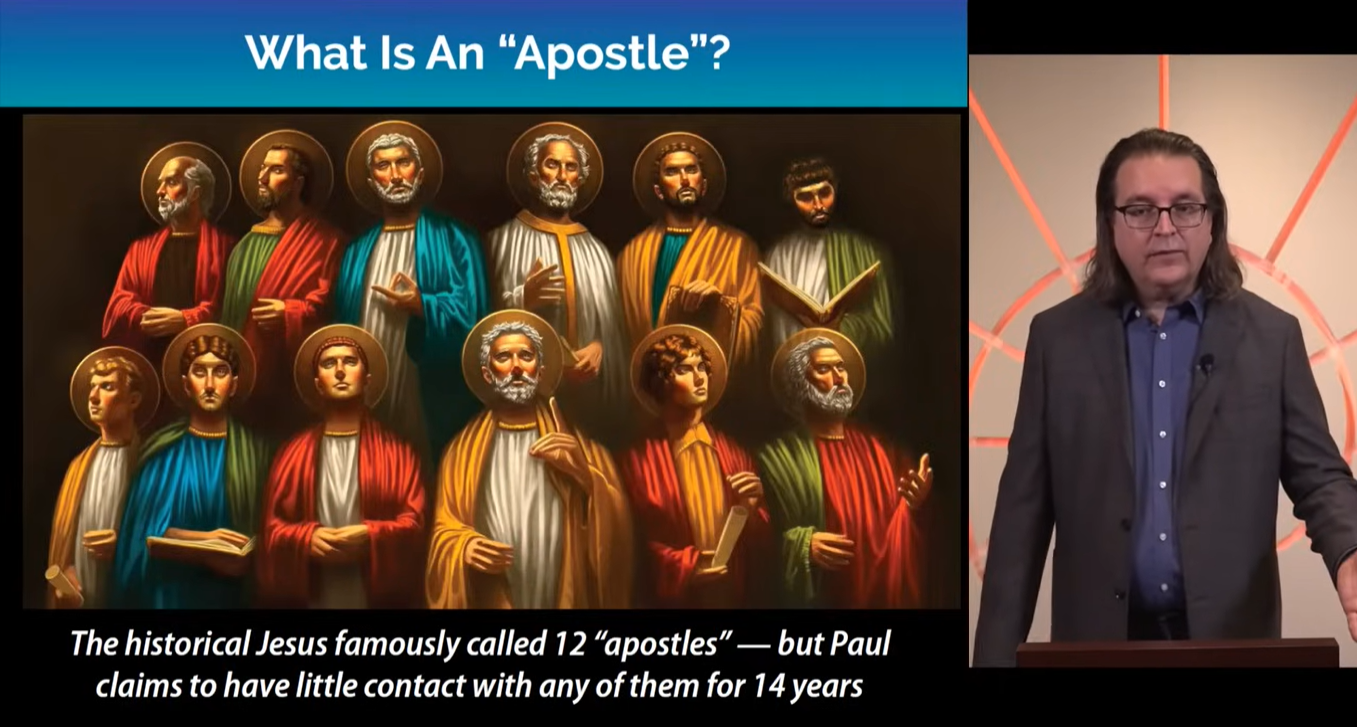 To get at that into the context of it, I want to look at those other apostles, these other leaders who are now challenging Paul and who Paul feels the need to meet with. So what is an apostle? We had a whole lecture on this, but I want to just do a little bit of a shorthand of it. The historical Jesus famously called 12 apostles, but as we've seen here, Paul claims to have had little contact with any of them for the first 14 years of Paul's own ministry as an apostle. So he's not claiming that he was one of the 12, even though he is claiming that he is an apostle. So how many apostles are there? There's not just 12. In fact, there were many, many more than 12 apostles in the first generations of Christianity.
Many, Many More than Twelve Apostles
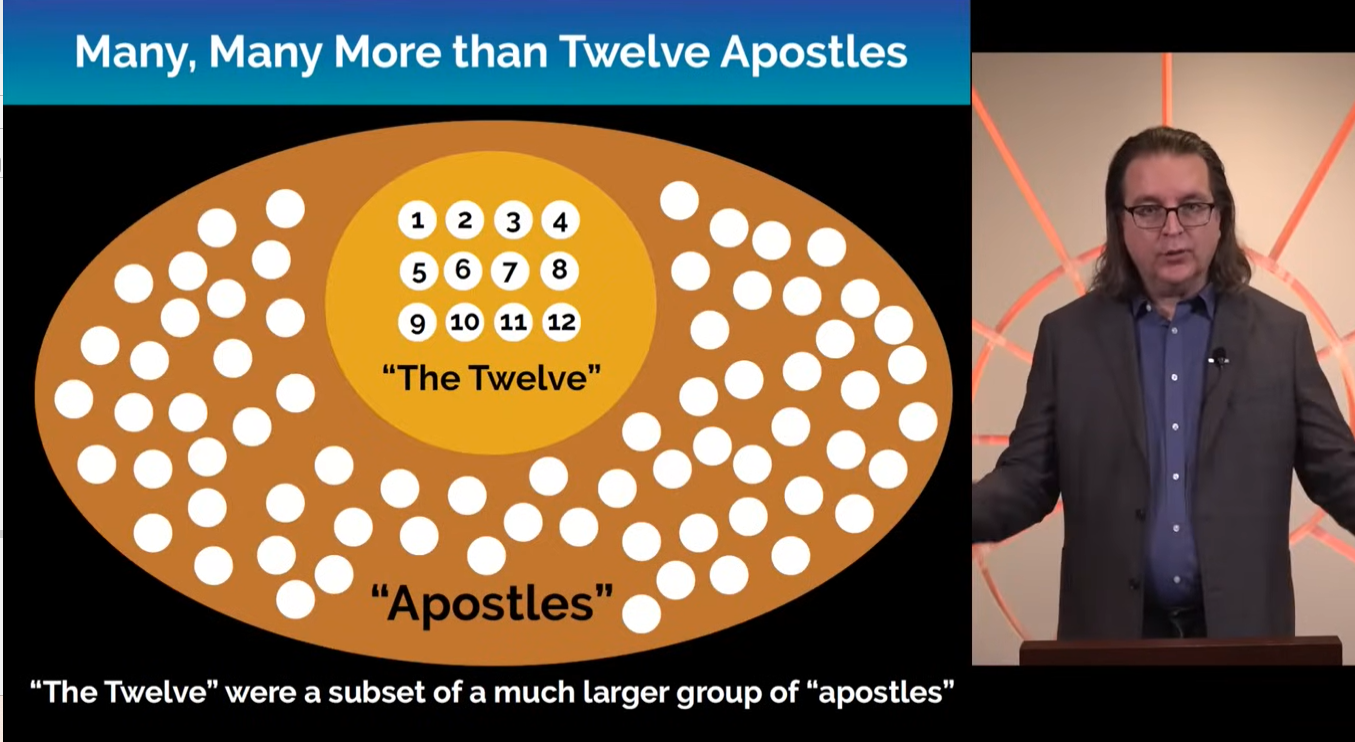 The 12 were simply a subset of a much larger group of apostles. The 12 were set apart specifically by Jesus to symbolically represent the new Israel, the 12 tribes of Israel symbolically, but it's only 12 of his much wider group of apostles. So what's the rest of the apostles? What is it to be an apostle? Oh yeah, I'll point out here, Paul would have been one of these other apostles, not one of the 12, even though he often makes a list of the 12, and if you're going to have artwork on the side of a cathedral, sometimes Paul will be, you know, the second most important of the 12 that's listed, but it's only because a lot of the apostles aren't, a lot of the 12 didn't end up being that important, and we've seen before how we have a, we don't even have a one single list of them anyway.
What Was an “Apostle"?
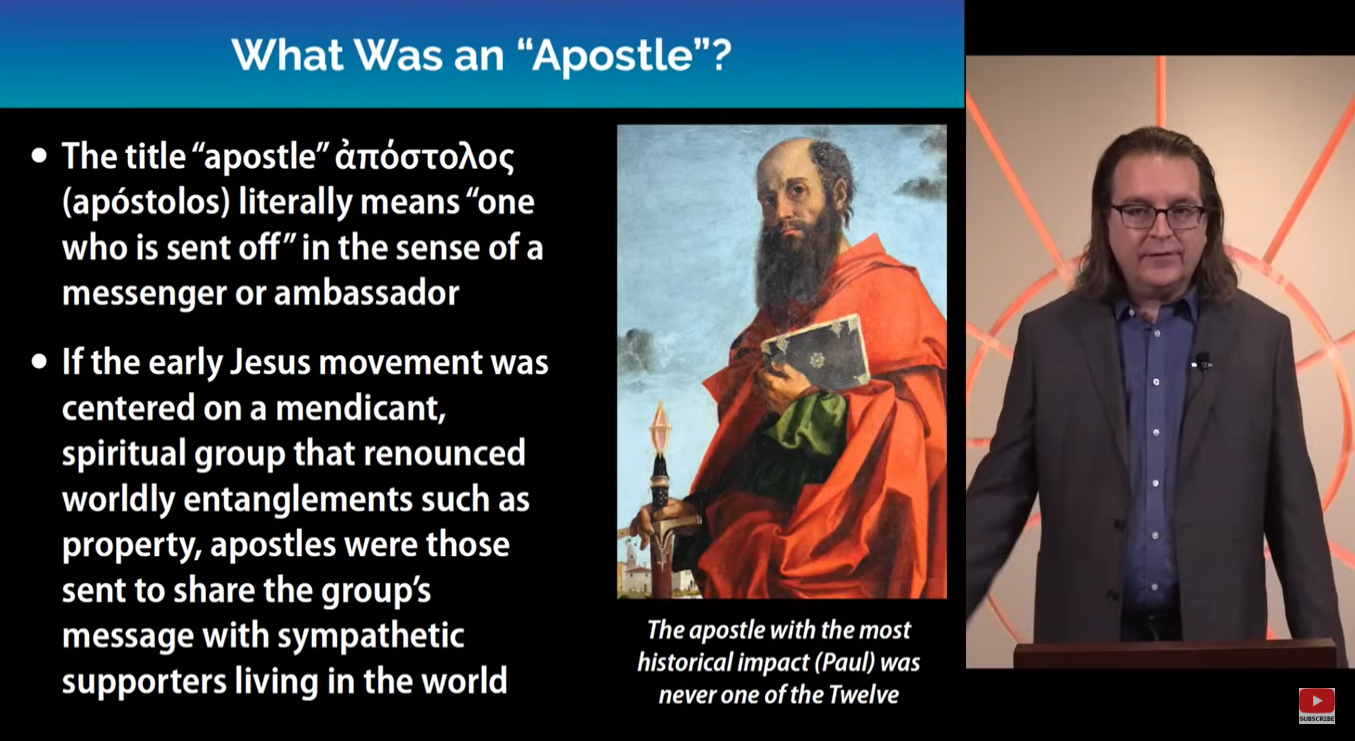 So what's an apostle? The title "apostolos" literally means "one who is sent off," the Greek original of this word, and it sort of has the same sense of being a messenger or an ambassador. So if the earliest Jesus group is sort of centered on a mendicant, which is a begging spiritual group that had renounced worldly entanglements such as property and who are praying "give us this day our daily bread," they're operating a little bit like mendicant friars, so like a Franciscan monk or like a Buddhist monk. The apostles were the people who were fully committed to that begging lifestyle, who gave away all their property to the poor to live this spiritual life, who then were sent to share the group's message with all sorts of a wider circle of sympathetic supporters who are living in the world, who are able to have regular jobs and who are able to give food and other supplies to the central core of the apostles.
Gospel Descriptions of the Apostolic Role
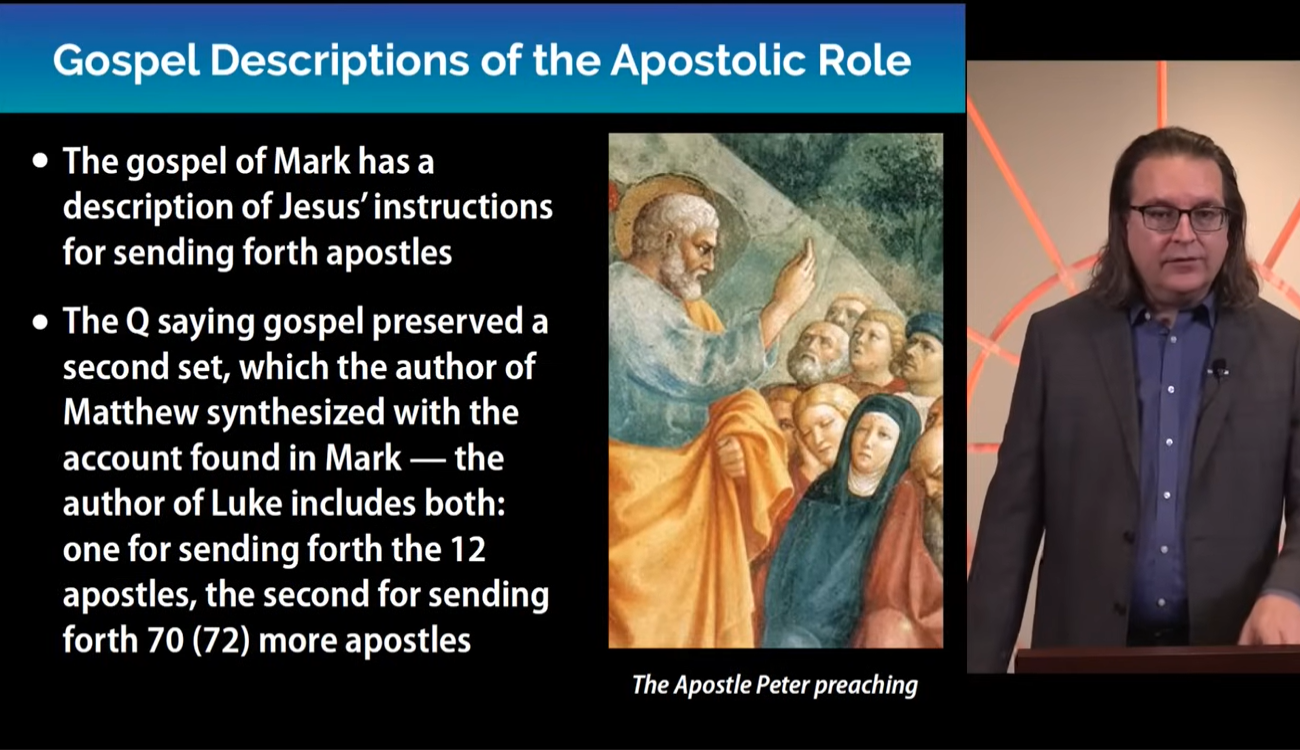 The Gospel of Mark has a description of Jesus' instructions for sending forth the apostles, and then we have from the sayings gospel Q a second set, and we can say it's from Q because we have it surviving in Matthew and also in Luke. So the author of Matthew synthesized the Q version together with Mark, whereas the author of Luke includes both the Q version separately from Mark and also Mark. So the way Luke explains that is that the first one, Mark's version, regards the sending forth of the 12 apostles, and the second sends forth another 70 or 72 more apostles. The idea already that's in the canonical gospels is that there's a much wider group of apostles.
Description in Mark 6:7-13
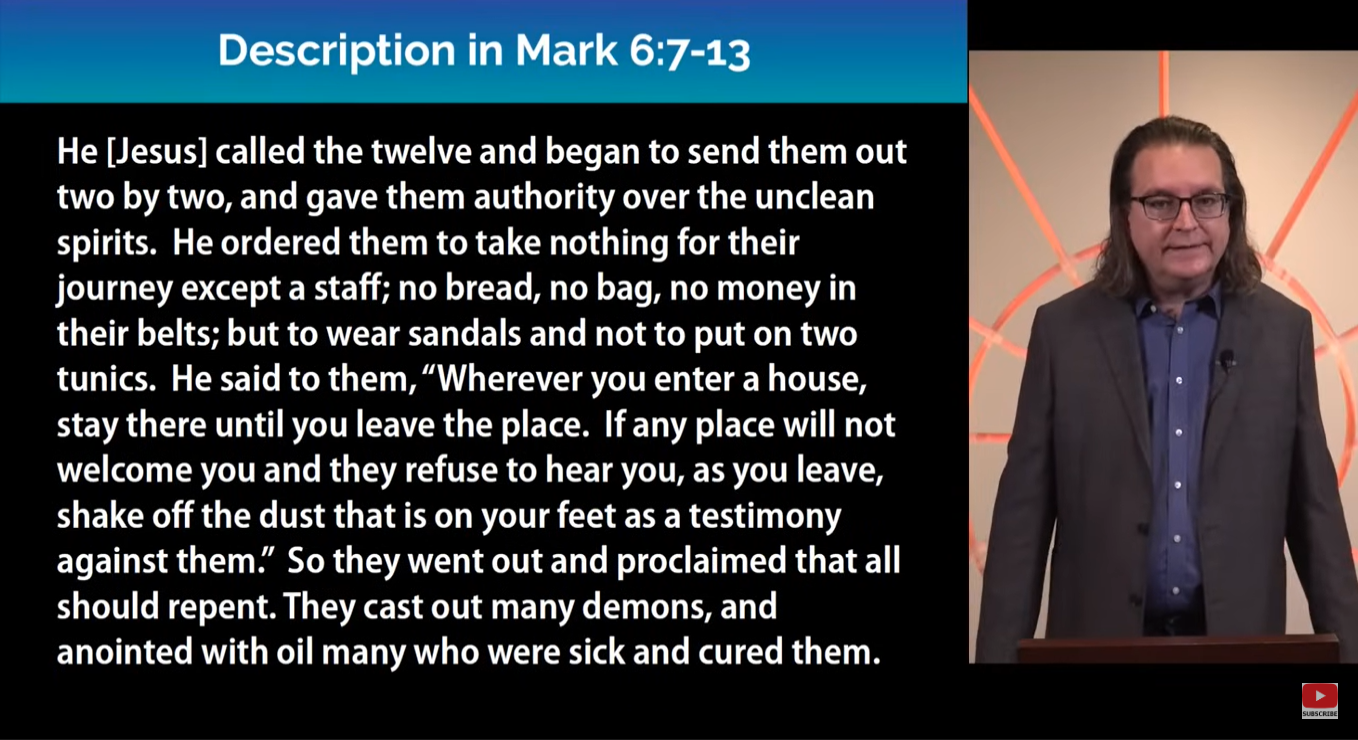 If we look at what the instructions are from Mark, we read, "Jesus called the 12 and began to send them out two by two, and he gave them authority over the unclean spirits. He ordered them to take nothing for their journey except a staff, no bread, no bag, no money in their belts, but to wear sandals and not to put on two tunics." So they are really supposed to not take anything with them because they're going to live by begging. In other words, he says to them, "Whenever you enter a house, stay there until you leave that place. If any place will not welcome you and they refuse to hear you, as you leave, shake off the dust that is on your feet as a testimony against them." So they went out and proclaimed that all should repent. They cast out many demons and anointed with oil many who were sick and cured them.
Spiritual Emissaries Authorized by Jesus
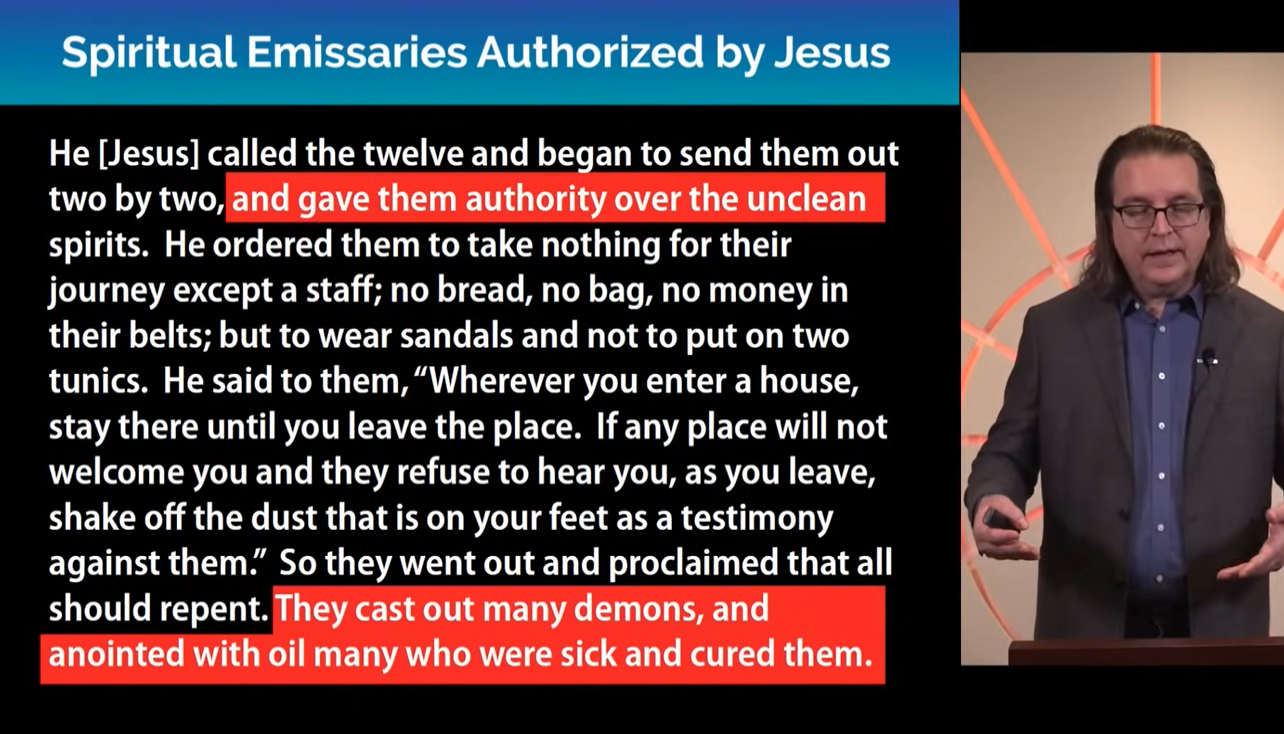 Part of this then is a spiritual task. Jesus gives these apostles authority over unclean spirits. They cast out the demons, they heal the sick, and so forth. They're bringing people, inviting people who are outcast into community again.
Sent Out in Pairs, Proclaiming the Message
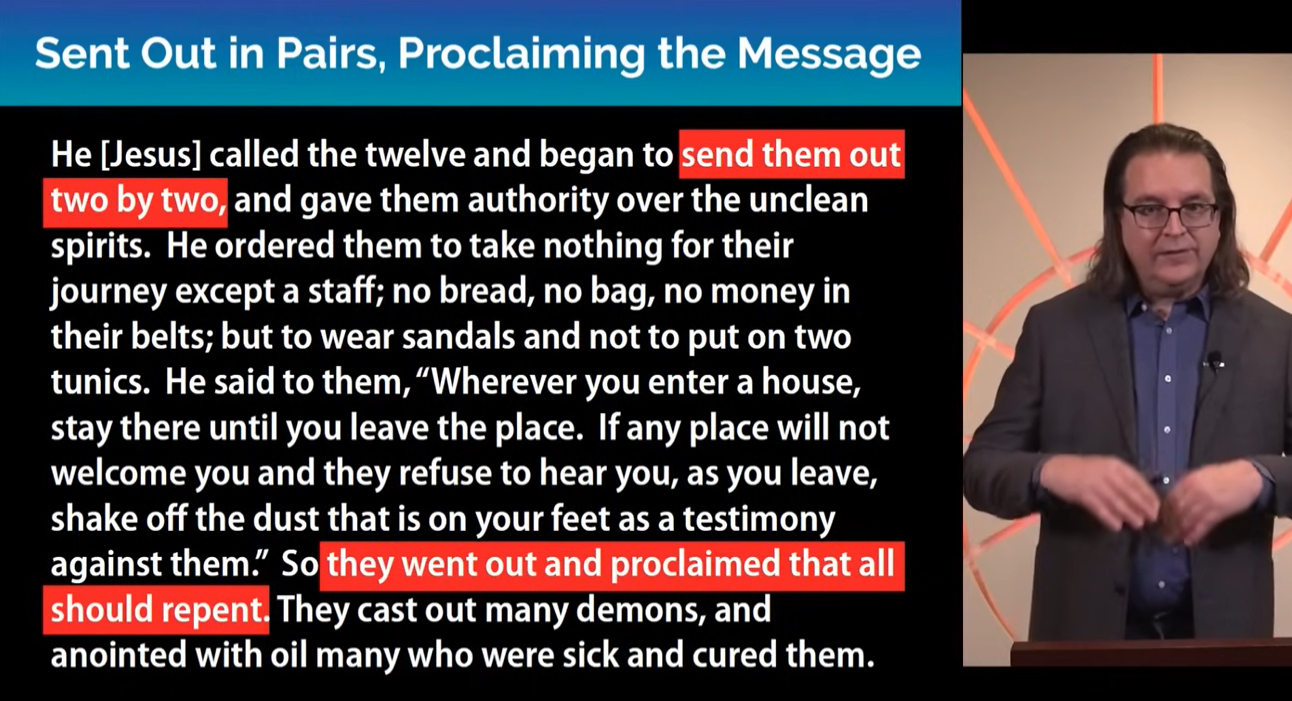
They are sent out by twos, so they go in companions together, and they're going around and saying, "Repent." So they are saying, "Turn your life around. We are now sharing essentially the good news of what's going to become the Christian gospel."
Mendicant/No Property*/Live by Donations
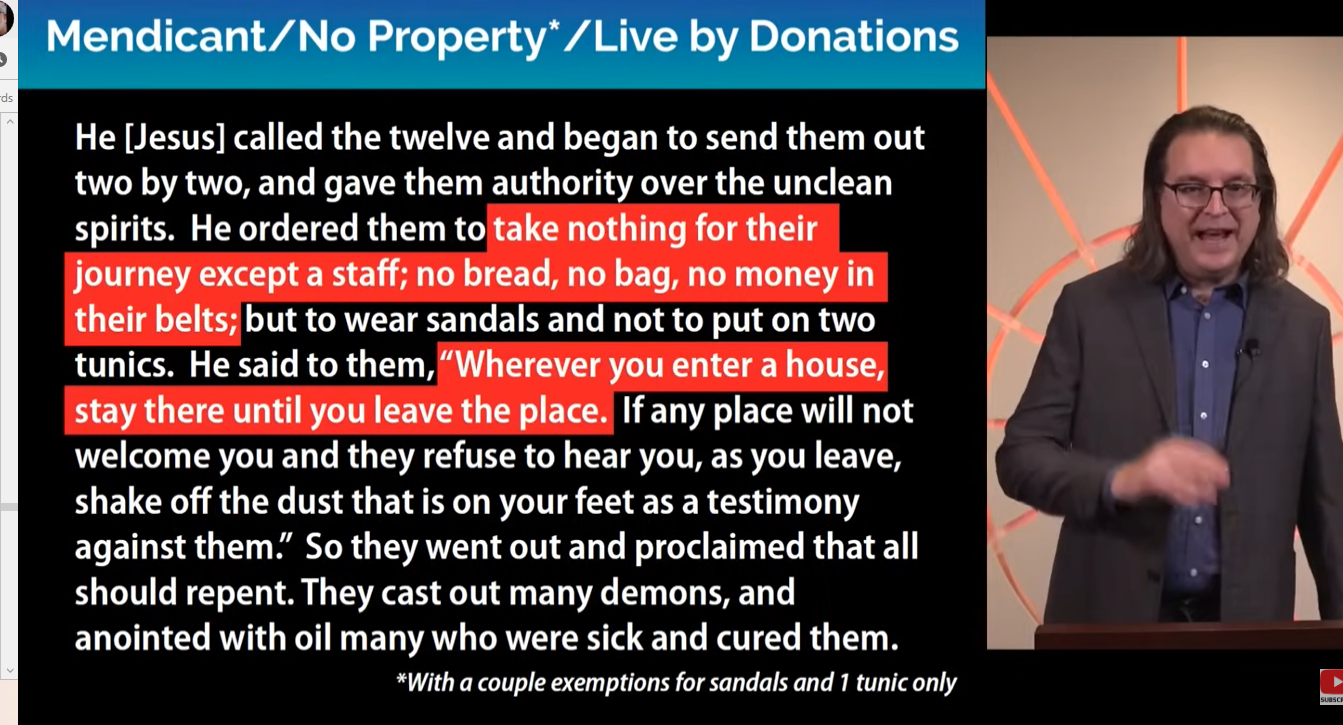
Again, they're mendicants, so you're not going to take a staff, no bread, no money, no bag, even on your belts. Even once somebody invites you to stay with them, then you have to stay in that house until you leave the place. You can't just keep getting, "Oh, well, I got a better offer now," until you leave that person. It's whoever first comes first serves in terms of a person providing you charity. You're living by donations, not with property.
Description from the Didache
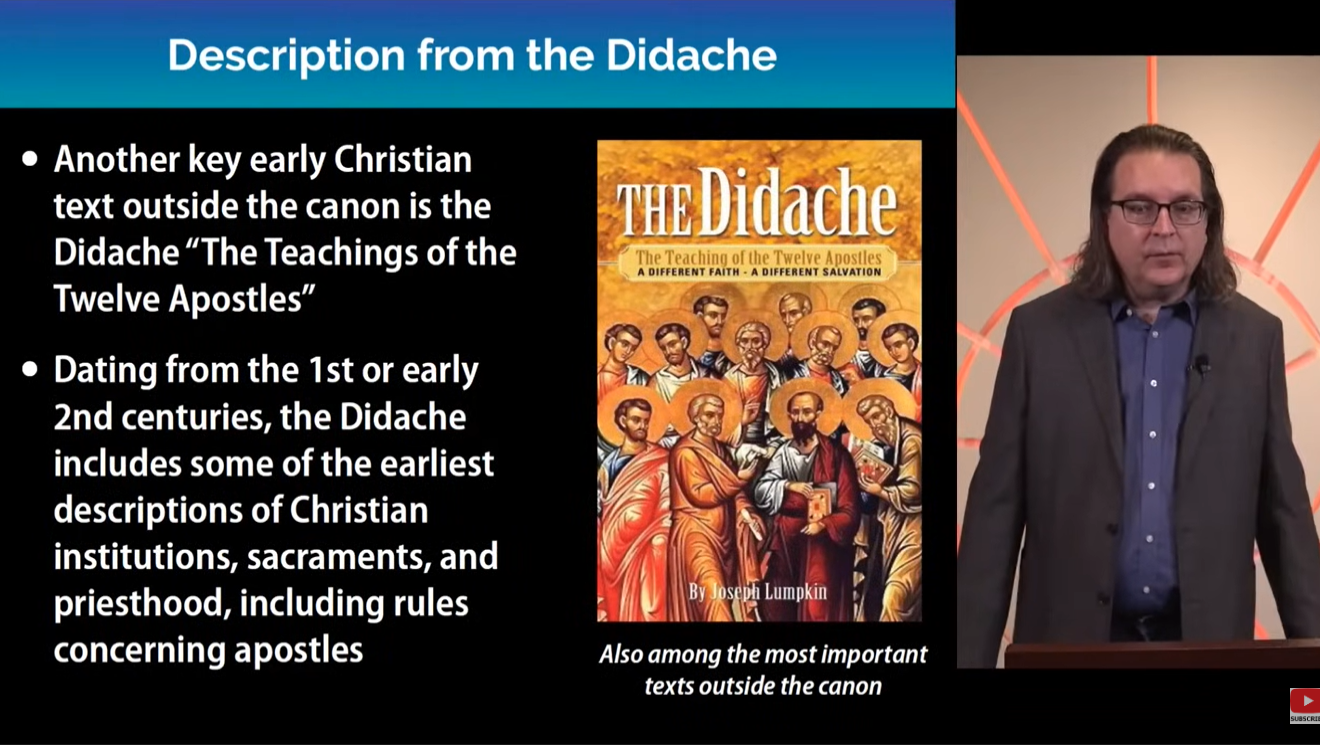 There's another key early description in one of the most important first-century texts of Christian sources that didn't make it into the Bible, the Didache. It's also called the Teaching of the Twelve Apostles. We had a whole lecture on the Didache. The Didache dates from either the first century or maybe the early second century. Maybe there's parts of it that are from the first, and then it continues to be edited. The Didache includes some of the earliest descriptions of Christian institutions. It talks about what the sacraments are, how to perform sacraments, talks about priesthood and rules for priesthood members, including rules about apostles.
Didache Chapter 11: Apostles & Prophets
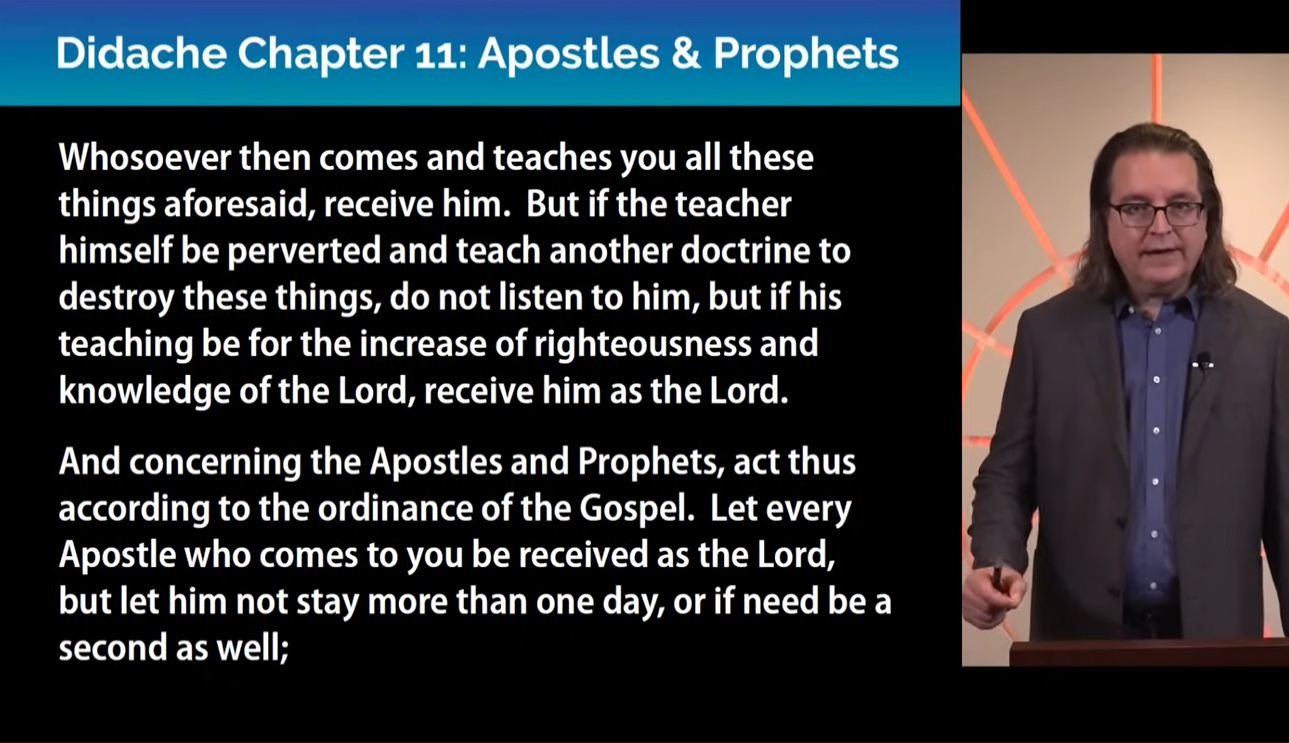 The Didache, in its chapter 11, says this about the role of apostle and prophet:
"Whosoever then comes and teaches you all of these things aforesaid, receive him. But if the teacher himself be perverted and teach another doctrine to destroy these things, do not listen to him. But if his teaching be for the increase of righteousness and the knowledge of the Lord, receive him as the Lord." So they're already worried that they're getting bad prophets. You have to tell the difference between a good apostle and a bad apostle. "Now concerning the apostles and prophets, act thus according to the ordinance of the gospel. Let every apostle who comes to you be received as the Lord." This is a very big deal. You're receiving him as if he's the Lord, right? So this is an important role that this mendicant spiritual beggar is having. "But let him not stay more than one day, or if need be, a second as well." So he can come, and you can give him a place to stay overnight and so forth, maybe even a second day. "But if he stays three days, he is a false prophet. And when an apostle goes forth, let him accept nothing but bread till he reaches his night's lodging. But if he asks for money, he is a false prophet. Do not test or examine any prophet who is speaking in the spirit, for 'every sin shall be forgiven, but this sin shall not be forgiven.'" So he's preaching by the spirit, and he says something. You're supposed to pay a lot of attention to it. But it cautions here, "Not everyone who speaks in the spirit is a prophet, except he have the behavior of the Lord. From his behavior, then, the false prophet and the true prophet shall be known."
So you can see by the time the Didache is even getting written, there's problems in this role of a prophet and apostle, this person who's going around in twos, begging, preaching by the spirit, who you're supposed to receive as if they're the Lord. You're not supposed to question what they speak by the spirit because it won't be forgiven. But now there's a lot of exceptions here. You know, he may not be a true prophet. He's asking for money. He's a false prophet. All those kinds of things. So we're already in this period when people are getting more tired of these prophets, these apostles, and we're going to get to a time in the second century when they no longer exist, when this no longer becomes part of Christianity. But it's here at the beginning.
Didache Chapter 11: Apostles & Prophets
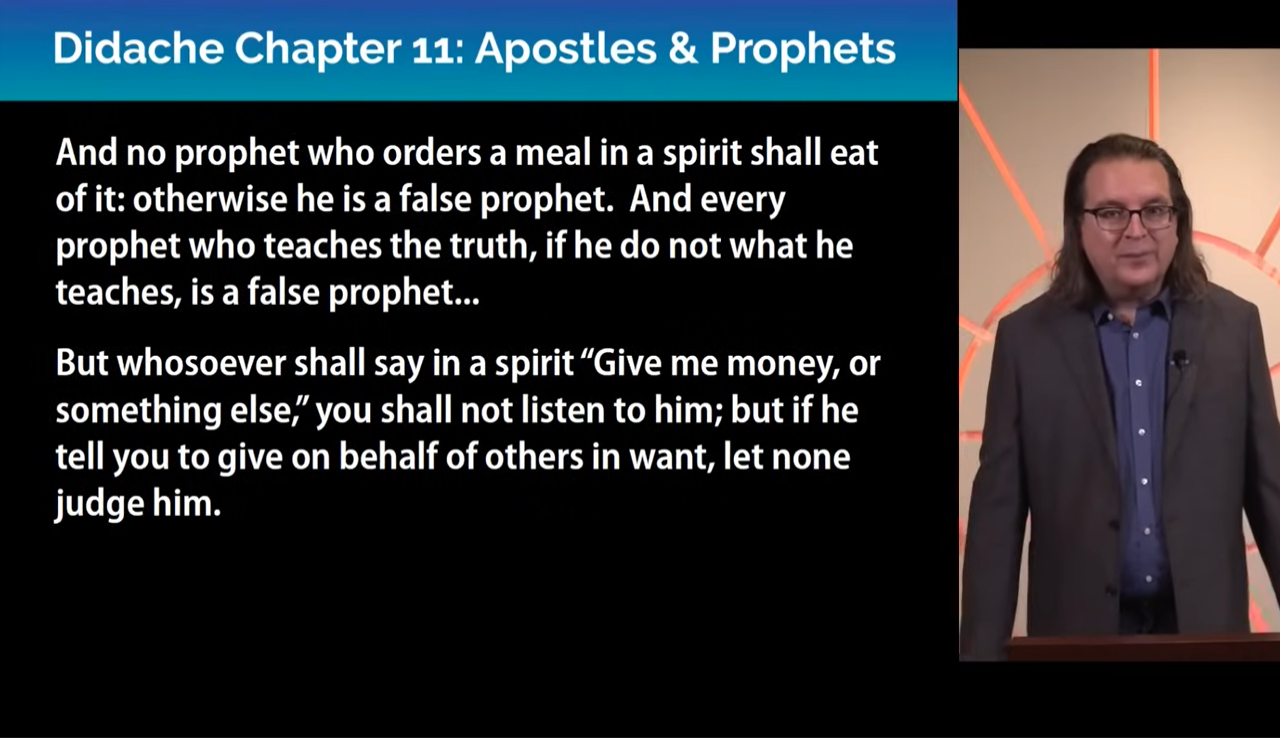 Here's another part of this:
"No prophet who orders a meal in the spirit shall eat of it; otherwise, he is a false prophet." So don't have him, if he preaches, "Thus saith the spirit, give me, bring a whole slab of roast beef," then he's not a prophet. "And every prophet who teaches the truth, if he does not do what he teaches, he's a false prophet." So he also has to practice what he preaches. If he's telling you to all do this kind of thing, and then you see him not do it, then he's a false prophet. "Whoever shall say in a spirit, 'Give me money or give me something else,' you shall not listen to him. But if he tells you to give on behalf of others in want, let none judge him."
>
Excuse me. So you can kind of see, even just here in the text, what some of the red lines are, right? So if a person here is trying to take advantage of you by asking for money, that's when you know they're not a prophet and so or not an apostle.
Original Apostles: Both Male & Female
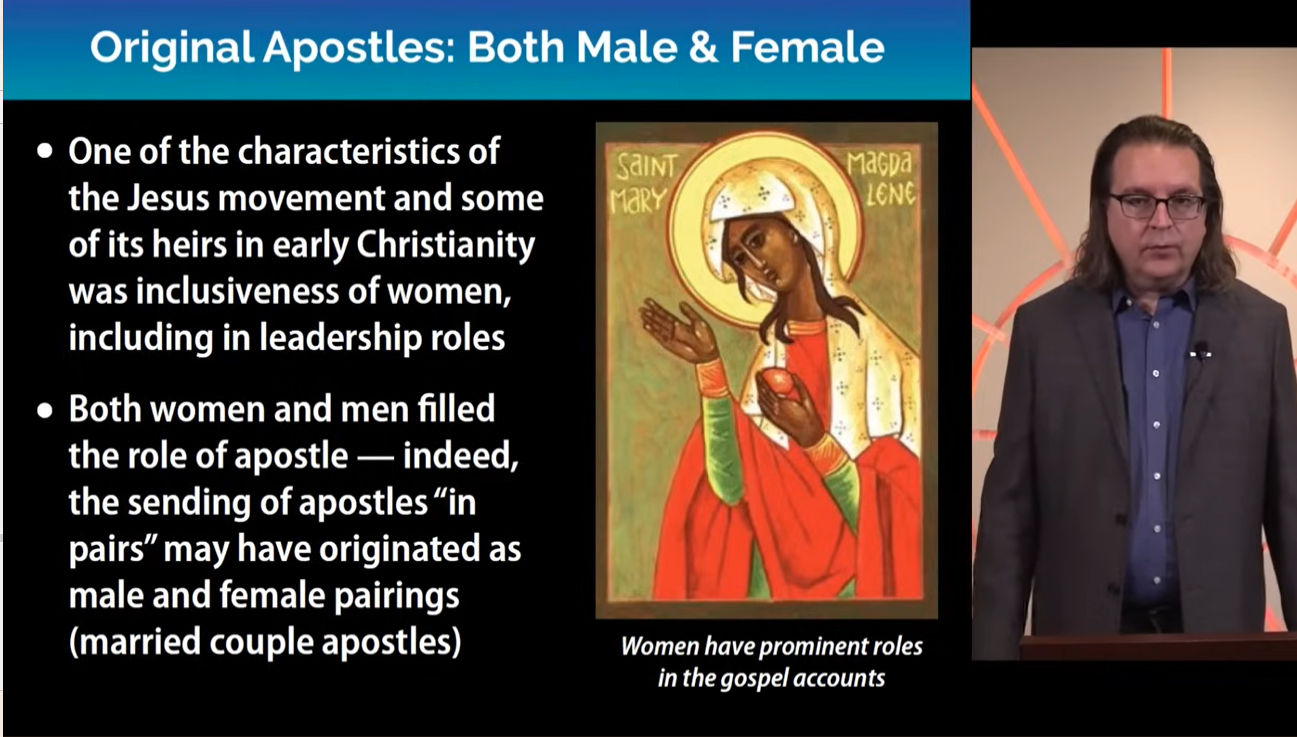 One of the characteristics of the Jesus movement and some of its heirs in early Christianity is the inclusiveness of women, including in leadership roles, including apostles. So both women and men filled the role of apostle, and actually, the whole idea of sending apostles in pairs may have originated as having male and female pairings, so married couples going off together as apostles.
Paul’s Description of the Rights of Apostles
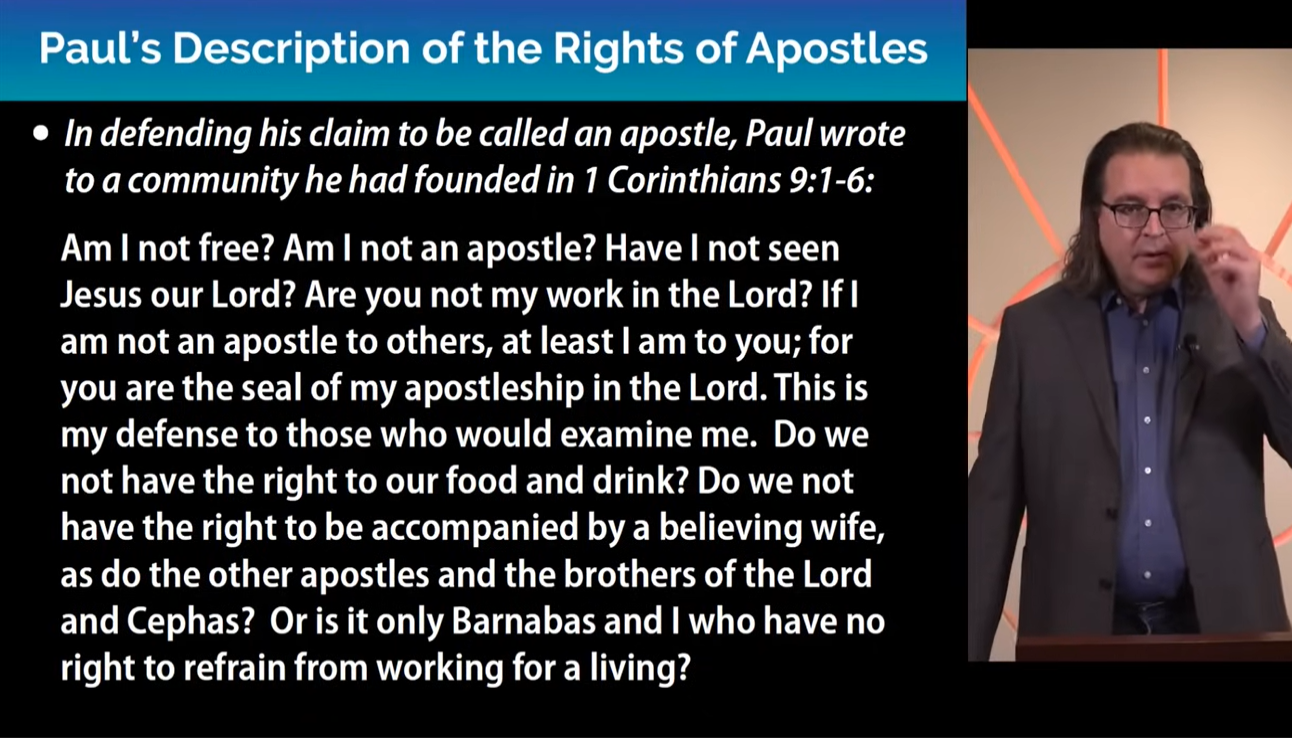 Paul talks about that in Paul's writings to the Corinthians. Paul says, "Am I not free? Am I not an apostle? Have I not seen Jesus our Lord? Are you not my work in the Lord? If I am not an apostle to others, at least I am to you." So he's having to defend there. Some of these apostles are saying Paul's not a real apostle. "But at least my own church here, the Corinthians, you who I have founded, I'm an apostle because you have listened to me, and you, for this, you are the seal of my apostleship in the Lord. The fact that you have become Christian because I have brought this message to you, I brought the gospel to you, that actually makes me an apostle. This is my defense to those who would examine me." And then he says, "Do we not have the right to our food and drink?" So people, can I come, I beg you, give me food and drink. "Do we not have the right to be accompanied by a believing wife, as do the other apostles and the brothers of the Lord and Cephas? Or is it only Barnabas and I who have no right to refrain from working for a living?" So people have criticized Paul for how he's practicing being an apostle, but he's saying, "Yeah, I'm not married. I'm going around here with a companion, Barnabas, but all of the other apostles, including Peter and the brothers of the Lord, they are all going around in twos with their believing wives. So I'm not married, but I have these male companions that I'm going around with in that same way." So this sort of is an example of Paul talking about his competitors, the original apostles, the brothers of the Lord, Peter, and so forth, who are traveling in pairs with, in some cases, a believing wife.
Male & Female Apostolic Pairings
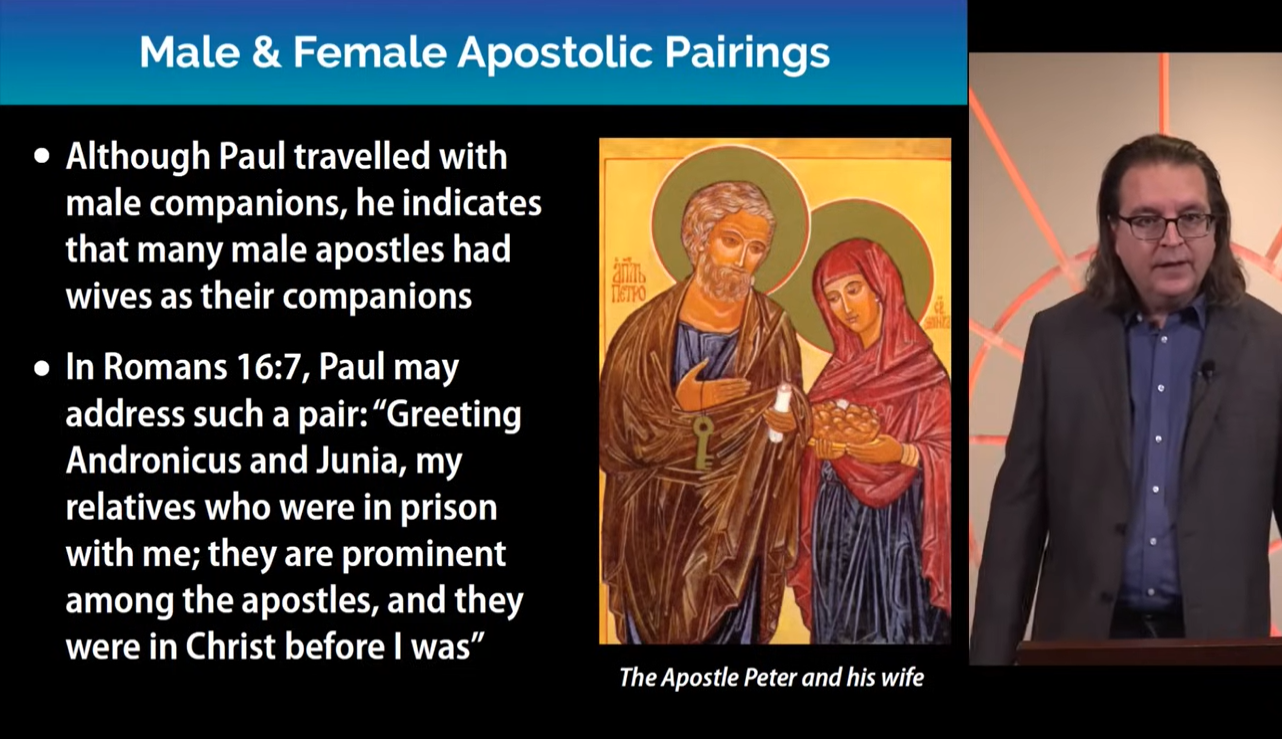 Although, like I say, Paul travels with male companions, many of the apostles have wives as companions. Paul also may address a pair like this in his letter to the Romans. So he says in the letter to the Romans, as he's greeting a bunch of people, "Greet Andronicus and Junia, my relatives who were in prison with me. They, Andronicus and Junia, were prominent among the apostles, and they were in Christ before I was." So there's an apostle here, Junia, and her husband, presumably Andronicus, who Paul calls relatives and who actually says that they were Christian before he even was, and now they are prominent among the apostles.
Additional Missionary Pairings
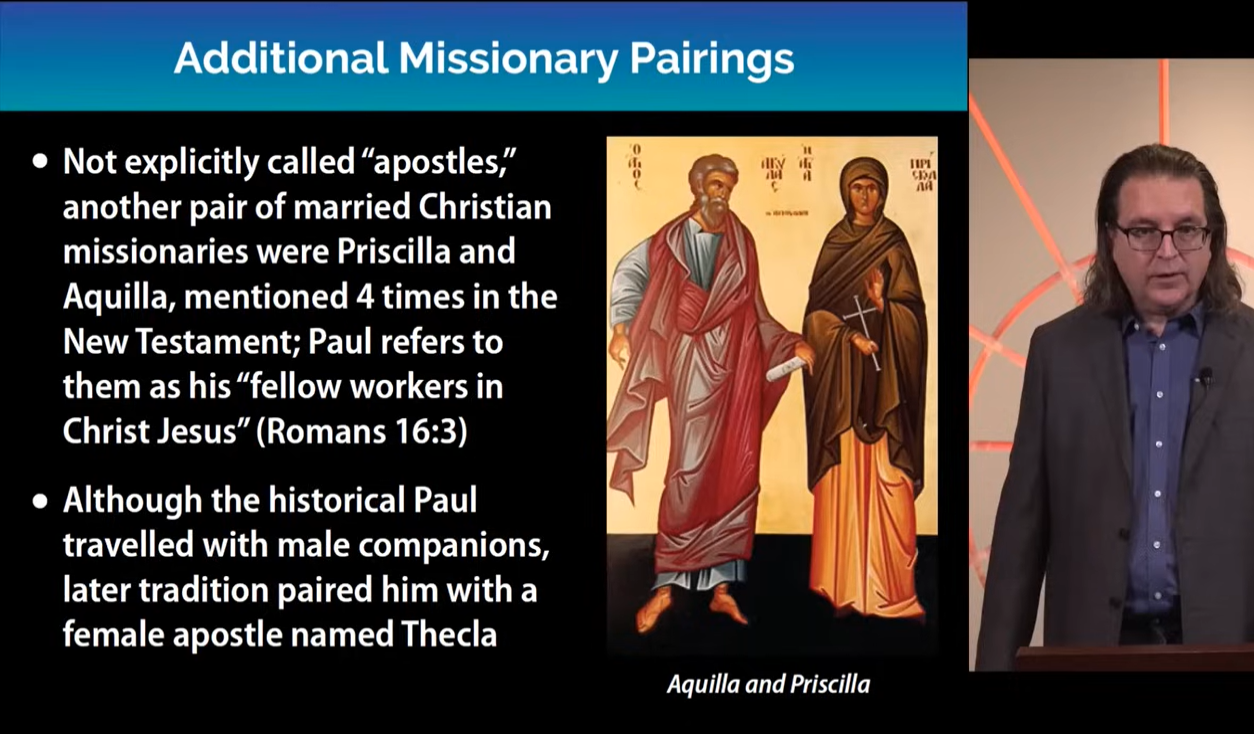 So there is a New Testament woman apostle, although not explicitly Paul's apostles. Another pair of married Christian missionaries are Priscilla and Aquila, who are mentioned four times in the New Testament. Paul refers to them as his fellow workers in Christ, again in the letter to the Romans. Like I say, although the actual historical Paul traveled with male companions, later tradition actually has him paired with a female apostle named Thecla. So there's an entire apocryphal book of the Acts of Paul and Thecla. It's not that the historical Paul didn't have a companion, a woman who was a companion named Thecla, but the fact that early Christians who are writing an apocrypha have a woman apostle who's paired with him shows an example of how there were male and female apostles who were paired.
Summary of Apostles in Early Christianity
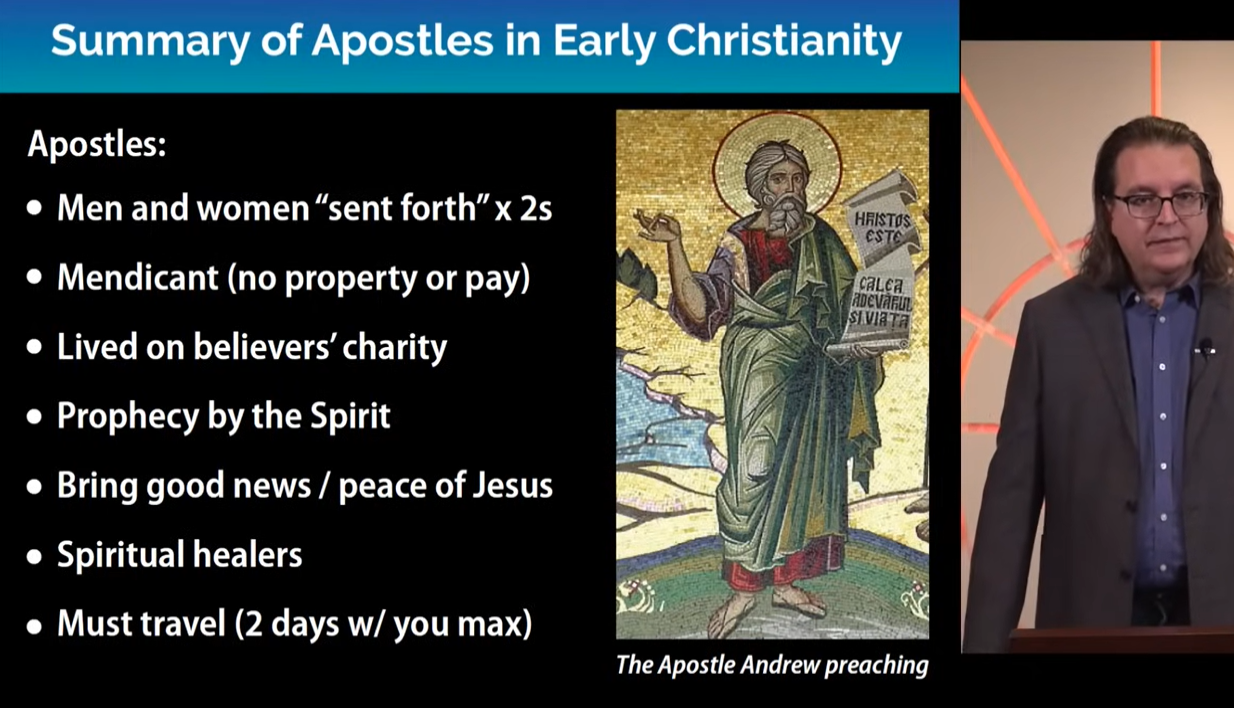 If we summarize then apostles in early Christianity, they are men and also women who were sent forth in twos. They are mendicant; they beg for their daily bread. They're not supposed to have property or pay. They live on believers' charity or their own work. They prophesy by the spirit, and when they're doing it properly, you're supposed to believe them. They're supposed to bring the good news, the peace of Jesus, be spiritual healers, and they are supposed to travel. So they're not supposed to stay with you past two days maximum when they're living on your charity, as we saw.
A Diversity of Early Christianities
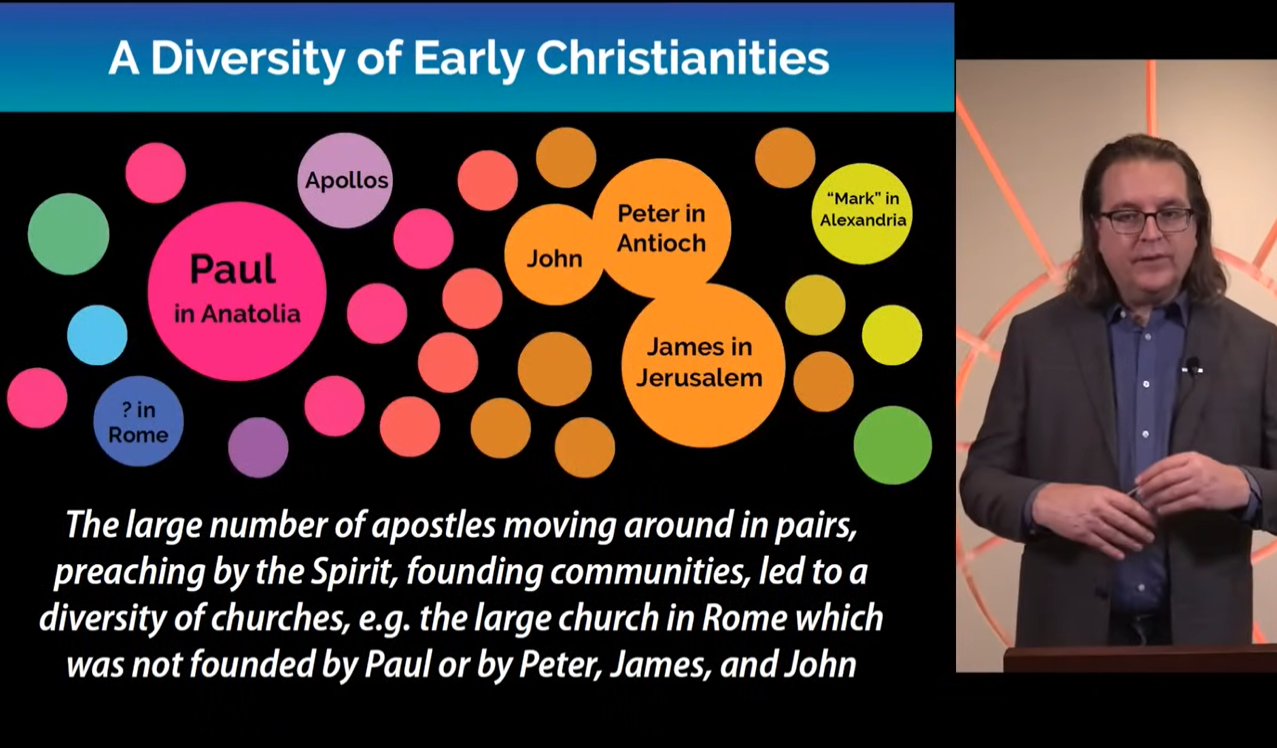 The large number of apostles then moving around in pairs, preaching by the spirit, founding communities, that led to a diversity of churches. A great example of this is the large Christian community in Rome. I'm using the word Christian here; they ultimately become Christian. The large community in Rome, which is not founded by Paul, and it also isn't founded by Peter, James, and John, but is by some of these other apostles. So maybe, you know, Junia and her husband were one of the people that helped found the community in Rome. So it's wrong to think of this as only as a Pauline church and a Jacobite church. There are, in fact, multiple strains that are interacting with each other.
####
Paul’s Conflict with James and Peter
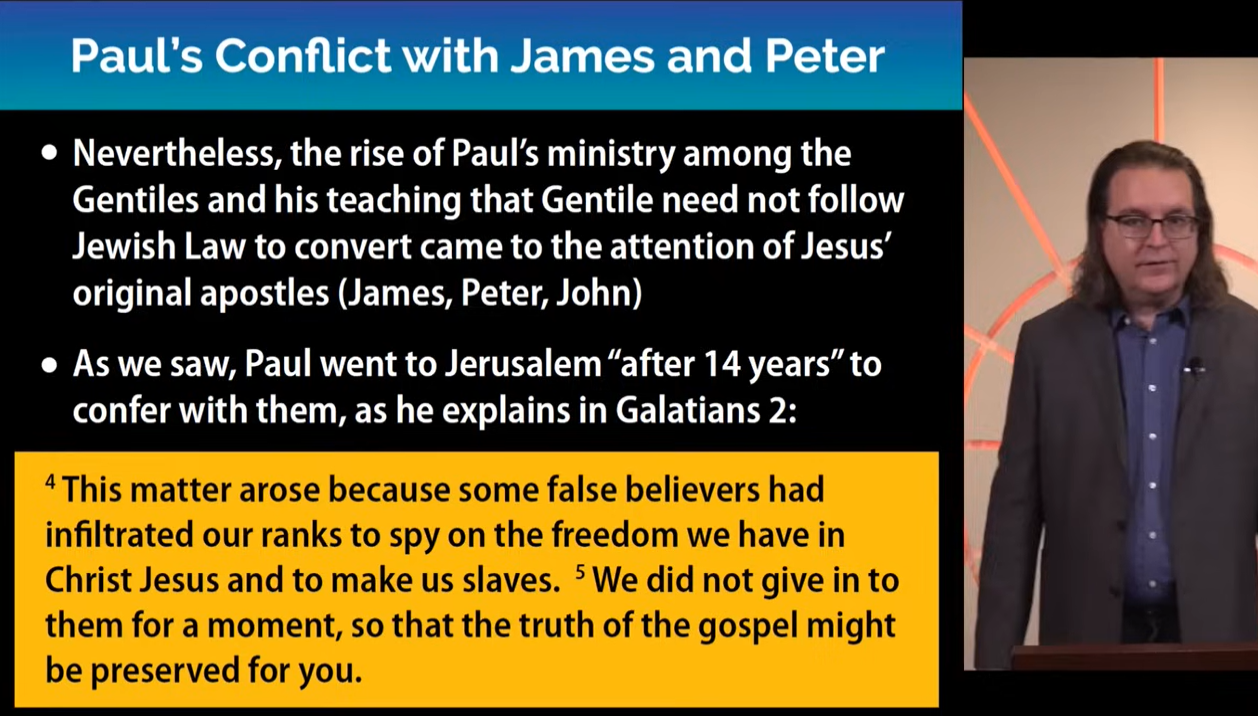 Nevertheless, the rise of Paul's ministry among the Gentiles and his teaching, especially that Gentiles need not follow Jewish law when they convert, does come to the attention of Jesus' original apostles. So James, the brother of Jesus, Peter, and John, these are the ones that Paul talks about as historical disciples who he actually met. So as we saw, Paul went to Jerusalem after 14 years to confer with them, as he explains in the letter to the Galatians, chapter 2. So he says, "Why did he do it?
Well, the matter arose because some false believers had infiltrated our ranks to spy on the freedom we have in Christ and also to make us slaves. We did not give in to them for a moment so the truth of the gospel might be preserved for you."
>
Paul: No Esteem for James/Peter
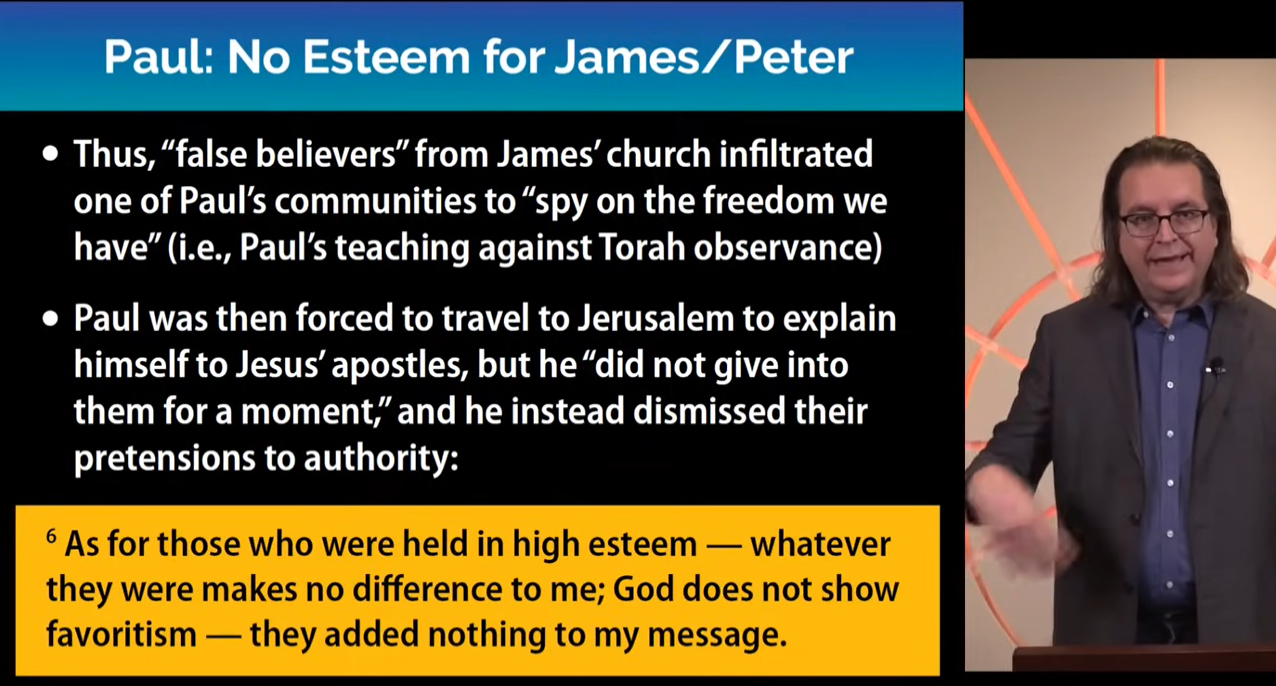 So what's going on here? So false believers from some other church, presumably here James's church, since they're actually spying on the freedom we have in Paul's communities and taking that back to James's church in Jerusalem. That's why Paul has to go to Jerusalem to explain himself. So what's the freedom that we have in Christ? This is Paul's teaching against Torah observance. So we don't have to obey the law. His understanding is that Christians, that Jesus has fulfilled the law, and there's now a new covenant, and we no longer are going to keep kosher in all those ways. So Paul is then forced, or he feels forced anyway, in order to try to resolve the issue, to travel to Jerusalem so that he can explain himself to Jesus' apostles. But, quote, "He did not give in to them for a moment." And like he was telling the Galatians, "And I did it all for you." In other words, for us to continue, all of my churches who I planted, so I didn't give in to them for a moment. Instead, actually, he dismisses their pretensions of authority. So as for those who were held in high esteem, these guys who were leaders of the Jerusalem church, you know, sure, they're Jesus's brothers, they're Paul, I'm sorry, Peter, his lead apostle, and so forth. Whatever they were makes no difference to me. God does not show favoritism. They added nothing to my message. These guys who are held in high esteem, God doesn't think any highly of them compared to anybody else. So he is very much dissing their authority as leaders of the church.
Paul's Version of the Council
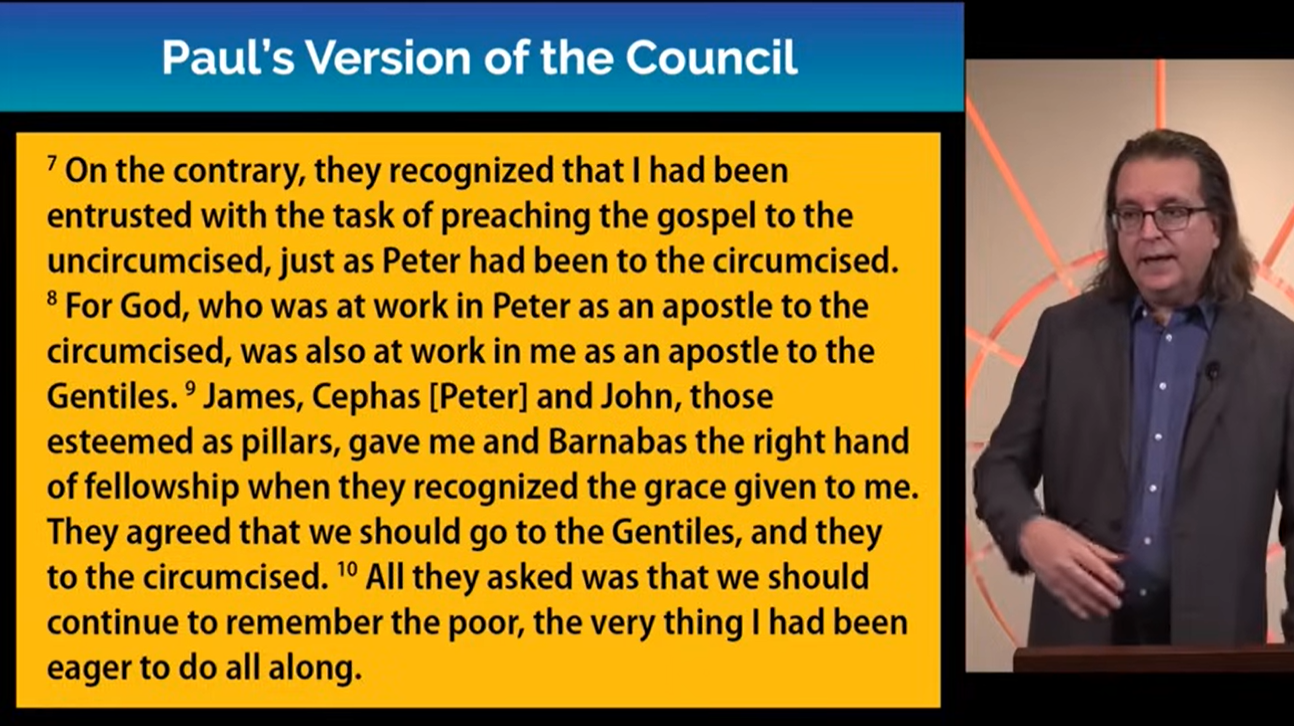 On the contrary, Paul continues, they recognized that I had been entrusted with the task of preaching the gospel to the uncircumcised, just as Peter had been to the circumcised. So I have a special calling, as Paul now has understood it, to go and preach specifically to the Gentiles, to preach to Greek-speaking pagans. For God, who was at work in Peter as an apostle to the circumcised, to Jews, was also at work in me as an apostle to the Gentiles. So James, Cephas, there's Peter, and John, those esteemed as pillars, the leaders of the church in Jerusalem, those are the pillars in the church, James, the brother of Jesus, Peter, his leading apostle, John, his other apostle, some later tradition, beloved apostle, and the historical John, though, gave me and Barnabas, my companion, the right hand of fellowship when they recognized the grace given to me. They agreed that we should go to the Gentiles and they should go to the circumcised. All they asked was that we should continue to remember the poor, the very thing that I had been eager to do all along.
So Paul's characterization of the conference here, the council, is positive, that he's able to convince them there's a deal. He's going to stop messing around with Jews, and he's going to be, you know, limiting what he is, his church planting to the Gentiles, to the pagans that they're not having a lot of good results with anyway. And the add-on here is that he should be remembering the poor, the poor of Jerusalem, which might be the name of the community of the Jerusalem church, as we'll kind of see. As Paul interprets this later, as we'll see, as taking up a collection, raising money for the Jerusalem church.
Not So Rosey After All
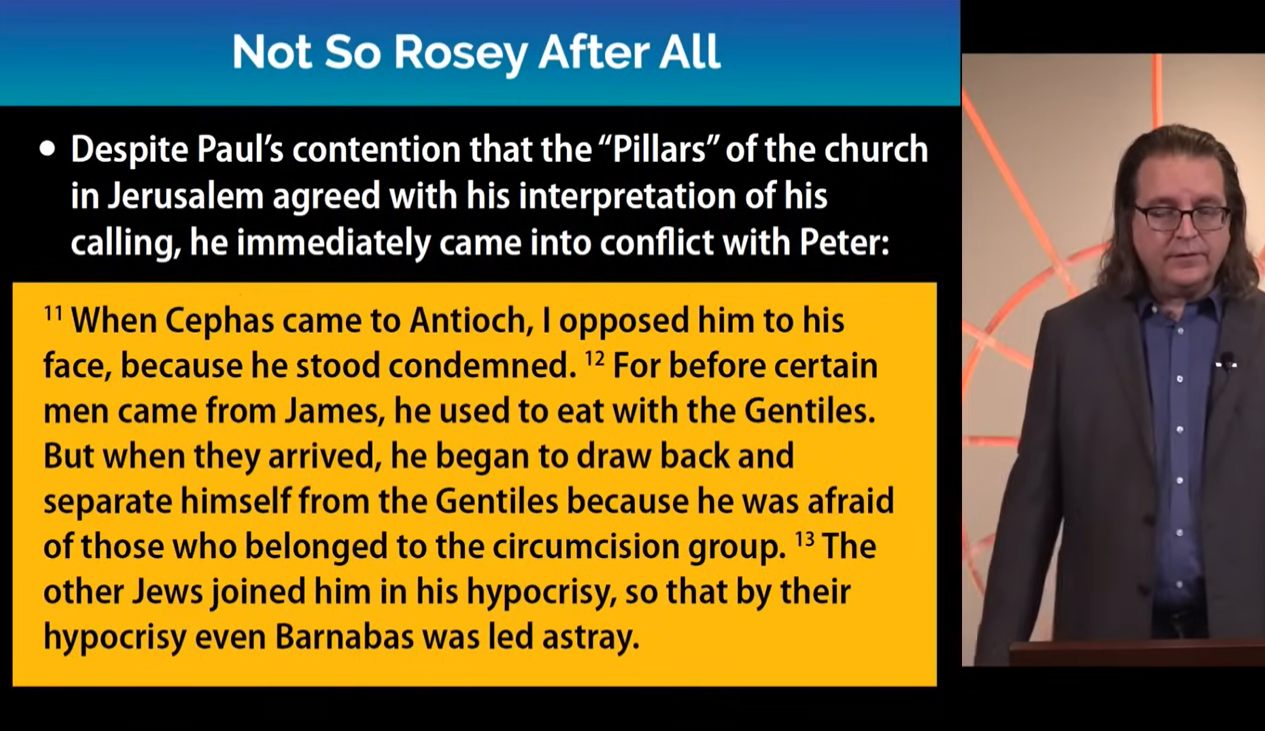 Despite Paul's contention that the pillars of the church in Jerusalem agreed with his interpretation of his calling as an apostle, in the next verses of his letter, he immediately comes into conflict with Peter. So when Cephas came to Antioch, I opposed him to his face because he stood condemned. For before certain men came, I say, for before certain men came from James, he used to eat with the Gentiles. So he wasn't obeying the law either. He was eating with Gentiles just like me. He wasn't adhering to Jewish law. But then certain men came from James, from James the Just, who is very interested in everybody obeying the law. And when they arrived, he began to draw back and separate himself from the Gentiles because he was afraid of those who belonged to the circumcision group, the circumcision faction, the faction of Jerusalem. The other Jewish Christians joined him in his hypocrisy so that by their hypocrisy, even Barnabas was led astray. So, you know, so although Paul, you know, Paul wins here, he keeps winning in his own account. Nevertheless, after he wins, he always has to retreat. And so this is where we talk about a little bit about even though Paul is going to have the most contemporary source, he is putting spin on it. And so we have to also read into his own biases. So although in his account, Paul opposes Peter to his face and he yells at him and he tells all different arguments that he told Peter, he doesn't actually say what Peter said in response. So he says that he won the argument and Peter stood condemned. Nevertheless, as a result, Paul's own companion Barnabas was actually convinced that Peter was right and left Paul to follow Peter. And Paul himself had to abandon this took place in Antioch, the capital of Syria, and Paul abandoned his communities in Syria and Cilicia. And now he has to retreat and found new churches in Anatolia and elsewhere.
After “Winning," Paul Retreats
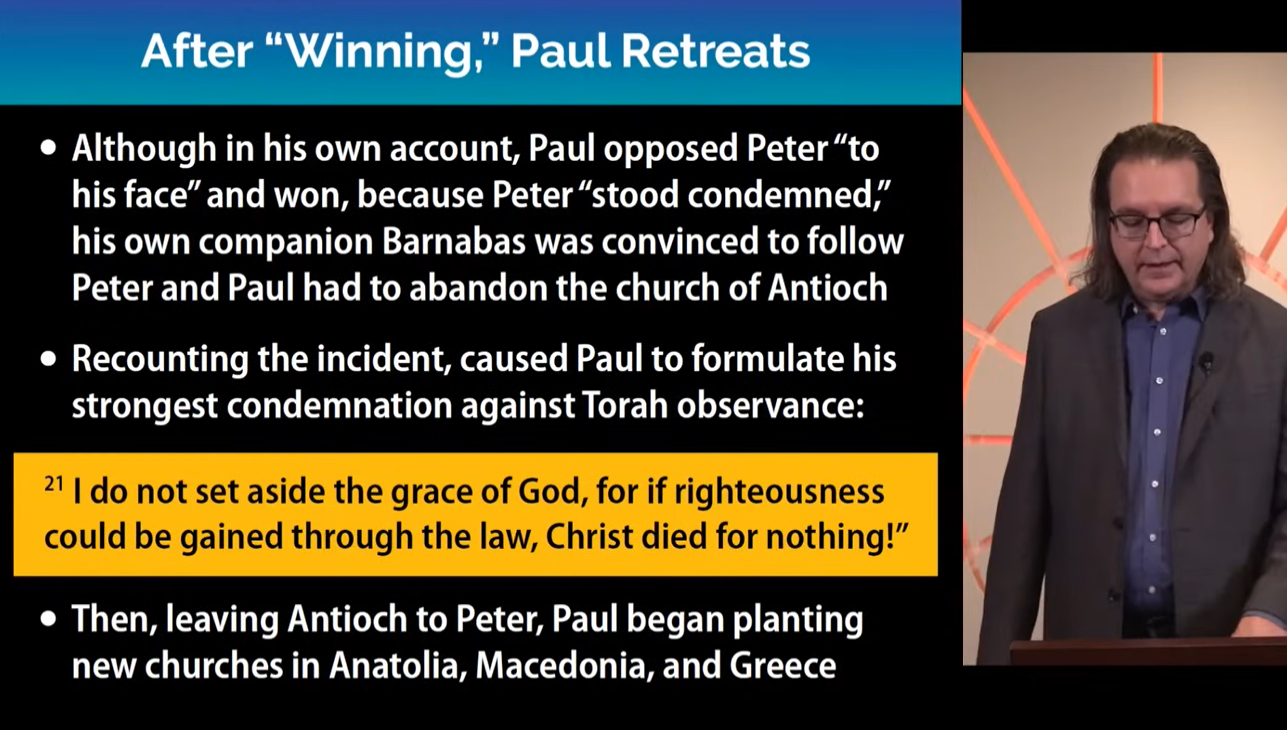 Recounting the incident, this caused Paul, as he's writing to the Galatians, it caused Paul to really formulate his strongest condemnation against Torah observance. So this circumcision faction, the leaders of the rival church here by James, the brother of Jesus, and Peter and so on, who were insisting that you have to continue to follow Torah, follow law as a Christian, Paul says, "I did not set aside the grace of God, for if righteousness could be gained through the law, then Christ died for nothing." So if you are actually going to, if you're going to rely instead on belief and God's grace, if you're going to rely on obedience to law, you know, your righteousness, your zeal for obeying law, then Christ died for nothing. You know, this is the whole, these guys are anti-Christ, you know, Jesus's brother, Jesus's chief apostle, you are saying more or less Christ died for nothing.
So leaving Antioch in control, you know, to Peter, Paul then goes and begins planting new churches in Anatolia, in Macedonia, and Greece.
Paul once again began successfully planting new Christian churches further West than Syria and Cilicia
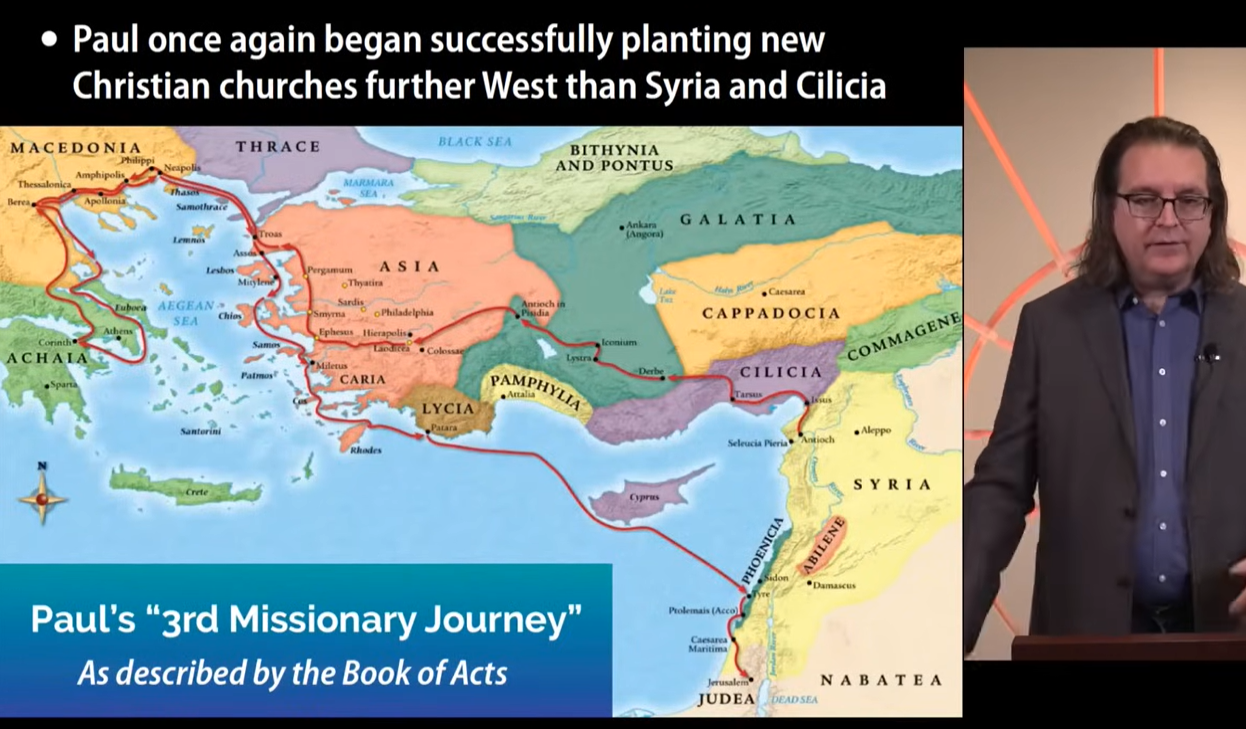
And so this is a map of Paul's third missionary journey as described in the book of Acts. I would say that again, that this is one of those cases where the author of Acts is probably, you know, in making these three missionary journeys that are described as probably radically oversimplifying what's actually happening, but, you know, creating a narrative that maybe doesn't exist. But what is happening is that after Paul leaves Antioch, you can kind of see the top of Syria, it's a little tiny, Syria is yellow above Judea and Cilicia, which is where Paul has been planting churches. Now Paul heads west to, you know, Cappadocia, Galatia, Asia, which is where Ephesus and the Ephesians are, crossing into Macedonia, the Macedonians, the Thessalonians are, and then Achaia, where the Corinthians and other churches then that he is planting all are. So Paul once again begins successfully planting new Christian churches further west than Syria and Cilicia in Anatolia, in Asia Minor, and Greece.
The Occasion for Writing the Galatians
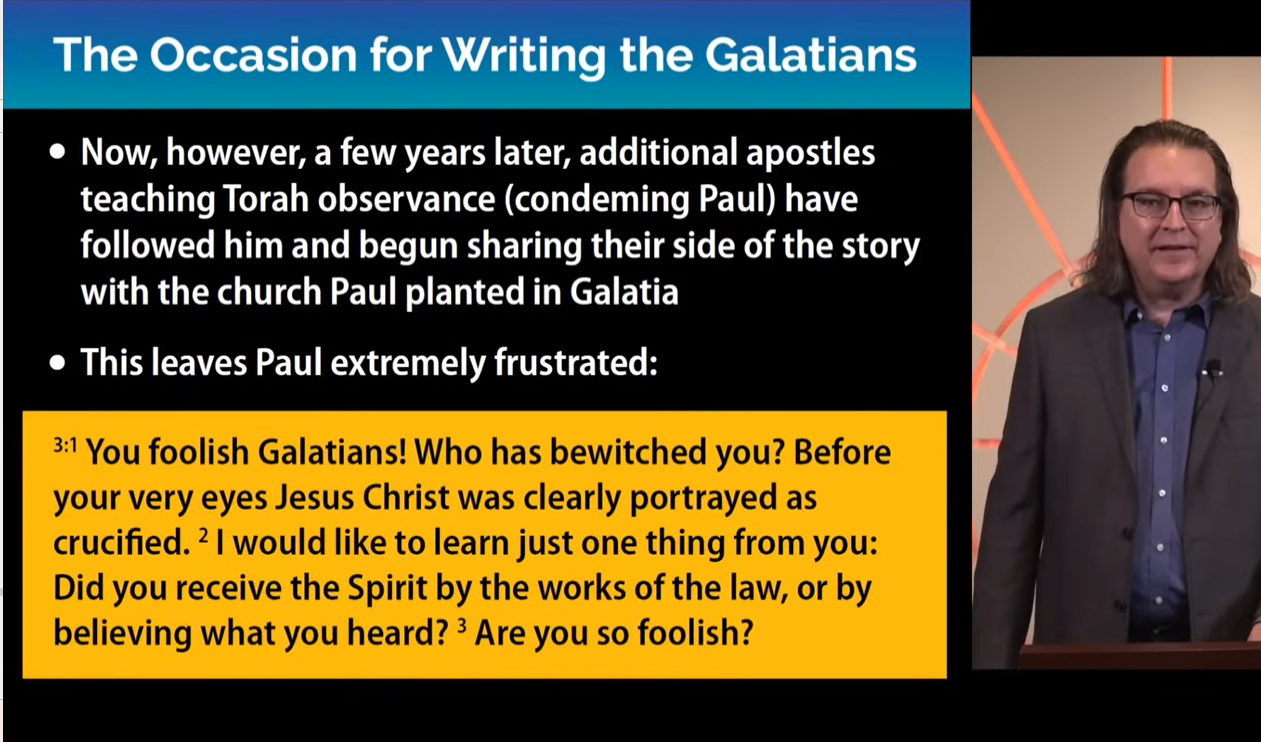 But now we actually are getting to the context for why Paul is writing this letter to the Galatians. So he's not, this is not a contemporary account of what he's doing when the Council of Jerusalem happens or what he's writing from Antioch. He's actually writing this later after he's founded new churches in Galatia and Anatolia. So after a few years, more apostles who are promoting Torah observance, in other words, condemning Paul for saying you don't have to obey the Torah, have followed him and they've begun sharing their side of the story with churches that Paul has planted, including the one in Galatia. And so this has left Paul really, really frustrated. So he's explained all of this history of the Galatians and he's now pulling his hair out at them. He says, "You foolish Galatians, who has bewitched you? Before your very eyes, Jesus Christ was clearly portrayed as crucified. I would like to learn just one thing from you. Did you receive the Spirit by the works of the law or by believing what you heard? Are you so foolish?" So he is very angry, very frustrated that he has the one that converted them. He's taught them about believing and that the spirit is what's important and that it's through the grace of Christ that you receive salvation. It's not through racking up all of these points and being righteous and zealous and obeying law. That's not what we're doing anymore. And this, however, people have come and have, who has bewitched you? Somebody has bewitched you.
Was All Paul's Work in Vain?
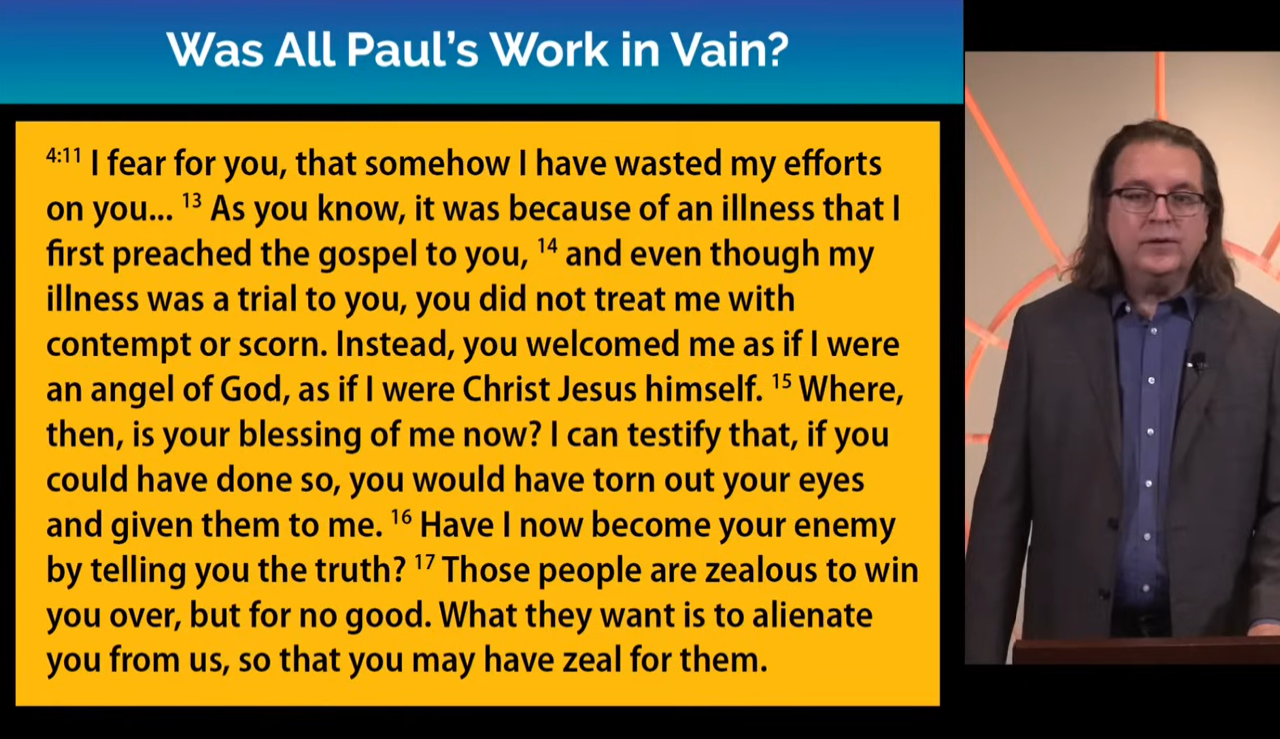 I fear for you, Paul continues, that somehow I have wasted my efforts on you. Spent all this time building all these churches and now you guys believe wrong things. As you know, it was because of an illness that I first preached the gospel to you. And even though my illness was a trial to you, you did not treat me with contempt or scorn. Instead, you welcomed me as if I were an angel of God, as if I were Christ Jesus himself. So we saw in the Didache how when a person comes to you speaking as the Lord, you're supposed to, I'm sorry, speaking with the spirit, you're supposed to welcome him as the Lord. The Galatians have done that in the past. We don't know what this incident that Paul's talking about. So he was sick or something and they were able to nurse him while he was preaching. Where then is your blessing of me now? I can testify that if you could have done so, you would have torn out your eyes and given them to me. So in other words, you were very welcoming back then. Have I now become your enemy by telling you the truth? Those people are zealous to win you over. Those people, these other apostles that keep getting sent to you by who I don't know, but by these people who want you to follow Torah observance, which is to say Cephas and James, those people are zealous to win you over, but for no good. What they want is to alienate you from us so that you may have zeal for them.
James and the “Circumcision Party"
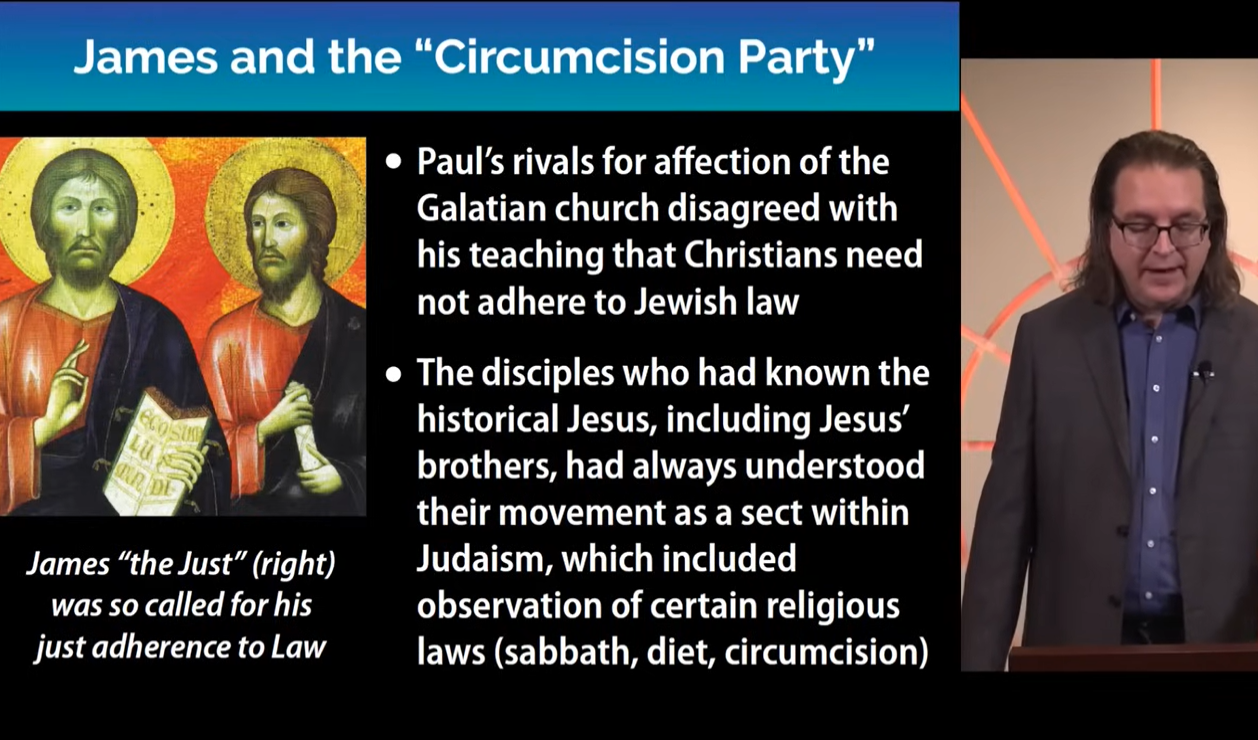 So who are these people in the circumcision party? It's not always explicitly told, although it's pretty clear, I think, as we've just been reading this, that Paul's rivals for affection in the Galatian church obviously disagreed with his teaching that Christians need not adhere to Jewish law. So the disciples who had known the historical Jesus, including Jesus' brothers, had always understood their movement as a sect within Judaism, which had always included observation of certain religious laws, things like Sabbath observance, things like dietary laws that prevented you from sharing meals with people outside the community, things like circumcision, which is a pretty big barrier to entry for adult converts. So Jesus' brother James, he's called James the Just to identify him from other Jameses. He's sometimes also called James the Brother of the Lord, but James the Just, and just here is meant to mean one who is very righteous in his zeal for the law, his adherence to law. So law is critically important in James's understanding of Christianity.
Biblical Texts Written in Jacoban Authority
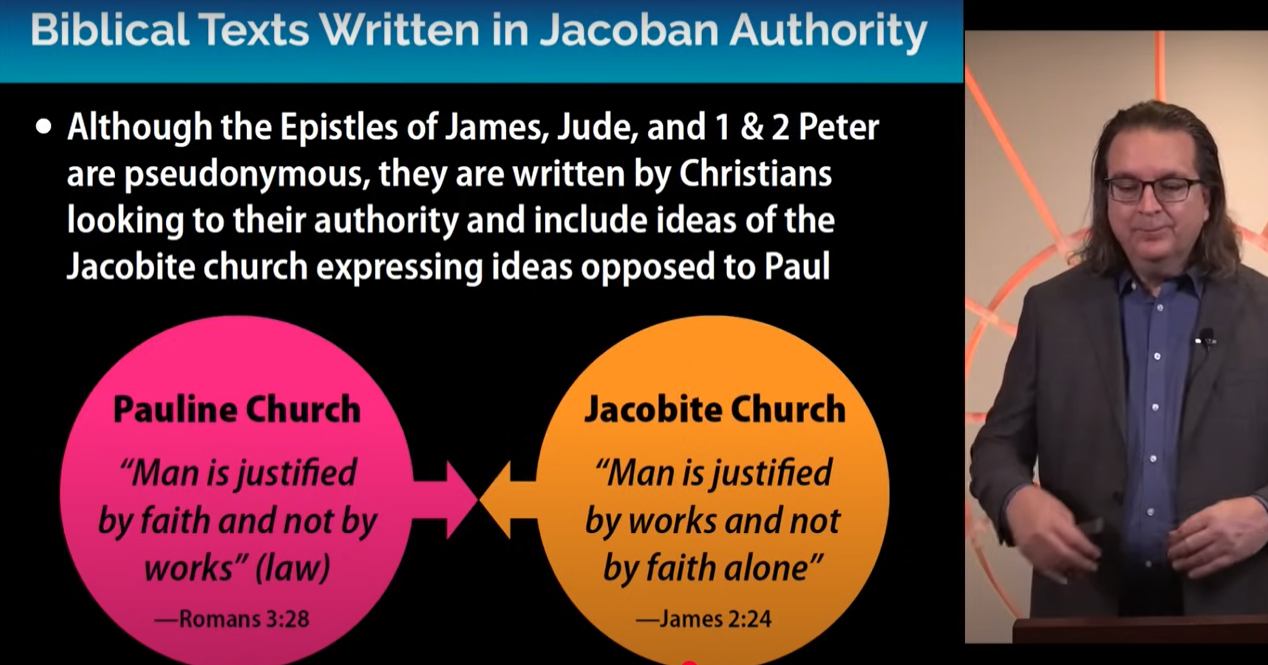 Although we don't have any writings from the historical James, so for example, all of the texts like the Epistle of James, the Epistle of Jude, 1 and 2 Peter, they're pseudonymous. They are not written by James, Jude, and Peter, but nevertheless, they are written by Christians who look to their authority and who are including in their writings ideas of the Jacobite church. And so they are therefore, even though they're not doing it loudly, otherwise they wouldn't have probably made it into the New Testament, they're being a little circumspect, they are still expressing ideas that are opposed to Paul. And so whereas the Pauline church has a teaching like in Paul's letter to the Romans, "Man is justified by faith and not by works," not by doing stuff that adheres to law, we have the exact opposite in the Epistle to James from the Jacobite church, "Man is justified by works and not by faith alone."
James: Obey Every Part of the Law
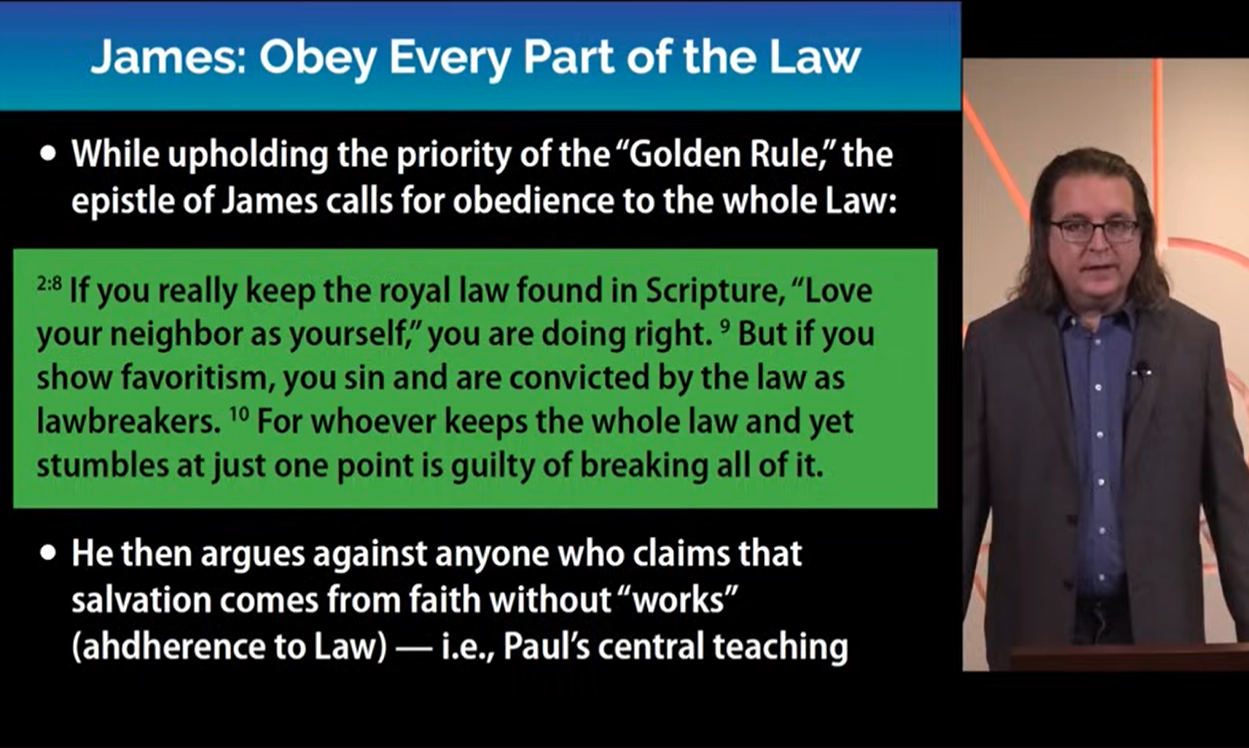 So let's just take this from some of the writings from the Epistle of James. So writing not by James, but writing in James's name, someone who agrees with this perspective, while upholding the priority of the Golden Rule, like Jesus did when asked, "What is the most important of the commandments?" The Epistle of James calls for obedience to the whole law. So we read in the Epistle of James,
"If you really keep the royal law found in Scripture, you know, 'Love your neighbor as yourself,' which Jesus was quoting from the Old Testament, you are doing right. But if you show favoritism," so if you're going to ask which commandments are the most important, if you're going to show favoritism, "you sin and you are convicted by the law as lawbreakers. For whoever keeps the whole law and yet stumbles at just one point is guilty of breaking all of it."
So you're not going to, in James's idea here, you're not going to get a lot from just following the two greatest commandments. You have to obey the whole law because if you show favoritism and break one little law that's found in the Old Testament in Scripture, then you are going to break all of it.
The author of James then argues against anybody who claims that salvation comes from faith without works, so by just believing rather than adhering to the law. So in other words, argues against Paul's central teaching.
James: Faith without Works Is Dead
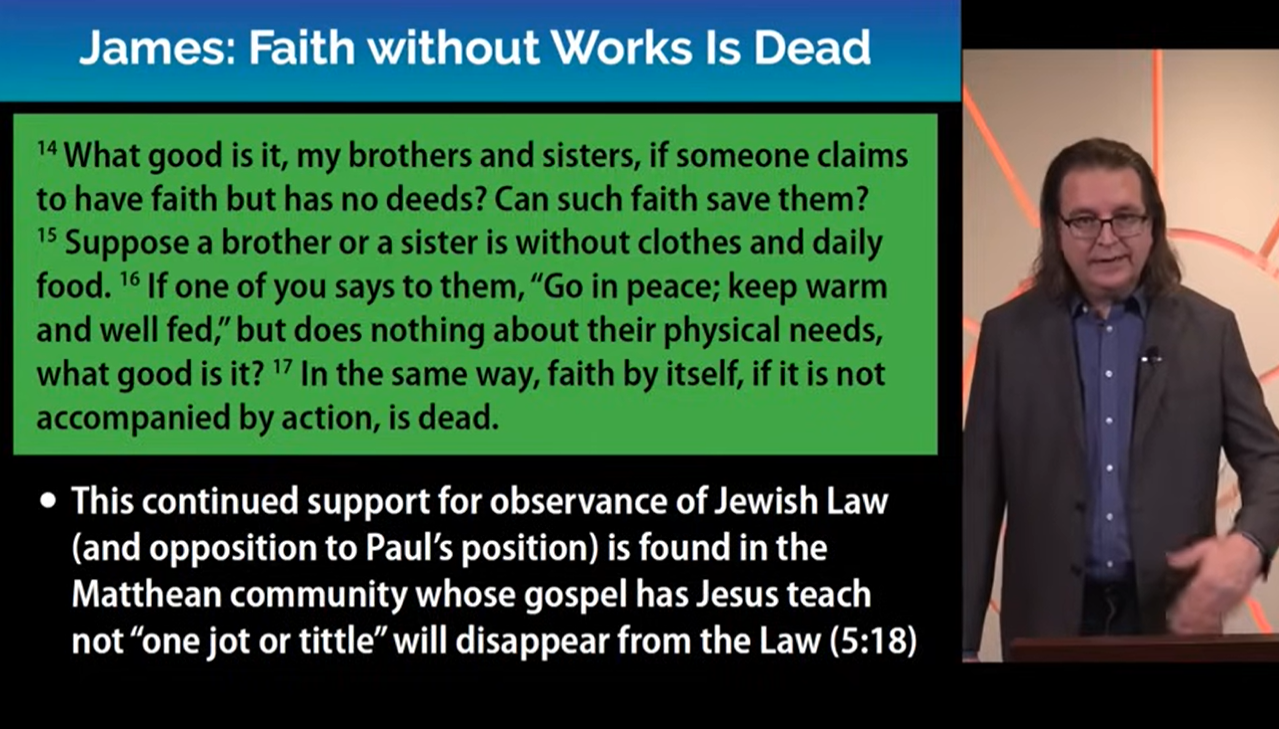 He says, "What good is it, my brothers and sisters, if someone claims to have faith but has no deeds? Can such faith save them?" Faith is what saves you, or, you know, grace is what saves you for Paul. Anyway, but so this is not what it is. "Can that faith save them? Suppose a brother or a sister is without clothes and daily food. If one of you says to them, 'Go in peace, keep warm and well-fed,' but does nothing about their physical needs, what good is it? It's just words. The same way, faith by itself, not accompanied by action, is dead." So this continued support for observance of Jewish law and the opposition to Paul's position on faith and on grace is found also, for example, in the Matthean community, whose gospel has Jesus teach that not one jot or one tittle will disappear from the law until everything is fulfilled. And so you have to continue to adhere to law as far as the author of Matthew and the Matthean community is concerned.
Condemnations in the Book of Jude
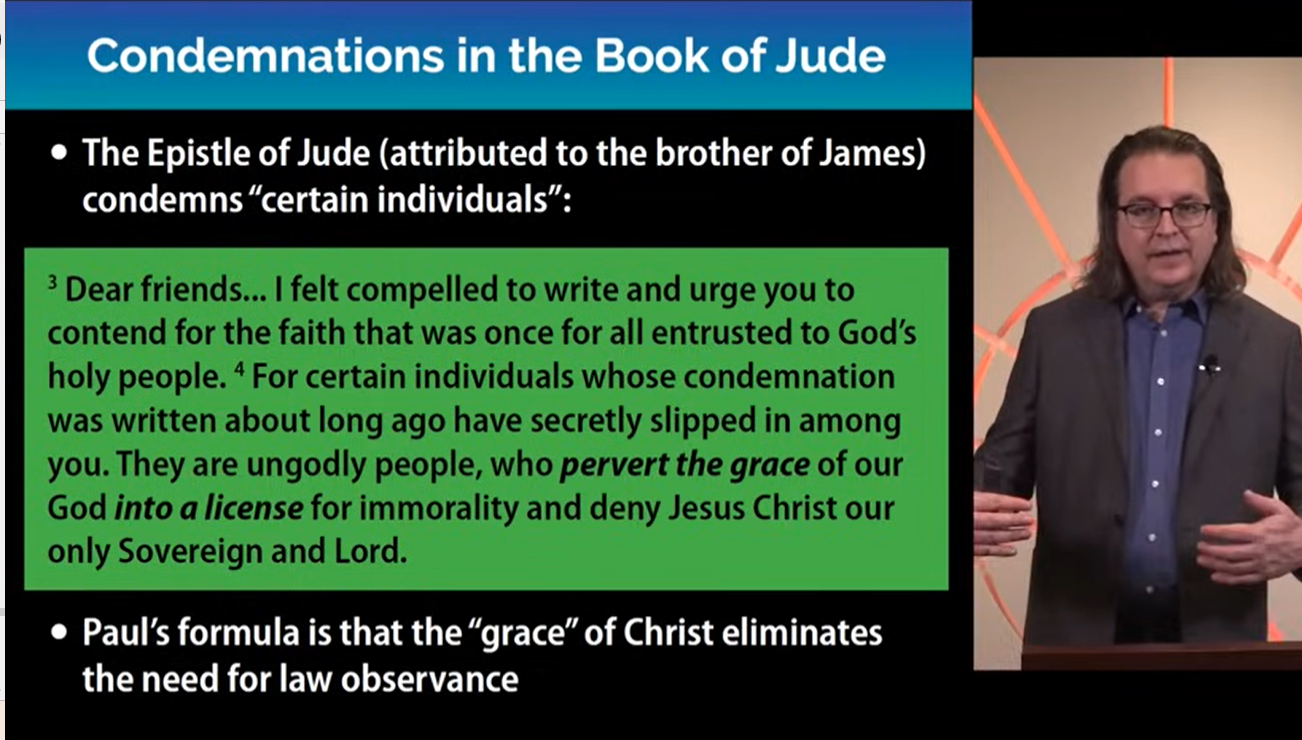 The Epistle of Jude, who is attributed to the brother of James, also highlights certain individuals, the same way that Paul is arguing against these individuals who came as spies, these super apostles who are leading all of his followers astray. Here in the Jamesian church, they're also worrying about certain individuals who are leading people astray. So the author of Jude writes, "Dear friends, I feel compelled to write and urge you to contend for the faith that was once for all entrusted to God's holy people. For certain individuals whose condemnation was written about long ago have secretly slipped in among you. They are ungodly people who pervert the grace of our God into a license for immorality and deny Jesus Christ, our only Sovereign and Lord." So by saying that you are saved by grace alone, by promoting faith rather than adherence to law the way Paul does, by saying you no longer have to obey the commandments, the law, that becomes a license for immorality as far as the Jamesian church is concerned.
This is just, I think, a pretty strong highlight of the two competing perspectives that exist in the middle of the first century in Christianity.
Jacobites Follow Paul West
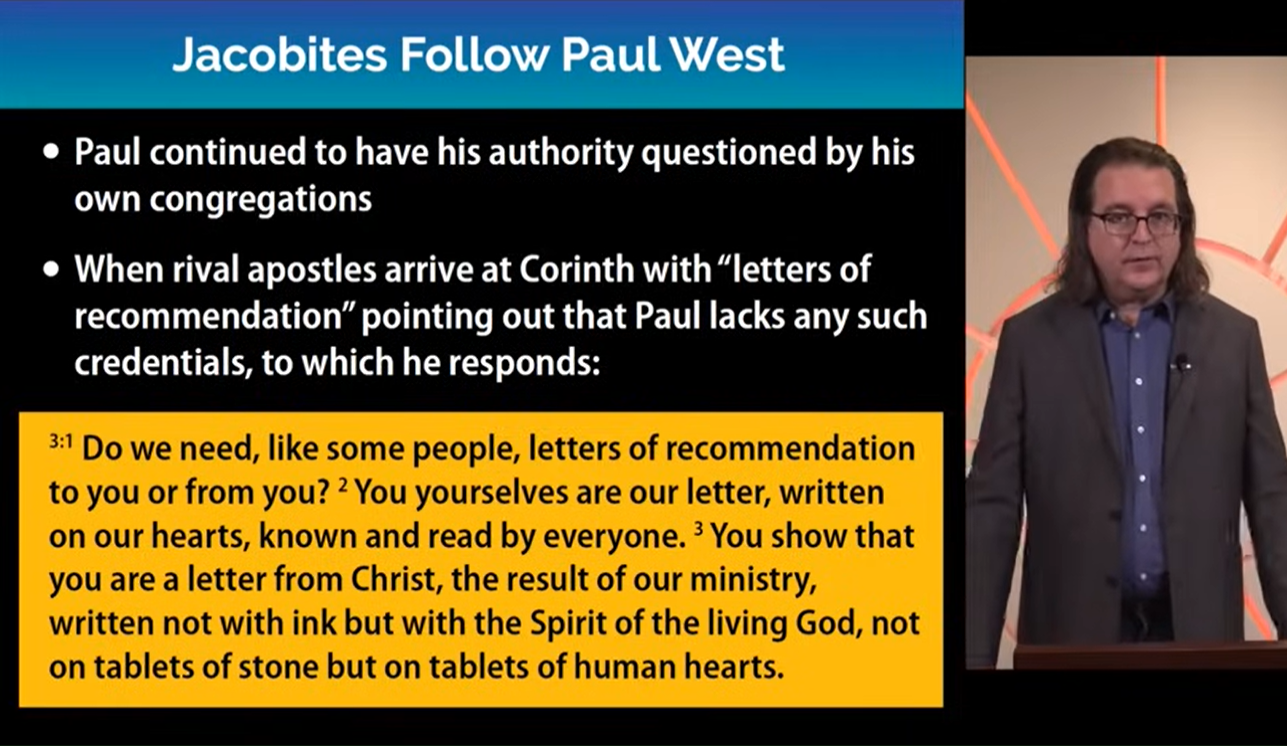 Paul continued to have his authority questioned by members of his own congregations. So as representatives of what he calls the circumcision party, what he calls super apostles, almost certainly, I think, people who are representatives of, including even Peter himself, of Peter and the Jamesian church, they continue to come and question Paul's authority and challenge his teachings with the churches that he himself has founded. So when rival apostles appear at Corinth bearing letters of recommendation, they point out to the Corinthian Christians that Paul doesn't have any letter or credential. You know, where are these letters of recommendation coming from? So it's presumably coming from Peter or from James, you know, the brother of Jesus, saying, "So and so, I certify that so and so is an apostle of the Lord. They are, you know, receive them in faith sincerely, you know, James, the brother of our Lord, James, the brother of Jesus, or Cephas, and so on." So Paul replies to this challenge,
"Do we need, me, Paul, do I need, like some people, like some of these other apostles that you're meeting, do we need letters of recommendation to you or from you? You yourselves, you Corinthians, this church that I planted, you are our letter. You are a letter that's written on our hearts, known and read by everyone. You should know that you are a letter from Christ. You are the result of our ministry, written not with ink but with the spirit of the living God, not on tablets of stone," see, he's against the law, tablets of stone, "but on tablets of the human heart."
>
So Paul again is trying to argue his case here with his own church against people who are arguing in favor of adherence to law and now have backed their authority up by having letters of recommendation.
Paul's Last Hope for Reconciliation
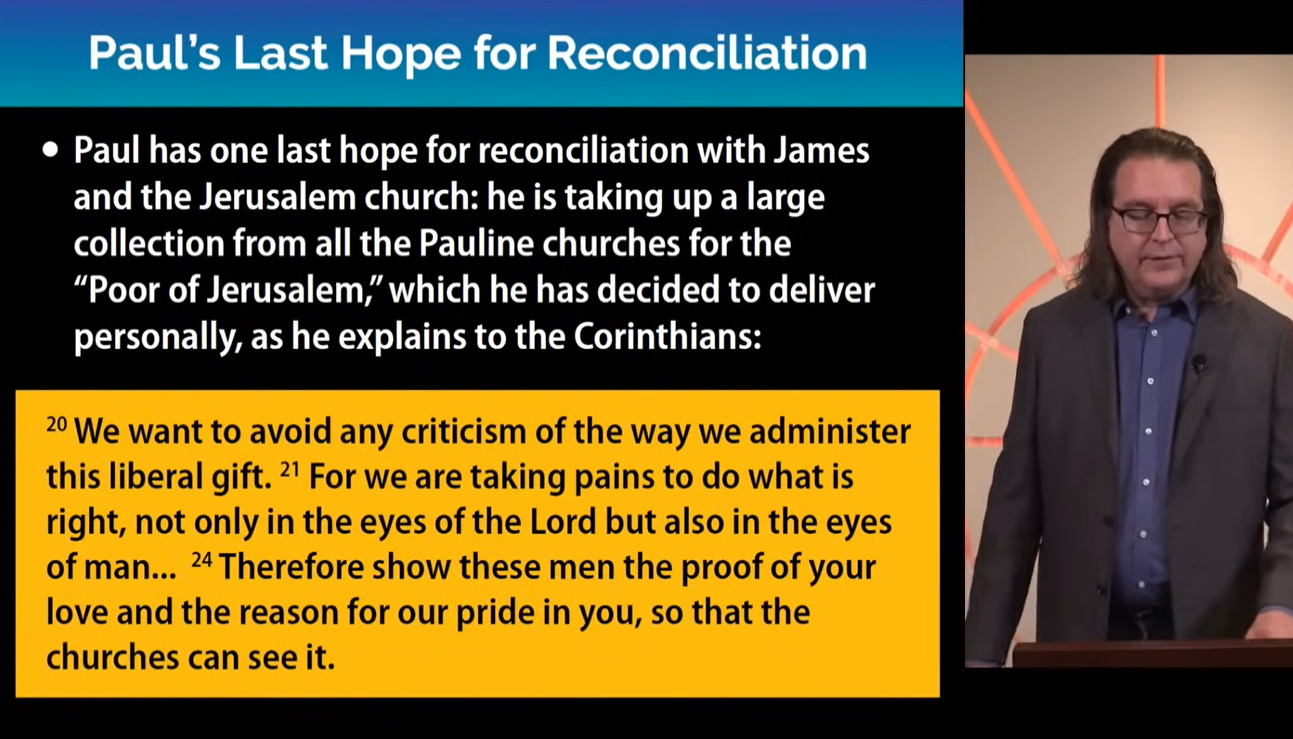 After all of these losses of community after community in these authority battles, Paul essentially has one last hope for reconciling with James and the Jerusalem church. Like he said in his letter to the Galatians, only that he remembers the poor of Jerusalem. And so Paul begins taking up a very large collection from all the Pauline churches in Macedonia and Greece, where members there contribute alms for the poor of Jerusalem, which he has ultimately decided to deliver personally, as he explains to the Corinthians. "So we want to avoid any criticism of the way we administer this liberal gift. So I'm collecting all of this from you. We thank you for charity. The Macedonians have given us a lot. We hope you will too. We are taking pains to do what is right, not only in the eyes of the Lord but also in the eyes of man. Therefore, show these men the proof of your love and the reason for our pride in you so that the churches can see it." So he wants these men, these other leaders, and the churches to see that we're all brothers here in one faith, and you are, you, the churches that I've planted, are prepared to liberally give alms in support of the Jamesian church.
Paul Prepares One Last Retreat
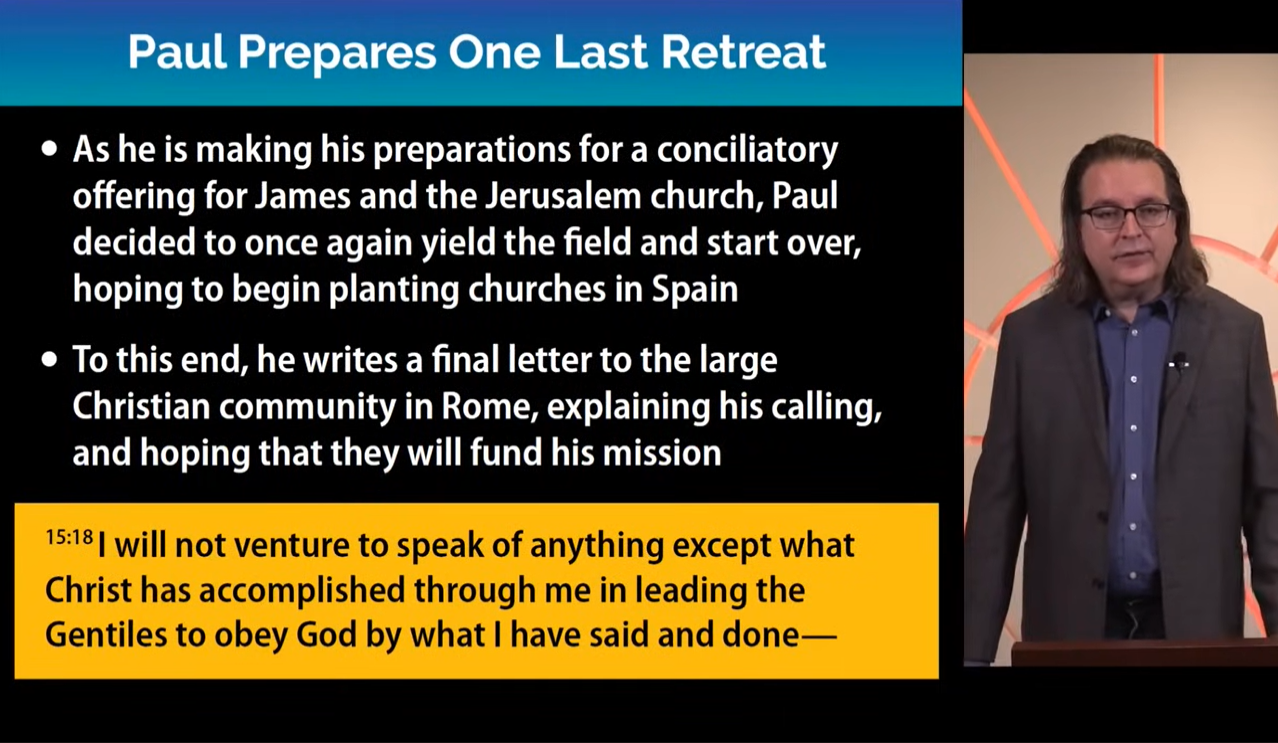 So as he's making preparations for a conciliatory offering for James and the Jerusalem church, Paul decides yet once again, though, he's going to have to surrender the field. He's going to leave Macedonia and Greece and start over once again, and he begins kind of playing out the idea that he's going to go to Spain and plant churches there. So, you know, he starts in Arabia, he goes to Syria and Cilicia, then Anatolia, then Macedonia, then Greece. He's moving further and further west. He keeps getting kicked out by apostles from James's church who question his authority. So to this end, he writes a final letter to the very large Christian community in Rome, which has sprung up through other apostles and is a very large and relatively well-off community. And he explains to them his calling, and he also hopes that they're going to be able to fund his mission. It's not going to, he can't get to Spain for free, and his operation takes, it's more than just one person. He has lots of companions to help him write these letters and do the preaching and so forth. So he writes to the Romans,
"You know, I'm not going to venture to speak of anything except what Roman Christians here, except what Christ has accomplished through me in leading the Gentiles to obey God by what I have said and done,
“No Place for Me” in the East
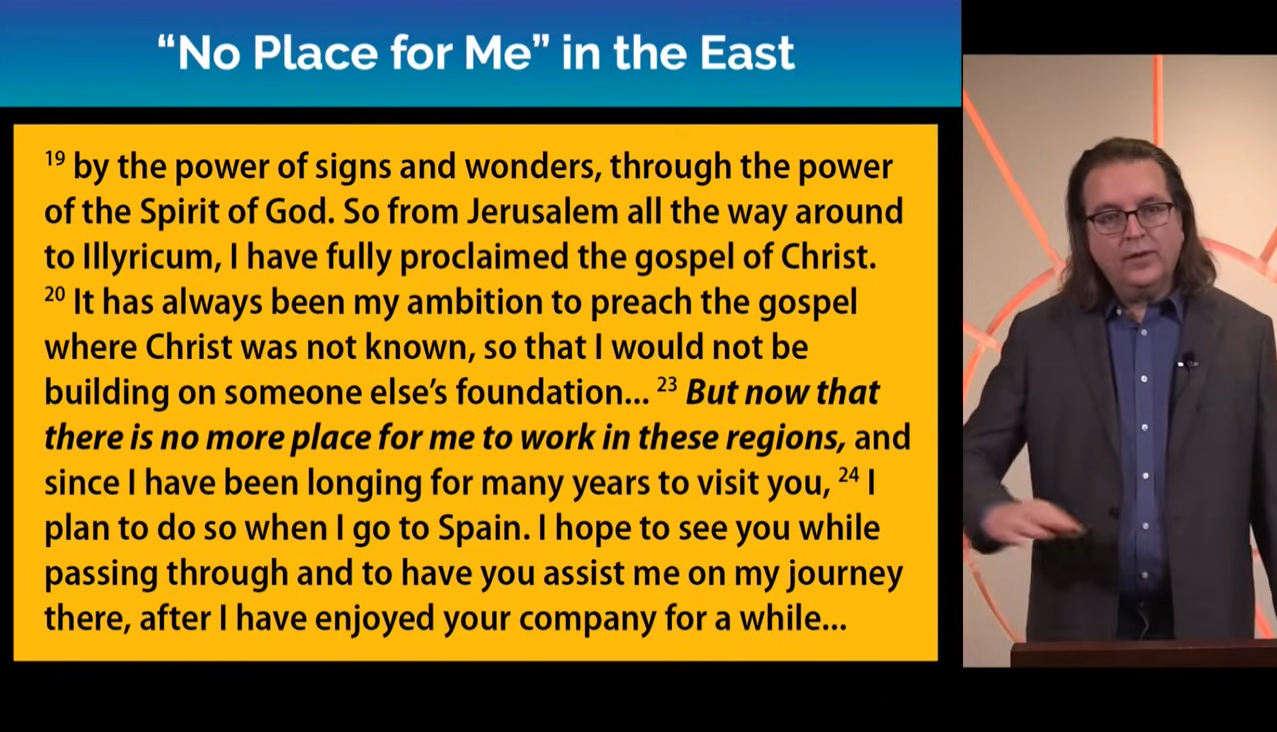
by the power of signs and wonders, through the power of the Spirit of God. So from Jerusalem all the way to Illyricum," this modern Croatia,
"I have fully proclaimed the gospel of Christ. It has always been my ambition to preach the gospel where Christ was not known so that I would not be building on someone else's foundation. But now that there is no more place for me to work in these regions," so I no longer have any place for me in the East, all of these places where I founded all these churches, "and since I've been longing for many years to visit Rome, I want to come visit you. I plan to do that. I plan to visit with you on my way to Spain. I hope to see you while passing through and to have you assist me on my journey there after I have enjoyed your company for a little while."
So he's writing to the church in Rome. He's hoping he's going to be received there well, given his fame and his different successes as an apostle that he's had, and then also hopefully they're going to see fit to take up a collection so that he can begin his operation over again, planting churches in Spain.
####
After Taking the Money to Jerusalem...
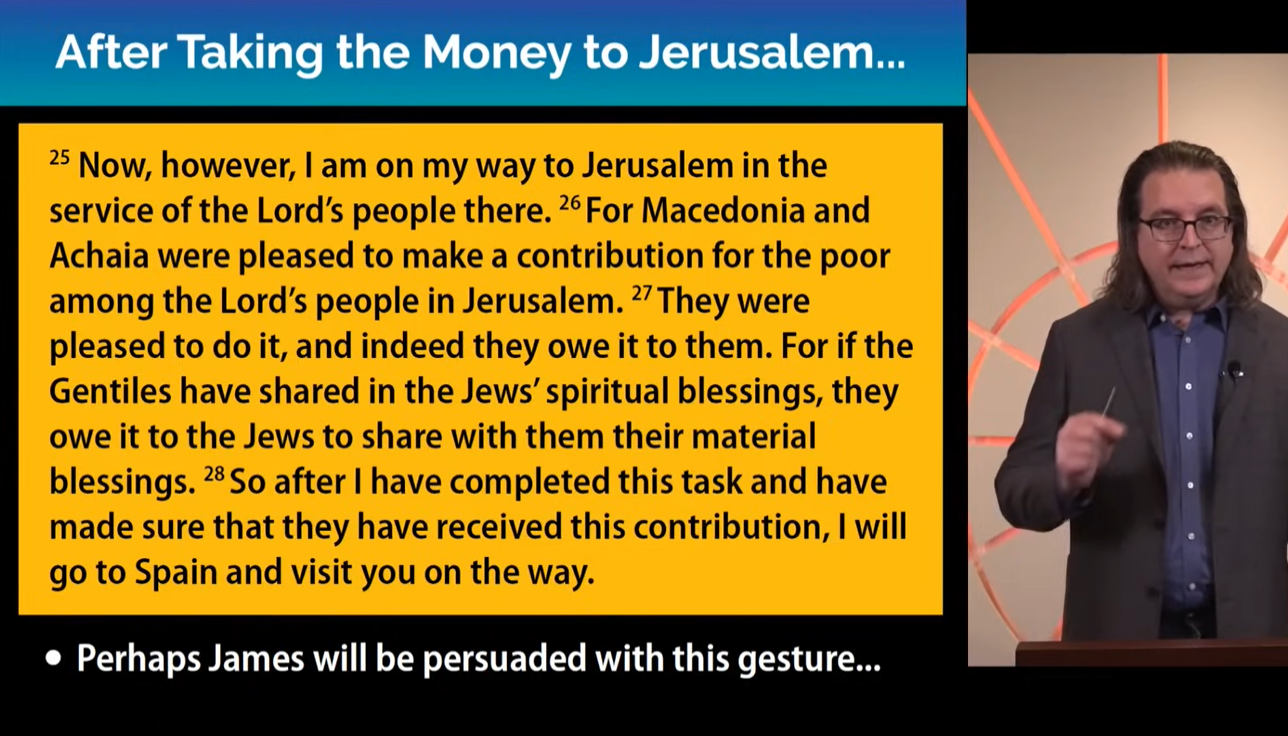 "Now, however," he tells them, "I am on my way to Jerusalem in the service of the Lord's people there. For Macedonia and Achaia, Macedonia and Greece, were pleased to make a contribution for the poor among the Lord's people in Jerusalem. They were pleased to do it, and indeed they owe it to them. For if the Gentiles have shared in the Jews' spiritual blessings, they owe it to the Jews to share with them in their material blessings. So after I've completed this task and have made sure that they've received this contribution, I will go to Spain and I will visit you on the way." So Paul is hoping that he can maybe reconcile with James by this last gesture, right? So there are all these Jewish Christians that have been so negative to Paul, the original apostles of Jesus who don't really recognize Paul, but Paul has promised them that there's a point in having all of these Gentile Christian churches, and indeed maybe part of the point is going to be that they can provide some material support to the very poor group that calls themselves deliberately poor of Jerusalem. But, you know, they can't take up alms in that kind of way. Paul will come with those alms and deliver that, and he's also going to seed all of Greece and Macedonia and Anatolia, and he's going to leave again and go away and plant churches some other place. So maybe that will make peace finally with James.
####
Paul Denounced/Arrested in Jerusalem
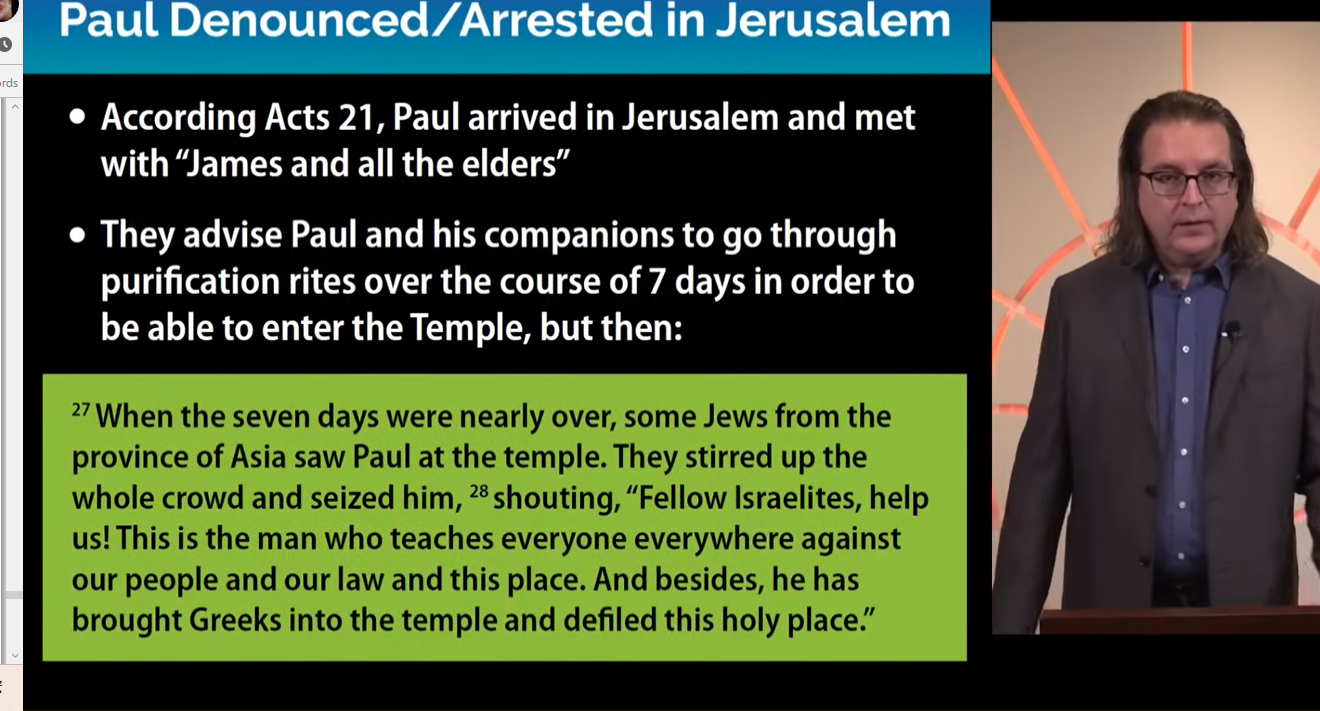 However, and we don't know, we don't have from Paul any more writings after that, but according to the narrative in Acts, in Acts 21, when Paul arrives in Jerusalem and meets with James and all of the elders of the Jerusalem church, and while they're there, while Paul is there, they advise that Paul and his companions should go through the Jewish purification rites over the course of seven days in order to be able to enter the temple because obviously they haven't been obeying Jewish law. That's part of Paul's whole thing, and for them to actually be part of the Jewish community and be able to be in the Jewish temple, they need to go through purification rituals. So when the seven days of those purification rites are nearly over, some Jews from the province of Asia saw Paul at the temple and they stirred up the whole crowd and seized him, shouting,
"Fellow Israelites, help us! This is the man who teaches everyone everywhere against our people and against our law and this place, and besides, he has brought Greeks into the temple and defiled this holy place."
>
And so, because for the other sect of Judaism, adherence to Jewish law is essential for being allowed to be in the precinct of the temple, the fact that, you know, this is a trap essentially for Paul.
Aftermath of Paul's Arrest
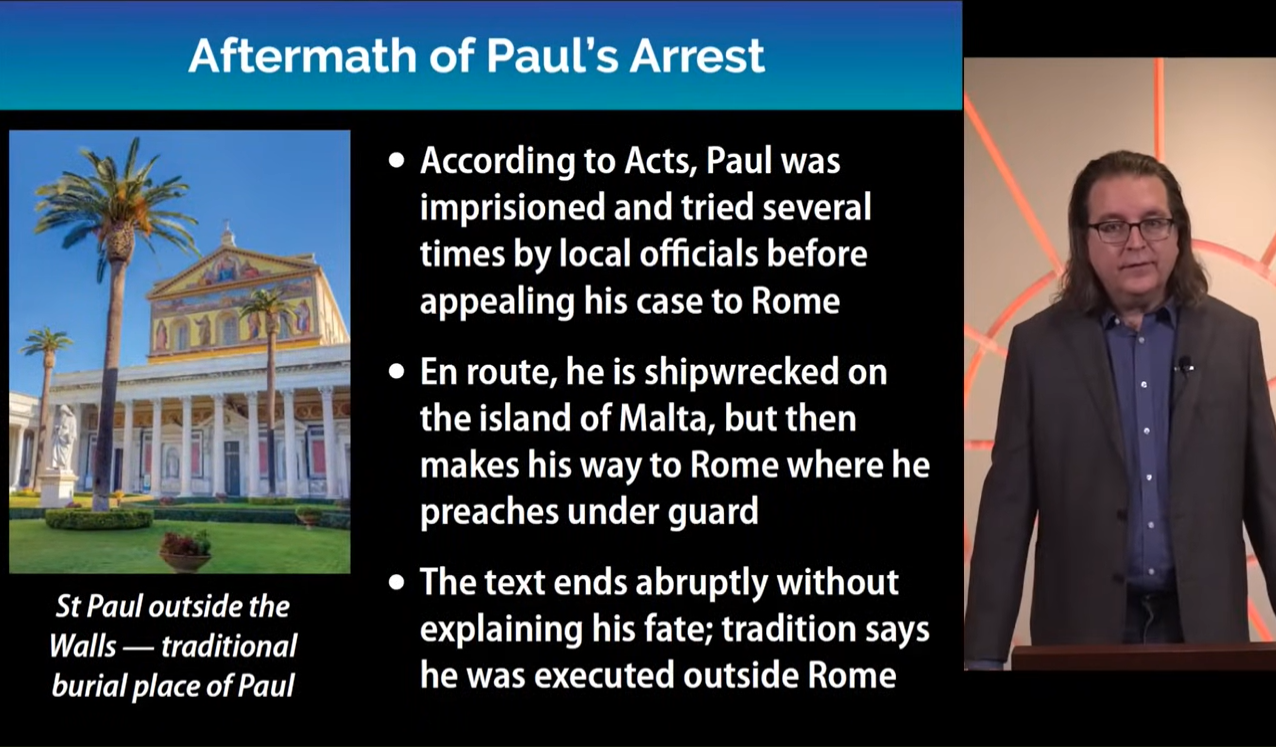 And so according to Acts, Paul is imprisoned and he's tried several times before local Roman officials in Judea before appealing his case to Rome, which he's able to do as a Roman citizen, which he is according to the book of Acts. So en route, he is shipwrecked on the island of Malta, but then he's able to make his way to Italy and ultimately to Rome where he's kept under house arrest but is able to preach under guard. The text of Acts really bizarrely ends abruptly without explaining his fate. You would think that it would go on a little further and explain like a martyrdom story for Paul, but for some reason, we don't have that. We don't have the martyrdom story for any of them. I mean, we would presumably want to end the story with Paul, James, and ultimately Peter all getting martyred, but that doesn't happen in their story. So we have to therefore rely on tradition at this point, and so Paul, according to tradition, is martyred outside of Rome. There is a big ancient basilica called St. Paul Outside the Walls, which is the traditional burial place of Paul.
Decline of Jacobite Influence
 So Paul at that point, you know, may have thought, like I said at the beginning of this, that his preaching and everything that he'd done had been in vain. He had brought a lot of people into Christianity, but it did look like he had lost out to the circumcision party, to people who had the opposite formulation, the opposite idea about theology from the high Christology that Paul was preaching. However, very rapidly from the very height of influence at the end of Paul's life, the Jacobean Church very quickly declines, and so James, the brother of Jesus, is himself executed maybe around the year 62, so just a couple of years later, and Jerusalem itself is destroyed just a few years after that. And again, the poor of Jerusalem, the whole Christian community flees and reestablishes itself in Pella, in a city that lacks the authoritative centrality that Jerusalem had had. The temple's gone, so this issue of being able to go in the temple or not is gone, and it doesn't take too much longer for James's other brothers like Jude to eventually pass away. That generation passes away along with Peter. Meanwhile, Paul's letters continue to exist. They become authoritative among many early Christians along with his views of Mosaic law. Early gospels end up being written by Greek-speaking Gentile converts like Mark and Luke, who probably don't have a Jewish Christian background. There do continue to be Jewish Christians who continue to adhere to the law, and that's reflected in the Gospel of Matthew, but this position slowly declines in the first and especially the second and third centuries.
Three Keys to Paul's Success
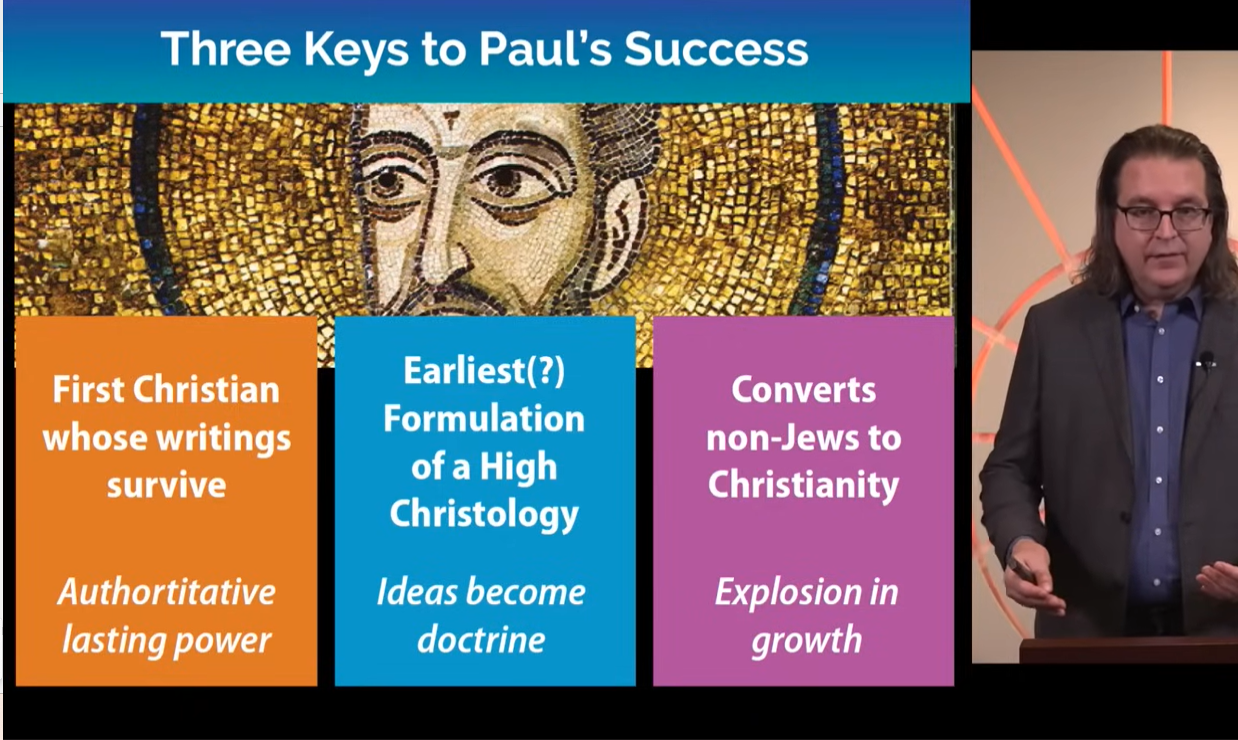 And so we begin where we end. So, why does Paul succeed? Well, he's the first Christian whose writings survived. Those prove authoritative and have lasting power. He, in that writing, formulates a high Christology that ends up being very influential. So when the Bible does start to take shape, Paul's ideas become doctrine and they are used to formulate later Christian theology. And finally, the conversion of non-Jews to Christianity is much more effective than converting Jews. While there was a significant sect within Judaism of people who became Christian and there were a bunch of Samaritans who became Christian as well, the largest by far group to become Christian are people who have a pagan background. And so all three of these end up being reasons why Paul continued to be influential.
Timeline of Paul's Ministry
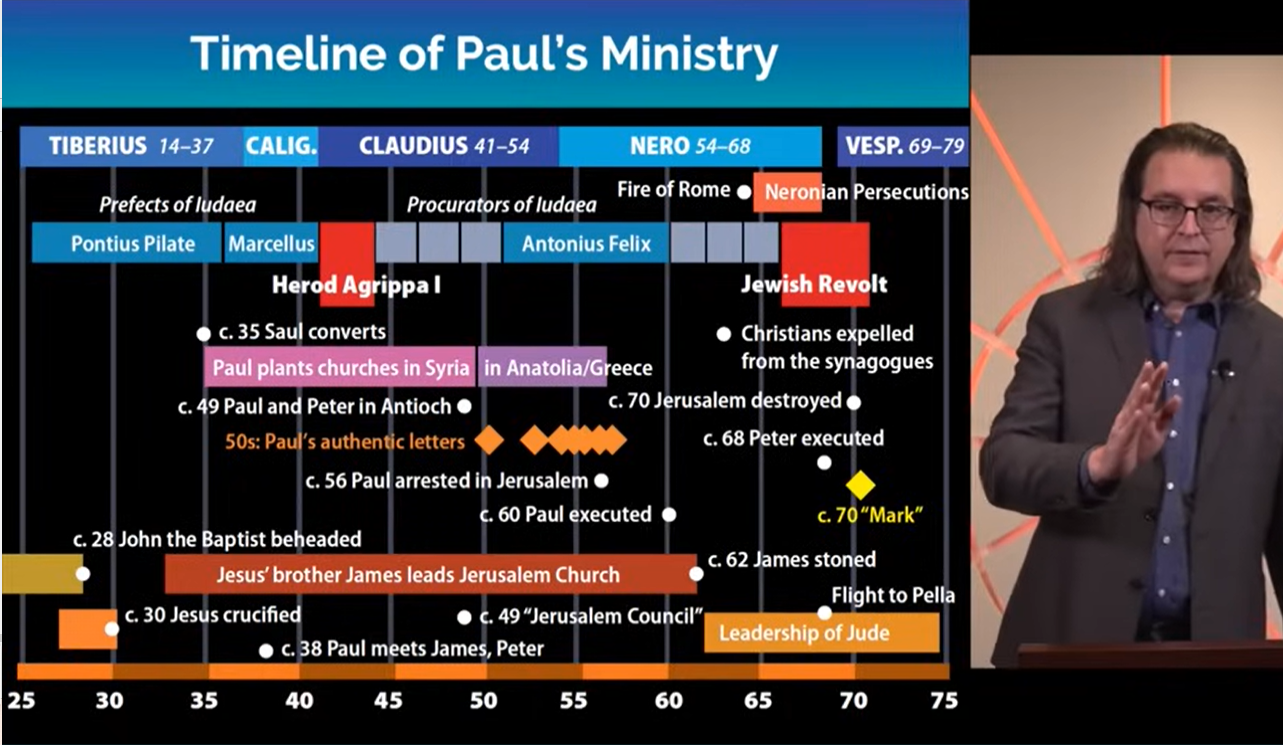
And so we can just sum up, we bring back our time frame here, and so Paul's execution at the year 60 seemed like a low moment for him, but there's a lot of chaos that's about to erupt with James's execution, the Jewish revolt, the execution of Peter, the ending of those earliest generations, anybody who had known the historical Jesus, and now kind of the reformulation of Christianity in the second century.
Q&A
And so, that is my explanation of why Paul's church is one. I'm going to get a glass of water as Leandro compiles some of your questions. I want to thank some January PayPal contributors: Charles Reynolds, Ariel Tiara Molina, Katherine Brian, Eleanor, CI Rosie, Sher Donald Stedman, Ray Paul, Ralph Lebcusher, Anne Elliott, Brie Valdez, and William Gibson. I wonder if I can have access to this. There are so many things here I need to go through. Today's... oh, and then we also have... sorry, we also have had people who contributed during this lecture: Ron Wagner, Dave Anderson, Sydney Santel, Dan Howard, Carney Defoe, Mark Long, James Sweeney, Cheddar B, Baby Bloated Warlock, Michael Rogers, and Daryl Scott. Thank you all. I can move this queue out, Leandro. So here are some questions. Julie Bazooki asks, "Can you briefly explain which of Paul's Epistles are considered genuine by most historians?" So I put a whole chart in. You probably, I think you asked this before we got to the chart in that, about which are the ones that are considered the most... anyway, the ones that everyone agrees are genuine, the ones that people go either way on, and the ones that most scholars think are written after Paul's death because they include ideas that are later developed. Ron Wagner asks, "Is there a book on how all the apostles died?" So I don't know of a particular book. I'm sure there is, but what I would just say is we had a whole lecture on all of the apostles and the historic apostles. Ron, you might want to go back to it, and all of the answers are legendary, so we do not have any, I don't think we have any good historical, contemporary, or any kind of narrative about any of the apostles, including Paul. So Paul is maybe the most likely to actually have made it to Rome and be there. I mean, there's a tradition that Peter did, and I don't think that tradition is very good or very likely. I think almost all of the others, the best I guess is James, the brother of Jesus, who does not make it on the apostle list according to the 12 apostles, but we actually have a narration of how he dies according to Josephus. He gets stoned by a group of non-Jewish Christians in Jerusalem. Leandro, I'm sorry, I've been scrolling with this and so I got to stop because I was taking control and now I can't, so you have to pull it back up for me because I can't see now or pull it back down. There we go, so I'll stop touching the mouse, you can do it. So Mike was having me do it and Leandro's back and he has more control over this prompter than me. Okay, Sean Hogan, thank you so much for your support. Jan Gun says, "What's the difference between first-century synagogues that John is referring to, that I'm referring to I think you mean, and the temple?" So there's a big difference. The temple is the one place where according to Jewish law certain rituals of the Mosaic law can take place. This is the place where animal sacrifices are offered, where a bunch of different rituals happen. This is the central focus of second-century Judaism. Synagogues are, it's a word essentially that originally just more or less means congregation or group of people. There becomes a building associated with this in the middle of the first century, but there hadn't always been, and this is a place where people get together for prayer and also to read the law, to debate, and to share experiences. This is what we think of more nowadays when we think of a synagogue or we think of a church. That's what a synagogue would be like, whereas the temple is what you might think of a pagan temple, a Greek or Roman temple, to be like. The exception is that unlike a pagan temple, there's no cult statue. You're not allowed to make a statue of God, the God of the Jews. Otherwise, it would be like that. Bubbles, it's the first time here. Thank you so much for your support. Jeff INFJ asks, "Should Christians give Paul's letters more credibility than the four gospels given that it was the earliest manuscripts that we have and thus less prone to copy errors?" Well, in terms of copy errors, I think you only look at transmission errors. The problem with the gospels is that they are written so long after the fact that the sayings that they ascribe to Jesus have gone through evolution through the oral tradition, through a translation from the original language Aramaic into Greek, and much of the narrative is also not from any memory of an eyewitness and rather has to be reconstructed, as we've seen when we go through the gospels. I'm going to cough real quick. Sorry. And so, as opposed to that, Paul's letters, he is absolutely writing at the time, so we are getting what a historical figure thinks at that purpose. So Christians should give more credibility as historians. Christian historians should understand their value as a historical document. Christians religiously don't need to give Paul's letters more credibility than the gospels because Christianity is not a history class. We don't need to worry, frankly, about what the historical Jesus did or didn't do or anything about the historical Jesus. The gospels are a sacred story that should be part of the lived church now, and they are a text that in worship points Christians to God, who Christians understand in three persons, and so it points us to God. It's not a history book. And so, yeah, we as historians should take them with much more credibility. There's no... but I think that in terms of the Christian worship, they are not more important. The gospels are more important than Paul's letters.
Sandra Burn asks, "I'm always looking for good historical resources about what life was like at the time of the Bible. Can you recommend a resource? I appreciate what you're asking because social history and lived history are some of the most difficult things to study. Historians almost weren't concerned about it at all a century ago, but it has become a focus recently. When I'm researching Jesus, one resource I go to is a five-volume series called 'A Marginal Jew.' It contains a wealth of contextual information. I know that here at Church Headquarters, they have all five volumes in the library. There are many resources, but that's the one I use. I wish I had one that I could recommend for sure, like 'Daily Life in First-Century Palestine.' There are many one-volume commentaries at the temple library, but they don't solely focus on everyday life. The series includes all the daily life information I mean to convey. Michael Rogers, thank you for your support."
Michael Loose asks, "If Paul was a Roman citizen, shouldn't we have his 'tria nomina'? Romans, especially those from noble families, had triple names, like Gaius Julius Caesar, where you have your praenomen, nomen, and cognomen. Only a handful of names like Marcus, Sextus, etc., were used. Your first name is your praenomen, then your nomen like Julius, and noble families like Claudius, Fabius, etc., had these names. The final name indicates which clan or subclan of the Julii you are from, like the Julii Caesar as opposed to other Julii. Not all Romans and Roman citizens had these names, so Paul wouldn't necessarily have one. You might adopt such a name if, for example, you gained citizenship through a patron like the emperor. Josephus did this by being adopted by the Flavians, becoming Flavius Josephus. He was a noble at the Imperial Court and took the Imperial name as part of his own. However, not everyone granted Roman citizenship adopted noble Roman naming practices. It could simply be a legal status. A whole Greek city or an ally of an Italian city in the Social War might have been granted citizenship and kept their original names. Follow-up: Luke Michael Loose asks if Paul could be the cognomen of a famous Republican family. There is a Roman family name 'Paulinus' and 'Paulus,' so Paul might have chosen a name familiar to Romans. 'Saul' was not a name they would recognize, but 'Paulus' was. However, he wasn't from a famous Republican family, so he might have picked that name to be more relatable to Greek and Roman people, adopting their customs to be an ambassador and a good missionary. Similarly, in Toronto, many Chinese Canadians have a Chinese name and also choose an English name, which doesn't necessarily relate to anyone native to Canada. That's what I would say about that."
Day Landro notes that there are more than 400 people watching live right now, with 188 likes on YouTube, and asks if we can reach 200 likes by the end of the lecture. "400 is a lot. Thank you all for tuning in. I appreciate everyone being here."
James Sweeney asks, "Were early Christian apologist authors in any way related to modern apologetics in terms of motive? Modern apologists seem focused on biblical inerrancy, for example. Thanks for the awesome lecture."
I agree with you; they have different agendas. Modern biblical inerrancy is a significant concern today. Modern apologists write since the invention of the modern academic discipline of history, and they are very concerned about historicity. They might distort readings to fit them into history, a concern people didn't have in the past because they lacked the nuanced ability to deconstruct something historically. They assumed that what was written largely happened. It's a huge modern concern because we are so worried about historicity. Ancient apologists had different motives, so the answer is no; they have very different motives.
Carney Defo asks, "The writings of Paul are in the form of letters that were copied and distributed. Did the original James Ministry have geographically spread groups that may have communicated by writing?"
Originally, they didn't have writing, which is why Paul, in the first 10 years of planting churches, wasn't writing either. He started writing when he left his first churches to the Jamesian and other churches. He was no longer in Antioch, Syria, and Cilicia, and instead started planting churches across Anatolia and into Macedonia and Greece. To keep tabs on the different churches as rivals spread alternate teachings, he wrote letters, which was an innovation for his circumstances. The original Jamesian church was more like what we read about in long texts about apostles and prophets going out, speaking in the spirit, begging, being put up, staying for two days, continuing on, and traveling. They preached by the spirit in little groups, constantly traveling and doing it orally. That's why we don't have early writings in Aramaic, their original language. It's only later, reacting to Paul's churches having authoritative writings, that they decided to get some writings too, doing it in Greek. James, Jude, 1 and 2 Peter, and probably the Apocalypse of John are influenced by a Jamesian perspective. These texts, probably from that group, are still written in Greek. They reacted to the existence of these writings in Greek-speaking churches more like Paul's. It's only later that anyone worried about Aramaic and started translating Greek texts into Aramaic, which is an interesting reversal of getting it back into the original language.
L says there are 226 likes after that cutout, so thank you, and let's keep them coming.
Brian Bunan asks, "Where are these traditions written down or passed down, for example, the idea that Luke is a physician?"
Luke is called a physician in one of the later letters in the New Testament attributed to Paul. The name Luke refers to a historical companion of Paul, mentioned alongside others like Barnabas and Titus. Later writings by Pauline Christians, writing in Paul's name, talk more about these companions and add different traditions. One of these later letters identifies Luke as a physician. It's only later that anyone says this anonymous gospel, which we might call the third gospel, the Gospel we now call Luke, and the Book of Acts, the second half of it, were written by an anonymous Christian. Many years later, towards the end of the second century, an early Christian writer named Irenaeus identifies those books as being written by Luke the Physician. Whether or not that's an accurate identification, it's only a century later that an early Christian identifies this text with that person. That's why that tradition isn't likely in my view. These traditions happen in the writings of early Christians we call the Church Fathers. The earliest traditions are at the end of the first century, with more in the second century, and they really get going in the third and fourth centuries. They are often fairly late traditions, including traditional identifications of martyrs' tombs like Paul's or Peter's, which don't date to when the historical figures died but are traditions that come up later.
Cheddar B. Baby asks, "Was eating the sacrificial meal the first controversy where Paul departed from the Jerusalem Church? How much of a scandal would it have been to Jews, and could it have preceded the whole circumcision debate?"
That's interesting; I hadn't thought of that in terms of historical priority. Paul is pragmatic on this question. In all these pagan cities where Paul is planting new churches, almost all the meat comes from animals sacrificed at temples. Modern people often think sacrificing means burning the whole animal, but it's mostly burning the waste, and the rest is consumed or sold. In Jewish law and early Christian practice, you can't eat meat from a pagan sacrifice because it implies belief in those gods. Christians emphasize that those gods don't exist; there's only one God. Paul, when asked about it, says, "If you go to someone's house and they're serving you meat, don't ask about it. They're giving you hospitality; it's none of your business. If they later say it's a pagan sacrifice, then don't eat it anymore, but don't ask questions about where the meat came from." Paul is flexible, thinking the point is more important than literal obligation. The spirit of the rule matters.
Matild Hman, thank you for your contribution. Matilda says, "Thank you so much for the lectures. I listen to them all the time. I've learned a lot; it's very valuable for my faith as well." Very happy to hear it.
JB asks, "In the New Testament, Jesus implies Peter will lead his church, yet Peter seems to be a relatively minor leader compared to Paul, James, and even John. Why do we have this tradition of Peter as a founder?"
That happens in the Gospel of Matthew. In Matthew, Jesus says to Simon, "You are Peter, and upon this rock, I will build my church." This is important to papal claims that Peter is the leader after Jesus' resurrection, but it's only in Matthew's gospel. Matthew's group clearly looked to Peter as the authority, but different early Christian groups elevated different leaders. Some looked to John, Paul, Mark, Mary Magdalene, Thomas, and others. We're getting scripture from a community that elevates Peter, implying he was an important leader. Peter probably was important, as Paul talks about him a lot, even antagonistically. Peter, James, and John were likely important leaders. Unfortunately, we don't have more books of Acts. It would be nice to have multiple early acts books from different perspectives to better understand this diversity.
Donny Lee Gringo in Brazil, thank you for your support. Bloated Warlock says, "Massive love to you all. Does Paul explicitly state that Peter and Cephas are the same person, or is it Mark that links these names?"
I don't think Paul ever does. Peter is a translation for Cephas; both mean "rock." It's like the relationship between Thomas and Didymus, both meaning "twin." I don't think there's a scholarly case that Peter and Cephas are different people; they are identified as the same person, also known as Simon or Simeon bar Jonah.
Austin Lewis asks, "Paul says the apostles went out to share the gospel. What is the history of the word 'gospel'? Also, if Mark, Luke, etc., hadn't been written yet, what gospel are they sharing?"
The word "gospel" is an older English term meaning "good news." Christians often refer to it as the "good news of Christ." When sharing the gospel, they weren't sharing a particular book. The books claim to be gospels, but the good news according to Paul is smaller. I quoted it when I mentioned his phrase to the Corinthians: "I wanted to share with you what I myself received, that Christ was born according to the scriptures, lived, died, and was raised again on the third day in accordance with the scriptures."