Gnostic Jesus, Transcript with Slides
Transcript
The Gnostic Jesus - YouTube
Transcript:
- Our topic this evening is the Gnostic Jesus. We've done several past lectures on Gnosticism and Gnostic texts, including a recent one in Lyon where we discussed one of the most important early critics of the Gnostics, Irenaeus of Lyon. We've also conducted numerous lectures on Jesus, both on how Jesus is reconstructed academically, the historical Jesus, the search for the historical Jesus, and how different groups, both contemporary and historical, remember and understand Jesus. Not too long ago, we examined how Jesus is understood in Islam, and tonight we will discuss how the Gnostics understand Jesus and the different ways they do so.
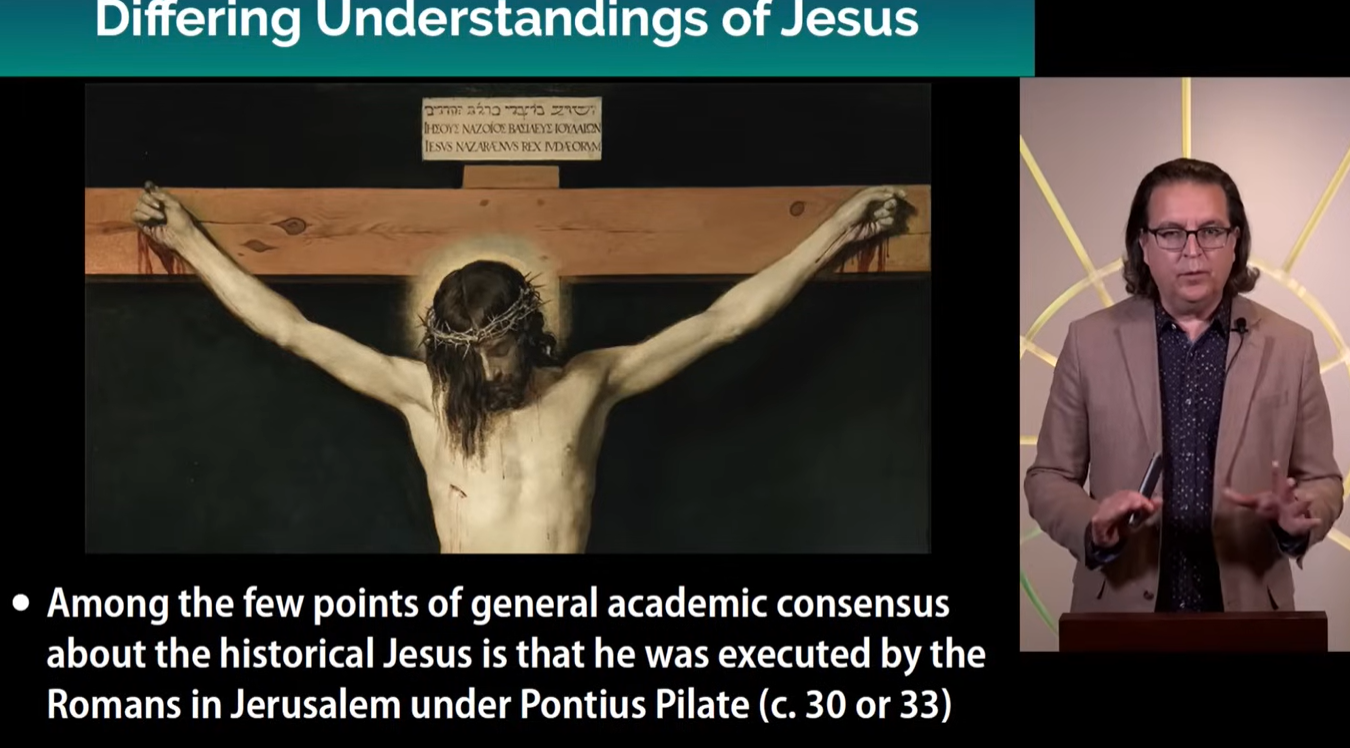
Among the few points of general academic consensus about the historical Jesus, we can say that there are a few basic points that all historians sort of agree upon regarding the historical figure. One of these is that he was executed by the Romans during the governorship of the Roman procurator Pontius Pilate. Because we know the dates Pontius Pilate was in office, we can calculate when there was an appropriate Passover time, leading people to date Jesus' execution to either 30 or 33. Essentially, we have that idea as a kind of historical point in the timeline that we can actually anchor to.
An Unexpected Outcome
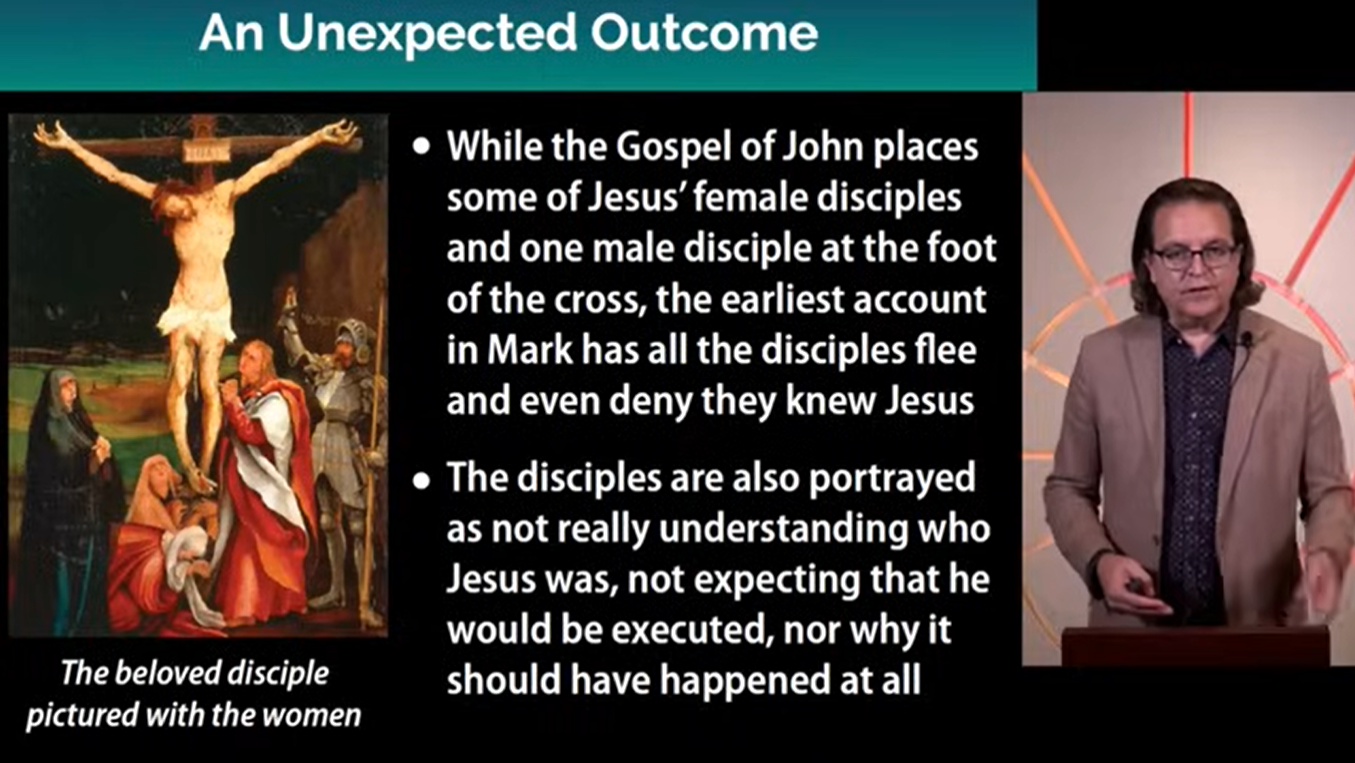 When we look at the crucifixion picture as envisioned in artwork over the last 2,000 years, Jesus is often portrayed with the Beloved Disciple, who, according to Christian tradition, is John the Beloved, along with different women, including Mary, Jesus' mother. They are pictured at the crucifixion scene, which comes from the description in the Gospel of John, placing some of Jesus' female disciples, including his mother (unnamed in that gospel), and one male disciple (again unnamed, the Beloved Disciple) at the foot of the cross. By contrast, John's account of the crucifixion, the earliest account we have in the Gospel of Mark, has all the male disciples fleeing and, in some cases, even denying that they knew Jesus, most notably the story of Peter denying that he had been a disciple of Jesus three times.
- In addition to that, in all the gospels, but especially beginning in Mark, the disciples are portrayed as not really understanding who Jesus was and not expecting that he would be executed. They also didn't understand why, if Jesus is the Messiah, an execution would have happened at all. What's the point of that? How does that work? There is confusion even in the gospels as they are written, and indeed in our earliest texts, Christians have competing views on this. Most scholars of the historical Jesus imagine that there were no disciples present at the crucifixion likely, and therefore, because the disciples were not expecting it and they were themselves in danger of being arrested, how could the disciples not know?
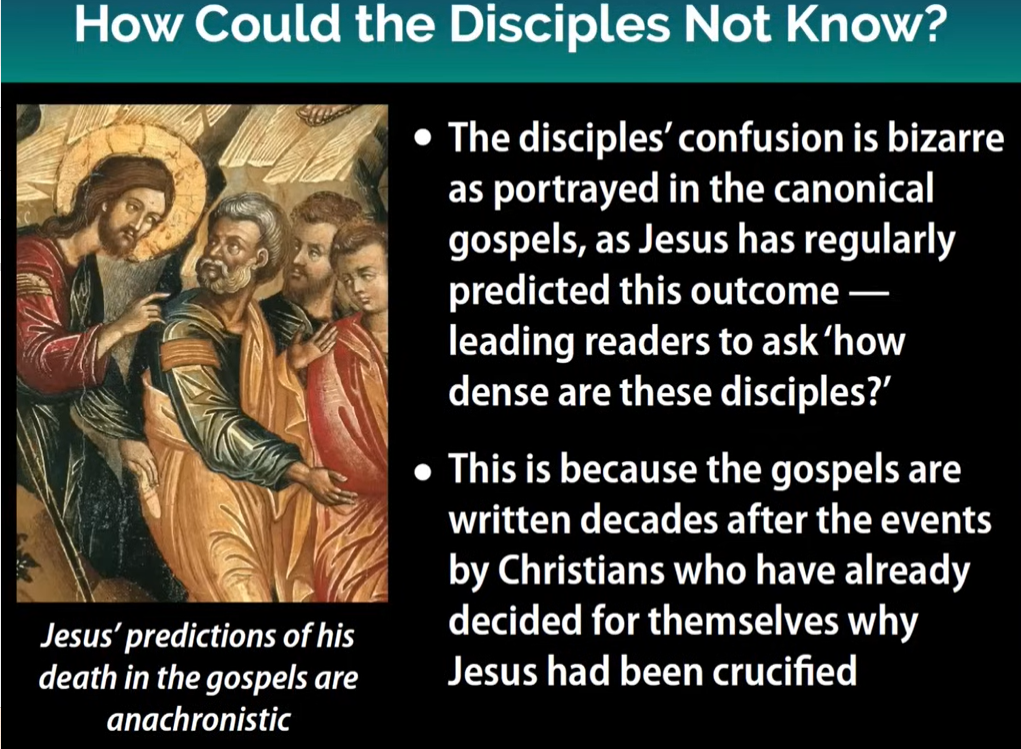 As we read the canonical gospels, the disciples' confusion just seems bizarre. Jesus is continuously predicting this outcome, telling them that he's going to be killed and resurrected. Yet, as we read the gospel accounts, we can't help but ask ourselves how dense these disciples are that they are not just listening to even more explicit predictions of the outcome and why it has to happen by Jesus.
- In terms of the texts, this is because the gospels are all written decades after the events, and they're already written by Christians who have decided for themselves the answer to this question. Christian communities have been wrestling with this for decades already by the time the gospels are written, and those explanations are then put back into the text as explanations in Jesus' lips and predictions in Jesus' lips, all of which are anachronistic, all of which are not due to the historical Jesus but to Jesus of the gospels.
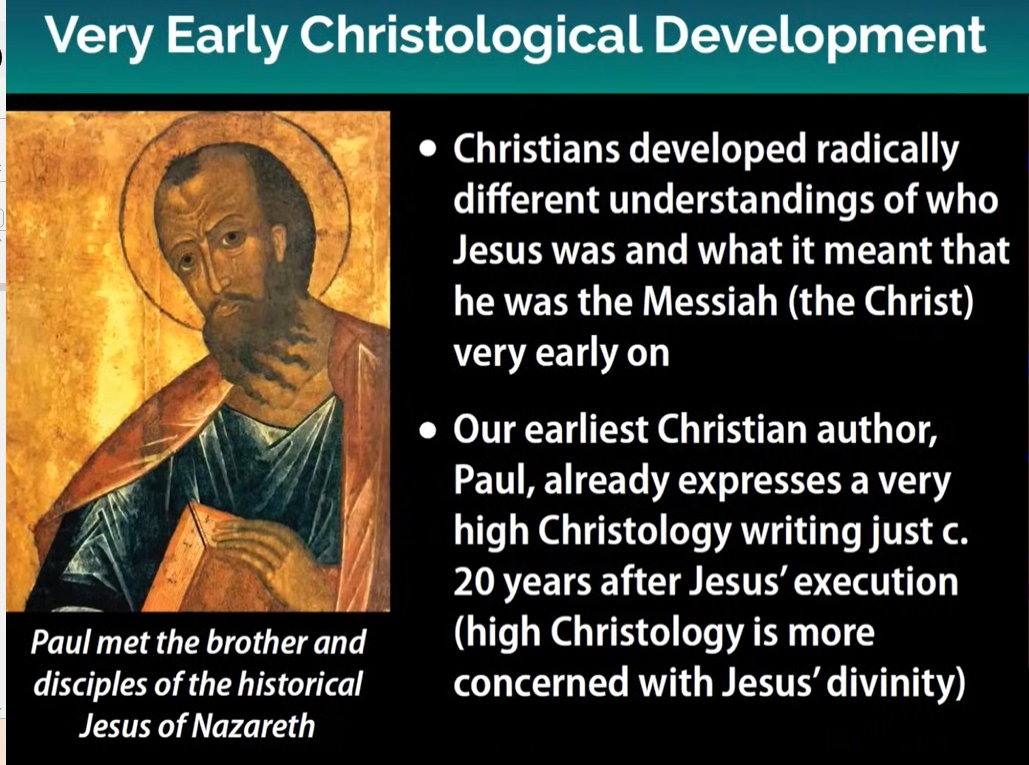
- What's also interesting is how radically different understandings were right out of the gate. Who was Jesus? What does it mean to say that he's the Messiah, that he's the Christ? Very early on, Christians did not agree on the answers to those questions. Our earliest Christian author, whom we often cite when trying to get back to the historical Jesus, Paul, met the brother of Jesus and some of the disciples of the historical Jesus but never himself met the historical Jesus in person. He describes a spiritual experience with the Risen Christ but not meeting the historical Jesus. Paul already develops and expresses a very high Christology, even though his writings are happening just 20 years after Jesus' execution.
- Christology is how Christians talk about what Christ's life means, who Christ is, and so on. When we talk about a high Christology, we're talking about Christians who are really emphasizing Jesus' divinity, such as Jesus as the Lord or Jesus as the only begotten, the one Son of God. A low Christology is more concerned with Jesus' humanity. Logically, the closer you get in time to when the historical Jesus was alive, when a man was walking around and gathering disciples and teaching, you would think that this would develop from a low Christology to a high Christology and that our earliest writings would actually have a low Christology. But that isn't the case. We actually have both right from the start, including a fairly high Christology.
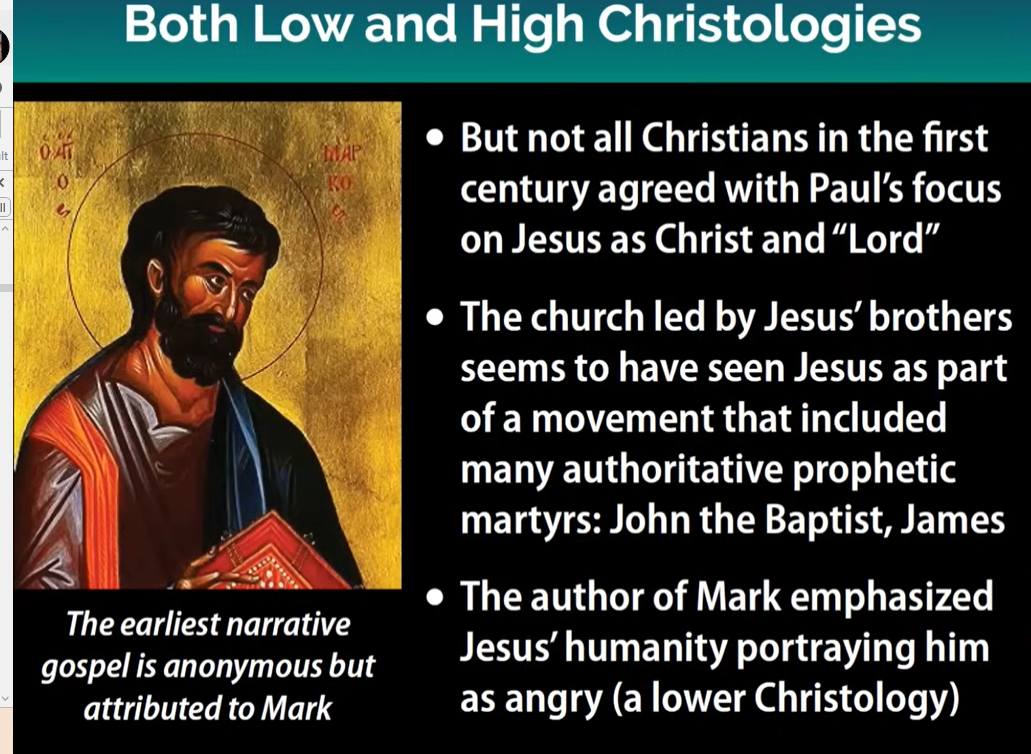
- Not all Christians in the first century agreed with that high Christology that Paul had. Paul's focus on Jesus as the Christ and on Christ as Lord, in other words, Christ as the visible glory of God made manifest, an idea that Hellenistic Jews like Philo of Alexandria had already sort of talked about when they were creating their own sort of philosophical Greek philosophical understanding of Jewish monotheism and how we perceive the Creator, who is ineffable and unseeable, invisible, and we're not even supposed to say his name. How can we relate to this unknowable Creator in the world? Through his glory or through the creation itself. This is understood anyway, using the word Lord for that manifestation or reflection or hypothesis of God, which then Paul describes as Christ, the Risen Christ.
- Among the early Christian groups, we often talk about the Jamesian or Jacobin church, the church led by Jesus' brothers. As we've seen in previous lectures on that group, they seem to have seen Jesus as part of a movement that included many authoritative prophetic martyrs, prophets who sealed their testimony by being killed. Those included John the Baptist, who was killed by one of the Herodians, James, the brother of Jesus, who was killed by a high priest in Jerusalem, and then, of course, Jesus. In addition to that group, the author of the Gospel of Mark, who is actually not part of that group and is antagonistic towards that group, emphasizes Jesus' humanity throughout his gospel by portraying Jesus as really emotional and very human-like. Often, he even just gets angry, sometimes for no reason, which seems to express a lower Christology. Jesus is not this impassible manifestation of a divine man walking around as much in Mark.
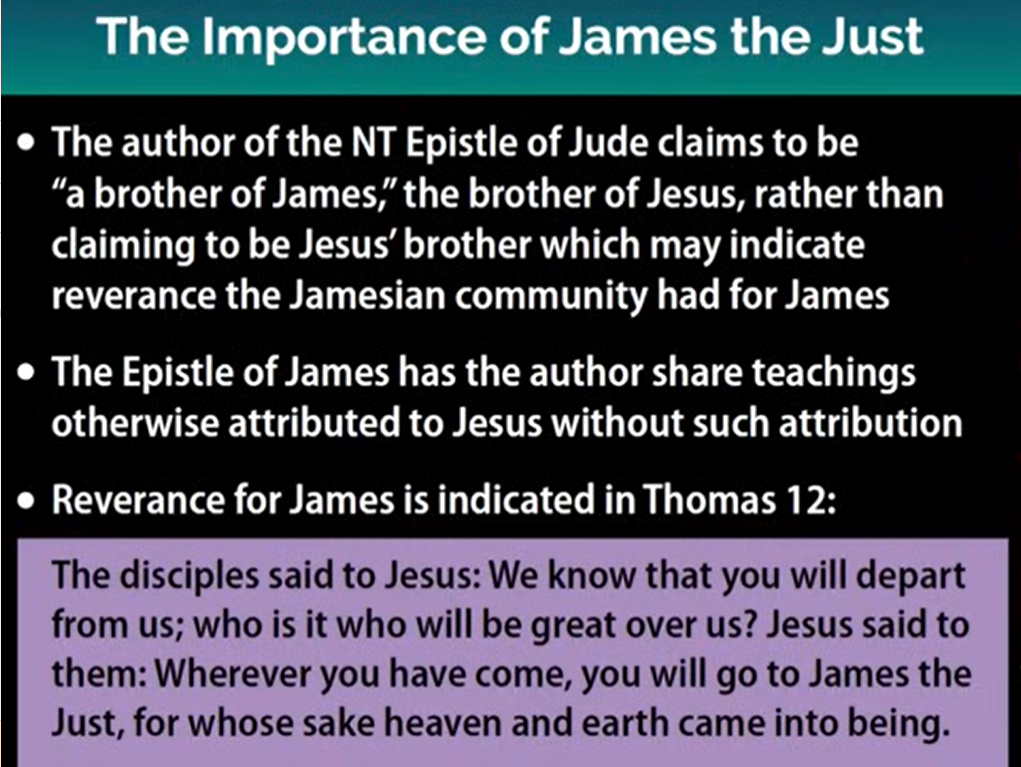 If we look back at that Jamesian church, a low Christology, the author of the New Testament Epistle of Jude, when identifying himself, is probably a pseudepigraphic author but claiming to be Jude and identifies Jude as a brother of James, even though James is the brother of Jesus. You would think that Jude would say, "James, the brother of..." I'm sorry, this is written by Jude, the brother of Jesus, or maybe even Jude, the brother of Jesus and James. Rather than claiming to be Jesus' brother, this author claims to be Jude, brother of James, which may indicate a reverence within this Jacobin church, the Jamesian community, a reverence they had for James in addition to Jesus and John the Baptist.
- In another one of these texts that come from this group, the New Testament's Epistle of James, which claims to be written by the brother of Jesus, again, it's probably a pseudepigraphical text but written in James' name, the author shares teachings where James more or less is quoting, you know, quoting, he's teaching himself as if he was just sharing these teachings, but these are sayings that in the gospels, for example, would be attributed to Jesus. But in the Epistle of James, he's not saying Jesus taught us this; it's just James teaching us this. Again, this might indicate a higher level of authority for the person of James within this community. Reverence for James is indicated in the 12th saying of the sayings gospel. We're going to talk about this sayings gospel because it also includes a lot of ideas identified with Gnostic Christianity, but many scholars think there are different layers or different components of these sayings that have been gathered together. This one wouldn't be from the Gnostic component of it if that's the case. Anyway, let's read it. This is one that indicates, again, an amazing reverence for the figure of James, the brother of Jesus. The disciples said to Jesus, "We know that you will depart from us. Who is it who will be great over us?" Jesus said to them, "Wherever you have come, you will go to James the Just, for whose sake heaven and earth came into being." This assigns to James, the brother of Jesus, James the Just, an exalted place in cosmology. Heaven and earth have come into being for his sake. Anyway, he's also saying that he's to be Jesus' successor. This may have come again, a saying that is coming from the Jamesian community originally, that's made its way into Thomas.
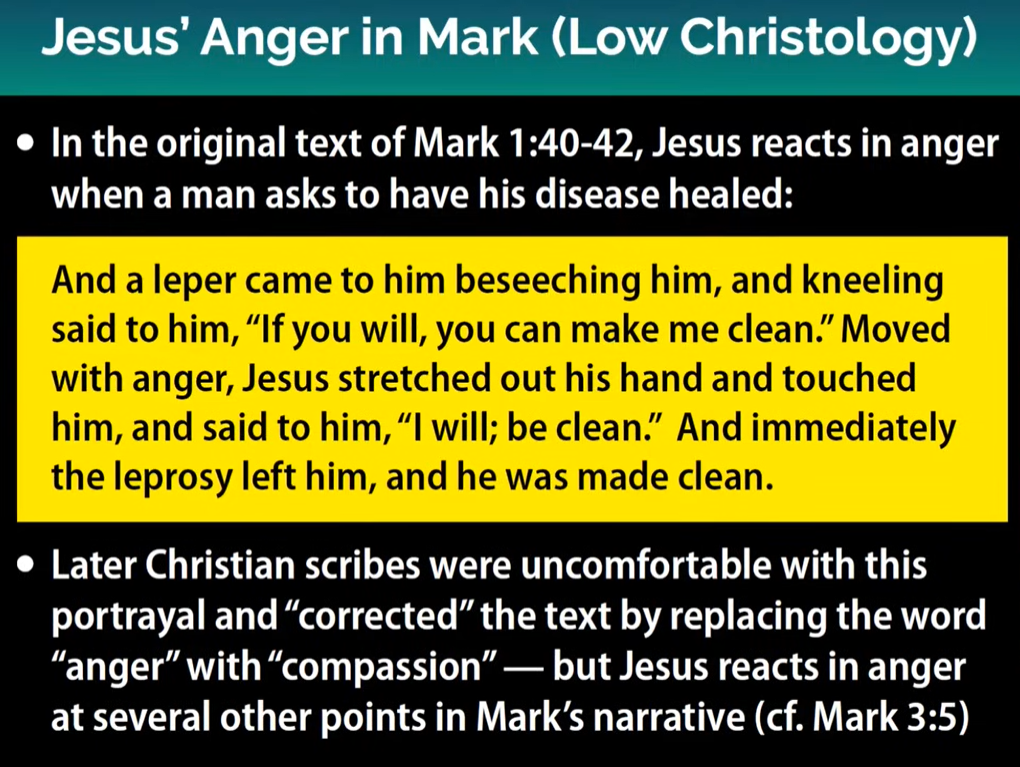 We also talked about, in addition to the Jamesian community, this Markan low Christology, the low Christology that we see in the text of the Gospel of Mark. For example, in the original text of chapter 1 of Mark, verses 40 to 42, Jesus reacts in anger for no particular reason, seemingly anyway, when a man who has leprosy just asks Jesus to have his disease healed. We read there, "A leper came to him, beseeching him, and kneeling, said to him, 'If you will, you can make me clean.' Moved with anger, Jesus stretched out his hand and touched him and said to him, 'I will, be clean.' Immediately, the leprosy left him, and he was made clean." That already just sounds very strange in terms of our probable conception of Jesus that most people have. He doesn't seem like the kind of guy who's just moved with anger for no seeming reason. Anyway, Christian scribes were also very uncomfortable with this portrayal, and they seem to have corrected the text by replacing the word "anger" with the word "compassion." In many translations, people will use this later version. It will say, "Moved with compassion, Jesus stretched out his hand." Bart Ehrman and other scholars make arguments, I think, that are very strong for the original, for the anger as being the original reading because, again, when Luke and Matthew are using this phrase, they don't have it. They just leave it out, the whole emotion altogether, and they wouldn't delete "moved with compassion." Jesus is reacting in anger at several other points in Mark's narrative as well. He heals somebody when he's angry in Mark 3:5. In other words, there's anger, and this may be a special example that Christians later found odd and wanted to maybe clean up.
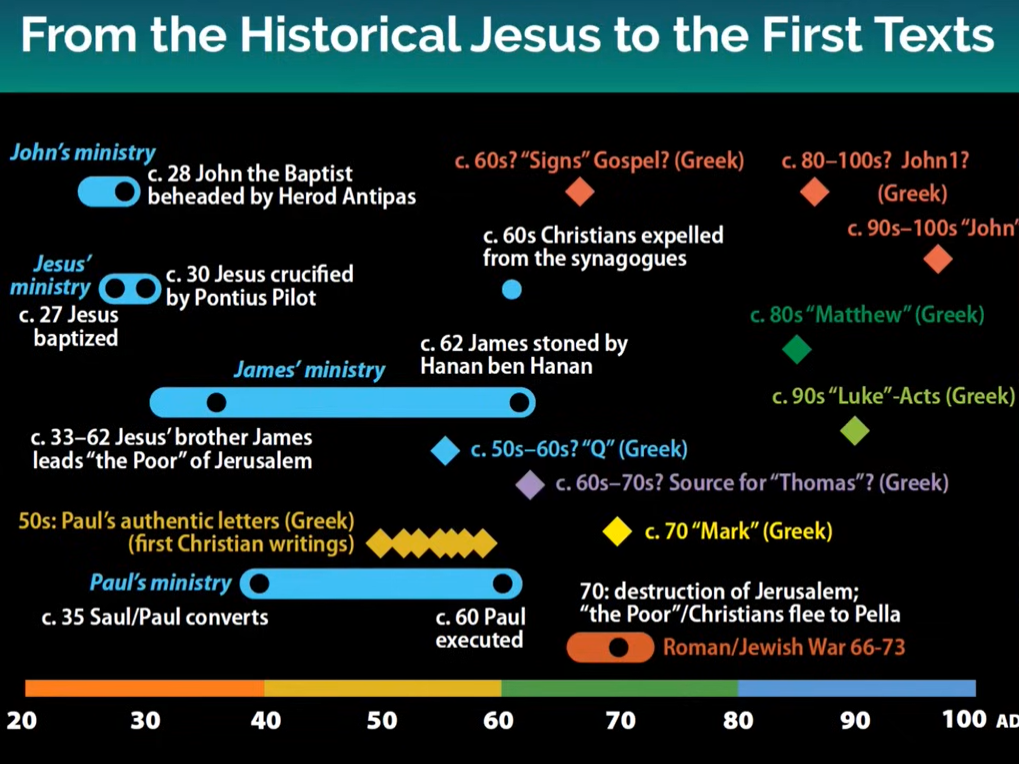 Let's just ground ourselves a little in the first century so that we can see this time period when these early different competing visions of who Jesus was, from his actual lifetime ministry that we can see at the left-hand side of the timeline here, where he's maybe, if he died in 30 as opposed to 33, the three years prior to that between his baptism under John the Baptist and his crucifixion under Pontius Pilate, and then before him, John's execution by Herod Antipas, and then after him, James' ministry, where for a couple of decades he is leading the church in Jerusalem, sometimes called the Poor of Jerusalem, before his martyrdom. Simultaneously, Paul's ministry occurs first in the Levant, it's called Arabia, but anyway, probably the area, kind of the desert area on the outside of Palestine, then later in Syria, and finally in Anatolia and Greece before the very end of his career when he plans to go to Rome and ultimately Spain but is arrested and killed along the way. Those are the lifetimes of the historical figures, which we have in those blue bars, and we're only starting to get writings, again, after Jesus' death, while Paul is disputing with his enemies, which in other lectures we have made the case are probably from the Jamesian church. In any event, then we start having other writings. There's possibly as early as the 50s and the 60s a sayings source, which scholars hypothesize and call Q, which would then later be known to the authors of Matthew and Luke but has subsequently been lost. In that same kind of time frame, possibly a source of the sayings that later get incorporated into Thomas, which goes through much development and exists in its present form in a much later version. Then the earliest, and we also have on there possibly the signs gospel, which is a source, a hypothetical source for the Gospel of John. Then the gospels that we actually have, beginning with Mark around the year 70, Matthew, Luke, and John in the 80s and '90s. In that amount of time, from when people had actual contact with the historical Jesus and then all the way up through the middle of the century when people who had known Jesus were still alive, we already are having competing Christologies, both low and high, developing, and they are being written down then by Christians in the second half of the century towards the end especially.
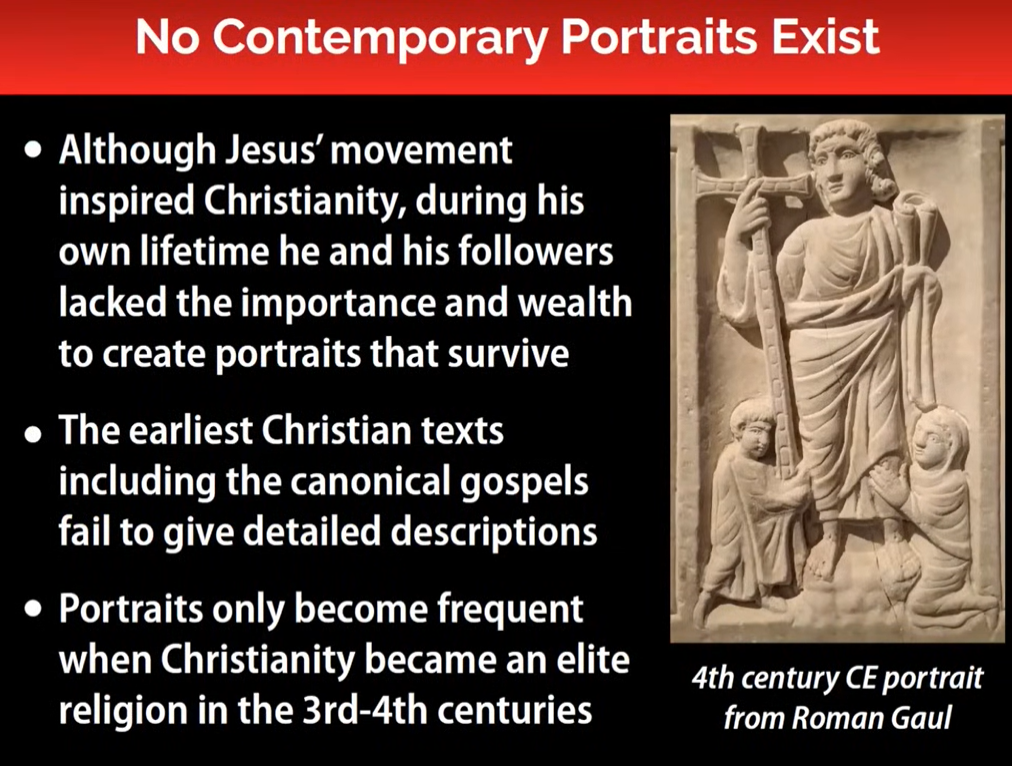 Just like we don't have any writings from the historical Jesus, we don't have any portraits of him or any descriptions even of his likeness. During his own lifetime, he and his followers lacked the importance and wealth to create portraits that survive, and like I say, the texts also don't give descriptions. By the time Christianity spreads enough and that it's present among elite people who can pay for creating artwork, that's already the end of the 3rd century and into the 4th century. When that happens, as in this portrait of Jesus, one of the earliest really from Roman Gaul, you can see here that Jesus doesn't look like we would portray him. He doesn't have the beard, and he's dressed essentially like a Roman, like a Roman philosopher or even a senator. It's because ancient people have very little historical awareness, and so they often then would just picture everybody the way they picture themselves.
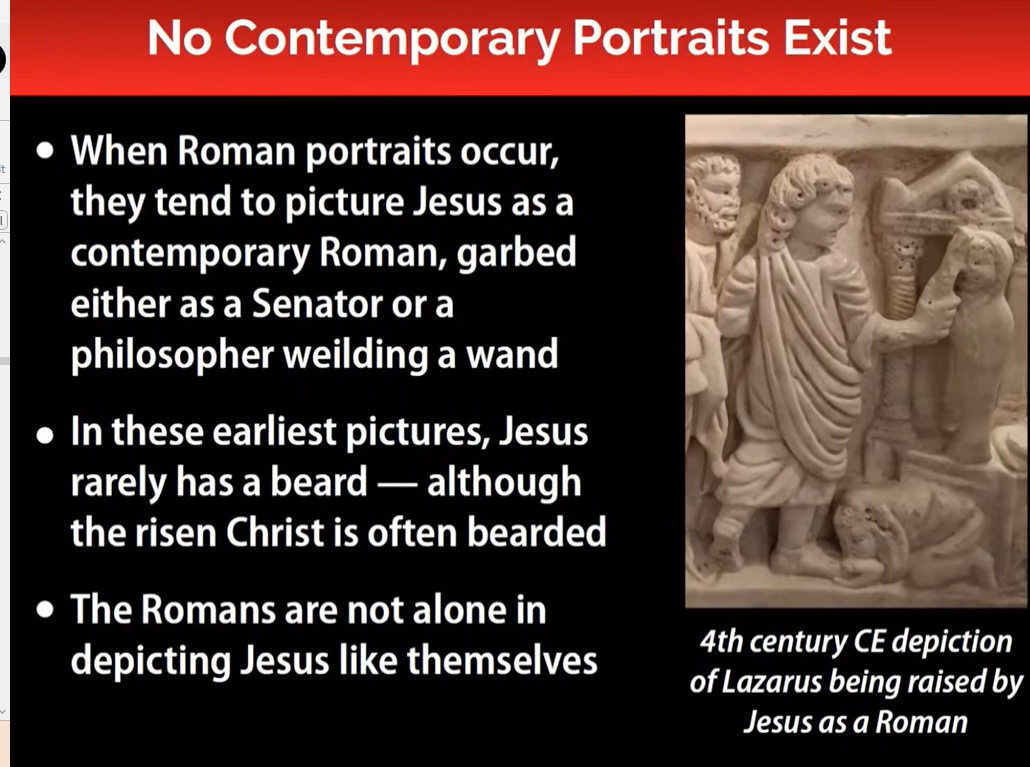 This also happens here in a similar contemporary 4th-century depiction of Jesus, again without a beard, raising Lazarus. Lazarus is the little guy on the right, all wrapped up in his shroud. Again, this is Jesus as a Roman. When Roman portraits occur, they tend to picture Jesus as a contemporary Roman, garbed as a senator or philosopher. Often he has a wand because he is performing miraculous feats, magic tricks, and that's how it's portrayed artistically in the earliest pictures. Jesus rarely has a beard, although when he is resurrected as the Risen Christ, then he often appears bearded. He is two versions of this divine man: the divine man who in his lifetime ministry is portrayed as kind of a magic philosopher, and then as the Risen Christ, he essentially takes on the visage or form of Zeus or Jupiter. The Romans aren't alone in depicting Jesus like themselves. Throughout history, we have medieval Chinese Christian pictures of Jesus where he's dressed as Chinese. We have medieval European ones where he's dressed like the medieval European times, and we have Church African ones for Africa and so forth.
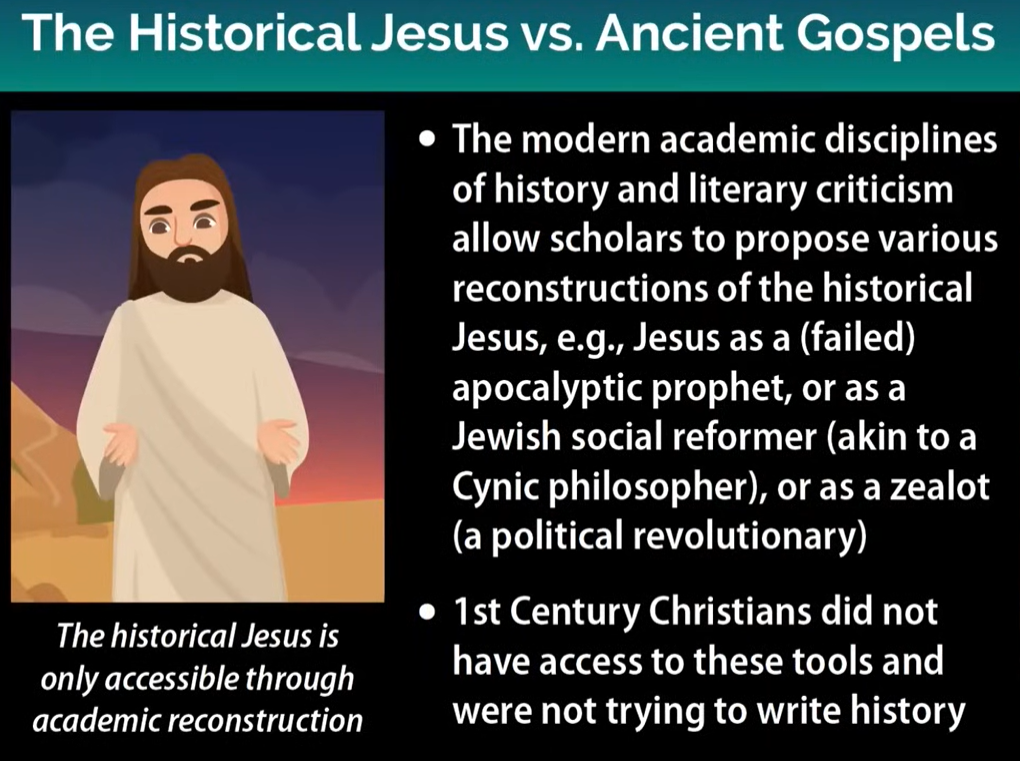 The modern academic disciplines of history and literary criticism allow scholars to propose various reconstructions of the historical Jesus, and we've talked about this when we've done lectures on that topic. The most common, with whom Bart Ehrman is a major proponent, is Jesus as a failed apocalyptic prophet. Another academically defensible portrait is Jesus as a social reformer, perhaps akin to what Cynic philosophers contemporaneously are doing in the Roman Empire, and this is proposed by folks like John Dominic Crossan and others. Possibly as a zealot, a political revolutionary, I think that this is the least compelling by far, but it's popularized by, what's his name, Reza Aslan, anyway, a person who is not really a specialist on the topic, but he's a popularizer. Those are different potential pictures. However, first-century Christians did not have access to the modern academic tools, history, literary criticism, and so forth, and they're really not trying to write history. The author of Luke is trying to give their gospel a historical veneer, but they still have a different agenda than a historian has. A historian's goal is to determine what is the most likely thing that happened historically and what are things that are very unlikely to have happened or impossible to have happened. In fact, all of the evangelists, their goal is instead to convince you that Jesus is the Christ and to convince you to become Christians, which is a different goal.
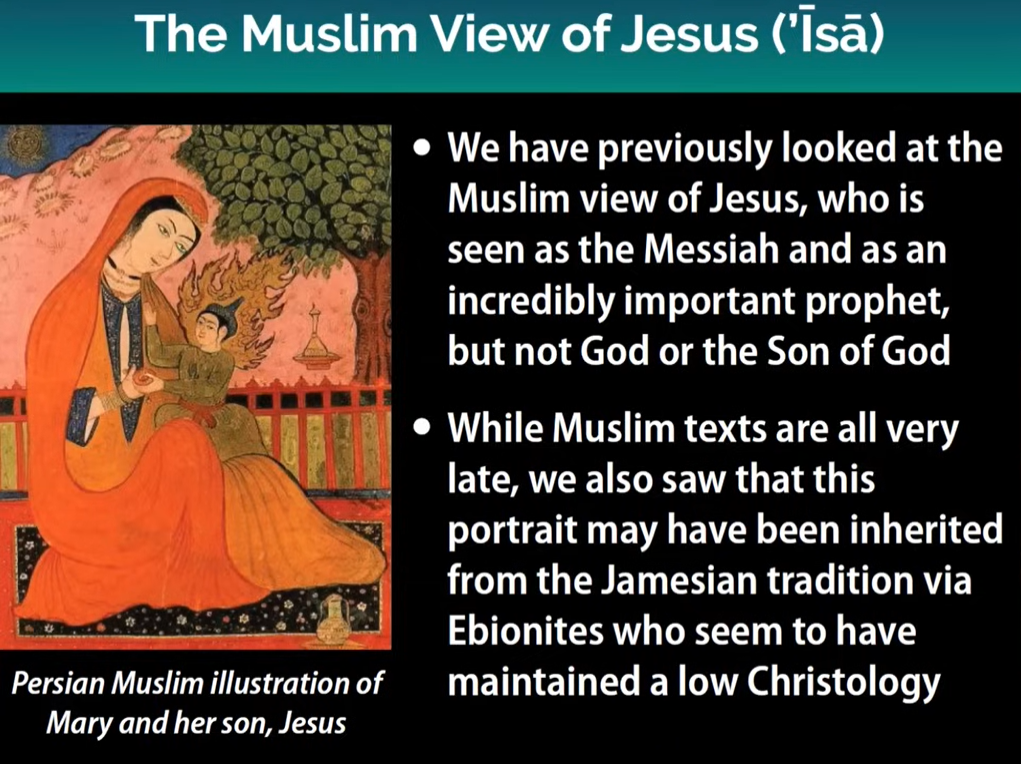 We had a lecture on the Muslim view of Jesus, and in Islam, Jesus is seen as the Messiah, but it's just a different definition of what Messiah means. He's also seen as an incredibly important prophet and can do miraculous things, but Islam is very clear he is not God in any way or a divine Son of God. As we saw, all the Muslim texts are very late, but they may have been heirs to a tradition that was maybe born from an offshoot of the Jamesian church, the Ebionites, which are Christians who continued to follow Jewish law. That group seems to have maintained a low Christology. In other words, Jesus is the Messiah, but that doesn't mean that he's God or the Son of God. It means that it's a very particular title that is important but separate. They're maintaining a stricter monotheism.
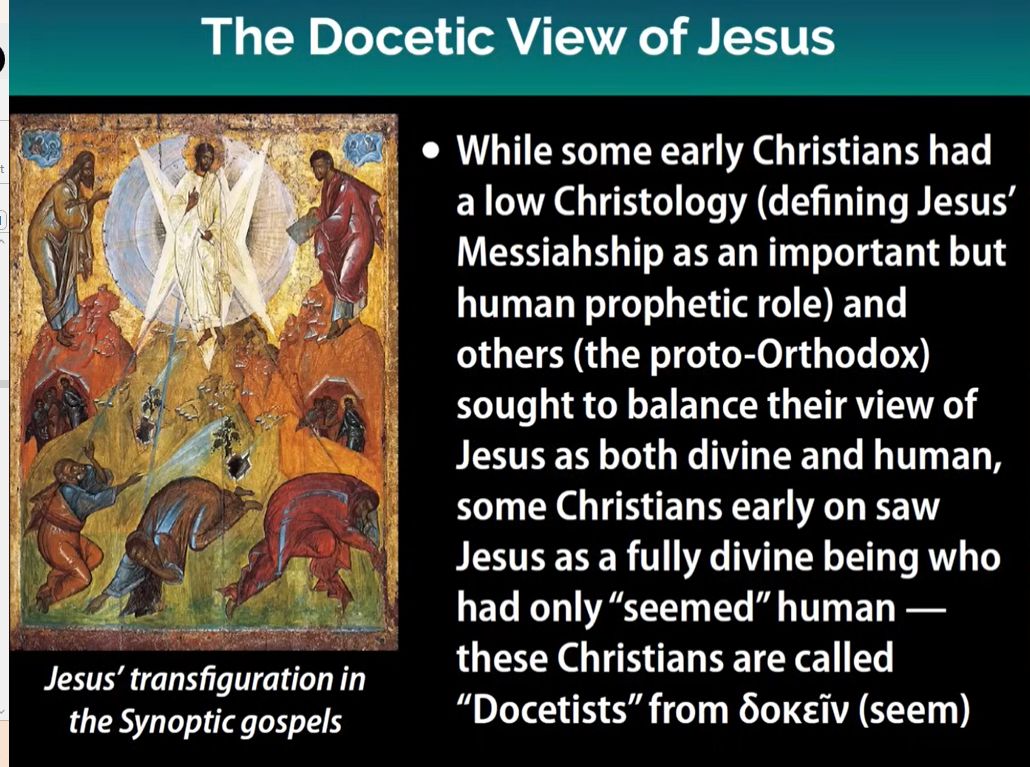 While some early Christians had that low Christology, like I say, defining Jesus' messiahship as important but a human prophetic role, others, the Proto-Orthodox community, the community that eventually wins out and becomes Nicene Christianity, which most all of Christianity today is descended from, sought to balance their view of Jesus as both divine and human. This ultimately gets resolved into the creeds as that Jesus is both fully human and fully divine. Nevertheless, they're kind of striking the balance on the centrist. There were some Christians early on who saw Jesus as being fully divine, who really only seemed human. As we've had in several lectures, we call this last group the Docetists, from the Greek word "dokein," which means to seem. He only seemed like a human; he only seemed to suffer; he only seemed to die on the cross. He was actually a divine being sent to us as a savior. There is a wide community of theologies and Christologies, or not community, diversity of groups that fit into this category, some of whom are Gnostic, although not all Gnostics are Docetists, and some of which are not Gnostic.
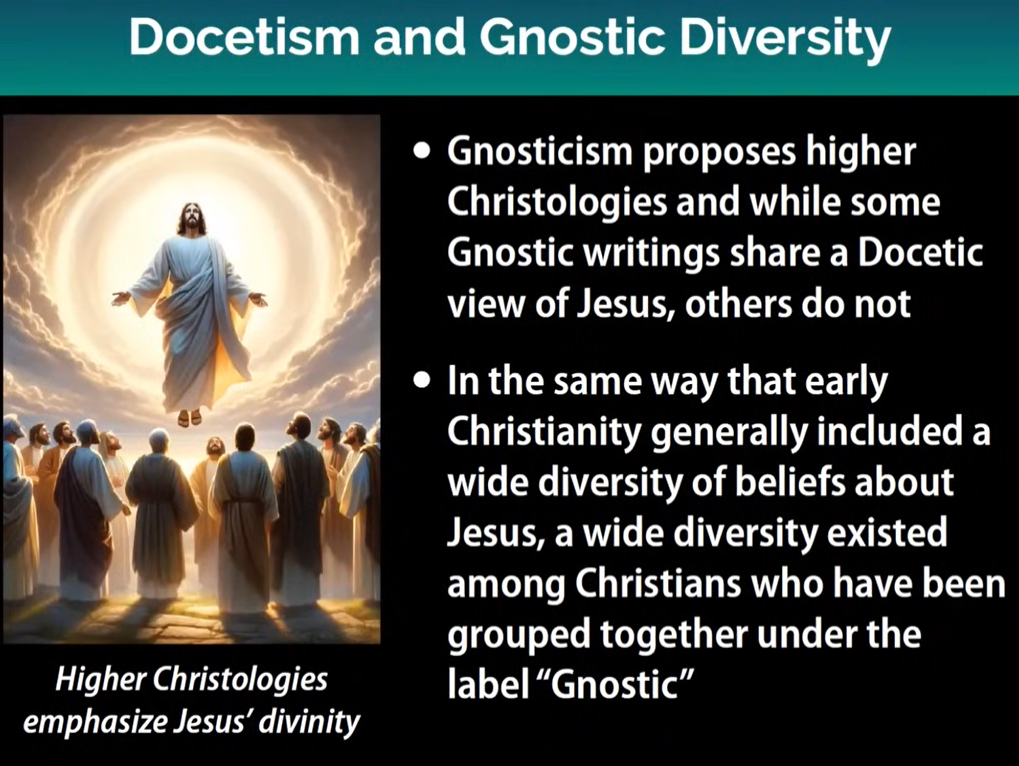 Gnosticism does propose higher Christologies, so in other words, a focus on Jesus as divine. While some Gnostic writings have a docetic view of Jesus, others do not. In the same way, early Christianity generally included a wide diversity of beliefs about Jesus. A wide diversity existed among Christians who have been, by their enemies and also by scholars, grouped together under the label Gnostic.
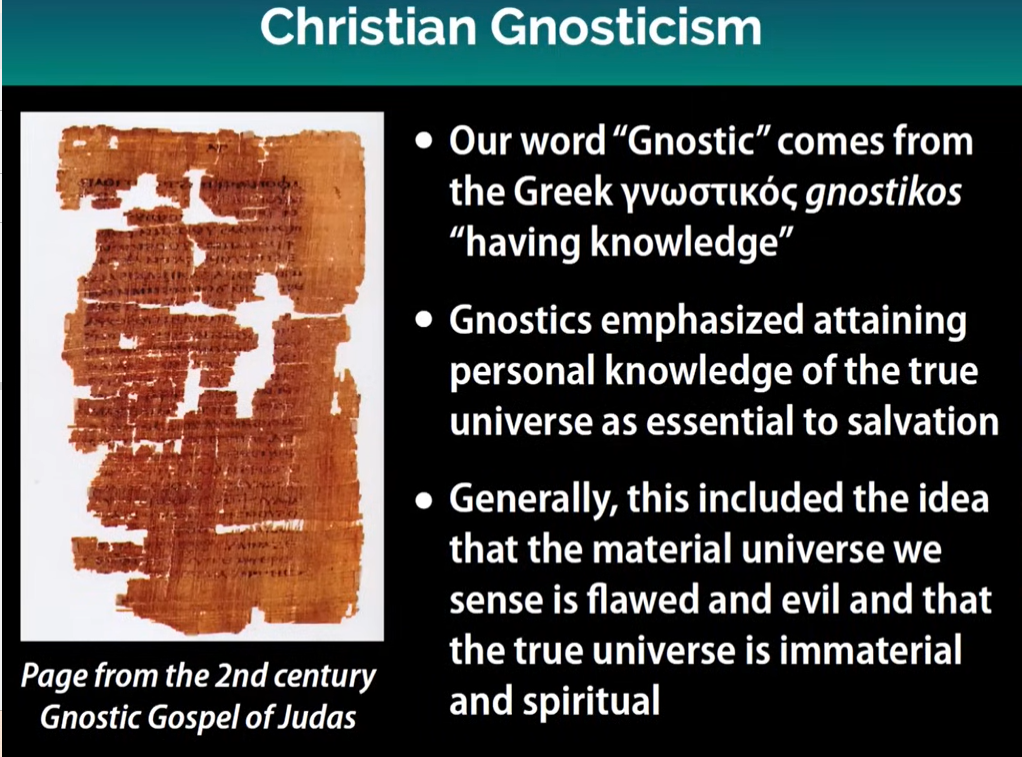 Our word Gnostic comes from the Greek "gnostikos," which means having knowledge, and it's not unlike some of the other names for pejorative names that you have for your enemies. This is not one that I think the Gnostics would particularly dislike, Gnostics, because Gnostics did emphasize attaining personal knowledge, knowledge of the true universe as the most important thing, that which is essential to salvation, that which essentially frees us from our material concerns or temporal mortal concerns so that we can contemplate the divine and imperishable and understand that we are part of that imperishable realm. Generally, like I say, this includes their gnosis, their knowledge, includes the idea that the material universe that we can sense, the sensible universe as Plato described it, is flawed and probably evil, a mistake, and that the true universe is the immaterial and imperishable spiritual realm, what Plato would have called the intellectual realm, the realm that can only be sensed by our intellect, not by our physical senses.
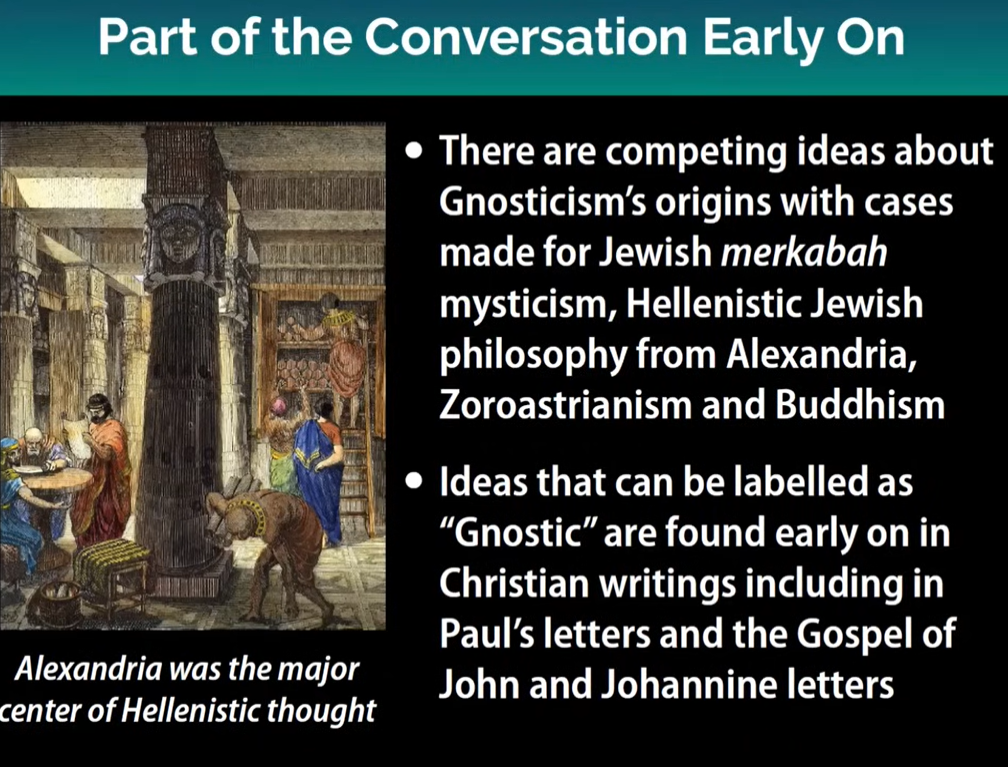 There are competing ideas about Gnosticism's origins, and I think we'll have to do that in a completely different lecture because we want to go to the Gnostic portrait of Jesus. Different scholars have made cases that Gnosticism emerged out of Jewish mysticism, the Merkabah mysticism. There's also the idea that maybe it is from a Jewish group in Alexandria, like Philo, who have a kind of Hellenistic Jewish philosophy, or they're interpreting Jewish scriptures through the lens of Platonism. Other scholars have suggested that there are all kinds of sources within Zoroastrianism, the world religion of the Persians, that may have been the source of inspiration for Gnosticism. Just because people like to throw it into the mix, people wonder if it's possible that some Buddhist ideas, which seem similar, are in fact transmitted from India across Persia and across the Middle East to the Levant.
Ideas that can be labeled as Gnostic are found early on in Christian writings, including Paul's letters and also in the Gospel of John, the Johannine letters. Paul is not a Gnostic as Gnosticism emerges in its full form when we have fully Gnostic texts, let's say, nor is really the Gospel of John in the form that we have it. Nevertheless, those texts could still fit within the universe of Gnostics as they might have used or enjoyed them or used them to help develop their ideas, depending on exactly how early Gnosticism is emerging within Christianity.
 In contrasting the spiritual realm with the sensible material world, Gnostics, following Plato, frequently made use of the analogy of light. As we're just looking at these Gnostic, maybe Gnostic-seeming teachings that are within the Gospel of John, the Gospel of John makes dozens of references to Jesus as being light. Those include, for example, John 8:12, when Jesus spoke again to the people, he said, "I am the light of the world. Whoever follows me will never walk in darkness but will have the light of life." That would be very understandable to a Gnostic. "I am" already is a saying that equates Jesus with God, and also, "I am light," so light is this analogy that even Plato used to the imperishable world. If you follow me, you'll get out of darkness, the material world, and you'll have the light of life eternal. Again, light leads you to the imperishable. In chapter John 12:46, Jesus says, "I have come into the world as a light so that no one who believes in me should stay in darkness." There's plenty more where that came from in the Gospel of John.
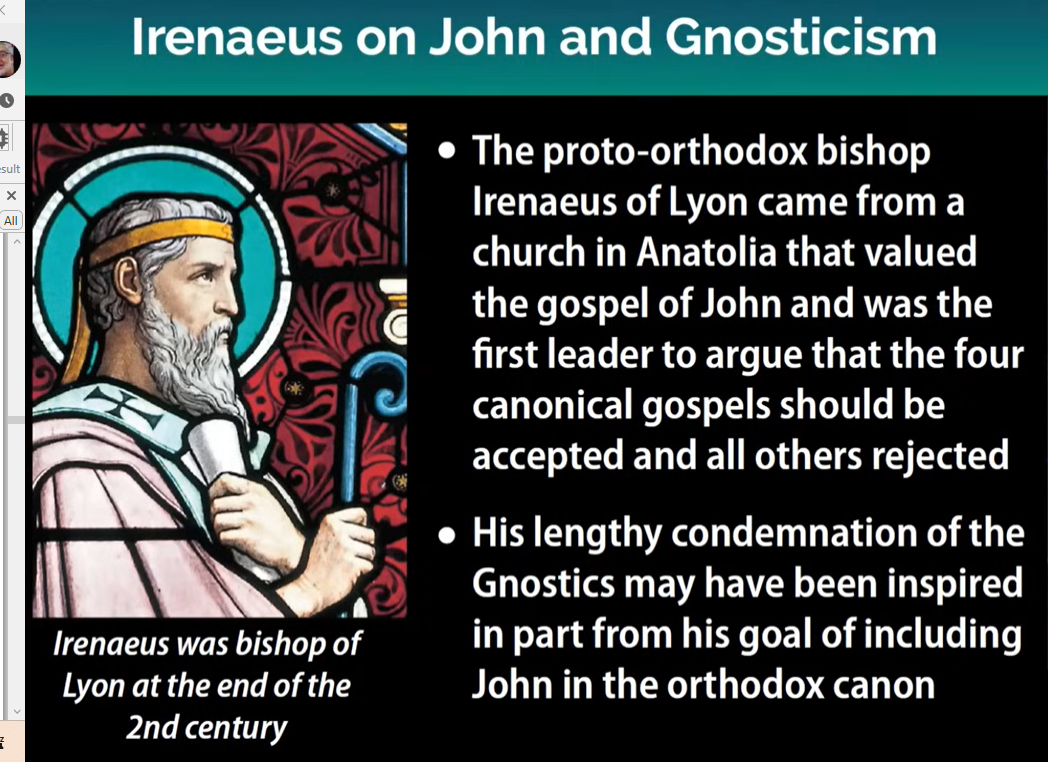 The Proto-Orthodox Bishop Irenaeus of Lyon, that we talked about when we were visiting Lyon a month ago, came from a church in Anatolia, in Asia Minor, what's now Turkey. It was a church that really valued the Gospel of John, and Irenaeus, as a result of that, was the first Proto-Orthodox Christian leader, maybe the first early Christian leader altogether, to argue that Christians should really be using all four gospels that ended up in the New Testament canon: Mark, Matthew, Luke, and John. Irenaeus said that he had kind of mystical reasons why he felt that those should all be included, while all of the other contemporary gospels, many of which he was aware of, should be rejected and kept out of the canon. Irenaeus also wrote a very lengthy condemnation of Gnosticism, different forms of Gnosticism, and it's possible that he did that in part because he wanted to include the Gospel of John in the Orthodox canon. Contemporaries who came from a church, let's say, that simply used the Gospel of Matthew as their gospel, and that was for their community the main Christian scripture, and they see this Gospel of John, which portrays Jesus so differently than the Gospel of Matthew does, and then they see that these Gnostics are using quotations from the Gospel of John to show a very different kind of Christology than what they have, you know, it's always dangerous. Any gospel that can be used that way, Proto-Orthodox people want to condemn it and get rid of it and make sure that it's suppressed so that they don't have the competition of it. Irenaeus, who really liked this gospel, wanted to maybe rescue it from Gnostics.
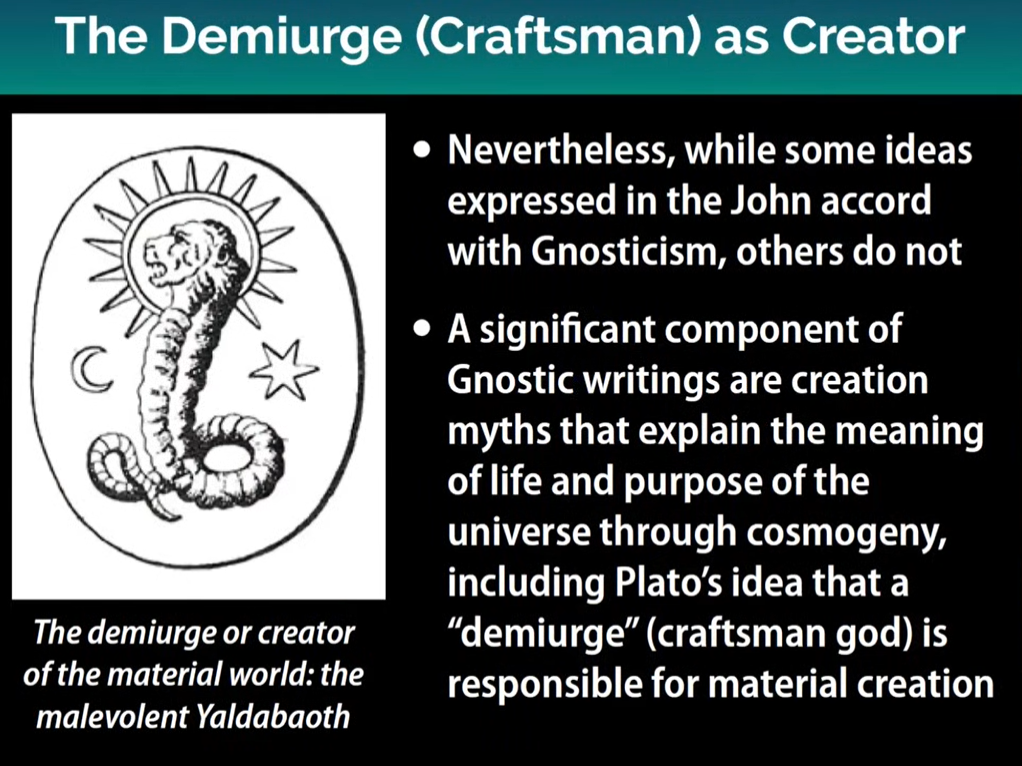 While some ideas expressed in John accord with Gnosticism, others don't. A significant component of Gnostic writings are creation myths that explain the meaning of life and the purpose of the universe through a cosmogony, that is to say, a creation myth. That kind of cosmogony usually includes Plato's idea that there is a craftsman god, a demiurge, as the name comes to us from the Greek, is actually responsible for the material creation. This takes the name, this demiurge, in some of the Gnostic stories, of the god Yaldabaoth or Yaldabaoth.
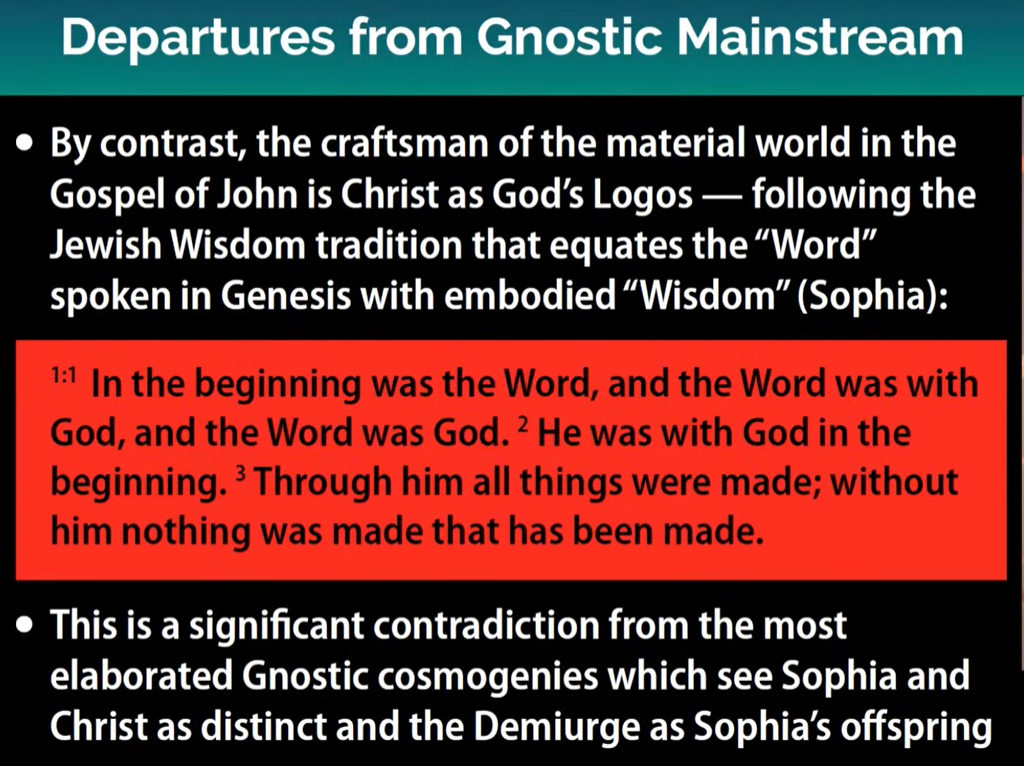 By contrast, the craftsman of the material world in the Gospel of John, depending on how you interpret it, as it's often read anyway, is Christ as God's logos. This follows the Jewish wisdom tradition that equates the word, so God, in the beginning of the Genesis story, says, "Let there be light." He spoke the word in Genesis with the embodied wisdom, Sophia. In the wisdom tradition in the Book of Proverbs, embodied wisdom, Sophia, says that she was with God in the creation and helped God in the whole rest of creation. At the beginning of the Gospel of John, we read, "In the beginning was the Word, and the Word was with God, and the Word was God. He was with God in the beginning. Through him, all things were made, and without him, nothing was made that has been made." At first glance, anyway, this would seem to be different, at odds with the Gnostic understanding, since if all of the creation is happening through the logos, through Christ. On the other hand, as I've thought about it, it may well be that the Gnostics would argue when they say "all things" here, they're not talking about material things because material things aren't even real. It could be that way. It could be a contradiction from the most elaborated Gnostic cosmogony, I think, would have an apologetic way of recovering this text if they wanted to.
 The point here has not been to argue that the Gospel of John is a Gnostic text but simply to illustrate that there was a great diversity of thought early on among the various Christianities, and some components of these earliest traditions could be read in harmony with Gnostic theologies. The Gnostics themselves had diverse different ideas, and they also evolved, they also became elaborated, and they began to use some of these early Christian texts to inspire their later understanding of the evolution of the Gnostic Christology and cosmology.
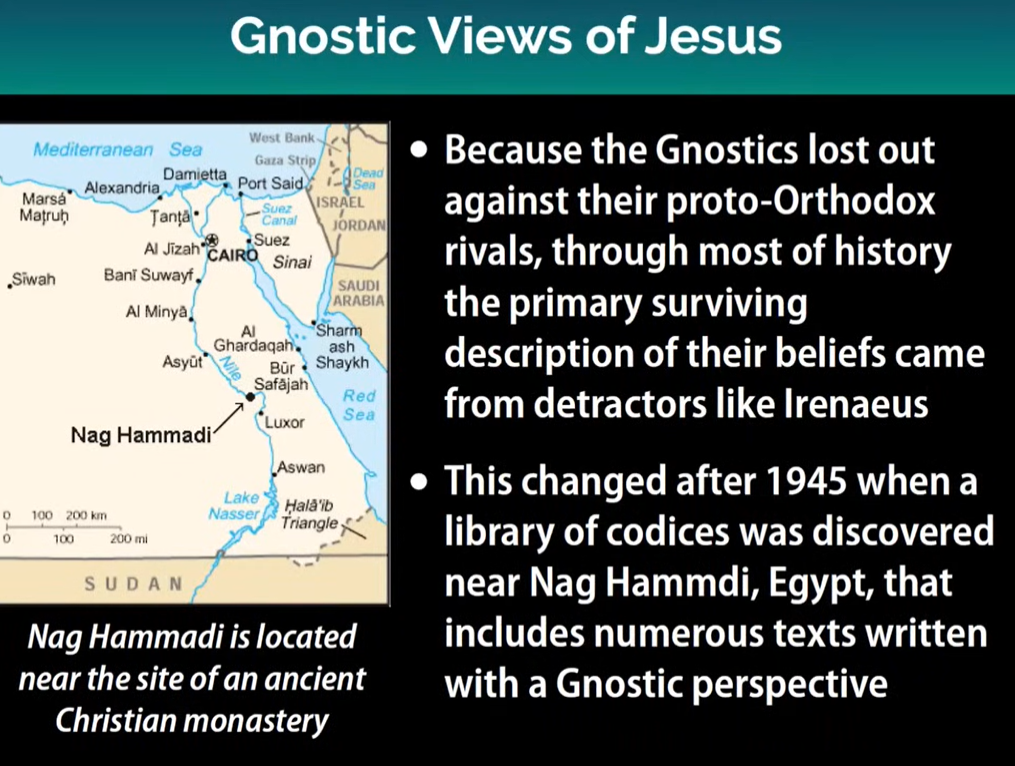 Because the Gnostics lost out against their Proto-Orthodox rivals, the Christian bishops that ultimately formed the Nicene church under Constantine, which later became the Roman state religion of the Roman Empire, most of the history, throughout most of history, the primary surviving description of Gnostic beliefs came from detractors and antagonists, people like Irenaeus, who were writing books against Gnostics in their various forms. There are some, and we'll look at them, there are some fragments that survived that we had, but for the bulk of this, it was true until 1945 when a library of codices was discovered near Nag Hammadi, Egypt, that includes numerous texts written with a Gnostic perspective. They're not all Gnostic, but they all have maybe, let's say, a broad appeal to Gnostics. For example, one of the texts is simply a partial reworking of Plato's Republic. By no means is the Republic a Gnostic Christian text, but Plato, as I've already mentioned him several times in this lecture, Plato has ideas that appeal to people who were Gnostics.
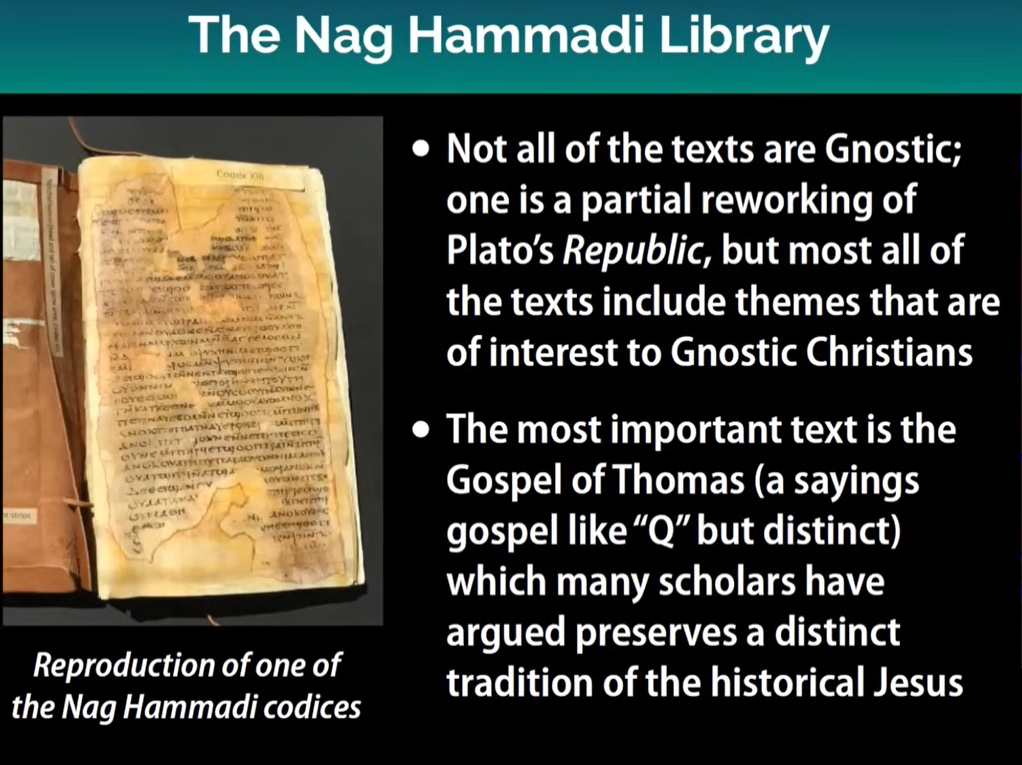 Most all of the texts, like I say, then include themes that would be of interest to Gnostic Christians.
For scholars today, the most important text recovered at Nag Hammadi is the Gospel of Thomas. This is a sayings gospel, like the hypothetical Q sayings source, but distinct from Q. Some scholars, anyway, have argued that the Gospel of Thomas preserves a distinct tradition of the historical Jesus, and if so, that helps us with our multiple attestation. When we're trying to get back to what may or may not have happened for the historical figure Jesus, we would like to have independent traditions all talk about the same thing or the larger number of them.
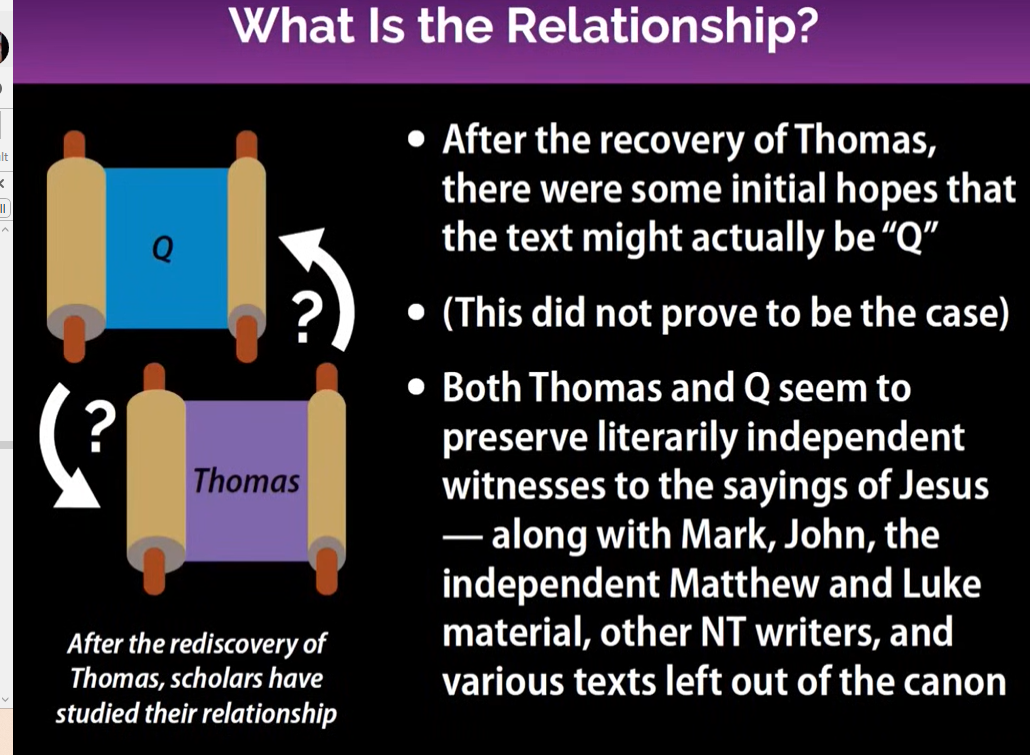 As soon as the sayings Gospel of Thomas was recovered, scholars immediately started to wonder about the relationship it had with Q, and some initially hoped that the text might actually be Q. I know some of you who are listeners in the audience really want it to be Q, but this has proved not to be the case. We know about Q because Matthew and Luke are literarily dependent on Q, and Thomas has versions of sayings that are literarily independent witnesses to the sayings of Jesus. There are similar materials for many of the Thomas sayings. There are parallel sayings in Q or in Matthean or Lucan material or in Mark or in other quotations from the early Christian corpus that have parallels with Thomas, but they aren't literarily dependent on any of those. It's not like the author of Thomas had a copy of Q or the author of Thomas had a copy of Matthew or something like that.
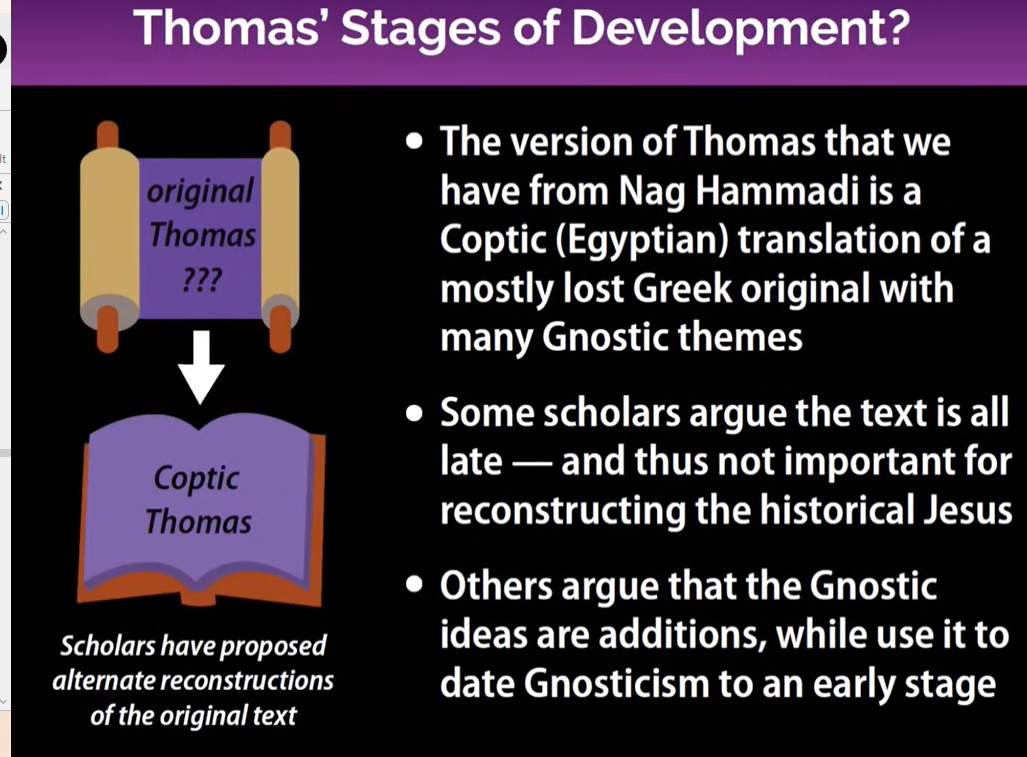 The version of Thomas that we have from Nag Hammadi is a Coptic Egyptian translation of a mostly lost Greek original. We have a couple of fragments from the Greek, and many of the sayings in the version that we have have Gnostic themes. Many of them have themes that don't relate to Gnosticism and are maybe even contradictory of Gnosticism. I argued that that one saying about James the Just doesn't seem to fit in with a Gnostic worldview. Some scholars have argued that the text is altogether late, so maybe in the 2nd century, and doesn't have an independent witness for reconstructing the historical Jesus. Others who think it's important and does preserve this independent witness, some of them argue that there are stages in the development and the Gnostic ideas are later additions, and so we have maybe an earlier version that has some connection to the Jamesian church or something like that. Others, though, see the Gnostic ideas as fairly early, like Elaine Pagels, and would like to use this text to date Gnosticism to an earlier stage. The case can be made for any of those.
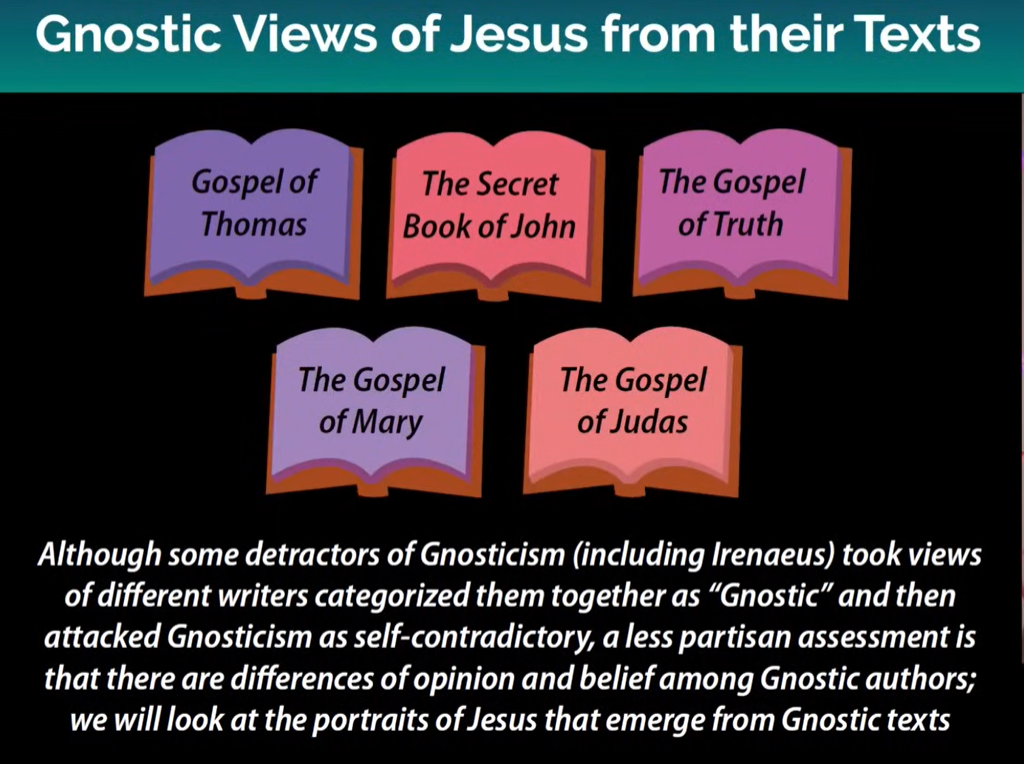 That's the background that I wanted to give about Gnosticism and the context of some of these texts, and now I want to use five of them to see what sort of picture of Jesus emerges from the texts. Some of the detractors of Gnosticism, including our friend Irenaeus, took all of the views that are categorized as Gnostic, lumped them together, and then when they contradict each other, attacked Gnosticism as self-contradictory. A less partisan assessment is that there are differences of opinion and belief among Gnostic authors, and it may well be that these texts are also not fully Gnostic anyway. They may preserve non-Gnostic witnesses as well.
 Let's look at the different portraits, beginning with the Gospel of Thomas, which has a bunch of Gnostic sayings within it but is not entirely Gnostic. I'm not going to look specifically at just the Gnostic teachings, but I want to look at the teachings that the Gospel of Thomas has about Jesus. This gospel largely consists of sayings attributed to Jesus,
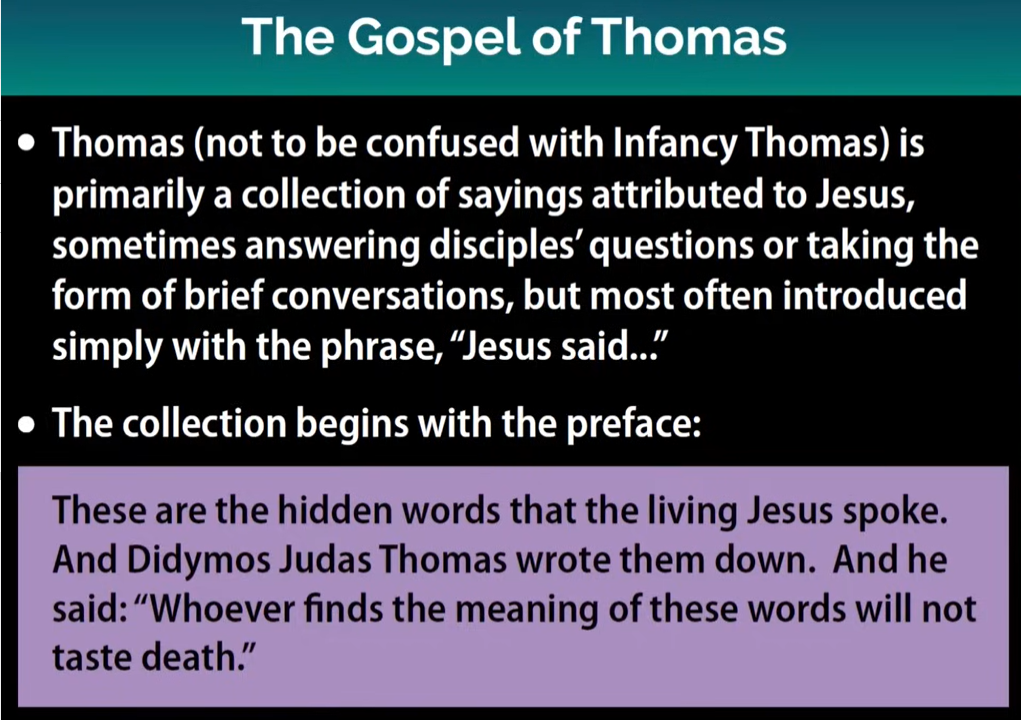 and sometimes Jesus is answering disciples' questions, or sometimes we have a little dialogue as Jesus is talking to the disciples and they answer and have a little conversation. Most often, the sayings in this gospel are simply introduced with the phrase "Jesus said." The collection begins with the preface: "These are the hidden words that the living Jesus spoke, and Didymus Judas Thomas wrote them down, and he said, 'Whoever finds the meaning of these words will not taste death.'" Didymus Judas Thomas, Judas would be the name of this Apostle Thomas, where Didymus is Greek for twin, and Thomas is Aramaic for twin, so the idea is it's Judas the twin, but it's the Apostle Thomas as opposed to the Apostle Judas. This first saying equates eternal life, "you're not going to taste death," it says, if you find meaning within hidden words. That's a very central Gnostic theme. The whole meaning of life and salvation is finding hidden meaning that exists, the gnosis.
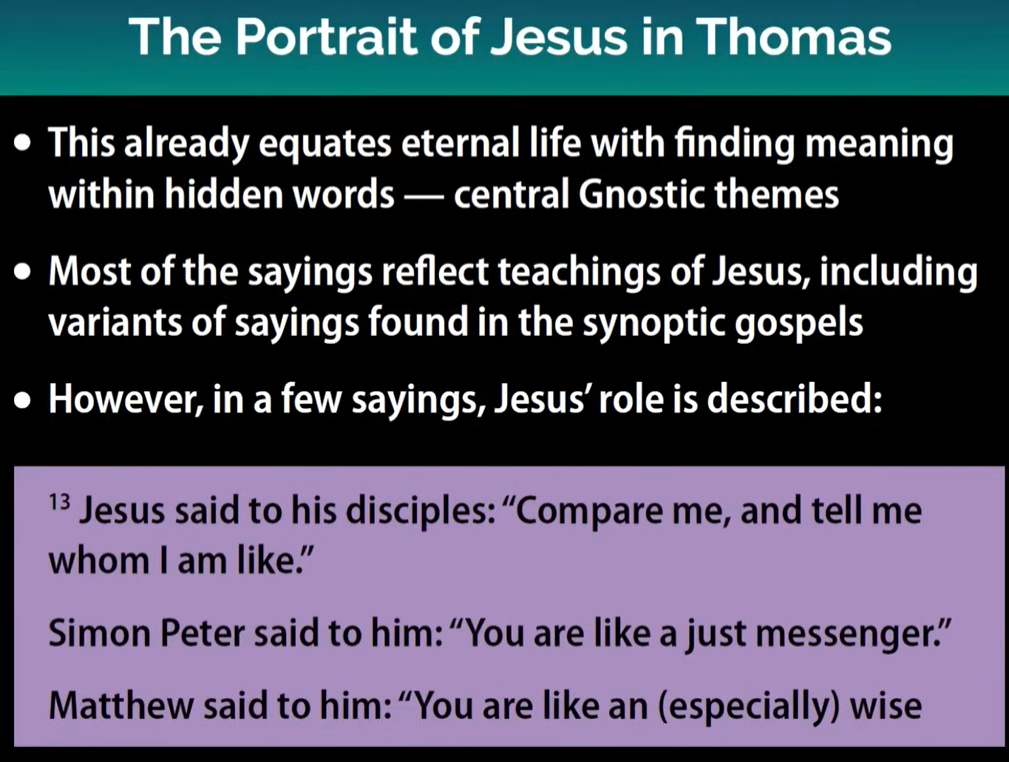 Most of the sayings reflect teachings of Jesus, and like I say, they include variants of sayings found in the synoptic gospels. However, in some of the sayings, Jesus' role is described. For example, in saying 13, Jesus says to his disciples, "Compare me and tell me who I am like." Simon Peter said to him, "You are like a just messenger, you are like an angel."
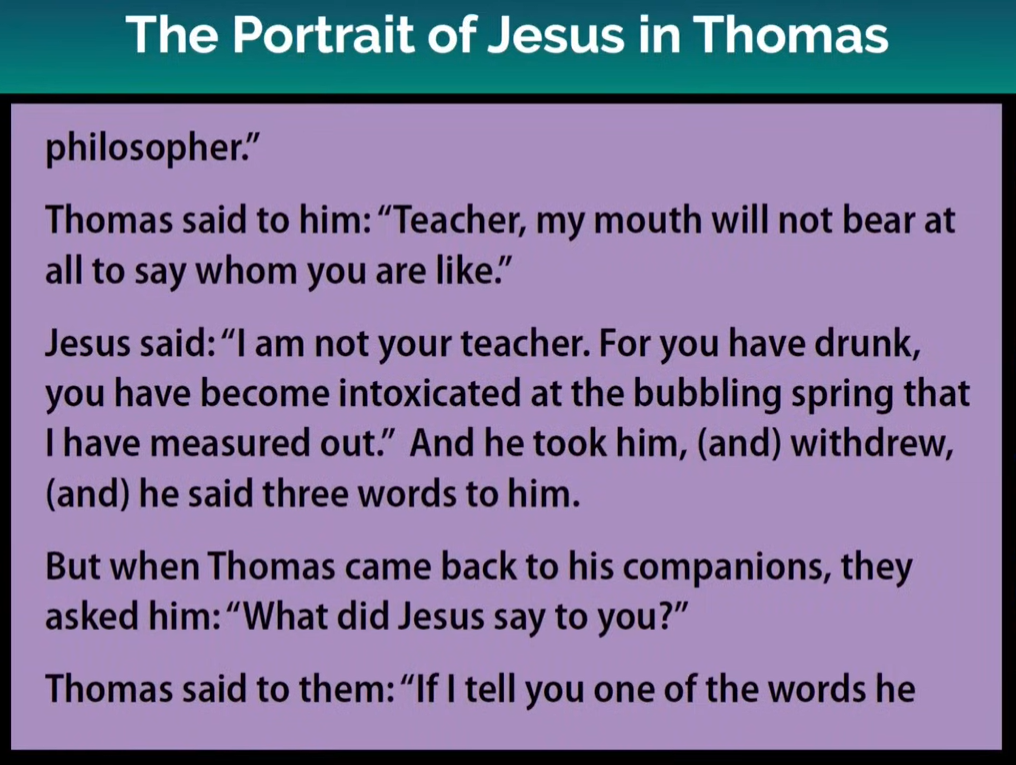 Matthew said to him, "You are like an especially wise philosopher." But Thomas said to him, "Teacher, my mouth will not bear at all to say whom you are like." Jesus says, "I'm not your teacher, for you have drunk, you have become intoxicated at the bubbling spring that I've measured out." Jesus took Thomas and withdrew, and he said three words to him. But when Thomas came back to his companions, they asked him, "What did Jesus say to you?" Thomas said to them,
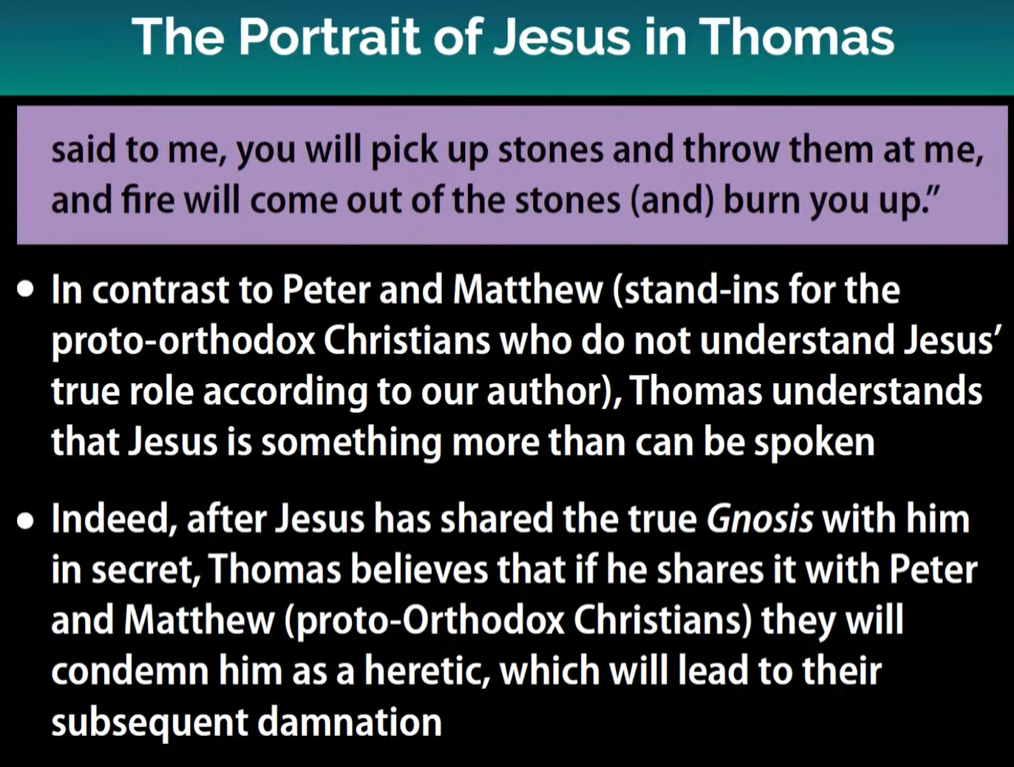 "If I tell you one of the words he said to me, you will pick up stones and throw them at me, and then fire will come out of the stones and burn you up."
In contrast to Peter and Matthew here, who are serving as foils, I think, or stand-ins for the Proto-Orthodox Christians, people who do not understand Jesus' true role according to the author of this saying, Thomas, the Apostle Thomas here, understands that Jesus is something more than can be spoken openly. Indeed, after Jesus has shared true gnosis with him in secret, Thomas believes that if he then goes on to share it with Peter and Matthew, like I say, if you go and share this now with Proto-Orthodox Christians who accept the authority of Peter, they will condemn the Gnostic as a heretic, which will lead to the Proto-Orthodox Christians' subsequent damnation. Nothing good will come of that.
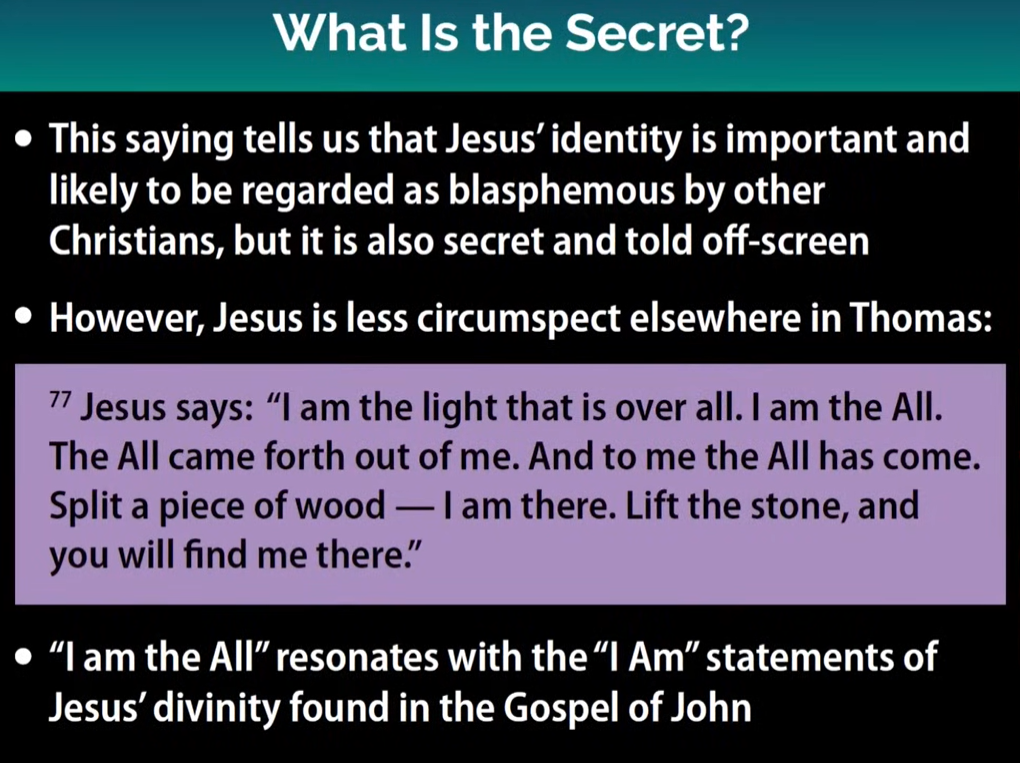 The saying tells us that Jesus' identity is important and likely to be regarded as blasphemous by other Christians if the Gnostics say it to them in public, but it's also a secret, and it's told off-screen, so we don't know what those three words are, at least explicitly in the text.
However, elsewhere in the Gospel of Thomas, Jesus is a bit less circumspect. For example, in saying 77, Jesus says, "I am the light that is over all. I am the all. The all came forth out of me, and to me, the all has come. Split a piece of wood, I am there. Lift the stone, and you will find me there." While it's not the same saying as we have in the Gospel of John, this "I am all" or "I am the all, I am the light" resonates with all of those "I am" statements like "I am the way, the truth, and the light," all that we find in the Gospel of John's statements of Jesus' divinity.
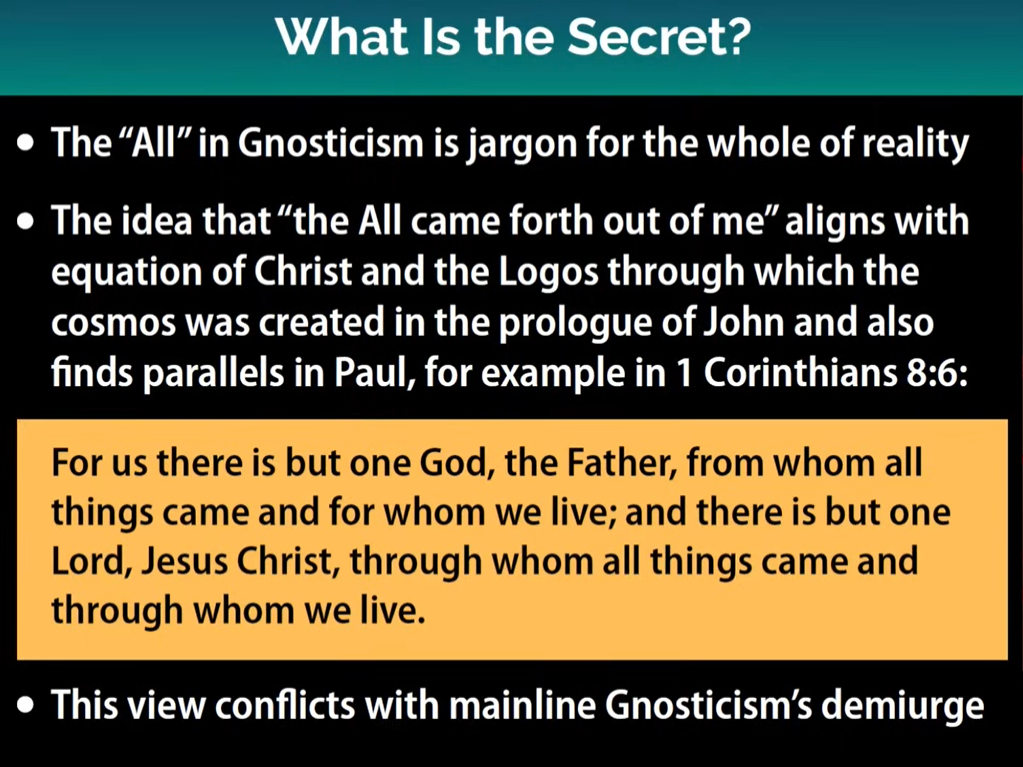 The "all" in Gnosticism is a jargon term for the whole of reality, so the idea that "the all came forth out of me" aligns with the equation of Christ and the logos through which the cosmos was created in the prologue of John that we read. It also finds parallels in Paul, for example, in the first letter of the Corinthians, chapter 8:6, where Paul says, "For us, there is but one God, the Father, from whom all things came and for whom we all live." So there's that one ineffable source, but there is one but one Lord, Jesus Christ, through whom all things came and through whom we live. It's expressing again the one ineffable God and then God's word made manifest, the Lord, that is also present at creation, the source of creation.
This could again conflict with the mainline Gnosticism idea of a demiurge creating the sensible cosmos, but again, this also could be just talking about the "all" as in the Gnostic sense of the true universe, where the physical world doesn't really count as part of the "all" since it's simply a false shadow.
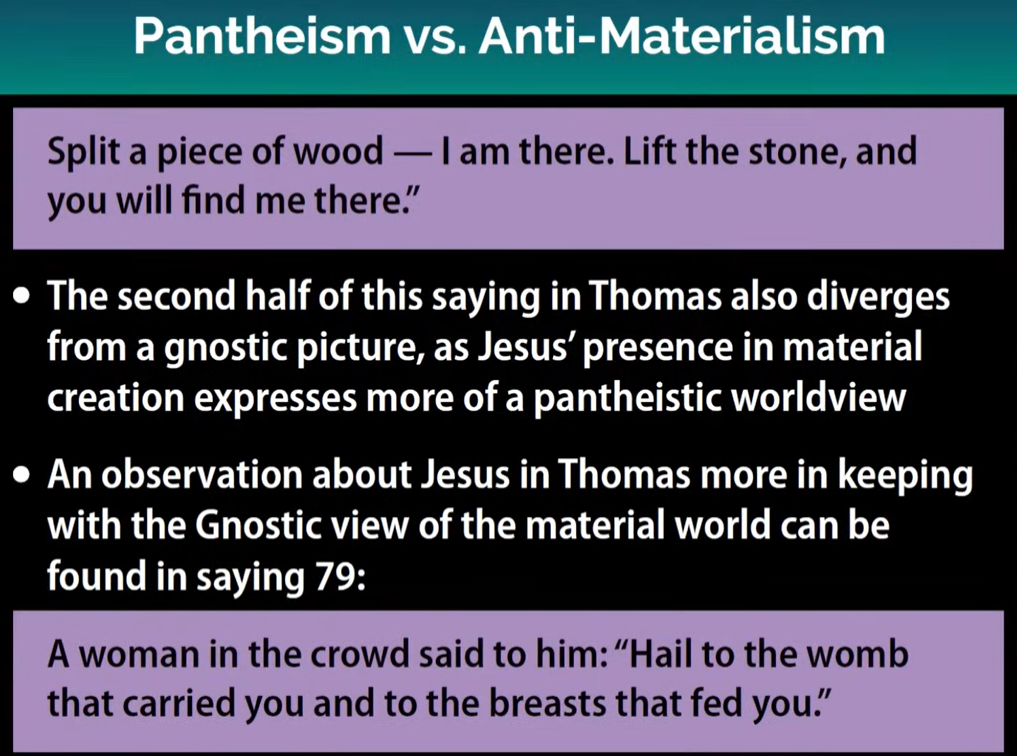 The second part of the saying, "Split a piece of wood, I am there. Lift the stone, and you will find me there," I feel also diverges from a purely Gnostic picture because it's talking about Jesus' presence in material creation. In other words, a piece of wood is a physical object, a stone is a physical object, and so perhaps is representing more of a pantheistic worldview of Jesus as the animating, as the Christ, the animating presence of the world spirit or something like that.
Another observation about Jesus in Thomas is more in line with the more traditional Gnostic view of the material world, and that can be found in saying 79, where a woman in the crowd said to Jesus, "Hail to the womb that carried you and the breasts that fed you."
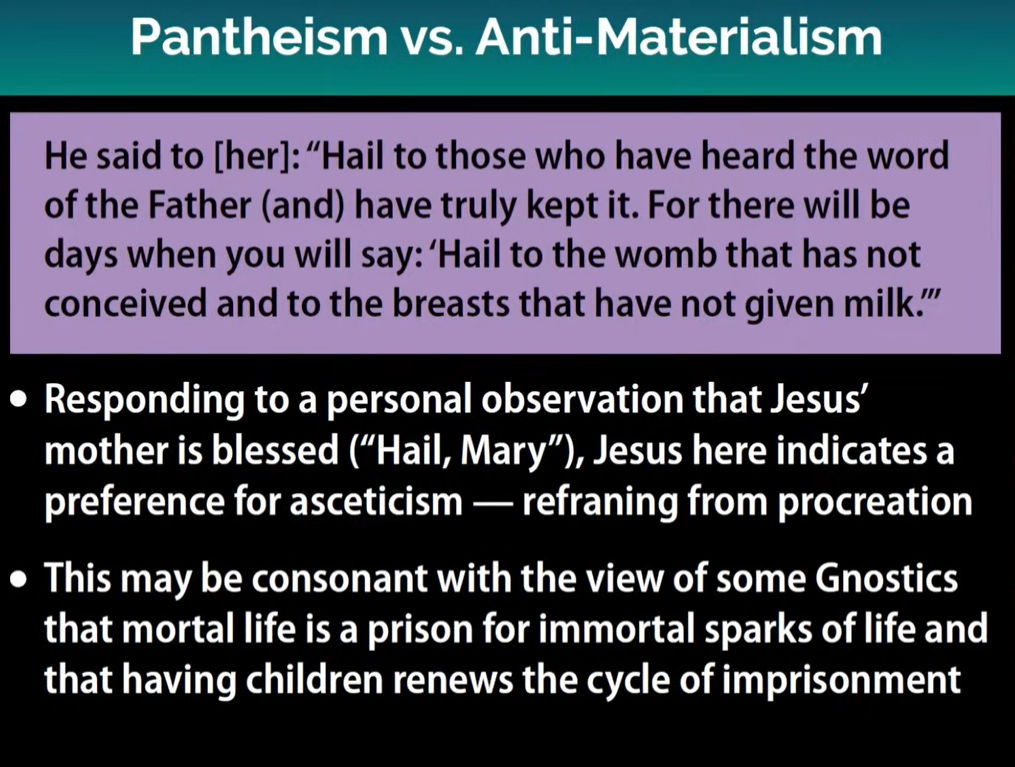 He said back to her, "Hail to those who have heard the word of the Father and have truly kept it, for there will be days when you will say, 'Hail to the womb that has not conceived and to the breasts that have not given milk.'" He's kind of responding to a personal observation that Jesus' mother is blessed, so he's born of a woman, rather than saying, "Yeah, that's true," or maybe he's even kind of trying to tamp down on that as an idea. This idea of "Hail Mary," which is a prayer derived from the account of the Christmas story in the Gospel of Luke, Jesus here indicates maybe a preference for a kind of asceticism, refraining altogether from procreation. You won't be having children if you are following the Father and kept the word of the Father truly. That may be consonant with the view that some Gnostics have that mortal life is a prison for immortal sparks of life, and that when you have sex, which is a work of the flesh, and when you then conceive and bear children, that merely renews the cycle of imprisonment, and so therefore it's not a great idea. Some Gnostic religions, the perfect people at the center of the movement will refrain from having sex and procreating.
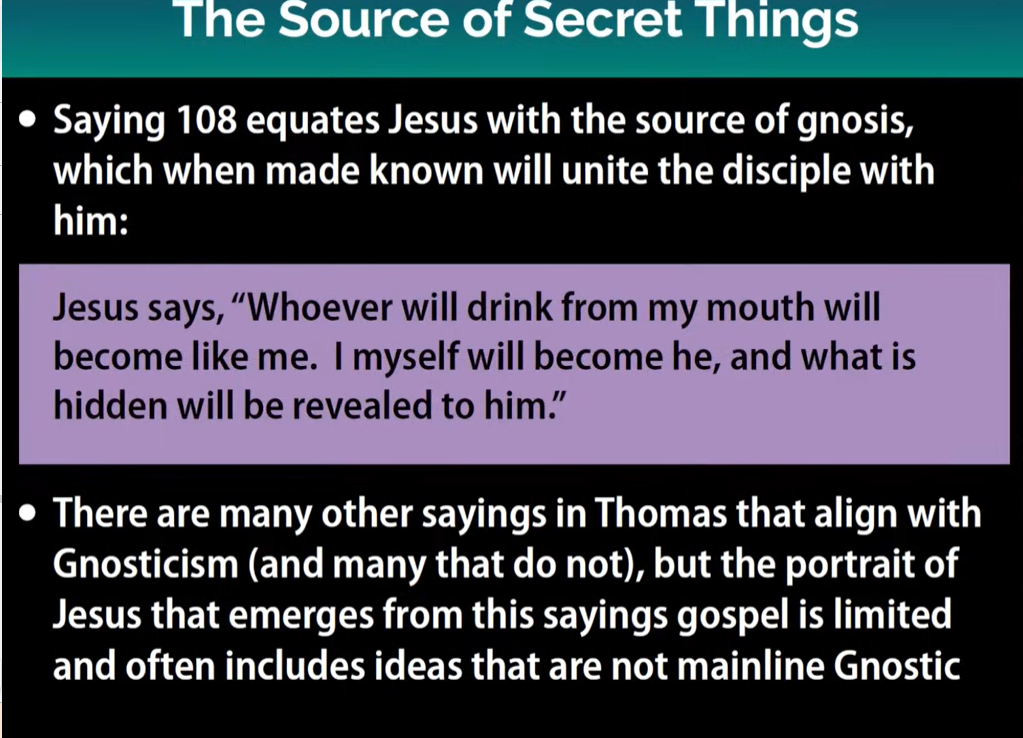 Also in the Gospel of Thomas, saying 108 equates Jesus with the source of knowledge, the source of gnosis, which when made known will unite the disciple with him. Jesus says, "Whoever will drink from my mouth will become like me. I myself will become he, and what is hidden will be revealed to him." There are many other things in Thomas that align with Gnosticism and many others that don't really, but the portrait of Jesus that emerges from the sayings gospel is limited and has ideas that may diverge from mainline Gnosticism or may require mainline Gnostics to have apologetics to explain why they would still keep this. That's Thomas.
 Now I want to look at the Secret Book of John, the Apocryphon of John.
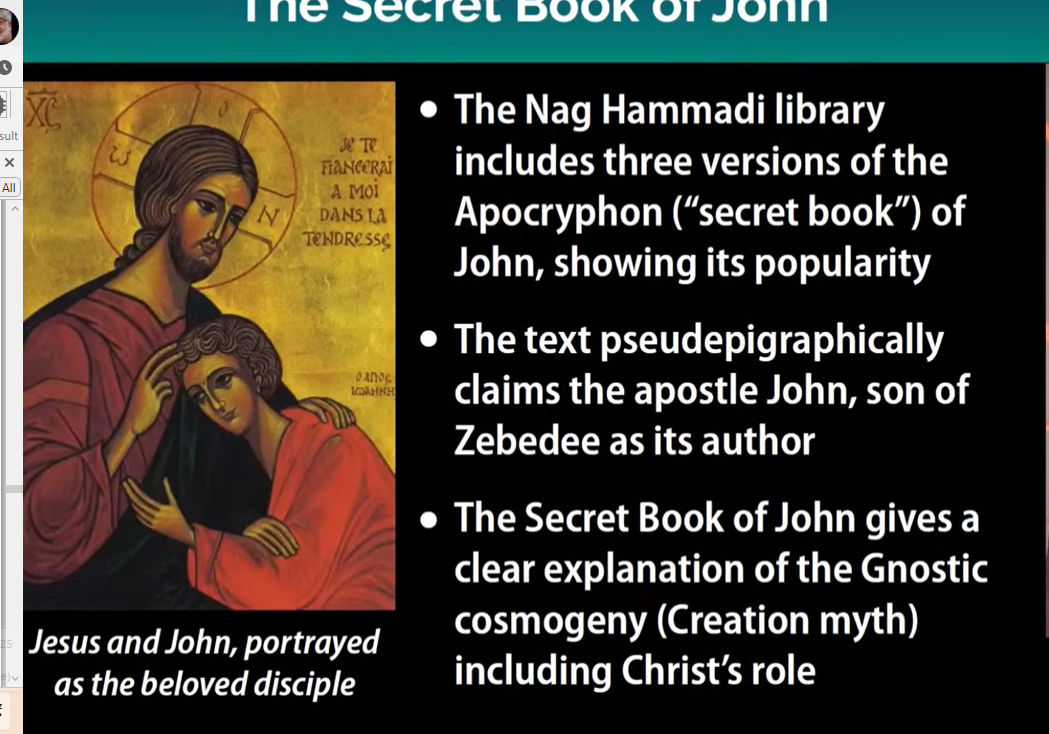 The Nag Hammadi library actually includes three versions of this Apocryphon or Secret Book of John, which shows its popularity. The text pseudographically claims to be written by the Apostle John, the son of Zebedee, but no scholars really credit that claim. Rather, it's a second-century text. It's one of the ones condemned by Irenaeus, so it has to have been written before 180. The Secret Book of John gives a clear example of the main Gnostic cosmogony, the creation myth, and included within that is Christ's role, so it's a good text to look at to get the core Gnostic portrait of Christ.
Christ in the Secret Book of John, as the cosmology is explained, as the theology is explained, the highest principle of the universe is the Monad, that is to say, the ineffable God. The Monad is described as monarchy with nothing above it. The Monad is described as supreme, absolute, eternal, self-sufficient, holy, and so on, but it's also described in ways that are very transcendent, ineffable, invisible, unknowable, unseeable. It is very hard for humans to have a direct relationship with the highest principle, and this is one of the reasons why we have all of the emanations from the Monad in order for us to connect to what really matters. From its first thought, the Monad produces a feminine divine principle known in the Apocryphon of John and elsewhere as the Barbelo. In this text, that principle is also called things like Mother, Father, and Holy Spirit. The Barbelo is also the first of a class of divine principles known as Aeons. This maybe is an equivalent or is an elaboration on the Platonic idea of forms or the highest forms. The Aeons' interaction between the Barbelo and the Monad produces many other Aeons, including Mind and Light, which are born from the Monad's reflection on the Barbelo. Light is synonymous in this text with Christ, and we've seen that before, and also explained why all of the sayings about light in the Gospel of John therefore had appeal to Gnostic Christians.
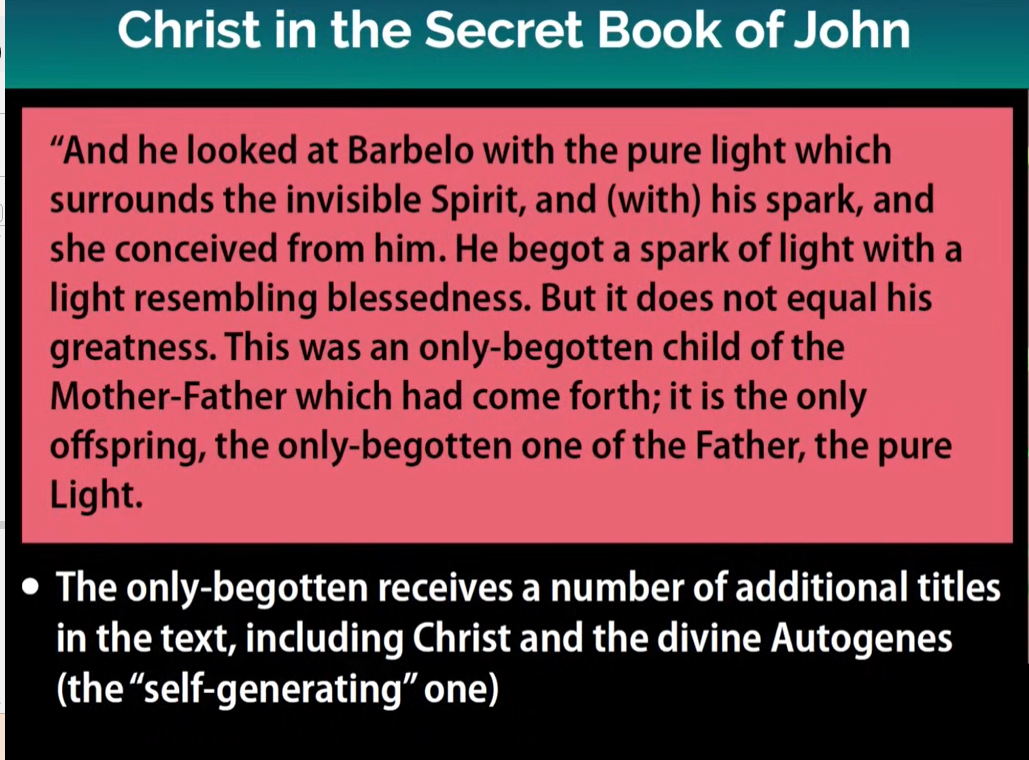 We read about Christ in the Secret Book of John. This is not Christ at first, but anyway, the principal looked on the Barbelo with the pure light which surrounds the invisible spirit and with his spark, and she conceived from him, and he begot a spark of light with a light resembling blessedness, but it does not equal his greatness. This was an only begotten child of the Mother-Father which had come forth. It is the only offspring, the only begotten one of the Father, the pure light. The only begotten receives a number of additional titles in this text, including Christ, so we're seeing this is part of the Christology and the location of Christ within this pantheon of emanations, and other titles include the Autogenes, the self-generating one, in addition to being only begotten and so on.
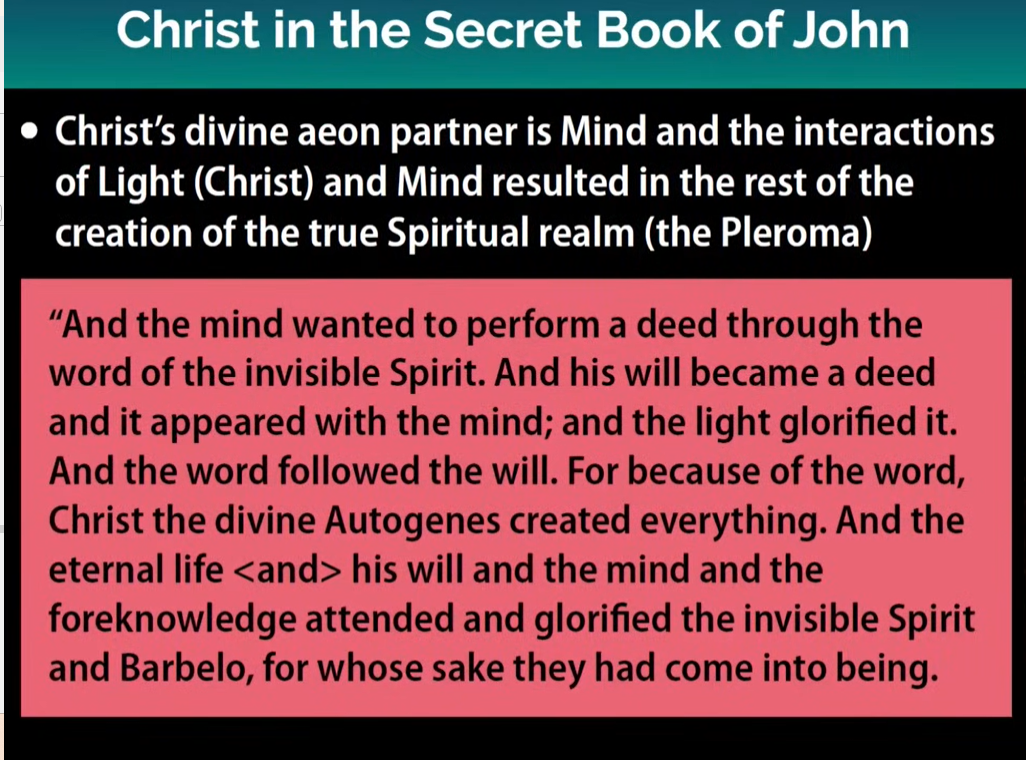 Christ's divine Aeon partner as Light is Mind, and the interactions between Light and Mind result in the rest of the creation of the true spiritual realm, the Pleroma. The Mind wanted to perform a deed through the word of the invisible spirit, and his will became a deed, and it appeared with the Mind, and the Light glorified it, and the word followed the will, for because of the word, Christ, the divine Autogenes, created everything, and the eternal life, and his will, and the Mind, and the foreknowledge attended and glorified the invisible spirit and Barbelo, for whose sake they had come into being.
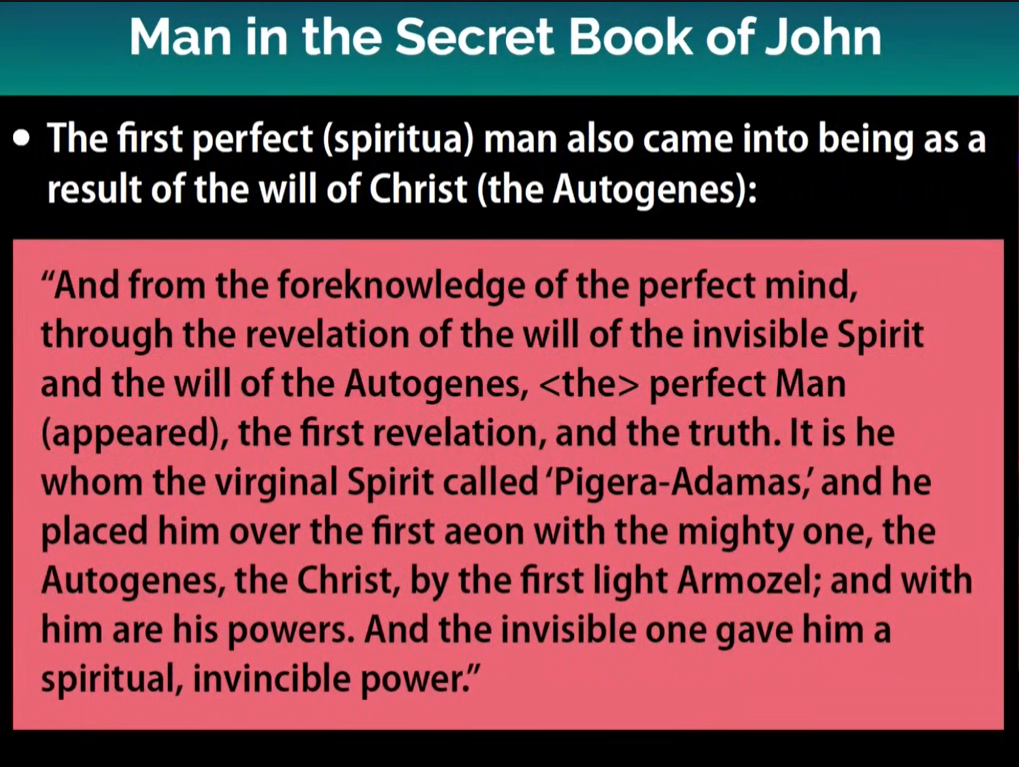 Also, in addition to all of the spiritual creation that comes into being through Christ, the first perfect spiritual man also comes into being as a result of the will of Christ, the Aeons. We read from the foreknowledge of the perfect Mind through the revelation of the will of the invisible Spirit and the will of the Autogenes, the perfect man appeared, the first revelation and the truth. It is he whom the virginal Spirit called Pigera Adamas, and he placed him over the first Aeon with the mighty one, the Autogenes, the Christ, by the first Light, Armosel, and with him are his powers, and the invisible one gave him a spiritual invincible power. We're starting to see if you read these Gnostic texts, there are many, many names that are elaborated as all of the many Aeons and their partner Aeons are outlined in how the divine realm, the spiritual realm, came into being.
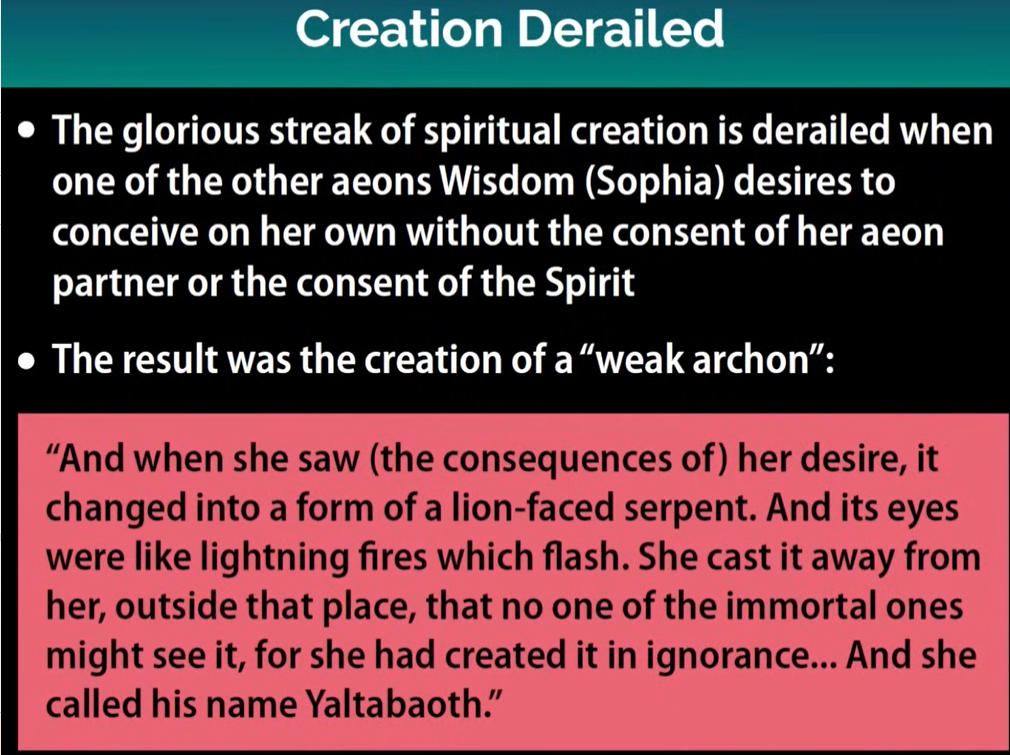 However, the glorious streak of spiritual creation is derailed when one of the other Aeons, Holy Wisdom, Sophia, desires to conceive on her own, and she does this without the consent of her Aeon partner. All these Aeons are operating in partnership and also without the consent of the Spirit. The result, because of the incredible power she has, was the creation of a weak Archon that happens immediately. When she, Sophia, when Wisdom saw the consequences of her desire, it changed into the form of a lion-faced serpent, and its eyes were like lightning fires which flash, and she cast it away from her outside that place that not one of the immortal ones might see it, for she had created it in ignorance, and she called his name Yaldabaoth.
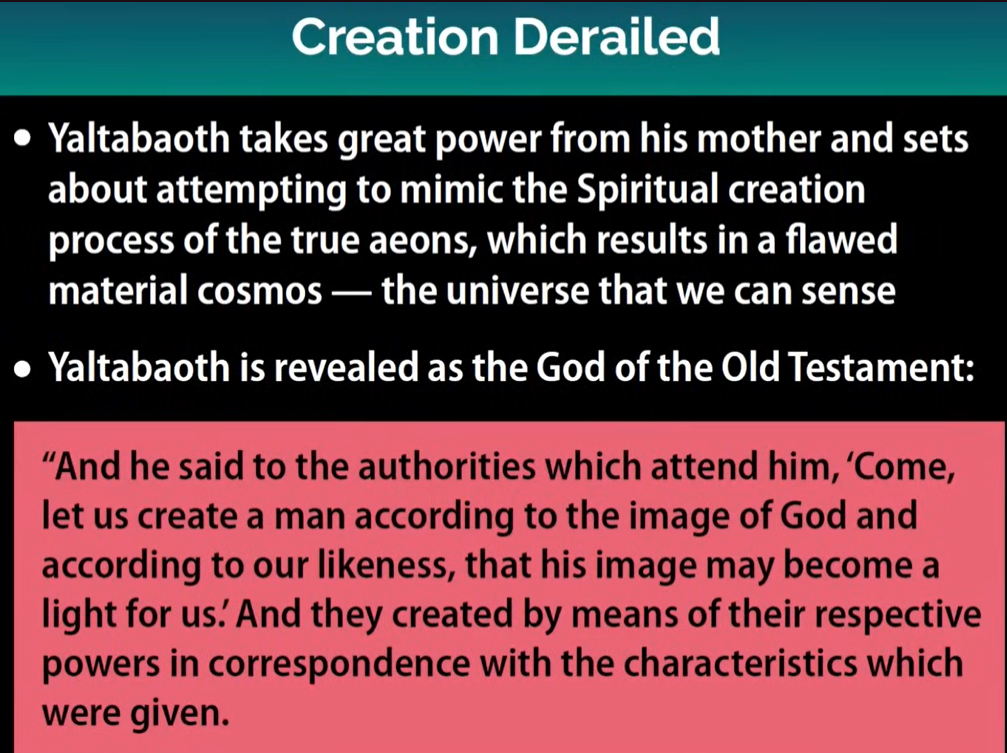 Yaldabaoth takes great power from his mother and then sets about attempting to mimic the spiritual creation process that the true Aeons have been doing, and this results in a flawed material cosmos, the universe that we can sense, the sensible world. Yaldabaoth, in the course of this, is revealed as the god of the Old Testament. For example, the text mimics the first sentence of Genesis when it says, "He, Yaldabaoth, said to the authorities which attended him, 'Come, let us create a man according to the image of God and according to our likeness, that his image may become a light for us.'" They created by means of their respective powers in correspondence with characteristics which were given, and so their plot here seems to be that they are understanding themselves to be lesser than the Aeons, and when they have this new creation that is made in the image of the true God, that will help empower them and get their power back.
Each authority supplied a characteristic in the form of the image which he had seen in its natural form. He created a being according to the likeness of the first, the perfect man that we saw created before spiritually, and they said, "Let us call him Adam, man, that his name might be a power of light for us."
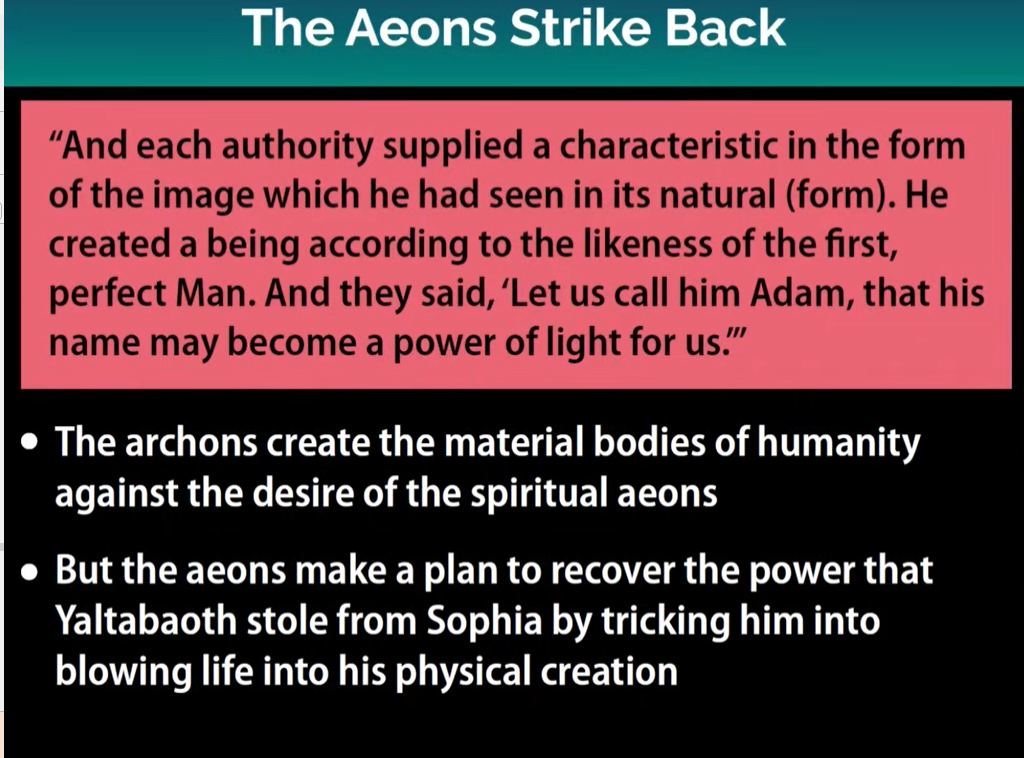 These lesser limited Archons then create what become the material bodies of humanity against the desire of the spiritual Aeons, but the Aeons strike back. They make a plan to recover all of that power that Yaldabaoth has stolen from Sophia, and they trick him into blowing that light and life that he had seized into his physical creation, into Adam, into man.
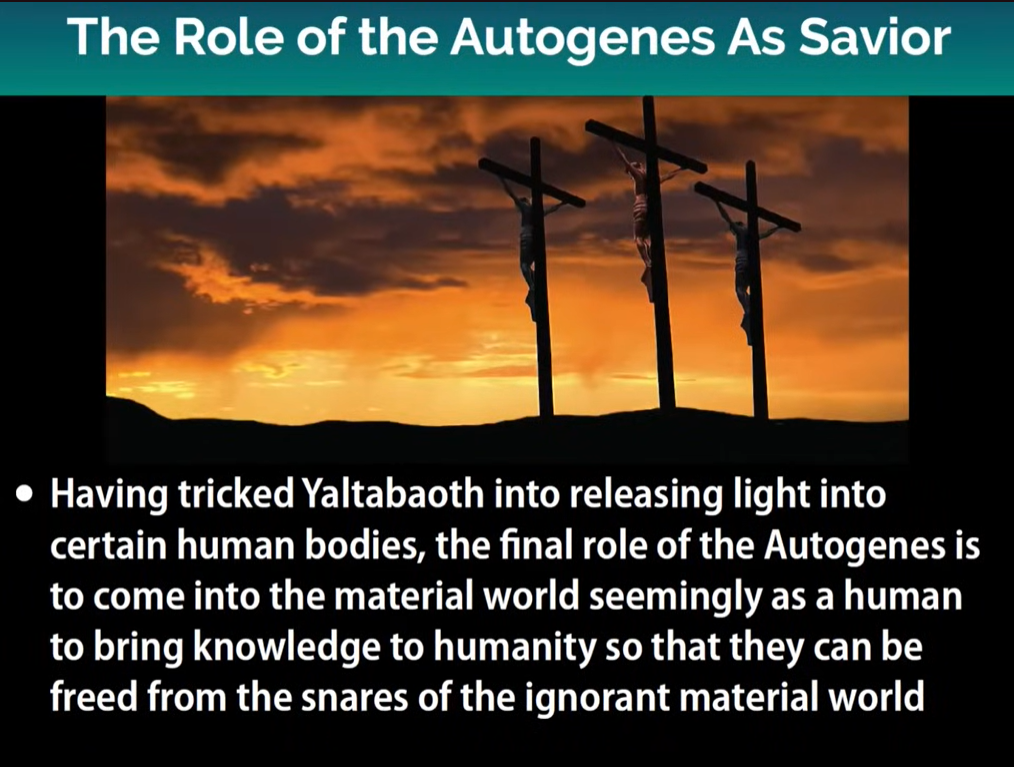 Having tricked Yaldabaoth into releasing light into certain human bodies, the final role of the Autogenes is to come into this flawed material creation, seemingly as a human, to bring knowledge to humanity so that these sparks of life can be freed from the snares of the ignorant material world, and so that reveals the Autogenes as the Savior, as Christ.
That's the picture that we could try to piece together from the Gospel of Thomas, the more traditional or full-blown view of Christ from the Secret Book of John.
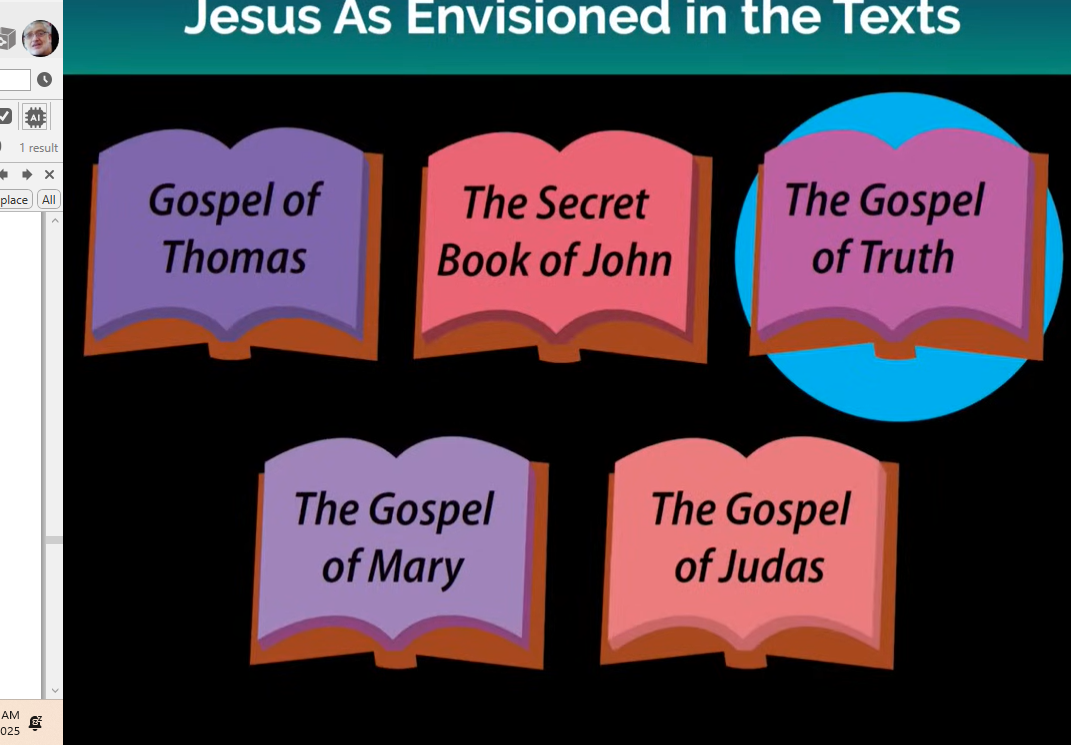 Let's look at another book that we recovered from Nag Hammadi, the Gospel of Truth.
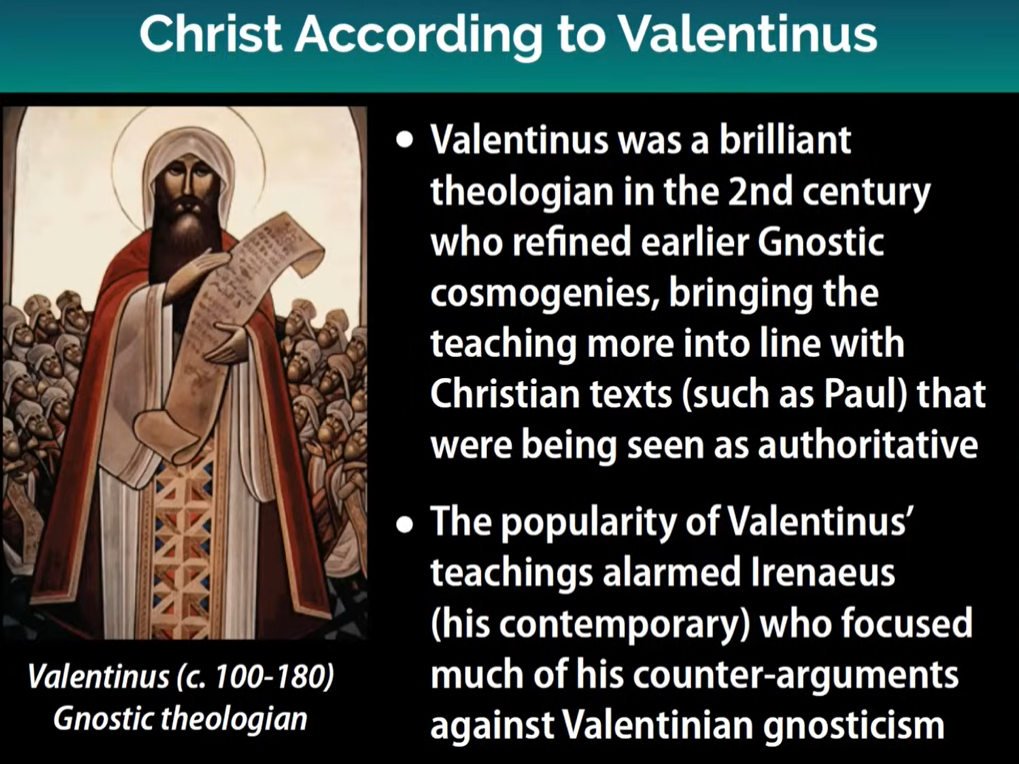 Valentinus was a brilliant theologian in the 2nd century, probably lived from around 100 to 180, who took those Gnostic ideas like the one I just read and brought them and refined them and included now as Christianity has started to define, let's say, gospel texts and also letters of Paul as being authoritative, and so bringing, updating, and bringing Gnosticism more into line with that and making it more palatable for the 2nd-century Christian audience. He did a great job of doing this. The popularity of Valentinus' teachings alarmed our friend Irenaeus, his contemporary, who focused much of his time in his book against the Gnostics writing counterarguments against the Valentinian conception of Gnosticism.
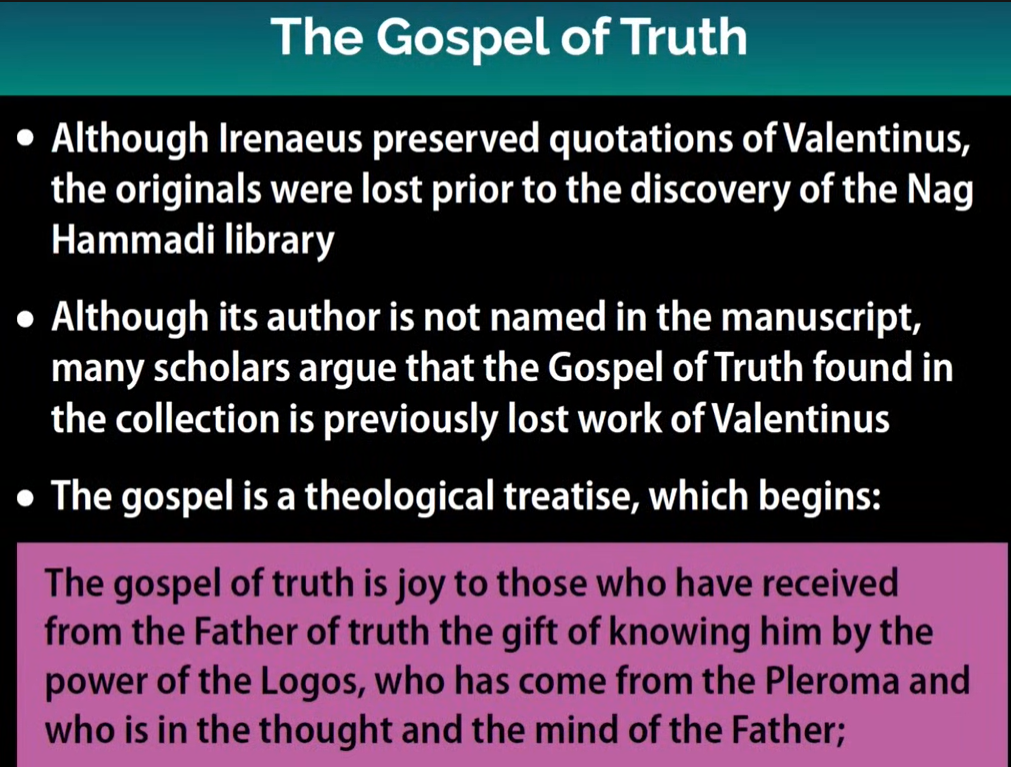 Although we had all of Irenaeus' quotations of Valentinus, the original of the text of all his texts were lost prior to the discovery of the Nag Hammadi library, where we found a text called the Gospel of Truth. Although the manuscript doesn't actually name Valentinus as an author, many scholars argue that this is the Gospel of Truth that was previously a lost work of Valentinus, a known lost work.
As opposed to a sayings gospel or a narrative story about Jesus' ministry, the gospel is actually a theological treatise, which includes a lot of explanations of a Valentinian view of Christology or a Gnostic view if it is Valentinian. In the Gospel of Truth, we read at the very start of this, "Joy to those who have received from the Father of Truth the gift of knowing him by the power of the Logos who has come from the Pleroma and who is in the thought and mind of the Father." The Father, again, the ineffable one, we now have it being called the Father instead of the Monad, but is nevertheless the same source that can't be known except through the Logos, the Christ, who came from the spiritual realm, the Pleroma.
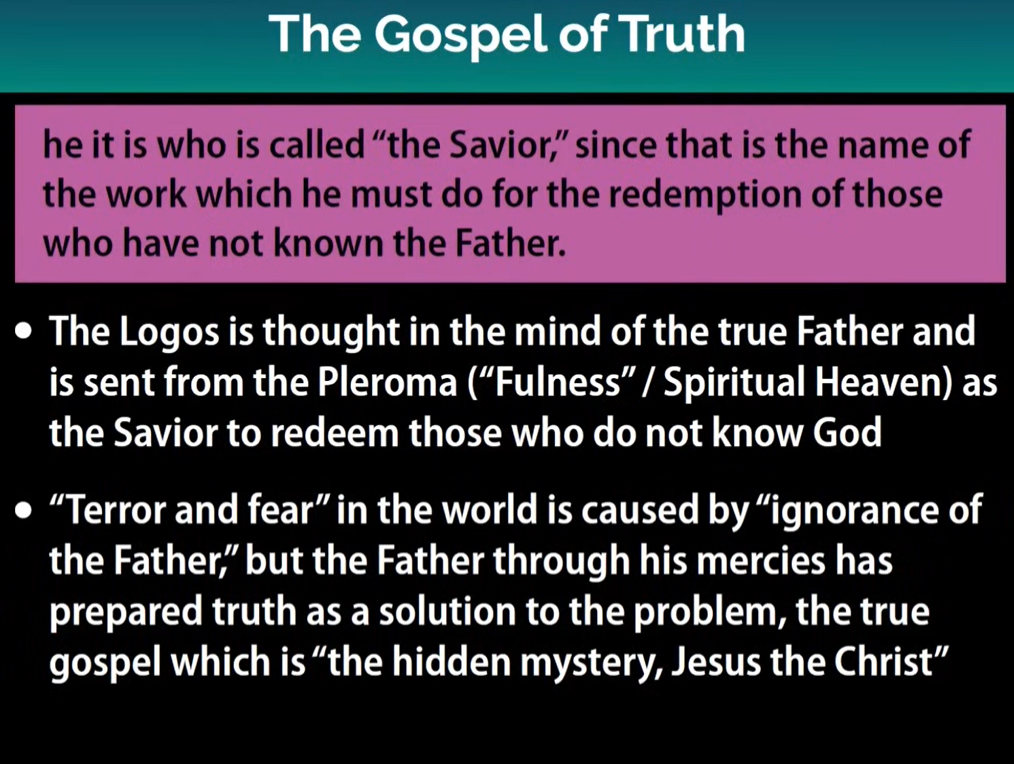 "He it is who is called the Savior since that is the name of the work which he must do for the redemption of those who have not known the Father." Already right here in the very first sentences, the Logos is described as thought in the mind of the true Father and is sent from the Pleroma, the fullness, spiritual heaven, and is sent as the Savior in order to redeem people. What they need to be redeemed from, they need to be redeemed from ignorance, their ignorance of the Father.
The text goes on to say the terror and fear in the world is caused by ignorance of the Father, and so this is the Valentinian idea for the problem of evil. All calamities, fear, terror, all bad things are resulting from ignorance of the Father, which we can't know unless we are experiencing through the Logos, through the Word. The Father, though, through his mercies, has prepared truth as the solution to the problem, the true gospel, which is the hidden mystery, Jesus the Christ.
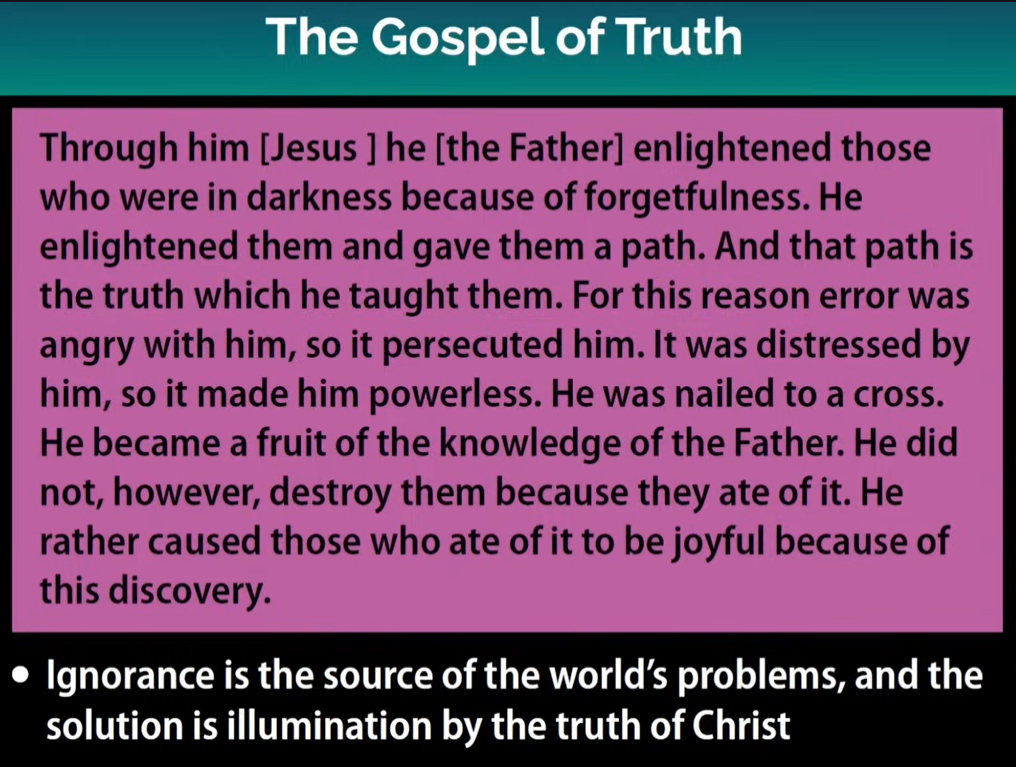 We read that through him, Jesus, the Father enlightened those who were in darkness because of forgetfulness. He enlightened them and gave them a path, and that path is the truth which he taught them, and for this reason, error was angry with him. It persecuted him. Error was distressed by him, so it made him powerless. He was nailed to a cross. He became a fruit of the knowledge of the Father. He did not, however, destroy them because they ate of it. He rather caused those who ate of it to be joyful because of the discovery. This is not a vengeful picture of Christ. There is a reinterpretation here of what the crucifixion is for or an explanation from this Gnostic Valentinian perspective. Ignorance being the source of the world's problems, the solution is the illumination, getting rid of ignorance, the truth that is lived by Christ.
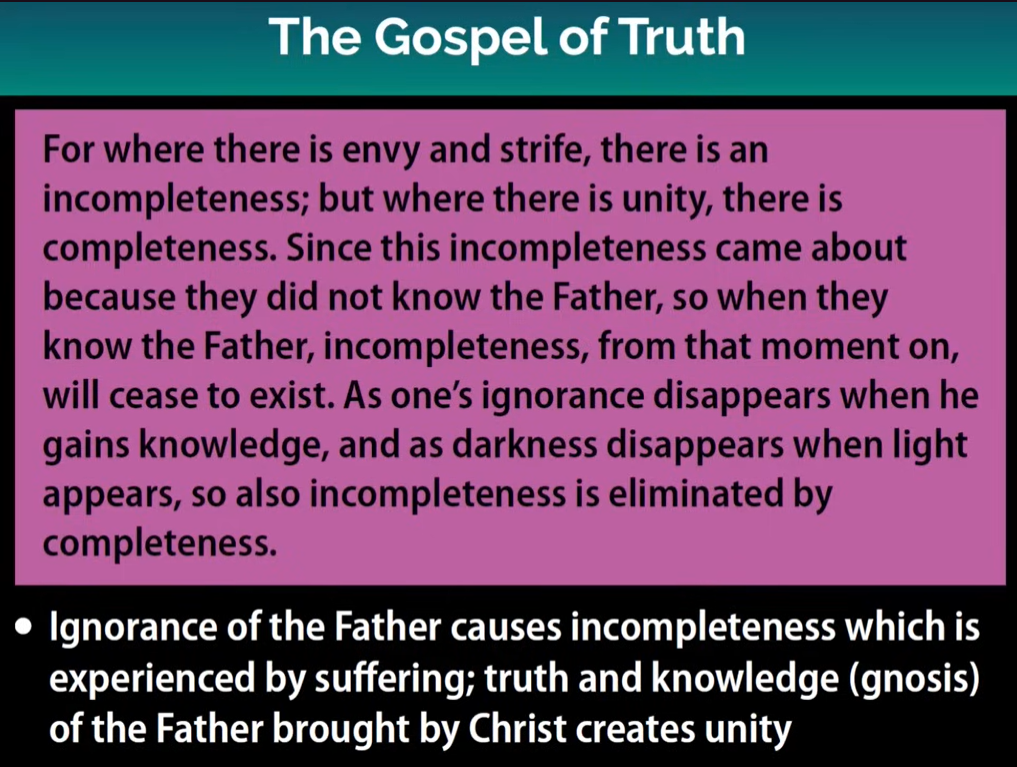 We read as it continues, "For where there is envy and strife, there is incompleteness, but where there is unity, there is completeness. Since this incompleteness came about because they did not know the Father, so when they know the Father, incompleteness from that moment on will cease to exist." As one's ignorance disappears when he gains knowledge, and as darkness disappears when light appears, so also incompleteness is eliminated by completeness. I think that's pretty clear. Ignorance of the Father-Mother is what's causing incompleteness. That's the source of all pain and suffering and everything else. Truth and knowledge, gnosis of the Father brought by Christ, creates completeness, which creates unity, which creates light. It edges out darkness until no suffering will occur.
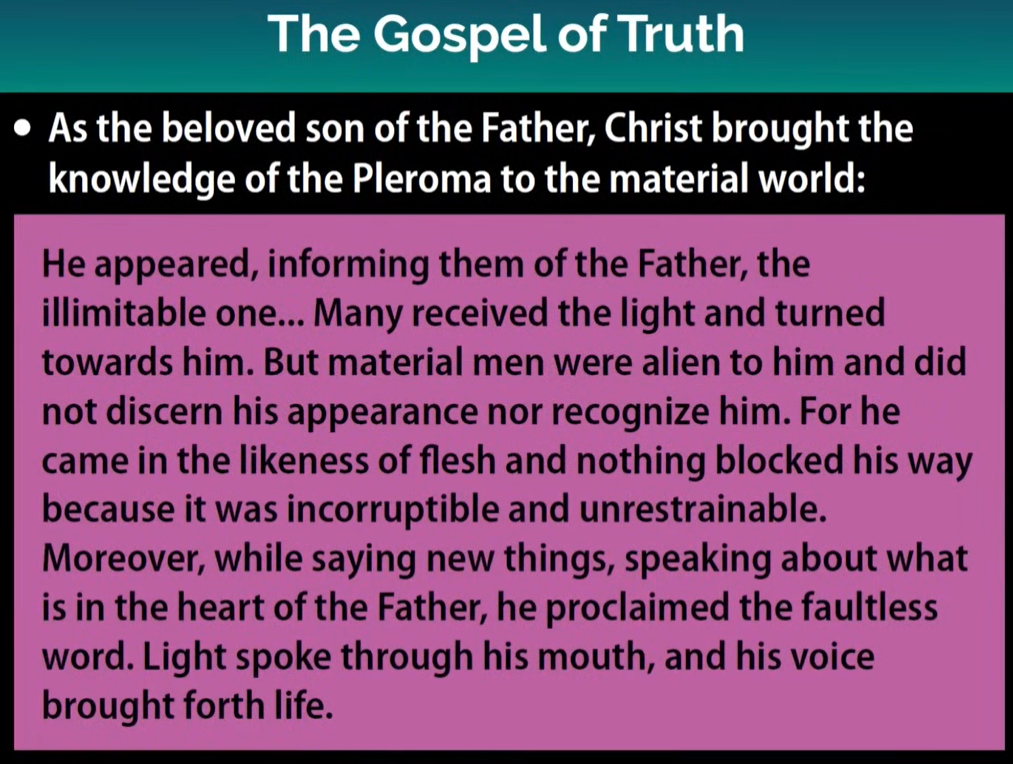 As the beloved Son of the Father, Christ brought knowledge of the Pleroma, the true spiritual world, to this material world. He appeared informing them of the Father, the illimitable one, so one we can't really know of unless through an intermediary here. Many received the light and turned towards him, but material men were alien to him and did not discern his appearance nor recognize him, for he came in the likeness of flesh, and nothing blocked his way because it was incorruptible and unrestrainable. Moreover, while saying new things, speaking about what is in the heart of the Father, he proclaimed the faultless word. Light spoke through his mouth, and his voice brought forth life.
We have already here, when we're saying he came in the likeness of flesh, probably a continuation of a worldview that is going to have a very high Christology, that is, that Christ only seems this important being, only seems to have been human. There are all kinds of other positive formulas, though, in the Gospel of Truth of how to understand Jesus that are familiar to the New Testament reader. It says Jesus is the shepherd who left behind the 99 sheep which had not strayed and went in search of the one that was lost, and he rejoiced when he had found it. Then that one joins the group and becomes part of the number that are numbered with the ineffable source, the Father.
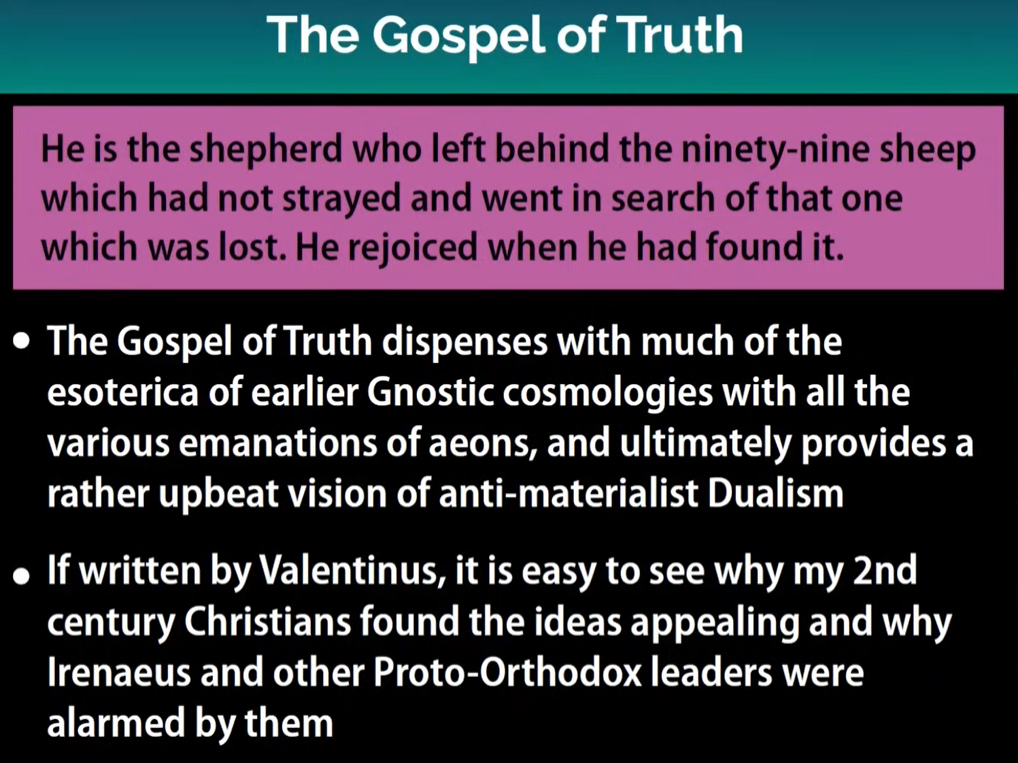 The Gospel of Truth dispenses with a lot of the esoterica of the earlier Gnostic cosmologies, with all this talk of monads and Aeons and emanations and so on. Ultimately, when you read it, it's a pretty not a long text. I think it provides a rather upbeat take on the anti-materialist dualism of Gnosticism. If it is written by Valentinus, it's easy to see why many 2nd-century Christians found the ideas appealing and why Irenaeus and other Proto-Orthodox leaders were alarmed by how popular these might get.
That's what we can see of Gnostic portrayals or portraits in the first three of these.
 Let's look now at the Gospel of Mary.
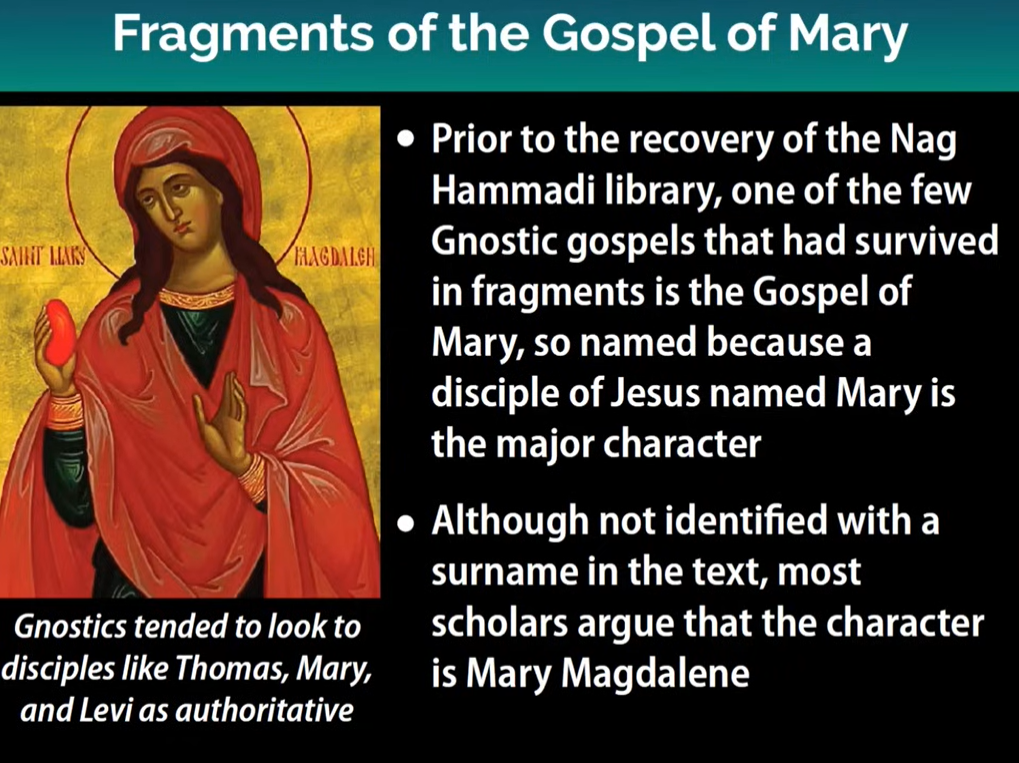 Prior to the recovery of Nag Hammadi, this is one of the Gnostic gospels that had survived in fragment form, the Gospel of Mary. So named because a disciple of Jesus named Mary is the major character. We don't get a surname or a further identification in the text, but most scholars, I think, argue that the character is the disciple Mary Magdalene. The Gnostic texts, in general, tend to look on disciples like Thomas and Mary and Levi as being more authoritative and look at disciples like Peter and Andrew as being more like foils that they used to represent the Proto-Orthodox Christians.
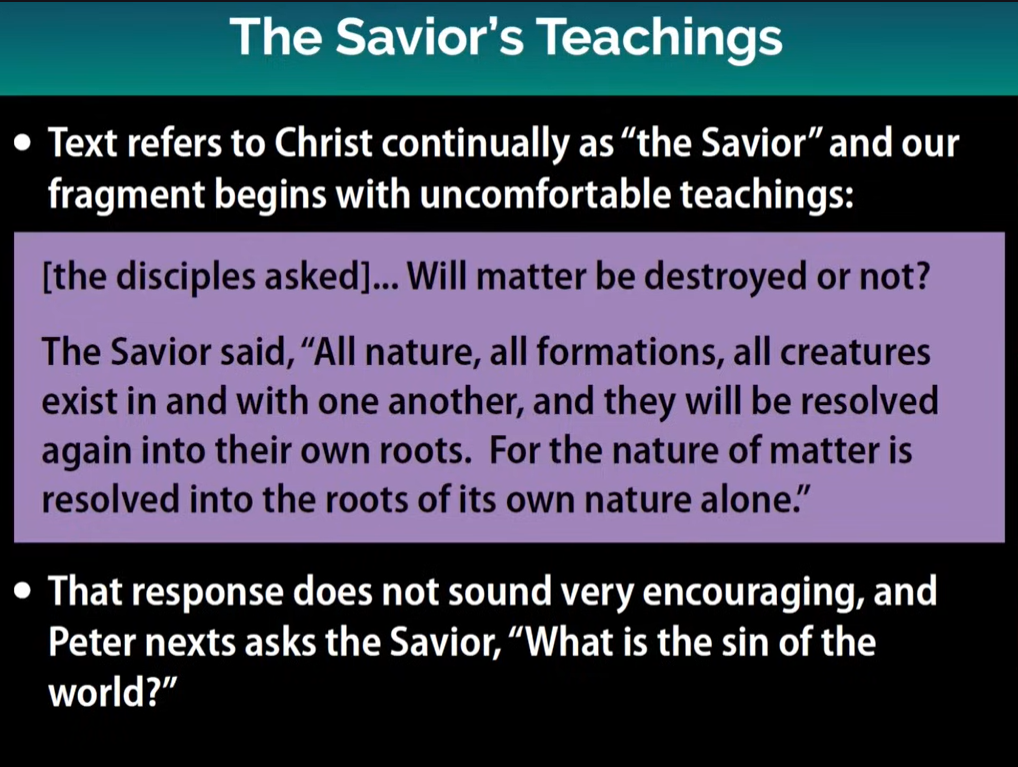 The text in the Gospel of Mary continually refers to Christ as the Savior, and it's a fragment, right? Our fragment that survives begins with some uncomfortable teachings. The disciples ask, "Will matter be destroyed or not?" The Savior answers, "All nature, all formations, all creatures exist in and with one another, and they will be resolved again into their own roots, for the nature of matter is dissolved into the roots of its own nature alone." It's not entirely clear. You could interpret that a couple of ways, but it doesn't sound very encouraging. It does sound that maybe everything in the material world is just grounded nature, and from, you know, it's like ashes to ashes, dust to dust kind of thing. That doesn't sound encouraging.
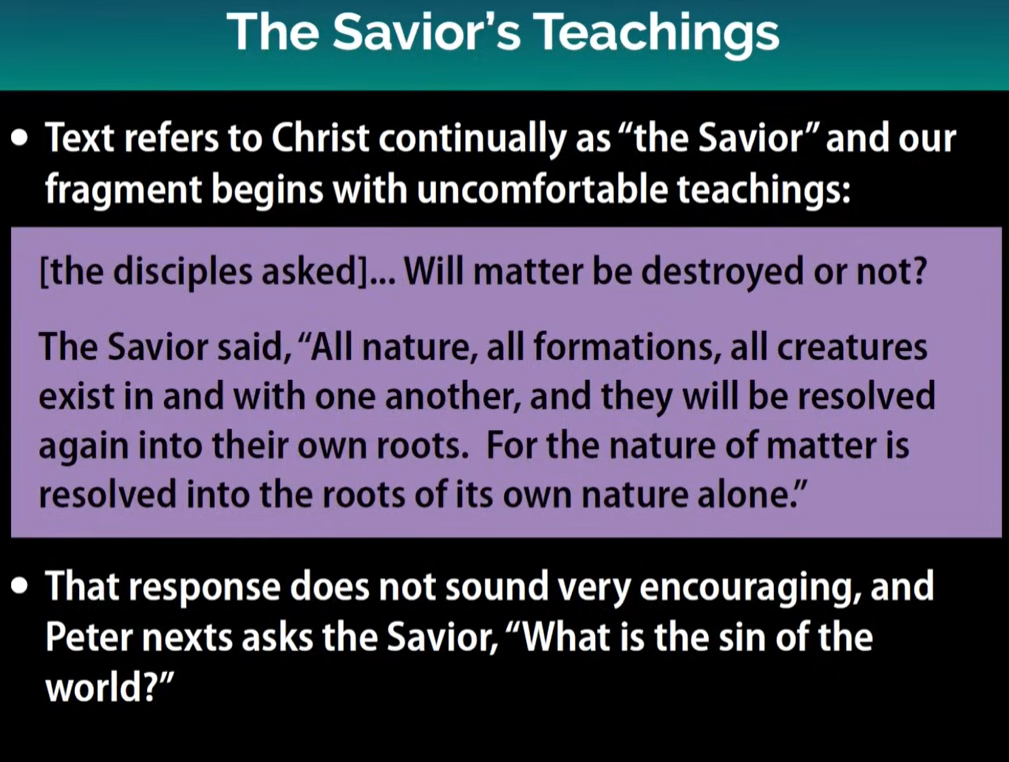 Peter next asks the Savior, "Well, what is the sin of the world?" I'm missing a slide, but I'll just say that here, that the Savior's response is that there really isn't a sin, but you make the sin, you bring the sin in with all of your kinds of confusions.
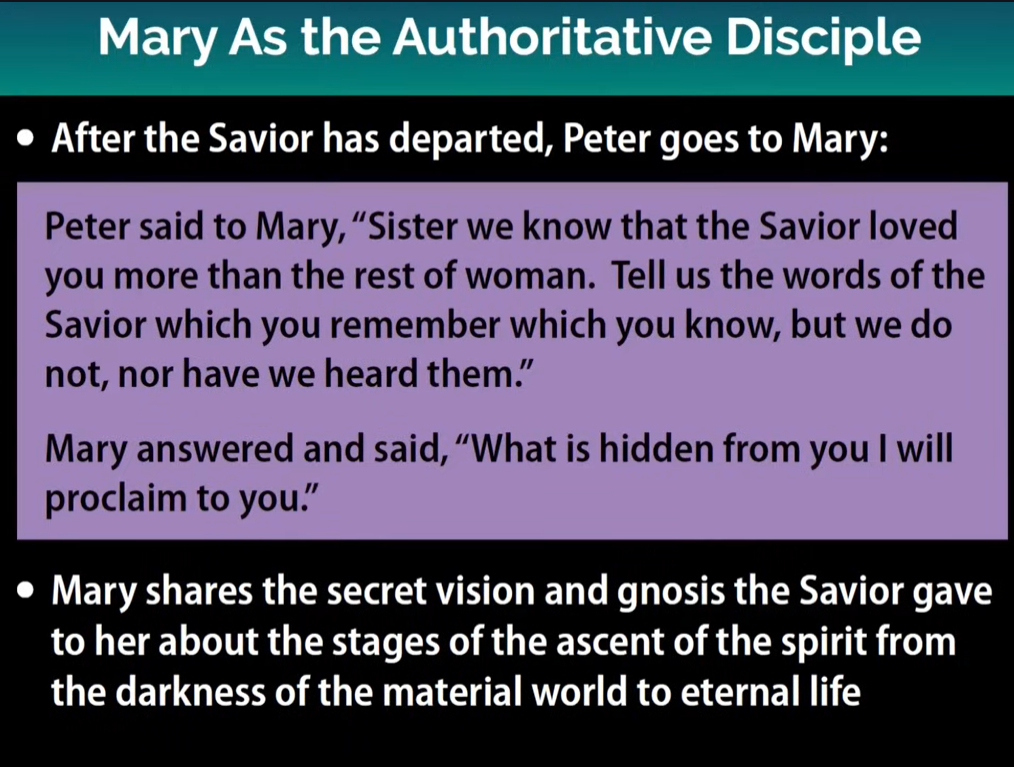 Then after the Savior has departed from earthly life, Peter goes to Mary and says, "Sister, we know that the Savior loved you more than the rest of womankind. Tell us the words of the Savior which you remember, which you know, but which we do not, nor have we heard them." Mary answers and says, "What is hidden from you, I will proclaim to you." Again, as Gnostics tend to, is privileging Mary and Mary's testimony as a disciple. Mary shares this secret, a secret vision that she says she had, and gnosis that the Savior gave her. The part that we have is about stages of the ascent of the spirit from the darkness of the material world into eternal life. Considering we just had Jesus more or less dismiss the continuation of matter, this is a much more encouraging response about whether or not humans have a spirit that will live on eternally.
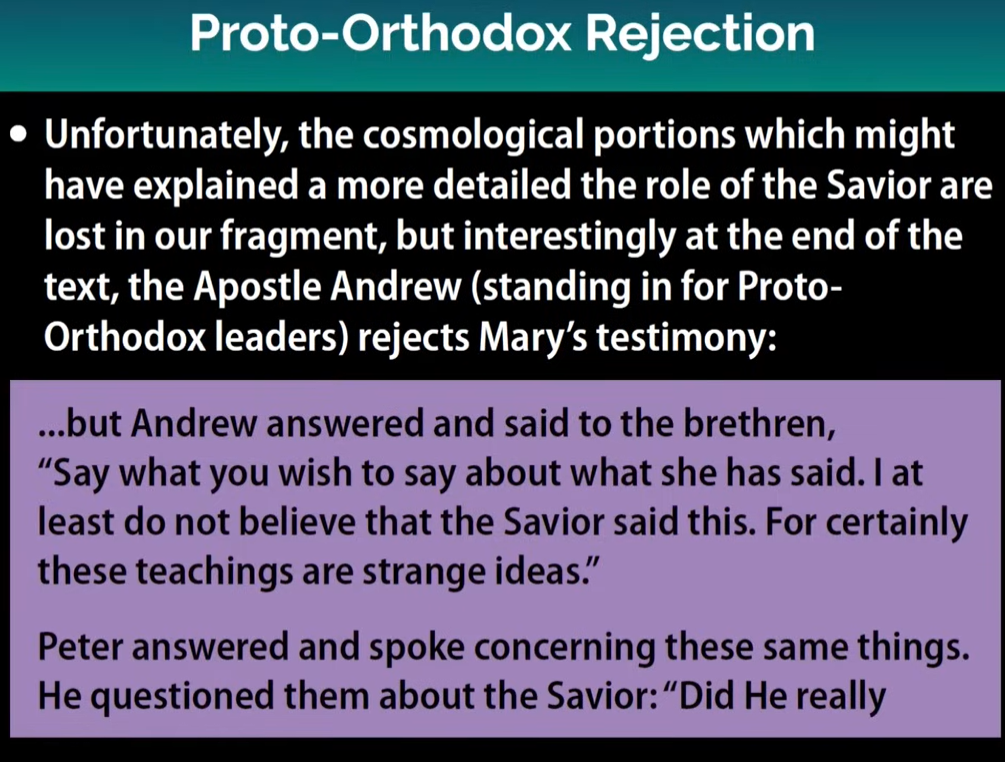 Unfortunately, the cosmological portions of the text, which might have explained the more detailed role of the Savior, are lost in our fragment, so I can't draw a portrait of Christ so much from the Gospel of Mary. I did want to highlight it because, interestingly, at the end of the text, the Apostle Andrew, which I would say is a stand-in for Proto-Orthodox leaders, rejects Mary's testimony. After she's told the entire gospel to them, Andrew answered and said to the brethren, "You know, say what you wish to say about what she has said. I at least do not believe that the Savior said this, for certainly these teachings are strange ideas." Peter answered and spoke concerning the same things. He questioned them about the Savior.
 "Did he really speak privately with a woman and not openly to us? Are we to turn about and all listen to her? Did he prefer her to us?" Mary wept and said to Peter, "My brother Peter, what do you think? Do you think that I have thought this up myself in my heart or that I'm lying about the Savior?" Levi answered and said to Peter, "You know, Peter, you have always been hot-tempered. Now I see you contending against the woman like the adversaries, but if the Savior made her worthy, who are you indeed to reject her? Surely the Savior knows her very well. This is why he loved her more than us. Rather, let us be ashamed, rather let us be ashamed and put on the perfect man and separate as he commanded us and preach the gospel." Let's become again focused on the true spirit as the testimony that Mary has given us about what Christ's teachings were.
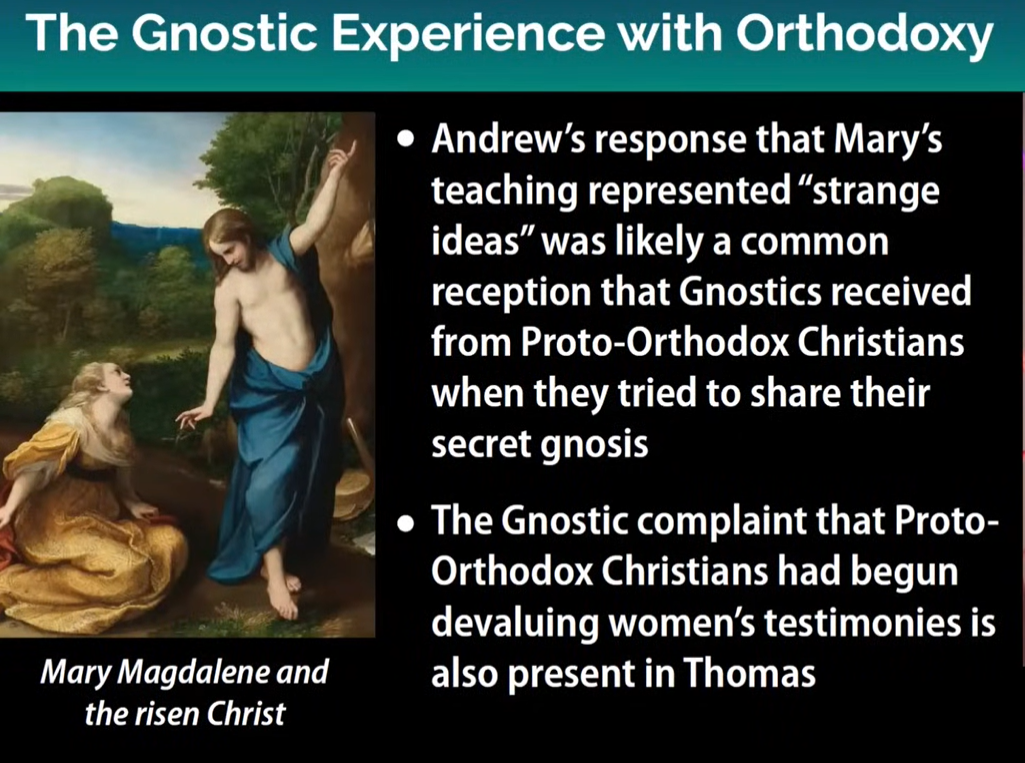 Andrew's response that Mary's teachings represent strange ideas, I think, was likely a very common reception that many Gnostics received from their Proto-Orthodox Christian neighbors when they might have come up to them in church or after church and tried to share their understanding, the secret gnosis that they had learned from one of these gospels. These Christians, mainline Proto-Orthodox folks, might say, "That's weird, that's strange. I'm not sure if I believe that Mary actually was taught that by Jesus." The Gnostic complaint that Proto-Orthodox Christians had begun devaluing the testimony of women in the church was also present in Thomas, and so that, I think, is also an interesting component that we get out of the Gnostic worldview here.
That's kind of the portraits that we can see in these first four books: Thomas, Apocryphon of John, the Gospel of Truth, the Gospel of Mary.
 Let's look at one last text discovered more recently, the Gospel of Judas.
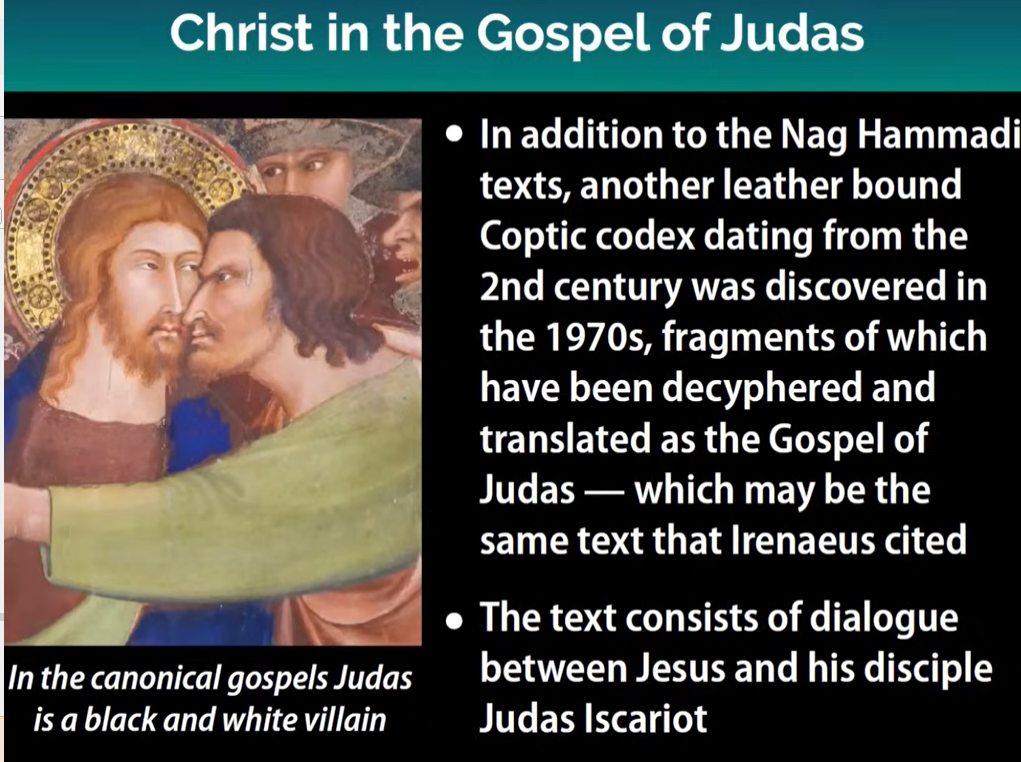 In addition to the Nag Hammadi texts, another leather-bound Coptic codex dating from the 2nd century was discovered in the 1970s. It's also damaged, so fragments of it have been deciphered and translated, and it's now known as the Gospel of Judas, which may be the same Gospel of Judas that was known to Irenaeus but had been lost for all of the intervening centuries. The text, as it's now refound, consists of a dialogue between Jesus and his disciple Judas Iscariot, the traitor, the betrayer, which the canonical gospels portray as just a black-and-white villain.
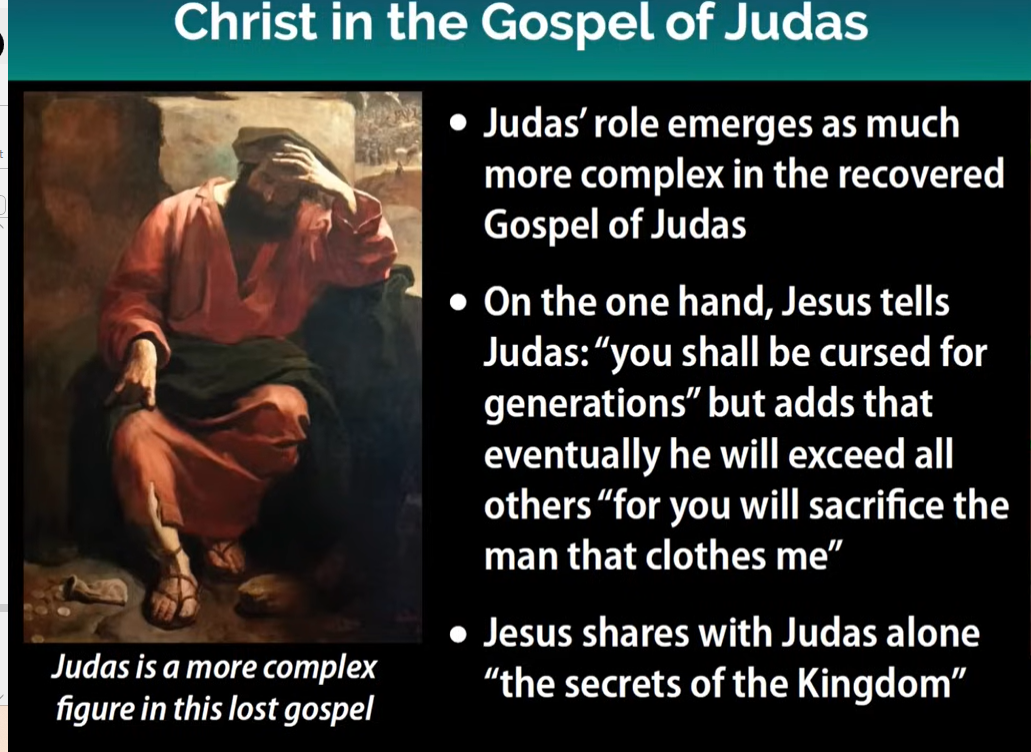 Judas' role in this Gospel of Judas emerges as much more complex. On the one hand, Jesus does tell Judas, "You shall be cursed for generations for what you're going to have to do," but he adds that eventually, Judas will exceed all others of the apostles and man because you are going to perform this important act, which is to sacrifice the man that clothes me, so this body, this physical body is nothing, is not the real Christ. Jesus shares then with Judas alone secrets of the kingdom in this gospel.
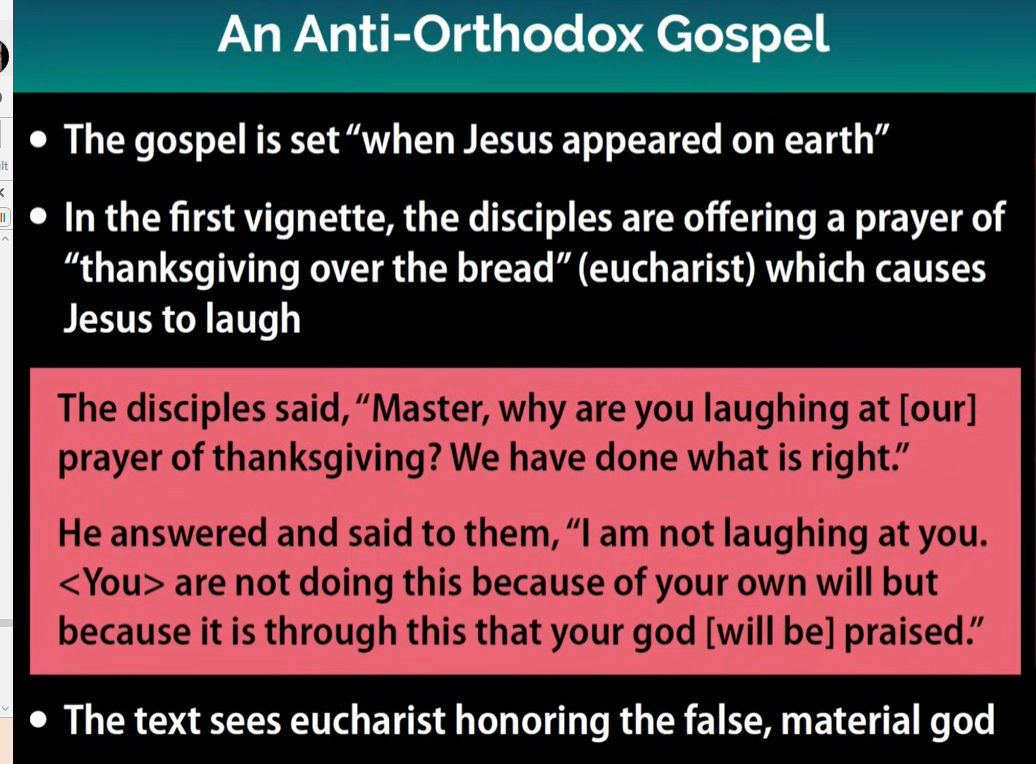 The gospel is set when Jesus appeared on the earth, so once again, understanding Jesus as a divine being that comes to the physical world.
In the first vignette of the Gospel, the disciples are offering a prayer of thanksgiving over bread. In other words, it seems to be the sacrament or the ritual of the Eucharist, as central as it is becoming central to the Proto-Orthodox Christians and Christians generally, and this causes Jesus to laugh. The disciples say, "Master, why are you laughing at our prayer of thanksgiving? We have done what is right." He answered and said to them, "I'm not laughing at you, but you're not doing this of your own will, but because it is through this that your God will be praised." They're thinking, "Well, wait a second, you're the son of our God," and he's like, "Yeah, I don't think you know what God you're praying to." The text here sees the Eucharist ritual as honoring a false material God because it's making use of physical material. It is being modeled on the ancient, I'm sure, the previous Jewish practice of sacrifice and sacrificial offerings, which are being made not to the true ineffable God but to the material demiurge, the creator of this world.
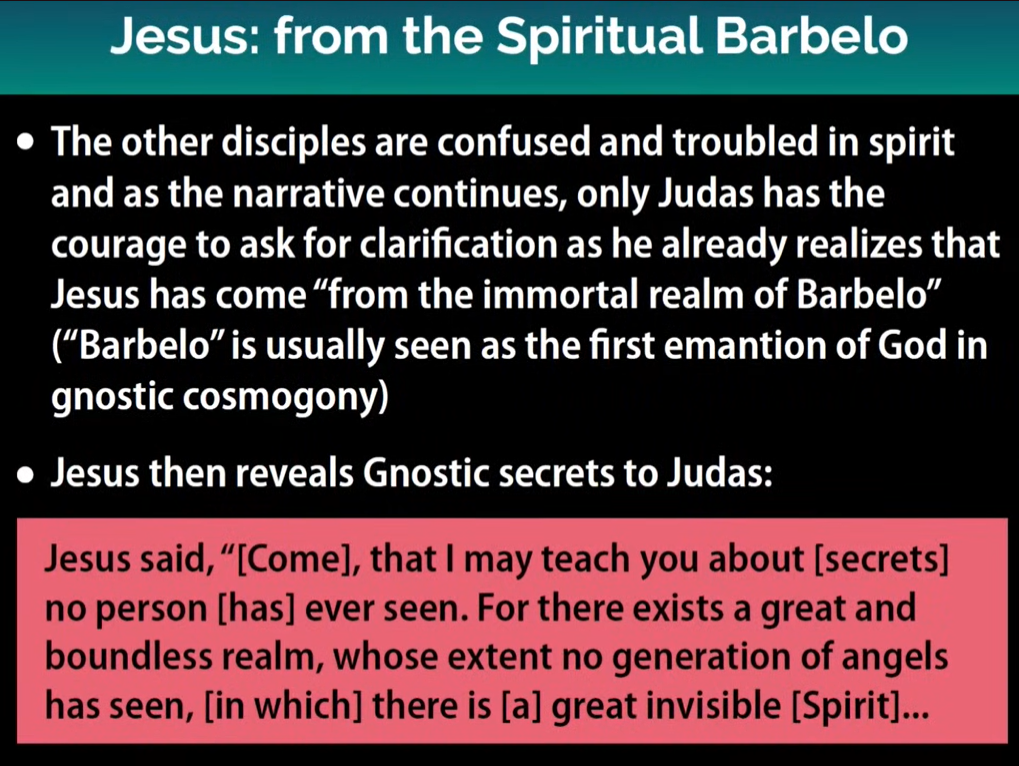 The disciples are confused, and they're troubled in spirit, and as the narrative continues, only Judas has the courage to ask for clarification. Part of this is that he already has a testimony and realizes that Jesus has come, he says, from the immortal realm of Barbelo. As we saw in previous texts, Barbelo is usually seen as the first emanation of God, the female principal, the mother, the mother-father in Gnostic cosmogony. Jesus then reveals a whole bunch of Gnostic secrets to Judas. Jesus says, "Come, that I may teach you about secrets that no person has ever seen, for there exists a great and boundless realm whose extent no generation of angels has seen, in which there is a great invisible spirit."
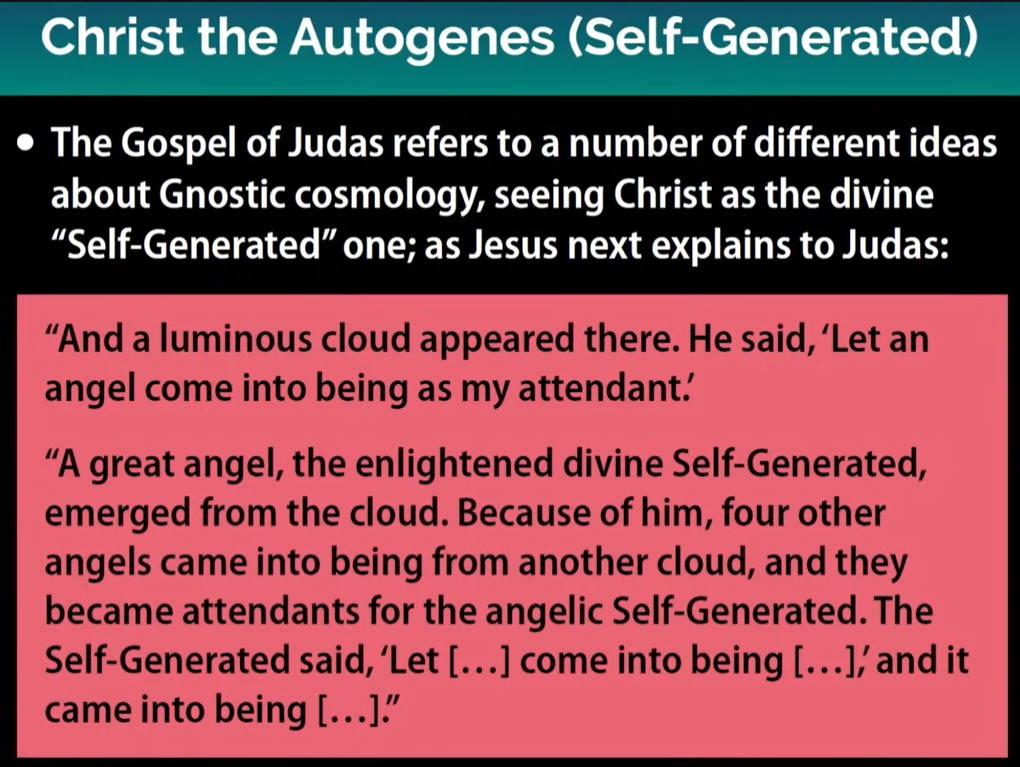 The Gospel of Judas then refers to a number of different ideas about Gnostic cosmology and pictures Christ as the divine self-generated one, as we've seen in other texts. Jesus next explains to Judas, "A luminous cloud appeared there and said, 'Let an angel come into being as my attendant.' A great angel, the enlightened divine self-generated one, emerged from the cloud, and because of him, four other angels came into being from another cloud, and they became attendants for the angelic self-generated. The self-generated said, 'Let...' and the text is lost here, 'come into being,' and then it did come into being, whatever this kind of spiritual creation that the Autogenes, that Christ, is performing
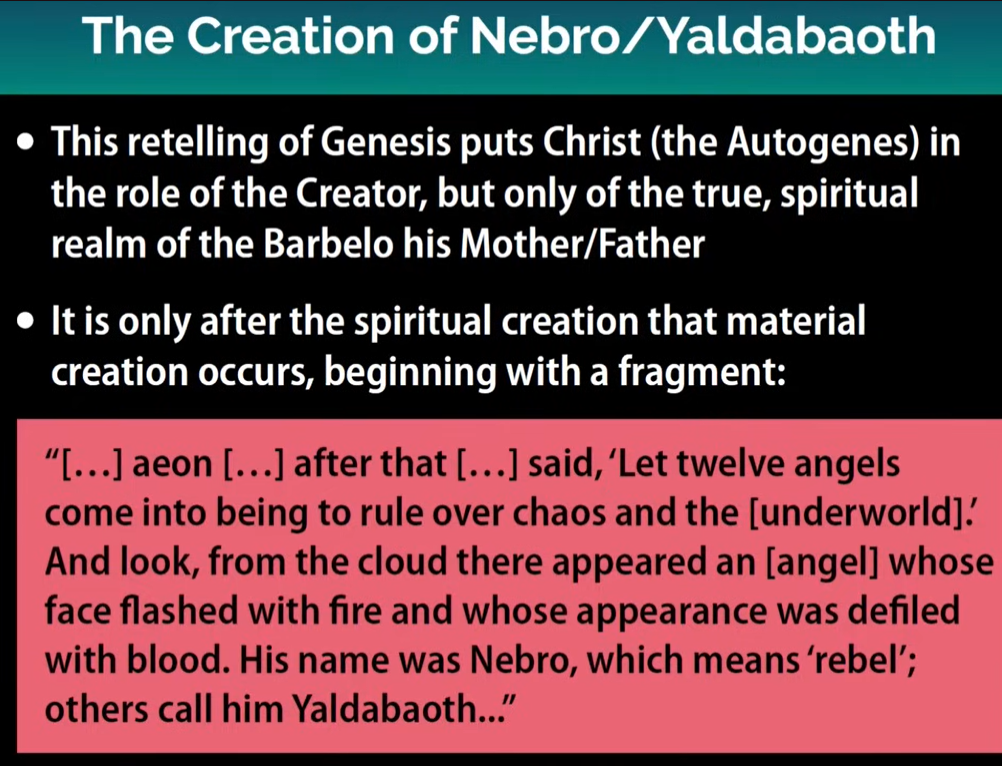 in the retelling of Genesis. This puts Christ in the role of creator, but probably here creator only of the true spiritual realm of the Barbelo, his mother-father. It is only after the spiritual creation that a material creation occurs, beginning again with a fragment of the text, something about an Aeon, and after that, that Aeon said, 'Let 12 angels come into being to rule over chaos and the underworld.' Look, from the cloud there appeared an angel whose face flashed with fire and whose appearance was defiled with blood, and his name was Nebro, which means rebel, and others called him Yaldabaoth."
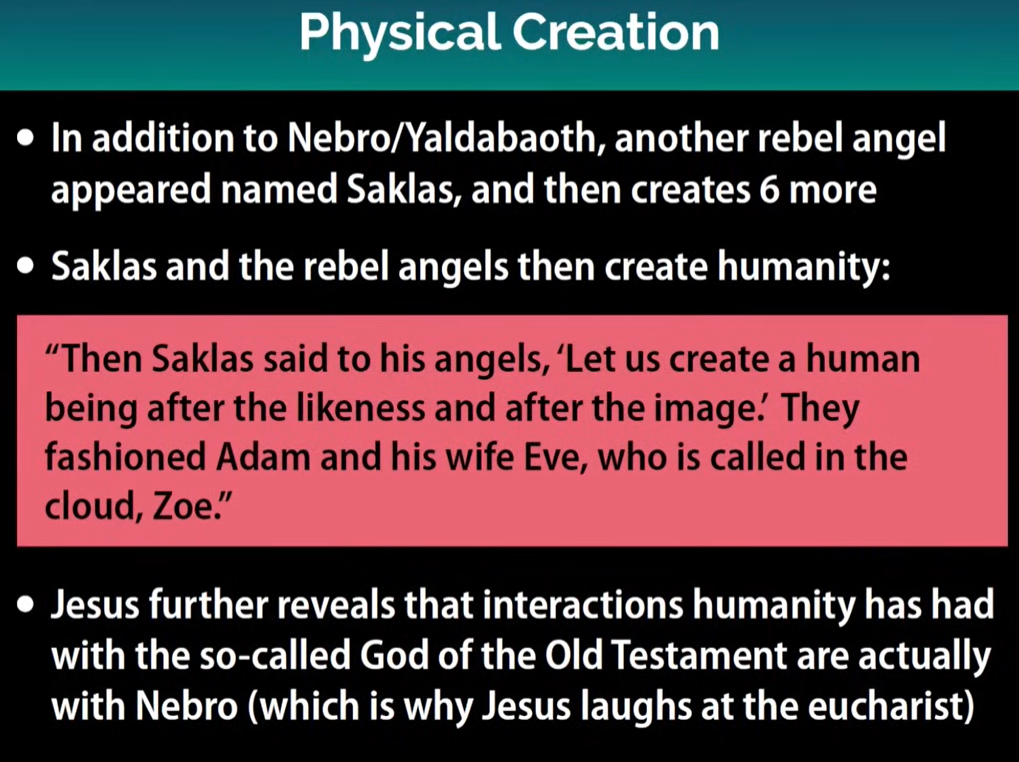 In addition to Nebro or Yaldabaoth, another rebel angel appears in this text called Saklas, and they then create six more rebel angels, and then Saklas and the rebel angels create humanity. Saklas says to his angels, "Let us create a human being after the likeness and after the image," and they fashioned Adam and his wife Eve, who was called in the cloud or in the spiritual realm, Zoe. Jesus further reveals that interactions humanity has had with the so-called God of the Old Testament are actually with Nebro, Yaldabaoth, which is why Jesus laughs at things like the Proto-Orthodox understanding of the Eucharist.
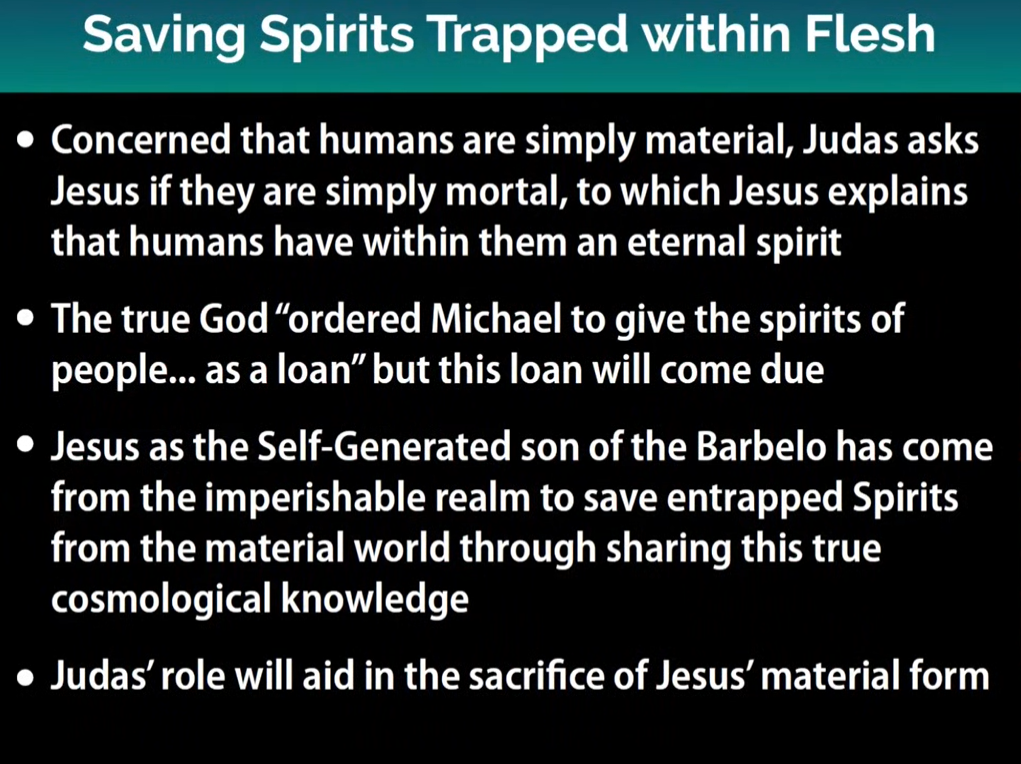 Concerned that humans are simply material, Judas asks Jesus, "If there's no afterlife, are we just going to die with death?" To which Jesus explains that humans have within them eternal spirit. The true God, it turns out, ordered Michael, one of the angels of light, to give the spirits of people as a loan into Yaldabaoth's flawed creation, but this loan will come due, is coming due. Jesus, as the self-generated son of the Barbelo, has come from the imperishable realm to save entrapped spirits from the material world by sharing this true cosmological knowledge with them. Ultimately, we find then that Judas' role, his role as the betrayer, will actually aid in the sacrifice of Jesus' material form, which brings all of this about.
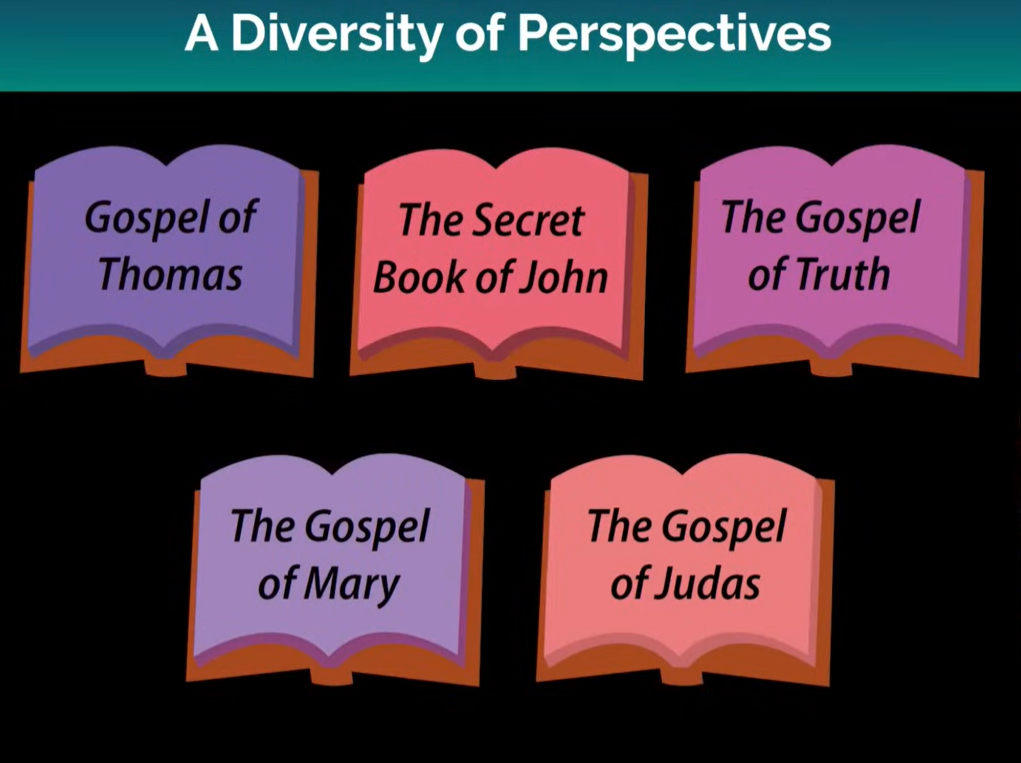 From that, we can kind of see there's a bunch of common themes within Gnosticism about the Gnostic image or the Gnostic portrait of Jesus, but just because there are differences, it doesn't mean that they are self-contradictory. It just means that there, again, is a diversity of views among the different authors of this interesting early tradition. I'm going to get a glass of water while Leandro is looking for your comments and questions.