Plato and Christianity, Transcript
(3) Plato and Christianity - YouTube
History of Philosophy
Transcript:
(00:01) our topic this evening is plato and christianity
x
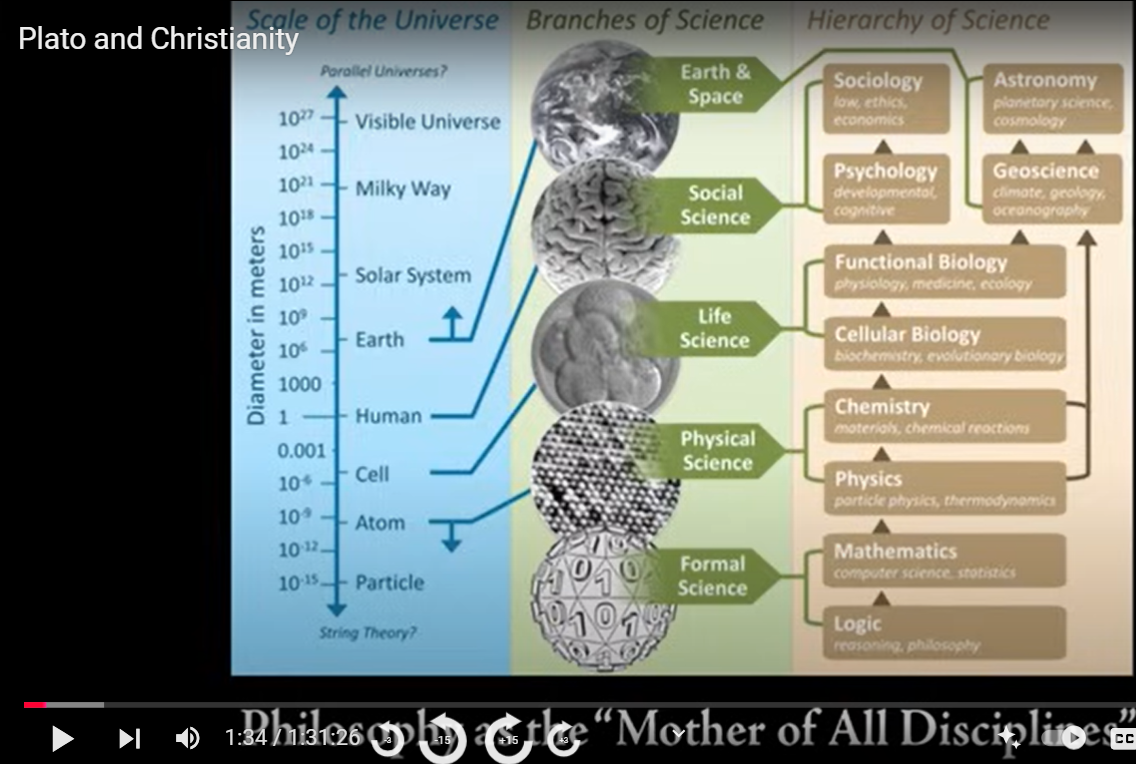
so we'll talk a little bit about just um the evolution of uh the discipline of philosophy so this is a kind of a timeline of and hierarchy of science of the branches of science and also let's say the scale of the universe and what it's what's each one of the sciences is studying so this is essentially um the idea here is philosophy ultimately uh is the mother of all disciplines if we get all the way back down to the lower right hand corner here of formal
(00:46) science we have mathematics and logic logic as reasoning and philosophy so in other words these basic um bedrock that all of the other things that are built upon as as we're having specializations now in social sciences life sciences physical sciences and so forth when we go back to uh the time period of the ancient greeks uh when we're in time period of plato and aristotle and so on um more or less the study of all of these things fell within the purview of what we what they would call philosophy you know there's
(01:27) some components of it that didn't fit into that and then if you were studying the more natural world part of it then that would be essentially a natural philosopher is what you'd say but essentially it would still fall within that discipline
X
so over time what's happened is is that as ancient philosophy has essentially thrown off all of these other fields everything from you know natural philosophy then becomes the physical sciences chemistry and so forth mathematics everything becomes separated and so nowadays if you are going to go
(01:59) to graduate school and get a philosophy degree it doesn't necessarily mean that you um you know that that's necessary to to learn quantum physics or to learn biology or anything like that in fact those aren't essential uh to what philosophy still does today and so whereas in ancient time periods the word philosopher and so forth was essentially all encompassing of any kind of study that you might do now because we know so much and because everything is so very specialized all of these different things are fields
(02:33) and there is now a very specialized field of philosophy today we've talked about this before so we've had a lecture just a month ago on religion
religion
and we talked about how ancient religion like ancient philosophy being uh all-encompassing of all knowledge and study ancient religion was all encompassing of everything you might do in life so it covered everything from of course still your relationships with the divine your sense of propriety law was backed up by a prayer things that are still considered to be
(03:09) religious divination maybe but the calendar writing itself is religious all sports that was religion these are all religious festivals just processing of meat that simply essentially wasn't done outside of temples in the ancient world comedy drama entertainment that was part of again religious festivals as were parades holidays travel and tourism in other words that was going on pilgrimages and so forth care for the sick care for the poor this is all components of religion uh in the ancient world
x
and so like um we saw with philosophy
(03:51) where ancient religion was all-encompassing many of these features like you know the super bowl or something like that sports those you know people some of the people watch sports very religiously but it isn't generally categorized what we think of today as religion so the border that has been drawn around formal religion or organized religion and closes less and less as all of these other kinds of activities have been spun off over time in our culture and history
x
so we talked about this in the religion lecture so the idea of religion lacks
(04:26) meaning and so um we spent an entire lecture talking about how our definition or our even our use of this word at all is an idea that's born from an early modern european context that really doesn't actually translate to antiquity or to the rest of the world and doesn't really have any meaning and so um the western judeo-christian ideas about the meaning of the religion are based on specific european history and they don't really translate outside that judeo-christian context religion in places outside the west
(04:59) encompasses many facets of society that aren't considered religion in the west at this point so we also have seen that it's almost impossible even to define the word
x
and so i looked at wikipedia what is religion and the religion article and so it defines it as or currently it could be edited at any time religion is a cultural system of designated behaviors and practices morals worldviews texts sanctified places prophecies ethics or so this is not and any one of these things they don't have to be these don't
(05:36) have to be included or organizations that relates to humanity i'm sorry relates humanity to the supernatural the transcendental or spiritual elements however there is no scholarly consensus over what precisely constitutes religion so we've talked about how how complicated this is and how no one thing is does the word have any particular one meaning
x
um nevertheless there is a sense uh in the especially coming out of the 19th and 20th century west that science and religion are hostile and that they are antagonistic and
(06:13) indeed many people who consider themselves very very religious are hostile to what they think of or understand to be science and many scientists today are hostile to that kind of religion or maybe even all of religion because they identify um that kind of fundamentalism with religion in general
x
so for example um one of our favorite uh guys and i guess i talk about him because of this that uh giant noah's ark that they built in kentucky as well but he also has this creationist museum where this guy ken ham insists that
(06:47) human beings coexisted among dinosaurs because he believes um all kinds of crazy things but essentially that the earth was you know only a few thousand years old and so on and so he's made a bunch of exhibits to show humans running around with dinosaurs and so on
x
and so the logical evolution of this sort of fundamentalist christianness uh idea i wouldn't call it christianity but like christianism in the same way instead of muslims we would say islamists so christianists you know have essentially here is um saint
(07:21) reagan with a gun on a you know writing a dinosaur to save the universe and that sort of thing the messiah all right so that's just silly but those are i didn't make that picture that's on the internet
x
so anyway um anti-intellectualism is not new but i think the perceived general antagonism between science and religion is a modern phenomenon entirely
x
in the middle ages for example there was a complete overlap between science and religion in the medieval west there was scholars and philosophers including
(07:56) natural philosophers which is the medieval and ancient word for what we would now call a scientist a scientist is a modern word they were all clerics everybody who is trained essentially in any of the universities which are all church schools are are essentially clerics or members of the clergy latin of course today is still the language you know of scientific language and it's still the language of the church in the west uh the catholic church and and there's no um quin it's not a coincidence it's
(08:30) because the church is what kept science alive and what science is all derived from from again medieval and ancient clerics the university system everything like that those are all founded as church schools
x
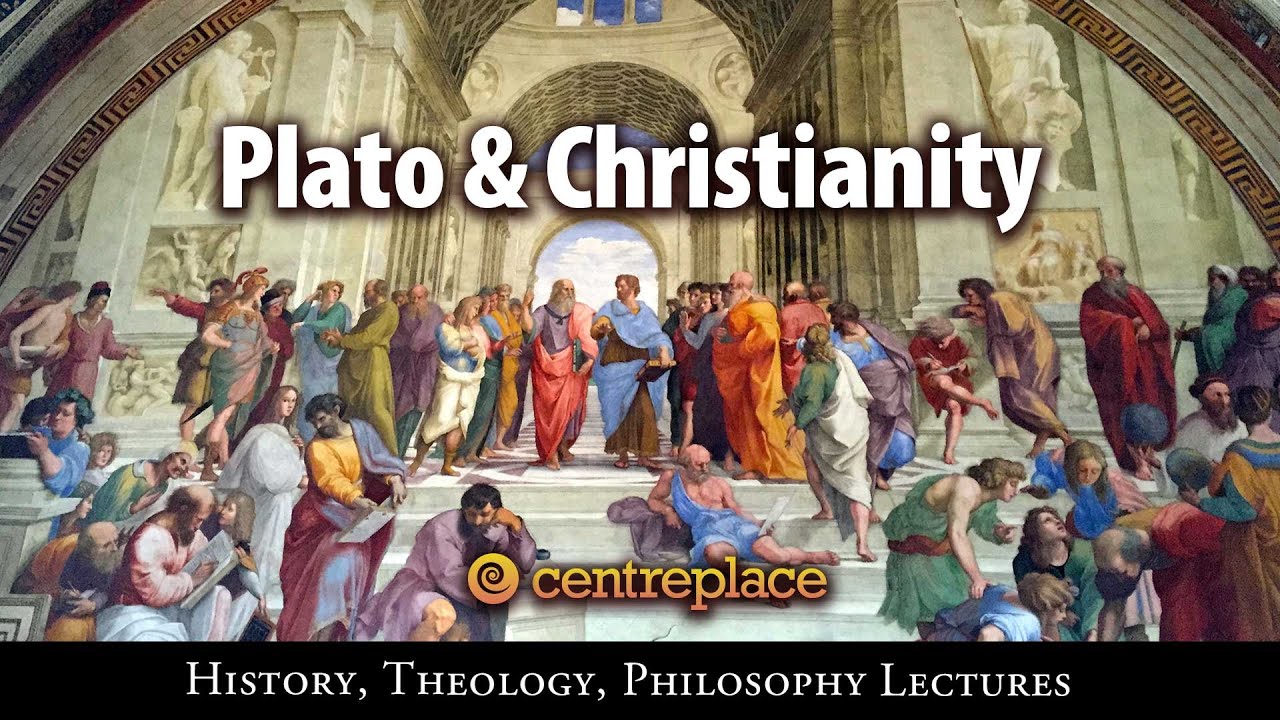
so we use as our as our kind of our symbol or our background or backdrop for this group the history theology philosophy group this picture by rafael which is the school of athens and you know i've seen my we went and go and went and visited this but what we sometimes don't um think about is that this is actually a painting that
(09:08) that the pope uh julius ii commissioned raphael to make and this is in the papal chambers in the vatican so this is not something where all of these philosophers or anything like that are viewed as antagonists or enemies but rather they're quite being honored at you know anyway the heart of western christendom at the time you know in the vatican same thing when we look at this the painting in general the setting you can see that this place of ancient philosophy athens athens of course never looked this grand certainly not in plato's time
(09:43) but as reimagined as this philosophical utopia in fact architecturally what's being portrayed here is the new saint peter's that julius ii has commissioned and is being rebuilt so he demolished the old fourth century basilica and now they're building new saint peter's the saint peter's that we all know today and you can kind of see here then it an idea that all of ancient philosophy and the philosophers natural science and so forth are holy consonants with the contemporary church at least
(10:17) when rafael is painting this
x
okay and so because science descends from ancient philosophy ancient philosophers as all are often viewed through the lenses of modern scientists and so we tend to look back and we figure well socrates and and plato and aristotle are effectively like modern scientists and if we think of the stereotype of many modern scientists anyway therefore kind of let's say at least not interested in religion or being religious so some of course are religious but many are let's say at least agnostic and some
(10:57) are very actively atheists and so on
x
but because of the all-encompassing nature in antiquity ancient philosophers should also be viewed through the lens of religious reformer so what i would also suggest is that the things that socrates and plato and aristotle were doing was kind of similar to what martin luther is doing in terms of proposing that the traditional religion that they had inherited was a need of reformation and they were not talking about uh eliminating everything but rather reforming it and getting to a
(11:36) sense of let's say what what truly matters
overlap in
another thing that is true in antiquity is that there was also a very an overlap in church and state and we've talked about this before when we've looked at the history of paganism so there was no separation of church and state these are two different statues of the emperor augustus in the one he's wearing the toga of a civic magistrate and the other one he's wearing is toga as a priest a civic priest so all you do is you put the thing up and suddenly now
(12:13) the same guy is the priest and we talked about how for example julius caesar one of his early titles and positions was pontifex maximus the chief priest of rome same title one of one of the pope's many titles the punifx maximus
Plato’s influence
okay so let's look about look a little bit now as we're talking about that context let's look a little bit about plato and plato's influence so as the student of socrates who himself left no written works and as the teacher of aristotle plato was arguably the most influential
(12:48) thinker in the western tradition so alfred north whitehead kind of famously characterized all of the western philosophical tradition as a series of footnotes to plato of course whenever anybody makes a sweeping statement like that that everybody argues against it and say well that's that's overreach and so on yet nevertheless um uh you can kind of see when we look at it we'll we can see that he has a point and uh and that even can make such a point it's important to say plato's an important thinker of the western
(13:19) tradition
X
plato also like i say i would say is a religious reformer
so traditional greek religion at the time was about piety ritual behavior performed to propitiate the gods who were viewed as totally unpredictable chaotic forces by asking questions like how do you live a good life what is justice philosophers attempting to add rational ethics to pagan life
x
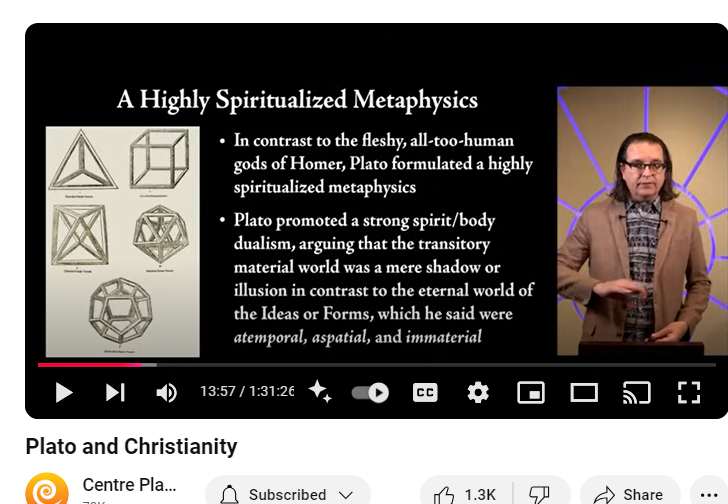 so plato developed a very highly spiritualized metaphysics and so in contrast to the very fleshy all-too-human physical gods of homer plato formulated a highly spiritualized
(14:04) metaphysics promoted he promoted a very strong spirit body dualism and argued that the transitory material world the physical world was a mere shadow or illusion in contrast to the eternal world of the ideas or the forms which he said were
- a temporal
- a spatial
- and immaterial
so this is a um was a huge gauntlet that he threw down and and like i said then everybody as they've either built on that or argued against that that's those series of footnotes that we're talking about in terms of western thought
x
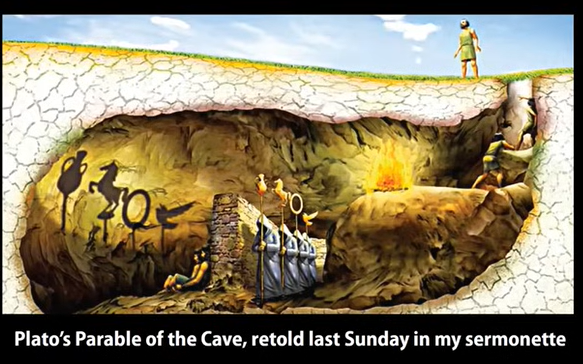 (14:46) we talked about we've one of anyway one of the formulation of that kind of um plato's philosophical thought what's either called platonic realism or platonic idealism from his sense that uh ideas are actually more real than uh the material world is his famous allegory of the cave um and then those of you who watch the lectures are not also going to our church service but on sunday to begin our church service i actually recounted the parable of the cave because of how relevant uh this is to the idea of
(15:25) christianity and so on but anyway let's just say talked about it very briefly so the idea in this parable is imagine a series of prisoners who are chained in a cave they are watching a shadow play on the on a wall and that's the only direction they can see uh as far as they could assume that the that everything that is going on that's reality because that's all their senses are showing them however they could be unchained if they could get up if they could turn around they would say wait a second
(15:55) this shadow play is not the shadows here are only shadows that are being cast by something else that's something else being puppets puppets that are lit by a dim fire light so it's not even anything real it's a shadow of something unreal and then further if those prisoners were to escape and make their way out of the cave and emerge into our real world and see the light and see the true light and the sun it would be almost inconceivable to them when they experience the ideal world the world of real reality according to plato
(16:34) um anyway so this is essentially um an allegory that's explaining again plato's very strong uh idealism that we shouldn't be captivated by all of the um things our senses are telling us all of the sort of traditional material realities that we get caught up in our day-to-day lives and instead be concentrating on things that are more real which is to say eternal concepts like essentially justice and goodness and so forth
Plato’s God
so for plato the ultimate superlative idea is the form of the good so he explains this in analogy with the
(17:13) sun good as an analogy with the (17:13) sun
so for example that prisoner going up and seeing the sun the sun is not sight but it is the cause of sight itself the sun is in the visible realm as the form of the good is in the intelligible realm it quote gives truth to things that are known and the power to know the knower the good is not only the cause of knowledge and truth it is also the object of knowledge so it's a complicated way of kind of saying this the idea is okay sun is not only the is not only sight it's the cause of sight itself so in other words you can't
(17:50) if you have um uh you might have the eye you might have eyes and the ability to see but without light you can't actually exercise that and so likewise this uh by analogy this highest form this highest idea goodness for goodness his own sake good the good is both the cause of knowledge and truth and it's also the object of that knowledge for plato
x
okay um another thing that is also very true is as again plato as a religious reformer um he in in his uh in his book the republic where he's talking about
(18:28) how to have a perfect utopia or society because the behavior of the gods and the traditional poems of homer and hezekiah did not conform to the ethics of reforming philosophers like himself plato argued that ancient religious greek religious texts should be banned so as to eliminate divine precedence for immoral activity this is a complaint that people sometimes make when they read greek mythology they think how can people have a religion um where their gods are behaving so horribly and and it's in frankly comedically uh where the
(19:04) gods are often so dumb and get caught up in all of this kind of thing well ancient ancient philosophers also made that kind of argument and said well this gives people um an excuse for their bad behavior a person can be a flanderer and they say well zeus does the same and so on um anyway so this is a an example i think of plato attempting here to be a religious reformer
What Does Plato have to do With Jesus?
okay so that's some plato context what does plato have to do with jesus since the concept of this lecture here is plato and christianity so even if people you know might see
(19:41) okay i can see what you're saying plato was a sort of a religious reformer because he is promoting ethical behavior and a very spiritual kind of metaphysical world view what does that have to do with jesus so plato lived in athens some four centuries prior to jesus and jesus was a galilean jew who practiced a kind of judaism of the second temple period we've talked about that in our lecture recently on the historical jesus
what has athens to do with jerusalem
what has athens to do with jerusalem and that's a question posed by early christians
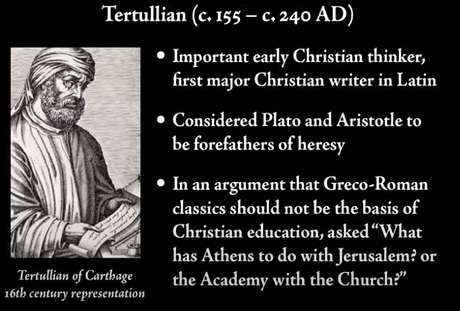
themselves in fact tertullian
(20:20) an important early christian thinker and actually the first major christian writer in latin he considered plato and aristotle to be forefathers of heresy and in an argument that greco-roman classics should not be the basis of christian education he asked this famous question you know what has athens to do with jerusalem what does the academy have to do with the church the academy being the name of plato's philosophical school what does that have to do with the church of course in antiquity in the roman empire here that tertullian is living in
(20:55) studying classical texts is how you got an education so you would be reading all of those greco-roman classic classics tertullian was sort of saying now we should just be focusing on scripture and so on and so forth and have an entirely new curriculum um a by the way a uh an idea or a thing that didn't actually happen in fact actually throughout all of western history christian history churches and church schools the universities and so on kept on studying classics so um tertilian anyway was talking about it but we didn't it didn't
(21:32) actually go through and by the way tertullian himself was classically educated all of his terms and concepts are inherited from classical theology i'm sorry classical philosophy his own theological arguments when he was would make them it actually depended on stoicism so um he you know is sort of rejecting uh the philosophers sort of overtly or explicitly but implicitly he'd already adopted that worldview that language and he used that to even understand christianity himself
God (22:08) as trace persona una substantia in other words three persons but one substance and substance
so for example he was the first christian to formulate god
(22:08) as trace persona una substantia in other words three persons but one substance and substance here is a um a philosophical technical philosophical term a latin term for a greek term in philosophy that's still not very well um understood by lay people right and so um you know we talk about you know this is the formulation of the trinity right so the trinity is one uh substance for god but in three persons substance here is the same word that when catholics are talking about the eucharist being transubstantiated so in other
(22:53) words being literally the body and blood of christ in the mystery of the sacrament they're actually not saying that it has been transmaterialized because this is not a material argument so it's not like a transporter and star trek has changed the molecular um composition of the emblems of the of the host and so forth rather the substance has changed which is philosophically akin to saying the purpose so now that that object has become one in purpose according to catholic theology with god and so it effectively then uh is as
(23:38) opposed to materially is anyway so i just mentioned that because it's very confused people have argued well catholics think people the protestants have said catholics are saying they're actually eating you know anyway i don't need to go into the you know the complexity but it's confusing what i'm saying is that there is um uh the basis for all of these things ends up being the inherited philosophical language that tertullian and all those whose successors had so what did athens have to do with
(24:06) jerusalem
greek influence in second temple judaismx
turns out tertullian it's an awful lot and even for tertullian it was continued to have a lot to do with each other there had already been so way before jesus was even born lots of greek influence in second temple judaism so the conquest of the persian empire by aristotle student alexander of macedon meant that as of 332 bc judea became a province ruled by hellenistic or greek speaking kings and so although many judeans resisted the introduction of greek ideas and customs many of them enthusiastically adopted them
(24:50) so for example elite judeans took greek names so the high priests in jerusalem took names such as jason and menelaus even the maccabees you know these hasmonean kings who very famously if you know the hanukkah story and so forth led an anti-hellenistic judean revolt against uh the hellenistic kings in order to have a kind of the short-lived um uh judean kingdom they took names like antigonus and alexander and these are not um these are not bible names these are homer names in other words these are you know uh greek names and in fact for the
(25:31) earliest synagogues um the decoration so this is a floor um and you can just see uh the decoration of this is and it seems so amazing in a one of our earliest uh ancient jewish synagogues it's the zodiac signs which in a lot of cases are themselves you know greek gods you know the constellations and the centers helios the sun and so anyway um
Alexandria and Diaspora Judaism
there is a lot of hellenism going on certainly the fact that um there was a giant jewish community in alexandria alexandria was the capital of ptolemaic egypt it was the capital of greek thought so initially in
(26:19) in plato and aristotle's time and so on it had been athens now in the hellenistic era alexandria is the place where everything moves it's where the museum is which is to say the temple in honor of the muses and that's where the great library was housed it also had a massive jewish diaspora community many more jewish a much bigger community than what anywhere is existing in judea itself so the city has a 500 000 people and so this jewish community read their scriptures and worshiped in greek there so they're interacting with
(27:00) greek speakers at the heart of um essentially the intellectual capital the cultural capital of the hellenistic world
septuagint
they translated uh the hebrew bible into greek the septuagint it's traditionally composed by the 70 jewish scholars in alexandria at the behest of ptolemy that's a legendary story not a historical story but in any event the grouping became the earliest compilation of books that became the hebrew bible as a brought the hebrew bible into a canonical collection as opposed to just individual books
(27:36) the septuagint also then was exclusively uh was used exclusively by the christian writers of the new testament who did not go back to the hebrew bible for their um you know the hebrew language version of it to make their quotations they were just quoting every time jesus quotes from the hebrew bible in the greek new testament he's just quoting from the septuagint okay
biblical tradition of wisdom
so there is also in addition to greek philosophy there is a biblical tradition of wisdom so the book of proverbs uh includes the character of holy wisdom
(28:12) and she describes her part in the creation
book of proverbs uh includes the character of holy wisdom
the lord created me at the beginning of his work the first of his acts love long ago ages ago i was set up at the first before the beginning of the earth when he established the heavens i was there
while the earliest components of proverbs are part of the pre-hellenistic middle eastern wisdom tradition and they include a translation of a very popular ancient egyptian compilation book of wisdom uh later books of the sabtoo again such as ecclesiastes which was composed in
(28:50) the third century bc and sirach in the second century bc they continued to be written in the hellenistic era and are updated then to include greek thought which is now the contemporary thought we've had a whole lecture on philo alexandria who's essentially a contemporary of jesus { see _Transcript for Philo of Alexandria: Judaism as Greek Philosophy by CentrePlace_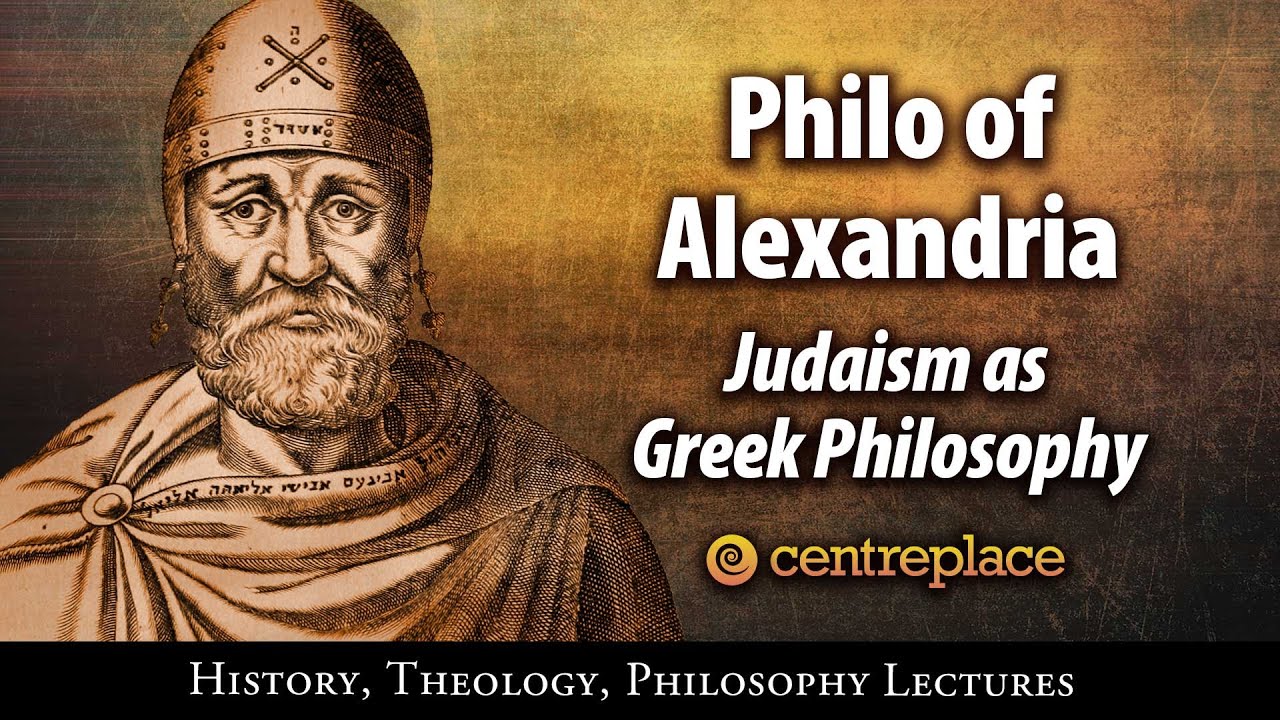 }
and he's among the leaders of that jewish diaspora community in alexandria he's trained in greek philosophy and he attempts to build on the biblical wisdom tradition and to reinterpret the hebrew bible using the philosophical tools developed by plato's
(29:28) heirs and he himself then
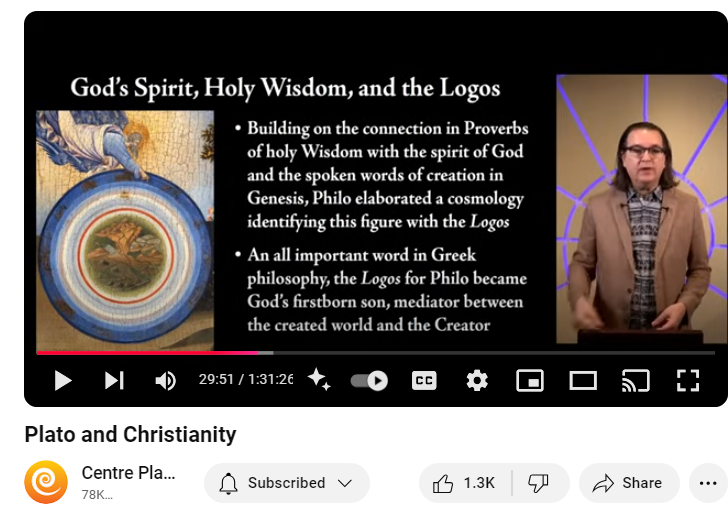
makes moses into a proto-philosopher essentially someone who god revealed all of plato's ideas to before um you know and who wrote them all down and so on before you know centuries before plato existed
God’s Spirit, Holy Wisdom, and the Logos
all right so for example um building on that connection in proverbs of the holy wisdom connecting holy wisdom with the spirit of god and the spoken words of creation in genesis.
{see and _Transcript for What Is the Holy Spirit? By CenterPlace_} philo elaborated a cosmology identifying this figure holy wisdom the spoken word with god's logos god's word
(30:10) so this is an all-important word in greek philosophy the logos for philo became god's first born son and the mediator between the created world and the unseen unknowable creator
The logos in the Gospel of John
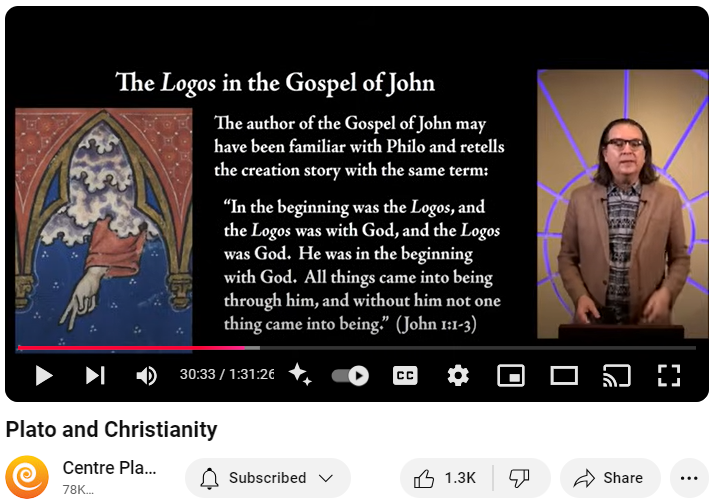
so the author of the gospel of john as we've seen may have been very familiar with philo and he retells the creation story using that same term quoted this before
in the beginning was the logos and the logos was with god and the logos was god he was in the beginning with god all came things came into being through him the logos and without him not one (30:46) thing came into being _John 1:1-3 The Word Became Flesh_
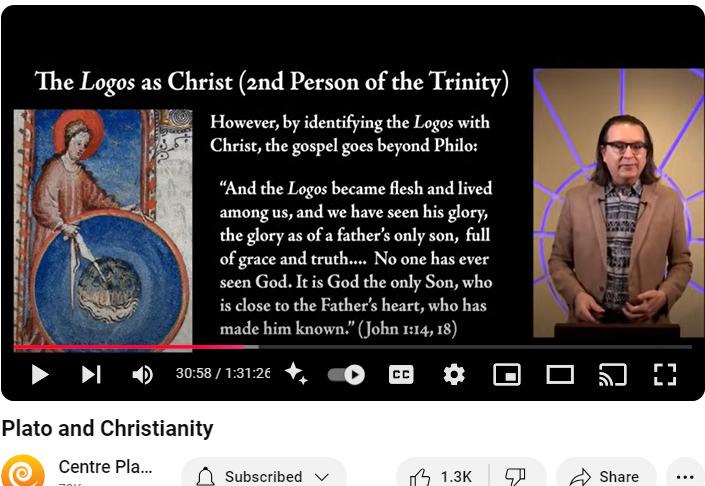
however by identifying the logos with christ the gospel goes beyond philo who remains a jewish leader.
the logos became flesh and lived among us and we have seen his glory the glory as of a father's only son full of grace and truth no one has ever seen god the unknowable unseeable creator it is god the only this only the son who is close to the father's heart who has made him known
so now we can see the logos god's glory because we understand that and we can envision that through the christian idea of christ the
(31:25) second person of the trinity
Jesus: Part of the Wisdom Tradition
all right so that's the christian formulation
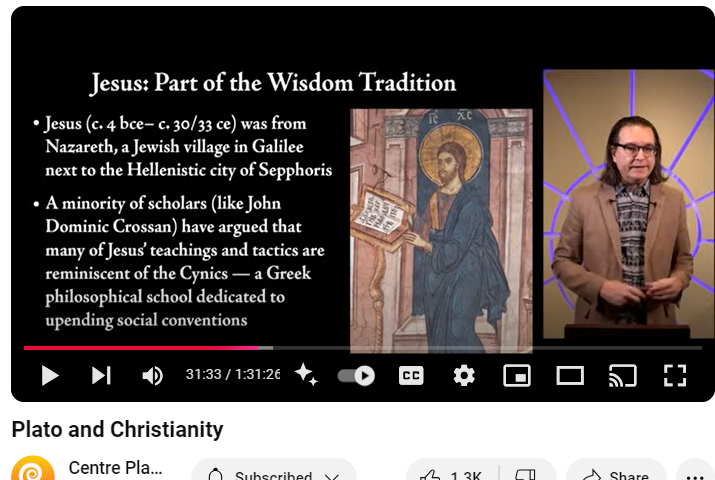
if we back up a little bit to the historical jesus jesus was from nazareth a jewish village in galilee next to the hellenistic city of sephora so there's a minority of scholars of the historical jesus my favorite minority though scholars like john dominic crossan who his book i really recommend and really love they've argued that many of jesus teachings and tactics are reminiscent of the cynics which is a ancient greek philosophical school
(32:03) school that is devoted to upending social conventions
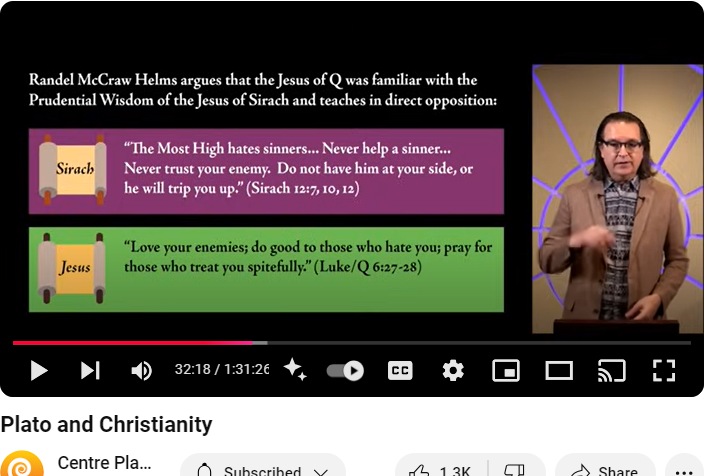
one of my favorite biblical scholars randall macron helms argues that the jesus that we find in the q source the sayings gospel the hypothetical source of the sayings that are now found in the gospels of matthew and luke that that jesus or that author there of q was familiar with the prudential wisdom of the jesus in the book of sirach so the book of sirach is also written by jesus as a common name back then so it's also written by someone named jesus and in fact that (32:43) the the jesus in you know the new testament jesus christ here is making his sayings in direct opposition so in the book of sirach we read the most high hates sinners never help a sinner never trust your enemy do not have him at your side or he will trip you up so this is a prudential type of wisdom and it is completely argued against by uh the wisdom sayings that are attributed to jesus from the queue saying his gospel that are now at luke and matthew so jesus here says love your enemies do good to those who hate you
(33:25) pray for those who treat you spitefully so you know there's a certain sense let's say of practical wisdom you don't don't trust your enemies you know don't have them at your side they're going to go after you i mean that's a kind of like a common sense wisdom um but it doesn't necessarily lead to making the world let's say a better place you know as uh as what the the argument here that turns it over anyway in uh in the jesus of the gospels
Another Example
here's another example so jesus the son of sirach in
(33:54) the book of sirach lists a number of people and activities that are blessed
blessed are the so and so woe unto so and so and jesus takes exactly the opposite position so in syriac we read
you who fear the lord expect prosperity lasting happiness and favor blessed is the rich that is found without blemish wealth is good greed is good
guess that's a great um 1980s uh repetition of ancient sirac right so jesus turns that around obviously in the gospels so
blessed are you who are poor for yours is the kingdom of god
(34:36) woe to you who are rich for you've received your consolation
so the opposite wisdom tradition but part of a wisdom dialogue perhaps sirac here again says a devout man lends to his neighbors but if he cannot repay the neighbor he has defrauded the other of his money and gratuitously made an enemy of him he will pay him back in curses and insults so again practical wisdom if you know you have to give loans to people or whatever but if they don't pay you back you know curse them and jesus in the gospel says
(35:12) if you lend only where you be expect to be repaid what credit is that to you even sinners lend to each other to be repaid in full so thus here in if if jesus is responding to surak what he's essentially saying is what sirac is calling a devout man for jesus is only a sinner right that's only what um all right
jesus relationship with god in the context of monotheism
so after jesus's death christians needed sophisticated theological tools to try to understand jesus relationship with god in the context of monotheism so um they were agreed they were monotheists
(35:52) there's only one god essentially not all agreed but anyway pretty much everybody was agreed even the pagans the philosophers more or less agreed that there is essentially one divine source even if there might be let's say multiple gods apollo and zeus and so on who are all emanations uh from that one source likewise there is only one god for sure in judaism so how do we understand if there's god the father there's jesus who's somehow divine the son of god and there's the spirit how do we understand this all so they needed
(36:30) these philosophical tools that had been developed by plato and aristotle and their heirs
hypostasis
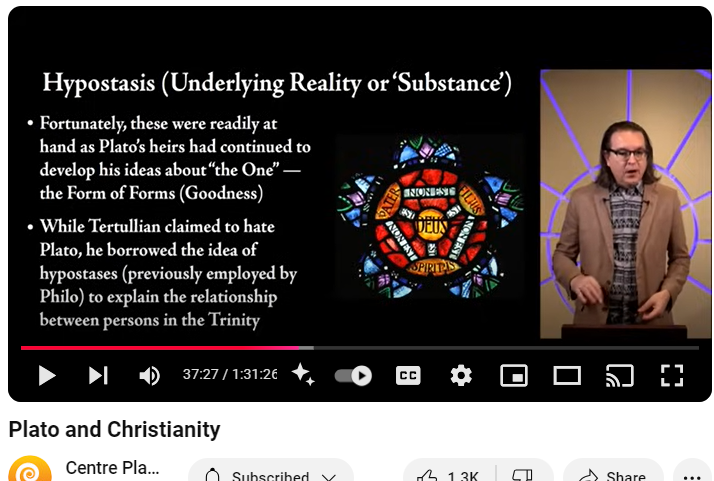
so for example they took this term hypostasis which is to say the under lying reality that word i've talked about substance right so when we had the formulation the hypostasis is the greek substance here is the latin so this is in in the latin when we get words like i say like trans substantiation consubstantial this is hypostasis hypostatic union so these needs of being able to say and formulate complicated theological and
(37:10) philosophical ideas were at the ready since plato's heirs had continued to iden develop ideas about plato's concept of the one the source of the form the form of forms the good and so forth so while tertullian claimed to hate plato he actually borrowed the idea of hypostasis that had been previously employed by philo to explain the relationship in the persons of the trinity so in other words they have one substance one hypostasis together their hypostatic union all right a contemporary of tetulian Origen of alexandria was a much more
(37:49) sophisticated thinker and he was extremely influential and an amazingly prolific early christian writer so he's at the end of the second early third centuries third century is when he's actually active as a writer he studied both under clement of alexandria an important father of the christian church but also under the neo-platonus philosopher ammonia sackas origen had absolutely no qualms about using philosophical tools in formulating christian theology so origen's influence was enormous like the platonous origins was an idealist
(38:24) and so who felt that matter was relatively insignificant the material world what's more important is the ideas the spiritual world origen taught that the logos christ is the rational creative principle that permeates the created universe origins theology of god the father paralleled platonic ideas of the one so in other words a perfect unity indivisible invisible and corporal incorporeal and transcending all things material in other words quite similar so um christian theology go you know moves on from people like origin um
(39:07) platonism continued too in the pagan sphere too and so platinus is in the third century kind of one of the last great non-christian philosophers so christianity is going to take over the empire soon and there isn't going to be a place for great thinkers who aren't actually part of uh the rel that the empire's official religion potinus is um is not convinced and he doesn't like christianity nevertheless he is a neoplatonous who is amazingly influential on christianity so he also studied under ammonia sakas same teacher
(39:48) as origen he theorized that there was one source which was prior to all else was undivided and was equated with the concept of good very much similar to what we're talking about before with plato but it's much more developed now with platinus that everything else emanates from the one that the first emanation is the intellect which he calls the logos or identifies with the logos which is the will toward good and then the next emanation is the world soul which includes nature from which precedes things such as human
(40:22) souls and matter and so forth so this is a very brief thumbnail
platinus
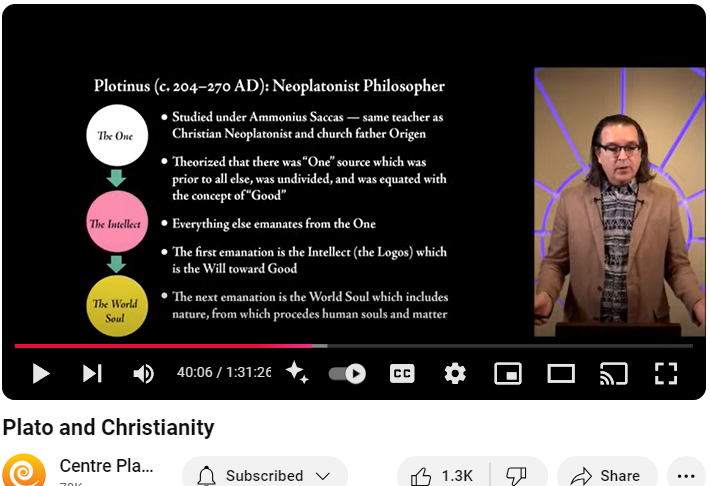 platinus is a very uh in-depth thinker we're gonna have a whole lecture on in the future but in any event um also quite um you can see this isn't that different frankly from contemporary what his fellow student origin is also saying within christianity so pagans and christians are fairly close to each other at this point in in history in terms of their underlying understanding philosophy theology of the universe
augustine of hippo Saint Augustine
so augustine of hippo is where it all kind of comes together
(41:00) saint augustine is the great thinker of the latin west through whom essentially all of previous uh theology and philosophy and so on comes through him and then it all goes out and and is built on him afterwards so he himself is initially a rhetoric creature who became a manichaean we've had a lecture on the manikins they're an interesting world religion that subsequently died out a duelist world religion his mother was christian but he rejected it because he found when he read the bible he thought it's pretty dumb it's really poor
(41:34) literature he couldn't believe any of that because if you're reading it literally it doesn't make any many sense as far as he's concerned he converted to christianity only after he met ambrose of milan another very important contemporary christian thinker who taught augustine that scripture needed to be interpreted symbolically instead of literally and after ambrose shared the writings of platinus and other neoplatonists to explain christian theology so then augustine became a great thinker and writer whose philosophy and theology
(42:06) like i say uh set the course for the latin tradition until the western european recovery of aristotle in the middle ages so augustine's theology influenced everybody else he's directly influenced by origin and the neoplateans like platinus everybody else who came after him is uh influenced by augustine because on the one hand he's a great thinker on the other hand he wrote so much so for example when the christian writer boethius turned to philosophy for his consolation in the 6th century it was to christian neoplatonism
(42:41) and so you know to kind of just bring this forward
Timeline of Plato and Christianity
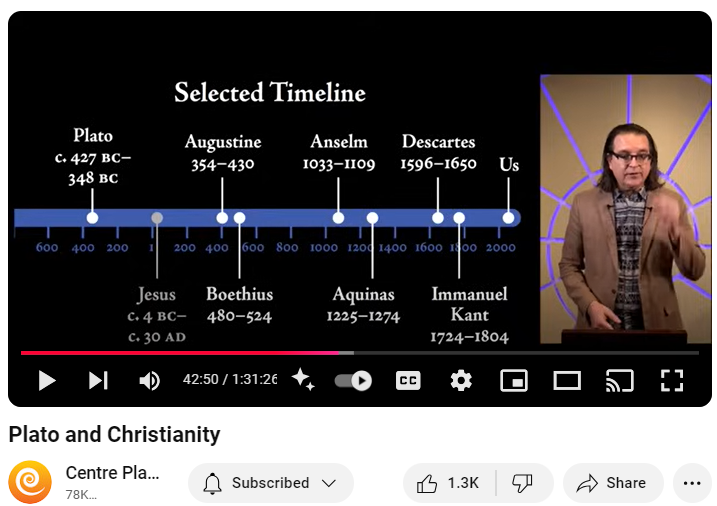
i have a little bit of a timeline here um you know
plato all the way back in the 400s to 300s bc
jesus around the early part of the first century of the common era
augustine boethius together at the end of the roman empire in the west and then as we kind of emerge out of the darker part of the middle ages into the height of the middle ages and then the early modern time period to get to us so anselm aquinas uh descartes content us so boethius here writing after the fall of
(43:23) the western roman empire but still within a very late antique world it's kind of the very beginning of the middle ages at the very end of antiquity he wrote a book that we've had a lecture on called the consolation of philosophy and it's one of the most copied read translated and studied books throughout the middle ages so for example king alfred the great actually translated it into old english and queen elizabeth the first translated it into elizabethan english so in other words it was an important book that
(43:56) scholar kings felt uh in queens felt them compelled to themselves do the translation work or you know their court helped them i'm sure to because that's important for their philosophy it's also the source of chaucer's philosophy imagery from the roman de la rose boccaccio's to cameron dante's divine comedy it's all being divine comedy has been called an expansion of boethius so who was he he was one of the last great thinkers who had had access to all of classical antiquity and he had as a
(44:30) project to translate all of plato and aristotle into latin and if he had actually completed his project that would have completely altered western history part of the problem [Music] for western thinkers with the contraction of learning and the ability to get books and so on also the ability to read greek was was lost for most western uh scholars and so pretty much if it was translated into latin you could have it and so essentially the fact that boethius translated aristotle's prior analytics topics and statistical
(45:06) refutations those were among the very few bits of aristotle available to the early medieval west and it pretty much formed the basics for logical thought through most of the middle ages because they had those components that boethius had done so through his commentaries he also intended to synthesize plato and aristotle which became kind of the project for christians for the rest of the middle ages as well especially when um when some of the texts were really recovered in the central middle ages so um boethius had been the prime minister of
(45:42) the barbarian king theoderic the ostergoth he was essentially arrested for a conspiracy his sympathies may have been with constantinople which continued to be the capital of the eastern roman empire the gothic party led by a minister named cyprian denounced a member of boethius's party named albinus as a traitor and they said he was plotting and so forth um boethius himself got charged with treason and was deprived of his office and imprisoned um he wrote in this book the consolation of philosophy uh about uh fickle fortune
(46:19) and really popularized this idea of the wheel of fortune you can see as fortune just mercilessly turns her wheel the little guy who's being raised up the king's on top and they can see the person being you know cast down in other words there's all kinds of things that are not in our control uh fate and fortune or never sorry fortunate is um you know in things happen now that there's without chance happens without um our control um so during his imprisonment uh waiting execution that's when boethius writes
(46:52) this book it's not a systematic philosophy but it is a very accessible and compelling popular book meant to convey practical philosophy and boethius writes the text as a conversation between himself and lady philosophy philosophy uh personified the anthropomorphic expression of western thought so lady philosophy finds boethius with the muses she identifies him as a patient in need of her remedies and so that becomes the allegory of the book after a whole bunch of different arguments we have a whole lecture on this topic which um you
(47:29) should go to she says none of uh none of these things i've tried are very strong medicine but i have uh i have something deeper medicine so she argues if i ask you whether there is anything more precious to you than your own self you will say no so if you are in possession of yourself you will possess something you would never wish to lose and fortune can't take away so in other words if you yourself are well grounded if you have been a good person if you um you're a philosopher it doesn't matter as the stoics would even
(48:01) say you know if you're if you're in a prisoner that's not something that fortune can take away the way riches are so philosophy as she's arguing with boethius she says that although people think that money reputation power etc are actually um are actually the ends that they're seeking that in every one of those cases they're actually seeking something else so she argues if a person is seeking wealth philosophy argues that people will actually want is to be self-sufficient but she says wealth actually brings
(48:35) nothing of the kind since rich people continue continue to be very dependent on others thus none of these wants are naturally or intrinsically good nor do they lead to true happiness and so philosophy shows that the way is actually to the highest good good for goodness at sake love for love's own sake and so on so following plato's timaeus one of the very few platonic dialogues that actually got translated into latin and so it was available to people in the middle ages philosophy argues that quote if there were a being
(49:12) self-sufficient able to accomplish everything from its own resources glorious and worthy of reverence surely it would also be supremely happy which leads ultimately to the conclusion that god and happiness are one and the same thing and that in seeking true happiness and goodness and unity a person is seeking the same thing god having made the platonic case for god as the supreme good philosophy then also offers boethius platonic answers for the problem of evil she says evil is its own punishment because participating in evil brings
(49:48) only false happiness while good people seem to suffer this is only material suffering but in seeking the supreme good good people alone participate in true happiness so whether you're convinced by her arguments or not um one of the points that i think i'm trying to make here is um that christian theologians the leading thinkers uh throughout all of these times are are very much grounded in these same kinds of arguments that are ultimately drawn from plato so you know we mentioned here we've gone through a little bit about augustine and
(50:28) boethius at the very beginning of the middle ages we've also had lectures on anselm and aquinas at kind of as the as we get to the central middle ages we talked about anselm of beck who is uh archbishop of canterbury he's a major political figure at his time and therefore not just some thinker living off in an ivory tower nevertheless he's also a prolific author influential teacher and he also innovates in the use of logic and has a really enduring impact on the emerging university system scholasticism that's
(51:04) being created at the time period that he is existing in the central middle ages so his philosophy ultimately influences aquinas and descartes and his definition of thought theology faith yes faith seeking understanding continues to be quoted he's most famous for his ontological argument and we have that whole lecture on the ontological argument but before he wrote composed that he had another book another argument called the monologue on the monologue or the monologue on reason for faith in which he cites and follows
(51:41) augustine's work on the trinity everyone after augustine follows augustine and he proposes arguments for god's existence through platonic ideas about goodness hierarchy and necessity so i just want to give you a little taste of that so he writes in the monologueion of all things that exist there is one nature that is supreme it alone is self-sufficient in its eternal happiness yet through its all-powerful goodness it creates and gives to all other things their very existence and their goodness now take someone who has
(52:15) either never heard of nor does not believe in and so does not know this i think that they can even if of average ability convince themselves to a large extent of the truth of these beliefs simply by reasonable now since this could be done in several ways i will set down one that i consider to be the most readily available anyone then can quite easily ask himself the following question given that there is such an uncountable number of good things the sheer multiplicity of which is simply a datum of bodily sense as well as something we
(52:51) perceive by means of the rational mind given this are we to believe that there is some one thing through which all good things whatsoever are good or do different good things have their existence through different things so anyway um we're not going to get into like all of the this argument when i or whether any of this kind of uh platonist and neoplatonous arguing convinces you to believe in god or any of these things just rather what i want to kind of say is how all of this framework is pulling from the same
(53:30) uh platonic terminology and worldview and conceptions right so he's talking about we're having sense data that are a bodily sense from the sensible world the material world as plato's talking about it in his dualism versus something that we perceive perceive via the rational mind the intelligible world the world of the forms of the ideas of realism and so forth um so there's that's already right there and in the same way he's talking about the different good things and whether good things share in the
(54:03) form of goodness itself so in other words is uh every good thing just its own um what what how how are they related to each other how are they how are they um things that we call connected with a principle of goodness and so forth so here's a goodness argument in the monologuium so many things are good including thing x y and z and so even though x may be better than y and y may be better than z they're all good but they simply have different degrees of goodness if they're all good they have something in common that
(54:42) causes them to be good all things that are good depends on that which causes goodness and according to anselm's argument here so in other words that which causes goodness is very good and further is good through itself as such it is goodness in the highest degree in other words the supreme good and so anyway this is how uh our anyway he is making this kind of platonic argument uh for good things participating in the good and of which the supreme good is the cause of good right he also has an our hierarchy argument if
(55:20) one considers the nature of things one cannot help realizing that they're not all of equal value but different degrees for the nature of a horse is better than that of a tree and that of a human more excellent than that of a horse and to doubt that is simply not human it is undeniable that some natures can be better than others so slugs are not as good according to uh uh and some here nonetheless reason argues that there is some nature that so overtops the others that it is inferior to none so we can't have
(55:55) infinite regress there's got to be some hierarchy that's here at the top for there is an in if there is an infinite distinction in degrees so that there is no degree which does not have a superior degree above it then reason is led uh to conclude that the number of natures is endless but this is senseless we can't have infinite regress there has to be there's got to be something that's the top right necessarily then there is some nature which is superior to others in a way that is inferior to none
(56:26) so that's just a taste of the this kind of logical argument that anselm is making which you can kind of see i think is very much in keeping with um you know it's based a lot more on plato than it's based let's say on reading the hebrew bible so anselm ultimately has a definition that than which none greater can be conceived for how he uh understands god and from that then he derives a host of divine qualities including whatever it is better to be than not to be and so ultimately anselm's reasoning
(57:02) tells him that god is justice truth omnipotence mercifulness impassability which is to say inability to suffer immateriality self-existence wisdom goodness happiness permanence unity since all of these are better than their opposites all right so that's all the way through to anselm we are going to have a lecture next week on aquinas so i'm not going to go into detail on aquinas today instead i want to just conclude by kind of talking about one of the things when we talk about how these ideas have been pulled all the way
(57:41) through um that you know frankly up into just within the last couple i mean to the present um we're talking about every all of western thought being footnotes to plato um that certainly through late antiquity in the middle ages uh uh medieval theologians and philosophers are all um focusing on what plato and aristotle said and how they understand that to those kind of thoughts that they're creating in a philosophical world view to understand and formulate their own understanding in light of christianity how they're
(58:20) experiencing it and in so doing of their experi people the population a different percentage of the population is experiencing it so in plato's day the number of uh people who were involved who like listen to socrates who are part of plato's direct school or aristotle school or anything like that it's just a tiny proportion of the elite population that embraced philosophical thinking um there's still huge effects that happen uh because uh some of those people include plato's plato's teaching
(58:58) you know the uh you know the dictator of syracuse and and and aris i'm sorry aristotle's teaching alexander so you know it's not like um uh having these ideas doesn't have like massive effects but it's not like they're immediately getting uh infused into the whole giant population whereas by the time you get to late antiquity and medieval religion um these ideas uh get effectively um the basis for a religion that definitely gets uh transmitted to the whole popular level and so in some sense um
(59:37) the triumph of christianity is in a way taking greco-roman philosophy and actually bringing it to the masses even if the masses don't ever quite get it or experience it or so on but in part that's part of what happened and so that is my brief thumbnail of plato and christianity and how amazingly intertwined plato's thought is with christian theology throughout time and even down to the present and so like i say um we having we've had wonderful discussion questions and hopefully you've already been
(1:00:15) writing some of your comments and questions and so forth into the chat and landra's been maybe compiling those and is going to get them for me as i uh get a glass of water and i'm not leaving you with new questions because there's just too much that went on today so um uh
nietzsche called christianity platonism for the masses
Nietzsche called Christianity "Platonism for the masses" in the preface to Beyond Good and Evil. Nietzsche's statement was not a compliment to either Plato or Christianity. Instead, he believed that philosophy had declined since Plato and that Christianity had corrupted civilization.
awake at the wheel says i recently heard it said that nietzsche called christianity platonism for the masse well i just said that at the that was my conclusion i'm sure the comment no no no but i think that's good so i mean so nietzsche and i
(1:00:59) agree on that we don't agree on everything you know but um but yeah so um yes i think that that's a a thumbnail like any like any um you know anytime you make a simplification like when you say all of western thought is a footnote to plato that's obviously overselling it in the same thing and so is christianity merely platonism for the masses okay if there's some truth there and you know but it's an oversimplification yes but i think there's a fundamental truth there yes so the n a works says
(1:01:32) is there any chance jesus explicitly knew about diogenes or was jesus more generally inheriting from the school of cynicism or do we just not know so what i'd say on those kind of things is we we just don't we those are things we can't know is there a chance that um uh uh jesus would have explicitly have heard about diogenes he's living like i said right next to sephiroth a very sophisticated uh hellenistic greek speaking city that's lots of the people in nazareth were probably the workers who help build it
(1:02:06) and everything like that so there's every possibility of those kind of things but we don't have any so without um without having actually like direct evidence so when there is a so when we have let's say literary dependency when we have something like that where we can just show uh a direct uh connection then then we can show it otherwise we can simply say uh cynicism is is one of these schools of thought that was widely spread around the hellenistic world um uh nazareth judea of um the first century had already been part of the
(1:02:48) hellenistic world for three centuries and there was greek influence that goes back even before that um these ideas are around so you know i i so whether so i don't think that any of the scholars like crossing or something like that is actually saying that you know jesus went off to cynic school or something like that rather these are ideas that a contemporary group of greek thinkers are having as kind of social reformers people who are attacking um mindless tradition and convention and it could be something that
(1:03:23) is being done by jesus and other leaders john the baptist and so forth uh in in the jesus movement um without even being in in direct uh imitation or anything like that but just simply as a um as a contemporary idea that is happening kind of at the same time so yeah we don't know but it could be it's possible um stephanie ceresi asked does jesus teach teaching against sirach actually having anything to do with leaving that book out of the protestant bible um was it also known as ecclesiasticus so yeah i think that surak is the is also
(1:04:03) known as ecclesiasticus it does not have anything to do with leaving and out of the protestant bible i don't think so um so in fact actually i don't think that very many people have identified um have identified jesus teaching against uh ecclesiasticus against sirach so this is a i think this is an interesting case that randall helms is actually making so he's making a case here for um for textual dependency so in other words he's saying that enough of the q gospel enough of the sayings gospel is
(1:04:40) actually referencing uh teachings in ecclesiasticus and actually counter-teaching them that that that the author of q is familiar with and whether it's jesus or actually going back to jesus is actually familiar with that text and is actually directly countering it which is interesting so when if that's the case you know when you can if you can establish like i say a literary dependence then um then you can say well then that's something that that that jesus or um these early christian readers who are
(1:05:14) the authors of q um would have had access to and are responding to and they're in dialogue with that earlier text ecclesiasticus regarding leaving it out of the protestant bible so um ecclesiasticus gets left out like just like a whole bunch of other books these are books that the these are books that had been part of the christian canon and continue to be part of the christian canon in the catholic church and the orthodox churches and so forth but the protestants threw them all out and they called them the apocrypha they're called the
(1:05:47) deuterocanonical books in catholics and orthodoxy and where what the what where that comes from is not the content what comes from is that the christian canon has always gone back to the subtoogant so it always goes back to that greek version of the hebrew bible but when protestants started you know started opening up the hood on it and trying to change things and fix things one of the things they did was they realized wait a second we would we why are we translating we want to have things in our bible in our own language if we're
(1:06:23) gonna have a bible in english why would we translate uh something that is from latin that had been translated from greek that had been translated from hebrew we've got to go back to hebrew and get the hebrew and translate the hebrew and and translate that into english and there are jewish people so so so jewish people exist in western europe and so in other words there are hebrew bibles available and one of the things that the protestants kind of realize when they do this is like wait a second hebrew bible doesn't have all these
(1:06:52) extra books so so the hebrew bible canon was actually created later so rabbinic judaism is formulates kind of gets formulated and is actually a newer religion than the earliest christianity which is formulated earlier and the christian canon is created earlier and later when the what's decided to be the hebrew canon and rabbinic judaism they don't take all of they don't like all these hellenism uh that has maybe led to christianity and so instead they um they have a smaller canon and so what the protestants do is say well if the if
(1:07:29) it's not in the jewish bible we're not going to have it be a part of we just that must have been added you know by pagans and so forth and so they so they get rid of all those that's why those are left out okay the godward podcasts um ask heraclitus talked about uh logos before philo um you know now we're getting to place one when i'm doing these uh uh you know i don't have a slide in front of me so so i'm gonna have to go back and look at what it is so i you know um so i don't that's from very early yeah this was
(1:08:07) early in the lecture i appreciate it with something at the time um i anyway i uh would have to go back to it so i don't see it so uh uh mike is here actually and he said it's okay for me to call him michelangelo mike sanchez asks uh did medieval thinkers think that platonic forms existed in heaven in some way did pythagorean thinking influence these philosophic philosophy discussions so so the answer is yes so heaven um and so heaven is understood to not be the sky and the clouds so some people um incorrectly think that
(1:08:50) medieval people thought the world was flat that columbus was proving the world was around medieval people all knew that the world was round and they all understood that heaven is not um the sky you know in other words in the clouds and so on that it is an immaterial world and so that immaterial world is the world of the platonic forms and so the platonic forms actually what they existed is not in heaven they exist in the mind of god so that's where um kind of the innovation that christians have for platonism
(1:09:25) is that they now have a um [Music] a place where the forums can reside and so so yeah so the forums continue to be very influential and and heaven is this immaterial platonic place so the question on pythagoras did pythagorean thinking influence these philosophical discussions so they're it's having less influence at the later end so lots of pythagoreans pythagorean stuff is mostly lost but it was really influential on plato so so plato had lots of um did some studying at a pythagorean school and um aristotle said
(1:10:07) plato is really influenced by the pythagoreans and so forth and so much of the pythagorean thinking gets transmitted into this whole thing but through plato so right at the beginning um brando said did uh did aquinas cite plato or aristotle more that's an interesting question i don't have a um you know like a list of that he probably he probably cites a gust in the most that's what everybody does but um you know aquinas is probably citing aristotle more but um but it doesn't mean that he's
(1:10:42) more that every single thing even for him about their understanding of aristotle is still viewed through a platonic lens because plato had been the whole mainstream and any sighting augustine who's uh essentially you know giving a platon as platonism so what he's trying to do what aquinas is trying to do is um bring aristotle's ideas which are viewed by a lot of his contemporaries as being very very dangerous and and say no these are actually really in concord with what we already understand the platonic idea
(1:11:16) that is has already been the center of everything that we've been doing ever since augustine um ron wagner asked did plato's ideas influence islam absolutely so in fact when people like anselm and uh and abelard and uh and aquinas are getting a hold of plato and aristotle especially aristotle but plato too they are getting it through all of the rich islamic philosophical thinkers who had been wrestling with the very same things just a few centuries earlier at kind of the height of muslim intellectualism which you know had just had its
(1:12:08) flourishing and was now in kind of decline right before kind of the explosion of thought in the christian middle ages and in fact because in a lot of cases the latins are getting their versions of aristotle and so on um they're actually getting it it's like greek translated into arabic translated into latin um they're getting it through um the commentaries of just very important um uh uh islamic thinkers so the the latin names four of whom like evans senators have you know uh avacina and averroes you know was the latin names for them
(1:12:47) and so these um these um muslim philosophers and theologians who have to wrestle with very similar problems uh because of uh it's a related abrahamic religion they produce a lot of solutions that are adopted by the medieval christian thinkers so yes uh so now we are to daryl scott who writes ancient philosophers understood the world via a priori logic with physics this now seems ridiculous and unscientific so why do we listen to them when it comes to immaterial things well so um so i would just say that uh in some
(1:13:35) cases so yeah we definitely uh are in a place where materialism has been the um uh has been the the kind of the the lens through which things have been seen for the last several hundred years and so in a lot of cases uh even philosophy and so forth has become kind of radically materialistic where everything is kind of understood uh in a physics kind of sense um and and if you now think of physics as what science is then then other kinds of thinking logic and so forth might seem to you to be unscientific uh nevertheless
(1:14:16) there are lots of things that let's say using the tools of studying physics are not always as great in understanding let's say the mind and how uh how thoughts and ideas work uh how um some of these some of these things about our humanity and so on understanding self uh these sorts of kind of questions that are still part of philosophy um the material things that um maybe seem immaterial or unimportant but maybe um are relevant to people for um motivation why you might want to do anything why anything might have meaning to you and
(1:15:03) so forth um this is still a let's say the the open space for um you know us to be you know contemplating these things um it doesn't mean that there's uh that the space that uh everything in the the material physical science and everything like that uh isn't completely relevant and everything like that to everything we're doing but there are other things i think that are still open philosophical questions even if like we kind of showed in that chart it used to be all-encompassing and it's
(1:15:37) now just a little tiny component of its former self um maximilian sonofx said how could non-uh platonic christianity be summarized quickly um well you know the there's a kind of christianity um you can't be summarized quickly because it would be all there's multiple types of non-platonic christianity i would say for the um i i kind of i kind of listed some leading theologians i think certainly when we're gonna we talk about augustine and aquinas that's pretty much the top of the tier for christian theologians
(1:16:23) origin and so forth you know we've had all this list but it's not like they're the only thinkers there are um there were plenty of others who um would have argued against a lot of these things so an example we've had a lecture on is william of ockham who argued a kind of very strongly against the idea of ideas and forms when his his philosophy is called nominalism because he's saying those are just names there's no such thing as justice justice is just a word uh and so on so that would be the um
(1:17:07) um opposite of platonic christianity and so it's not william mavacam very influential franciscan thinker uh and so on and so that would be kind of a um a non-platonic christianity although obviously one that is very much in dialogue with platonism so in other words plate not platonic christianities but informed by but rejecting some of the central components of it so that would be like a thinker example of of a non-platonic christianity and of course there's you could also say that you know like literalists and
(1:17:47) fundamentalists are obviously uh you know very widespread and are um also you know not they're really not informed by platonic christianity but i wouldn't they wouldn't qualify probably as thinkers as much so all right so few a few users were also commenting on whether uh we can call plato a fascist because of one of the things he he advocates in the republic are are eugenics um yeah so plato um so plato's really early whether you can be called a fascist i mean so so fascism is a modern development um
(1:18:26) plato's republic as it's kind of um spelled out if that were to exist now in the 21st century somewhere it may be kind of it would be pretty fascist because it would be informed by our experience which is fascists so i mean in other words where we know what fascism is and how fast a society would work this is a theoretical society that um you know we now have more practical uh experience and understanding eugenics and understanding why that's a bad idea and all those kind of things so when you're somebody who's
(1:19:04) um back a couple thousand years ago and kind of theorizing about some of these things yeah he's got a bunch of very problematic ideas in addition to some interesting ideas i mean some of these ideas were still interesting but you know we wouldn't want to advocate i'm not wasn't i wasn't um i'm not in agreement with him for example i know that uh when he's talking about censoring the uh censoring the religious texts i was using that as an example of plato as a person who is actually kind of a
(1:19:33) religious reformer to show that he's interested in in in changing how people understand their traditional religion by getting rid of um you know censoring uh texts but um again so in that sense burning books that's also not something that i would advocate so there's all kinds of um things about plato's republic that would make me not want to live in it okay fastball flakes said john where do i sign up to join your commune [Laughter] i think you could build a pretty hip utopia think about it well so we do have a community here so
(1:20:17) and uh people are part of this intentional community we are not um though we're not actually living together in a commune um it is something that does happen um a fair amount in the history of my particular denomination my church there's a friend of mine lives in two couple friends actually live in a pretty cool um what was created as kind of like a it's like a 1970s uh christian space commune where um where there's underground houses that are made out of concrete domes so they don't have to um be
(1:20:54) uh you know so that for geothermal heating and so on and and and it was shared around a common area with the with a um uh like a co-op as the as the central store and so forth um so that's one that was kind of developed in the in the 70s and it's it still looks kind of like the dharma initiative it's really cool the more recently people have been working on things like doing co-housing and so and certainly something that people think about and are you know i know you're kind of making this kind of
(1:21:29) a funny comment but um it is something that people think about in our in in our movement in my church so all right thank you all so much that was a really great and uh fantastic comments we tried to do a lot in a short amount of time and um i i grossly oversimplified everything throughout the whole thing but you know we the nietzsche quote niche was grossly oversimplifying so was the quote about um uh all of western thought being a footnote to to plato uh in order to you know kind of show those kind of development you have
(1:22:05) to do a little bit of simplification and that kind of thing so next week we'll talk about aquinas and so i hope you'll join us and so in fact in advance i guess we'll advance the slide there we go you
(1:31:26) you