Major deities
| Name | Image | Major cult centers | Celestial body | Details |
|---|---|---|---|---|
|
Anu[52] |  | Eanna temple in Uruk[53] | Equatorial sky[54][47] | An (in Sumerian), later known as Anu (in Akkadian),[55] was the supreme God and "prime mover in creation", embodied by the sky.[52] He is the first and most distant ancestor,[52] theologically conceived as the God of Heaven in its "transcendental obscurity".[56] In some theological systems all of the deities were believed to be the offspring of An and his consort Ki.[52][57][24] However Anu was himself described as the descendant of various primordial beings in various texts (god lists, incantations, etc.), and Enlil was often equipped with his own elaborate family tree separate from Anu's.[58] While An was described as the utmost god,[59][52] at least by the time of the earliest written records the main god in terms of actual cult was Enlil.[60][61] Anu's supremacy was therefore "always somewhat nominal" according to Wilfred G. Lambert.[62] Luludanitu, a multicolored stone (red, white and black) was associated with him.[63] |
|
Nunamnir, Ellil[64][65] | [ ](https://www.wikiwand.com/en/articles/List_of_Mesopotamian_deities#/media/File:Iranian_-Cylinder_Seal_-Walters_42775_-_Side_E.jpg) | Ekur temple in Nippur[66][67] | Northern sky[54][47] | Enlil, later known as Ellil, is the god of wind, air, earth, and storms[64] and the chief of all the gods.[68] The Sumerians envisioned Enlil as a benevolent, fatherly deity, who watches over humanity and cares for their well-being.[69] One Sumerian hymn describes Enlil as so glorious that even the other gods could not look upon him.[65][70] His cult was closely tied to the holy city of Nippur[67] and, after Nippur was sacked by the Elamites in 1230 BC, his cult fell into decline.[71] He was eventually paralleled in his role as chief deity by Marduk, the national god of the Babylonians,[71] and Assur, who fulfilled an analogous role for the Assyrians.[72] He was associated with lapis lazuli.[63][73] |
|
Nudimmud, Ninshiku, Ea[74] |  | E-Abzu temple in Eridu[74] | Canopus,[75] southern sky[54][47] | Enki, later known as Ea, and also occasionally referred to as Nudimmud or Ninšiku, was the god of the subterranean freshwater ocean,[74] who was also closely associated with wisdom, magic, incantations, arts, and crafts.[74] He was either the son of An, or the goddess Nammu,[74] and is the former case the twin brother of Ishkur.[74] His wife was the goddess Damgalnuna (Ninhursag)[74] and his children include the gods Marduk, Asarluhi, Enbilulu, the sage Adapa, and the goddess Nanshe.[74] His sukkal, or minister, was the two-faced messenger god Isimud.[74] Enki was the divine benefactor of humanity,[74] who helped humans survive the Great Flood.[74] In Enki and the World Order, he organizes "in detail every feature of the civilised world."[74] In Inanna and Enki, he is described as the holder of the sacred mes, the tablets concerning all aspects of human life.[74] He was associated with jasper.[63][73] |
| Marduk |  | Babylon[76][71] | Jupiter[77] | Marduk is the national god of the Babylonians.[76] The expansion of his cult closely paralleled the historical rise of Babylon[76][71] and, after assimilating various local deities, including a god named Asarluhi, he eventually came to parallel Enlil as the chief of the gods.[76][71] Some late sources go as far as omitting Enlil and Anu altogether, and state that Ea received his position from Marduk.[39] His wife was the goddess Sarpānītu.[76] |
| Ashur |  | Assur[78] | Ashur was the national god of the Assyrians.[78] It has been proposed that originally he was the deification of the city of Assur,[79] or perhaps the hill atop which it was built.[80] He initially lacked any connections to other deities, having no parents, spouse or children.[81] The only goddess related to him, though in an unclear way, was Šerua.[81] Later he was syncretized with Enlil,[82][72] and as a result Ninlil was sometimes regarded as his wife, and Ninurta and Zababa as his sons.[81] Sargon II initiated the trend of writing his name with the same signs as that of Anshar, a primordial being regarded as Anu's father in the theology of Enuma Elish.[72] He may have originally been a local deity associated with the city of Assur,[78] but, with the growth of the Assyrian Empire,[78] his cult was introduced to southern Mesopotamia.[83] In Assyrian texts Bel was a title of Ashur, rather than Marduk.[84] | |
| Nabu | [ ](https://www.wikiwand.com/en/articles/List_of_Mesopotamian_deities#/media/File:Attendant_God_from_the_Temple_of_Nabu_at_Nimrud,_Mesopotamia..JPG) | Borsippa,[85] Kalhu[86] | Mercury[85] | Nabu was the Mesopotamian god of scribes and writing.[85] His wife was the goddess Tashmetu[85] and he may have been associated with the planet Mercury,[85] though the evidence has been described as “circumstantial” by Francesco Pomponio.[87] He later became associated with wisdom and agriculture.[85] In the Old Babylonian and early Kassite periods his cult was only popular in central Mesopotamia (Babylon, Sippar, Kish, Dilbat, Lagaba), had a limited extent in peripheral areas (Susa in Elam, Mari in Syria) and there is little to no evidence of it from cities such as Ur and Nippur, in sharp contrast with later evidence.[88] In the first millennium BCE he became one of the most prominent gods of Babylonia.[88] In Assyria his prominence grew in the eighth and seventh centuries BCE.[86] In Kalhu and Nineveh he eventually became more common in personal names than the Assyrian head god Ashur.[86] He also replaced Ninurta as the main god of Kalhu.[86] In the Neo-Babylonian periods some inscriptions of kings such as Nebuchadnezzar II indicate that Nabu could take precedence even over the supreme Babylonian god Marduk.[86] His cult also spread beyond Mesopotamia, to cities such as Palmyra, Hierapolis, Edessa or Dura Europos,[89] and to Egypt, as far as Elephantine, where in sources from the late first millennium BCE he is the most frequently attested foreign god next to Yahweh.[89] |
|
Enzu, Zuen, Suen, Sin[90] |  | E-kiš-nu-ğal temple in Ur and another temple in Harran[49] | Moon[49] | Nanna, Enzu or Zuen ("Lord of Wisdom") in Sumerian, later altered as Suen and Sin in Akkadian,[90] is the ancient Mesopotamian god of the Moon.[49] He was the son of Enlil and Ninlil and one of his most prominent myths was an account of how he was conceived and how he made his way from the Underworld to Nippur.[49] A theological system where Nanna, rather than Enlil, was the king of gods, is known from a text from the Old Babylonian period;[91] in the preserved fragment Enlil, Anu, Enki and Ninhursag served as his advisers, alongside his children Utu and Inanna.[35] Other references to Nanna holding such a position are known from personal names and various texts, with some going as far as stating he holds "Anuship and Enlilship," and Wilfred G. Lambert assumes that he was regarded as the supreme god by his clergy in Ur and Harran.[36] |
|
Shamash[92] | [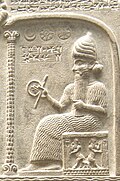 ](https://www.wikiwand.com/en/articles/List_of_Mesopotamian_deities#/media/File:Tablet_of_Shamash_%282%29.jpg) | E-Babbar temples at Sippar and Larsa[93] | Sun[92] | Utu, later known as Shamash, is the ancient Mesopotamian god of the Sun,[92] who was also revered as the god of truth, justice, and morality.[93] He was the son of Nanna and the twin brother of Inanna. Utu was believed to see all things that happen during the day[93] and to aid mortals in distress.[93] Alongside Inanna, Utu was the enforcer of divine justice.[94] |
|
Ishtar[95] |  | Eanna temple in Uruk,[96][46][53] though she also had temples in Nippur, Lagash, Shuruppak, Zabalam, and Ur[96] | Venus[46] | Inanna, later known as Ishtar, is "the most important female deity of ancient Mesopotamia at all periods."[95] She was the Sumerian goddess of love, sexuality, prostitution, and war.[97] She was the divine personification of the planet Venus, the morning and evening star.[46] Accounts of her parentage vary;[95] in most myths, she is usually presented as the daughter of Nanna and Ningal,[98] but, in other stories, she is the daughter of Enki or An along with an unknown mother.[95] The Sumerians had more myths about her than any other deity.[99][100] Many of the myths involving her revolve around her attempts to usurp control of the other deities' domains.[101] Her most famous myth is the story of her descent into the Underworld,[102] in which she attempts to conquer the Underworld, the domain of her older sister Ereshkigal,[102] but is instead struck dead by the seven judges of the Underworld.[103][104][105] She is only revived due to Enki's intervention[103][104][105] and her husband Dumuzid is forced to take her place in the Underworld.[106][107] Alongside her twin brother Utu, Inanna was the enforcer of divine justice.[94] |
|
Damgalnuna, Ninmah[108] | [ ](https://www.wikiwand.com/en/articles/List_of_Mesopotamian_deities#/media/File:Mesopotamian_-Cylinder_Seal_-Walters_42564_-_Impression.jpg) | E-Mah temple in Adab, Kesh[108] | Ninhursag ("Mistress of the mountain ranges"[109]), also known as Damgalnuna, Ninmah, Nintur[110] and Aruru,[111] was the Mesopotamian mother goddess. Her primary functions were related to birth (but generally not to nursing and raising children, with the exception of sources from early Lagash) and creation.[112] Descriptions of her as "mother" weren't always referring to motherhood in the literal sense or to parentage of other deities, but sometimes instead represented her esteem and authority as a senior deity, similar to references to major male deities such as Enlil or Anu as "fathers."[113] Certain mortal rulers claimed her as their mother,[108] a phenomenon recorded as early as during the reign of Mesilim of Kish (c. 2700 BCE).[114] She was the wife of Enki,[108] though in some locations (including Nippur) her husband was Šulpae instead.[115] Initially no city had Ninhursag as its tutelary goddess.[116] Later her main temple was the E-Mah in Adab,[108] originally dedicated to a minor male deity, Ašgi.[117] She was also associated with the city of Kesh,[108] where she replaced the local goddess Nintur,[111] and she was sometimes referred to as the "Bēlet-ilī of Kesh" or "she of Kesh".[108] It is possible her emblem was a symbol similar to later Greek letter omega.[118] | |
|
Ninĝírsu[119] |  | E-šu-me-ša temple in Nippur,[119] Girsu,[120] Lagash,[121][122] and later Kalhu in Assyria[123][124][125] | Saturn,[126] originally Mercury | Ninurta, also known as Ningirsu, was a Mesopotamian warrior deity who was worshipped in Sumer from the very earliest times.[119] He was the champion of the gods against the Anzû bird after it stole the Tablet of Destinies from his father Enlil[119] and, in a myth that is alluded to in many works but never fully preserved, he killed a group of warriors known as the "Slain Heroes".[119] Ninurta was also an agricultural deity and the patron god of farmers.[119] In the epic poem Lugal-e, he slays the demon Asag and uses stones to build the Tigris and Euphrates rivers to make them useful for irrigation.[124] His major symbols were a perched bird and a plow.[127] |
| Nergal |  | E-Meslam temple in Kutha and Mashkan-shapir[49] | Mars[128] | Nergal was associated with the Underworld[129] and is usually the husband of Ereshkigal.[129] He was also associated with forest fires (and identified with the fire-god, Gibil[130]), fevers, plagues, and war.[129] In myths, he causes destruction and devastation.[129] In the neo-Babylonian period in many official documents Nergal is listed immediately after the supreme gods Marduk and Nabu, and before such prominent deities as Shamash and Sin.[86] |
|
Tammuz[131] |  | Bad-tibira and Kuara[131] | Dumuzid, later known by the corrupted form Tammuz, is the ancient Mesopotamian god of shepherds[131] and the primary consort of the goddess Inanna.[131] His sister is the goddess Geshtinanna.[131][132] In addition to being the god of shepherds, Dumuzid was also an agricultural deity associated with the growth of plants.[133][134] Ancient Near Eastern peoples associated Dumuzid with the springtime, when the land was fertile and abundant,[133][135] but, during the summer months, when the land was dry and barren, it was thought that Dumuzid had "died".[133][136] During the month of Dumuzid, which fell in the middle of summer, people all across Sumer would mourn over his death.[137][138] An enormous number of popular stories circulated throughout the Near East surrounding his death.[137][138] | |
| Ereshkigal |  | Kutha | Hydra[139] | Ereshkigal was the queen of the Mesopotamian Underworld.[140][141] She lived in a palace known as Ganzir.[140] In early accounts, her husband is Gugalanna,[140] whose character is undefined, but later the northern god Nergal was placed in this role.[140][141] Her gatekeeper was the god Neti[141] and her sukkal was Namtar.[140] In the poem Inanna's Descent into the Underworld, Ereshkigal is described as Inanna's "older sister".[142] In the god list An = Anum she opens the section dedicated to underworld deities.[143] |
|
and Ninisina, Nintinugga, Ninkarrak[144] | [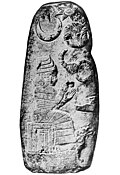 ](https://www.wikiwand.com/en/articles/List_of_Mesopotamian_deities#/media/File:The_goddess_Gula,_known_as_The_Great_Physician._Wellcome_M0006293.jpg) | E-gal-mah temple in Isin and other temples in Nippur, Borsippa, Assur,[144] Sippar,[145] Umma[146] | A prominent place in the Mesopotamian pantheon was occupied by healing goddesses,[147] regarded as divine patronesses of doctors and medicine-workers.[144] Multiple such deities existed:
Eventually Gula became the preeminent healing goddess,[146] and other healing goddesses were sometimes syncretised with her,[150] though in the god list *An = Anum* Gula, Ninkarrak and Nintinugga all figure as separate deities with own courts.[150] Dogs were associated with many healing goddesses[145] and Gula in particular is often shown in art with a dog sitting beside her.[144] | |
| Bau |  | Lagash, Kish | Bau was a prominent goddess of Lagash, and some of its kings regarded her as their divine mother.[115] She was also a healing goddess, though unlike other healing goddesses she only developed such a function at some point in her history.[151] She was the wife of Ningirsu, and rose to prominence in third millennium BCE in the state of Lagash.[152] Gudea elevated Bau's rank to equal of that of Ningirsu, and called her "Queen who decides the destiny in Girsu."[153] This made her the highest ranking goddess of the local pantheon of Lagash,[154] putting her above Nanshe.[155] During the reign of the Third Dynasty of Ur, she was the second most notable "divine wife" after Ninlil,[156] with some sources (ex. from Nippur) indicating she was exalted above Ningirsu.[148] While the original Lagashite cult of Bau declined alongside the city,[157] she continued to be prominent in Kish in northern Babylonia, where she arrived in the Old Babylonian period.[158] The city god of Kish, Zababa, became her husband.[159] She remained a major goddess of that city as late as the neo-Babylonian period.[160] | |
|
Adad, Hadad[161] |  | Karkar,[162] Assur,[163][164] Kurba'il[165] | Ishkur, later known as Adad or Hadad (from the root *hdd, "to thunder"[166]), was the Mesopotamian god of storms and rain.[161] In northern Mesopotamia, where agriculture relied heavily on rainfall, he was among the most prominent deities, and even in the south he ranked among the "great gods."[167] In god lists his position is similar to that of Sin, Shamash and Ishtar.[168] Ishkur is already attested as the god of Karkar in the Uruk period,[162] however evidence such as theophoric names indicates that the weather god's popularity only grew in later periods under the Akkadian name.[169] Hadad is already attested as the name of the weather god in early sources from Ebla.[166] In Mesopotamia these two gods started to merge in the Sargonic period,[170] and it seems it was already impossible to find a clear distinction between them in the Ur III period.[171] While northern texts put an emphasis on the benevolent character of the weather god as a bringer of rain, in the south he was often associated with destructive weather phenomena, including dust storms,[172] though even there he was credited with making plant growth possible in areas which weren't irrigated.[173] He was regarded as the son of An,[169] though less commonly he was also referred to as a son of Enlil.[174] His wife was Shala,[161] while his sukkal was Nimgir, the deified lightning.[175] In addition to being a weather god, Hadad was also a god of law and guardian of oaths,[176] as well as a god of divination (extispicy).[164] In these roles he was associated with Shamash.[164] In Zabban, a city in the northeast of Babylonia, he was regarded as the head of the local pantheon.[38] In Assyrian sources he was closely connected to military campaigns of the kings.[165] Kurba'il on the northern frontier of the empire was regarded as his most notable cult center in neo-Assyrian times.[165] In god lists foreign weather gods such as Hurrian Teshub ("Adad of Subartu"), Kassite Buriyaš or Ugaritic Baal were regarded as his equivalents.[177] | |
| Ištaran | Der[163] | Ištaran was a prominent[178] god, who served as the tutelary deity of the Sumerian city-state of Der, which was located east of the Tigris river on the border between Mesopotamia and Elam.[163] His wife was the goddess Šarrat-Dēri, whose name means "Queen of Der",[163] or alternatively Manzat (goddess of the rainbow),[178] and his sukkal was the snake-god Nirah.[163] He was regarded as a divine judge, and kings were said to "render justice like Ištaran."[179] A text from the late Early Dynastic Period invokes Ištaran to resolve a boundary dispute between the cities of Lagash and Umma.[163] In one of his inscriptions, King Gudea of Lagash mentions himself having installed a shrine for Ištaran in the temple of Ningirsu at Girsu[163] and describes Ištaran as a god of justice.[163] On kudurrus (boundary stones), Ištaran is often represented by a serpent, which may be Nirah[163] or Ištaran himself.[180] It is also possible that he's the god with an ophidian lower body known from cylinder seals.[178] In a ritual associated with the Ekur temple in Nippur, Ištaran is a "dying god" and is equated with Dumuzid.[180] A reference to Ištaran as a dying god appears also in a late text from Assur.[179] His national cult fell into decline during the Middle Babylonian Period,[163] though he still appeared in documents such as neo-Assyrian land grants.[181] However, in Der he continued to be venerated in later periods as well.[182] | ||
| Nanaya |  | Uruk and Kish[183] | Corona Borealis[184] | Nanaya was a goddess of love[185] (including erotic love and lust).[186] She was commonly invoked in spells connected to this sphere.[187] Her worship was widespread, and she appears frequently in the textual record.[188] She was also involved in intercession and was regarded as "lady of lamma," a class of minor protective goddesses capable of interceding on behalf of humans.[189] She shared these roles with Ninshubur.[189] She was closely associated with Inanna/Ishtar,[190] though not identical to her as the two often appear side by side in the same texts: for example in Larsa Inanna, Nanaya and Ninsianna all functioned as distinct deities,[51] while in god lists Nanaya appears among Inanna's courtiers, usually following Dumuzi and Ninshubur.[191] In late sources Nanaya and Ishtar sometimes appear as goddesses of equal status.[192] In neo-Babylonian Uruk she was one of the most important deities, and retained this status under Persian rule as well.[193] There is also evidence for her worship continuing in Seleucid and Parthian times, as late as 45 CE.[194] |
| Nanshe | [ ](https://www.wikiwand.com/en/articles/List_of_Mesopotamian_deities#/media/File:Terracotta_plaque_showing_seated_goddess_Nanshe_and_geese._from_southern_Iraq._2003-1595_BCE._Iraq_Museum.jpg) | Lagash[85] | Nanshe was a goddess associated with the state of Lagash,[195][49] whose cult declined with the loss of political relevance of that city.[160] She was a daughter of Enki and sister of Ningirsu.[49] She was associated with divination and the interpretation of dreams, but was also believed to assist the poor and the impoverished and ensure the accuracy of weights and measurements.[49] She was also associated with fish and waterfowl.[196] The First Sealand dynasty revived (or continued) her cult, making her the royal tutelary goddess.[160] | |
| Ninazu | Eshnunna and Enegi[197] | Ninazu was a god regarded as either the son of Ereshkigal or of Enlil and Ninil.[197] He was also the father of Ningishzida.[198] He was closely associated with the Underworld,[198] and some researchers go as far as proposing he was the oldest Mesopotamian god associated with it,[152] though it is most likely more accurate to say that there was initially no single universally agreed upon version of relevant mythical and cultic concepts, with various deities, both male and female, ruling over the Underworld in the belief systems of various areas and time periods.[199] Ninazu was also a Ninurta-like warrior god,[197] as well as the "king of snakes."[200] He was worshipped in Eshnunna during the third millennium BCE, but he was later supplanted there by Tishpak, who despite foreign origin had a similar character and attributes.[201] Ninazu was also worshipped at Enegi in southern Sumer.[197] His divine beast was the mušḫuššu, a serpentine dragon-like mythical creature, which was later also associated with Tishpak, Marduk (and by extension Nabu) and after Sennacherib's destruction of Babylon also with Ashur.[202] | ||
| Ninlil | Nippur, Assur,[203] Kish, Ḫursaĝkalama[204] | Ninlil was the wife of Enlil, the ruler of the gods.[108] She was not associated with any city of her own, serving primarily as Enlil's spouse,[205] and as such was probably an artificially created deity, invented as a female equivalent to Enlil.[108] She was nonetheless regarded as having power on par with Enlil;[206] in one poem, Ninlil declares, "As Enlil is your master, so am I also your mistress!"[206] In documents from the Ur III period, Ninlil was believed to be able to determine fates much like husband, and the pair was jointly regarded as the source of royal power by kings.[156] Sud, the tutelary goddess of Šuruppak, came to be regarded as one and the same as Ninlil, and the myth Enlil and Sud explain that Sud was the goddess' name before she married Enlil, receiving the name Ninlil.[160] However, Sud was originally an independent deity who was close in character to Sudag, an alternate name of the wife of Shamash; the confusion between Sudag and Sud(/Ninlil) is reflected in a myth where Ishum, normally regarded as the son of Shamash and his wife, is instead the son of Ninlil.[160] | ||
| Ninshubur |  | Akkil;[207] worshipped with Inanna as her sukkal | Orion[208] | Assyriologists regard Ninshubur as the most commonly worshiped sukkal ("vizier"),[209] a type of deity serving as another's personal attendant. Her mistress was Inanna.[119][210] Many texts indicate they were regarded very close to each other, with one going as far as listing Ninshubur with the title "beloved vizier," before Inanna's relatives other than her husband Dumuzi.[211] She consistently appears as the first among Inanna's courtiers in god lists, usually followed by another commonly worshiped deity, Nanaya.[212] She was portrayed as capable of "appeasing" Inanna,[213] and as "unshakably loyal" in her devotion to her.[210] In the Sumerian myth of Inanna and Enki, Ninshubur rescues Inanna from the monsters that Enki sends to capture her,[214][215][210] while in Inanna's Descent into the Underworld, she pleads with the gods Enlil, Nanna and finally Enki in effort to persuade them to rescue Inanna from the Underworld.[216][217] She was regarded as a wise adviser[210] of her divine masters and human rulers alike.[209] In addition to being the sukkal of Inanna, she also served An[210] and the divine assembly.[218] In later Akkadian mythology, Ninshubur was syncretized with the male messenger deities Ilabrat and Papsukkal,[208] though this process wasn't complete until Seleucid times.[219] Ninshubur was popular[209] in the sphere of personal religion, for example as tutelary deity of a specific family, due to the belief she could mediate between humans and higher ranking gods.[220] |
| Nisaba | [ ](https://www.wikiwand.com/en/articles/List_of_Mesopotamian_deities#/media/File:Vessel_fragment_depicting_the_goddess_Nisaba_%28%3F%29_and_an_inscription_from_Entemena,_ruler_of_Lagash,_circa_2430_BC,_chlorite,_Pergamon_Museum,_Berlin.jpg) | Eresh, later Nippur[221] | Nisaba was originally a goddess of grain and agriculture,[124] but, starting in the Early Dynastic Period, she developed into a goddess of writing, accounting, and scribal knowledge.[124] Her main cult city, Eresh, was evidently prominent in early periods, but after the reign of Shulgi almost entirely disappeared from records.[221] Texts mentioning Nisaba are sporadically attested as far west as Ebla and Ugarit, though it is uncertain if she was actively venerated further west than Mari.[222] Nisaba was the mother of the goddess Sud, syncretised with Enlil's wife Ninlil, and as a result she was regarded as his mother in law.[223] While a less common tradition identified her as the daughter of Enlil,[221] she was usually regarded as the daughter of Uraš, and references to Anu or Ea as her father are known from first millennium BCE literature.[221] Her husband was the god Haya.[124] There is little direct evidence for temples (in Nippur she was worshiped in the temple of her daughter Ninlil[224]) and clergy of Nisaba, but literary texts were commonly ended with the doxology "praise to Nisaba!" or other invocations of her.[224] The term "house of wisdom of Nisaba" attested in many texts was likely a generic term for institutions connected to writing.[224] Her importance started to decline (especially outside the scribal circles) after the Old Babylonian period, though attestations as late as from the reign of Nabopolassar are known.[225] | |
| Zababa | Kish[226][159] | Zababa was a war god who served as the tutelary deity of Kish.[159] His main temple was E-mete-ursag.[226] The earliest attestation of him comes from the Early Dynastic Period.[226] During the reign of Old Babylonian kings such as Hammurabi it was Zababa, rather than Ninurta, who was regarded as the primary war god.[227] He was initially regarded as a son of Enlil,[159] but Sennacherib called him a son of Ashur instead.[228] Initially his wife was Ishtar of Kish (regarded as separate from Ishtar of Uruk), but after the Old Babylonian period she was replaced by Bau in this role, and continued to be worshiped independently from him.[158] In some texts Zababa uses weapons usually associated with Ninurta and fights his mythical enemies, and on occasion he was called the "Nergal of Kish," but all 3 of these gods were regarded as separate.[229] In one list of deities he is called "Marduk of battle."[226] His primary symbol was a staff with the head of an eagle.[226] His sukkal was Papsukkal.[230] |