Documentary Hypothesis
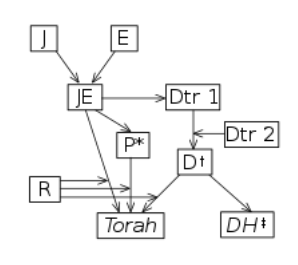
Diagram of the 20th century documentary hypothesis.
- J: Yahwist (10th–9th century BCE)
- E: Elohist (9th century BCE)
- Dtr1: early (7th century BCE) Deuteronomist historian
- Dtr2: later (6th century BCE) Deuteronomist historian
- P*: Priestly (6th–5th century BCE)
- D†: Deuteronomist
- R: redactor
- DH: Deuteronomistic history (books of Joshua, Judges, Samuel, Kings)
The documentary hypothesis is a theory that the first five books of the Bible, the Pentateuch, were written by multiple authors, not just Moses. It's also known as the JEDP theory, after the four sources of tradition that are thought to have been combined to create the Torah. [1, 2]
How does the hypothesis work? [2, 3]
J source
The first source to be written, and responsible for most of Genesis. The J source uses the Tetragrammaton as God's name. [2, 3]
E source
The Elohist source, which uses Elohim ("God") for the divine name until Exodus 3-6. The E source wrote parts of Genesis, Exodus, and Numbers. [2]
D source
The Deuteronomic source. [4]
P source
The Priestly source, which includes Levitical laws, the Holiness code, and genealogies. [4, 5]
History [3]
The documentary hypothesis was most famously formulated by the German scholar Julius Wellhausen in the 19th century. It was almost universally accepted for most of the 20th century. [3]
Generative AI is experimental.
[1] https://research.auctr.edu/DocumentaryHypothesis
[2] https://www.sas.upenn.edu/~jtreat/rs/002/Judaism/jepd.html
[3] https://ehrmanblog.org/tag/documentary-hypothesis/
[4] https://case.web.baylor.edu/sites/g/files/ecbvkj1551/files/2024-01/documentary_hypothesis_resource_-_week_1.pdf
[5] https://en.wikiversity.org/wiki/Bible/King_James/Documentary_Hypothesis