Summary
The file "Transcript for Why Paul's Churches Won by Centre Place" is a transcript of a discussion on why Paul's interpretation of Christianity became the dominant one.
Here's a summary of the key points covered in the transcript:
- Paul's Importance: Paul is considered a significant figure in the spread and development of early Christianity, sometimes referred to as the "second founder" after Jesus.
- Rivalry in Early Christianity: There was a perceived rivalry between Paul's churches (Pauline Christianity) and the churches led by Jesus's original disciples (Peter, James, and John). However, the reality was a more complex diversity of early Christian communities.
- Paul's Success: Three key factors contributed to Paul's success:
- First Christian Writings: Paul's writings are some of the earliest surviving Christian texts, giving them lasting power and authority.
- Early High Christology: Paul formulated an early version of a "high Christology," emphasizing Christ's divinity, which became the dominant view.
- Conversion of Non-Jews: Paul's approach to allowing non-Jews (Gentiles) to convert without strictly adhering to Jewish law led to an explosion in the growth of Christianity.
- Paul's Background: Paul (Saul of Tarsus) was a Jewish Pharisee who initially persecuted followers of Jesus before having a conversion experience and becoming an apostle.
- Sources on Paul: The primary sources for information on Paul are his own writings and the Acts of the Apostles. However, there are contradictions between these sources.
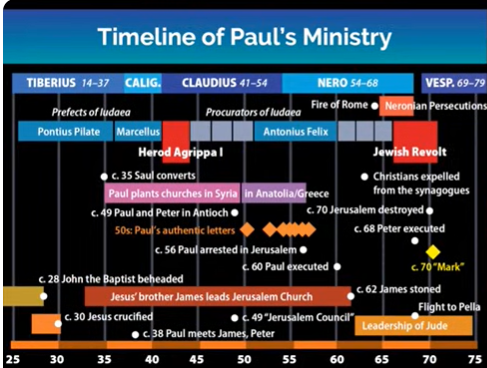
- Paul's Ministry: The transcript outlines a timeline of Paul's ministry, including his conversion, interactions with other apostles, and missionary journeys
.
- Apostles in Early Christianity: The role of apostles in early Christianity was discussed, including their characteristics as mendicants and preachers. It also mentions women could be apostles.
- Conflict with Other Apostles: Paul had conflicts with other apostles, particularly regarding the issue of whether Gentile converts needed to follow Jewish law.
- Paul's Letters: The transcript mentions which of Paul's letters are considered authentic by most scholars and also notes the existence of pseudonymous letters written in Paul's name.
- Paul's Later Life: Paul's later life, including his attempts to reconcile with the Jerusalem Church and his eventual arrest and execution, is discussed.
- Why Paul's Churches Won: The transcript concludes by reiterating the reasons for Paul's ultimate success and the dominance of his interpretation of Christianity.