Resilience Engineering
- A much more non-linear approach to understanding performance and safety in complex systems was taken by the Resilience Engineering movement founded in 2004 by Erik Hollnagel, David D. Woods, and other safety researchers
- While Charles Perrow’s 1984 Normal Accident Theory represents the pessimist approach to complexity and adaptive systems, Resilience Engineering took from the outset an optimist’s stand, assuming that “an adaptive system has some ability to self-monitor its adaptive capacity (reflective adaptation) and anticipate/learn so that it can modulate its adaptive capacity to handle future situations, events, opportunities and disruptions
The Resilience Engineering movement investigates socio-technological systems in which predictable technological processes interact with unpredictable human behavior
- Together they form complex adaptive systems that are dynamic (ever changing) and able to adjust to conditions that cannot be built into the system at the design-phase
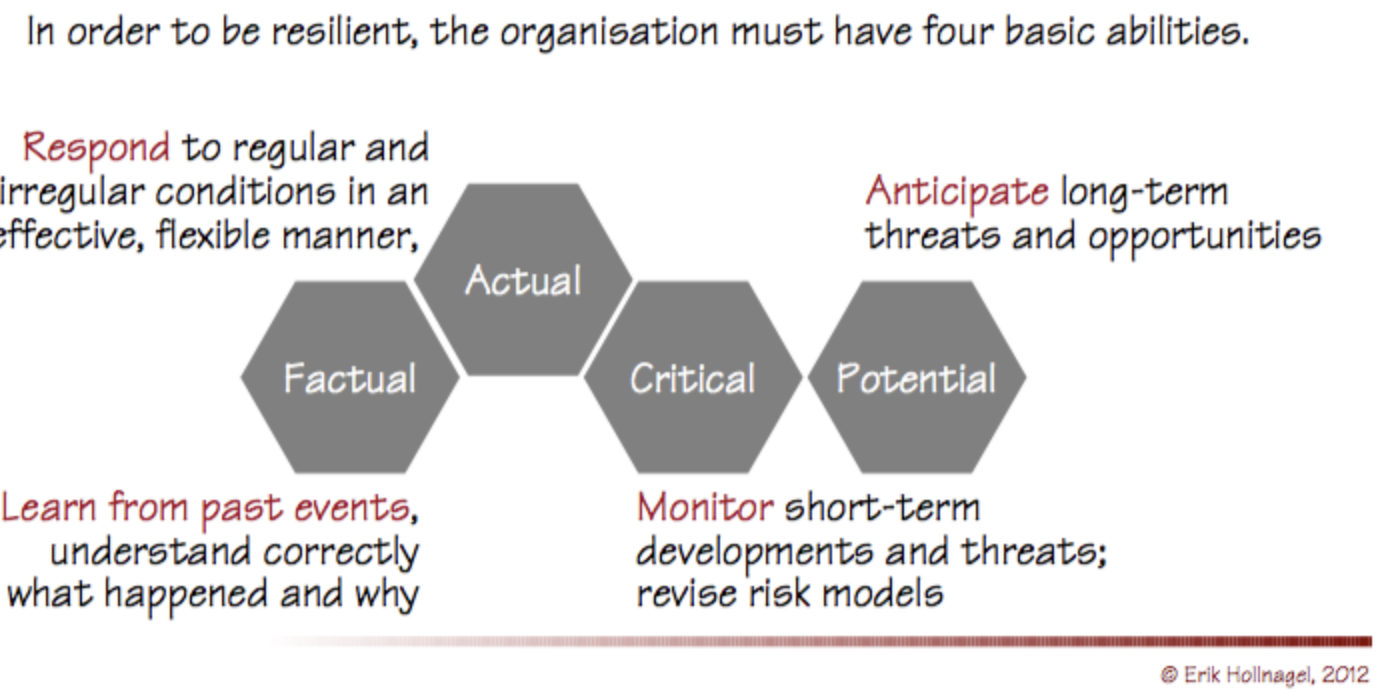
- The movement’s definition of resilience reads: “The essence of resilience is therefore the intrinsic ability of an organization (system) to maintain or regain a dynamically stable state, which allows it to continue operations after a major mishap and/or in the presence of a continuous stress” (Hollnagel et al. 2006: 16).