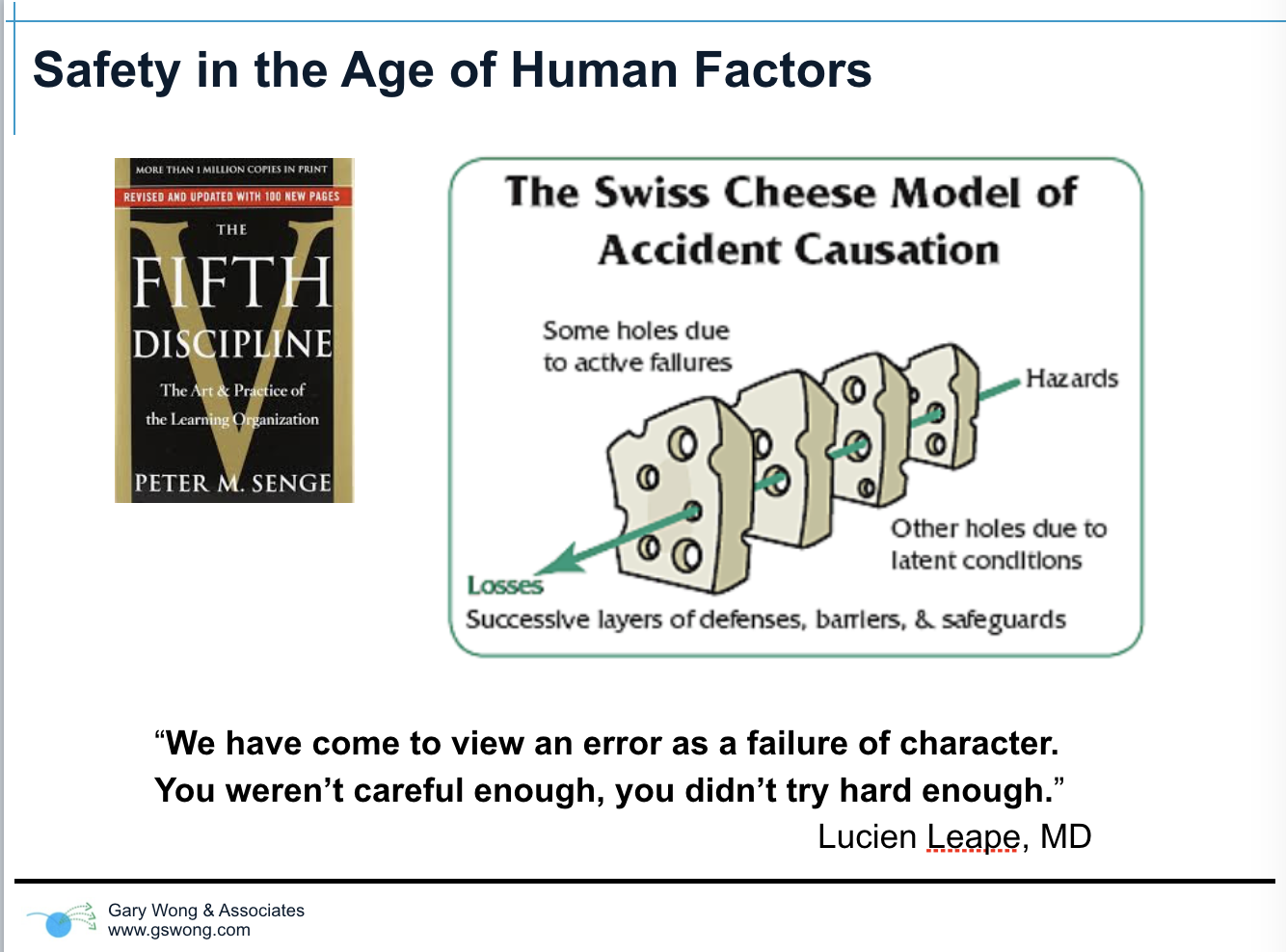
Swiss Cheese Model (1990) replaced dominoes and added more contributing factors in the form of “holes” and barriers in terms of “slices”.
James Reason conducted deep research on humans and the “mistakes” they make. Notable books of his include Human Error (1990) and Managing Organizational Accidents (1997).
The Swiss Cheese Model emphasizes the importance of implementing multiple layers of defense, barriers, and safeguards to reduce the risk of accidents.
The model applies a systems thinking approach to safety that addresses both active failures (e.g., human errors) and latent failures (e.g., organizational issues) to prevent accidents.
At any given time some of the barriers may be breached or degraded in one way or another, but you don’t have a true failure/accident unless all of the “holes” line up just right.
Limitations and criticisms
Opens the door to short-sighted blame of the operator by management for systemic failures.
Simplification of complexity: The Swiss Cheese Model simplifies the complexity of accidents by presenting them as a linear sequence of events. In reality, accidents are often the result of complex interactions among multiple factors, including human behavior, technical failures, and organizational issues. The model's linear representation may not fully capture the dynamic and non-linear nature of accidents.
Lack of clarity on interactions: The model does not explicitly illustrate how the various defenses or barriers interact with each other. It assumes that failures in different layers align linearly to create a pathway for accidents. However, it may not adequately address the complex interactions and dependencies among different defenses or barriers.
Attribution of failure: The Swiss Cheese Model implies that accidents occur solely due to the alignment of holes in different defenses. This can create a perception that accidents are solely the result of individual errors or failures. However, accidents often involve a combination of system-level failures and individual actions, and it is important to consider both systemic and individual factors.
Static representation: The model represents defenses and barriers as fixed slices of cheese, which may not reflect the dynamic nature of safety systems. In reality, defenses can be continuously changing, being strengthened, weakened, or adapted. The model does not explicitly address the dynamic nature of defenses and their interactions over time.