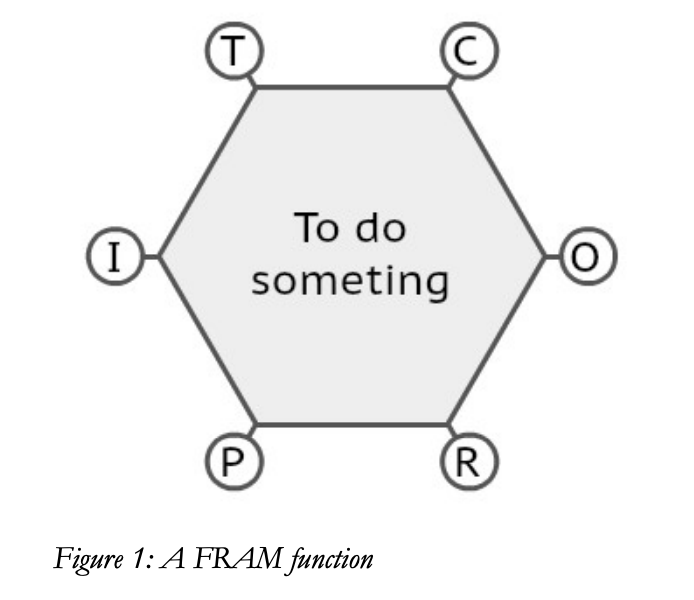
FRAM Primer
The Input (I) to a function is traditionally that which is used or transformed by the function to produce the Output. The Input can represent matter, energy, or information. But an Input can also be that which activates or starts a function, such as a clearance or an instruction to begin doing something. Input can be seen as a form of data or information, or more generally as a state change a function interprets as a signal to begin. Formally, an Input is always the result of a change in the condition of something, whether it is energy, information, or position. It is for that reason that the description of the Input always is a noun or a noun phrase. When a Input aspect is described for one function, it must also be described as an Output from another function.
• The Output (O) of a function describes the result of what the function does, for example, the result of processing the Input. The Output may represent material, energy, or information – an example of the latter would be a permission or clearance, or the result of a decision. The Output describes a change of state – of the system or of one or more output parameters. The Output may, for example, be the signal to start a function. The description of the Output should be a noun or a noun phrase. When an Output aspect is described for one function, it must also be defined as an Input, Precondition, Resource, Control, or Time aspect for another function.
• A function can sometimes not begin before one or more Preconditions (P) have been established. These Preconditions can be understood as system states that must exist, or as conditions that ought to be verified before a function is carried out. A Precondition Figure 1: A FRAM function does, however, not itself constitute a signal that can activate a function. This simple rule can be used to determine whether something should be described as an Input or as a Precondition. The description of a Precondition should be a noun or a noun phrase. When a Precondition aspect is defined for one function, it must also be defined as an Output from another function.
• A Resource (R) is something that is needed or consumed while a function is carried out. A Resource can represent matter, energy, information, competence, software, tools, manpower, etc. Time can, in principle, also be considered as a Resource, but since Time has a special status it is treated as a separate aspect. Some resources are consumed while the function is carried out and others are not, it is useful to distinguish between (proper) Resources on the one hand and Execution Conditions on the other. A (proper) Resource is consumed by a function and will therefore be reduced as time goes by; an Execution Condition only needs to be available or exist while a function is active. (The difference between a Precondition and an Execution Condition is that the former is only required before the function starts, but not while it is carried out.) The description of a Resource (an Execution Condition) should be a noun or a noun phrase. When a Resource aspect is defined for one function, it must also be defined as an Output from another function.
• Control (C) is that which supervises or regulates a function so that it produces the desired Output. Control can be a plan, a schedule, a procedure, a set of guidelines or instructions, a program (an algorithm), a ‘measure and correct’ functionality, etc. Another, less formal type of control is social control or expectations to how the work should be done. Social control can be external, such as the expectations of others (management, organisation, co-workers) or a person’s own expectations. Social control can also be internal, for example, when we plan a job and mentally go through when and how to do it, or when we imagine what others expect of us. The description of Controls should be a noun or a noun phrase. When a Control aspect is defined for one function, it must also be defined as an Output from another function.
• Time (T) represents the various ways in which time can affect the performance of a function. Time, or rather temporal relations, can be seen as a form of Control. A function may, for instance, have to be carried out (or be completed) before another function, after another function, or overlapping with – parallel to – another function. Time may also relate to a function alone, seen in relation to either clock time or elapsed time. Time can also be seen as representing a Resource, such as when something must be completed before a certain point in time, or within a certain duration (as when a report must be produced in less than a week). Time can, of course, also be seen as a Precondition, e.g., that a function must not begin before midnight, or that it must not begin before another functions has been completed. Yet rather than having Time as a part of either of the three aspects of a function it is reasonable to recognise its special status by having it as an aspect in its own right. The description of a Time aspect should be a noun, if it is a single word, or begin with a noun if it is a short sentence. When a Time aspect is defined for one function, it must also be defined as an Output from another function.