Meltdown
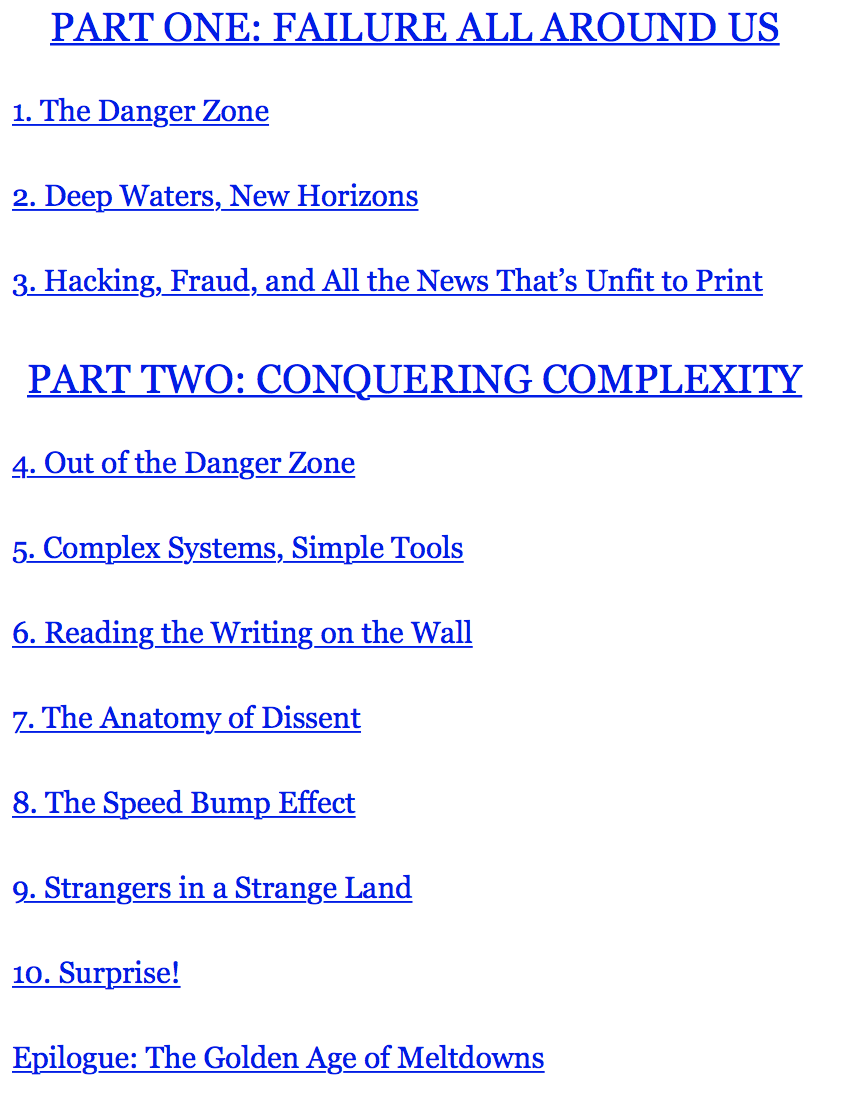
Click here or on image to access book.

Meltdown is something of a rarity: an enlightening and entertaining business book. It synthesizes the work of experts in high-risk systems such as Perrow, Karl Weick of the University of Michigan, Kathleen Sutcliffe of Johns Hopkins University, and Marlys Christianson of the University of Toronto, all of whom studied effective response, and builds upon it in an accessible and practical way.
All the disasters recounted in Meltdown share characteristics first identified by sociologist Charles Perrow. Now in his nineties, Perrow earned the appellation “master of disaster” for his seminal study of a host of incidents in high-risk settings, starting with the Three Mile Island Nuclear Generating Station accident in 1979. “In Perrow’s view,” explain Clearfield and Tilcsik, “the accident was not a freak occurrence, but a fundamental feature of the nuclear power plant as a system.”
This system — indeed, each of the systems described in Meltdown’s disasters — is complex and tightly coupled: complex in that the systems are nonlinear, with parts sometimes interacting in hidden ways, and tightly coupled in that there is little slack in these systems. A failure in one part quickly, and often, unexpectedly affects other parts.
A crash on the Washington, D.C. metro system. An accidental overdose in a state-of-the-art hospital. An overcooked holiday meal. At first glance, these disasters seem to have little in common. But surprising new research shows that all these events--and the myriad failures that dominate headlines every day--share similar causes. By understanding what lies behind these failures, we can design better systems, make our teams more productive, and transform how we make decisions at work and at home.
Weaving together cutting-edge social science with riveting stories that take us from the frontlines of the Volkswagen scandal to backstage at the Oscars, and from deep beneath the Gulf of Mexico to the top of Mount Everest, Chris Clearfield and András Tilcsik explain how the increasing complexity of our systems creates conditions ripe for failure and why our brains and teams can't keep up. They highlight the paradox of progress: Though modern systems have given us new capabilities, they've become vulnerable to surprising meltdowns--and even to corruption and misconduct.
But Meltdown isn't just about failure; it's about solutions--whether you're managing a team or the chaos of your family's morning routine. It reveals why ugly designs make us safer, how a five-minute exercise can prevent billion-dollar catastrophes, why teams with fewer experts are better at managing risk, and why diversity is one of our best safeguards against failure. The result is an eye-opening, empowering, and entirely original book--one that will change the way you see our complex world and your own place in it.