Covey Principles & Complexity Thinking
Covey's principles are not behavioural rules
- They are universal, timeless dispositions that shape the conditions under which effective behaviour emerges in complex adaptive systems
- They operate in the substrate as actants at the level of constraints, attractors, and hidden patterns
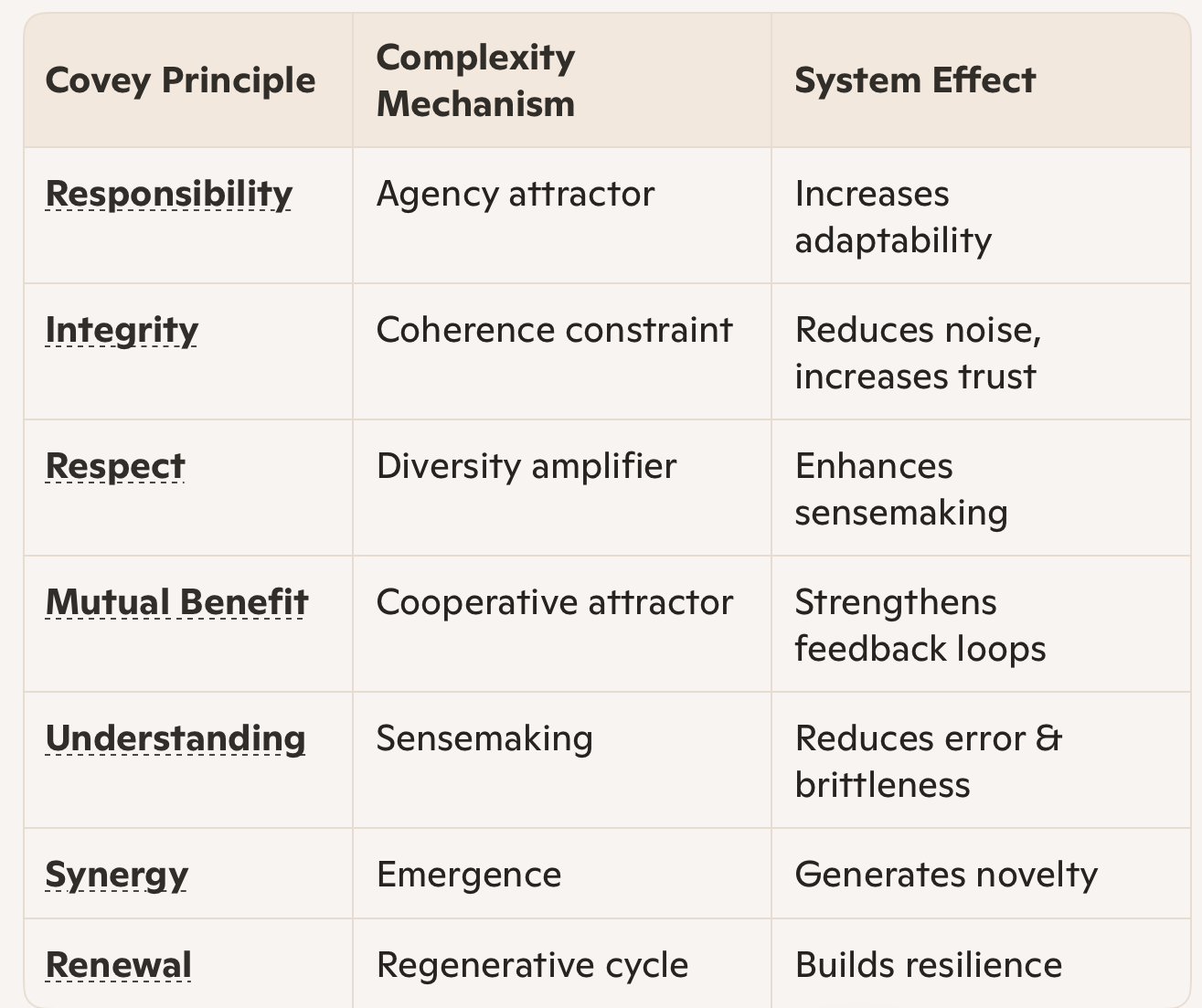
- Principle of Responsibility
Complexity function: Agency attractor
• Responsibility is not moral; it is a shift in system disposition from reactivity to proactivity
• In complexity, this increases degrees of freedom and manages entanglement with external volatility.
• It creates a stable attractor around intentional action.
- Principle of Integrity
Complexity function: Coherence constraint
• Integrity stabilizes behaviour across contexts, reducing noise in the system.
• It acts as a coherence‑generating constraint, enabling trust and predictable interactions.
• Systems with integrity have lower entropy and higher reliability.
- Principle of Respect
Complexity function: Diversity amplifier
• Respect increases the system’s ability to incorporate multiple perspectives.
• This enhances weak‑signal detection, a core requirement in complex environments.
• It prevents premature convergence and supports adaptive sense-making.
- Principle of Mutual Benefit
Complexity function: Collaborative attractor
• Mutual benefit creates positive‑sum attractors (i.e., whole is greater than sum of the parts) that reduce adversarial energy loss.
• It strengthens reciprocal feedback loops, increasing system resilience.
• Collaboration is a known driver of fitness in complex adaptive systems.
- Principle of Understanding
Complexity function: Sense-making before action
• Understanding is a probe → sense → respond principle.
• It prioritizes contextual awareness over pre‑determined solutions.
• This aligns directly with Cynefin’s Complex domain: act only after sensing.
- Principle of Synergy
Complexity function: Emergence
• Synergy is Covey’s articulation of emergent properties.
• Novel capabilities arise from interactions, not individuals.
• It is a higher‑order system effect, not a behaviour.
- Principle of Renewal
Complexity function: Regenerative loop
• Renewal is a self‑maintenance cycle that prevents system collapse.
• It increases adaptive capacity and long‑term resilience.
• Mirrors ecological adaptive cycles (growth → conservation → release → renewal).