Safety-I
Safety-I is a traditional approach to safety management that focuses on the prevention of accidents and incidents by identifying and eliminating hazards and risks. It is based on the assumption that safety is achieved by minimizing or eliminating the negative outcomes, such as accidents, injuries, and errors.
- Erik Hollnagel coined the term “Safety-I” to describe the current paradigm that dominates safety thinking
- Safe system = Nothing Unwanted Happens
- If you can imagine it, you can guard against it
- We are great at handling “Known knowns” because they are certain, repeatable, predictable (Cynefin Clear domain)
- We can even deal with "Known Unknowns” which is Risk
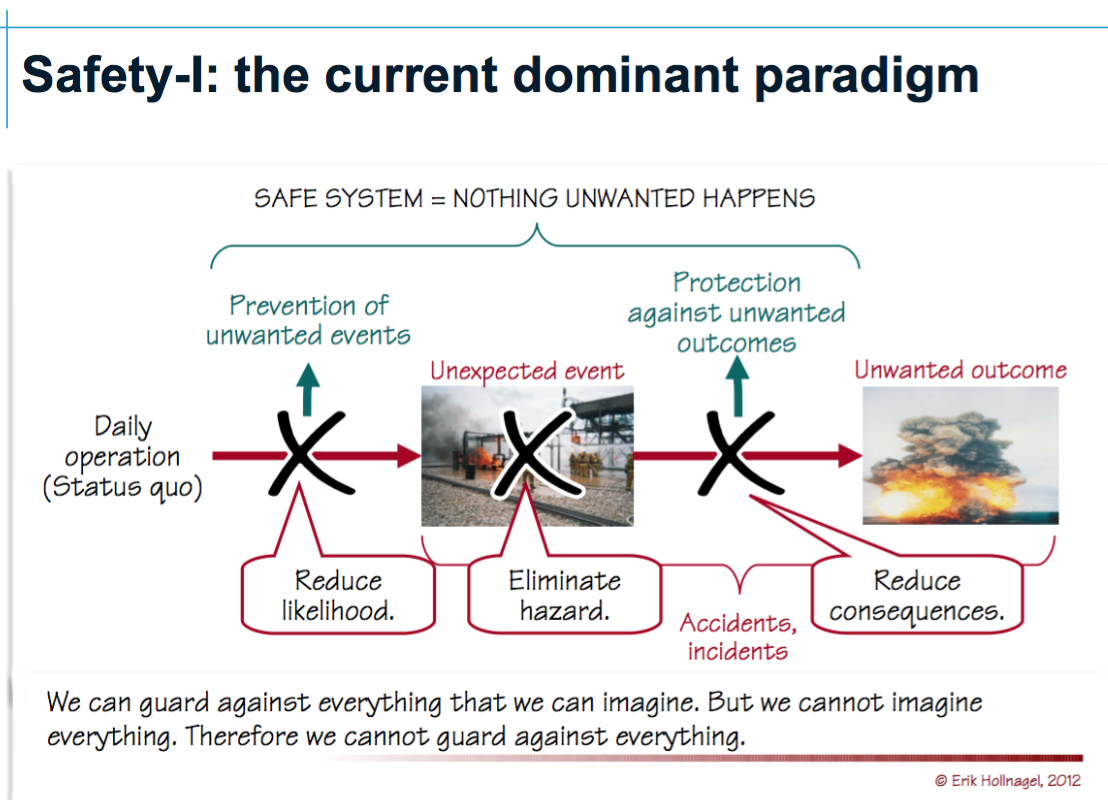
The key principles of Safety-I include:
- Hazard identification: Safety-I emphasizes identifying potential hazards and risks in the workplace through various methods such as risk assessments, inspections, and incident investigations.
- Risk reduction: Once hazards are identified, the focus is on implementing controls and measures to reduce the likelihood of accidents and injuries. This may involve engineering controls, administrative procedures, and personal protective equipment.
- Compliance and rules-based approach: Safety-I relies on adherence to rules, regulations, and standard operating procedures as a means to prevent accidents. It emphasizes compliance and enforcement of safety protocols.
- Reactive safety management: Safety-I often relies on reactive safety management, where the focus is on responding to incidents and near-misses after they occur. The goal is to investigate the root causes and implement corrective actions to prevent similar incidents in the future.
- Hierarchy of controls: Safety-I follows the hierarchy of controls, which prioritizes eliminating hazards at the source over implementing controls that rely on human behavior. The hierarchy starts with eliminating hazards, followed by engineering controls, administrative controls, and personal protective equipment as the least preferred option.